

ASTM F3459-21
(Specification)Standard Specification for Rigid Poly Vinyl Chloride (PVC) Exterior Profiles Used for Sound Walls
General Information
- Abstract
SCOPE
1.1 This specification establishes requirements for the material properties and physical properties, including dimensional tolerances, extrusion quality, and weatherability, of rigid poly (vinyl chloride) (PVC) exterior profiles used for sound walls. Methods for testing and for identifying exterior profile extrusions that comply with this specification are also provided. In addition, requirements for flexural capacity are given.
Note 1: Information with regard to application, assembly, and installation should be obtained from the manufacturer.
1.2 The material used in these exterior profiles is limited to rigid poly (vinyl chloride) (PVC) compounds in a single homogeneous extrusion or in a coextrusion of two or more PVC compounds in distinct layers.
1.3 Units—The values stated in inch-pound units are to be regarded as standard. The values given in parentheses are mathematical conversions to SI units that are provided for information only and are not considered standard.
1.4 This standard does not purport to address all of the safety concerns, if any, associated with its use. It is the responsibility of the user of this standard to establish appropriate safety, health, and environmental practices and determine the applicability of regulatory limitations prior to use.
1.5 This international standard was developed in accordance with internationally recognized principles on standardization established in the Decision on Principles for the Development of International Standards, Guides and Recommendations issued by the World Trade Organization Technical Barriers to Trade (TBT) Committee.
- Status
- Published
- Publication Date
- 31-Dec-2020
- Technical Committee
- F14 - Fences
- Drafting Committee
- F14.30 - Rigid Polymer Fence Systems
Overview
ASTM F3459-21 is an international standard specification developed by ASTM for rigid poly vinyl chloride (PVC) exterior profiles used for sound wall applications. This standard details the requirements for material properties, dimensional tolerances, extrusion quality, weatherability, structural performance, and test methods necessary for PVC profiles intended for constructing sound barriers. The document supports quality assurance and promotes a consistent level of performance for manufacturers, distributors, and users of PVC sound wall systems.
PVC sound walls are vital structures for reducing noise pollution in sensitive areas such as residential neighborhoods, commercial zones, and transportation corridors. ASTM F3459-21 sets the baseline criteria to ensure durability, safety, and effectiveness of these noise barrier systems, aligning with internationally recognized principles on standardization.
Key Topics
- Material Requirements: Covers rigid polyvinyl chloride (PVC) compounds, allowing both single homogeneous extrusions and coextrusions with distinct layers. Only compatible, traceable materials - including reworked and post-consumer recycled PVC - are permitted, provided all specified requirements are met.
- Physical Properties: Defines tolerances for length, width, wall thickness, and bow (horizontal and vertical deviation). Specifies minimum wall thickness and impact resistance under varied temperature conditions.
- Extrusion Quality: Mandates profiles to be free from visual defects such as cracks, voids, or inclusions, and sets standards for uniform color and consistent capstock thickness for coextruded profiles.
- Structural Performance: Requires sound wall panels to demonstrate minimum flexural strength, modulus of elasticity, and sufficient resistance to wind loads, determined according to referenced ASTM and ASCE test standards.
- Weatherability: Profiles must exhibit resistance to UV exposure, surface degradation, and color fading after artificial weathering cycles.
- Fire Performance: Stipulates maximum allowable flame spread and extent of burning for safety in terms of fire behavior.
- Identification and Marking: Specifies permanent marking of profiles with manufacturer’s information, product identification, traceability, and compliance with ASTM F3459.
- Quality Assurance: Emphasizes the need for a documented quality control program, verifiable qualification tests, and certificates of compliance for supplied PVC sound wall components.
Applications
ASTM F3459-21 provides a framework for:
- Highway and railway noise barriers: Ensuring the longevity and sound attenuation effectiveness of PVC profiles installed adjacent to transportation corridors.
- Residential and commercial developments: Supporting effective noise abatement systems that comply with rigorous physical and environmental requirements.
- Industrial and utility infrastructure: Offering a standard for sound wall solutions around factories, substations, or any installations requiring acoustic shielding.
- Public procurement and project specifications: Enabling engineers, architects, and contractors to specify compliant materials, streamline approvals, and reduce risk in project delivery.
Adherence to ASTM F3459-21 assures end users, regulators, and project owners that PVC sound wall systems will perform reliably and meet global expectations for sustainability, durability, and safety.
Related Standards
Projects involving rigid PVC sound wall profiles may reference additional ASTM and international standards for materials and testing, including:
- ASTM D4216: For PVC building product compounds
- ASTM D4226: Impact resistance of rigid PVC products
- ASTM D635: Flammability (horizontal burn) of plastics
- ASTM E84: Surface burning characteristics of building materials
- ASTM D2565: Xenon-arc exposure of plastics for weathering testing
- ASCE/SEI 7: Minimum design loads and associated criteria for buildings and other structures
- ASTM A123, A153, A500: Standards for galvanized coatings, hardware, and structural steel often used in support frameworks
By aligning with ASTM F3459-21 and these referenced documents, project teams can ensure a harmonized approach in delivering high-quality, durable, and acoustically effective PVC sound wall systems.
Keywords: ASTM F3459-21, rigid PVC sound wall, polyvinyl chloride profiles, exterior sound barriers, noise reduction, dimensional tolerances, extrusion quality, weatherability, structural performance, quality control, building standards, acoustic barriers.
Relations
- Effective Date
- 01-Feb-2024
- Effective Date
- 01-Dec-2023
- Effective Date
- 01-Nov-2023
- Effective Date
- 01-Nov-2023
- Effective Date
- 01-Oct-2023
- Effective Date
- 01-Sep-2023
- Effective Date
- 01-Jan-2020
- Effective Date
- 01-Nov-2019
- Effective Date
- 01-Nov-2019
- Effective Date
- 01-Aug-2019
- Effective Date
- 01-Jul-2019
- Effective Date
- 15-Apr-2019
- Effective Date
- 15-Apr-2019
- Effective Date
- 01-Mar-2019
- Effective Date
- 01-Feb-2019
Get Certified
Connect with accredited certification bodies for this standard

DIBt (Deutsches Institut für Bautechnik)
German Institute for Building Technology.
DIN CERTCO
DIN Group product certification.

Aboma Certification B.V.
Specialized in construction, metal, and transport sectors.
Sponsored listings
Frequently Asked Questions
ASTM F3459-21 is a technical specification published by ASTM International. Its full title is "Standard Specification for Rigid Poly Vinyl Chloride (PVC) Exterior Profiles Used for Sound Walls". This standard covers: SCOPE 1.1 This specification establishes requirements for the material properties and physical properties, including dimensional tolerances, extrusion quality, and weatherability, of rigid poly (vinyl chloride) (PVC) exterior profiles used for sound walls. Methods for testing and for identifying exterior profile extrusions that comply with this specification are also provided. In addition, requirements for flexural capacity are given. Note 1: Information with regard to application, assembly, and installation should be obtained from the manufacturer. 1.2 The material used in these exterior profiles is limited to rigid poly (vinyl chloride) (PVC) compounds in a single homogeneous extrusion or in a coextrusion of two or more PVC compounds in distinct layers. 1.3 Units—The values stated in inch-pound units are to be regarded as standard. The values given in parentheses are mathematical conversions to SI units that are provided for information only and are not considered standard. 1.4 This standard does not purport to address all of the safety concerns, if any, associated with its use. It is the responsibility of the user of this standard to establish appropriate safety, health, and environmental practices and determine the applicability of regulatory limitations prior to use. 1.5 This international standard was developed in accordance with internationally recognized principles on standardization established in the Decision on Principles for the Development of International Standards, Guides and Recommendations issued by the World Trade Organization Technical Barriers to Trade (TBT) Committee.
SCOPE 1.1 This specification establishes requirements for the material properties and physical properties, including dimensional tolerances, extrusion quality, and weatherability, of rigid poly (vinyl chloride) (PVC) exterior profiles used for sound walls. Methods for testing and for identifying exterior profile extrusions that comply with this specification are also provided. In addition, requirements for flexural capacity are given. Note 1: Information with regard to application, assembly, and installation should be obtained from the manufacturer. 1.2 The material used in these exterior profiles is limited to rigid poly (vinyl chloride) (PVC) compounds in a single homogeneous extrusion or in a coextrusion of two or more PVC compounds in distinct layers. 1.3 Units—The values stated in inch-pound units are to be regarded as standard. The values given in parentheses are mathematical conversions to SI units that are provided for information only and are not considered standard. 1.4 This standard does not purport to address all of the safety concerns, if any, associated with its use. It is the responsibility of the user of this standard to establish appropriate safety, health, and environmental practices and determine the applicability of regulatory limitations prior to use. 1.5 This international standard was developed in accordance with internationally recognized principles on standardization established in the Decision on Principles for the Development of International Standards, Guides and Recommendations issued by the World Trade Organization Technical Barriers to Trade (TBT) Committee.
ASTM F3459-21 is classified under the following ICS (International Classification for Standards) categories: 91.060.10 - Walls. Partitions. Facades. The ICS classification helps identify the subject area and facilitates finding related standards.
ASTM F3459-21 has the following relationships with other standards: It is inter standard links to ASTM D883-24, ASTM E84-23d, ASTM D883-23, ASTM A500/A500M-23, ASTM D2565-23, ASTM E84-23c, ASTM D883-20, ASTM D4226-19e1, ASTM D4226-19, ASTM D883-19c, ASTM E84-19b, ASTM E84-19a, ASTM D883-19a, ASTM E84-19, ASTM D883-19. Understanding these relationships helps ensure you are using the most current and applicable version of the standard.
ASTM F3459-21 is available in PDF format for immediate download after purchase. The document can be added to your cart and obtained through the secure checkout process. Digital delivery ensures instant access to the complete standard document.
Standards Content (Sample)
This international standard was developed in accordance with internationally recognized principles on standardization established in the Decision on Principles for the
Development of International Standards, Guides and Recommendations issued by the World Trade Organization Technical Barriers to Trade (TBT) Committee.
Designation:F3459 −21
Standard Specification for
Rigid Poly Vinyl Chloride (PVC) Exterior Profiles Used for
Sound Walls
This standard is issued under the fixed designation F3459; the number immediately following the designation indicates the year of
original adoption or, in the case of revision, the year of last revision.Anumber in parentheses indicates the year of last reapproval.A
superscript epsilon (´) indicates an editorial change since the last revision or reapproval.
1. Scope A123/A123MSpecification for Zinc (Hot-Dip Galvanized)
Coatings on Iron and Steel Products
1.1 This specification establishes requirements for the ma-
A153/A153MSpecification for Zinc Coating (Hot-Dip) on
terialpropertiesandphysicalproperties,includingdimensional
Iron and Steel Hardware
tolerances, extrusion quality, and weatherability, of rigid poly
A449Specification for Hex Cap Screws, Bolts and Studs,
(vinyl chloride) (PVC) exterior profiles used for sound walls.
Steel, Heat Treated, 120/105/90 ksi Minimum Tensile
Methods for testing and for identifying exterior profile extru-
Strength, General Use
sions that comply with this specification are also provided. In
A500/A500MSpecification for Cold-Formed Welded and
addition, requirements for flexural capacity are given.
Seamless Carbon Steel Structural Tubing in Rounds and
NOTE 1—Information with regard to application, assembly, and instal-
Shapes
lation should be obtained from the manufacturer.
A563Specification for Carbon and Alloy Steel Nuts
1.2 The material used in these exterior profiles is limited to
A653/A653MSpecification for Steel Sheet, Zinc-Coated
rigid poly (vinyl chloride) (PVC) compounds in a single
(Galvanized) or Zinc-Iron Alloy-Coated (Galvannealed)
homogeneous extrusion or in a coextrusion of two or more
by the Hot-Dip Process
PVC compounds in distinct layers.
A780/A780MPracticeforRepairofDamagedandUncoated
1.3 Units—The values stated in inch-pound units are to be
Areas of Hot-Dip Galvanized Coatings
regarded as standard. The values given in parentheses are
A992/A992MSpecification for Structural Steel Shapes
mathematical conversions to SI units that are provided for
A1011/A1011MSpecification for Steel, Sheet and Strip,
information only and are not considered standard.
Hot-Rolled, Carbon, Structural, High-Strength Low-
1.4 This standard does not purport to address all of the Alloy, High-Strength Low-Alloy with Improved
safety concerns, if any, associated with its use. It is the Formability, and Ultra-High Strength
responsibility of the user of this standard to establish appro-
D618Practice for Conditioning Plastics for Testing
priate safety, health, and environmental practices and deter-
D635Test Method for Rate of Burning and/or Extent and
mine the applicability of regulatory limitations prior to use.
Time of Burning of Plastics in a Horizontal Position
1.5 This international standard was developed in accor-
D696TestMethodforCoefficientofLinearThermalExpan-
dance with internationally recognized principles on standard-
sion of Plastics Between −30°C and 30°C with a Vitreous
ization established in the Decision on Principles for the
Silica Dilatometer
Development of International Standards, Guides and Recom-
D790Test Methods for Flexural Properties of Unreinforced
mendations issued by the World Trade Organization Technical
and Reinforced Plastics and Electrical Insulating Materi-
Barriers to Trade (TBT) Committee.
als
D883Terminology Relating to Plastics
2. Referenced Documents
D1042Test Method for Linear Dimensional Changes of
2.1 ASTM Standards:
Plastics Caused by Exposure to Heat and Moisture
A36/A36MSpecification for Carbon Structural Steel
D1600TerminologyforAbbreviatedTermsRelatingtoPlas-
tics
ThisspecificationisunderthejurisdictionofASTMCommitteeF14onFences
D2565Practice for Xenon-Arc Exposure of Plastics In-
and is the direct responsibility of Subcommittee F14.30 on Rigid Polymer Fence
tended for Outdoor Applications
Systems.
D4216Specification for Rigid Poly(Vinyl Chloride) (PVC)
Current edition approved Jan. 1, 2021. Published February 2021. DOI: 10.1520/
F3459-21.
and Related PVC and Chlorinated Poly(Vinyl Chloride)
For referenced ASTM standards, visit the ASTM website, www.astm.org, or
(CPVC) Building Products Compounds
contact ASTM Customer Service at service@astm.org. For Annual Book of ASTM
D4226Test Methods for Impact Resistance of Rigid Poly-
Standards volume information, refer to the standard’s Document Summary page on
the ASTM website. (Vinyl Chloride) (PVC) Building Products
Copyright © ASTM International, 100 Barr Harbor Drive, PO Box C700, West Conshohocken, PA 19428-2959. United States
F3459−21
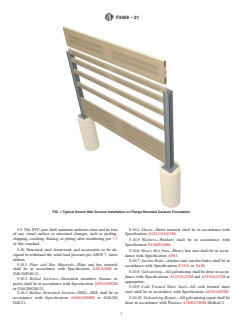
E72Test Methods of Conducting Strength Tests of Panels brackets, may be made from PVC or non-PVC materials, or
for Building Construction both. Fig. 1 shows a typical sound wall ground installation on
E84Test Method for Surface Burning Characteristics of
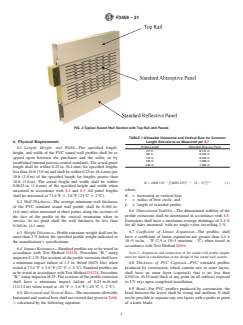
a flange mounted caisson foundation. Fig. 2 shows a typical
Building Materials
wall section with top rail, absorptive panels, and a reflective
F436/F436MSpecification for Hardened SteelWashers Inch
bottompanel.Theinformationcontainedinthisspecificationis
and Metric Dimensions
intended to be helpful to producers (manufacturers),
F1554Specification for Anchor Bolts, Steel, 36, 55, and
distributors, and users and to promote understanding between
105-ksi Yield Strength
purchasers and sellers.
2.2 CSA Standard:
G40.20/G40.21 Grade 350W General Requirements for
5. Materials and Manufacture
Rolled or Welded Structural Quality Steel
4 5.1 The rigid poly vinyl chloride (PVC) compound for
2.3 ASCE Standard:
exterior profile extrusions meeting the requirements of this
ASCE/SEI 7-16Minimum Design Loads and Associated
specification are categorized by the cell class requirements in
Criteria for Buildings and Other Structures
accordance with Specification D4216.
3. Terminology
5.2 ThePVCcompoundsusedfortheproductsmeetingthis
3.1 General—DefinitionsareinaccordancewithTerminolo-
specification shall meet a minimum cell class of 1-00233-23
gies D883 and D1600, unless otherwise indicated.
for PVC profiles and 3-20233-23/4-20233-23 for PVC sub-
strate with alternate capstock materials as defined in Specifi-
3.2 Definitions of Terms Specific to This Standard:
cation D4216. Compounds that have higher cell classification
3.2.1 capstock, n—the outer layer in a coextrusion exposed
because one or more properties are superior to those in the
to weathering.
specified compound are acceptable.
3.2.2 coextrusion, n—the process of coextruding profiles
from two or more concentric streams of PVC compounds.
5.3 The color of the profiles shall be as agreed upon
3.2.2.1 Discussion—Separate PVC materials may be coex-
between the purchaser and the seller. The color specified shall
truded to form a multi-layered profile with each layer having
be uniform throughout a single material extrusion or through-
different physical characteristics such as strength and weath-
out the capstock layer of a coextruded profile for profiles
ering.
intended to be of uniform color.
3.2.3 reworked material, n—material from the manufactur-
5.4 The extruded profiles shall be free from visible cracks,
er’s facility of known, compatible composition meeting the
voids, or foreign inclusions.
material requirement of this specification that has been
reground, pelletized, or solvated after having been previously
5.5 ThePVCextrusion,whentestedinaccordancewithTest
processed by molding, extrusion, and so forth.
Method D635, shall not exceed an average extent of burn of
1in.(25mm),withanaveragetimeofburnnottoexceed30s.
3.2.4 single layer profile, n—profiles extruded from a single
A sample of the manufactured profile thickness shall be used.
PVC compound; weathering and other physical characteristics
In addition, it shall have a Flame Spread Index of less than 25
are uniform throughout the profile.
when tested in accordance with Test Method E84.
3.2.5 sound wall, n—exterior structure designed to protect
inhabitants of sensitive land use areas from sound pollution;
5.6 The requirements for material and design specification
also referred to as a sound wall, sound barrier, or acoustical
apply to all panels required for the successful structural
barrier.
performance of the designed sound wall system. Components
3.2.6 substrate, n—inner layer(s) of a coextrusion not ex- considered decorative and not required for the structural
posed to weathering. performance of the system may be omitted from the testing
protocols of this standard.
4. Significance and Use
NOTE 2—The flammability testing data, conclusions, and recommen-
4.1 The purpose of this specification is to establish a
dations of Test Method D635 relate solely to the measurement and
recognized standard of quality and performance for rigid poly
descriptionofthepropertiesofmaterials,products,orsystemsinresponse
vinyl chloride (PVC) exterior profiles for use in constructing
toheatandflameundercontrolledlaboratoryconditionsandshouldnotbe
used for the description or appraisal of the fire hazard of materials,
sound walls. The term “PVC sound wall” refers to complete
products, or systems under actual fire conditions.
systems in which the horizontal members spanning between
soundwallpostsaremadefromPVCextrudedprofiles.Certain
5.7 Post consumer recycled material may only be used in
steelaccessorymaterials,includingsupportposts,arespecified
the production of sound wall PVC profiles if the profiles
in 5.8. Other accessory components not included in this
produced from these materials meet all of the requirements of
specification, such as bolts, screws, hinges, latches, caps, and
thisspecification.Postconsumerrecycledmaterialsmaynotbe
used in any layer of the product exposed to the sun.
Available from Canadian Standards Association (CSA), 178 Rexdale Blvd.,
5.8 Clean reworked material may be used, provided that the
Toronto, ON M9W 1R3, Canada, http://www.csagroup.org.
4 profiles produced in whole or in part from the reworked
Available fromAmerican Society of Civil Engineers (ASCE), 1801Alexander
Bell Dr., Reston, VA 20191, http://www.asce.org. materials meet all of the requirements of this specification.
F3459−21
FIG. 1Typical Sound Wall Ground Installation on Flange Mounted Caisson Foundation
5.9 The PVC part shall maintain uniform color and be free 5.10.4 Sheets—Sheet material shall be in accordance with
of any visual surface or structural changes, such as peeling,
Specification A1011/A1011M.
chipping, cracking, flaking, or pitting after weathering per 7.1
5.10.5 Washers—Washers shall be in accordance with
of this standard.
Specification F436/F436M.
5.10 Structural steel framework and accessories to be de-
5.10.6 Heavy Hex Nuts—Heavy hex nuts shall be in accor-
signed to withstand the wind load pressure perASCE 7, latest
dance with Specification A563.
edition.
5.10.7 Anchor Rods—Anchorrods(anchorbolts)shallbein
5.10.1 Plate and Bar Materials—Plate and bar material
accordance with Specifications F1554 or A449.
shall be in accordance with Specification A36/A36M or
5.10.8 Galvanizing—Allgalvanizingshallbedoneinaccor-
G40.20/G40.21.
dance with Specifications A123/A123M and A153/A153M as
5.10.2 Rolled Sections—Structural members (beams or
appropriate.
posts) shall be in accordance with Specification A992/A992M
5.10.9 Cold Formed Sheet Steel—All cold formed sheet
or G40.20/G40.21.
steel shall be in accordance with Specification A653/A653M.
5.10.3 Hollow Structural Sections (HSS)—HSS shall be in
5.10.10 Galvanizing Repair—Allgalvanizingrepairshallbe
accordance with Specification A500/A500M or G40.20/
G40.21. done in accordance with Practice A780/A780M Method 2.
F3459−21
FIG. 2Typical Sound Wall Section with Top Rail and Panels
TABLE 1 Allowable Horizontal and Vertical Bow for Common
6. Physical Requirements Length Extrusions as Measured per 8.7
Profile Length Allowable Bow per Piece
6.1 Length, Height, and Width—The specified length,
72 in. 0.141 in.
height, and width of the PVC sound wall profiles shall be as
96 in. 0.250 in.
agreed upon between the purchaser and the seller, or by 144 in. 0.563 in.
192 in. 1.000 in.
establishedinternalprocesscontrolstandards.Theactualpanel
240 in. 1.563 in.
length shall be within 0.25in. (6.4mm) for specified lengths
lessthan10ft(3.0m)andshallbewithin0.25in.(6.4mm)per
10ft (3.0m) of the specified length for lengths greater than
10ft (3.0m). The actual height and width shall be within 2 2 1⁄2
B 54608.125 2 @ 4608.125 2 L⁄2 # (1)
~ ! ~ !
0.0625in. (1.6mm) of the specified height and width when
where:
measured in accordance with 8.4 and 8.5. All panel len
...