

ASTM C1667-15(2023)
(Test Method)Standard Test Method for Using Heat Flow Meter Apparatus to Measure the Center-of-Panel Thermal Transmission Properties of Vacuum Insulation Panels
General Information
- Abstract
SIGNIFICANCE AND USE
5.1 Heat flow meter apparatus are being used to measure the center-of-panel portion of a vacuum insulation panel, which typically has a very high value of thermal resistivity (that is, equal to or greater than 90 m-K/W). As described in Specification C1484, the center-of-panel thermal resistivity is used, along with the panel geometry and barrier material thermal conductivity, to determine the effective thermal resistance of the evacuated panel.
5.2 Using a heat flow meter apparatus to measure the thermal resistivity of non-homogenous and high thermal resistance specimens is a non-standard application of the equipment, and shall only be performed by qualified personnel with understanding of heat transfer and error propagation. Familiarity with the configuration of both the apparatus and the vacuum insulation panel is necessary.
5.3 The center-of-panel thermal transmission properties of evacuated panels vary due to the composition of the materials of construction, mean temperature and temperature difference, and the prior history. The selection of representative values for the thermal transmission properties of an evacuated panel for a particular application must be based on a consideration of these factors and will not apply necessarily without modification to all service conditions.
SCOPE
1.1 This test method covers the measurement of steady-state thermal transmission through the center of a flat rectangular vacuum insulation panel using a heat flow meter apparatus.
1.2 Total heat transfer through the non-homogenous geometry of a vacuum insulation panel requires the determination of several factors, as discussed in Specification C1484. One of those factors is the center-of-panel thermal resistivity. The center-of-panel thermal resistivity is an approximation of the thermal resistivity of the core evacuated region.
1.3 This test method is based upon the technology of Test Method C518 but includes modifications for vacuum insulation panel applications as outlined in this test method.2
1.4 This test method shall be used in conjunction with Practice C1045 and Practice C1058.
1.5 The values stated in SI units are to be regarded as standard. No other units of measurement are included in this standard.
1.6 This standard does not purport to address all of the safety concerns, if any, associated with its use. It is the responsibility of the user of this standard to establish appropriate safety, health, and environmental practices and determine the applicability of regulatory limitations prior to use.
1.7 This international standard was developed in accordance with internationally recognized principles on standardization established in the Decision on Principles for the Development of International Standards, Guides and Recommendations issued by the World Trade Organization Technical Barriers to Trade (TBT) Committee.
- Status
- Published
- Publication Date
- 31-Oct-2023
- Technical Committee
- C16 - Thermal Insulation
- Drafting Committee
- C16.30 - Thermal Measurement
Overview
ASTM C1667-15(2023), "Standard Test Method for Using Heat Flow Meter Apparatus to Measure the Center-of-Panel Thermal Transmission Properties of Vacuum Insulation Panels," provides a standardized procedure for determining steady-state thermal transmission through the center of a vacuum insulation panel (VIP) using a heat flow meter apparatus. This method specifically addresses the center-of-panel region, a critical area in VIPs characterized by very high thermal resistivity. The standard supports accurate measurement of thermal performance for modern vacuum insulation products, aiding research, product development, and quality control in the thermal insulation industry.
Key Topics
- Center-of-Panel Measurement: Focuses on the measurement of thermal resistivity at the geometric center of flat, rectangular vacuum insulation panels, excluding edge effects.
- Heat Flow Meter Apparatus: Adapts procedures from ASTM C518 for application to VIPs, including unique calibration steps to accommodate non-homogeneity and high thermal resistance.
- Panel Characterization: Emphasizes the need to consider panel composition, barrier material thermal conductivity, mean temperatures, and prior panel history when determining effective thermal resistance.
- Specimen Preparation and Calibration: Outlines requirements for preparing specimens, such as ensuring parallel panel surfaces and minimizing surface irregularities. Details specialized calibration routines due to the lack of accepted VIP reference standards.
- Qualified Personnel: Highlights that this method should be performed by personnel with expertise in heat transfer and error analysis, due to the non-standard application of heat flow meters on VIPs.
- Measurement Uncertainty and Reporting: Specifies calculating and reporting uncertainty, including measurement method, calibration data, and environmental conditions.
Applications
This ASTM standard is an essential tool for professionals and organizations involved in the manufacturing, design, and assessment of vacuum insulation panels for building envelopes, refrigerated transport, appliances, and specialty insulation systems. Key practical applications include:
- Product Certification: Enables manufacturers to demonstrate compliant thermal performance of VIPs for use in construction, refrigeration, and other energy-sensitive applications.
- Quality Assurance: Facilitates routine testing during production to ensure consistency in core thermal resistivity, supporting long-term product reliability and performance.
- Research and Development: Assists R&D teams in evaluating new barrier materials, core compositions, and panel geometries by providing reliable data on center-of-panel thermal transmission.
- Comparative Testing: Allows comparison of VIP products, supporting decision-making for architects, engineers, and construction professionals seeking high-performance insulation solutions.
Related Standards
- ASTM C1484 – Specification for Vacuum Insulation Panels: Defines requirements for VIPs referenced throughout C1667.
- ASTM C518 – Test Method for Steady-State Thermal Transmission Properties by Means of the Heat Flow Meter Apparatus: Provides the foundational technique adapted in C1667.
- ASTM C1045 – Practice for Calculating Thermal Transmission Properties Under Steady-State Conditions: Outlines calculation methods used in conjunction with this test method.
- ASTM C1058 – Practice for Selecting Temperatures for Evaluating and Reporting Thermal Properties of Thermal Insulation: Provides guidance on temperature selection during measurements.
- ASTM C168 – Terminology Relating to Thermal Insulation: Supplies standardized definitions essential for clear communication.
- ASTM C740 – Guide for Evacuated Reflective Insulation in Cryogenic Service: Offers further information on evacuated insulation systems.
Conclusion
ASTM C1667-15(2023) is a critical standard for accurately measuring the high thermal resistivity of vacuum insulation panels using a heat flow meter apparatus. Its robust procedures ensure valid, repeatable, and comparable results, making it invaluable for manufacturers, researchers, and quality assurance professionals aiming to optimize the thermal performance of advanced insulation materials. By using this method in conjunction with related ASTM standards, stakeholders can confidently assess and document the energy efficiency benefits of VIP technologies in various industries.
Relations
- Effective Date
- 01-Nov-2023
- Effective Date
- 15-Apr-2024
- Effective Date
- 01-May-2022
- Effective Date
- 01-Nov-2023
- Referred By
ASTM C1774-13(2019) - Standard Guide for Thermal Performance Testing of Cryogenic Insulation Systems - Effective Date
- 01-Nov-2023
Get Certified
Connect with accredited certification bodies for this standard

DIBt (Deutsches Institut für Bautechnik)
German Institute for Building Technology.
DIN CERTCO
DIN Group product certification.

Aboma Certification B.V.
Specialized in construction, metal, and transport sectors.
Sponsored listings
Frequently Asked Questions
ASTM C1667-15(2023) is a standard published by ASTM International. Its full title is "Standard Test Method for Using Heat Flow Meter Apparatus to Measure the Center-of-Panel Thermal Transmission Properties of Vacuum Insulation Panels". This standard covers: SIGNIFICANCE AND USE 5.1 Heat flow meter apparatus are being used to measure the center-of-panel portion of a vacuum insulation panel, which typically has a very high value of thermal resistivity (that is, equal to or greater than 90 m-K/W). As described in Specification C1484, the center-of-panel thermal resistivity is used, along with the panel geometry and barrier material thermal conductivity, to determine the effective thermal resistance of the evacuated panel. 5.2 Using a heat flow meter apparatus to measure the thermal resistivity of non-homogenous and high thermal resistance specimens is a non-standard application of the equipment, and shall only be performed by qualified personnel with understanding of heat transfer and error propagation. Familiarity with the configuration of both the apparatus and the vacuum insulation panel is necessary. 5.3 The center-of-panel thermal transmission properties of evacuated panels vary due to the composition of the materials of construction, mean temperature and temperature difference, and the prior history. The selection of representative values for the thermal transmission properties of an evacuated panel for a particular application must be based on a consideration of these factors and will not apply necessarily without modification to all service conditions. SCOPE 1.1 This test method covers the measurement of steady-state thermal transmission through the center of a flat rectangular vacuum insulation panel using a heat flow meter apparatus. 1.2 Total heat transfer through the non-homogenous geometry of a vacuum insulation panel requires the determination of several factors, as discussed in Specification C1484. One of those factors is the center-of-panel thermal resistivity. The center-of-panel thermal resistivity is an approximation of the thermal resistivity of the core evacuated region. 1.3 This test method is based upon the technology of Test Method C518 but includes modifications for vacuum insulation panel applications as outlined in this test method.2 1.4 This test method shall be used in conjunction with Practice C1045 and Practice C1058. 1.5 The values stated in SI units are to be regarded as standard. No other units of measurement are included in this standard. 1.6 This standard does not purport to address all of the safety concerns, if any, associated with its use. It is the responsibility of the user of this standard to establish appropriate safety, health, and environmental practices and determine the applicability of regulatory limitations prior to use. 1.7 This international standard was developed in accordance with internationally recognized principles on standardization established in the Decision on Principles for the Development of International Standards, Guides and Recommendations issued by the World Trade Organization Technical Barriers to Trade (TBT) Committee.
SIGNIFICANCE AND USE 5.1 Heat flow meter apparatus are being used to measure the center-of-panel portion of a vacuum insulation panel, which typically has a very high value of thermal resistivity (that is, equal to or greater than 90 m-K/W). As described in Specification C1484, the center-of-panel thermal resistivity is used, along with the panel geometry and barrier material thermal conductivity, to determine the effective thermal resistance of the evacuated panel. 5.2 Using a heat flow meter apparatus to measure the thermal resistivity of non-homogenous and high thermal resistance specimens is a non-standard application of the equipment, and shall only be performed by qualified personnel with understanding of heat transfer and error propagation. Familiarity with the configuration of both the apparatus and the vacuum insulation panel is necessary. 5.3 The center-of-panel thermal transmission properties of evacuated panels vary due to the composition of the materials of construction, mean temperature and temperature difference, and the prior history. The selection of representative values for the thermal transmission properties of an evacuated panel for a particular application must be based on a consideration of these factors and will not apply necessarily without modification to all service conditions. SCOPE 1.1 This test method covers the measurement of steady-state thermal transmission through the center of a flat rectangular vacuum insulation panel using a heat flow meter apparatus. 1.2 Total heat transfer through the non-homogenous geometry of a vacuum insulation panel requires the determination of several factors, as discussed in Specification C1484. One of those factors is the center-of-panel thermal resistivity. The center-of-panel thermal resistivity is an approximation of the thermal resistivity of the core evacuated region. 1.3 This test method is based upon the technology of Test Method C518 but includes modifications for vacuum insulation panel applications as outlined in this test method.2 1.4 This test method shall be used in conjunction with Practice C1045 and Practice C1058. 1.5 The values stated in SI units are to be regarded as standard. No other units of measurement are included in this standard. 1.6 This standard does not purport to address all of the safety concerns, if any, associated with its use. It is the responsibility of the user of this standard to establish appropriate safety, health, and environmental practices and determine the applicability of regulatory limitations prior to use. 1.7 This international standard was developed in accordance with internationally recognized principles on standardization established in the Decision on Principles for the Development of International Standards, Guides and Recommendations issued by the World Trade Organization Technical Barriers to Trade (TBT) Committee.
ASTM C1667-15(2023) is classified under the following ICS (International Classification for Standards) categories: 91.060.10 - Walls. Partitions. Facades. The ICS classification helps identify the subject area and facilitates finding related standards.
ASTM C1667-15(2023) has the following relationships with other standards: It is inter standard links to ASTM C1667-15, ASTM C168-24, ASTM C168-22, ASTM C1484-10(2018), ASTM C1774-13(2019). Understanding these relationships helps ensure you are using the most current and applicable version of the standard.
ASTM C1667-15(2023) is available in PDF format for immediate download after purchase. The document can be added to your cart and obtained through the secure checkout process. Digital delivery ensures instant access to the complete standard document.
Standards Content (Sample)
This international standard was developed in accordance with internationally recognized principles on standardization established in the Decision on Principles for the
Development of International Standards, Guides and Recommendations issued by the World Trade Organization Technical Barriers to Trade (TBT) Committee.
Designation: C1667 − 15 (Reapproved 2023)
Standard Test Method for
Using Heat Flow Meter Apparatus to Measure the Center-of-
Panel Thermal Transmission Properties of Vacuum
Insulation Panels
This standard is issued under the fixed designation C1667; the number immediately following the designation indicates the year of
original adoption or, in the case of revision, the year of last revision. A number in parentheses indicates the year of last reapproval. A
superscript epsilon (´) indicates an editorial change since the last revision or reapproval.
1. Scope 2. Referenced Documents
2.1 ASTM Standards:
1.1 This test method covers the measurement of steady-state
C168 Terminology Relating to Thermal Insulation
thermal transmission through the center of a flat rectangular
C518 Test Method for Steady-State Thermal Transmission
vacuum insulation panel using a heat flow meter apparatus.
Properties by Means of the Heat Flow Meter Apparatus
1.2 Total heat transfer through the non-homogenous geom-
C740 Guide for Evacuated Reflective Insulation In Cryo-
etry of a vacuum insulation panel requires the determination of
genic Service
several factors, as discussed in Specification C1484. One of
C1045 Practice for Calculating Thermal Transmission Prop-
those factors is the center-of-panel thermal resistivity. The
erties Under Steady-State Conditions
center-of-panel thermal resistivity is an approximation of the
C1058 Practice for Selecting Temperatures for Evaluating
thermal resistivity of the core evacuated region.
and Reporting Thermal Properties of Thermal Insulation
C1484 Specification for Vacuum Insulation Panels
1.3 This test method is based upon the technology of Test
E691 Practice for Conducting an Interlaboratory Study to
Method C518 but includes modifications for vacuum insulation
Determine the Precision of a Test Method
panel applications as outlined in this test method.
E177 Practice for Use of the Terms Precision and Bias in
1.4 This test method shall be used in conjunction with ASTM Test Methods
Practice C1045 and Practice C1058.
3. Terminology
1.5 The values stated in SI units are to be regarded as
3.1 Definitions—Terminology C168 applies to terms used in
standard. No other units of measurement are included in this
this specification.
standard.
3.2 Definitions of Terms Specific to This Standard:
1.6 This standard does not purport to address all of the
3.2.1 center-of-panel—the location at the center of the
safety concerns, if any, associated with its use. It is the
largest planar surface of the panel, equidistant from each pair
responsibility of the user of this standard to establish appro-
of opposite edges of that surface.
priate safety, health, and environmental practices and deter-
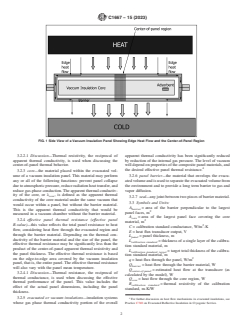
3.2.2 center-of-panel apparent thermal resistivity—the ther-
mine the applicability of regulatory limitations prior to use.
mal performance of vacuum insulation panels includes an edge
1.7 This international standard was developed in accor-
effect due to heat flow through the barrier material and this
dance with internationally recognized principles on standard-
shunting of heat around the evacuated volume of the panel
ization established in the Decision on Principles for the
becomes more prevalent with greater barrier thermal
Development of International Standards, Guides and Recom-
conductivity, as shown in Fig. 1. For panels larger than a
mendations issued by the World Trade Organization Technical
minimum size (as described in Annex A1), the center-of-panel
Barriers to Trade (TBT) Committee.
apparent thermal resistivity is a close approximation of the
intrinsic core thermal resistivity of the vacuum insulation
panel. The effective thermal performance of a panel will vary
This test method is under the jurisdiction of ASTM Committee C16 on Thermal
with the size and shape of the panel.
Insulation and is the direct responsibility of Subcommittee C16.30 on Thermal
Measurement.
Current edition approved Nov. 1, 2023. Published December 2023. Originally
approved in 2007. Last previous edition approved in 2015 as C1667 – 15. DOI: For referenced ASTM standards, visit the ASTM website, www.astm.org, or
10.1520/C1667-15R23. contact ASTM Customer Service at service@astm.org. For Annual Book of ASTM
All references to particular sections of Test Method C518 within this document Standards volume information, refer to the standard’s Document Summary page on
refer to the 2010 edition of Test Method C518. the ASTM website.
Copyright © ASTM International, 100 Barr Harbor Drive, PO Box C700, West Conshohocken, PA 19428-2959. United States
C1667 − 15 (2023)
FIG. 1 Side View of a Vacuum Insulation Panel Showing Edge Heat Flow and the Center-of-Panel Region
3.2.2.1 Discussion—Thermal resistivity, the reciprocal of apparent thermal conductivity has been significantly reduced
apparent thermal conductivity, is used when discussing the by reduction of the internal gas pressure. The level of vacuum
center-of-panel thermal behavior. will depend on properties of the composite panel materials, and
the desired effective panel thermal resistance.
3.2.3 core—the material placed within the evacuated vol-
ume of a vacuum insulation panel. This material may perform 3.2.6 panel barrier—the material that envelops the evacu-
any or all of the following functions: prevent panel collapse ated volume and is used to separate the evacuated volume from
due to atmospheric pressure, reduce radiation heat transfer, and the environment and to provide a long term barrier to gas and
reduce gas-phase conduction. The apparent thermal conductiv- vapor diffusion.
ity of the core, or λ , is defined as the apparent thermal
core
3.2.7 seal—any joint between two pieces of barrier material.
conductivity of the core material under the same vacuum that
3.3 Symbols and Units:
would occur within a panel, but without the barrier material.
A = area of the barrier perpendicular to the largest
barrier
This is the apparent thermal conductivity that would be
panel faces, m
measured in a vacuum chamber without the barrier material.
A = area of the largest panel face covering the core
core
3.2.4 effective panel thermal resistance (effective panel 2
material, m
R-value)—this value reflects the total panel resistance to heat 2
C = calibration standard conductance, W/m -K
flow, considering heat flow through the evacuated region and
E = heat flux transducer output, V
through the barrier material. Depending on the thermal con-
L = panel thickness, m
panel
ductivity of the barrier material and the size of the panel, the
L = thickness of a single layer of the calibra-
calibration standard
effective thermal resistance may be significantly less than the
tion standard material, m
product of the center-of-panel apparent thermal resistivity and
L = target total thickness of the calibra-
calibration standard, target
the panel thickness. The effective thermal resistance is based
tion standard material, m
on the edge-to-edge area covered by the vacuum insulation 2
q = heat flux through the panel, W/m
panel, that is, the entire panel. The effective thermal resistance
Q = heat flow through the barrier material, W
barrier
will also vary with the panel mean temperature.
Q = estimated heat flow at the transducer (as
center-of-panel
3.2.4.1 Discussion—Thermal resistance, the reciprocal of
calculated by the model), W
thermal conductance, is used when discussing the effective
Q = heat flow through the core region, W
core
thermal performance of the panel. This value includes the
R = thermal resistivity of the calibration
calibration standard
effect of the actual panel dimensions, including the panel
standard, m-K/W
thickness.
3.2.5 evacuated or vacuum insulations—insulation systems
For further discussion on heat flow mechanisms in evacuated insulations, see
whose gas phase thermal conductivity portion of the overall Practice C740 on Evacuated Reflective Insulation in Cryogenic Service.
C1667 − 15 (2023)
R = center of panel thermal resistivity, m-K/W 7. Specimen Preparation
center-of-panel
S = calibration factor, (W/m )/V
7.1 Vacuum insulation panels are typically rigid and the
T = specimen cold surface temperature, K
c
shape cannot be modified for testing purposes. However, to
T = specimen hot surface temperature, K
h
obtain representative thermal values for the panel, the two
t = thickness of the barrier material, m
barrier
primary surfaces must be parallel and have limited surface
W , W = panel width, panel length, m
1 2
irregularities.
u = combined standard uncertainty
c
7.2 If none of the standard product sizes are appropriate for
u = uncertainty component, for example, standard uncer-
n
the heat flow meter apparatus used in this test, then represen-
tainty for the measurement
tative test specimens must be produced so that they accurately
Z = an approximate estimate of the ratio of the heat flow
edge
represent both the same average performance as the production
through the barrier material to the heat flow through the core
product and the same typical product variability.
material, dimensionless
λ = thermal conductivity of the barrier material,
7.3 The specimens shall be of the same thickness as the
barrier
W/m-K average thickness to be applied in use.
λ = apparent thermal conductivity of the core region,
core
7.4 The minimum panel size for this test is determined by
W/m-K
the size of the heat flux transducer in the heat flow meter
apparatus, the overall maximum specimen size limit for the
4. Summary of Test Method
apparatus, the thermal conductivity of the barrier, the thickness
4.1 This test method describes a modified application of
of the barrier, and the thermal conductivity of the core. Annex
Test Method C518 to evacuated panels. These panels fall
A1 contains a procedure to estimate the minimum acceptable
outside the scope of Test Method C518, both in their non-
panel size.
homogeneity and in the current lack of specimens having an
7.4.1 Preferably, specimens shall be of such size as to fully
accepted reference value that are of similar size and have the
cover the plate assembly surfaces, with an allowance of up to
necessary thermal characteristics. Therefore, modifications are
6 mm on each side to allow room for panel seals.
necessary in the areas of apparatus calibration, plate separation,
7.4.2 If the width or length, or both, of the specimen are
test procedures, precision and bias, and reporting.
smaller than the apparatus compartment, surround the speci-
NOTE 1—Primary calibration standards, using vacuum insulation
men with high thermal resistance insulation. This surrounding
panels, have not been prepared for this class of products due to
material will reduce edge heat transfer and prevent air circu-
uncertainties about their long-term stability characteristics.
lation around the specimen.
5. Significance and Use
7.5 For panels with smooth parallel surfaces, the specimen
thickness is represented by the plate separation.
5.1 Heat flow meter apparatus are being used to measure the
center-of-panel portion of a vacuum insulation panel, which
7.6 For panels with irregular surfaces, to insure thermal
typically has a very high value of thermal resistivity (that is,
contact with the apparatus surfaces, it is necessary to:
equal to or greater than 90 m-K/W). As described in Specifi-
7.6.1 Measure the panel thickness with an accuracy of
cation C1484, the center-of-panel thermal resistivity is used,
60.05 mm in at least five locations distributed over the surface
along with the panel geometry and barrier material thermal
of the panel and use the average of the local values. Care shall
conductivity, to determine the effective thermal resistance of
be taken so that the contact between the caliper jaws or the
the evacuated panel.
length meter’s pressure foot does not damage the specimen
surface.
5.2 Using a heat flow meter apparatus to measure the
7.6.2 Record the output of one thermocouple placed on the
thermal resistivity of non-homogenous and high thermal resis-
center of the top and one thermocouple placed on the center of
tance specimens is a non-standard application of the
the bottom of the panel. The temperatures recorded by the
equipment, and shall only be performed by qualified personnel
thermocouples, not the hot and cold plate temperatures, shall
with understanding of heat transfer and error propagation.
be used to calculate the center-of-panel apparent thermal
Familiarity with the configuration of both the apparatus and the
resistivity.
vacuum insulation panel is necessary.
7.6.3 Place one sheet (approximately 3 mm thick) of an
5.3 The center-of-panel thermal transmission properties of
elastomeric or soft foam rubber between each side of the panel
evacuated panels vary due to the composition of the materials
and the corresponding apparatus plate. This sheet will improve
of construction, mean temperature and temperature difference,
contact between the controlled temperature plates and prevent
and the prior history. The selection of representative values for
air circulation between the panel and the plates.
the thermal transmission properties of an evacuated panel for a
particular application must be based on a consideration of these
8. Calibration
factors and will not apply necessarily without modification to
8.1 The apparatus shall be calibrated according to Test
all service conditions.
Method C518 sections 6.1 to 6.5.
6. Apparatus
8.2 Specimens having an accepted reference value with
6.1 Follow Test Method C518, Section 5 except use Section physical and thermal characteristics similar to vacuum insula-
8 of this test method for calibration. tion panels are not yet available. The linearity of the heat flux
C1667 − 15 (2023)
transducers at very low levels of heat flux must be verified T 2 T
~ !
h c
S 5 (3)
using another method. The apparatus calibration must include 1
E ×
(
the addition of at least one of the modified calibration C
Layers
procedures described in 8.5 and 8.6, that is Modified Calibra-
8.5.4 For each heat flux transducer, evaluate the variation in
tion Procedure A or B. As described in 8.7, the two modified
S as a function of heat flux. Determine whether the variation is
procedures can be combined if necessary to meet uncertainty
acceptable and include this value as an element of the
goals. Although each method magnifies an element of experi-
measurement uncertainty in the reported error analysis.
mental error (as discussed below), it is necessary to augment
the standard Test Method C518 calibration for this particular
NOTE 6—Any change in the calibration factor for increased thickness
reflects not only the effect of the reduced heat flux magnitude (which will
application.
be pertinent to the vacuum insulation panel measurement), but also the
8.3 It is not intended that the heat flow meter apparatus
effect of increased lateral heat losses or gains caused by the increased edge
calibration be altered based on the results of these supplemen-
area (which may not be pertinent for this application). The lateral heat
losses can be minimized by keeping the mean test temperature equal to the
tary procedures. Rather the results will be used by qualified
temperature of the local environment.
personnel (as described in 5.2) to determine whether a particu-
lar heat flow meter apparatus will give meaningful results for
8.6 Modified Calibration Procedure B—Make a series of
a vacuum panel application, and if so, to provide guidance on
test measurements with small temperature differences using a
interpreting and applying the Test Method C518 test results.
single calibration standard. Calculate the target temperature
NOTE 2—Just as with the standard calibration technique, the supple-
difference as shown in Eq 4.
mentary calibration need not be repeated for every test if the equipment
T 2 T 5 R × q × L (4)
has been stable over a significant period of time. See Test Method C518 ~ !
h c calibration standard target calibration standard
target
section 4.5.1.
8.6.1 Holding the mean temperature constant, adjust the
NOTE 3—The heat flow meter apparatus may take a long time to reach
a true steady-state condition for low conductance specimens, as described
plate temperatures as necessary to reduce the temperature
in Test Method C518 section 7.7.3.
difference across the calibration specimen.
8.4 In order to evaluate the linearity of the heat flux
8.6.2 For each heat flux transducer, calculate the calibration
transducers at the reduced levels of heat flux that will occur
factor, S from Eq 3, at each heat flux level. For each heat flux
with the vacuum insulation panels, a target heat flux is
transducer, evaluate the variation in S as a function of heat flux.
calculated from Eq 1, using the best information available
Determine whether the variation is acceptable and include this
about the center-of-panel thermal resistivity, the panel
value as an element of the measurement uncertainty in the
thickness, and the temperature difference of interest.
reported error analysis.
8.6.3 For each heat flux transducer, the calibration factor S
~T 2 T !
h c
q 5 (1)
target
is a function of plate temperature. The user shall include the
R × L
center of panel, estimated panel
variation of S with temperature in the error analysis unless this
8.5 Modified Calibration Procedure A—Make a series of
variability has already been included in the calibration factor.
test measurements using multiple thicknesses of the calibration
standard, with a radiation-blocking septum between the layers.
NOTE 7—At smaller temperature differences, the effect of the impreci-
sion of the plate temperature measurements on the final result will be
Calculate a target thickness for the heat flux level of interest
greater.
using Eq 2, recognizing that the actual thickness will be an
even multiple of the thickness of a single layer or the sum of
8.7 If neither Modified Calibration Procedure A or B are
the available calibration standard thicknesses.
sufficient to reduce the experimental heat flux to the desired
levels within an acceptable uncertainty, it will be necessary to
~T 2 T !
h c
L 5 (2)
calibration standard, target combine them, that is, to use multiple calibration specimens
R × q
calibration standard target
with a reduced temperature difference.
NOTE 4—The use of radiation-blocking septums in this procedure is not
meant to imply that radiation is not a significant heat transfer mechanism
8.7.1 Edge effect errors will be magnified with the stacked
within a vacuum insulation panel. Rather, the septums are used to allow
specimen method, compared to a single calibration thickness.
the addition of previously measured conductances for each individual
Smaller temperature differences will magnify the impact of the
laye
...