

ASTM G24-21
(Practice)Standard Practice for Conducting Exposures to Daylight Filtered Through Glass
General Information
- Abstract
SIGNIFICANCE AND USE
4.1 Since solar radiation, air temperature, relative humidity, and the amount and kind of atmospheric contaminants vary continuously, results from exposures based on elapsed time will sometimes differ. The variations in the results will usually be reduced by timing the exposures in terms of:
4.1.1 One or more environmental parameters such as solar radiant exposure, or
4.1.2 A predefined property change of a weathering reference specimen with known performance.
4.2 Variations in temperature, moisture, and atmospheric contaminants can have a significant effect on the degradation caused by solar radiation. In addition, exposures conducted at different times of the year can cause large differences in the rate of degradation. Different materials generally have different sensitivities to heat, moisture, and atmospheric contaminants, and this could explain differences in rankings of specimens exposed to equivalent solar radiant exposure when other environmental conditions vary.
4.3 Since the method of mounting has an influence on the temperature and other parameters during exposure of the specimen, there shall be agreement between contractual parties as to the method of mounting the specimen for the particular exposure test under consideration.
4.4 There are differences among various single strength window glasses in their transmittance in the 300 to 350 nm region. For example, at 320 nm, the percent transmittance for seven different lots of single strength window glass ranged from 8.4 to 26.8 %. At 380 nm, the percent transmittance ranged from 84.9 % to 88.1 %.5
4.5 Differences in UV transmittance between different lots of glass generally continue even after solarization. The largest differences among window glasses in UV transmittance are in the spectral range of 300 to 320 nm.
4.6 This practice is best used to compare the relative performance of materials tested at the same time behind the same lot of glass. Because of variability between lots of g...
SCOPE
1.1 This practice describes procedures for conducting exposures of various materials to daylight filtered through glass in passively ventilated and non-vented enclosures. For exposures in under glass enclosures with forced air circulation, refer to Practice G201.
1.1.1 This practice is not intended for corrosion testing of bare metals.
1.2 For direct exposures, refer to Practice G7.
1.3 This practice is limited to the method of conducting the exposures. The preparation of test specimens and evaluation of results are covered in various standards for the specific materials.
1.4 Exposure conducted according to this practice can use two types of exposure cabinets.
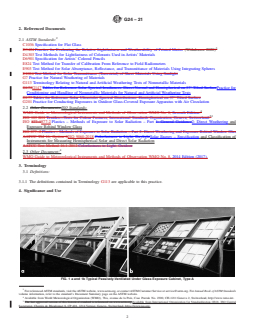
1.4.1 Type A—A cabinet that allows passive ventilation of specimens being exposed behind glass.
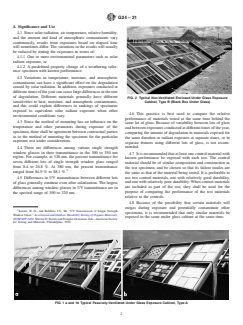
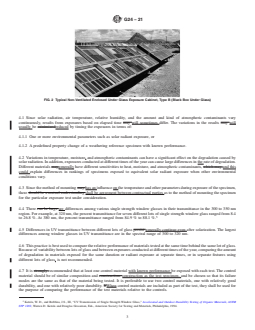
1.4.2 Type B—Enclosed cabinet with exterior painted black that does not provide for ventilation of specimens exposed behind glass. Exposures conducted using a Type B cabinet are typically referred to as “black box under glass exposures.”
1.5 Type A exposures of this practice are technically similar to Method B of ISO 877-2.
1.6 Units—The values stated in SI units are to be regarded as standard. The values given in parentheses after SI units are provided for information only and are not considered standard.
1.7 This standard does not purport to address all of the safety concerns, if any, associated with its use. It is the responsibility of the user of this standard to establish appropriate safety, health, and environmental practices and determine the applicability of regulatory limitations prior to use.
1.8 This international standard was developed in accordance with internationally recognized principles on standardization established in the Decision on Principles for the Development of International Standards, Guides and Recommendations issued by the World Trade Organization Technical Barriers to Trade (TBT) Committee.
- Status
- Published
- Publication Date
- 30-Nov-2021
- Technical Committee
- G03 - Weathering and Durability
- Drafting Committee
- G03.02 - Natural and Environmental Exposure Tests
Overview
ASTM G24-21: Standard Practice for Conducting Exposures to Daylight Filtered Through Glass provides a standardized methodology for exposing nonmetallic materials to natural sunlight that passes through glass. This practice is widely used to evaluate how materials age, degrade, or change in appearance and performance when subjected to daylight conditions in environments such as indoor or automotive settings where glass acts as a filter. ASTM G24-21 outlines procedures for exposures using passively ventilated and non-ventilated enclosures, methods for monitoring key environmental variables, and general best practices for specimen mounting and reporting.
Key Topics
Exposure Methods:
ASTM G24-21 specifies two types of exposure cabinets:- Type A: Passively ventilated, protects specimens from rain while allowing ambient air circulation.
- Type B: Non-ventilated “black box under glass” for conditions simulating higher interior temperatures, such as inside vehicles.
Environmental Variables:
Exposure outcomes may be influenced by several factors:- Solar radiation variability
- Air temperature and humidity
- Atmospheric contaminants
- Seasonal differences in environmental conditions
Glass Variability and UV Transmittance:
Glass used in enclosures can vary significantly in UV transmittance, especially between 300–350 nm. These differences persist after pre-exposure aging of the glass, making it critical to test all specimens under the same lot of glass for meaningful comparative results.Mounting and Positioning:
The practice emphasizes consistency in specimen orientation, mounting method, and distance from the glass to control exposure conditions.Control Materials:
Including control samples with known aging performance is strongly recommended to benchmark and compare degradation rates among test materials.Measurement and Reporting:
The standard describes two methods for measuring solar radiant exposure-direct under-glass measurement and calculation based on glass transmittance.
Applications
ASTM G24-21 is applied in diverse sectors where evaluating material durability under indoor sunlight or simulated windowed environments is essential, such as:
- Automotive: Simulating dashboard, upholstery, and plastic component exposure to sunlight through car windows to assess fading, discoloration, or material degradation.
- Building Materials: Testing paints, coatings, plastics, or textiles intended for indoor use near windows to gauge resistance to light-induced changes.
- Consumer Products: Evaluating colorfastness and general weatherability of products exposed to sunlight indoors, such as furniture fabrics, artwork, and packaging materials.
- Research & Development: Used in quality control and product development to compare material performance, optimize formulations, and demonstrate compliance with industry standards.
Related Standards
The practice references several standards and documents for broader context and harmonization, including:
- ASTM G7: Practice for Natural Weathering of Materials, for direct (non-glass filtered) exposures.
- ASTM G201: Practice for Conducting Exposures in Outdoor Glass-Covered Exposure Apparatus with Air Circulation, for forced air systems.
- ISO 877-2: Plastics-Methods of Exposure to Solar Radiation-Part 2: Direct Weathering and Exposure Behind Window Glass, similar in technical scope to Type A exposures.
- ASTM C1036: Specification for Flat Glass, for requirements regarding glass used in exposure tests.
- ASTM E903, E1084: Methods for measuring solar transmittance of materials.
- AATCC TM 16: Colorfastness to Light, relevant for textile testing.
By implementing ASTM G24-21, laboratories and manufacturers can ensure consistent, reliable, and comparable data for material performance under daylight filtered through glass, supporting quality assurance, product claims, and regulatory compliance.
Keywords: daylight exposure, weathering, ASTM G24-21, glass filtered sunlight, UV transmittance, lightfastness testing, indoor sunlight simulation, material durability, automotive weathering, building materials testing.
Relations
- Effective Date
- 01-Dec-2023
- Effective Date
- 15-Apr-2018
- Effective Date
- 01-Jun-2017
- Effective Date
- 01-Feb-2016
- Effective Date
- 01-Mar-2014
- Effective Date
- 01-Oct-2011
- Effective Date
- 01-Oct-2011
- Refers
ASTM E824-10 - Standard Test Method for Transfer of Calibration From Reference to Field Radiometers - Effective Date
- 01-Dec-2010
- Refers
ASTM D4303-10 - Standard Test Methods for Lightfastness of Colorants Used in Artists' Materials - Effective Date
- 01-Jun-2010
- Effective Date
- 01-Dec-2009
- Effective Date
- 15-Jun-2009
- Effective Date
- 01-Feb-2009
- Effective Date
- 01-Aug-2008
- Effective Date
- 01-Dec-2006
- Effective Date
- 01-Dec-2006
Get Certified
Connect with accredited certification bodies for this standard

Control Union Certifications
Global certification for agriculture and sustainability.

Hohenstein Institut
Textile testing and certification.

Bureau Veritas Bangladesh
Bureau Veritas certification services in Bangladesh.
Sponsored listings
Frequently Asked Questions
ASTM G24-21 is a standard published by ASTM International. Its full title is "Standard Practice for Conducting Exposures to Daylight Filtered Through Glass". This standard covers: SIGNIFICANCE AND USE 4.1 Since solar radiation, air temperature, relative humidity, and the amount and kind of atmospheric contaminants vary continuously, results from exposures based on elapsed time will sometimes differ. The variations in the results will usually be reduced by timing the exposures in terms of: 4.1.1 One or more environmental parameters such as solar radiant exposure, or 4.1.2 A predefined property change of a weathering reference specimen with known performance. 4.2 Variations in temperature, moisture, and atmospheric contaminants can have a significant effect on the degradation caused by solar radiation. In addition, exposures conducted at different times of the year can cause large differences in the rate of degradation. Different materials generally have different sensitivities to heat, moisture, and atmospheric contaminants, and this could explain differences in rankings of specimens exposed to equivalent solar radiant exposure when other environmental conditions vary. 4.3 Since the method of mounting has an influence on the temperature and other parameters during exposure of the specimen, there shall be agreement between contractual parties as to the method of mounting the specimen for the particular exposure test under consideration. 4.4 There are differences among various single strength window glasses in their transmittance in the 300 to 350 nm region. For example, at 320 nm, the percent transmittance for seven different lots of single strength window glass ranged from 8.4 to 26.8 %. At 380 nm, the percent transmittance ranged from 84.9 % to 88.1 %.5 4.5 Differences in UV transmittance between different lots of glass generally continue even after solarization. The largest differences among window glasses in UV transmittance are in the spectral range of 300 to 320 nm. 4.6 This practice is best used to compare the relative performance of materials tested at the same time behind the same lot of glass. Because of variability between lots of g... SCOPE 1.1 This practice describes procedures for conducting exposures of various materials to daylight filtered through glass in passively ventilated and non-vented enclosures. For exposures in under glass enclosures with forced air circulation, refer to Practice G201. 1.1.1 This practice is not intended for corrosion testing of bare metals. 1.2 For direct exposures, refer to Practice G7. 1.3 This practice is limited to the method of conducting the exposures. The preparation of test specimens and evaluation of results are covered in various standards for the specific materials. 1.4 Exposure conducted according to this practice can use two types of exposure cabinets. 1.4.1 Type A—A cabinet that allows passive ventilation of specimens being exposed behind glass. 1.4.2 Type B—Enclosed cabinet with exterior painted black that does not provide for ventilation of specimens exposed behind glass. Exposures conducted using a Type B cabinet are typically referred to as “black box under glass exposures.” 1.5 Type A exposures of this practice are technically similar to Method B of ISO 877-2. 1.6 Units—The values stated in SI units are to be regarded as standard. The values given in parentheses after SI units are provided for information only and are not considered standard. 1.7 This standard does not purport to address all of the safety concerns, if any, associated with its use. It is the responsibility of the user of this standard to establish appropriate safety, health, and environmental practices and determine the applicability of regulatory limitations prior to use. 1.8 This international standard was developed in accordance with internationally recognized principles on standardization established in the Decision on Principles for the Development of International Standards, Guides and Recommendations issued by the World Trade Organization Technical Barriers to Trade (TBT) Committee.
SIGNIFICANCE AND USE 4.1 Since solar radiation, air temperature, relative humidity, and the amount and kind of atmospheric contaminants vary continuously, results from exposures based on elapsed time will sometimes differ. The variations in the results will usually be reduced by timing the exposures in terms of: 4.1.1 One or more environmental parameters such as solar radiant exposure, or 4.1.2 A predefined property change of a weathering reference specimen with known performance. 4.2 Variations in temperature, moisture, and atmospheric contaminants can have a significant effect on the degradation caused by solar radiation. In addition, exposures conducted at different times of the year can cause large differences in the rate of degradation. Different materials generally have different sensitivities to heat, moisture, and atmospheric contaminants, and this could explain differences in rankings of specimens exposed to equivalent solar radiant exposure when other environmental conditions vary. 4.3 Since the method of mounting has an influence on the temperature and other parameters during exposure of the specimen, there shall be agreement between contractual parties as to the method of mounting the specimen for the particular exposure test under consideration. 4.4 There are differences among various single strength window glasses in their transmittance in the 300 to 350 nm region. For example, at 320 nm, the percent transmittance for seven different lots of single strength window glass ranged from 8.4 to 26.8 %. At 380 nm, the percent transmittance ranged from 84.9 % to 88.1 %.5 4.5 Differences in UV transmittance between different lots of glass generally continue even after solarization. The largest differences among window glasses in UV transmittance are in the spectral range of 300 to 320 nm. 4.6 This practice is best used to compare the relative performance of materials tested at the same time behind the same lot of glass. Because of variability between lots of g... SCOPE 1.1 This practice describes procedures for conducting exposures of various materials to daylight filtered through glass in passively ventilated and non-vented enclosures. For exposures in under glass enclosures with forced air circulation, refer to Practice G201. 1.1.1 This practice is not intended for corrosion testing of bare metals. 1.2 For direct exposures, refer to Practice G7. 1.3 This practice is limited to the method of conducting the exposures. The preparation of test specimens and evaluation of results are covered in various standards for the specific materials. 1.4 Exposure conducted according to this practice can use two types of exposure cabinets. 1.4.1 Type A—A cabinet that allows passive ventilation of specimens being exposed behind glass. 1.4.2 Type B—Enclosed cabinet with exterior painted black that does not provide for ventilation of specimens exposed behind glass. Exposures conducted using a Type B cabinet are typically referred to as “black box under glass exposures.” 1.5 Type A exposures of this practice are technically similar to Method B of ISO 877-2. 1.6 Units—The values stated in SI units are to be regarded as standard. The values given in parentheses after SI units are provided for information only and are not considered standard. 1.7 This standard does not purport to address all of the safety concerns, if any, associated with its use. It is the responsibility of the user of this standard to establish appropriate safety, health, and environmental practices and determine the applicability of regulatory limitations prior to use. 1.8 This international standard was developed in accordance with internationally recognized principles on standardization established in the Decision on Principles for the Development of International Standards, Guides and Recommendations issued by the World Trade Organization Technical Barriers to Trade (TBT) Committee.
ASTM G24-21 is classified under the following ICS (International Classification for Standards) categories: 59.080.01 - Textiles in general. The ICS classification helps identify the subject area and facilitates finding related standards.
ASTM G24-21 has the following relationships with other standards: It is inter standard links to ASTM G201-23, ASTM E824-10(2018)e1, ASTM G147-17, ASTM G201-16, ASTM G113-14, ASTM C1036-11, ASTM C1036-11e1, ASTM E824-10, ASTM D4303-10, ASTM G201-09, ASTM G113-09, ASTM G147-09, ASTM G113-08, ASTM G113-06, ASTM G113-06e1. Understanding these relationships helps ensure you are using the most current and applicable version of the standard.
ASTM G24-21 is available in PDF format for immediate download after purchase. The document can be added to your cart and obtained through the secure checkout process. Digital delivery ensures instant access to the complete standard document.
Standards Content (Sample)
This international standard was developed in accordance with internationally recognized principles on standardization established in the Decision on Principles for the
Development of International Standards, Guides and Recommendations issued by the World Trade Organization Technical Barriers to Trade (TBT) Committee.
Designation: G24 − 21
Standard Practice for
Conducting Exposures to Daylight Filtered Through Glass
ThisstandardisissuedunderthefixeddesignationG24;thenumberimmediatelyfollowingthedesignationindicatestheyearoforiginal
adoptionor,inthecaseofrevision,theyearoflastrevision.Anumberinparenthesesindicatestheyearoflastreapproval.Asuperscript
epsilon (´) indicates an editorial change since the last revision or reapproval.
1. Scope* mendations issued by the World Trade Organization Technical
Barriers to Trade (TBT) Committee.
1.1 Thispracticedescribesproceduresforconductingexpo-
sures of various materials to daylight filtered through glass in
2. Referenced Documents
passively ventilated and non-vented enclosures. For exposures
2.1 ASTM Standards:
in under glass enclosures with forced air circulation, refer to
C1036Specification for Flat Glass
Practice G201.
D4303Test Methods for Lightfastness of Colorants Used in
1.1.1 This practice is not intended for corrosion testing of
Artists’Materials
bare metals.
D6901Specification for Artists’ Colored Pencils
1.2 For direct exposures, refer to Practice G7.
E824Test Method for Transfer of Calibration From Refer-
1.3 This practice is limited to the method of conducting the
ence to Field Radiometers
exposures.Thepreparationoftestspecimensandevaluationof
E903Test Method for Solar Absorptance, Reflectance, and
results are covered in various standards for the specific
Transmittance of Materials Using Integrating Spheres
materials.
G7Practice for Natural Weathering of Materials
G113Terminology Relating to Natural andArtificialWeath-
1.4 Exposure conducted according to this practice can use
ering Tests of Nonmetallic Materials
two types of exposure cabinets.
G147Practice for Conditioning and Handling of Nonmetal-
1.4.1 Type A—A cabinet that allows passive ventilation of
lic Materials for Natural and Artificial Weathering Tests
specimens being exposed behind glass.
G201Practice for Conducting Exposures in Outdoor Glass-
1.4.2 Type B—Enclosed cabinet with exterior painted black
Covered Exposure Apparatus with Air Circulation
that does not provide for ventilation of specimens exposed
2.2 ISO Standards:
behind glass. Exposures conducted using a Type B cabinet are
ISO 877-2Plastics – Methods of Exposure to Solar Radia-
typically referred to as “black box under glass exposures.”
tion – Part 2: Direct Weathering and Exposure Behind
1.5 TypeAexposuresofthispracticearetechnicallysimilar
Window Glass
to Method B of ISO877-2.
ISO 9060:2018Solar Energy – Specification and Classifica-
1.6 Units—The values stated in SI units are to be regarded
tion of Instruments for Measuring Hemispherical Solar
as standard. The values given in parentheses after SI units are
and Direct Solar Radiation
providedforinformationonlyandarenotconsideredstandard.
2.3 Other Document:
1.7 This standard does not purport to address all of the WMO Guide to Meteorological Instruments and Methods of
Observation WMO No. 8,2014 Edition (2017).
safety concerns, if any, associated with its use. It is the
responsibility of the user of this standard to establish appro-
3. Terminology
priate safety, health, and environmental practices and deter-
mine the applicability of regulatory limitations prior to use.
3.1 Definitions:
1.8 This international standard was developed in accor-
3.1.1 The definitions contained in Terminology G113 are
dance with internationally recognized principles on standard-
applicable to this practice.
ization established in the Decision on Principles for the
Development of International Standards, Guides and Recom-
For referenced ASTM standards, visit the ASTM website, www.astm.org, or
contact ASTM Customer Service at service@astm.org. For Annual Book of ASTM
Standards volume information, refer to the standard’s Document Summary page on
ThispracticeisunderthejurisdictionofASTMCommitteeG03onWeathering the ASTM website.
and Durability and is the direct responsibility of Subcommittee G03.02 on Natural Available from International Organization for Standardization (ISO), ISO
and Environmental Exposure Tests. Central Secretariat, Chemin de Blandonnet 8, CP 401, 1214 Vernier, Geneva,
Current edition approved Dec. 1, 2021. Published December 2021. Originally Switzerland, https://www.iso.org.
approved in 1973. Last previous edition approved in 2013 as G24–13. DOI: AvailablefromWorldMeteorologicalOrganization(WMO),7bis,avenuedela
10.1520/G0024-21. Paix,CasePostaleNo.2300,CH-1211Geneva2,Switzerland,http://www.wmo.int.
*A Summary of Changes section appears at the end of this standard
Copyright © ASTM International, 100 Barr Harbor Drive, PO Box C700, West Conshohocken, PA 19428-2959. United States
G24−21
4. Significance and Use
4.1 Since solar radiation, air temperature, relative humidity,
and the amount and kind of atmospheric contaminants vary
continuously, results from exposures based on elapsed time
will sometimes differ.The variations in the results will usually
be reduced by timing the exposures in terms of:
4.1.1 One or more environmental parameters such as solar
radiant exposure, or
4.1.2 A predefined property change of a weathering refer-
ence specimen with known performance.
4.2 Variations in temperature, moisture, and atmospheric
contaminants can have a significant effect on the degradation
caused by solar radiation. In addition, exposures conducted at
differenttimesoftheyearcancauselargedifferencesintherate
of degradation. Different materials generally have different
FIG. 2 Typical Non-Ventilated Enclosed Under Glass Exposure
sensitivities to heat, moisture, and atmospheric contaminants,
Cabinet, Type B (Black Box Under Glass)
and this could explain differences in rankings of specimens
exposed to equivalent solar radiant exposure when other
4.6 This practice is best used to compare the relative
environmental conditions vary.
performance of materials tested at the same time behind the
4.3 Since the method of mounting has an influence on the
same lot of glass. Because of variability between lots of glass
temperature and other parameters during exposure of the
andbetweenexposuresconductedatdifferenttimesoftheyear,
specimen,thereshallbeagreementbetweencontractualparties
comparing the amount of degradation in materials exposed for
as to the method of mounting the specimen for the particular
the same duration or radiant exposure at separate times, or in
exposure test under consideration.
separate fixtures using different lots of glass, is not recom-
mended.
4.4 There are differences among various single strength
window glasses in their transmittance in the 300 to 350 nm
4.7 Itisrecommendedthatatleastonecontrolmaterialwith
region. For example, at 320 nm, the percent transmittance for
known performance be exposed with each test. The control
seven different lots of single strength window glass ranged
material should be of similar composition and construction as
from 8.4 to 26.8 %. At 380 nm, the percent transmittance
the test specimen, and be chosen so that its failure modes are
ranged from 84.9 % to 88.1 %.
the same as that of the material being tested. It is preferable to
use two control materials, one with relatively good durability,
4.5 Differences in UV transmittance between different lots
andonewithrelativelypoordurability.Whencontrolmaterials
of glass generally continue even after solarization. The largest
are included as part of the test, they shall be used for the
differences among window glasses in UV transmittance are in
purpose of comparing the performance of the test materials
the spectral range of 300 to 320 nm.
relative to the controls.
4.8 Because of the possibility that certain materials will
outgas during exposure and potentially contaminate other
Ketola, W. D., and Robbins, J.S., III, “UV Transmission of Single Strength
specimens, it is recommended that only similar materials be
Window Glass,” Accelerated and Outdoor Durability Testing of Organic Materials,
exposed in the same under glass cabinet at the same time.
ASTM STP 1202,WarrenD.KetolaandDouglasGrossman,Eds.,AmericanSociety
for Testing and Materials, Philadelphia, 1994.
FIG. 1 a and 1b Typical Passively-Ventilated Under Glass Exposure Cabinet, Type A
G24−21
5. Apparatus for measurement of transmittance of solid samples recom-
mendedbythemanufactureroftheUV-visiblespectrophotom-
5.1 Exposure Cabinet:
eter used. When a spectrophotometer with an integrating
5.1.1 Type A—A glass-covered enclosure or cabinet of any
sphere is used, the measurements shall be performed in
convenient size, constructed to protect the specimens from
accordance with Test Method E903.
rain. It typically is constructed of metal or wood, and shall be
open on the back or sides to allow ambient air to passively
NOTE 3—Other standards describing exposures behind glass have
circulateoverthespecimens(Fig.1aandbshowatypicalglass
different requirements for glass transmittance and do not require pre-
cabinet empty, and with specimens, respectively). aging.
5.1.2 Type B (Black Box Under Glass)—A glass-covered
NOTE 4—After the initial pre-aging period, the UV transmittance of
window glass is suitable for at least 60 months of use. UV transmittance
enclosure or cabinet of any convenient size. It shall be
differences between lots of glass persist during this time, however.
constructed of corrosion resistant metal and be enclosed to
Different lots of single-strength window glass can have different optical
prevent ambient air from circulating over specimens. Exterior
properties even when purchased from the same manufacturer.
non-glass surfaces that will be irradiated shall be painted flat
5.1.3.3 Theexacthistoryofeachindividualpieceofglassis
black. The interior shall remain unpainted (Fig. 2).
typically not tracked.
NOTE1—Forsomeexposures(forexample,MethodBofTestMethods
5.1.3.4 Wash the exterior surface of the glass cover every
D4303 or MethodAof Specification D6901), a small fan is inserted into
the Type B enclosure to minimize condensation. For enclosures with monthwithsoapandwater,andtheinteriorsurfaceoftheglass
forced air circulation, refer to Practice G201.
cover every 3 months (or more frequently, as required) to
NOTE 2—The black box under glass enclosure is often used to simulate
remove dust particles and other undesirable deposits. Cleaning
under glass exposures under conditions of high temperature, such as the
the interior surface with solvents will be needed when outgas-
interior of an automobile. Black box under glass cabinets are enclosed,
andairtemperaturesinsidethecabinetmayexceed80°Cunderconditions sing products are seen, followed by washing with soap and
of high outside ambient temperature and solar irradiance. Significant
water to remove the cleaning agents. Remove the glass from
differences in air and specimen temperatures can be experienced between
the exposure frame when cleaning the interior surface.
upper and lower portions of the cabinet. Frequent temperature measure-
5.1.4 Theenclosureorcabinetshallbeequippedwitharack
ment and specimen repositioning may be required to properly use this
enclosure. which supports the specimens in a plane which is as close to
paralleltotheglassaspracticallypossible.Wheneverpossible,
5.1.3 Unless otherwise specified, the glass cover shall be a
the specimens are positioned such that the primary surface is
pieceofclear,non-laminated,transparentflatglass,greenhouse
supported at a distance of 75 6 25 mm (3 6 1 in.) behind the
quality Q4 or better as specified in subsection 4.1 of Specifi-
glass cover. Formed specimens with irregular dimensions will
cation C1036. Thickness shall be 2.0 to 3.2 mm.
requirecustommountingwithvaryingdistancesfromtheglass
5.1.3.1 In order to reduce variability of results due to
cover. In such cases, mount the test specimen so that the
changes in UV transmittance of glass, all new glass shall be
surface of major interest is parallel to the glass cover at a
exposed for at least three months prior to using to expose
distanceof75 625mm(3 61in.)behindtheglasscover.The
specimens per this practice. Expose the new glass facing the
mounting frame or plate shall be constructed of a material that
equator at any convenient exposure tilt angle within the range
of 5 to 45°, according to Practice G7 or on an empty under is compatible with the test specimens. In order to minimize
shadowing from the top and sides of the cabinet, the usable
glass exposure cabinet.
5.1.3.2 After the three-month pre-exposure period, it is exposure area under the glass shall be limited to that of the
glasscoverreducedbytwicethedistancefromthecovertothe
recommended that the spectral transmittance of
...
This document is not an ASTM standard and is intended only to provide the user of an ASTM standard an indication of what changes have been made to the previous version. Because
it may not be technically possible to adequately depict all changes accurately, ASTM recommends that users consult prior editions as appropriate. In all cases only the current version
of the standard as published by ASTM is to be considered the official document.
Designation: G24 − 13 G24 − 21
Standard Practice for
Conducting Exposures to Daylight Filtered Through Glass
This standard is issued under the fixed designation G24; the number immediately following the designation indicates the year of original
adoption or, in the case of revision, the year of last revision. A number in parentheses indicates the year of last reapproval. A superscript
epsilon (´) indicates an editorial change since the last revision or reapproval.
1. Scope*
1.1 This practice evaluates the resistance of nonmetallic materials to solar radiation describes procedures for conducting exposures
of various materials to daylight filtered through glass in passively ventilated and non-vented enclosures. For exposures in under
glass enclosures with forced air circulation, refer to Practice G201.
1.1.1 This practice is not intended for corrosion testing of bare metals.
1.2 For direct exposures, refer to Practice G7.
1.3 This practice is limited to the method of conducting the exposures. The preparation of test specimens and evaluation of results
are covered in various standards for the specific materials.
1.4 Exposure conducted according to this practice can use two types of exposure cabinets.
1.4.1 Type A—A cabinet that allows passive ventilation of specimens being exposed behind glass.
1.4.2 Type B—Enclosed cabinet with exterior painted black that does not provide for ventilation of specimens exposed behind
glass. Exposures conducted using a Type B cabinet are typically referred to as “black box under glass exposures.”
1.5 Type A exposures of this practice are technically similar to Method B of ISO 877-2.
1.6 Units—The values stated in SI units are to be regarded as the standard. The inch-pound units values given in parentheses are
for information only.after SI units are provided for information only and are not considered standard.
1.7 This standard does not purport to address all of the safety concerns, if any, associated with its use. It is the responsibility
of the user of this standard to establish appropriate safety safety, health, and healthenvironmental practices and determine the
applicability of regulatory limitations prior to use.
1.8 This international standard was developed in accordance with internationally recognized principles on standardization
established in the Decision on Principles for the Development of International Standards, Guides and Recommendations issued
by the World Trade Organization Technical Barriers to Trade (TBT) Committee.
This practice is under the jurisdiction of ASTM Committee G03 on Weathering and Durability and is the direct responsibility of Subcommittee G03.02 on Natural and
Environmental Exposure Tests.
Current edition approved June 1, 2013Dec. 1, 2021. Published July 2013December 2021. Originally approved in 1973. Last previous edition approved in 20052013 as
G24 – 05.G24 – 13. DOI: 10.1520/G0024-13.10.1520/G0024-21.
*A Summary of Changes section appears at the end of this standard
Copyright © ASTM International, 100 Barr Harbor Drive, PO Box C700, West Conshohocken, PA 19428-2959. United States
G24 − 21
2. Referenced Documents
2.1 ASTM Standards:
C1036 Specification for Flat Glass
D3424 Practice for Evaluating the Relative Lightfastness and Weatherability of Printed Matter (Withdrawn 2020)
D4303 Test Methods for Lightfastness of Colorants Used in Artists’ Materials
D6901 Specification for Artists’ Colored Pencils
E824 Test Method for Transfer of Calibration From Reference to Field Radiometers
E903 Test Method for Solar Absorptance, Reflectance, and Transmittance of Materials Using Integrating Spheres
E1084 Test Method for Solar Transmittance (Terrestrial) of Sheet Materials Using Sunlight
G7 Practice for Natural Weathering of Materials
G113 Terminology Relating to Natural and Artificial Weathering Tests of Nonmetallic Materials
G173G147 Tables for Reference Solar Spectral Irradiances: Direct Normal and Hemispherical on 37° Tilted SurfacePractice for
Conditioning and Handling of Nonmetallic Materials for Natural and Artificial Weathering Tests
G177 Tables for Reference Solar Ultraviolet Spectral Distributions: Hemispherical on 37° Tilted Surface
G201 Practice for Conducting Exposures in Outdoor Glass-Covered Exposure Apparatus with Air Circulation
2.2 Other Documents:ISO Standards:
WMO Guide to Meteorological Instruments and Methods of Observation WMO No. 8, Seventh Edition.
ISO 105 B01 Textiles—Tests for Colour Fastness, International Standards Organization, Geneva, Switzerland.
ISO 877-1877-2 Plastics – Methods of Exposure to Solar Radiation – Part 1: General Guidance2: Direct Weathering and
Exposure Behind Window Glass
ISO 877–2 Plastics – Methods of Exposure to Solar Radiation – Part 2: Direct Weathering and Exposure Behind Window Glas
AATCC TM 16, Option 6ISO 9060:2018 Colorfastness to Light, DaylightSolar Energy – Specification and Classification of
Instruments for Measuring Hemispherical Solar and Direct Solar Radiation
AATCC Test Method 16.1-2012 Colorfastness to Light: Outdoor
2.3 Other Document:
WMO Guide to Meteorological Instruments and Methods of Observation WMO No. 8, 2014 Edition (2017).
3. Terminology
3.1 Definitions:
3.1.1 The definitions contained in Terminology G113 are applicable to this practice.
4. Significance and Use
FIG. 1 a and 1b Typical Passively-Ventilated Under Glass Exposure Cabinet, Type A
For referenced ASTM standards, visit the ASTM website, www.astm.org, or contact ASTM Customer Service at service@astm.org. For Annual Book of ASTM Standards
volume information, refer to the standard’s Document Summary page on the ASTM website.
Available from World Meteorological Organization (WMO), 7bis, avenue de la Paix, Case Postale No. 2300, CH-1211 Geneva 2, Switzerland, http://www.wmo.int.
The last approved version of this historical standard is referenced on www.astm.org.Available from International Organization for Standardization (ISO), ISO Central
Secretariat, Chemin de Blandonnet 8, CP 401, 1214 Vernier, Geneva, Switzerland, https://www.iso.org.
G24 − 21
FIG. 2 Typical Non-Ventilated Enclosed Under Glass Exposure Cabinet, Type B (Black Box Under Glass)
4.1 Since solar radiation, air temperature, relative humidity, and the amount and kind of atmospheric contaminants vary
continuously, results from exposures based on elapsed time may will sometimes differ. The variations in the results may will
usually be minimizedreduced by timing the exposures in terms of:
4.1.1 One or more environmental parameters such as solar radiant exposure, or
4.1.2 A predefined property change of a weathering reference specimen with known performance.
4.2 Variations in temperature, moisture, and atmospheric contaminants can have a significant effect on the degradation caused by
solar radiation. In addition, exposures conducted at different times of the year can cause large differences in the rate of degradation.
Different materials maygenerally have different sensitivities to heat, moisture, and atmospheric contaminants, which may and this
could explain differences in rankings of specimens exposed to equivalent solar radiant exposure when other environmental
conditions vary.
4.3 Since the method of mounting may has an influence on the temperature and other parameters during exposure of the specimen,
there should be a mutual understanding shall be agreement between contractual parties as to the method of mounting the specimen
for the particular exposure test under consideration.
4.4 There can be large are differences among various single strength window glasses in their transmittance in the 300 to 350 nm
region. For example, at 320 nm, the percent transmittance for seven different lots of single strength window glass ranged from 8.4
to 26.8 %. At 380 nm, the percent transmittance ranged from 84.9 % to 88.1 %.
4.5 Differences in UV transmittance between different lots of glass persist generally continue even after solarization. The largest
differences among window glasses in UV transmittance are in the spectral range of 300 to 320 nm.
4.6 This practice is best used to compare the relative performance of materials tested at the same time behind the same lot of glass.
Because of variability between lots of glass and between exposures conducted at different times of the year, comparing the amount
of degradation in materials exposed for the same duration or radiant exposure at separate times, or in separate fixtures using
different lots of glass, is not recommended.
4.7 It is strongly recommended that at least one control material with known performance be exposed with each test. The control
material should be of similar composition and construction. construction as the test specimen, and be chosen so that its failure
modes are the same as that of the material being tested. It is preferable to use two control materials, one with relatively good
durability, and one with relatively poor durability. IfWhen control materials are included as part of the test, they shall be used for
the purpose of comparing the performance of the test materials relative to the controls.
Ketola, W. D., and Robbins, J.S., III, “UV Transmission of Single Strength Window Glass,” Accelerated and Outdoor Durability Testing of Organic Materials, ASTM
STP 1202, Warren D. Ketola and Douglas Grossman, Eds., American Society for Testing and Materials, Philadelphia, 1994.
G24 − 21
4.8 There are other standards which describe exposures to glass filtered daylight. Six cited standards are D3424, D4303,D6901,
ISO 105-B01, ISO 877-1, ISO-877-2, AATCC TM 16C.
4.8 Because of the possibility that certain materials maywill outgas during exposure, exposure and potentially contaminate other
specimens, it is recommended that only similar materials be exposed in the same under glass cabinet at the same time.
5. Apparatus
5.1 Exposure Cabinet:
5.1.1 Type A—A glass-covered enclosure or cabinet of any convenient size, constructed to protect the specimens from rain. It
typically is constructed of metal or wood, and shall be open on the back or sides to allow ambient air to passively circulate over
the specimens (Fig. 1a and b).b show a typical glass cabinet empty, and with specimens, respectively).
5.1.2 Type B (Black Box Under Glass)—A glass-covered enclosure or cabinet of any convenient size. It shall be constructed of
corrosion resistant metal and be enclosed to prevent ambient air from circulating over specimens. Exterior non-glass surfaces that
will be irradiated shall be painted flat black. The interior shall remain unpainted (Fig. 2).
NOTE 1—For some exposures (for example, Method B of Test Methods D4303 or Method A of Specification D6901), a small fan is inserted into the Type
B enclosure to minimize condensation. For enclosures with forced air circulation, refer to Practice G201.
NOTE 2—The black box under glass enclosure is often used to simulate under glass exposures under conditions of high temperature, such as the interior
of an automobile. However, because black Black box under glass cabinets are enclosed, and air temperatures inside the cabinet may exceed 80°C80 °C
under conditions of high outside ambient air temperature and solar irradiance. In addition, significant Significant differences in air and specimen
temperatures can be experienced between upper and lower portions of the cabinet. Frequent temperature measurement and specimen repositioning may
be required to properly use this enclosure.
5.1.3 Unless otherwise specified, the glass cover shall be a piece of clear, non-laminated, transparent flat glass, greenhouse quality
Q4 or better as specified in sectionsubsection 4.1 of Specification C1036. Thickness shall be 2.0 to 3.2 mm.
5.1.3.1 In order to reduce variability of results due to changes in UV transmittance of glass, all new glass shall be exposed facing
the equator,for at least three months prior to using to expose specimens per this practice. Expose the new glass facing the equator
at any convenient exposure tilt angle within the range of 5 to 45°, according to Practice G7, or on an empty under glass exposure
cabinet, for at least three months prior to installation in test cabinets. cabinet.
5.1.3.2 After the three-month pre-exposure period, it is recommended that the spectral transmittance of representative samples
from each lot of glass be measured. Typically, “single strength” glass will have a transmittance of 10 to 20 % at 320 nm and at
least 85 % at wavelengths of 380 nm or higher after the three month pre-aging procedure. IfWhen transmittance of the glass is
measured, report the average for at least three pieces of the lot of glass being tested. Follow the instructions for measurement of
transmittance of solid samples recommended by the manufacturer of the UV-visible spectrophotometer used. IfWhen a
spectrophotometer with an integrating sphere is used, the measurements shall be performed in accordance with Test Method E903.
NOTE 3—Other standards describing exposures behind glass have different requirements for glass transmittance and do not require pre-aging.
NOTE 4—After the initial pre-aging period, the UV transmittance of window glass is suitable for at least 60 months of use. UV transmittance differences
between lots of glass persist during this time, however. Different lots of single-strength window glass can have different optical properties even ifwhen
purchased from the same manufacturer.
5.1.3.3 The exact history of each individual piece of glass is typically not tracked.
5.1.3.4 Wash the exterior surface of the glass cover every month, and month with soap and water, and the interior surface of the
glass cover every 3 months (or more frequently, ifas required) to remove dust particles and other undesirable deposits. Cleaning
the interior surface with solvents will be needed when outgassing products are seen, followed by washing with soap and water to
remove the cleaning agents. Remove the glass from the exposure frame when cleaning the interior surface.
5.1.4 The enclosure or cabinet shall be equipped with a rack which supports the specimens in a plane which is as close to parallel
to the glass. glass as practically possible. Whenever possible, the specimens should be are positioned such that the primary surface
G24 − 21
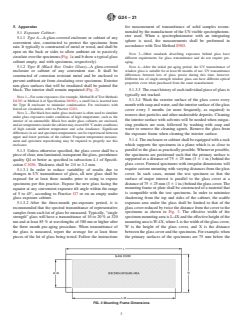
is supported at a distance of 75 6 25 mm (3 6 1 in.) behind the glass cover. Formed specimens with irregular dimensions maywill
require custom mounting with varying distances from the glass cover. In such cases, mount the test sample specimen so that the
surface of major interest is parallel to the glass cover at a distance of 75 6 25 mm (3 6 1 in.) behind the glass cover. The mounting
frame or plate shall be constructed of a material that is compatible with the test specimens. In order to minimize shadowing from
the top and sides of the cabinet, the usable exposure area under the glass shall be limited to that of the glass cover reduced by twice
the distance from the cover to the specimens as shown in Fig. 3. The effective width of the specimen mounting area is L-4X and
the effective height of the mounting area is W-4X, where L is the width of the glass cover, W is the height of the glass cover, and
X is the distance between the glass cover and the specimens. For example, if the when the primary surfaces of the specimens are
75 mm below the glass, then all specimens shall be at least 150 mm from the top, or sides. Three bottom, or sides. Use one of
these three types of mounting frames or backings may be used.backings.
5.1.4.1 Unbacked or Open Mounting—Specimens are attached only at edges.
5.1.4.2 Expande
...