

ASTM G201-23
(Practice)Standard Practice for Conducting Exposures in Outdoor Glass-Covered Exposure Apparatus with Air Circulation
General Information
- Abstract
SIGNIFICANCE AND USE
5.1 As with any accelerated test, the increase in rate of weathering compared to in-service exposure is material dependent. Results from exposures conducted to this practice may provide good rank correlation to results from actual use conditions for one type of material or product. It should not be assumed that this will be true for other materials or products. It is always best to verify the ability of an accelerated exposure test to properly rank the durability of materials with actual use conditions. Guide G141 provides information about using rank correlation.
5.2 Variation in results may be expected when operating conditions are varied within the accepted limits of this practice. Therefore, no reference shall be made to results from the use of this practice unless accompanied by a report detailing the specific operating conditions in conformance with Report Section 8.
5.3 The durability of materials in outdoor use can be very different depending on the location of the exposure because of differences in solar radiation, moisture, heat, pollutants, and other factors. Therefore, it cannot be assumed that results from exposure in a single location will be useful for determining durability ranking of materials in a different location.
5.4 It is recommended that at least one control material be exposed with each test. The control material should be of similar composition and construction and be chosen so that its failure modes are the same as that of the material being tested. It is preferable to use two control materials, one with relatively good durability, and one with relatively poor durability. If control materials are included as part of the test, they shall be used for the purpose of comparing the performance of the test materials relative to the controls.
SCOPE
1.1 This practice covers the basic principles and operating procedures for using outdoor glass-covered exposure apparatus with air circulation. This practice is limited to the procedures for obtaining, measuring and controlling conditions of exposure. A number of exposure procedures are listed in Appendix X1; however, this practice does not specify the exposure conditions best suited for the material to be tested.
1.2 For direct weathering exposures, refer to Practice G7. For exposures behind glass without air circulation, refer to Practice G24.
1.3 Test specimens are exposed to solar radiation filtered through glass under partially controlled environmental test conditions. Different glass types and operating parameters are described.
1.4 Specimen preparation and evaluation of the results are covered in ASTM methods or specifications for specific materials. More specific information for determining the change in properties after exposure and reporting these results is described in Practices D5870, D2244 and Test Method D523.
1.5 The values stated in SI units are to be regarded as standard.
1.6 This standard does not purport to address all of the safety concerns, if any, associated with its use. It is the responsibility of the user of this standard to establish appropriate safety, health, and environmental practices and determine the applicability of regulatory limitations prior to use.
1.7 This international standard was developed in accordance with internationally recognized principles on standardization established in the Decision on Principles for the Development of International Standards, Guides and Recommendations issued by the World Trade Organization Technical Barriers to Trade (TBT) Committee.
- Status
- Published
- Publication Date
- 30-Nov-2023
- Technical Committee
- G03 - Weathering and Durability
- Drafting Committee
- G03.02 - Natural and Environmental Exposure Tests
Buy Documents
ASTM G201-23 - Standard Practice for Conducting Exposures in Outdoor Glass-Covered Exposure Apparatus with Air Circulation
REDLINE ASTM G201-23 - Standard Practice for Conducting Exposures in Outdoor Glass-Covered Exposure Apparatus with Air Circulation
Overview
ASTM G201-23 outlines a standard practice for conducting exposures in outdoor, glass-covered exposure apparatus with air circulation. Developed by ASTM International, this practice details the principles and operating procedures for exposing materials in controlled outdoor environments to assess their weathering durability. Materials are tested by placing specimens in glass-covered enclosures where solar radiation, humidity, and temperature can be partially controlled and air circulation is managed using fans. This standard is widely used for accelerated weathering evaluations of nonmetallic materials and products to help predict their durability and lifespan in outdoor conditions.
Key Topics
- Outdoor glass-covered exposure apparatus: Specifies the use of enclosures covered with clear or laminated glass through which natural sunlight is filtered.
- Air circulation control: Describes operation modes for circulating fans-options include continuous operation during daylight or activation based on temperature thresholds.
- Exposure conditions: Provides guidelines for configuring test parameters such as glass type and thickness, specimen distance from glass, operational orientation, and the use of temperature-controlled black panel thermometers.
- Measurement and control: Recommends methods for measuring solar radiant exposure and temperature using pyranometers, radiometers, and black panel thermometers.
- Reporting requirements: Emphasizes documenting all operating and environmental conditions, including exposure dates, location, enclosure and specimen details, and method of radiant exposure measurement.
- Significance of test results: Advises that weathering rates and durability rankings can be highly material and location dependent; verification against real-world conditions is necessary.
Applications
- Accelerated weathering testing: Used to simulate long-term outdoor exposure in a controlled manner, making it possible to estimate product durability efficiently.
- Material comparison studies: Recommended for ranking the outdoor durability of plastics, coatings, automotive components, construction materials, and textiles.
- Research and development: Supports laboratories in optimizing material formulations or developing new products with improved resistance to solar radiation, heat, and humidity.
- Quality assurance: Enables manufacturers to routinely check material compliance with performance standards before deployment in outdoor environments.
- Automotive and building materials testing: Particularly valuable for applications where UV, heat, and moisture exposure behind glass (as in windshields or skylights) is a key durability factor.
Related Standards
- ASTM G7: Practice for natural weathering of materials, providing baseline direct exposure protocols.
- ASTM G24: Practice for conducting exposures to daylight filtered through glass, without specified air circulation.
- ASTM G141: Provides guidance on assessing variability and rank correlation in exposure testing.
- ASTM D523, D2244, D5870: Methods and practices for evaluating appearance changes such as gloss, color, and property retention.
- ASTM E903, E1084: Test methods for measuring solar spectral transmittance of materials.
- ASTM G179, G183: Specifications for temperature measurement devices and the use of radiometers/pyranometers in field testing.
- ISO 9060: Specification and classification of instruments for measuring hemispherical solar and direct solar radiation.
Practical Value
Following ASTM G201-23 ensures repeatable, reliable, and well-documented procedures for simulating outdoor weathering conditions, supporting consistent product quality and material innovation. By detailing apparatus design, test parameters, and evaluation methods, this standard enables users to collect meaningful durability data, supporting regulatory compliance, customer assurance, and competitive product performance in a global marketplace.
Relations
- Effective Date
- 01-Dec-2023
- Effective Date
- 01-Dec-2023
- Referred By
ASTM G24-21 - Standard Practice for Conducting Exposures to Daylight Filtered Through Glass - Effective Date
- 01-Dec-2023
Buy Documents
ASTM G201-23 - Standard Practice for Conducting Exposures in Outdoor Glass-Covered Exposure Apparatus with Air Circulation
REDLINE ASTM G201-23 - Standard Practice for Conducting Exposures in Outdoor Glass-Covered Exposure Apparatus with Air Circulation
Get Certified
Connect with accredited certification bodies for this standard

IMP NDT d.o.o.
Non-destructive testing services. Radiography, ultrasonic, magnetic particle, penetrant, visual inspection.
Inštitut za kovinske materiale in tehnologije
Institute of Metals and Technology. Materials testing, metallurgical analysis, NDT.
Q Techna d.o.o.
NDT and quality assurance specialist. 30+ years experience. NDT personnel certification per ISO 9712, nuclear and thermal power plant inspections, QA/
Sponsored listings
Frequently Asked Questions
ASTM G201-23 is a standard published by ASTM International. Its full title is "Standard Practice for Conducting Exposures in Outdoor Glass-Covered Exposure Apparatus with Air Circulation". This standard covers: SIGNIFICANCE AND USE 5.1 As with any accelerated test, the increase in rate of weathering compared to in-service exposure is material dependent. Results from exposures conducted to this practice may provide good rank correlation to results from actual use conditions for one type of material or product. It should not be assumed that this will be true for other materials or products. It is always best to verify the ability of an accelerated exposure test to properly rank the durability of materials with actual use conditions. Guide G141 provides information about using rank correlation. 5.2 Variation in results may be expected when operating conditions are varied within the accepted limits of this practice. Therefore, no reference shall be made to results from the use of this practice unless accompanied by a report detailing the specific operating conditions in conformance with Report Section 8. 5.3 The durability of materials in outdoor use can be very different depending on the location of the exposure because of differences in solar radiation, moisture, heat, pollutants, and other factors. Therefore, it cannot be assumed that results from exposure in a single location will be useful for determining durability ranking of materials in a different location. 5.4 It is recommended that at least one control material be exposed with each test. The control material should be of similar composition and construction and be chosen so that its failure modes are the same as that of the material being tested. It is preferable to use two control materials, one with relatively good durability, and one with relatively poor durability. If control materials are included as part of the test, they shall be used for the purpose of comparing the performance of the test materials relative to the controls. SCOPE 1.1 This practice covers the basic principles and operating procedures for using outdoor glass-covered exposure apparatus with air circulation. This practice is limited to the procedures for obtaining, measuring and controlling conditions of exposure. A number of exposure procedures are listed in Appendix X1; however, this practice does not specify the exposure conditions best suited for the material to be tested. 1.2 For direct weathering exposures, refer to Practice G7. For exposures behind glass without air circulation, refer to Practice G24. 1.3 Test specimens are exposed to solar radiation filtered through glass under partially controlled environmental test conditions. Different glass types and operating parameters are described. 1.4 Specimen preparation and evaluation of the results are covered in ASTM methods or specifications for specific materials. More specific information for determining the change in properties after exposure and reporting these results is described in Practices D5870, D2244 and Test Method D523. 1.5 The values stated in SI units are to be regarded as standard. 1.6 This standard does not purport to address all of the safety concerns, if any, associated with its use. It is the responsibility of the user of this standard to establish appropriate safety, health, and environmental practices and determine the applicability of regulatory limitations prior to use. 1.7 This international standard was developed in accordance with internationally recognized principles on standardization established in the Decision on Principles for the Development of International Standards, Guides and Recommendations issued by the World Trade Organization Technical Barriers to Trade (TBT) Committee.
SIGNIFICANCE AND USE 5.1 As with any accelerated test, the increase in rate of weathering compared to in-service exposure is material dependent. Results from exposures conducted to this practice may provide good rank correlation to results from actual use conditions for one type of material or product. It should not be assumed that this will be true for other materials or products. It is always best to verify the ability of an accelerated exposure test to properly rank the durability of materials with actual use conditions. Guide G141 provides information about using rank correlation. 5.2 Variation in results may be expected when operating conditions are varied within the accepted limits of this practice. Therefore, no reference shall be made to results from the use of this practice unless accompanied by a report detailing the specific operating conditions in conformance with Report Section 8. 5.3 The durability of materials in outdoor use can be very different depending on the location of the exposure because of differences in solar radiation, moisture, heat, pollutants, and other factors. Therefore, it cannot be assumed that results from exposure in a single location will be useful for determining durability ranking of materials in a different location. 5.4 It is recommended that at least one control material be exposed with each test. The control material should be of similar composition and construction and be chosen so that its failure modes are the same as that of the material being tested. It is preferable to use two control materials, one with relatively good durability, and one with relatively poor durability. If control materials are included as part of the test, they shall be used for the purpose of comparing the performance of the test materials relative to the controls. SCOPE 1.1 This practice covers the basic principles and operating procedures for using outdoor glass-covered exposure apparatus with air circulation. This practice is limited to the procedures for obtaining, measuring and controlling conditions of exposure. A number of exposure procedures are listed in Appendix X1; however, this practice does not specify the exposure conditions best suited for the material to be tested. 1.2 For direct weathering exposures, refer to Practice G7. For exposures behind glass without air circulation, refer to Practice G24. 1.3 Test specimens are exposed to solar radiation filtered through glass under partially controlled environmental test conditions. Different glass types and operating parameters are described. 1.4 Specimen preparation and evaluation of the results are covered in ASTM methods or specifications for specific materials. More specific information for determining the change in properties after exposure and reporting these results is described in Practices D5870, D2244 and Test Method D523. 1.5 The values stated in SI units are to be regarded as standard. 1.6 This standard does not purport to address all of the safety concerns, if any, associated with its use. It is the responsibility of the user of this standard to establish appropriate safety, health, and environmental practices and determine the applicability of regulatory limitations prior to use. 1.7 This international standard was developed in accordance with internationally recognized principles on standardization established in the Decision on Principles for the Development of International Standards, Guides and Recommendations issued by the World Trade Organization Technical Barriers to Trade (TBT) Committee.
ASTM G201-23 is classified under the following ICS (International Classification for Standards) categories: 19.040 - Environmental testing. The ICS classification helps identify the subject area and facilitates finding related standards.
ASTM G201-23 has the following relationships with other standards: It is inter standard links to ASTM G201-16, ASTM G113-22, ASTM G24-21. Understanding these relationships helps ensure you are using the most current and applicable version of the standard.
ASTM G201-23 is available in PDF format for immediate download after purchase. The document can be added to your cart and obtained through the secure checkout process. Digital delivery ensures instant access to the complete standard document.
Standards Content (Sample)
This international standard was developed in accordance with internationally recognized principles on standardization established in the Decision on Principles for the
Development of International Standards, Guides and Recommendations issued by the World Trade Organization Technical Barriers to Trade (TBT) Committee.
Designation: G201 − 23
Standard Practice for
Conducting Exposures in Outdoor Glass-Covered Exposure
Apparatus with Air Circulation
This standard is issued under the fixed designation G201; the number immediately following the designation indicates the year of
original adoption or, in the case of revision, the year of last revision. A number in parentheses indicates the year of last reapproval. A
superscript epsilon (´) indicates an editorial change since the last revision or reapproval.
1. Scope mendations issued by the World Trade Organization Technical
Barriers to Trade (TBT) Committee.
1.1 This practice covers the basic principles and operating
procedures for using outdoor glass-covered exposure apparatus
2. Referenced Documents
with air circulation. This practice is limited to the procedures
2.1 ASTM Standards:
for obtaining, measuring and controlling conditions of expo-
D523 Test Method for Specular Gloss
sure. A number of exposure procedures are listed in Appendix
D2244 Practice for Calculation of Color Tolerances and
X1; however, this practice does not specify the exposure
Color Differences from Instrumentally Measured Color
conditions best suited for the material to be tested.
Coordinates
1.2 For direct weathering exposures, refer to Practice G7.
D5870 Practice for Calculating Property Retention Index of
For exposures behind glass without air circulation, refer to
Plastics
Practice G24.
E903 Test Method for Solar Absorptance, Reflectance, and
1.3 Test specimens are exposed to solar radiation filtered
Transmittance of Materials Using Integrating Spheres
through glass under partially controlled environmental test
E1084 Test Method for Solar Transmittance (Terrestrial) of
conditions. Different glass types and operating parameters are
Sheet Materials Using Sunlight
described.
G7 Practice for Natural Weathering of Materials
G24 Practice for Conducting Exposures to Daylight Filtered
1.4 Specimen preparation and evaluation of the results are
Through Glass
covered in ASTM methods or specifications for specific
G113 Terminology Relating to Natural and Artificial Weath-
materials. More specific information for determining the
ering Tests of Nonmetallic Materials
change in properties after exposure and reporting these results
G141 Guide for Addressing Variability in Exposure Testing
is described in Practices D5870, D2244 and Test Method
of Nonmetallic Materials
D523.
G173 Tables for Reference Solar Spectral Irradiances: Direct
1.5 The values stated in SI units are to be regarded as
Normal and Hemispherical on 37° Tilted Surface
standard.
G177 Tables for Reference Solar Ultraviolet Spectral Distri-
1.6 This standard does not purport to address all of the
butions: Hemispherical on 37° Tilted Surface
safety concerns, if any, associated with its use. It is the
G179 Specification for Metal Black Panel and White Panel
responsibility of the user of this standard to establish appro-
Temperature Devices for Natural Weathering Tests
priate safety, health, and environmental practices and deter-
G183 Practice for Field Use of Pyranometers, Pyrheliom-
mine the applicability of regulatory limitations prior to use.
eters and UV Radiometers
1.7 This international standard was developed in accor-
2.2 Other Documents:
dance with internationally recognized principles on standard-
WMO No. 8 Guide to Meteorological Instruments and
ization established in the Decision on Principles for the
Methods of Observation, Fifth Edition
Development of International Standards, Guides and Recom-
1 2
This practice is under the jurisdiction of ASTM Committee G03 on Weathering For referenced ASTM standards, visit the ASTM website, www.astm.org, or
and Durability and is the direct responsibility of Subcommittee G03.02 on Natural contact ASTM Customer Service at service@astm.org. For Annual Book of ASTM
and Environmental Exposure Tests. Standards volume information, refer to the standard’s Document Summary page on
Current edition approved Dec. 1, 2023. Published January 2024. Originally the ASTM website.
approved in 2009. Last previous edition approved in 2016 as G201 – 16. DOI: Available from World Meteorological Organization (WMO), 7bis, avenue de la
10.1520/G0201-23. Paix, Case postale 2300, CH-1211 Geneva 2, Switzerland, http://www.wmo.int.
Copyright © ASTM International, 100 Barr Harbor Drive, PO Box C700, West Conshohocken, PA 19428-2959. United States
G201 − 23
GMW3417 Natural Weathering Exposure Tests for Interior 5.4 It is recommended that at least one control material be
Trims/Materials exposed with each test. The control material should be of
similar composition and construction and be chosen so that its
2.3 ISO Standard:
failure modes are the same as that of the material being tested.
ISO 9060 Solar energy — Specification and classification of
It is preferable to use two control materials, one with relatively
instruments for measuring hemispherical solar and direct
good durability, and one with relatively poor durability. If
solar radiation
control materials are included as part of the test, they shall be
used for the purpose of comparing the performance of the test
3. Terminology
materials relative to the controls.
3.1 The definitions given in Terminology G113 are appli-
cable to this practice.
6. Apparatus
3.2 Other Definitions:
6.1 Enclosure:
3.2.1 limit temperature, n—For enclosures operated in tem-
6.1.1 Exposures shall be conducted in a glass-covered
perature control mode, the specified black panel temperature at
enclosure of any convenient size (see Fig. 1). The enclosure
which the circulating fan switches on in order to prevent or
shall be constructed of a corrosion-resistant metal, such as
minimize black panel temperature readings above the set
anodized aluminum or stainless steel, and be designed to
temperature.
prevent outside air from circulating over specimens.
Optionally, vents covered with air filter material may be
4. Summary of Practices
installed in the bottom of the test fixture if required to limit the
4.1 Specimens are exposed to light, moisture (in the form of
black panel temperature to a specified maximum. Typical
humidity) and heat in an outdoor glass-covered enclosure with
enclosure sizes are about 1.8 m wide by 0.9 m high by 0.7 m
air circulation.
deep (6 ft wide by 3 ft high by 2.3 ft deep). Other sizes may be
4.2 The exposure conditions may be varied by selection of: used. Additional construction information can be found in
GMW3417.
4.2.1 Glass Type:
4.2.2 Operation of the circulating fan (whether constantly 6.1.2 The enclosure shall be located where it will receive
solar radiation throughout the day with no shadow on any
on during daylight hours or only on when a specific limit
temperature is reached). specimen when the sun’s angle of elevation is greater than 20
degrees. When the enclosure is installed over grass, the
4.2.3 Temperature level at which the fan operates.
4.2.4 Orientation of the test fixture. distance between the bottom of the enclosure and the ground
shall be sufficient to prevent contact with plant growth, or to
5. Significance and Use minimize damage that might occur during maintenance.
5.1 As with any accelerated test, the increase in rate of
weathering compared to in-service exposure is material depen-
dent. Results from exposures conducted to this practice may
provide good rank correlation to results from actual use
conditions for one type of material or product. It should not be
assumed that this will be true for other materials or products. It
is always best to verify the ability of an accelerated exposure
test to properly rank the durability of materials with actual use
conditions. Guide G141 provides information about using rank
correlation.
5.2 Variation in results may be expected when operating
conditions are varied within the accepted limits of this practice.
Therefore, no reference shall be made to results from the use of
this practice unless accompanied by a report detailing the
specific operating conditions in conformance with Report
Section 8.
5.3 The durability of materials in outdoor use can be very
different depending on the location of the exposure because of
differences in solar radiation, moisture, heat, pollutants, and
other factors. Therefore, it cannot be assumed that results from
exposure in a single location will be useful for determining
durability ranking of materials in a different location.
Available from International Organization for Standardization (ISO), 1, ch. de
la Voie-Creuse, Case postale 56, CH-1211, Geneva 20, Switzerland, http://
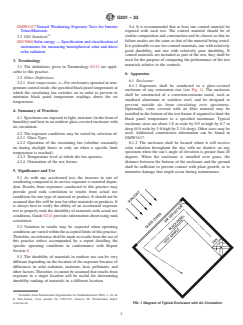
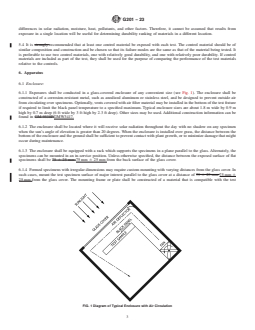
www.iso.ch. FIG. 1 Diagram of Typical Enclosure with Air Circulation
G201 − 23
6.1.3 The enclosure shall be equipped with a rack which 6.2.1.1 Clear Tempered Glass—The glass cover shall be
supports the specimens in a plane parallel to the glass. non-laminated, tempered, clear flat glass having a nominal
Alternately, the specimens can be mounted in an in-service thickness of 3 mm to 4 mm. The glass thickness used shall be
position. Unless otherwise specified, the distance between the included in the test report.
exposed surface of flat specimens shall be 75 mm 6 25 mm 6.2.1.2 Clear Laminated Glass—The glass cover shall be
from the back surface of the glass cover. laminated, clear flat glass having a thickness of 6.3 mm 6
6.1.4 Formed specimens with irregular dimensions may 1.0 mm and containing a PVB (polyvinyl butyral) inner layer
require custom mounting with varying distances from the glass with an approximate thickness of 0.76 mm (0.030 in.). This
cover. In such cases, mount the test specimen surface of major type of glass is typically used in automotive applications.
interest parallel to the glass cover at a distance of 75 mm 6 6.2.1.3 Any other glass type as agreed upon between inter-
25 mm from the glass cover. The mounting frame or plate shall ested parties.
be constructed of a material that is compatible with the test 6.2.2 Wash the exterior and interior surfaces of the glass
specimens. In order to minimize shadowing from the top and cover every month (or more frequently, if required) to remove
sides of the enclosure, keep specimens away from each edge by dust particles and other undesirable material.
a distance of at least twice the difference between specimens
6.3 Black Panel Thermometer:
and glass as shown in Fig. 2. The effective width of the
6.3.1 For enclosures with a temperature-controlled circulat-
specimen mounting area is L-4X and the effective height of the
ing fan, one of the following black panel thermometer types
mounting area is W-4X, where L is the width of the glass cover,
shall be installed in the enclosure:
W is the height of the glass cover, and X is the distance
6.3.1.1 Automotive Black Panel—The black panel thermom-
between the glass cover and the specimens. For example, if the
eter shall be constructed of 0.60 mm 6 0.06 mm (24 gauge)
specimens are 75 mm below the glass, then all specimens shall
sheet steel with dimensions of approximately 100 mm by
be at least 150 mm from the top, bottom, and sides.
125 mm (4 in. by 5 in.). The exposed surface of the black panel
6.1.5 The enclosure shall be capable of being oriented in a
shall be primed and painted with black high heat spray paint.
manner mutually agreed upon between interested parties. The
6.3.1.2 Specification G179 Black Panel—The black panel
test report shall contain the orientation used. Possible exposure
thermometer shall be constructed in accordance with the
orientations are:
requirements of Specification G179 with dimensions of ap-
6.1.5.1 Fixed tilt angle, typically in the range of 5 to 45
proximately 100 mm by 125 mm (4 in. by 5 in.).
degrees, with cabinet facing equator.
6.3.1.3 The type of black panel thermometer used shall be
6.1.5.2 Fixed tilt angle, typically 51 degrees, with tracking
described in the test report. Regardless of which type of black
in rotation (azimuth).
panel is used, the black panel is exposed parallel to the glass at
6.1.5.3 Tracking azimuth and elevation in order to maintain
the same respective depth from the surface of the glass as the
the exposure plane normal to the sun’s direct beam.
exposed surface of the test specimen. The panel must be
6.1.5.4 Any other angle that is mutually agreed on by all
mounted on 13 mm ( ⁄2 in.) thick plywood, painted black,
interested parties may be used. In some instances, exposures
whose dimensions are at least 110 mm by 135 mm (4 ⁄8 in. by
facing directly away from the equator or some other specific
5 ⁄8 in.) with a machined recess to allow space for the tempera-
direction may be desired.
ture sensor, thermocouple and their respective lead wires
6.2 Glass Cover: attached to the back of the black panel. The black panel must
6.2.1 The glass cover shall be flat glass of one of the be fastened to the plywood with small screws near the corners
following types: of the panel. The black panel assembly shall be mounted in the
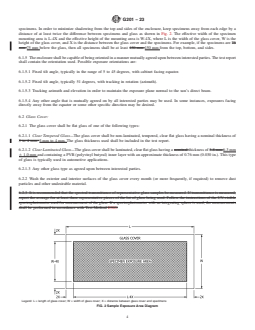
Legend: L = length of glass cover; W = width of glass cover; X = distance between glass cover and specimens
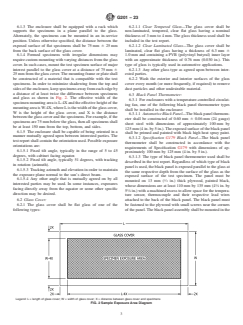
FIG. 2 Sample Exposure Area
...
This document is not an ASTM standard and is intended only to provide the user of an ASTM standard an indication of what changes have been made to the previous version. Because
it may not be technically possible to adequately depict all changes accurately, ASTM recommends that users consult prior editions as appropriate. In all cases only the current version
of the standard as published by ASTM is to be considered the official document.
Designation: G201 − 16 G201 − 23
Standard Practice for
Conducting Exposures in Outdoor Glass-Covered Exposure
Apparatus with Air Circulation
This standard is issued under the fixed designation G201; the number immediately following the designation indicates the year of
original adoption or, in the case of revision, the year of last revision. A number in parentheses indicates the year of last reapproval. A
superscript epsilon (´) indicates an editorial change since the last revision or reapproval.
1. Scope
1.1 This practice covers the basic principles and operating procedures for using outdoor glass-covered exposure apparatus with
air circulation. This practice is limited to the procedures for obtaining, measuring and controlling conditions of exposure. A number
of exposure procedures are listed in Appendix X1; however, this practice does not specify the exposure conditions best suited for
the material to be tested.
1.2 For direct weathering exposures, refer to Practice G7. For exposures behind glass without air circulation, refer to Practice G24.
1.3 Test specimens are exposed to solar radiation filtered through glass under partially controlled environmental test conditions.
Different glass types and operating parameters are described.
1.4 Specimen preparation and evaluation of the results are covered in ASTM methods or specifications for specific materials. More
specific information for determining the change in properties after exposure and reporting these results is described in Practices
D5870, D2244 and Test Method D523.
1.5 The values stated in SI units are to be regarded as standard.
1.6 This standard does not purport to address all of the safety concerns, if any, associated with its use. It is the responsibility
of the user of this standard to establish appropriate safety and healthsafety, health, and environmental practices and determine
the applicability of regulatory limitations prior to use.
1.7 This international standard was developed in accordance with internationally recognized principles on standardization
established in the Decision on Principles for the Development of International Standards, Guides and Recommendations issued
by the World Trade Organization Technical Barriers to Trade (TBT) Committee.
2. Referenced Documents
2.1 ASTM Standards:
D523 Test Method for Specular Gloss
D2244 Practice for Calculation of Color Tolerances and Color Differences from Instrumentally Measured Color Coordinates
D5870 Practice for Calculating Property Retention Index of Plastics
E903 Test Method for Solar Absorptance, Reflectance, and Transmittance of Materials Using Integrating Spheres
This practice is under the jurisdiction of ASTM Committee G03 on Weathering and Durability and is the direct responsibility of Subcommittee G03.02 on Natural and
Environmental Exposure Tests.
Current edition approved Feb. 1, 2016Dec. 1, 2023. Published February 2016January 2024. Originally approved in 2009. Last previous edition approved in 20092016 as
G201 – 09. DOI: 10.1520/G0201-16.16. DOI: 10.1520/G0201-23.
For referenced ASTM standards, visit the ASTM website, www.astm.org, or contact ASTM Customer Service at service@astm.org. For Annual Book of ASTM Standards
volume information, refer to the standard’s Document Summary page on the ASTM website.
Copyright © ASTM International, 100 Barr Harbor Drive, PO Box C700, West Conshohocken, PA 19428-2959. United States
G201 − 23
E1084 Test Method for Solar Transmittance (Terrestrial) of Sheet Materials Using Sunlight
G7 Practice for Natural Weathering of Materials
G24 Practice for Conducting Exposures to Daylight Filtered Through Glass
G113 Terminology Relating to Natural and Artificial Weathering Tests of Nonmetallic Materials
G141 Guide for Addressing Variability in Exposure Testing of Nonmetallic Materials
G173 Tables for Reference Solar Spectral Irradiances: Direct Normal and Hemispherical on 37° Tilted Surface
G177 Tables for Reference Solar Ultraviolet Spectral Distributions: Hemispherical on 37° Tilted Surface
G179 Specification for Metal Black Panel and White Panel Temperature Devices for Natural Weathering Tests
G183 Practice for Field Use of Pyranometers, Pyrheliometers and UV Radiometers
2.2 Other Document:Documents:
WMO No. 8 Guide to Meteorological Instruments and Methods of Observation, Fifth Edition
GM 9538PGMW3417 Natural Weathering Exposure Tests for Interior TrimsTrims/Materials
2.3 ISO Standard:
ISO 9060 Solar energy — Specification and classification of instruments for measuring hemispherical solar and direct solar
radiation
3. Terminology
3.1 The definitions given in Terminology G113 are applicable to this practice.
3.2 Other Definitions:
3.2.1 limit temperature, n—For enclosures operated in temperature control mode, the specified black panel temperature at which
the circulating fan switches on in order to prevent or minimize black panel temperature readings above the set temperature.
4. Summary of Practices
4.1 Specimens are exposed to light, moisture (in the form of humidity) and heat in an outdoor glass-covered enclosure with air
circulation.
4.2 The exposure conditions may be varied by selection of:
4.2.1 Glass Type:
4.2.2 Operation of the circulating fan (whether constantly on during daylight hours or only on when a specific limit temperature
is reached).
4.2.3 Temperature level at which the fan operates.
4.2.4 Orientation of the test fixture.
5. Significance and Use
5.1 As with any accelerated test, the increase in rate of weathering compared to in-service exposure is material dependent. Results
from exposures conducted to this practice may provide good rank correlation to results from actual use conditions for one type
of material or product. It should not be assumed that this will be true for other materials or products. It is always best to verify
the ability of an accelerated exposure test to properly rank the durability of materials with actual use conditions. Guide G141
provides information about using rank correlation.
5.2 Variation in results may be expected when operating conditions are varied within the accepted limits of this practice.
Therefore, no reference shall be made to results from the use of this practice unless accompanied by a report detailing the specific
operating conditions in conformance with Report Section 8.
5.3 The durability of materials in outdoor use can be very different depending on the location of the exposure because of
Available from World Meteorological Organization (WMO), 7bis, avenue de la Paix, Case postale 2300, CH-1211 Geneva 2, Switzerland, http://www.wmo.int.
Available from International Organization for Standardization (ISO), 1, ch. de la Voie-Creuse, Case postale 56, CH-1211, Geneva 20, Switzerland, http://www.iso.ch.
G201 − 23
differences in solar radiation, moisture, heat, pollutants, and other factors. Therefore, it cannot be assumed that results from
exposure in a single location will be useful for determining durability ranking of materials in a different location.
5.4 It is strongly recommended that at least one control material be exposed with each test. The control material should be of
similar composition and construction and be chosen so that its failure modes are the same as that of the material being tested. It
is preferable to use two control materials, one with relatively good durability, and one with relatively poor durability. If control
materials are included as part of the test, they shall be used for the purpose of comparing the performance of the test materials
relative to the controls.
6. Apparatus
6.1 Enclosure:
6.1.1 Exposures shall be conducted in a glass-covered enclosure of any convenient size (see Fig. 1). The enclosure shall be
constructed of a corrosion-resistant metal, such as anodized aluminum or stainless steel, and be designed to prevent outside air
from circulating over specimens. Optionally, vents covered with air filter material may be installed in the bottom of the test fixture
if required to limit the black panel temperature to a specified maximum. Typical enclosure sizes are about 1.8 m wide by 0.9 m
high by 0.7 m deep (6 ft wide by 3 ft high by 2.3 ft deep). Other sizes may be used. Additional construction information can be
found in GM 9538P.GMW3417.
6.1.2 The enclosure shall be located where it will receive solar radiation throughout the day with no shadow on any specimen
when the sun’s angle of elevation is greater than 20 degrees. When the enclosure is installed over grass, the distance between the
bottom of the enclosure and the ground shall be sufficient to prevent contact with plant growth, or to minimize damage that might
occur during maintenance.
6.1.3 The enclosure shall be equipped with a rack which supports the specimens in a plane parallel to the glass. Alternately, the
specimens can be mounted in an in-service position. Unless otherwise specified, the distance between the exposed surface of flat
specimens shall be 75 6 25 mm 75 mm 6 25 mm from the back surface of the glass cover.
6.1.4 Formed specimens with irregular dimensions may require custom mounting with varying distances from the glass cover. In
such cases, mount the test specimen surface of major interest parallel to the glass cover at a distance of 75 6 25 mm 75 mm 6
25 mm from the glass cover. The mounting frame or plate shall be constructed of a material that is compatible with the test
FIG. 1 Diagram of Typical Enclosure with Air Circulation
G201 − 23
specimens. In order to minimize shadowing from the top and sides of the enclosure, keep specimens away from each edge by a
distance of at least twice the difference between specimens and glass as shown in Fig. 2. The effective width of the specimen
mounting area is L-4X and the effective height of the mounting area is W-4X, where L is the width of the glass cover, W is the
height of the glass cover, and X is the distance between the glass cover and the specimens. For example, if the specimens are 75
mm 75 mm below the glass, then all specimens shall be at least 150 mm 150 mm from the top, bottom, and sides.
6.1.5 The enclosure shall be capable of being oriented in a manner mutually agreed upon between interested parties. The test report
shall contain the orientation used. Possible exposure orientations are:
6.1.5.1 Fixed tilt angle, typically in the range of 5 to 45 degrees, with cabinet facing equator.
6.1.5.2 Fixed tilt angle, typically 51 degrees, with tracking in rotation (azimuth).
6.1.5.3 Tracking azimuth and elevation in order to maintain the exposure plane normal to the sun’s direct beam.
6.1.5.4 Any other angle that is mutually agreed on by all interested parties may be used. In some instances, exposures facing
directly away from the equator or some other specific direction may be desired.
6.2 Glass Cover:
6.2.1 The glass cover shall be flat glass of one of the following types:
6.2.1.1 Clear Tempered Glass—The glass cover shall be non-laminated, tempered, clear flat glass having a nominal thickness of
3 to 4 mm. 3 mm to 4 mm. The glass thickness used shall be included in the test report.
6.2.1.2 Clear Laminated Glass—The glass cover shall be laminated, clear flat glass having a nominal thickness of 5.8 mm 6.3 mm
6 1.0 mm and containing a PVB (polyvinyl butyral) inner layer with an approximate thickness of 0.76 mm (0.030 in.). This type
of glass is typically used in automotive applications.
6.2.1.3 Any other glass type as agreed upon between interested parties.
6.2.2 Wash the exterior and interior surfaces of the glass cover every month (or more frequently, if required) to remove dust
particles and other undesirable material.
6.2.3 It is recommended that the spectral transmittance of representative glass samples be measured. If transmittance is measured,
report the average for at least three representative pieces of the lot of glass being used. Follow the instructions of the UV-visible
spectrophotometer used for measurement of the glass. If a spectrophotometer with an integrating sphere is used, the measurements
shall be performed in accordance with Test Method E903.
Legend: L = length of glass cover; W = width of glass cover; X = distance between glass cover and specimens
FIG. 2 Sample Exposure Area Diagram
G201 − 23
6.3 Black Panel Thermometer:
6.3.1 For enclosures with a temperature-controlled circulating fan, one of the following black panel thermometer types shall be
installed in the enclosure:
6.3.1.1 Automotive Black Panel—The black panel thermometer shall be constructed of 0.60 6 0.06 mm 0.60 mm 6 0.06 mm (24
gauge) sheet steel with dimensions of approximately 100 by 125 mm (4 by 5 in.). 100 mm by 125 mm (4 in. by 5 in.). The exposed
surface of the black panel shall be primed and painted with black high heat spray paint.
6.3.1.2 Specification G179 Black Panel—The black panel thermometer shall be constructed in accordance with the requirements
of Specification G179 with dimensions of approximately 100 by 125 mm (4 by 5 in.).100 mm by 125 mm (4 in. by 5 in.).
6.3.1.3 The type of black panel thermometer used shall be described in the test report. Regardless of which type of black panel
is used, the black panel is exposed parallel to the glass at the same respective depth from the surface of the glass as the exposed
surface of the test specimen. The panel must be mounted on 13 mm ( ⁄2 in.) thick plywood, painted black, whose dimensions are
3 3
at least 110 by 135 mm 110 mm by 135 mm (4 ⁄8 in. by 5 ⁄8 in.) in.) with a machined recess to allow space for the temperature
sensor, thermocouple and their respective lead wires attached to the back of the black panel. The black panel must be fastened to
the plywood with small screws near the corners of the panel. The black panel assembly shall be mounted in the plane of the test
samples near the top edge of the sample mounting area no closer than 200 mm from the left or right edge of the glass cover as
shown in Fig. 3.
6.4 Circulating Fan:
6.4.1 The test enclosure shall be equipped with a circulating fan which directs air between the top surface of specimens and the
glass cover. This fan can be set to operate continuously during daylight hours, or based on the temperature reading from a black
panel thermometer. The circulating fan shall be of sufficient air flow to maintain the desired black panel temperature. Unless
otherwise specified, when the circulating fan is switched off and on based on the temperature of a black panel thermometer, set
the controller to turn on at the desired limit temperature and off at a temperature that is 3°C3 °C less than the limit temperature.
6.5 Over Temperature Protection:
6.5.1 Unless otherwise specified, test en
...