

ASTM G90-23
(Practice)Standard Practice for Performing Accelerated Outdoor Weathering of Materials Using Concentrated Natural Sunlight
General Information
- Abstract
SIGNIFICANCE AND USE
4.1 Results obtained from this practice can be used to compare the relative durability of materials subjected to the specific test cycle used. No accelerated test can be specified as a perfect simulation of natural or field exposures. Results obtained from this practice can be considered as representative of natural weathering only when a sufficient magnitude of mathematical correlation exists between exposures.
4.2 The acceleration factor relating the rate of degradation in this accelerated exposure to the rate of degradation in a natural weathering exposure varies with the type and formulation of the material. Each material and formulation may respond differently to the increased level of irradiance and differences in temperature and humidity. Thus an acceleration factor determined for one material may not be applicable to other materials. For this reason, the use of a single acceleration factor is not recommended. Also, a different acceleration factor may be obtained by using different mirror types and configurations. Because of variability in test results for both accelerated and natural weathering exposures, results from a sufficient number of tests must be obtained to determine an acceleration factor for a material. Further, the acceleration factor is applicable to only one exposure location because results from natural weathering will vary due to seasonal or annual differences in climatic factors.
4.3 The relative durability of materials determined by this practice can be used to determine the relative durability of the materials exposed under natural weathering conditions provided the materials have similar acceleration factors. However, even if results from a specific accelerated test condition are found to be useful for comparing the durability of materials exposed in a particular exterior location, it cannot be assumed that they will be useful for determining the relative durability for a different location. The relative durability of materials in n...
SCOPE
1.1 Linear Fresnel reflector concentrators using the sun as source are utilized in the accelerated outdoor exposure testing of materials.
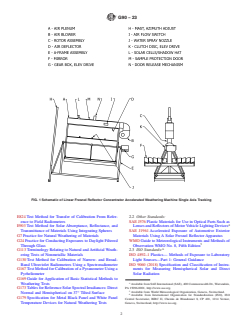
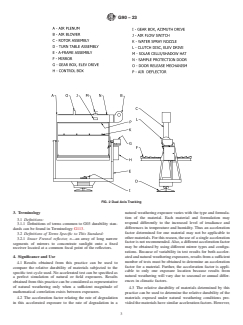
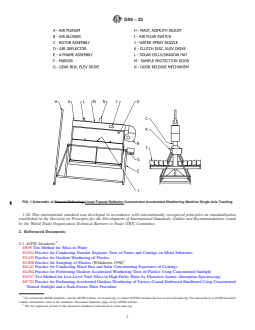
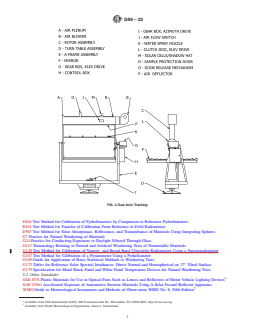
1.2 This practice covers a procedure for performing accelerated outdoor exposure testing of materials using a linear Fresnel reflector, accelerated outdoor weathering, test machine. The apparatus (see Fig. 1 and Fig. 2) and guidelines are described herein to minimize the variables encountered during outdoor accelerated exposure testing.
1.3 This practice does not specify the exposure conditions best suited for the materials to be tested but is limited to the method of obtaining, measuring, and controlling the procedures and certain conditions of the exposure. Sample preparation, test conditions, and evaluation of results are covered in existing methods or specifications for specific materials.
1.4 The linear Fresnel reflector accelerated outdoor exposure test apparatus described may be suitable for the determination of the relative durability of materials when these materials are exposed to concentrated sunlight, heat, and moisture.
1.5 This practice establishes uniform sample mounting and in-test maintenance procedures. Also included in the practice are standard provisions for maintenance of the machine and linear Fresnel reflector mirrors to ensure cleanliness and durability.
1.6 This practice shall apply to specimens whose size meets the dimensions of the target board as described in 8.2.
1.7 For test machines currently in use, this practice is not recommended for specimens exceeding 13 mm (1/2 in.) in thickness because of specimen cooling.
1.8 Values stated in SI units are to be regarded as the standard. The inch-pound units in parentheses are provided for information only.
1.9 This standard does not purport to address all of the safety concerns, if any, associated with its use. It is the responsibility of the user of this standard to establish appropriate...
- Status
- Published
- Publication Date
- 30-Jun-2023
- Technical Committee
- G03 - Weathering and Durability
- Drafting Committee
- G03.02 - Natural and Environmental Exposure Tests
Buy Documents
ASTM G90-23 - Standard Practice for Performing Accelerated Outdoor Weathering of Materials Using Concentrated Natural Sunlight
REDLINE ASTM G90-23 - Standard Practice for Performing Accelerated Outdoor Weathering of Materials Using Concentrated Natural Sunlight
Overview
ASTM G90-23 is the internationally recognized standard practice for performing accelerated outdoor weathering of materials using concentrated natural sunlight. Developed by ASTM International, this standard outlines procedures utilizing linear Fresnel reflector concentrators to simulate and accelerate the aging and deterioration of materials caused by environmental factors such as sunlight, temperature, and moisture. The practice is widely adopted in industries that require rapid assessment of material durability, enabling manufacturers, researchers, and quality assurance professionals to predict long-term material performance more efficiently.
The main objective of ASTM G90-23 is to offer a consistent and reliable method for accelerated outdoor exposure testing, facilitating comparative studies and quality assurance. While it does not provide a perfect simulation of natural weathering, its value lies in the ability to generate comparative data under controlled, yet intensified, exposure conditions.
Key Topics
Accelerated Weathering Using Fresnel Reflectors
- The method utilizes linear Fresnel reflector concentrators to intensify natural sunlight onto test specimens.
- Three typical spray cycles simulate varying environmental moisture conditions during testing.
Comparative Durability Assessment
- The standard is intended for relative durability comparisons between materials subjected to the same test cycle.
- Acceleration factors determined are specific to the material type, formulation, and climate location, and should not be generalized.
Test Procedures and Specimen Preparation
- Provides uniform guidance for sample mounting, use of cooling systems, and apparatus maintenance to minimize variables.
- Addresses water spray orientation, specimen dimensions (not exceeding 13 mm in thickness), and appropriate reporting protocols.
Limitations and Safety
- Results are only representative when enough correlation exists with natural weathering data.
- Safety measures include proper personal protective equipment to guard against concentrated sunlight and machine hazards.
Applications
ASTM G90-23 is essential in industries where durability and long-term performance of materials are critical. Notable applications include:
- Automotive Coatings
- Used to accelerate the evaluation of paint, plastics, and exterior materials for UV resistance and surface durability.
- Construction Materials
- Assists in predicting the weathering behavior of roofing, siding, and outdoor plastics.
- Industrial Coatings and Finishes
- Supports comparative testing of protective coatings used on metals and other substrates.
- Polymers and Plastics
- Assesses the longevity and color stability of plastics used in outdoor environments.
- Quality Control and R&D
- Facilitates fast screening of candidate materials and additive formulations before field testing.
This standard is referenced in several application-specific testing practices, such as for automotive parts (SAE J1961), prefinished hardboard (ASTM D5722), and plastics (ASTM D4364).
Related Standards
ASTM G90-23 works alongside various other ASTM and international standards to ensure comprehensive weathering evaluation:
- ASTM D1014 - Exterior exposure tests on paints and coatings.
- ASTM D1435 - Outdoor weathering of plastics.
- ASTM D4141 - Black box and solar concentrating exposures for coatings.
- ASTM D4364 - Outdoor accelerated weathering of plastics using concentrated sunlight.
- ASTM D5722 - Accelerated outdoor weathering of factory-coated hardboard.
- SAE J1961 - Automotive exterior materials testing.
- ISO 4892-1 - Laboratory light source exposure of plastics.
- WMO No. 8 / ISO 9060 - Meteorological instruments and solar radiation measurement.
- ASTM G113, G7, G24, G173, G179 - Supporting standards covering terminology, natural weathering practices, and environmental test guidance.
Practical Value
By following ASTM G90-23, users benefit from:
- Faster material testing cycles vs. natural weathering
- More consistent and reproducible results in accelerated testing
- Enhanced ability to identify the most durable materials for specific outdoor applications
- Improved data for making informed decisions in product development and quality assurance
Using this standard supports innovation and quality in outdoor-durable materials, helping organizations reduce time-to-market and improve product life cycles.
Relations
- Effective Date
- 29-Sep-2023
- Effective Date
- 01-Jun-2020
- Effective Date
- 01-Jul-2019
- Effective Date
- 15-Apr-2018
- Effective Date
- 01-Apr-2018
- Effective Date
- 01-Dec-2014
- Effective Date
- 01-Mar-2014
- Effective Date
- 01-Jun-2012
- Effective Date
- 01-Jul-2011
- Refers
ASTM E824-10 - Standard Test Method for Transfer of Calibration From Reference to Field Radiometers - Effective Date
- 01-Dec-2010
- Refers
ASTM G167-05(2010) - Standard Test Method for Calibration of a Pyranometer Using a Pyrheliometer - Effective Date
- 01-Dec-2010
- Effective Date
- 01-Dec-2010
- Effective Date
- 01-Oct-2009
- Effective Date
- 15-Jun-2009
- Effective Date
- 01-Feb-2009
Buy Documents
ASTM G90-23 - Standard Practice for Performing Accelerated Outdoor Weathering of Materials Using Concentrated Natural Sunlight
REDLINE ASTM G90-23 - Standard Practice for Performing Accelerated Outdoor Weathering of Materials Using Concentrated Natural Sunlight
Get Certified
Connect with accredited certification bodies for this standard

IMP NDT d.o.o.
Non-destructive testing services. Radiography, ultrasonic, magnetic particle, penetrant, visual inspection.
Inštitut za kovinske materiale in tehnologije
Institute of Metals and Technology. Materials testing, metallurgical analysis, NDT.
Q Techna d.o.o.
NDT and quality assurance specialist. 30+ years experience. NDT personnel certification per ISO 9712, nuclear and thermal power plant inspections, QA/
Sponsored listings
Frequently Asked Questions
ASTM G90-23 is a standard published by ASTM International. Its full title is "Standard Practice for Performing Accelerated Outdoor Weathering of Materials Using Concentrated Natural Sunlight". This standard covers: SIGNIFICANCE AND USE 4.1 Results obtained from this practice can be used to compare the relative durability of materials subjected to the specific test cycle used. No accelerated test can be specified as a perfect simulation of natural or field exposures. Results obtained from this practice can be considered as representative of natural weathering only when a sufficient magnitude of mathematical correlation exists between exposures. 4.2 The acceleration factor relating the rate of degradation in this accelerated exposure to the rate of degradation in a natural weathering exposure varies with the type and formulation of the material. Each material and formulation may respond differently to the increased level of irradiance and differences in temperature and humidity. Thus an acceleration factor determined for one material may not be applicable to other materials. For this reason, the use of a single acceleration factor is not recommended. Also, a different acceleration factor may be obtained by using different mirror types and configurations. Because of variability in test results for both accelerated and natural weathering exposures, results from a sufficient number of tests must be obtained to determine an acceleration factor for a material. Further, the acceleration factor is applicable to only one exposure location because results from natural weathering will vary due to seasonal or annual differences in climatic factors. 4.3 The relative durability of materials determined by this practice can be used to determine the relative durability of the materials exposed under natural weathering conditions provided the materials have similar acceleration factors. However, even if results from a specific accelerated test condition are found to be useful for comparing the durability of materials exposed in a particular exterior location, it cannot be assumed that they will be useful for determining the relative durability for a different location. The relative durability of materials in n... SCOPE 1.1 Linear Fresnel reflector concentrators using the sun as source are utilized in the accelerated outdoor exposure testing of materials. 1.2 This practice covers a procedure for performing accelerated outdoor exposure testing of materials using a linear Fresnel reflector, accelerated outdoor weathering, test machine. The apparatus (see Fig. 1 and Fig. 2) and guidelines are described herein to minimize the variables encountered during outdoor accelerated exposure testing. 1.3 This practice does not specify the exposure conditions best suited for the materials to be tested but is limited to the method of obtaining, measuring, and controlling the procedures and certain conditions of the exposure. Sample preparation, test conditions, and evaluation of results are covered in existing methods or specifications for specific materials. 1.4 The linear Fresnel reflector accelerated outdoor exposure test apparatus described may be suitable for the determination of the relative durability of materials when these materials are exposed to concentrated sunlight, heat, and moisture. 1.5 This practice establishes uniform sample mounting and in-test maintenance procedures. Also included in the practice are standard provisions for maintenance of the machine and linear Fresnel reflector mirrors to ensure cleanliness and durability. 1.6 This practice shall apply to specimens whose size meets the dimensions of the target board as described in 8.2. 1.7 For test machines currently in use, this practice is not recommended for specimens exceeding 13 mm (1/2 in.) in thickness because of specimen cooling. 1.8 Values stated in SI units are to be regarded as the standard. The inch-pound units in parentheses are provided for information only. 1.9 This standard does not purport to address all of the safety concerns, if any, associated with its use. It is the responsibility of the user of this standard to establish appropriate...
SIGNIFICANCE AND USE 4.1 Results obtained from this practice can be used to compare the relative durability of materials subjected to the specific test cycle used. No accelerated test can be specified as a perfect simulation of natural or field exposures. Results obtained from this practice can be considered as representative of natural weathering only when a sufficient magnitude of mathematical correlation exists between exposures. 4.2 The acceleration factor relating the rate of degradation in this accelerated exposure to the rate of degradation in a natural weathering exposure varies with the type and formulation of the material. Each material and formulation may respond differently to the increased level of irradiance and differences in temperature and humidity. Thus an acceleration factor determined for one material may not be applicable to other materials. For this reason, the use of a single acceleration factor is not recommended. Also, a different acceleration factor may be obtained by using different mirror types and configurations. Because of variability in test results for both accelerated and natural weathering exposures, results from a sufficient number of tests must be obtained to determine an acceleration factor for a material. Further, the acceleration factor is applicable to only one exposure location because results from natural weathering will vary due to seasonal or annual differences in climatic factors. 4.3 The relative durability of materials determined by this practice can be used to determine the relative durability of the materials exposed under natural weathering conditions provided the materials have similar acceleration factors. However, even if results from a specific accelerated test condition are found to be useful for comparing the durability of materials exposed in a particular exterior location, it cannot be assumed that they will be useful for determining the relative durability for a different location. The relative durability of materials in n... SCOPE 1.1 Linear Fresnel reflector concentrators using the sun as source are utilized in the accelerated outdoor exposure testing of materials. 1.2 This practice covers a procedure for performing accelerated outdoor exposure testing of materials using a linear Fresnel reflector, accelerated outdoor weathering, test machine. The apparatus (see Fig. 1 and Fig. 2) and guidelines are described herein to minimize the variables encountered during outdoor accelerated exposure testing. 1.3 This practice does not specify the exposure conditions best suited for the materials to be tested but is limited to the method of obtaining, measuring, and controlling the procedures and certain conditions of the exposure. Sample preparation, test conditions, and evaluation of results are covered in existing methods or specifications for specific materials. 1.4 The linear Fresnel reflector accelerated outdoor exposure test apparatus described may be suitable for the determination of the relative durability of materials when these materials are exposed to concentrated sunlight, heat, and moisture. 1.5 This practice establishes uniform sample mounting and in-test maintenance procedures. Also included in the practice are standard provisions for maintenance of the machine and linear Fresnel reflector mirrors to ensure cleanliness and durability. 1.6 This practice shall apply to specimens whose size meets the dimensions of the target board as described in 8.2. 1.7 For test machines currently in use, this practice is not recommended for specimens exceeding 13 mm (1/2 in.) in thickness because of specimen cooling. 1.8 Values stated in SI units are to be regarded as the standard. The inch-pound units in parentheses are provided for information only. 1.9 This standard does not purport to address all of the safety concerns, if any, associated with its use. It is the responsibility of the user of this standard to establish appropriate...
ASTM G90-23 is classified under the following ICS (International Classification for Standards) categories: 19.040 - Environmental testing. The ICS classification helps identify the subject area and facilitates finding related standards.
ASTM G90-23 has the following relationships with other standards: It is inter standard links to ASTM D1898-68(1989), ASTM G130-12(2020), ASTM G179-04(2019), ASTM E824-10(2018)e1, ASTM D1014-18, ASTM D5722-14, ASTM G113-14, ASTM G130-12, ASTM G179-04(2011), ASTM E824-10, ASTM G167-05(2010), ASTM E816-05(2010), ASTM D4517-04(2009), ASTM G113-09, ASTM D1014-09. Understanding these relationships helps ensure you are using the most current and applicable version of the standard.
ASTM G90-23 is available in PDF format for immediate download after purchase. The document can be added to your cart and obtained through the secure checkout process. Digital delivery ensures instant access to the complete standard document.
Standards Content (Sample)
This international standard was developed in accordance with internationally recognized principles on standardization established in the Decision on Principles for the
Development of International Standards, Guides and Recommendations issued by the World Trade Organization Technical Barriers to Trade (TBT) Committee.
Designation: G90 − 23
Standard Practice for
Performing Accelerated Outdoor Weathering of Materials
Using Concentrated Natural Sunlight
This standard is issued under the fixed designation G90; the number immediately following the designation indicates the year of original
adoption or, in the case of revision, the year of last revision. A number in parentheses indicates the year of last reapproval. A superscript
epsilon (´) indicates an editorial change since the last revision or reapproval.
1. Scope* 1.8 Values stated in SI units are to be regarded as the
standard. The inch-pound units in parentheses are provided for
1.1 Linear Fresnel reflector concentrators using the sun as
information only.
source are utilized in the accelerated outdoor exposure testing
1.9 This standard does not purport to address all of the
of materials.
safety concerns, if any, associated with its use. It is the
1.2 This practice covers a procedure for performing accel-
responsibility of the user of this standard to establish appro-
erated outdoor exposure testing of materials using a linear
priate safety, health, and environmental practices and deter-
Fresnel reflector, accelerated outdoor weathering, test machine.
mine the applicability of regulatory limitations prior to use.
The apparatus (see Fig. 1 and Fig. 2) and guidelines are
1.10 This international standard was developed in accor-
described herein to minimize the variables encountered during
dance with internationally recognized principles on standard-
outdoor accelerated exposure testing.
ization established in the Decision on Principles for the
Development of International Standards, Guides and Recom-
1.3 This practice does not specify the exposure conditions
mendations issued by the World Trade Organization Technical
best suited for the materials to be tested but is limited to the
Barriers to Trade (TBT) Committee.
method of obtaining, measuring, and controlling the proce-
dures and certain conditions of the exposure. Sample
2. Referenced Documents
preparation, test conditions, and evaluation of results are
covered in existing methods or specifications for specific
2.1 ASTM Standards:
materials.
D859 Test Method for Silica in Water
D1014 Practice for Conducting Exterior Exposure Tests of
1.4 The linear Fresnel reflector accelerated outdoor expo-
Paints and Coatings on Metal Substrates
sure test apparatus described may be suitable for the determi-
D1435 Practice for Outdoor Weathering of Plastics
nation of the relative durability of materials when these
D1898 Practice for Sampling of Plastics (Withdrawn 1998)
materials are exposed to concentrated sunlight, heat, and
D4141 Practice for Conducting Black Box and Solar Con-
moisture.
centrating Exposures of Coatings
1.5 This practice establishes uniform sample mounting and
D4364 Practice for Performing Outdoor Accelerated Weath-
in-test maintenance procedures. Also included in the practice ering Tests of Plastics Using Concentrated Sunlight
are standard provisions for maintenance of the machine and
D4517 Test Method for Low-Level Total Silica in High-
linear Fresnel reflector mirrors to ensure cleanliness and Purity Water by Flameless Atomic Absorption Spectros-
durability.
copy
D5722 Practice for Performing Accelerated Outdoor Weath-
1.6 This practice shall apply to specimens whose size meets
ering of Factory-Coated Embossed Hardboard Using Con-
the dimensions of the target board as described in 8.2.
centrated Natural Sunlight and a Soak-Freeze-Thaw Pro-
1.7 For test machines currently in use, this practice is not
cedure
recommended for specimens exceeding 13 mm ( ⁄2 in.) in E816 Test Method for Calibration of Pyrheliometers by
thickness because of specimen cooling.
Comparison to Reference Pyrheliometers
1 2
This practice is under the jurisdiction of ASTM Committee G03 on Weathering For referenced ASTM standards, visit the ASTM website, www.astm.org, or
and Durabilityand is the direct responsibility of Subcommittee G03.02 on Natural contact ASTM Customer Service at service@astm.org. For Annual Book of ASTM
and Environmental Exposure Tests. Standards volume information, refer to the standard’s Document Summary page on
Current edition approved July 1, 2023. Published August 2023. Originally the ASTM website.
approved in 1985. Last previous edition approved in 2017 as G90 – 17. DOI: The last approved version of this historical standard is referenced on
10.1520/G0090-23. www.astm.org.
*A Summary of Changes section appears at the end of this standard
Copyright © ASTM International, 100 Barr Harbor Drive, PO Box C700, West Conshohocken, PA 19428-2959. United States
G90 − 23
FIG. 1 Schematic of Linear Fresnel Reflector Concentrator Accelerated Weathering Machine Single Axis Tracking
E824 Test Method for Transfer of Calibration From Refer- 2.2 Other Standards:
ence to Field Radiometers SAE J576 Plastic Materials for Use in Optical Parts Such as
E903 Test Method for Solar Absorptance, Reflectance, and Lenses and Reflectors of Motor Vehicle Lighting Devices
Transmittance of Materials Using Integrating Spheres SAE J1961 Accelerated Exposure of Automotive Exterior
G7 Practice for Natural Weathering of Materials Materials Using A Solar Fresnel Reflector Apparatus
G24 Practice for Conducting Exposures to Daylight Filtered WMO Guide to Meteorological Instruments and Methods of
Through Glass Observation WMO No. 8, Fifth Edition
G113 Terminology Relating to Natural and Artificial Weath- 2.3 ISO Standards:
ering Tests of Nonmetallic Materials ISO 4892–1 Plastics— Methods of Exposure to Laboratory
G130 Test Method for Calibration of Narrow- and Broad- Light Sources—Part 1: General Guidance
Band Ultraviolet Radiometers Using a Spectroradiometer ISO 9060 (2018) Specification and Classification of Instru-
G167 Test Method for Calibration of a Pyranometer Using a ments for Measuring Hemispherical Solar and Direct
Pyrheliometer Solar Radiation
G169 Guide for Application of Basic Statistical Methods to
Weathering Tests
Available from SAE International (SAE), 400 Commonwealth Dr., Warrendale,
PA 15096-0001, http://www.sae.org.
G173 Tables for Reference Solar Spectral Irradiances: Direct
Available from World Meteorological Organization, Geneva, Switzerland.
Normal and Hemispherical on 37° Tilted Surface
Available from International Organization for Standardization (ISO), ISO
G179 Specification for Metal Black Panel and White Panel
Central Secretariat, BIBC II, Chemin de Blandonnet 8, CP 401, 1214 Vernier,
Temperature Devices for Natural Weathering Tests Geneva, Switzerland, http://www.iso.org.
G90 − 23
FIG. 2 Dual Axis Tracking
3. Terminology natural weathering exposure varies with the type and formula-
tion of the material. Each material and formulation may
3.1 Definitions:
respond differently to the increased level of irradiance and
3.1.1 Definitions of terms common to G03 durability stan-
differences in temperature and humidity. Thus an acceleration
dards can be found in Terminology G113.
factor determined for one material may not be applicable to
3.2 Definitions of Terms Specific to This Standard:
other materials. For this reason, the use of a single acceleration
3.2.1 linear Fresnel reflector, n—an array of long narrow
factor is not recommended. Also, a different acceleration factor
segments of mirrors to concentrate sunlight onto a fixed
may be obtained by using different mirror types and configu-
receiver located at a common focal point of the reflectors.
rations. Because of variability in test results for both acceler-
4. Significance and Use
ated and natural weathering exposures, results from a sufficient
number of tests must be obtained to determine an acceleration
4.1 Results obtained from this practice can be used to
factor for a material. Further, the acceleration factor is appli-
compare the relative durability of materials subjected to the
cable to only one exposure location because results from
specific test cycle used. No accelerated test can be specified as
natural weathering will vary due to seasonal or annual differ-
a perfect simulation of natural or field exposures. Results
ences in climatic factors.
obtained from this practice can be considered as representative
of natural weathering only when a sufficient magnitude of
4.3 The relative durability of materials determined by this
mathematical correlation exists between exposures.
practice can be used to determine the relative durability of the
4.2 The acceleration factor relating the rate of degradation materials exposed under natural weathering conditions pro-
in this accelerated exposure to the rate of degradation in a vided the materials have similar acceleration factors. However,
G90 − 23
even if results from a specific accelerated test condition are unless performance comparisons are made relative to a control
found to be useful for comparing the durability of materials material exposed simultaneously. It is strongly recommended
exposed in a particular exterior location, it cannot be assumed that at least one control test specimen be exposed with each
that they will be useful for determining the relative durability test. It is preferable to use two control test specimens, one with
for a different location. The relative durability of materials in relatively good durability and one with relatively poor dura-
natural weathering exposure can be very different depending bility. Alternatively, the variability in the test can be defined so
on the location of the exposure because of differences in that statistically significant pass/fail judgements can be made.
important climatic factors, such as sunlight, time of wetness,
4.7 The use of at least three replicates of each control test
temperature, pollutants, etc.
specimen and each material being evaluated is recommended.
Consult Guide G169 for performing statistical analysis.
4.4 Variations in results may be expected when operating
conditions vary within the limits of this practice.
5. Apparatus
4.5 This practice is best used to compare the relative
5.1 Test Machines—Linear Fresnel reflector test machines
performance of materials tested at the same time in the same
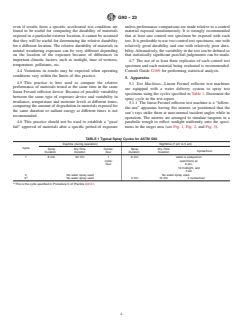
are equipped with a water delivery system to spray test
linear Fresnel reflector device. Because of possible variability
specimens using the cycles specified in Table 1. Document the
between the same type of exposure device and variability in
spray cycle in the test report.
irradiance, temperature and moisture levels at different times,
5.1.1 The linear Fresnel reflector test machine is a “follow-
comparing the amount of degradation in materials exposed for
the-sun” apparatus having flat mirrors so positioned that the
the same duration or radiant energy at different times is not
sun’s rays strike them at near-normal incident angles while in
recommended.
operation. The mirrors are arranged to simulate tangents to a
4.6 This practice should not be used to establish a “pass/ parabolic trough to reflect sunlight uniformly onto the speci-
fail” approval of materials after a specific period of exposure mens in the target area (see Fig. 1, Fig. 2, and Fig. 3).
TABLE 1 Typical Spray Cycles for ASTM G90
Daytime (during operation) Nighttime (7 pm to 5 am)
Cycle
Spray Dry-Time Cycles/ Spray Dry-Time
Cycles/hour
Duration Duration hour Duration Duration
1 8 min 52 min 1 8 min water is sprayed on
cycle/ specimens at:
hour 9 pm,
12 midnight, and
3 am
2 No water spray used No water spray used
A
3 No water spray used 3 min 12 min 4 cycles/hour
A
This is the cycle specified in Procedure C of Practice D4141.
G90 − 23
FIG. 3 Schematic of Optical System for a Linear Fresnel Reflector Concentrator Accelerated Weathering Machine
5.2 Mirrors—Typical spectral reflectance values for mirrors 5.3 Photoreceptor Cells—Two photoreceptor cells, such as
commonly in use as a function of wavelength are shown in Fig. silicon solar cells, are installed near the top of the air tunnel on
4. If other mirror types and configurations are used, they shall the side facing the sun. A “T” shadow maker is mounted above
meet the requirements of 6.2. the cells to illuminate equally one-half of each cell when the
FIG. 4 Typical Specular Reflectance of Mirror Material
G90 − 23
test machine is in proper focus. As one cell receives more 5.6 Nozzles—The test machine used in Cycles 1 and 3 of
radiation than the other, the balance is disturbed and a signal is Table 1 is provided with a nozzle assembly for spraying water
furnished through an amplifier to a reversible motor which
onto the specimens during exposure. Fan spray nozzles which
adjusts the machine to maintain focus. provide a uniform fine mist over the specimen area are
recommended.
5.4 Tracking System—The test machine shall be equipped
with a system to keep the target area in focus throughout the
5.7 Spray Orientation—The apparatus shall be positioned so
day. Several options are possible.
that specimens are sprayed at night either with specimens
5.4.1 Single-axis tracking with manual altitude adjustment
facing up or down.
(Fig. 1). The test machine’s axis is oriented in the north/south
5.7.1 Specimens Face Down—The apparatus is oriented
direction, with the north pole being altitude-adjustable to
with the mirrors below the target specimen area such that
account for seasonable variations in solar altitude at zenith.
nozzles spray high purity water in an upward direction onto the
5.4.2 Dual axis tracking (Fig. 2). The test machine is
specimens.
equipped with two sets of photoreceptor cells, one to control
5.7.2 Specimens Face Up—The apparatus is oriented with
the azimuth rotation of the machine, the other to control the tilt
the mirrors above the target specimen area such that nozzles
elevation. The axis of the target area remains parallel to the
spray high purity water in a downward direction onto the
ground. The machine rotates about horizontal and vertical axes
specimens.
to keep the target area in focus.
NOTE 2—No data has been presented indicating that exposures per-
5.5 Temperature—The test machine is equipped with a
formed using different spray orientations provide equivalent results, and
blower to cool the test specimens. The air is directed over the
as such, may provide different test results.
specimens by an adjustable deflector along one side of the
5.8 Ultraviolet Radiometers—Instrumental means of mea-
target area. For unbacked mounting, air is also directed under
suring 295 to 385 nm ultraviolet radiant exposure shall consist
the specimens. This limits the increase in surface temperatures
of two wavelength-band specific global irradiance radiometers,
of most specimens to 10°C above the maximum surface
each connected to an integrating device to indicate the energy
temperature that would be reached when identically mounted
received in the specified wavelength band over a given period.
specimens are exposed to direct sunlight at normal incidence at
The spectral response of the ultraviolet radiometers shall be
the same time and location without concentration.
known and shall be as flat as possible throughout the 295 to
5.5.1 Temperature Control—Unless otherwise specified, if
385 nm spectral region utilized. Calibrations shall be per-
measurement of uninsulated black- or white-panel temperature
formed using sunlight as the source. Each ultraviolet radiom-
is required, the panels shall be constructed, calibrated, and
eter shall be calibrated in accordance with Method E824 or
maintained according to Specification G179 except that the
G130 no less often than annually.
size shall be a minimum width of 50 mm by 125 mm. Unless
otherwise specified, if measurement of insulated black- or
5.9 A black-painted permanent shading disk is positioned
white-panel temperature is required, the panels shall be con-
over one radiometer to provide a diffuse-only measurement
structed and maintained according to ISO 4892-1.
(excluding 6 6 0.5 degree field of view). The 6 6 0.5 degree
field of view measurement is calculated as:
NOTE 1—If an insulated black-panel temperature is used, the tempera-
ture indicated will be higher than that indicated by an uninsulated
I 5 I 2 I (1)
6 deg field of view UV global UV diffuse only UV
black-panel thermometer under typical exposure conditions.
where:
5.5.2 Typically, temperature of specimens is not controlled
I = the UV irradiance in a 6 6 0.5 degree
on solar concentrating test devices. Typical specimen tempera- 6 deg field of view UV
field of view around the sun,
tures obtained are likely to be greater than the temperature that
I = the UV irradiance measured in a 180
global UV
would be experienced if the specimen were exposed to direct
degree field of view, and
solar radiation at normal incidence (without concentration) at
I = the diffuse-only UV irradiance.
diffuse only UV
the same time. Temperature differences between exposures
with and without concentration depend on the specimen
The shading disk and radiometers shall be mounted on a
absorptance and total coefficient of heat transfer, thickness,
tracking device to follow the sun. The tracking accuracy shall
backing, and composition. During daytime exposures in solar
be sufficient such that at no time during operation does the
concentrating test devices, variation in cloud cover may cause
shaded receiver receive direct radiation.
specimen temperatures to vary.
5.10 Construction of Shading Disk Apparatus:
5.5.3 If control of specimen temperature is required, the
5.10.1 To calculate the Field of View (FOV) of an existing
temperature of an uninsulated or insulated black or white
shading disk, the equation is as follows:
panel, or a specimen temperature may be monitored and used
as an input to control specimen temperature by adjusting the FOV 5 2*arctan D ⁄ 2 * h (2)
~ ~ !!
speed of air blowing across the specimens. Other methods of
where:
temperature control may be used if agreed upon between
D = the diameter of the shading disk, and
concerned parties.
h = the distance between the diffuser or dome on the
5.5.4 Temperatures during night time are typically not
radiometer and the shading disk.
controlled.
G90 − 23
For ultraviolet radiometers which meet the requirements of the distance h between the shading disk and diffuser or dome
5.8, the shading disk shall be constructed to meet the require- is 500 mm, the diameter of the shading disk is:
ments of 5.9 and as shown in Fig. 6. An equation for
D 5 2*500*tan 6 ° ⁄ 2 5 52.4 mm (4)
~ !
calculating the diameter of the shading disk is as follows:
This calculated diameter is acceptable because it is greater
D 5 2*h*tan FOV ⁄ 2 (3)
~ !
than the minimum diameter of 30 mm.
The distance h between the diffuser or dome of the radiom-
5.10.2 For ultraviolet radiometers with a height of 175 mm
eter and the shading disk shall be 400 mm to 600 mm (16 in.
(6.875 in.) and a diffuser diameter of 37 mm (1.5 in.), the
to 24 in.). The shading disk diameter shall be at
...
This document is not an ASTM standard and is intended only to provide the user of an ASTM standard an indication of what changes have been made to the previous version. Because
it may not be technically possible to adequately depict all changes accurately, ASTM recommends that users consult prior editions as appropriate. In all cases only the current version
of the standard as published by ASTM is to be considered the official document.
Designation: G90 − 17 G90 − 23
Standard Practice for
Performing Accelerated Outdoor Weathering of Materials
Using Concentrated Natural Sunlight
This standard is issued under the fixed designation G90; the number immediately following the designation indicates the year of original
adoption or, in the case of revision, the year of last revision. A number in parentheses indicates the year of last reapproval. A superscript
epsilon (´) indicates an editorial change since the last revision or reapproval.
1. Scope Scope*
1.1 Fresnel-reflecting Linear Fresnel reflector concentrators using the sun as source are utilized in the accelerated outdoor
exposure testing of materials.
1.2 This practice covers a procedure for performing accelerated outdoor exposure testing of materials using a Fresnel-reflector
linear Fresnel reflector, accelerated outdoor weathering, test machine. The apparatus (see Fig. 1 and Fig. 2) and guidelines are
described herein to minimize the variables encountered during outdoor accelerated exposure testing.
1.3 This practice does not specify the exposure conditions best suited for the materials to be tested but is limited to the method
of obtaining, measuring, and controlling the procedures and certain conditions of the exposure. Sample preparation, test conditions,
and evaluation of results are covered in existing methods or specifications for specific materials.
1.4 The Fresnel-reflector linear Fresnel reflector accelerated outdoor exposure test machinesapparatus described may be suitable
for the determination of the relative durability of materials when these materials are exposed to concentrated sunlight, heat, and
moisture, provided the mechanisms of chemical or physical change, or both, which control the acceleration factors for the materials
do not differ significantly.moisture.
1.5 This practice establishes uniform sample mounting and in-test maintenance procedures. Also included in the practice are
standard provisions for maintenance of the machine and Fresnel-reflector linear Fresnel reflector mirrors to ensure cleanliness and
durability.
1.6 This practice shall apply to specimens whose size meets the dimensions of the target board as described in 8.2.
1.7 For test machines currently in use, this practice may not apply tois not recommended for specimens exceeding 13 mm ( ⁄2 in.)
in thickness because cooling may be questionable.of specimen cooling.
1.8 Values stated in SI units are to be regarded as the standard. The inch-pound units in parentheses are provided for information
only.
1.9 This standard does not purport to address all of the safety concerns, if any, associated with its use. It is the responsibility
of the user of this standard to establish appropriate safety, health, and environmental practices and determine the applicability of
regulatory limitations prior to use.
This practice is under the jurisdiction of ASTM Committee G03 on Weathering and Durabilityand is the direct responsibility of Subcommittee G03.02 on Natural and
Environmental Exposure Tests.
Current edition approved Dec. 1, 2017July 1, 2023. Published December 2017August 2023. Originally approved in 1985. Last previous edition approved in 20102017 as
G90 – 10.G90 – 17. DOI: 10.1520/G0090-17.10.1520/G0090-23.
*A Summary of Changes section appears at the end of this standard
Copyright © ASTM International, 100 Barr Harbor Drive, PO Box C700, West Conshohocken, PA 19428-2959. United States
G90 − 23
FIG. 1 Schematic of Fresnel-Reflecting Linear Fresnel Reflector Concentrator Accelerated Weathering Machine Single Axis Tracking
1.10 This international standard was developed in accordance with internationally recognized principles on standardization
established in the Decision on Principles for the Development of International Standards, Guides and Recommendations issued
by the World Trade Organization Technical Barriers to Trade (TBT) Committee.
2. Referenced Documents
2.1 ASTM Standards:
D859 Test Method for Silica in Water
D1014 Practice for Conducting Exterior Exposure Tests of Paints and Coatings on Metal Substrates
D1435 Practice for Outdoor Weathering of Plastics
D1898 Practice for Sampling of Plastics (Withdrawn 1998)
D4141 Practice for Conducting Black Box and Solar Concentrating Exposures of Coatings
D4364 Practice for Performing Outdoor Accelerated Weathering Tests of Plastics Using Concentrated Sunlight
D4517 Test Method for Low-Level Total Silica in High-Purity Water by Flameless Atomic Absorption Spectroscopy
D5722 Practice for Performing Accelerated Outdoor Weathering of Factory-Coated Embossed Hardboard Using Concentrated
Natural Sunlight and a Soak-Freeze-Thaw Procedure
For referenced ASTM standards, visit the ASTM website, www.astm.org, or contact ASTM Customer Service at service@astm.org. For Annual Book of ASTM Standards
volume information, refer to the standard’s Document Summary page on the ASTM website.
The last approved version of this historical standard is referenced on www.astm.org.
G90 − 23
FIG. 2 Dual Axis Tracking
E816 Test Method for Calibration of Pyrheliometers by Comparison to Reference Pyrheliometers
E824 Test Method for Transfer of Calibration From Reference to Field Radiometers
E903 Test Method for Solar Absorptance, Reflectance, and Transmittance of Materials Using Integrating Spheres
G7 Practice for Natural Weathering of Materials
G24 Practice for Conducting Exposures to Daylight Filtered Through Glass
G113 Terminology Relating to Natural and Artificial Weathering Tests of Nonmetallic Materials
G130 Test Method for Calibration of Narrow- and Broad-Band Ultraviolet Radiometers Using a Spectroradiometer
G167 Test Method for Calibration of a Pyranometer Using a Pyrheliometer
G169 Guide for Application of Basic Statistical Methods to Weathering Tests
G173 Tables for Reference Solar Spectral Irradiances: Direct Normal and Hemispherical on 37° Tilted Surface
G179 Specification for Metal Black Panel and White Panel Temperature Devices for Natural Weathering Tests
2.2 Other Standards:
SAE J576 Plastic Materials for Use in Optical Parts Such as Lenses and Reflectors of Motor Vehicle Lighting Devices
SAE J1961 Accelerated Exposure of Automotive Exterior Materials Using A Solar Fresnel Reflector Apparatus
WMO Guide to Meteorological Instruments and Methods of Observation WMO No. 8, Fifth Edition
Available from SAE International (SAE), 400 Commonwealth Dr., Warrendale, PA 15096-0001, http://www.sae.org.
Available from World Meteorological Organization, Geneva, Switzerland.
G90 − 23
2.3 ISO Standards:
ISO 4892–1 Plastics— Methods of Exposure to Laboratory Light Sources—Part 1: General Guidance
ISO 9060 (2018) Specification and Classification of Instruments for Measuring Hemispherical Solar and Direct Solar Radiation
3. Terminology
3.1 DefinitionsDefinitions:—Definitions
3.1.1 Definitions of terms common to G03 durability standards can be found in Terminology G113. of terms common to G03
durability standards can be found in Terminology G113.
3.2 Definitions of Terms Specific to This Standard:
3.2.1 linear Fresnel reflector, n—an array of long narrow segments of mirrors to concentrate sunlight onto a fixed receiver located
at a common focal point of the reflectors.
4. Significance and Use
4.1 Results obtained from this practice can be used to compare the relative durability of materials subjected to the specific test
cycle used. No accelerated test can be specified as a perfect simulation of natural or field exposures. Results obtained from this
practice can be considered as representative of natural weathering only when the degree of comparative performance has been
established for the specific materials being tested.a sufficient magnitude of mathematical correlation exists between exposures.
4.2 The acceleration factor relating the rate of degradation in this accelerated exposure to the rate of degradation in a natural
weathering exposure varies with the type and formulation of the material. Each material and formulation may respond differently
to the increased level of irradiance and differences in temperature and humidity. Thus an acceleration factor determined for one
material may not be applicable to other materials. For this reason, the use of a single acceleration factor is not recommended. Also,
a different acceleration factor may be obtained by using different mirror types and configurations. Because of variability in test
results for both accelerated and natural weathering exposures, results from a sufficient number of tests must be obtained to
determine an acceleration factor for a material. Further, the acceleration factor is applicable to only one exposure location because
results from natural weathering will vary due to seasonal or annual differences in climatic factors.
4.3 The relative durability of materials determined by this practice can be used to determine the relative durability of the materials
exposed under natural weathering conditions provided the materials have similar acceleration factors. However, even if results
from a specific accelerated test condition are found to be useful for comparing the durability of materials exposed in a particular
exterior location, it cannot be assumed that they will be useful for determining the relative durability for a different location. The
relative durability of materials in natural weathering exposure can be very different depending on the location of the exposure
because of differences in important climatic factors, such as sunlight, time of wetness, temperature, pollutants, etc.
4.4 Variations in results may be expected when operating conditions vary within the limits of this practice.
4.5 Variations in results may be expected when operating conditions vary within the limits of this practice. For example, there can
be large differences in the amount of degradation in a single material between separate, although supposedly identical, exposures
carried out for the same duration or number of exposure cycles. This practice is best used to compare the relative performance of
materials tested at the same time in the same fresnel linear Fresnel reflector device. Because of possible variability between the
same type of exposure device and variability in irradiance, temperature and moisture levels at different times, comparing the
amount of degradation in materials exposed for the same duration or radiant energy at separatedifferent times is not recommended.
4.6 This practice should not be used to establish a “pass/fail” approval of materials after a specific period of exposure unless
performance comparisons are made relative to a control material exposed simultaneously. It is strongly recommended that at least
one control test specimen be exposed with each test. It is preferable to use two control test specimens, one with relatively good
durability and one with relatively poor durability. Alternatively, the variability in the test can be defined so that statistically
significant pass/fail judgements can be made.
4.7 The use of at least three replicates of each control test specimen and each material being evaluated is recommended. Consult
Guide G169 for performing statistical analysis.
Available from International Organization for Standardization (ISO), ISO Central Secretariat, BIBC II, Chemin de Blandonnet 8, CP 401, 1214 Vernier, Geneva,
Switzerland, http://www.iso.org.
G90 − 23
5. Apparatus
5.1 Test Machines—Fresnel-reflector test machines used in Cycles 1, 2, and 3 ofLinear Fresnel reflector test machines are equipped
with a water delivery system to Table 1 are nearly identical. The only difference betweenspray test specimens using the cycles
specified in Table 1the machines is the addition of a water delivery system to the device used in Cycles 1 and 3. Use of the specific
cycle should relate to end use of the material and should be agreed upon by all interested parties. Document the spray cycle in
the test report.
5.1.1 The Fresnel-reflector linear Fresnel reflector test machine is a follow-the-sun“follow-the-sun” apparatus having flat mirrors
so positioned that the sun’s rays strike them at near-normal incident angles while in operation. The mirrors are arranged to simulate
tangents to a parabolic trough in order to reflect sunlight uniformly onto the specimens in the target area (see Fig. 1, Fig. 2, and
Fig. 3).
TABLE 1 Fresnel-Reflector Test Machine Typical Spray Cycles
Daytime Nighttime
Cycle
Spray Dry-Time Spray Dry-Time
Cycles/h Cycles/h
Duration Duration Duration Duration
1 8 min 52 min 1 8 min
water is sprayed on the
test specimens at:
9:00 p.m.
12:00 midnight
3:00 a.m.
2 no water spray used no water spray used
A
3 no water spray used 3 min 12 min 4 cycles per hour
(from 7PM to 5 AM)
TABLE 1 Typical Spray Cycles for ASTM G90
Daytime (during operation) Nighttime (7 pm to 5 am)
Cycle
Spray Dry-Time Cycles/ Spray Dry-Time
Cycles/hour
Duration Duration hour Duration Duration
1 8 min 52 min 1 8 min
cycle/ water is sprayed on
hour specimens at:
9 pm,
12 midnight, and
3 am
2 No water spray used No water spray used
A
3 No water spray used 3 min 12 min 4 cycles/hour
A
This is the cycle specified in Procedure C of Practice D4141.
G90 − 23
FIG. 3 Schematic of Optical System for a Linear Fresnel ReflectingReflector Concentrator Accelerated Weathering Machine
5.2 Mirrors—The Fresnel-reflector system mirrors of typical machines currently in use have a typical specular, spectral reflectance
curve such as that presented Typical spectral reflectance values for mirrors commonly in use as a function of wavelength are shown
in Fig. 4. Other If other mirror types and configurations may be used providing they are used, they shall meet the requirements
FIG. 4 Typical Specular Reflectance of Mirror Material
G90 − 23
of 6.2.
5.3 Photoreceptor Cells—Two photoreceptor cells, such as silicon solar cells, are installed near the top of the air tunnel on the side
facing the sun. A “T” shadow maker is mounted above the cells to illuminate equally one-half of each cell when the test machine
is in proper focus. As one cell receives more radiation than the other, the balance is disturbed and a signal is furnished through
an amplifier to a reversible motor which adjusts the machine to maintain focus.
5.4 Tracking System—The test machine shall be equipped with a system to keep the target area in focus throughout the day. Several
options are possible.
5.4.1 Single-axis tracking with manual altitude adjustment (Fig. 1). The test machine’s axis is oriented in the north/south direction,
with the north pole being altitude-adjustable to account for seasonable variations in solar altitude at zenith.
5.4.2 Dual axis tracking (Fig. 2). The test machine is equipped with two sets of photoreceptor cells, one to control the azimuth
rotation of the machine, the other to control the tilt elevation. The axis of the target area remains parallel to the ground. The
machine rotates about horizontal and vertical axes to keep the target area in focus.
5.5 Temperature—The test machine is equipped with a blower to cool the test specimens. The air is directed over the specimens
by an adjustable deflector along one side of the target area. For unbacked mounting, air is also directed under the specimens. This
limits the increase in surface temperatures of most specimens to 10°C above the maximum surface temperature that would be
reached when identically mounted specimens are exposed to direct sunlight at normal incidence at the same time and location
without concentration.
5.5.1 Temperature Control—Unless otherwise specified, if measurement of uninsulated black- or white-panel temperature is
required, the panels shall be constructed, calibrated, and maintained according to Specification G179 except that the size shall be
a minimum width of 50 mm by 125 mm. Unless otherwise specified, if measurement of insulated black- or white-panel temperature
is required, the panels shall be constructed and maintained according to ISO 4892-1.
NOTE 1—If an insulated black-panel temperature is used, the temperature indicated will be higher than that indicated by an uninsulated black-panel
thermometer under typical exposure conditions.
5.5.2 Typically, temperature of specimens is not controlled on solar concentrating test devices. Typical specimen temperatures
obtained are likely to be greater than the temperature that would be experienced if the specimen were exposed to direct solar
radiation at normal incidence (without concentration) at the same time. Temperature differences between exposures with and
without concentration depend on the specimen absorptance and total coefficient of heat transfer, thickness, backing, and
composition. During daytime exposures in solar concentrating test devices, variation in cloud cover may cause specimen
temperatures to vary.
5.5.3 If control of specimen temperature is required, the temperature of an uninsulated or insulated black or white panel, or a
specimen temperature may be monitored and used as an input to control specimen temperature by adjusting the speed of air
blowing across the specimens. Other methods of temperature control may be used if agreed upon between concerned parties.
5.5.4 Temperatures during night time are typically not controlled.
5.6 Nozzles—The test machine used in Cycles 1 and 3 of Table 1 is provided with a nozzle assembly for spraying water onto the
specimens during exposure. Fan spray nozzles which provide a uniform fine mist over the specimen area are recommended.
5.7 Spray Orientation—The apparatus shall be positioned so that specimens are sprayed at night either with specimens facing up
or down.
5.7.1 Specimens Face Down—The apparatus is oriented with the mirrors below the target specimen area such that nozzles spray
high purity water in an upward direction onto the specimens.
5.7.2 Specimens Face Up—The apparatus is oriented with the mirrors above the target specimen area such that nozzles spray high
purity water in a downward direction onto the specimens.
G90 − 23
NOTE 2—No data has been presented indicating that exposures performed using different spray orientations provide equivalent results, and as such, may
provide different test results.
5.8 Ultraviolet Radiometers—Instrumental means of measuring 295 to 385 nm ultraviolet radiant exposure shall consist of two
wavelength-band specific global irradiance radiometers, each connected to an integrating device to indicate the energy received
in the specified wavelength band over a given period. The spectral response of the ultraviolet radiometers shall be known and shall
be as flat as possible throughout the 295 to 385 nm spectral region utilized. Calibrations shall be performed using sunlight as the
source. TheEach ultraviolet radiometer shall be calibrated in accordance with Method E824 or G130 no less often than annually.
A black-painted permanent shading disk is positioned over one radiometer as shown in Fig. 6 and Figs. 7-9 to provide a
diffuse-only measurement (excluding 6° field of view).
5.9 A black-painted permanent shading disk is positioned over one radiometer to provide a diffuse-only measurement (excluding
6 6 0.5 degree field of view). The 6 6 0.5 degree field of view measurement is calculated as:
I 5 I 2 I (1)
6degfieldofviewUV globalUV diffuseonlyUV
where:
I = the UV irradiance in a 6 6 0.5 degree field of view around the sun,
6 deg field of view UV
I = the UV irradiance measured in a 180 degree field of view, and
global UV
I = the diffuse-only UV irradiance.
diffuse only UV
FIG. 5 Examples of Correctly and Incorrectly Mounted Specimens
G90 − 23
FIG. 6 Shading Disk In OperationGeometry
The shading disk and radiometers shall be mounted on a tracking device to follow the sun. The tracking accuracy shall be
sufficient such that at no time during operation does the shaded receiver receive direct radiation.
5.10 Construction of Shading Disk Apparatus:
5.10.1 To calculate the Field of View (FOV) of an existing shading disk, the equation is as follows:
FOV5 2*arctan D ⁄ 2 * h (2)
~ ~ !!
where:
D = the diameter of the shading disk, and
h = the distance between the diffuser or dome on the radiometer and the shading disk.
For ultraviolet radiometers which meet the requirements of 5.8, the shading disk shall be co
...