

ASTM G7/G7M-21
(Practice)Standard Practice for Natural Weathering of Materials
General Information
- Abstract
SIGNIFICANCE AND USE
4.1 The relative durability of materials in natural exposures can be very different depending on the location of the exposure because of differences in ultraviolet (UV) radiation, relative humidity, time of wetness, temperature, wet-dry cycling, freeze-thaw cycling, pollutants, and other factors. Therefore, it cannot be assumed that results from one exposure in a single location will be useful for determining relative durability in a different location. Exposures in several locations with different climates which represent a broad range of anticipated service conditions are recommended.
4.2 Because of year-to-year climatological variations, results from a single exposure test cannot be used to predict the absolute rate at which a material degrades. Several exposures, repeated over several years are needed to get a representative test result for a given location.
4.3 Solar UV radiation varies considerably as a function of time of year. This can cause large differences in the apparent rate of degradation in many materials. Comparing results for materials exposed for short periods (less than one year) is not recommended unless materials are exposed at the same time in the same location.
4.4 The duration of natural weathering tests is often based on time (24 months for example). The variability between different exposures can be reduced by using a duration based on total solar or solar UV radiant exposure. Solar UV measurements are typically made using instruments which record broadband UV (for example, 295 to 385 nm), as described in 7.2.4. An inherent limitation in timing a weathering test based solely on solar-radiation measurements is that temperature and moisture may also influence the rate or type of degradation.
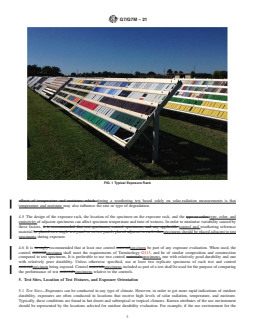
4.5 The design of the exposure rack, the location of the specimen on the exposure rack, and the type, color, and emissivity of adjacent specimens can affect specimen temperature and time of wetness. In order to minimize variability caused by t...
SCOPE
1.1 This practice covers procedures to be followed for direct exposure of materials to the environment. Typically, this testing is performed on exposure racks tilted at a commonly-used tilt angle from the horizontal (such as 5 or 45 degrees) and facing the equator. Other exposure orientations can be used.
1.2 This practice is not intended for the corrosion testing of bare metals, or for testing behind glass.
1.2.1 For corrosion testing, refer to Practice G50
1.2.2 For exposures behind glass, refer to Practice G24
1.3 Units—The values stated in either SI units or inch-pound units are to be regarded separately as standard. The values stated in each system are not necessarily exact equivalents; therefore, to ensure conformance with the standard, each system shall be used independently of the other, and values from the two systems shall not be combined.
1.4 This practice is technically equivalent to the parts of ISO 877-1 and -2 that describe direct exposures of specimens to the environment.
1.5 This standard does not purport to address all of the safety concerns, if any, associated with its use. It is the responsibility of the user of this standard to establish appropriate safety, health, and environmental practices and determine the applicability of regulatory limitations prior to use.
1.6 This international standard was developed in accordance with internationally recognized principles on standardization established in the Decision on Principles for the Development of International Standards, Guides and Recommendations issued by the World Trade Organization Technical Barriers to Trade (TBT) Committee.
- Status
- Published
- Publication Date
- 30-Jun-2021
- Technical Committee
- G03 - Weathering and Durability
- Drafting Committee
- G03.02 - Natural and Environmental Exposure Tests
Overview
ASTM G7/G7M-21: Standard Practice for Natural Weathering of Materials provides comprehensive procedures for the direct exposure of nonmetallic materials to outdoor environmental conditions. Published by ASTM International, this widely referenced standard is designed to assess material durability through natural weathering tests in real-world climates. The standard emphasizes that material performance during natural exposure may vary significantly by location due to factors such as ultraviolet (UV) radiation, humidity, temperature, wet-dry and freeze-thaw cycles, and local pollutants.
Natural weathering testing is crucial for industries aiming to predict how materials like plastics, coatings, paints, and polymers will perform over extended outdoor service. ASTM G7/G7M-21 outlines exposure rack placement, specimen orientation, test duration, and reporting requirements to facilitate meaningful comparisons and long-term performance assessment.
Key Topics
Test Procedures and Setup
- Guidelines for mounting specimens on exposure racks at common tilt angles (e.g., 5° or 45°) facing the equator.
- Flexibility for alternative orientations to better simulate actual end-use conditions.
- Requirements for specimen backing types (unbacked, backed, black box) and material choices for test racks.
Significance of Environmental Variables
- Recognition that UV radiation, relative humidity, wetness, temperature fluctuations, and pollutants impact material degradation.
- Importance of using multiple locations and repeated exposures over several years to obtain representative durability data.
Exposure Duration Measurement
- Test durations commonly defined by calendar time or total solar/UV radiant exposure.
- The necessity to consider climatic variations and the effects of temperature and moisture alongside radiant exposure.
Data Collection and Reporting
- Recommendations for recording ambient temperature, humidity, total solar radiation, and UV exposure with properly calibrated instruments.
- Detailed reporting requirements including specimen description, exposure location, orientation, climate data, and any deviations from the practice.
Control Materials and Replicates
- Use of at least one control specimen, preferably more, to benchmark performance.
- Importance of placing test and control specimens adjacent to each other to minimize variability.
Applications
ASTM G7/G7M-21 is vital across a range of sectors where material longevity and performance in outdoor environments must be validated:
- Plastics and Polymers: Assessing UV and weathering resistance in construction materials, packaging, and automotive components.
- Coatings and Paints: Evaluating durability and colorfastness for architectural, transportation, and industrial uses.
- Adhesives, Tapes, and Films: Measuring how prolonged exposure affects bonding strength and physical integrity.
- Quality Assurance and R&D: Supporting product development, material selection, and continuous improvement by providing a framework for comparative and repeatable weathering tests.
Testing per ASTM G7/G7M-21 helps manufacturers, specifiers, and regulatory bodies understand product performance, improve formulations, and comply with market or customer requirements for durability.
Related Standards
- ASTM G50 - Practice for Conducting Atmospheric Corrosion Tests on Metals (for corrosion testing of bare metals)
- ASTM G24 - Practice for Conducting Exposures to Daylight Filtered Through Glass (for exposures behind glass)
- ASTM G113 - Terminology Relating to Natural and Artificial Weathering Tests of Nonmetallic Materials
- ISO 877-1 and ISO 877-2 - International standards equivalent to direct outdoor weathering methods
- ISO 9060 - Solar energy measurement instrument specifications
- Guide D3614 - Air quality sampling and analysis
- ASTM G130, G167 - Procedures for calibration of radiometric instruments for solar and UV exposure measurements
Keywords: natural weathering, durability testing, UV exposure, ASTM G7, materials testing, environmental exposure, specimen orientation, outdoor aging, radiant exposure, weathering resistance.
Relations
- Effective Date
- 01-Jun-2020
- Effective Date
- 15-Apr-2018
- Effective Date
- 01-Mar-2014
- Effective Date
- 01-Sep-2013
- Effective Date
- 01-Jun-2012
- Effective Date
- 01-Sep-2011
- Refers
ASTM G167-05(2010) - Standard Test Method for Calibration of a Pyranometer Using a Pyrheliometer - Effective Date
- 01-Dec-2010
- Refers
ASTM E824-10 - Standard Test Method for Transfer of Calibration From Reference to Field Radiometers - Effective Date
- 01-Dec-2010
- Effective Date
- 01-Sep-2010
- Effective Date
- 15-Jun-2009
- Effective Date
- 01-Aug-2008
- Effective Date
- 01-Jun-2007
- Effective Date
- 01-Dec-2006
- Effective Date
- 01-Dec-2006
- Effective Date
- 01-Jun-2006
Get Certified
Connect with accredited certification bodies for this standard

IMP NDT d.o.o.
Non-destructive testing services. Radiography, ultrasonic, magnetic particle, penetrant, visual inspection.
Inštitut za kovinske materiale in tehnologije
Institute of Metals and Technology. Materials testing, metallurgical analysis, NDT.
Q Techna d.o.o.
NDT and quality assurance specialist. 30+ years experience. NDT personnel certification per ISO 9712, nuclear and thermal power plant inspections, QA/
Sponsored listings
Frequently Asked Questions
ASTM G7/G7M-21 is a standard published by ASTM International. Its full title is "Standard Practice for Natural Weathering of Materials". This standard covers: SIGNIFICANCE AND USE 4.1 The relative durability of materials in natural exposures can be very different depending on the location of the exposure because of differences in ultraviolet (UV) radiation, relative humidity, time of wetness, temperature, wet-dry cycling, freeze-thaw cycling, pollutants, and other factors. Therefore, it cannot be assumed that results from one exposure in a single location will be useful for determining relative durability in a different location. Exposures in several locations with different climates which represent a broad range of anticipated service conditions are recommended. 4.2 Because of year-to-year climatological variations, results from a single exposure test cannot be used to predict the absolute rate at which a material degrades. Several exposures, repeated over several years are needed to get a representative test result for a given location. 4.3 Solar UV radiation varies considerably as a function of time of year. This can cause large differences in the apparent rate of degradation in many materials. Comparing results for materials exposed for short periods (less than one year) is not recommended unless materials are exposed at the same time in the same location. 4.4 The duration of natural weathering tests is often based on time (24 months for example). The variability between different exposures can be reduced by using a duration based on total solar or solar UV radiant exposure. Solar UV measurements are typically made using instruments which record broadband UV (for example, 295 to 385 nm), as described in 7.2.4. An inherent limitation in timing a weathering test based solely on solar-radiation measurements is that temperature and moisture may also influence the rate or type of degradation. 4.5 The design of the exposure rack, the location of the specimen on the exposure rack, and the type, color, and emissivity of adjacent specimens can affect specimen temperature and time of wetness. In order to minimize variability caused by t... SCOPE 1.1 This practice covers procedures to be followed for direct exposure of materials to the environment. Typically, this testing is performed on exposure racks tilted at a commonly-used tilt angle from the horizontal (such as 5 or 45 degrees) and facing the equator. Other exposure orientations can be used. 1.2 This practice is not intended for the corrosion testing of bare metals, or for testing behind glass. 1.2.1 For corrosion testing, refer to Practice G50 1.2.2 For exposures behind glass, refer to Practice G24 1.3 Units—The values stated in either SI units or inch-pound units are to be regarded separately as standard. The values stated in each system are not necessarily exact equivalents; therefore, to ensure conformance with the standard, each system shall be used independently of the other, and values from the two systems shall not be combined. 1.4 This practice is technically equivalent to the parts of ISO 877-1 and -2 that describe direct exposures of specimens to the environment. 1.5 This standard does not purport to address all of the safety concerns, if any, associated with its use. It is the responsibility of the user of this standard to establish appropriate safety, health, and environmental practices and determine the applicability of regulatory limitations prior to use. 1.6 This international standard was developed in accordance with internationally recognized principles on standardization established in the Decision on Principles for the Development of International Standards, Guides and Recommendations issued by the World Trade Organization Technical Barriers to Trade (TBT) Committee.
SIGNIFICANCE AND USE 4.1 The relative durability of materials in natural exposures can be very different depending on the location of the exposure because of differences in ultraviolet (UV) radiation, relative humidity, time of wetness, temperature, wet-dry cycling, freeze-thaw cycling, pollutants, and other factors. Therefore, it cannot be assumed that results from one exposure in a single location will be useful for determining relative durability in a different location. Exposures in several locations with different climates which represent a broad range of anticipated service conditions are recommended. 4.2 Because of year-to-year climatological variations, results from a single exposure test cannot be used to predict the absolute rate at which a material degrades. Several exposures, repeated over several years are needed to get a representative test result for a given location. 4.3 Solar UV radiation varies considerably as a function of time of year. This can cause large differences in the apparent rate of degradation in many materials. Comparing results for materials exposed for short periods (less than one year) is not recommended unless materials are exposed at the same time in the same location. 4.4 The duration of natural weathering tests is often based on time (24 months for example). The variability between different exposures can be reduced by using a duration based on total solar or solar UV radiant exposure. Solar UV measurements are typically made using instruments which record broadband UV (for example, 295 to 385 nm), as described in 7.2.4. An inherent limitation in timing a weathering test based solely on solar-radiation measurements is that temperature and moisture may also influence the rate or type of degradation. 4.5 The design of the exposure rack, the location of the specimen on the exposure rack, and the type, color, and emissivity of adjacent specimens can affect specimen temperature and time of wetness. In order to minimize variability caused by t... SCOPE 1.1 This practice covers procedures to be followed for direct exposure of materials to the environment. Typically, this testing is performed on exposure racks tilted at a commonly-used tilt angle from the horizontal (such as 5 or 45 degrees) and facing the equator. Other exposure orientations can be used. 1.2 This practice is not intended for the corrosion testing of bare metals, or for testing behind glass. 1.2.1 For corrosion testing, refer to Practice G50 1.2.2 For exposures behind glass, refer to Practice G24 1.3 Units—The values stated in either SI units or inch-pound units are to be regarded separately as standard. The values stated in each system are not necessarily exact equivalents; therefore, to ensure conformance with the standard, each system shall be used independently of the other, and values from the two systems shall not be combined. 1.4 This practice is technically equivalent to the parts of ISO 877-1 and -2 that describe direct exposures of specimens to the environment. 1.5 This standard does not purport to address all of the safety concerns, if any, associated with its use. It is the responsibility of the user of this standard to establish appropriate safety, health, and environmental practices and determine the applicability of regulatory limitations prior to use. 1.6 This international standard was developed in accordance with internationally recognized principles on standardization established in the Decision on Principles for the Development of International Standards, Guides and Recommendations issued by the World Trade Organization Technical Barriers to Trade (TBT) Committee.
ASTM G7/G7M-21 is classified under the following ICS (International Classification for Standards) categories: 19.040 - Environmental testing. The ICS classification helps identify the subject area and facilitates finding related standards.
ASTM G7/G7M-21 has the following relationships with other standards: It is inter standard links to ASTM G130-12(2020), ASTM E824-10(2018)e1, ASTM G113-14, ASTM E772-13, ASTM G130-12, ASTM E772-11, ASTM G167-05(2010), ASTM E824-10, ASTM G50-10, ASTM G113-09, ASTM G113-08, ASTM D3614-07, ASTM G113-06e1, ASTM G113-06, ASTM G130-06. Understanding these relationships helps ensure you are using the most current and applicable version of the standard.
ASTM G7/G7M-21 is available in PDF format for immediate download after purchase. The document can be added to your cart and obtained through the secure checkout process. Digital delivery ensures instant access to the complete standard document.
Standards Content (Sample)
This international standard was developed in accordance with internationally recognized principles on standardization established in the Decision on Principles for the
Development of International Standards, Guides and Recommendations issued by the World Trade Organization Technical Barriers to Trade (TBT) Committee.
Designation: G7/G7M − 21
Standard Practice for
Natural Weathering of Materials
This standard is issued under the fixed designation G7/G7M; the number immediately following the designation indicates the year of
original adoption or, in the case of revision, the year of last revision. A number in parentheses indicates the year of last reapproval. A
superscript epsilon (´) indicates an editorial change since the last revision or reapproval.
This standard has been approved for use by agencies of the U.S. Department of Defense.
1. Scope* 2. Referenced Documents
1.1 Thispracticecoversprocedurestobefollowedfordirect 2.1 ASTM Standards:
exposure of materials to the environment. Typically, this
D3614 Guide for Laboratories Engaged in Sampling and
testing is performed on exposure racks tilted at a commonly-
Analysis of Atmospheres and Emissions
usedtiltanglefromthehorizontal(suchas5or45degrees)and
E772 Terminology of Solar Energy Conversion
facing the equator. Other exposure orientations can be used.
E824 Test Method for Transfer of Calibration From Refer-
ence to Field Radiometers
1.2 This practice is not intended for the corrosion testing of
G24 Practice for Conducting Exposures to Daylight Filtered
bare metals, or for testing behind glass.
Through Glass
1.2.1 For corrosion testing, refer to Practice G50
G50 Practice for Conducting Atmospheric Corrosion Tests
1.2.2 For exposures behind glass, refer to Practice G24
on Metals
1.3 Units—The values stated in either SI units or inch- G113 Terminology Relating to Natural andArtificial Weath-
pound units are to be regarded separately as standard. The ering Tests of Nonmetallic Materials
G130 Test Method for Calibration of Narrow- and Broad-
values stated in each system are not necessarily exact equiva-
lents; therefore, to ensure conformance with the standard, each Band Ultraviolet Radiometers Using a Spectroradiometer
system shall be used independently of the other, and values G167 Test Method for Calibration of a Pyranometer Using a
from the two systems shall not be combined.
Pyrheliometer
2.2 ISO Standards:
1.4 This practice is technically equivalent to the parts of
ISO 877-1 and -2 that describe direct exposures of specimens ISO 877 Plastics—Methods of Exposure to Direct Weath-
to the environment. ering;toWeatheringUsingGlass-FilteredDaylight,andto
Intensified Weathering by Daylight Using Fresnel Mirrors
1.5 This standard does not purport to address all of the
ISO 9370 Plastics—Instrumental Determination of Radiant
safety concerns, if any, associated with its use. It is the
Exposure in Weathering Tests—General Guidance and
responsibility of the user of this standard to establish appro-
Basic Test Method
priate safety, health, and environmental practices and deter-
ISO 9060:2018 Solar Energy – Specification and Classifica-
mine the applicability of regulatory limitations prior to use.
tion of Instruments for Measuring Hemispherical Solar
1.6 This international standard was developed in accor-
and Direct Solar Radiation
dance with internationally recognized principles on standard-
2.3 Other Standards:
ization established in the Decision on Principles for the
WMO – No. 8, “Guide to Meteorological Instruments and
Development of International Standards, Guides and Recom-
Methods of Observation,” seventh edition, World Meteo-
mendations issued by the World Trade Organization Technical
Barriers to Trade (TBT) Committee. rological Organization, Geneva, Switzerland, 2008
1 2
This practice is under the jurisdiction ofASTM Committee G03 on Weathering For referenced ASTM standards, visit the ASTM website, www.astm.org, or
and Durability and is the direct responsibility of Subcommittee G03.02 on Natural contact ASTM Customer Service at service@astm.org. For Annual Book of ASTM
and Environmental Exposure Tests. Standards volume information, refer to the standard’s Document Summary page on
Current edition approved July 1, 2021. Published August 2021. Originally the ASTM website.
approved in 1969. Last previous edition approved in 2013 as G7/G7M – 13. DOI: Available from American National Standards Institute (ANSI), 25 W. 43rd St.,
10.1520/G0007_G0007M-21. 4th Floor, New York, NY 10036, http://www.ansi.org.
*A Summary of Changes section appears at the end of this standard
Copyright © ASTM International, 100 Barr Harbor Drive, PO Box C700, West Conshohocken, PA 19428-2959. United States
G7/G7M − 21
3. Terminology materials exposed for short periods (less than one year) is not
recommended unless materials are exposed at the same time in
3.1 Definitions—The definitions given in Terminologies
the same location.
G113 and E772 are applicable to this practice.
4.4 The duration of natural weathering tests is often based
4. Significance and Use
on time (24 months for example). The variability between
different exposures can be reduced by using a duration based
4.1 The relative durability of materials in natural exposures
can be very different depending on the location of the exposure on total solar or solar UV radiant exposure. Solar UV mea-
surements are typically made using instruments which record
because of differences in ultraviolet (UV) radiation, relative
humidity, time of wetness, temperature, wet-dry cycling, broadband UV (for example, 295 to 385 nm), as described in
7.2.4. An inherent limitation in timing a weathering test based
freeze-thaw cycling, pollutants, and other factors. Therefore, it
solely on solar-radiation measurements is that temperature and
cannot be assumed that results from one exposure in a single
moisture may also influence the rate or type of degradation.
location will be useful for determining relative durability in a
different location. Exposures in several locations with different
4.5 The design of the exposure rack, the location of the
climates which represent a broad range of anticipated service
specimen on the exposure rack, and the type, color, and
conditions are recommended.
emissivity of adjacent specimens can affect specimen tempera-
ture and time of wetness. In order to minimize variability
4.2 Because of year-to-year climatological variations, re-
sults from a single exposure test cannot be used to predict the caused by these factors, control and weathering reference
materialspecimensshouldbeplacedadjacenttotestspecimens
absolute rate at which a material degrades. Several exposures,
repeated over several years are needed to get a representative during exposure.
test result for a given location.
4.6 It is recommended that at least one control specimen be
4.3 Solar UV radiation varies considerably as a function of part of any exposure evaluation. When used, the control
time of year. This can cause large differences in the apparent specimen shall meet the requirements of Terminology G113,
rate of degradation in many materials. Comparing results for and be of similar composition and construction compared to
FIG. 1 Typical Exposure Rack
G7/G7M − 21
test specimens. It is preferable to use two control specimens, tal conditions than if using typical ground cover or exposing at
onewithrelativelygooddurabilityandonewithrelativelypoor ground level. These differences may affect test results.
durability.Unlessotherwisespecified,useatleasttworeplicate
5.2 The lowest row of specimens on a test fixture or rack
specimens of each test and control specimen being exposed.
shall be positioned at least 0.45 m [18 in.] above the surface of
Control specimens included as part of a test shall be used for
the ground and shall not contact vegetation. This will also
the purpose of comparing the performance of test specimens
minimize the possibility that damage that might occur during
relative to the controls.
grounds maintenance.
5. Test Sites, Location of Test Fixtures, and Exposure
5.3 Test fixtures shall be placed in a location so that there is
Orientation
no shadow on any specimen when the sun’s angle of elevation
above the horizon is greater than 20°.
5.1 Test Sites—Exposures can be conducted in any type of
climate. However, in order to get more rapid indications of
5.4 Exposure Orientation—Unless otherwise specified, ex-
outdoor durability, exposures are often conducted in locations
posure racks shall be oriented so that specimens face the
that receive high levels of solar radiation, temperature, and
equator. Specimens can be exposed at any orientation or
moisture. Typically, these conditions are found in hot desert
“exposure angle” in order to simulate end-use conditions of the
and subtropical or tropical climates. Known attributes of the
material being evaluated. Typical exposure angles are as
use environment should be represented by the locations se-
follows:
lectedforoutdoordurabilityevaluation.Forexample,iftheuse
5.4.1 Latitude Angle—Exposure rack is positioned so that
environment for the product being evaluated will include
the exposed surface of specimens are at an angle from the
freeze-thaw cycling, specimen exposure in a northern temper-
horizontal that is equal to the latitude of the exposure site and
ate climate is recommended. In addition, exposures are often
facing the equator.
conducted in areas where specimens are subjected to salt air
5.4.2 45°—Exposure rack is positioned so that the exposed
(seashore) or industrial pollutants.
specimens are at an angle of 45° from the horizontal facing the
5.1.1 Unlessotherwisespecified,theareabeneathandinthe
equator. This is the most commonly used exposure orientation.
vicinity of the test fixtures shall have ground cover typical of
5.4.3 90°—Exposure rack is positioned so that the exposed
the climatological area where the exposures are being con-
specimens are at an angle of 90° from the horizontal facing the
ducted. In desert areas, the typical ground cover is often gravel
equator.
to control dust, and in most temperate or subtropical areas, the
typicalgroundcoverislow-cutgrass.Thetypeofgroundcover 5.4.4 5°—Exposure rack is positioned so that the exposed
at the exposure site shall be indicated in the test report. If test
specimens are at an angle of 5° from the horizontal facing the
fixtures are placed over ground covers not typical of the equator. This angle is preferred over horizontal exposure to
climatological area (for example, rooftops, concrete or avoid standing water on exposed specimens. This exposure
asphalt), specimens may be subjected to different environmen- angle typically receives the highest levels of solar radiant
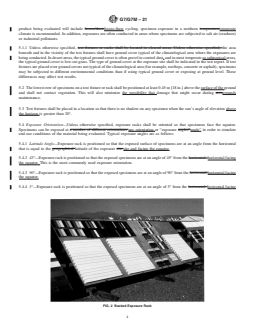
FIG. 2 Backed Exposure Rack
G7/G7M − 21
exposure during mid-summer and is used to expose materials 5.5.3 Black Box Exposure—Specimens are attached to the
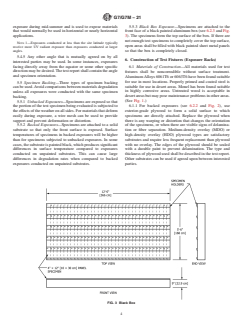
that would normally be used in horizontal or nearly horizontal front face of a black painted aluminum box (see 6.2.3 and Fig.
applications. 3). The specimens form the top surface of the box. If there are
not enough test specimens to completely cover the top surface,
NOTE 1—Exposures conducted at less than the site latitude typically
open areas shall be filled with black painted sheet metal panels
receive more UV radiant exposure than exposures conducted at larger
so that the box is completely closed.
angles.
5.4.5 Any other angle that is mutually agreed on by all
6. Construction of Test Fixtures (Exposure Racks)
interested parties may be used. In some instances, exposures
facing directly away from the equator or some other specific
6.1 Materials of Construction—All materials used for test
directionmaybedesired.Thetestreportshallcontaintheangle
fixtures shall be noncorrodible without surface treatment.
and specimen orientation.
AluminumAlloys 6061T6 or 6063T6 have been found suitable
for use in most locations. Properly primed and coated steel is
5.5 Specimen Backing—Three types of specimen backing
suitable for use in desert areas. Monel has been found suitable
canbeused.Avoidcomparisonsbetweenmaterialsdegradation
in highly corrosive areas. Untreated wood is acceptable in
unless all exposures were conducted with the same specimen
desertareasbutmayposemaintenanceproblemsinotherareas.
backing.
(See Fig. 1.)
5.5.1 Unbacked Exposures—Specimens are exposed so that
the portion of the test specimen being evaluated is subjected to 6.1.1 For backed exposures (see 6.2.2 and Fig. 2), use
theeffectsoftheweatheronallsides.Formaterialsthatdeform exterior-grade plywood to form a solid surface to which
easily during exposure, a wire mesh can be used to provide specimens are directly attached. Replace the plywood when
support and prevent deformation or distortion. there is any warping or distortion that changes the orientation
5.5.2 Backed Exposures—Specimens are attached to a solid of the specimens, or when there are visible signs of delamina-
substrate so that only the front surface is exposed. Surface tion or fiber separation. Medium-density overlay (MDO) or
temperatures of specimens in backed exposures will be higher high-density overlay (HDO) plywood types are satisfactory
than for specimens subjected to unbacked exposures. In some substrates and require less frequent replacement than plywood
cases,thesubstrateispaintedblack,whichproducessignificant with no overlay. The edges of the plywood should be sealed
differences in surface temperature compared to exposures with a durable paint to prevent delamination. The type and
conducted on unpainted substrates. This can cause large thickness of plywood used shall be described in the test report.
differences in degradation rates when compared to backed Other substrates can be used if agreed upon between interested
exposures conducted on unpainted substrates. parties.
FIG. 3 Black Box
G7/G7M − 21
FIG. 4 Black Box in Use
6.2 Test Fixture Design—Test racks shall be constructed to blackboxinuse.Allexposurepositionsonablackboxshallbe
hold specimens or specimen holders of any convenient width filled with either test or control specimens or blank panels.
and length. Racks shall be constructed so that any contamina- Specimens for black box exposure which are not flat shall be
tion from specimens higher on the fixture cannot cont
...
This document is not an ASTM standard and is intended only to provide the user of an ASTM standard an indication of what changes have been made to the previous version. Because
it may not be technically possible to adequately depict all changes accurately, ASTM recommends that users consult prior editions as appropriate. In all cases only the current version
of the standard as published by ASTM is to be considered the official document.
Designation: G7/G7M − 13 G7/G7M − 21
Standard Practice for
Atmospheric Environmental Exposure Testing of
Nonmetallic Natural Weathering of Materials
This standard is issued under the fixed designation G7/G7M; the number immediately following the designation indicates the year of
original adoption or, in the case of revision, the year of last revision. A number in parentheses indicates the year of last reapproval. A
superscript epsilon (´) indicates an editorial change since the last revision or reapproval.
This standard has been approved for use by agencies of the U.S. Department of Defense.
1. Scope Scope*
1.1 This practice covers procedures to be followed for direct exposure of nonmetallic materials to the environment. When
originators of a weathering test have the actual exposure conducted by a separate agency, the specific conditions for the exposure
of test and control specimens must be clearly defined and mutually agreed upon between all parties.Typically, this testing is
performed on exposure racks tilted at a commonly-used tilt angle from the horizontal (such as 5 or 45 degrees) and facing the
equator. Other exposure orientations can be used.
1.2 For exposures behind glass, refer to PracticeThis practice is not intended for the G24.corrosion testing of bare metals, or for
testing behind glass.
1.2.1 For corrosion testing, refer to Practice G50
1.2.2 For exposures behind glass, refer to Practice G24
1.3 Units—The values stated in either SI units or inch-pound units are to be regarded separately as standard. The values stated in
each system are not necessarily exact equivalents; therefore, to ensure conformance with the standard, each system shall be used
independently of the other, and values from the two systems shall not be combined.
1.4 This practice is technically equivalent to the parts of ISO 877 877-1 and -2 that describe direct exposures of specimens to the
environment.
1.5 This standard does not purport to address all of the safety concerns, if any, associated with its use. It is the responsibility
of the user of this standard to establish appropriate safety safety, health, and healthenvironmental practices and determine the
applicability of regulatory limitations prior to use.
1.6 This international standard was developed in accordance with internationally recognized principles on standardization
established in the Decision on Principles for the Development of International Standards, Guides and Recommendations issued
by the World Trade Organization Technical Barriers to Trade (TBT) Committee.
This practice is under the jurisdiction of ASTM Committee G03 on Weathering and Durability and is the direct responsibility of Subcommittee G03.02 on Natural and
Environmental Exposure Tests.
Current edition approved June 1, 2013July 1, 2021. Published June 2013August 2021. Originally approved in 1969. Last previous edition approved in 20112013 as
G7/G7M – 11.G7/G7M – 13. DOI: 10.1520/G0007_G0007M-13.10.1520/G0007_G0007M-21.
*A Summary of Changes section appears at the end of this standard
Copyright © ASTM International, 100 Barr Harbor Drive, PO Box C700, West Conshohocken, PA 19428-2959. United States
G7/G7M − 21
2. Referenced Documents
2.1 ASTM Standards:
D3614 Guide for Laboratories Engaged in Sampling and Analysis of Atmospheres and Emissions
E41E772 Terminology Relating to Conditioningof Solar Energy Conversion (Withdrawn 2019)
E824 Test Method for Transfer of Calibration From Reference to Field Radiometers
E913 Method for Calibration of Reference Pyranometers With Axis Vertical by the Shading Method (Withdrawn 2005)
E941 Test Method for Calibration of Reference Pyranometers With Axis Tilted by the Shading Method (Withdrawn 2005)
G24 Practice for Conducting Exposures to Daylight Filtered Through Glass
G50 Practice for Conducting Atmospheric Corrosion Tests on Metals
G113 Terminology Relating to Natural and Artificial Weathering Tests of Nonmetallic Materials
G130 Test Method for Calibration of Narrow- and Broad-Band Ultraviolet Radiometers Using a Spectroradiometer
G167 Test Method for Calibration of a Pyranometer Using a Pyrheliometer
2.2 ISO Standards:
ISO 877 Plastics—Methods of Exposure to Direct Weathering; to Weathering Using Glass-Filtered Daylight, and to Intensified
Weathering by Daylight Using Fresnel Mirrors
ISO 9370 Plastics—Instrumental Determination of Radiant Exposure in Weathering Tests—General Guidance and Basic Test
Method
ISO 9060:2018 Solar Energy – Specification and Classification of Instruments for Measuring Hemispherical Solar and Direct
Solar Radiation
2.3 ASTM Adjuncts:
A Test Rack
2.3 Other Standards:
WMO – No. 8, “Guide to Meteorological Instruments and Methods of Observation,” seventh edition, World Meteorological
Organization, Geneva, Switzerland, 2008
3. Terminology
3.1 Definitions—The definitions given in TerminologyTerminologies E41G113 and Terminology G113E772 are applicable to this
practice.
4. Significance and Use
4.1 The relative durability of materials in natural exposures can be very different depending on the location of the exposure
because of differences in ultraviolet (UV) radiation, relative humidity, time of wetness, temperature, wet-dry cycling, freeze-thaw
cycling, pollutants, and other factors. Therefore, it cannot be assumed that results from one exposure in a single location will be
useful for determining relative durability in a different location. Exposures in several locations with different climates which
represent a broad range of anticipated service conditions are recommended.
4.2 Because of year-to-year climatological variations, results from a single exposure test cannot be used to predict the absolute
rate at which a material degrades. Several years of repeat exposures exposures, repeated over several years are needed to get an
“average”a representative test result for a given location.
4.3 Solar ultravioletUV radiation varies considerably as a function of time of year. This can cause large differences in the apparent
rate of degradation in many polymers.materials. Comparing results for materials exposed for short periods (less than one year) is
not recommended unless materials are exposed at the same time in the same location.
4.4 Defining exposure periods in terms of The duration of natural weathering tests is often based on time (24 months for example).
The variability between different exposures can be reduced by using a duration based on total solar or solar-ultraviolet radiant
energy can reduce variability in results from separate exposures. Solar ultravioletsolar UV radiant exposure. Solar UV
measurements are typically made using instruments which record broadband UV (for example, 295 to 385 nm) or narrow band
UV, nm), as described in 7.2.4 and 7.2.5. An inherent limitation in solar-radiation measurements is that they do not reflect the
For referenced ASTM standards, visit the ASTM website, www.astm.org, or contact ASTM Customer Service at service@astm.org. For Annual Book of ASTM Standards
volume information, refer to the standard’s Document Summary page on the ASTM website.
Available from American National Standards Institute (ANSI), 25 W. 43rd St., 4th Floor, New York, NY 10036, http://www.ansi.org.
G7/G7M − 21
FIG. 1 Typical Exposure Rack
effects of temperature and moisture, which timing a weathering test based solely on solar-radiation measurements is that
temperature and moisture may also influence the rate or type of degradation.
4.5 The design of the exposure rack, the location of the specimen on the exposure rack, and the type or color type, color, and
emissivity of adjacent specimens can affect specimen temperature and time of wetness. In order to minimize variability caused by
these factors, it is recommended that test specimens, control specimens, and any applicable control and weathering reference
material be placed on a single test panel or on test panels placed adjacent to each otherspecimens should be placed adjacent to test
specimens during exposure.
4.6 It is strongly recommended that at least one control materialspecimen be part of any exposure evaluation. When used, the
control materialspecimen shall meet the requirements of Terminology G113, and be of similar composition and construction
compared to test specimens. It is preferable to use two control materials,specimens, one with relatively good durability and one
with relatively poor durability. Unless otherwise specified, use at least two replicate specimens of each test and control
materialspecimen being exposed. Control materialsspecimens included as part of a test shall be used for the purpose of comparing
the performance of test materialsspecimens relative to the controls.
5. Test Sites, Location of Test Fixtures, and Exposure Orientation
5.1 Test Sites—Exposures can be conducted in any type of climate. However, in order to get more rapid indications of outdoor
durability, exposures are often conducted in locations that receive high levels of solar radiation, temperature, and moisture.
Typically, these conditions are found in hot desert and subtropical or tropical climates. Known attributes of the use environment
should be represented by the locations selected for outdoor durability evaluation. For example, if the use environment for the
G7/G7M − 21
product being evaluated will include freeze/thawfreeze-thaw cycling, specimen exposure in a northern temperaturetemperate
climate is recommended. In addition, exposures are often conducted in areas where specimens are subjected to salt air (seashore)
or industrial pollutants.
5.1.1 Unless otherwise specified, test fixtures or racks shall be located in cleared areas. Unless otherwise specified, the area
beneath and in the vicinity of the test fixtures shall have ground cover typical of the climatological area where the exposures are
being conducted. In desert areas, the typical ground cover is often gravel to control dust, and in most temperate or subtropical areas,
the typical ground cover is low-cut grass. The type of ground cover at the exposure site shall be indicated in the test report. If test
fixtures are placed over ground covers not typical of the climatological area (for example, rooftops, concrete or asphalt), specimens
may be subjected to different environmental conditions than if using typical ground cover or exposing at ground level. These
differences may affect test results.
5.2 The lowest row of specimens on a test fixture or rack shall be positioned at least 0.45 m [18 in.] above the surface of the ground
and shall not contact vegetation. This will also minimize the possibility that damage that might occur during areagrounds
maintenance.
5.3 Test fixtures shall be placed in a location so that there is no shadow on any specimen when the sun’s angle of elevation above
the horizon is greater than 20°.
5.4 Exposure Orientation—Unless otherwise specified, exposure racks shall be oriented so that specimens face the equator.
Specimens can be exposed at a number of different orientations any orientation or “exposure angles”angle” in order to simulate
end-use conditions of the material being evaluated. Typical exposure angles are as follows:
5.4.1 Latitude Angle—Exposure rack is positioned so that the exposed surface of specimens are at an angle from the horizontal
that is equal to the geographical latitude of the exposure site.site and facing the equator.
5.4.2 45°—Exposure rack is positioned so that the exposed specimens are at an angle of 45° from the horizontal. horizontal facing
the equator. This is the most commonly used exposure orientation.
5.4.3 90°—Exposure rack is positioned so that the exposed specimens are at an angle of 90° from the horizontal.horizontal facing
the equator.
5.4.4 5°—Exposure rack is positioned so that the exposed specimens are at an angle of 5° from the horizontal. horizontal facing
FIG. 2 Backed Exposure Rack
G7/G7M − 21
the equator. This angle is preferred over horizontal exposure to avoid standing water on specimens being exposed. exposed
specimens. This exposure angle typically receives the highest levels of solar radiation radiant exposure during mid-summer and
is used to testexpose materials that would normally be used in horizontal or nearly horizontal applications.
NOTE 1—Exposures conducted at less than the site latitude typically receive more ultraviolet radiation UV radiant exposure than exposures conducted
at larger angles.
5.4.5 Any other angle that is mutually agreed on by all interested parties may be used. In some instances, exposures facing directly
away from the equator or some other specific direction may be desired. The test report shall contain the exact angle and specimen
orientation.
5.5 Specimen Backing—Three types of specimen backing can be used. Avoid comparisons between materials degradation unless
all exposures were conducted with the same specimen backing.
5.5.1 Unbacked Exposures—Specimens are exposed so that the portion of the test specimen being evaluated is subjected to the
effects of the weather on all sides. For materials that deform easily during exposure, a wire mesh can be used to provide support
and prevent deformation or distortion.
5.5.2 Backed Exposures—Specimens are attached to a solid substrate so that only the front surface is exposed. Surface
temperatures of specimens in backed exposures will be higher than for specimens subjected to unbacked exposures. In some cases,
the substrate is painted black, which produces significant differences in surface temperature compared to exposures conducted on
unpainted substrate.substrates. This can cause large differences in degradation rates when compared to backed exposures conducted
on unpainted substrates.
5.5.3 Black Box Exposure—Specimens are attached to the front face of a black painted aluminum box (see 6.2.3 and Fig. 3). The
specimens form the top surface of the box. If there are not enough test specimens to completely cover the top surface, open areas
shall be filled with black painted sheet metal panels so that the box is completely closed.
FIG. 3 Black Box
G7/G7M − 21
FIG. 4 Black Box in Use
6. Construction of Test Fixtures (Exposure Racks)
6.1 Materials of Construction—All materials used for test fixtures shall be noncorrodible without surface treatment. Aluminum
Alloys 6061T6 or 6063T6 have been found suitable for use in most locations. Properly primed and coated steel is suitable for use
in desert areas. Monel has been found suitable in highly corrosive areas. Untreated wood is acceptable in desert areas but may pose
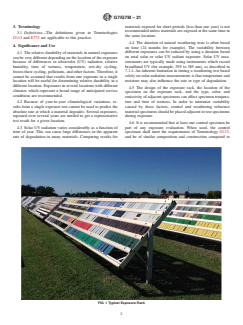
maintenance problems in other areas. (See Fig. 1.)
6.1.1 For backed exposures (see 6.2.2 and Fig. 2), use exterior-grade plywood to form a solid surface to which specimens are
directly attached. Replace the plywood when there is any warping or distortion that changes the orientation of the specimens, or
when there are visible signs of delamination or fiber separation. Medium-density overlay (MDO) or high-density overlay (HDO)
plywood types are satisfactory substrates and require less frequent replacement than plywood with no overlay. The edges of the
plywood should be sealed with a durable paint to prevent delamination. The type and thickness of plywood used shall be described
in the test report. Other substrates can be used if agreed upon between interested parties.
6.2 Test Fixture Design—Test racks shall be constructed to hold specimens or specimen holders of any convenient width and
length. Racks shall be constructed so that any contamination from specimens higher on the fixture cannot directly run down onto
contaminate specimens in lower positions.
6.2.1 Unbacked Exposures—Test racks shall be constructed so that most of the test specimen is exposed to the effects of the
weather on all sides. Specimens are attached to the test fixture at the top or bottom, or both, using clamping devices, properly
spaced slots, or mechanical fasteners. The method of attachment shall not prevent expansion and contraction of specimens caused
by temperature or moisture. Use fastening devices for attaching specimens to the test fixture that will not corrode or degrade and
corrode, degrade, or contaminate the specimens. Aluminum, properly galvanized steel, or stainless s
...