

ASTM D4422-19
(Test Method)Standard Test Method for Ash in Analysis of Petroleum Coke
General Information
- Abstract
SIGNIFICANCE AND USE
4.1 The ash content is one of the properties used to evaluate petroleum coke and indicates the amount of undesirable residue present. Acceptable ash content varies with the intended use.
SCOPE
1.1 This test method covers the determination of the ash content of petroleum coke.
1.2 The values stated in SI units are to be regarded as standard. No other units of measurement are included in this standard.
1.3 This standard does not purport to address all of the safety concerns, if any, associated with its use. It is the responsibility of the user of this standard to establish appropriate safety, health, and environmental practices and determine the applicability of regulatory limitations prior to use.
1.4 This international standard was developed in accordance with internationally recognized principles on standardization established in the Decision on Principles for the Development of International Standards, Guides and Recommendations issued by the World Trade Organization Technical Barriers to Trade (TBT) Committee.
- Status
- Published
- Publication Date
- 31-Dec-2018
- Technical Committee
- D02 - Petroleum Products, Liquid Fuels, and Lubricants
- Drafting Committee
- D02.05 - Properties of Fuels, Petroleum Coke and Carbon Material
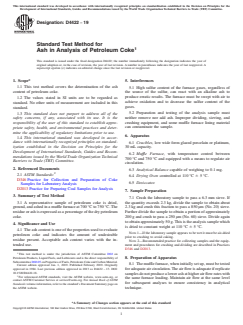


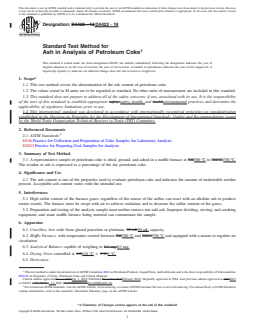
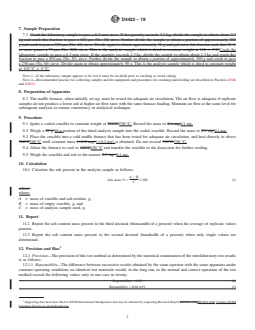


Overview
ASTM D4422-19: Standard Test Method for Ash in Analysis of Petroleum Coke is a key international standard designed to determine the ash content in petroleum coke samples. Developed by ASTM International, this standard specifies laboratory procedures for measuring the undesirable residue, or "ash," that remains after combustion of petroleum coke. Accurate assessment of ash content is critical as it serves as a measure of the amount of inorganic material present, which can affect the suitability and performance of petroleum coke in various industrial applications.
This test method is conducted using SI units and adheres to internationally recognized principles for standardization, ensuring its global applicability and consistency in quality control.
Key Topics
Significance of Ash Content
- Ash reflects the quantity of inorganic and non-combustible matter in petroleum coke.
- Monitoring ash percentage is essential for quality control, as excess ash can reduce fuel value and cause slagging or fouling in furnaces and industrial processes.
Test Scope
- Applicable to all petroleum coke types, the test method details procedures for drying, grinding, and ashing at controlled temperatures (700°C to 750°C) in a muffle furnace.
- Results are expressed as mass percentage of ash relative to the dry sample, enabling consistent comparison across different samples and applications.
Precision and Precision Range
- The method provides guidelines for repeatability and reproducibility within a typical ash content range of 0.10 wt% to 1.00 wt%.
- Clear instructions on sample handling and equipment calibration help minimize interference and improve precision.
Sample Preparation and Apparatus
- Outlines precise steps for crushing, sieving, and dividing coke samples to ensure representativeness and prevent contamination.
- Specifies apparatus requirements, including crucibles, drying ovens, muffle furnaces, and analytical balances for accurate measurement.
Applications
Quality Control in Refineries
- Used for grading petroleum coke prior to commercial sale or further processing, ensuring compliance with contractual or regulatory limits.
- Vital for producers and end-users who require verification of ash content for blending, fuel selection, and emissions control.
Industrial Process Optimization
- Assists operators in optimizing combustion systems, kiln firing, and metallurgical processes by controlling the undesirable impacts of ash.
- Supports emissions management and reduces risks related to equipment fouling, inefficiency, and downtime.
Materials Evaluation
- Essential in research and development for new coke products or blends, providing standardized data for material characterization.
- Facilitates international trade of petroleum coke by providing a consistent and reliable test method referenced globally.
Related Standards
- ASTM D346 - Practice for Collection and Preparation of Coke Samples for Laboratory Analysis: Addresses the standardized sampling procedures essential prior to ash content determination.
- ASTM D2013 - Practice for Preparing Coal Samples for Analysis: Offers guidance that parallels the sample preparation needs for petroleum coke.
- ISO Standards for Petroleum Coke Analysis - Internationally aligned approaches used in conjunction with ASTM standards for regulatory and cross-border commerce compliance.
By adhering to ASTM D4422-19, laboratories and industry professionals can ensure the accurate determination of ash content in petroleum coke, supporting quality, consistency, and regulatory adherence in fuel and metallurgical applications.
Relations
- Effective Date
- 01-Jan-2019
- Effective Date
- 01-May-2010
- Effective Date
- 01-Jun-2007
- Effective Date
- 01-Nov-2004
- Effective Date
- 01-Apr-2004
- Effective Date
- 01-Apr-2004
- Effective Date
- 01-Dec-2003
- Effective Date
- 10-Nov-2001
- Effective Date
- 10-Sep-1998
- Referred By
ASTM D6969-23 - Standard Practice for Preparation of Calcined Petroleum Coke Samples for Analysis - Effective Date
- 01-Jan-2019
- Effective Date
- 01-Jan-2019
Get Certified
Connect with accredited certification bodies for this standard

Bureau Veritas Chile
Bureau Veritas certification services in Chile.
Bureau Veritas Peru
Bureau Veritas certification services in Peru.
BVQI Peru
Bureau Veritas certification in Peru.
Sponsored listings
Frequently Asked Questions
ASTM D4422-19 is a standard published by ASTM International. Its full title is "Standard Test Method for Ash in Analysis of Petroleum Coke". This standard covers: SIGNIFICANCE AND USE 4.1 The ash content is one of the properties used to evaluate petroleum coke and indicates the amount of undesirable residue present. Acceptable ash content varies with the intended use. SCOPE 1.1 This test method covers the determination of the ash content of petroleum coke. 1.2 The values stated in SI units are to be regarded as standard. No other units of measurement are included in this standard. 1.3 This standard does not purport to address all of the safety concerns, if any, associated with its use. It is the responsibility of the user of this standard to establish appropriate safety, health, and environmental practices and determine the applicability of regulatory limitations prior to use. 1.4 This international standard was developed in accordance with internationally recognized principles on standardization established in the Decision on Principles for the Development of International Standards, Guides and Recommendations issued by the World Trade Organization Technical Barriers to Trade (TBT) Committee.
SIGNIFICANCE AND USE 4.1 The ash content is one of the properties used to evaluate petroleum coke and indicates the amount of undesirable residue present. Acceptable ash content varies with the intended use. SCOPE 1.1 This test method covers the determination of the ash content of petroleum coke. 1.2 The values stated in SI units are to be regarded as standard. No other units of measurement are included in this standard. 1.3 This standard does not purport to address all of the safety concerns, if any, associated with its use. It is the responsibility of the user of this standard to establish appropriate safety, health, and environmental practices and determine the applicability of regulatory limitations prior to use. 1.4 This international standard was developed in accordance with internationally recognized principles on standardization established in the Decision on Principles for the Development of International Standards, Guides and Recommendations issued by the World Trade Organization Technical Barriers to Trade (TBT) Committee.
ASTM D4422-19 is classified under the following ICS (International Classification for Standards) categories: 73.040 - Coals. The ICS classification helps identify the subject area and facilitates finding related standards.
ASTM D4422-19 has the following relationships with other standards: It is inter standard links to ASTM D4422-13, ASTM D346-04(2010), ASTM D2013-07, ASTM D2013-04, ASTM D346-04e1, ASTM D346-04, ASTM D2013-03, ASTM D2013-01, ASTM D346-90(1998), ASTM D6969-23, ASTM D3434-00(2018). Understanding these relationships helps ensure you are using the most current and applicable version of the standard.
ASTM D4422-19 is available in PDF format for immediate download after purchase. The document can be added to your cart and obtained through the secure checkout process. Digital delivery ensures instant access to the complete standard document.
Standards Content (Sample)
This international standard was developed in accordance with internationally recognized principles on standardization established in the Decision on Principles for the
Development of International Standards, Guides and Recommendations issued by the World Trade Organization Technical Barriers to Trade (TBT) Committee.
Designation: D4422 − 19
Standard Test Method for
Ash in Analysis of Petroleum Coke
This standard is issued under the fixed designation D4422; the number immediately following the designation indicates the year of
original adoption or, in the case of revision, the year of last revision. A number in parentheses indicates the year of last reapproval. A
superscript epsilon (´) indicates an editorial change since the last revision or reapproval.
1. Scope* 5. Interferences
1.1 This test method covers the determination of the ash
5.1 High sulfur content of the furnace gases, regardless of
content of petroleum coke.
the source of the sulfur, can react with an alkaline ash to
produce erratic results. The furnace must be swept with air to
1.2 The values stated in SI units are to be regarded as
achieve oxidation and to decrease the sulfur content of the
standard. No other units of measurement are included in this
gases.
standard.
5.2 Preparation and testing of the analysis sample must
1.3 This standard does not purport to address all of the
neither remove nor add ash. Improper dividing, sieving, and
safety concerns, if any, associated with its use. It is the
crushing equipment, and some muffle furnace lining material
responsibility of the user of this standard to establish appro-
can contaminate the sample.
priate safety, health, and environmental practices and deter-
mine the applicability of regulatory limitations prior to use.
6. Apparatus
1.4 This international standard was developed in accor-
dance with internationally recognized principles on standard-
6.1 Crucibles, low wide form glazed porcelain or platinum,
ization established in the Decision on Principles for the 30 mL capacity.
Development of International Standards, Guides and Recom-
6.2 Muffle Furnace, with temperature control between
mendations issued by the World Trade Organization Technical
700 °C and 750 °C and equipped with a means to regulate air
Barriers to Trade (TBT) Committee.
circulation.
2. Referenced Documents
6.3 Analytical Balance capable of weighing to 0.1 mg.
2.1 ASTM Standards:
6.4 Drying Oven controlled at 110 °C 6 5 °C.
D346 Practice for Collection and Preparation of Coke
6.5 Desiccator.
Samples for Laboratory Analysis
D2013 Practice for Preparing Coal Samples for Analysis
7. Sample Preparation
3. Summary of Test Method
7.1 Crush the laboratory sample to pass a 6.3 mm sieve. If
3.1 A representative sample of petroleum coke is dried, the quantity exceeds 2.3 kg, divide the sample to obtain about
ground, and ashed in a muffle furnace at 700 °C to 750 °C.The 2.3 kg and crush this fraction to pass a 850 µm (No. 20) sieve.
residueorashisexpressedasapercentageofthedrypetroleum Further divide the sample to obtain a portion of approximately
coke. 200 g and crush to pass a 250 µm (No. 60) sieve. Divide again
toobtainapproximately50 g.Thisistheanalysissamplewhich
4. Significance and Use
is dried to constant weight at 110 °C 6 5 °C.
4.1 The ash content is one of the properties used to evaluate
NOTE 1—If the laboratory sample appears to be wet it must be air-dried
petroleum coke and indicates the amount of undesirable
prior to crushing to avoid caking.
residue present. Acceptable ash content varies with the in-
NOTE 2—Recommended practice for collecting samples and the equip-
tended use.
ment and procedures for crushing and dividing are described in Practices
D346 and D2013.
This test method is under the jurisdiction of ASTM Committee D02 on
8. Preparation of Apparatus
Petroleum Products, Liquid Fuels, and Lubricants and is the direct responsibility of
SubcommitteeD02.05onPropertiesofFuels,PetroleumCokeandCarbonMaterial.
8.1 The muffle furnace, when initially set up, must be tested
Current edition approved Jan. 1, 2019. Published February 2019. Originally
foradequateaircirculation.Theairflowisadequateifreplicate
approved in 1984. Last previous edition approved in 2013 as D4422 – 13. DOI:
10.1520/D4422-18.
samplesdonotproducealowerashathigherairflowrateswith
For referenced ASTM standards, visit the ASTM website, www.astm.org, or
the same furnace loading. Maintain air flow at the same level
contact ASTM Customer Service at service@astm.org. For Annual Book of ASTM
for subsequent
...
This document is not an ASTM standard and is intended only to provide the user of an ASTM standard an indication of what changes have been made to the previous version. Because
it may not be technically possible to adequately depict all changes accurately, ASTM recommends that users consult prior editions as appropriate. In all cases only the current version
of the standard as published by ASTM is to be considered the official document.
Designation: D4422 − 13 D4422 − 19
Standard Test Method for
Ash in Analysis of Petroleum Coke
This standard is issued under the fixed designation D4422; the number immediately following the designation indicates the year of
original adoption or, in the case of revision, the year of last revision. A number in parentheses indicates the year of last reapproval. A
superscript epsilon (´) indicates an editorial change since the last revision or reapproval.
1. Scope*
1.1 This test method covers the determination of the ash content of petroleum coke.
1.2 The values stated in SI units are to be regarded as standard. No other units of measurement are included in this standard.
1.3 This standard does not purport to address all of the safety concerns, if any, associated with its use. It is the responsibility
of the user of this standard to establish appropriate safety safety, health, and healthenvironmental practices and determine the
applicability of regulatory limitations prior to use.
1.4 This international standard was developed in accordance with internationally recognized principles on standardization
established in the Decision on Principles for the Development of International Standards, Guides and Recommendations issued
by the World Trade Organization Technical Barriers to Trade (TBT) Committee.
2. Referenced Documents
2.1 ASTM Standards:
D346 Practice for Collection and Preparation of Coke Samples for Laboratory Analysis
D2013 Practice for Preparing Coal Samples for Analysis
3. Summary of Test Method
3.1 A representative sample of petroleum coke is dried, ground, and ashed in a muffle furnace at 700700 °C to 750°C.750 °C.
The residue or ash is expressed as a percentage of the dry petroleum coke.
4. Significance and Use
4.1 The ash content is one of the properties used to evaluate petroleum coke and indicates the amount of undesirable residue
present. Acceptable ash content varies with the intended use.
5. Interferences
5.1 High sulfur content of the furnace gases, regardless of the source of the sulfur, can react with an alkaline ash to produce
erratic results. The furnace must be swept with air to achieve oxidation and to decrease the sulfur content of the gases.
5.2 Preparation and testing of the analysis sample must neither remove nor add ash. Improper dividing, sieving, and crushing
equipment, and some muffle furnace lining material can contaminate the sample.
6. Apparatus
6.1 Crucibles, low wide form glazed porcelain or platinum, 30-mL30 mL capacity.
6.2 Muffle Furnace, with temperature control between 700700 °C and 750°C750 °C and equipped with a means to regulate air
circulation.
6.3 Analytical Balance capable of weighing to 0.1 mg.0.1 mg.
6.4 Drying Oven controlled at 110110 °C 6 5°C.5 °C.
6.5 Desiccator.
This test method is under the jurisdiction of ASTM Committee D02 on Petroleum Products, Liquid Fuels, and Lubricants and is the direct responsibility of Subcommittee
D02.05 on Properties of Fuels, Petroleum Coke and Carbon Material.
Current edition approved Dec. 1, 2013Jan. 1, 2019. Published December 2013February 2019. Originally approved in 1984. Last previous edition approved in 20082013
as D4422 – 03 (2008). – 13. DOI: 10.1520/D4422-13.10.1520/D4422-18.
For referenced ASTM standards, visit the ASTM website, www.astm.org, or contact ASTM Customer Service at service@astm.org. For Annual Book of ASTM Standards
volume information, refer to the standard’s Document Summary page on the ASTM website.
*A Summary of Changes section appears at the end of this standard
Copyright © ASTM International, 100 Barr Harbor Drive, PO Box C700, West Conshohocken, PA 19428-2959. United States
D4422 − 19
7. Sample Preparation
7.1 Crush the laboratory sample to pass a 6.3-mm sieve. If the quantity exceeds 2.3 kg, divide the sample to obtain about 2.3
kg and crush this fraction to pass a 850-μm (No. 20) sieve. Further divide the sample to obtain a portion of approximately 200
g and crush to pass a 250-μm (No. 60) sieve. Divide again to obtain approximately 50 g and pulverize this fraction such that 95 %
or more passes a 75-μm (No. 200) sieve. This is the analysis sample which is dried to constant weight at 110 6 5°C.Crush the
laboratory sample to pass a 6.3 mm sieve. If the quantity exceeds 2.3 kg, divide the sample to obtain about 2.3 kg and crush this
fraction to pass a 850 μm (No. 20) sieve. Further divide the sample to obtain a portion of approximately 200 g and crush to pass
a 250 μm (No. 60) sieve. Divide again to obtain approximately 50 g. This is the analysis sample which is dried to constant wei
...