

ASTM F970-22
(Test Method)Standard Test Method for Measuring Recovery Properties of Floor Coverings after Static Loading
General Information
- Abstract
SIGNIFICANCE AND USE
3.1 This test method is a meaningful test for determining the indentation recovery properties of uninstalled resilient floor covering.3
3.2 This test method is intended solely for the purpose of determining compliance, where applicable, with static load requirements set forth in resilient flooring product specifications under the jurisdiction of ASTM Committee F06 on Resilient Floor Coverings.
3.3 As testing is conducted on uninstalled flooring, results are not an indicator of the floor covering's installed performance.3
SCOPE
1.1 This test method is intended for use in determining the recovery properties of uninstalled resilient floor covering after long-term indentation test, 24 h under the load specified in the detail specification. The reported value, residual indentation, is the depth of the depression remaining 24 h after removal of the specified load.
1.2 This test method is intended to evaluate ex-factory floor covering and is not intended to evaluate the performance of installed floor coverings.
1.3 This test method is not intended for use in evaluating the long-term indentation resistance or recovery properties, or both, of resilient floor coverings at loads above those listed in the Precision and Bias statement as described in Section 10.
1.3.1 Testing at loads above 250 psi is outside the scope of this test method.
1.4 Testing with any other indentor plate other than the exact plates listed in Section 4 is outside the scope of this test method.
1.5 The values stated in inch-pound units are to be regarded as standard. The values given in parentheses are mathematical conversions to SI units that are provided for information only and are not considered standard.
1.6 This standard does not purport to address all of the safety concerns, if any, associated with its use. It is the responsibility of the user of this standard to establish appropriate safety, health, and environmental practices and determine the applicability of regulatory limitations prior to use.
1.7 This international standard was developed in accordance with internationally recognized principles on standardization established in the Decision on Principles for the Development of International Standards, Guides and Recommendations issued by the World Trade Organization Technical Barriers to Trade (TBT) Committee.
- Status
- Published
- Publication Date
- 30-Sep-2022
- Technical Committee
- F06 - Resilient Floor Coverings
- Drafting Committee
- F06.20 - Test Methods
Buy Documents

ASTM F970-22 - Standard Test Method for Measuring Recovery Properties of Floor Coverings after Static Loading
REDLINE ASTM F970-22 - Standard Test Method for Measuring Recovery Properties of Floor Coverings after Static Loading
Overview
ASTM F970-22 is the internationally recognized standard developed by ASTM International for measuring the recovery properties of resilient floor coverings after being subjected to static loading. This test method determines the residual indentation of uninstalled resilient flooring by evaluating the depth of the depression remaining 24 hours after the removal of a specified static load. The results help manufacturers, specifiers, and quality assurance professionals assess compliance with static load requirements outlined in product specifications.
Key Topics
- Purpose: The standard provides a reliable, repeatable method for measuring the indentation recovery of resilient floor coverings before installation. The test is designed to ensure materials meet compliance with static load requirements, as defined by ASTM Committee F06 on Resilient Floor Coverings.
- Scope: Testing applies solely to uninstalled, ex-factory flooring products. It is not intended to evaluate the long-term performance of installed floor coverings or loads exceeding 250 psi. Only the specified indentor plates and apparatus are to be used.
- Procedure:
- Specimens are cut and conditioned at a standard laboratory environment.
- Initial thickness is measured.
- A static load is applied for 24 hours, then removed.
- After an additional 24-hour recovery period, the thickness is measured again.
- Residual indentation is the reported outcome.
- Limitations: The method does not predict the performance of floor coverings after installation and is not suitable for testing with non-standard equipment or at higher than specified loads.
- Significance: Ensures product consistency and compliance with relevant static load requirements before installation.
Applications
- Quality Control: Manufacturers use ASTM F970-22 to verify that their resilient floor coverings meet the required recovery properties for market release.
- Product Specification Compliance: Architectural specifiers and building professionals reference this standard to identify resilient flooring products that comply with industry requirements for indentation recovery.
- Material Comparisons: Laboratories and development teams may use the method for comparative testing of different resilient flooring formulations.
- Regulatory Requirements: Conformance with ASTM F970-22 can be requested by regulatory authorities or project managers as proof of product durability under specified conditions.
By adhering to this standard, organizations demonstrate commitment to flooring product quality and customer satisfaction, as well as alignment with international trade and procurement requirements.
Related Standards
For comprehensive material evaluation, ASTM F970-22 should be used in conjunction with the following standards:
- ASTM F386 - Test Method for Thickness of Resilient Flooring Materials Having Flat Surfaces
- ASTM F387 - Test Method for Measuring Thickness of Resilient Floor Covering With Foam Layer
- ASTM F1914 - Test Methods for Short-Term Indentation and Residual Indentation of Resilient Floor Covering
- ASTM E691 - Practice for Conducting an Interlaboratory Study to Determine the Precision of a Test Method
These related standards help ensure thorough testing and effective material selection for resilient flooring solutions, supporting industry best practices and product performance verification.
Keywords: resilient floor covering, static load, residual indentation, recovery properties, ASTM F970-22, flooring compliance, indentation test, quality control, flooring standards
Relations
- Effective Date
- 01-Dec-2023
- Effective Date
- 01-Jun-2018
- Effective Date
- 01-Dec-2017
- Effective Date
- 01-May-2013
- Effective Date
- 01-Nov-2011
- Effective Date
- 01-Nov-2011
- Effective Date
- 15-Mar-2011
- Effective Date
- 15-Mar-2011
- Effective Date
- 01-Nov-2008
- Effective Date
- 01-Nov-2008
- Effective Date
- 01-Oct-2008
- Effective Date
- 01-Oct-2007
- Effective Date
- 15-Oct-2006
- Effective Date
- 01-Nov-2005
- Effective Date
- 01-Apr-2005
Buy Documents
ASTM F970-22 - Standard Test Method for Measuring Recovery Properties of Floor Coverings after Static Loading
REDLINE ASTM F970-22 - Standard Test Method for Measuring Recovery Properties of Floor Coverings after Static Loading
Frequently Asked Questions
ASTM F970-22 is a standard published by ASTM International. Its full title is "Standard Test Method for Measuring Recovery Properties of Floor Coverings after Static Loading". This standard covers: SIGNIFICANCE AND USE 3.1 This test method is a meaningful test for determining the indentation recovery properties of uninstalled resilient floor covering.3 3.2 This test method is intended solely for the purpose of determining compliance, where applicable, with static load requirements set forth in resilient flooring product specifications under the jurisdiction of ASTM Committee F06 on Resilient Floor Coverings. 3.3 As testing is conducted on uninstalled flooring, results are not an indicator of the floor covering's installed performance.3 SCOPE 1.1 This test method is intended for use in determining the recovery properties of uninstalled resilient floor covering after long-term indentation test, 24 h under the load specified in the detail specification. The reported value, residual indentation, is the depth of the depression remaining 24 h after removal of the specified load. 1.2 This test method is intended to evaluate ex-factory floor covering and is not intended to evaluate the performance of installed floor coverings. 1.3 This test method is not intended for use in evaluating the long-term indentation resistance or recovery properties, or both, of resilient floor coverings at loads above those listed in the Precision and Bias statement as described in Section 10. 1.3.1 Testing at loads above 250 psi is outside the scope of this test method. 1.4 Testing with any other indentor plate other than the exact plates listed in Section 4 is outside the scope of this test method. 1.5 The values stated in inch-pound units are to be regarded as standard. The values given in parentheses are mathematical conversions to SI units that are provided for information only and are not considered standard. 1.6 This standard does not purport to address all of the safety concerns, if any, associated with its use. It is the responsibility of the user of this standard to establish appropriate safety, health, and environmental practices and determine the applicability of regulatory limitations prior to use. 1.7 This international standard was developed in accordance with internationally recognized principles on standardization established in the Decision on Principles for the Development of International Standards, Guides and Recommendations issued by the World Trade Organization Technical Barriers to Trade (TBT) Committee.
SIGNIFICANCE AND USE 3.1 This test method is a meaningful test for determining the indentation recovery properties of uninstalled resilient floor covering.3 3.2 This test method is intended solely for the purpose of determining compliance, where applicable, with static load requirements set forth in resilient flooring product specifications under the jurisdiction of ASTM Committee F06 on Resilient Floor Coverings. 3.3 As testing is conducted on uninstalled flooring, results are not an indicator of the floor covering's installed performance.3 SCOPE 1.1 This test method is intended for use in determining the recovery properties of uninstalled resilient floor covering after long-term indentation test, 24 h under the load specified in the detail specification. The reported value, residual indentation, is the depth of the depression remaining 24 h after removal of the specified load. 1.2 This test method is intended to evaluate ex-factory floor covering and is not intended to evaluate the performance of installed floor coverings. 1.3 This test method is not intended for use in evaluating the long-term indentation resistance or recovery properties, or both, of resilient floor coverings at loads above those listed in the Precision and Bias statement as described in Section 10. 1.3.1 Testing at loads above 250 psi is outside the scope of this test method. 1.4 Testing with any other indentor plate other than the exact plates listed in Section 4 is outside the scope of this test method. 1.5 The values stated in inch-pound units are to be regarded as standard. The values given in parentheses are mathematical conversions to SI units that are provided for information only and are not considered standard. 1.6 This standard does not purport to address all of the safety concerns, if any, associated with its use. It is the responsibility of the user of this standard to establish appropriate safety, health, and environmental practices and determine the applicability of regulatory limitations prior to use. 1.7 This international standard was developed in accordance with internationally recognized principles on standardization established in the Decision on Principles for the Development of International Standards, Guides and Recommendations issued by the World Trade Organization Technical Barriers to Trade (TBT) Committee.
ASTM F970-22 is classified under the following ICS (International Classification for Standards) categories: 97.150 - Floor coverings. The ICS classification helps identify the subject area and facilitates finding related standards.
ASTM F970-22 has the following relationships with other standards: It is inter standard links to ASTM F1914-18(2023), ASTM F1914-18, ASTM F1914-17, ASTM E691-13, ASTM E691-11, ASTM F1914-07(2011), ASTM F387-11, ASTM F386-11, ASTM F387-02(2008), ASTM F386-02(2008), ASTM E691-08, ASTM F1914-07, ASTM F1914-06, ASTM E691-05, ASTM F1914-05. Understanding these relationships helps ensure you are using the most current and applicable version of the standard.
ASTM F970-22 is available in PDF format for immediate download after purchase. The document can be added to your cart and obtained through the secure checkout process. Digital delivery ensures instant access to the complete standard document.
Standards Content (Sample)
This international standard was developed in accordance with internationally recognized principles on standardization established in the Decision on Principles for the
Development of International Standards, Guides and Recommendations issued by the World Trade Organization Technical Barriers to Trade (TBT) Committee.
Designation: F970 − 22
Standard Test Method for
Measuring Recovery Properties of Floor Coverings after
Static Loading
ThisstandardisissuedunderthefixeddesignationF970;thenumberimmediatelyfollowingthedesignationindicatestheyearoforiginal
adoption or, in the case of revision, the year of last revision.Anumber in parentheses indicates the year of last reapproval.Asuperscript
epsilon (´) indicates an editorial change since the last revision or reapproval.
1. Scope 2. Referenced Documents
1.1 This test method is intended for use in determining the 2.1 ASTM Standards:
recovery properties of uninstalled resilient floor covering after E691 Practice for Conducting an Interlaboratory Study to
long-term indentation test, 24 h under the load specified in the Determine the Precision of a Test Method
detail specification. The reported value, residual indentation, is F386 Test Method for Thickness of Resilient Flooring Ma-
the depth of the depression remaining 24 h after removal of the terials Having Flat Surfaces
specified load. F387 Test Method for Measuring Thickness of Resilient
Floor Covering With Foam Layer
1.2 This test method is intended to evaluate ex-factory floor
F1914 Test Methods for Short-Term Indentation and Re-
covering and is not intended to evaluate the performance of
sidual Indentation of Resilient Floor Covering
installed floor coverings.
1.3 Thistestmethodisnotintendedforuseinevaluatingthe
3. Significance and Use
long-term indentation resistance or recovery properties, or
3.1 Thistestmethodisameaningfultestfordeterminingthe
both, of resilient floor coverings at loads above those listed in
indentation recovery properties of uninstalled resilient floor
the Precision and Bias statement as described in Section 10.
covering.
1.3.1 Testing at loads above 250 psi is outside the scope of
3.2 This test method is intended solely for the purpose of
this test method.
determining compliance, where applicable, with static load
1.4 Testing with any other indentor plate other than the
requirements set forth in resilient flooring product specifica-
exact plates listed in Section 4 is outside the scope of this test
tions under the jurisdiction of ASTM Committee F06 on
method.
Resilient Floor Coverings.
1.5 The values stated in inch-pound units are to be regarded
3.3 As testing is conducted on uninstalled flooring, results
as standard. The values given in parentheses are mathematical
are not an indicator of the floor covering’s installed perfor-
conversions to SI units that are provided for information only
mance.
and are not considered standard.
1.6 This standard does not purport to address all of the
4. Apparatus
safety concerns, if any, associated with its use. It is the
4.1 The following apparatus shall be used:
responsibility of the user of this standard to establish appro-
4.2 Conditioning Room, providing the standard laboratory
priate safety, health, and environmental practices and deter-
atmosphere of 50 % 6 5 % relative humidity at a temperature
mine the applicability of regulatory limitations prior to use.
of 73.4 °F 6 3.6 °F (23 °C 6 2.0 °C).
1.7 This international standard was developed in accor-
dance with internationally recognized principles on standard-
4.3 Indentation Machine, as described in Section 12 and
ization established in the Decision on Principles for the
pictured in Fig. 2 of Test Method F1914.
Development of International Standards, Guides and Recom-
4.4 Indentor Plates, each constructed of a piece of 2 in.
mendations issued by the World Trade Organization Technical
(50.8 mm) square stainless steel, 0.240 in. 6 0.005 in.
Barriers to Trade (TBT) Committee.
For referenced ASTM standards, visit the ASTM website, www.astm.org, or
ThistestmethodisunderthejurisdictionofASTMCommitteeF06onResilient contact ASTM Customer Service at service@astm.org. For Annual Book of ASTM
Floor Coverings and is the direct responsibility of Subcommittee F06.20 on Test Standards volume information, refer to the standard’s Document Summary page on
Methods. the ASTM website.
Current edition approved Oct. 1, 2022. Published October 2022. Originally For additional information, see Resilient Floor Covering Institute (RFCI)
approved in 1987. Last previous edition approved in 2017 as F970–17. DOI: document, Static LimitTesting of Resilient Flooring Products, available from RFCI,
10.1520/F0970–22. 115 Broad Street, Suite 201, La Grange, GA 30240, www.rfci.com.
Copyright ©ASTM International, 100 Barr Harbor Drive, PO Box C700, West Conshohocken, PA19428-2959. United States
F970 − 22
(6.1 mm 6 0.1 mm) thick, with one side turned to 1.125 in. 6. Conditioning
(28.6 mm) in diameter (one square inch area) to depth of 0.150
6.1 Condition the test unit at least 16 h at 73.4 °F 6 3.6 °F
in. (3.8 mm) (see Fig. 1).
(23.0 °C 6 2.0 °C) and 50 % 6 5 % relative humidity and test
4.5 Dial Micrometer, as described in Test Method F386 in the same environment.
when measuring resilient floor coverings containing a foam
7. Procedures
layer as part of the construction or as described in Test Method
F387 when measuring all other resilient floor coverings.
7.1 Measure the initial thickness of each specimen, wear
layer up, at the center of the specimen using the dial microm-
4.6 Template of Poly(methyl Methacrylate) (PMMA), or of
eter.Recordthevaluetothenearest0.001in.(0.025mm)as T .
other transparent material, 2 in. by 2 in. (50.8 mm by 50.8 mm)
with round scratch line centered on the template that is 1.125
7.2 Place the 2 in. by 2 in. (50.8 mm by 50.8 mm) indentor
in. (28.58 mm) in diameter, defining the test area, and with a ⁄2
plate on top of the 2 in. by 2 in. (50.8 mm by 50.8 mm)
in. (12.7 mm) diameter hole at the center of the template to
specimen with the 1.125 in. (28.58 mm) diameter surface flat
draw a circle on the specimen where thickness will be
against the wear layer of the specimen.
measured.
7.3 Stack the remaining specimens and indentor plates as
4.7 Die, 2 in. by 2 in. (50.8 mm by 50.8 mm) and press,
shown in Fig. 2. Place as many specimen/indentor plate sets
papercutter, or equivalent to cut specimens to 2 in. by 2 in. size
under the indentation machine plunger as will fit.
(50.8 mm by 50.8 mm).
7.4 Square the stack of specimen/indentor plate sets and
4.8 Optional—Open box without spring clips for 2 in. by 2
then center the stack under the plunger of the indentation
in. (50.8 mm by 50.8 mm) photographic slides, or equivalent,
machine.
to separate specimens during conditioning and recovery peri-
7.5 Check all clearances to be sure that the plunger and
ods.
major load shaft with weight platform and weights will be free
5. Sampling, Test Specimens and Test Units
to move down without restriction as the height of the stack of
specimens diminishes during test. If necessary, place a metal
5.1 The specimens shall be 2 in. by 2 in. (50.8 mm by 50.8
spacer above or below the plunger, and adjust the position of
mm). The test unit shall consist of three specimens.
the collar on the plunger that supports a dial indicator (not used
5.2 The central one square inch test area of each specimen
for static load test) to ensure adequate clearances during test.
should be free of mortar lines or other embossing lines, if
7.6 Apply the load according t
...
This document is not an ASTM standard and is intended only to provide the user of an ASTM standard an indication of what changes have been made to the previous version. Because
it may not be technically possible to adequately depict all changes accurately, ASTM recommends that users consult prior editions as appropriate. In all cases only the current version
of the standard as published by ASTM is to be considered the official document.
Designation: F970 − 17 F970 − 22
Standard Test Method for
Measuring Recovery Properties of Floor Coverings after
Static Loading
This standard is issued under the fixed designation F970; the number immediately following the designation indicates the year of original
adoption or, in the case of revision, the year of last revision. A number in parentheses indicates the year of last reapproval. A superscript
epsilon (´) indicates an editorial change since the last revision or reapproval.
1. Scope
1.1 This test method is intended for use in determining the recovery properties of uninstalled resilient floor covering after
long-term indentation test, 24 h under the load specified in the detail specification. The reported value, residual indentation, is the
depth of the depression remaining 24 h after removal of the specified load.
1.2 This test method is intended to evaluate ex-factory floor covering and is not intended to evaluate the performance of installed
floor coverings.
1.3 This test method is not intended for use in evaluating the long-term indentation resistance or recovery properties, or both, of
resilient floor coverings at loads above those listed in the Precision and Bias statement as described in Section 10.
1.3.1 Testing at loads above 250 psi is outside the scope of this test method.
1.4 Testing with any other indentor plate other than the exact plates listed in Section 4 is outside the scope of this test method.
1.5 The values stated in inch-pound units are to be regarded as standard. The values given in parentheses are mathematical
conversions to SI units that are provided for information only and are not considered standard.
1.6 This standard does not purport to address all of the safety concerns, if any, associated with its use. It is the responsibility
of the user of this standard to establish appropriate safety, health, and environmental practices and determine the applicability of
regulatory limitations prior to use.
1.7 This international standard was developed in accordance with internationally recognized principles on standardization
established in the Decision on Principles for the Development of International Standards, Guides and Recommendations issued
by the World Trade Organization Technical Barriers to Trade (TBT) Committee.
2. Referenced Documents
2.1 ASTM Standards:
E691 Practice for Conducting an Interlaboratory Study to Determine the Precision of a Test Method
F386 Test Method for Thickness of Resilient Flooring Materials Having Flat Surfaces
F387 Test Method for Measuring Thickness of Resilient Floor Covering With Foam Layer
This test method is under the jurisdiction of ASTM Committee F06 on Resilient Floor Coverings and is the direct responsibility of Subcommittee F06.20 on Test Methods.
Current edition approved May 1, 2017Oct. 1, 2022. Published May 2017October 2022. Originally approved in 1987. Last previous edition approved in 20152017 as
F970–15.–17. DOI: 10.1520/F0970–17.10.1520/F0970–22.
For referenced ASTM standards, visit the ASTM website, www.astm.org, or contact ASTM Customer Service at service@astm.org. For Annual Book of ASTM Standards
volume information, refer to the standard’s Document Summary page on the ASTM website.
Copyright © ASTM International, 100 Barr Harbor Drive, PO Box C700, West Conshohocken, PA 19428-2959. United States
F970 − 22
F1914 Test Methods for Short-Term Indentation and Residual Indentation of Resilient Floor Covering
3. Significance and Use
3.1 This test method is a meaningful test for determining the indentation recovery properties of uninstalled resilient floor
covering.
3.2 This test method is intended solely for the purpose of determining compliance, where applicable, with static load requirements
set forth in resilient flooring product specifications under the jurisdiction of ASTM Committee F06 on Resilient Floor Coverings.
3.3 As testing is conducted on uninstalled flooring, results are not an indicator of the floor covering’s installed performance.
4. Apparatus
4.1 The following apparatus shall be used:
4.2 Conditioning Room, providing the standard laboratory atmosphere of 50 6 5 %50 % 6 5 % relative humidity at a temperature
of 73.4 6 3.6°F (23 6 2.0°C).73.4 °F 6 3.6 °F (23 °C 6 2.0 °C).
4.3 Indentation Machine, as described in Section 12 and pictured in Fig. 2 of Test Method F1914.
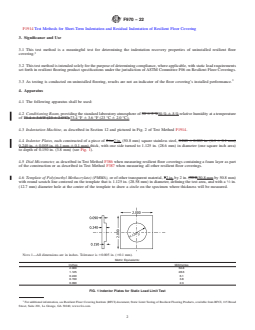
4.4 Indentor Plates, each constructed of a piece of 2-in.2 in. (50.8 mm) square stainless steel, 0.240 6 0.005 in. (6.1 6 0.1 mm)
0.240 in. 6 0.005 in. (6.1 mm 6 0.1 mm) thick, with one side turned to 1.125 in. (28.6 mm) in diameter (one square inch area)
to depth of 0.150 in. (3.8 mm) (see Fig. 1).
4.5 Dial Micrometer, as described in Test Method F386 when measuring resilient floor coverings containing a foam layer as part
of the construction or as described in Test Method F387 when measuring all other resilient floor coverings.
4.6 Template of Poly(methyl Methacrylate) (PMMA), or of other transparent material, 22 in. by 2 in. (50.8(50.8 mm by 50.8 mm)
with round scratch line centered on the template that is 1.125 in. (28.58 mm) in diameter, defining the test area, and with a ⁄2 in.
(12.7 mm) diameter hole at the center of the template to draw a circle on the specimen where thickness will be measured.
NOTE 1—All dimensions are in inches. Tolerance is 60.005 in. (60.1 mm).
Metric Equivalents:
Inches Millimetres
2.000 50.8
1.125 28.6
0.240 6.1
0.150 3.8
0.090 2.3
FIG. 1 Indentor Plates for Static Load Limit Test
For additional information, see Resilient Floor Covering Institute (RFCI) document, Static Limit Testing of Resilient Flooring Products, available from RFCI, 115 Broad
Street, Suite 201, La Grange, GA 30240, www.rfci.com.
F970 − 22
4.7 Die, 22 in. by 2 in. (50.8(50.8 mm by 50.8 mm) and press, papercutter, or equivalent to cut specimens to 22 in. by 2 in. size
(50.8(50.8 mm by 50.8 mm).
4.8 Optional—Open box without spring clips for 22 in. by 2 in. (50.8(50.8 mm by 50.8 mm) photographic slides, or equivalent,
to separate specimens during conditioning and recovery periods.
5. Sampling, Test Specimens and Test Units
5.1 The specimens shall be 22 in. by 2 in. (50.8(50.8 mm by 50.8 mm). The test unit shall consist of three specimens.
5.2 The central one square inch test area of each specimen should be free of mortar lines or other embossing lines, if possible.
If not possible, the largest flat, raised area should be centered on the specimen.
5.3 If the sample is nubble embossed, the specimen should be cut so that a nub is at the center of the specimen where the specimen
will be measured.
5.4 A circle slightly larger than the 0.250 in. (6.35 mm) diameter foot of the thickness gauge (4.5) is drawn on the wear layer at
the center of the specimen, using the PMMA template (4.6), to ensure that thickness measurements are made at the same spot.
6. Conditioning
6.1 Condition the test unit at least 16 h at 73.4 6 3.6°F (23.073.4 °F 6 3.6 °F (23.0 °C 6 2.0°C)2.0 °C) and
50 6 5 %50 % 6 5 % relative humidity and test in the same environment.
7. Procedures
7.1 Measure the initial thickness of each specimen, wear layer up, at the center of the specimen using the dial micrometer. Record
the value to the nearest 0.001 in. (0.025 mm) as T .
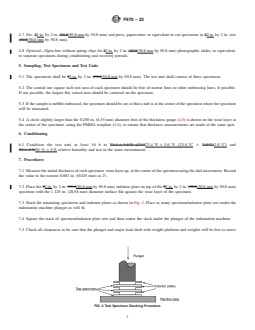
7.2 Place the 22 in. by 2 in. (50.8(50.8 mm by 50.8 mm) indentor plate on top of the 22 in. by 2 in. (50.8(50.8
...