

ASTM D7176-22
(Specification)Standard Specification for Non-Reinforced Polyvinyl Chloride (PVC) Geomembranes Used in Buried Applications
General Information
- Abstract
SCOPE
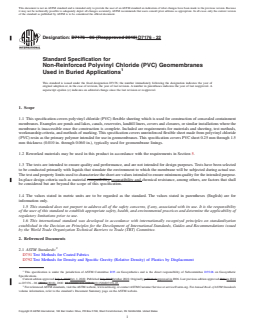
1.1 This specification covers polyvinyl chloride (PVC) flexible sheeting which is used for construction of concealed containment membranes. Examples are ponds and lakes, canals, reservoirs, landfill liners, covers and closures, or similar installations where the membrane is inaccessible once the construction is complete. Included are requirements for materials and sheeting, test methods, workmanship criteria, and methods of marking. This specification covers unreinforced flexible sheet made from polyvinyl chloride (PVC) resin as the primary polymer intended for use in geomembranes. This specification covers PVC sheet 0.25 mm through 1.5 mm thickness (0.010 in. through 0.060 in.), typically used for geomembrane linings.
1.2 Reworked materials may be used in this product in accordance with the requirements in Section 5.
1.3 The tests are intended to ensure quality and performance, and are not intended for design purposes. Tests have been selected to be conducted primarily with liquids that simulate the environment to which the membrane will be subjected during actual use. The test and property limits used to characterize the sheet are values intended to ensure minimum quality for the intended purpose. In-place design criteria such as material compatibility and chemical resistance, among others, are factors that shall be considered but are beyond the scope of this specification.
1.4 The values stated in metric units are to be regarded as the standard. The values stated in parentheses (English) are for information only.
1.5 This standard does not purport to address all of the safety concerns, if any, associated with its use. It is the responsibility of the user of this standard to establish appropriate safety, health, and environmental practices and determine the applicability of regulatory limitations prior to use.
1.6 This international standard was developed in accordance with internationally recognized principles on standardization established in the Decision on Principles for the Development of International Standards, Guides and Recommendations issued by the World Trade Organization Technical Barriers to Trade (TBT) Committee.
- Status
- Published
- Publication Date
- 30-Sep-2022
- Technical Committee
- D35 - Geosynthetics
- Drafting Committee
- D35.06 - Geosynthetic Specifications
Buy Documents
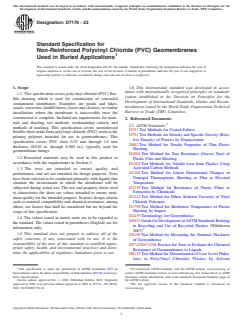
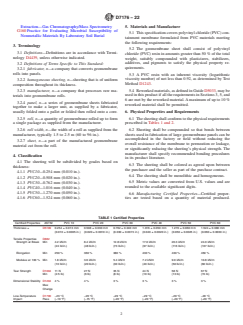
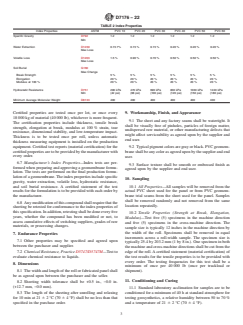
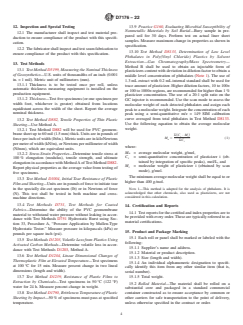
ASTM D7176-22 - Standard Specification for Non-Reinforced Polyvinyl Chloride (PVC) Geomembranes Used in Buried Applications
REDLINE ASTM D7176-22 - Standard Specification for Non-Reinforced Polyvinyl Chloride (PVC) Geomembranes Used in Buried Applications
Overview
ASTM D7176-22: Standard Specification for Non-Reinforced Polyvinyl Chloride (PVC) Geomembranes Used in Buried Applications provides requirements for flexible, unreinforced PVC sheeting used as concealed containment membranes in various engineered and environmental projects. This standard is essential for manufacturers, engineers, and contractors who require reliable performance from PVC geomembrane liners in installations that will become inaccessible after construction, such as landfill liners, reservoirs, canals, ponds, covers, and closures.
The standard addresses material composition, physical properties, test methods, production quality, and product marking for PVC geomembranes, ensuring consistency and minimum performance criteria in buried applications. The document also reflects internationally recognized principles for the standardization of geosynthetics.
Key Topics
Material Requirements:
- Geomembranes must be manufactured with polyvinyl chloride (PVC) resin as the primary polymer, making up over 50% of the sheet’s weight.
- Suitable additives such as plasticizers, stabilizers, and pigments are included.
- Reworked materials may be used up to specified limits if quality requirements are met.
Product Types:
- Non-reinforced, flexible PVC sheets ranging from 0.25 mm to 1.5 mm (0.010 to 0.060 in.) in thickness.
- Material grades are classified by thickness, from PVC10 to PVC60.
Physical and Mechanical Properties:
- Certified and index properties include tensile strength, elongation, tear resistance, dimensional stability, hydrostatic resistance, brittleness temperature, and others.
- Rigorous testing methods simulate environmental exposure and ensure minimum quality.
Workmanship and Appearance:
- PVC sheeting must be free from defects such as pinholes or foreign matter.
- Sheet finish (smooth or embossed) and color (e.g., gray or black) are determined by agreement between supplier and purchaser.
Sampling and Testing:
- Specimens for quality assurance are sampled randomly from each production lot.
- Testing frequency for key properties ensures ongoing compliance.
Certification and Marking:
- Test reports and material certifications are provided with each order.
- Rolls and panels are labeled with supplier information, dimensions, material designation, and weight.
Applications
ASTM D7176-22 compliant PVC geomembranes are essential in various applications requiring secure, flexible containment where post-installation access is difficult or impossible:
Water Containment:
- Lining ponds, lakes, canals, and reservoirs for agricultural, municipal, or industrial use.
Environmental Protection:
- Landfill liners and covers to prevent contamination and leakage.
- Closure systems for hazardous and non-hazardous waste sites.
Flood and Erosion Control:
- Flexible lining of channels and ditches.
General Civil Engineering:
- Concealed barriers for soil and water management in public and private facilities.
These geomembranes deliver long-term performance, chemical resistance, and water leakage prevention, making them ideal for demanding engineering environments.
Related Standards
Several referenced ASTM standards support the requirements and test methods specified in ASTM D7176-22, including:
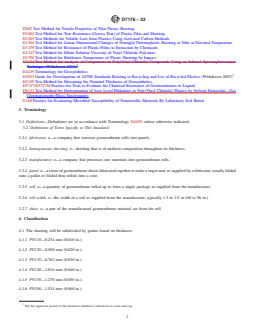
- ASTM D5199: Measuring Nominal Thickness of Geosynthetics
- ASTM D882: Tensile Properties of Thin Plastic Sheeting
- ASTM D1004: Tear Resistance of Plastic Film and Sheeting
- ASTM D1203 & D1204: Volatile Loss and Dimensional Change in Plastics
- ASTM D1239: Resistance to Extraction by Chemicals
- ASTM D1790: Brittleness Temperature of Plastic Sheeting
- ASTM D751: Hydrostatic Resistance Testing
- ASTM G160: Evaluating Microbial Susceptibility by Soil Burial
These and other referenced documents ensure repeatable testing and alignment with established industry practices for PVC geomembranes used in buried or inaccessible applications.
Relations
- Effective Date
- 01-Feb-2024
- Refers
ASTM D1203-23 - Standard Test Methods for Volatile Loss from Plastics Using Activated Carbon Methods - Effective Date
- 01-Nov-2023
- Refers
ASTM D1243-22e1 - Standard Test Method for Dilute Solution Viscosity of Vinyl Chloride Polymers - Effective Date
- 01-May-2022
- Effective Date
- 01-Apr-2020
- Refers
ASTM D5199-12(2019) - Standard Test Method for Measuring the Nominal Thickness of Geosynthetics - Effective Date
- 15-Jun-2019
- Effective Date
- 15-Mar-2019
- Effective Date
- 01-Nov-2018
- Effective Date
- 15-Apr-2018
- Effective Date
- 01-Aug-2017
- Effective Date
- 01-Aug-2017
- Refers
ASTM D1203-16 - Standard Test Methods for Volatile Loss From Plastics Using Activated Carbon Methods - Effective Date
- 01-Apr-2016
- Effective Date
- 01-Sep-2015
- Effective Date
- 01-Jul-2015
- Effective Date
- 01-Oct-2014
- Effective Date
- 01-Mar-2014
Buy Documents
ASTM D7176-22 - Standard Specification for Non-Reinforced Polyvinyl Chloride (PVC) Geomembranes Used in Buried Applications
REDLINE ASTM D7176-22 - Standard Specification for Non-Reinforced Polyvinyl Chloride (PVC) Geomembranes Used in Buried Applications
Get Certified
Connect with accredited certification bodies for this standard

Control Union Certifications
Global certification for agriculture and sustainability.

Hohenstein Institut
Textile testing and certification.

Bureau Veritas Bangladesh
Bureau Veritas certification services in Bangladesh.
Sponsored listings
Frequently Asked Questions
ASTM D7176-22 is a technical specification published by ASTM International. Its full title is "Standard Specification for Non-Reinforced Polyvinyl Chloride (PVC) Geomembranes Used in Buried Applications". This standard covers: SCOPE 1.1 This specification covers polyvinyl chloride (PVC) flexible sheeting which is used for construction of concealed containment membranes. Examples are ponds and lakes, canals, reservoirs, landfill liners, covers and closures, or similar installations where the membrane is inaccessible once the construction is complete. Included are requirements for materials and sheeting, test methods, workmanship criteria, and methods of marking. This specification covers unreinforced flexible sheet made from polyvinyl chloride (PVC) resin as the primary polymer intended for use in geomembranes. This specification covers PVC sheet 0.25 mm through 1.5 mm thickness (0.010 in. through 0.060 in.), typically used for geomembrane linings. 1.2 Reworked materials may be used in this product in accordance with the requirements in Section 5. 1.3 The tests are intended to ensure quality and performance, and are not intended for design purposes. Tests have been selected to be conducted primarily with liquids that simulate the environment to which the membrane will be subjected during actual use. The test and property limits used to characterize the sheet are values intended to ensure minimum quality for the intended purpose. In-place design criteria such as material compatibility and chemical resistance, among others, are factors that shall be considered but are beyond the scope of this specification. 1.4 The values stated in metric units are to be regarded as the standard. The values stated in parentheses (English) are for information only. 1.5 This standard does not purport to address all of the safety concerns, if any, associated with its use. It is the responsibility of the user of this standard to establish appropriate safety, health, and environmental practices and determine the applicability of regulatory limitations prior to use. 1.6 This international standard was developed in accordance with internationally recognized principles on standardization established in the Decision on Principles for the Development of International Standards, Guides and Recommendations issued by the World Trade Organization Technical Barriers to Trade (TBT) Committee.
SCOPE 1.1 This specification covers polyvinyl chloride (PVC) flexible sheeting which is used for construction of concealed containment membranes. Examples are ponds and lakes, canals, reservoirs, landfill liners, covers and closures, or similar installations where the membrane is inaccessible once the construction is complete. Included are requirements for materials and sheeting, test methods, workmanship criteria, and methods of marking. This specification covers unreinforced flexible sheet made from polyvinyl chloride (PVC) resin as the primary polymer intended for use in geomembranes. This specification covers PVC sheet 0.25 mm through 1.5 mm thickness (0.010 in. through 0.060 in.), typically used for geomembrane linings. 1.2 Reworked materials may be used in this product in accordance with the requirements in Section 5. 1.3 The tests are intended to ensure quality and performance, and are not intended for design purposes. Tests have been selected to be conducted primarily with liquids that simulate the environment to which the membrane will be subjected during actual use. The test and property limits used to characterize the sheet are values intended to ensure minimum quality for the intended purpose. In-place design criteria such as material compatibility and chemical resistance, among others, are factors that shall be considered but are beyond the scope of this specification. 1.4 The values stated in metric units are to be regarded as the standard. The values stated in parentheses (English) are for information only. 1.5 This standard does not purport to address all of the safety concerns, if any, associated with its use. It is the responsibility of the user of this standard to establish appropriate safety, health, and environmental practices and determine the applicability of regulatory limitations prior to use. 1.6 This international standard was developed in accordance with internationally recognized principles on standardization established in the Decision on Principles for the Development of International Standards, Guides and Recommendations issued by the World Trade Organization Technical Barriers to Trade (TBT) Committee.
ASTM D7176-22 is classified under the following ICS (International Classification for Standards) categories: 59.080.70 - Geotextiles. The ICS classification helps identify the subject area and facilitates finding related standards.
ASTM D7176-22 has the following relationships with other standards: It is inter standard links to ASTM D4439-24, ASTM D1203-23, ASTM D1243-22e1, ASTM D1204-14(2020), ASTM D5199-12(2019), ASTM G160-12(2019), ASTM D8133-18, ASTM D4439-18, ASTM D4439-17, ASTM D8133-17, ASTM D1203-16, ASTM D4439-15a, ASTM D4439-15, ASTM D1243-14, ASTM D1204-14. Understanding these relationships helps ensure you are using the most current and applicable version of the standard.
ASTM D7176-22 is available in PDF format for immediate download after purchase. The document can be added to your cart and obtained through the secure checkout process. Digital delivery ensures instant access to the complete standard document.
Standards Content (Sample)
This international standard was developed in accordance with internationally recognized principles on standardization established in the Decision on Principles for the
Development of International Standards, Guides and Recommendations issued by the World Trade Organization Technical Barriers to Trade (TBT) Committee.
Designation:D7176 −22
Standard Specification for
Non-Reinforced Polyvinyl Chloride (PVC) Geomembranes
Used in Buried Applications
This standard is issued under the fixed designation D7176; the number immediately following the designation indicates the year of
original adoption or, in the case of revision, the year of last revision.Anumber in parentheses indicates the year of last reapproval.A
superscript epsilon (´) indicates an editorial change since the last revision or reapproval.
1. Scope 1.6 This international standard was developed in accor-
dance with internationally recognized principles on standard-
1.1 Thisspecificationcoverspolyvinylchloride(PVC)flex-
ization established in the Decision on Principles for the
ible sheeting which is used for construction of concealed
Development of International Standards, Guides and Recom-
containment membranes. Examples are ponds and lakes,
mendations issued by the World Trade Organization Technical
canals,reservoirs,landfillliners,coversandclosures,orsimilar
Barriers to Trade (TBT) Committee.
installations where the membrane is inaccessible once the
construction is complete. Included are requirements for mate-
2. Referenced Documents
rials and sheeting, test methods, workmanship criteria, and
2.1 ASTM Standards:
methods of marking. This specification covers unreinforced
D751Test Methods for Coated Fabrics
flexible sheet made from polyvinyl chloride (PVC) resin as the
D792Test Methods for Density and Specific Gravity (Rela-
primary polymer intended for use in geomembranes. This
tive Density) of Plastics by Displacement
specification covers PVC sheet 0.25 mm through 1.5 mm
D882Test Method for Tensile Properties of Thin Plastic
thickness (0.010 in. through 0.060 in.), typically used for
Sheeting
geomembrane linings.
D1004Test Method for Tear Resistance (Graves Tear) of
1.2 Reworked materials may be used in this product in
Plastic Film and Sheeting
accordance with the requirements in Section 5.
D1203Test Methods for Volatile Loss from Plastics Using
Activated Carbon Methods
1.3 The tests are intended to ensure quality and
D1204Test Method for Linear Dimensional Changes of
performance, and are not intended for design purposes. Tests
Nonrigid Thermoplastic Sheeting or Film at Elevated
have been selected to be conducted primarily with liquids that
Temperature
simulate the environment to which the membrane will be
D1239Test Method for Resistance of Plastic Films to
subjected during actual use. The test and property limits used
Extraction by Chemicals
to characterize the sheet are values intended to ensure mini-
D1243Test Method for Dilute Solution Viscosity of Vinyl
mum quality for the intended purpose. In-place design criteria
Chloride Polymers
such as material compatibility and chemical resistance, among
D1790Test Method for Brittleness Temperature of Plastic
others, are factors that shall be considered but are beyond the
Sheeting by Impact
scope of this specification.
D4439Terminology for Geosynthetics
1.4 The values stated in metric units are to be regarded as
D5033GuideforDevelopmentofASTMStandardsRelating
the standard.The values stated in parentheses (English) are for
to Recycling and Use of Recycled Plastics (Withdrawn
information only.
2007)
1.5 This standard does not purport to address all of the
D5199Test Method for Measuring the Nominal Thickness
safety concerns, if any, associated with its use. It is the
of Geosynthetics
responsibility of the user of this standard to establish appro-
D5747/D5747MPractice for Tests to Evaluate the Chemical
priate safety, health, and environmental practices and deter-
Resistance of Geomembranes to Liquids
mine the applicability of regulatory limitations prior to use.
D8133Test Method for Determination of Low Level Phtha-
lates in Poly(Vinyl Chloride) Plastics by Solvent
1 2
This specification is under the jurisdiction of ASTM Committee D35 on For referenced ASTM standards, visit the ASTM website, www.astm.org, or
Geosynthetics and is the direct responsibility of Subcommittee D35.06 on Geosyn- contact ASTM Customer Service at service@astm.org. For Annual Book of ASTM
thetic Specifications. Standards volume information, refer to the standard’s Document Summary page on
Current edition approved Oct. 1, 2022. Published October 2022. Originally the ASTM website.
approved in 2006. Last previous edition approved in 2018 as D7176–06 (2018). The last approved version of this historical standard is referenced on
DOI: 10.1520/D7176-22. www.astm.org.
Copyright © ASTM International, 100 Barr Harbor Drive, PO Box C700, West Conshohocken, PA 19428-2959. United States
D7176−22
Extraction—Gas Chromatography/Mass Spectrometry 5. Materials and Manufacture
G160Practice for Evaluating Microbial Susceptibility of
5.1 This specification covers polyvinyl chloride (PVC) con-
Nonmetallic Materials By Laboratory Soil Burial
tainment membrane formulated from PVC materials meeting
the following requirements:
3. Terminology
5.2 The geomembrane sheet shall consist of polyvinyl
3.1 Definitions—Definitions are in accordance with Termi-
chloride (PVC) resin in amounts greater than 50% of the total
nology D4439, unless otherwise indicated.
weight, suitably compounded with plasticizers, stabilizers,
additives, and pigments to satisfy the physical property re-
3.2 Definitions of Terms Specific to This Standard:
quirements.
3.2.1 fabricator, n—a company that converts geomembrane
rolls into panels.
5.3 A PVC resin with an inherent viscosity (logarithmic
viscosity number) of not less than 0.92, as determined by Test
3.2.2 homogeneous sheeting, n—sheeting that is of uniform
Method D1243.
composition throughout its thickness.
5.4 Reworkedmaterials,asdefinedinGuideD5033,maybe
3.2.3 manufacturer, n—a company that processes raw ma-
usedinthisproductifalltherequirementsinSections3,5,and
terials into geomembrane rolls.
6 are met by the reworked material.Amaximum of up to 10%
3.2.4 panel, n—a series of geomembrane sheets fabricated
reworked material shall be permitted.
together to make a larger unit, as supplied by a fabricator,
usually folded onto a pallet or folded then rolled onto a core. 6. Physical Properties and Requirements
3.2.5 roll, n—a quantity of geomembrane rolled up to form 6.1 Thesheetingshallconformtothephysicalrequirements
a single package as supplied from the manufacturer. prescribed in Tables 1 and 2.
3.2.6 roll width, n—the width of a roll as supplied from the 6.2 Sheeting shall be compounded so that bonds between
manufacturer, typically 1.5 to 2.5 m (60 to 96 in.). sheets used in fabrication of large geomembrane panels can be
accomplished in the factory or field without reducing the
3.2.7 sheet, n—a part of the manufactured geomembrane
overall resistance of the membrane to permeation or leakage,
material cut from the roll.
or significantly reducing the sheeting’s physical strength. The
manufacturer shall specify recommended bonding procedures
4. Classification
in its product literature.
4.1 The sheeting will be subdivided by grades based on
6.3 The sheeting shall be colored as agreed upon between
thickness:
the purchaser and the seller as part of the purchase contract.
4.1.1 PVC10—0.254 mm (0.010 in.).
6.4 The sheeting shall be monolithic and homogeneous.
4.1.2 PVC20—0.508 mm (0.020 in.).
4.1.3 PVC30—0.762 mm (0.030 in.). 6.5 Metric values are converted from U.S. values and are
rounded to the available significant digits.
4.1.4 PVC40—1.016 mm (0.040 in.).
4.1.5 PVC50—1.270 mm (0.050 in.).
6.6 Manufacturing Certified Properties—Certified proper-
4.1.6 PVC60—1.524 mm (0.060 in.). ties are tested based on a quantity of material produced.
TABLE 1 Certified Properties
Certified Properties ASTM PVC 10 PVC 20 PVC 30 PVC 40 PVC 50 PVC 60
Thickness ± D5199 0.254 ± 0.013 mm 0.508 ± 0.030 mm 0.762 ± 0.040 mm 1.016 ± 0.050 mm 1.270 ± 0.060 mm 1.524 ± 0.080 mm
(0.010 ± 0.0005 in.) (0.020 ± 0.0010 in.) (0.030 ± 0.0015 in.) (0.040 ± 0.0020 in.) (0.050 ± 0.0025 in.) (0.060 ± 0.0030 in.)
Tensile Properties D882
Strength at Break Min 4.2 kN/m 8.4 kN/m 12.8 kN/m 17.0 kN/m 20.3 kN/m 24.0 kN/m
(24 lb/in.) (48 lb/in.) (73 lb/in.) (97 lb/in.) (116 lb/in.) (137 lb/in.)
Elongation Min 250 % 360 % 380 % 430 % 430 % 450 %
Modulus at 100 % Min 1.8 kN/m 3.6 kN/m 5.4 kN/m 7.2 kN/m 9.0 kN/m 10.8 kN/m
(10 lb/in.) (20 lb/in.) (30 lb/in.) (40 lb/in.) (50 lb/in.) (60 lb/in.)
Tear Strength D1004 11 N 27 N 35 N 44 N 58 N 67 N
Min (2.5 lb) (6 lb) (8 lb) (10 lb) (13 lb) (15 lb)
Dimensional Stability D1204 4% 4% 3% 3% 3% 3%
Max
Change
Low-Temperature D1790 –23 °C –26 °C –29 °C –29 °C –29 °C –29 °C
Impact Pass (–10 °F) (–15 °F) (–20 °F) (–20 °F) (–20 °F) (–20 °F)
D7176−22
TABLE 2 Index Properties
Index Properties ASTM PVC 10 PVC 20 PVC 30 PVC 40 PVC 50 PVC 60
Specific Gravity D792 1.2 1.2 1.2 1.2 1.2 1.2
Min
Water Extraction D1239 0.15 7% 0.15 % 0.15 % 0.20 % 0.20 % 0.20 %
Max Loss
Volatile Loss D1203 1.5 % 0.90 % 0.70 % 0.50 % 0.50 % 0.50 %
Max Loss
Soil Burial G160
Max Change
Break Strength 5 % 5 % 5 % 5 % 5 % 5 %
Elongation 20 % 20 % 20 % 20 % 20 % 20 %
Modulus at 100 % 20 % 20 % 20 % 20 % 20 % 20 %
Hydrostatic Resistance D751 290 kPa 470 kPa 690 kPa 830 kPa 1030 kPa 1240 kPa
Min (42 psi) (68 psi) (100 psi) (120 psi) (150 psi) (180 psi)
Minimum Average Molecular Weight D8133 400 400 400 400 400 400
Certified properties are tested once per lot, or once every 9. Workmanship, Finish, and Appearance
18000 kg of material (40000 lb), whichever is more frequent.
9.1 The sheet and any factory seams shall be watertight. It
The certification properties include thickness, tensile break
shall be visually free of pinholes, particles of foreign matter,
strength, elongation at break, modulus at 100% strain, tear
undispersed raw material, or other manufacturing defects that
resistance, dimensional stability, and low-temperature impact.
might affect serviceability as agreed upon by the supplier and
Thickness is to be tested once per roll, unless automatic
end user.
thickness meas
...
This document is not an ASTM standard and is intended only to provide the user of an ASTM standard an indication of what changes have been made to the previous version. Because
it may not be technically possible to adequately depict all changes accurately, ASTM recommends that users consult prior editions as appropriate. In all cases only the current version
of the standard as published by ASTM is to be considered the official document.
Designation: D7176 − 06 (Reapproved 2018) D7176 − 22
Standard Specification for
Non-Reinforced Polyvinyl Chloride (PVC) Geomembranes
Used in Buried Applications
This standard is issued under the fixed designation D7176; the number immediately following the designation indicates the year of
original adoption or, in the case of revision, the year of last revision. A number in parentheses indicates the year of last reapproval. A
superscript epsilon (´) indicates an editorial change since the last revision or reapproval.
1. Scope
1.1 This specification covers polyvinyl chloride (PVC) flexible sheeting which is used for construction of concealed containment
membranes. Examples are ponds and lakes, canals, reservoirs, landfill liners, covers and closures, or similar installations where the
membrane is inaccessible once the construction is complete. Included are requirements for materials and sheeting, test methods,
workmanship criteria, and methods of marking. This specification covers unreinforced flexible sheet made from polyvinyl chloride
(PVC) resin as the primary polymer intended for use in geomembranes. This specification covers PVC sheet 0.25 mm through 1.5
mm thickness (0.010 in. through 0.060 in.), typically used for geomembrane linings.
1.2 Reworked materials may be used in this product in accordance with the requirements in Section 5.
1.3 The tests are intended to ensure quality and performance, and are not intended for design purposes. Tests have been selected
to be conducted primarily with liquids that simulate the environment to which the membrane will be subjected during actual use.
The test and property limits used to characterize the sheet are values intended to ensure minimum quality for the intended purpose.
In-place design criteria such as material compatibility, compatibility and chemical resistance, among others, are factors that shall
be considered but are beyond the scope of this specification.
1.4 The values stated in metric units are to be regarded as the standard. The values stated in parentheses (English) are for
information only.
1.5 This standard does not purport to address all of the safety concerns, if any, associated with its use. It is the responsibility
of the user of this standard to establish appropriate safety, health, and environmental practices and determine the applicability of
regulatory limitations prior to use.
1.6 This international standard was developed in accordance with internationally recognized principles on standardization
established in the Decision on Principles for the Development of International Standards, Guides and Recommendations issued
by the World Trade Organization Technical Barriers to Trade (TBT) Committee.
2. Referenced Documents
2.1 ASTM Standards:
D751 Test Methods for Coated Fabrics
D792 Test Methods for Density and Specific Gravity (Relative Density) of Plastics by Displacement
This specification is under the jurisdiction of ASTM Committee D35 on Geosynthetics and is the direct responsibility of Subcommittee D35.06 on Geosynthetic
Specifications.
Current edition approved July 1, 2018Oct. 1, 2022. Published July 2018October 2022. Originally published approved in 2006. Last previous edition approved 2011 in 2018
as D7176 – 06 (2011).(2018). DOI: 10.1520/D7176-06R18.10.1520/D7176-22.
For referenced ASTM standards, visit the ASTM website, www.astm.org, or contact ASTM Customer Service at service@astm.org. For Annual Book of ASTM Standards
volume information, refer to the standard’s Document Summary page on the ASTM website.
Copyright © ASTM International, 100 Barr Harbor Drive, PO Box C700, West Conshohocken, PA 19428-2959. United States
D7176 − 22
D882 Test Method for Tensile Properties of Thin Plastic Sheeting
D1004 Test Method for Tear Resistance (Graves Tear) of Plastic Film and Sheeting
D1203 Test Methods for Volatile Loss from Plastics Using Activated Carbon Methods
D1204 Test Method for Linear Dimensional Changes of Nonrigid Thermoplastic Sheeting or Film at Elevated Temperature
D1239 Test Method for Resistance of Plastic Films to Extraction by Chemicals
D1243 Test Method for Dilute Solution Viscosity of Vinyl Chloride Polymers
D1790 Test Method for Brittleness Temperature of Plastic Sheeting by Impact
D2124 Test Method for Analysis of Components in Poly(Vinyl Chloride) Compounds Using an Infrared Spectrophotometric
Technique (Withdrawn 2020)
D4439 Terminology for Geosynthetics
D5033 Guide for Development of ASTM Standards Relating to Recycling and Use of Recycled Plastics (Withdrawn 2007)
D5199 Test Method for Measuring the Nominal Thickness of Geosynthetics
D5747/D5747M Practice for Tests to Evaluate the Chemical Resistance of Geomembranes to Liquids
D8133 Test Method for Determination of Low Level Phthalates in Poly(Vinyl Chloride) Plastics by Solvent Extraction—Gas
Chromatography/Mass Spectrometry
G160 Practice for Evaluating Microbial Susceptibility of Nonmetallic Materials By Laboratory Soil Burial
3. Terminology
3.1 Definitions—Definitions are in accordance with Terminology D4439, unless otherwise indicated.
3.2 Definitions of Terms Specific to This Standard:
3.2.1 fabricator, n—a company that converts geomembrane rolls into panels.
3.2.2 homogeneous sheeting, n—sheeting that is of uniform composition throughout its thickness.
3.2.3 manufacturer, n—a company that processes raw materials into geomembrane rolls.
3.2.4 panel, n—a series of geomembrane sheets fabricated together to make a larger unit, as supplied by a fabricator, usually folded
onto a pallet or folded then rolled onto a core.
3.2.5 roll, n—a quantity of geomembrane rolled up to form a single package as supplied from the manufacturer.
3.2.6 roll width, n—the width of a roll as supplied from the manufacturer, typically 1.5 to 2.5 m (60 to 96 in.).
3.2.7 sheet, n—a part of the manufactured geomembrane material cut from the roll.
4. Classification
4.1 The sheeting will be subdivided by grades based on thickness:
4.1.1 PVC10—0.254 mm (0.010 in.).
4.1.2 PVC20—0.508 mm (0.020 in.).
4.1.3 PVC30—0.762 mm (0.030 in.).
4.1.4 PVC40—1.016 mm (0.040 in.).
4.1.5 PVC50—1.270 mm (0.050 in.).
4.1.6 PVC60—1.524 mm (0.060 in.).
The last approved version of this historical standard is referenced on www.astm.org.
D7176 − 22
5. Materials and Manufacture
5.1 This specification covers polyvinyl chloride (PVC) containment membrane formulated from PVC materials meeting the
following requirements:
5.2 The geomembrane sheet shall consist of polyvinyl chloride (PVC) resin in amounts greater than 50 % of the total weight,
suitably compounded with plasticizers, stabilizers, additives, and pigments to satisfy the physical property requirements.
5.3 A PVC resin with an inherent viscosity (logarithmic viscosity number) of not less than 0.92, as determined by Test Method
D1243.
5.4 Reworked materials, as defined in Guide D5033, may be used in this product if all the requirements in Sections 3, 5, and 6
are met by the reworked material. A maximum of up to 10 % reworked material shall be permitted.
6. Physical Properties and Requirements
6.1 The sheeting shall conform to the physical requirements prescribed in Tables 1 and 2.
6.2 Sheeting shall be compounded so that bonds between sheets used in fabrication of large geomembrane panels can be
accomplished in the factory or field without reducing the overall resistance of the membrane to permeation or leakage, or
significantly reducing the sheeting’s physical strength. The manufacturer shall specify recommended bonding procedures in its
product literature.
6.3 The sheeting shall be colored as agreed upon between the purchaser and the seller as part of the purchase contract.
6.4 The sheeting shall be monolithic and homogeneous.
6.5 Metric values are converted from U.S. values and are rounded to the available significant digits.
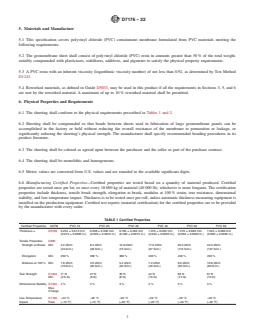
6.6 Manufacturing Certified Properties—Certified properties are tested based on a quantity of material produced. Certified
properties are tested once per lot, or once every 18 000 kg of material (40 000 lb), whichever is more frequent. The certification
properties include thickness, tensile break strength, elongation at break, modulus at 100 % strain, tear resistance, dimensional
stability, and low-temperature impact. Thickness is to be tested once per roll, unless automatic thickness measuring equipment is
installed on the production equipment. Certified test reports (material certification) for the certified properties are to be provided
by the manufacturer with every order.
TABLE 1 Certified Properties
Certified Properties ASTM PVC 10 PVC 20 PVC 30 PVC 40 PVC 50 PVC 60
Thickness ± D5199 0.254 ± 0.013 mm 0.508 ± 0.030 mm 0.762 ± 0.040 mm 1.016 ± 0.050 mm 1.270 ± 0.060 mm 1.524 ± 0.080 mm
(0.010 ± 0.0005 in.) (0.020 ± 0.0010 in.) (0.030 ± 0.0015 in.) (0.040 ± 0.0020 in.) (0.050 ± 0.0025 in.) (0.060 ± 0.0030 in.)
Tensile Properties D882
Strength at Break Min 4.2 kN/m 8.4 kN/m 12.8 kN/m 17.0 kN/m 20.3 kN/m 24.0 kN/m
(24 lb/in.) (48 lb/in.) (73 lb/in.) (97 lb/in.) (116 lb/in.) (137 lb/in.)
Elongation Min 250 % 360 % 380 % 430 % 430 % 450 %
Modulus at 100 % Min 1.8 kN/m 3.6 kN/m 5.4 kN/m 7.2 kN/m 9.0 kN/m 10.8 kN/m
(10 lb/in.) (20 lb/in.) (30 lb/in.) (40 lb/in.) (50 lb/in.) (60 lb/in.)
Tear Strength D1004 11 N 27 N 35 N 44 N 58 N 67 N
Min (2.5 lb) (6 lb) (8 lb) (10 lb) (13 lb) (15 lb)
Dimensional Stability D1204 4 % 4 % 3 % 3 % 3 % 3 %
Max
Change
Low-Temperature D1790 –23 °C –26 °C –29 °C –29 °C –29 °C –29 °C
Impact Pass (–10 °F) (–15 °F) (–20 °F) (–20 °F) (–20 °F) (–20 °F)
D7176 − 22
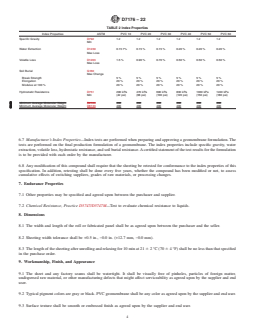
TABLE 2 Index Properties
Index Properties ASTM PVC 10 PVC 20 PVC 30 PVC 40 PVC 50 PVC 60
Specific Gravity D792 1.2 1.2 1.2 1.2 1.2 1.2
Min
Water Extraction D1239 0.15 7% 0.15 % 0.15 % 0.20 % 0.20 % 0.20 %
Max Loss
Volatile Loss D1203 1.5 % 0.90 % 0.70 % 0.50 % 0.50 % 0.50 %
Max Loss
Soil Burial G160
Max Change
Break Strength 5 % 5 % 5 % 5 % 5 % 5 %
Elongation 20 % 20 % 20 % 20 % 20 % 20 %
Modulus at 100 % 20 % 20 % 20 % 20 % 20 % 20 %
Hydrostatic Resistance D751 290 kPa 470 kPa 690 kPa 830 kPa 1030 kPa 1240 kPa
Min (42 psi) (68 psi) (100 psi) (120 psi) (150 psi) (180 psi)
Minimum Average Molecular Weight D2124 400 400 400 400 400 400
Minimum Average Molecular Weight D813
...