

ASTM D4969-17(2022)
(Specification)Standard Specification for Polytetrafluoroethylene–(PTFE) Coated Glass Fabric
General Information
- Abstract
ABSTRACT
This specification covers glass fabric impregnated, coated, and sintered on both sides with PTFE to a specified maximum nominal thickness. It does not pertain to structural fabric, single-sided PTFE coatings, or materials used for laminates. The PTFE-coated glass fabric is for electrical, chemical, and mechanical uses. The base material used in the manufacture of the products of this specification shall be a woven glass fabric. The glass fabric is impregnated or coated with polytetrafluoroethylene. When necessary, additives are used to aid the dispersion to achieve the required properties and performance of the final product. The glass fabric shall be tested for color, thickness, breaking strength, edge tear, conductivity, percent PTFE, smoothness, and porosity.
SCOPE
1.1 This specification covers glass fabric impregnated, coated, and sintered on both sides with PTFE to a nominal thickness of 0.318 mm (0.015 in.) or less.
1.2 The PTFE-coated glass fabric is for electrical, chemical, and mechanical uses.
1.3 The PTFE-coated glass fabric of this specification does not pertain to structural fabric, single-sided PTFE coatings, or materials used for laminates.
1.4 The values stated in SI units as detailed in IEEE/ASTM SI-10.
Note 1: There is no ISO standard that covers information included in this specification. The dielectric test is mentioned in ISO 12086-2 and ISO 13000-1 and -2.
1.5 This international standard was developed in accordance with internationally recognized principles on standardization established in the Decision on Principles for the Development of International Standards, Guides and Recommendations issued by the World Trade Organization Technical Barriers to Trade (TBT) Committee.
- Status
- Published
- Publication Date
- 30-Apr-2022
- Technical Committee
- D20 - Plastics
- Drafting Committee
- D20.15 - Thermoplastic Materials
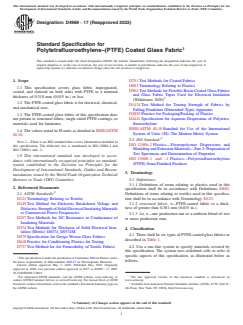

Overview
ASTM D4969-17(2022), Standard Specification for Polytetrafluoroethylene–(PTFE) Coated Glass Fabric, provides requirements for woven glass fabric that is impregnated, coated, and sintered on both sides with PTFE, up to a maximum nominal thickness of 0.318 mm (0.015 in). This standard, issued by ASTM International, outlines specifications for both the glass fabric base and PTFE coating, ensuring suitability for a range of electrical, chemical, and mechanical applications that demand the unique properties of PTFE-coated glass fabrics. It is not intended for structural fabrics, single-sided coatings, or materials for laminates.
Key Topics
- Material Scope: The specification covers only glass fabrics that are both impregnated and coated on both sides with PTFE, excluding single-sided coatings or structural fabrics.
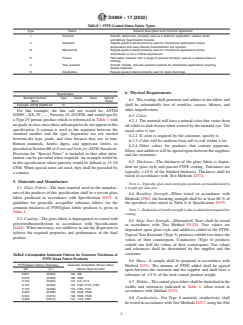
- Types of PTFE-Coated Glass Fabrics: The standard classifies six main types based on properties and applications:
- Type I: Premium - defect-free, for dielectric and specialized release applications
- Type II: Standard - mechanical and thermal applications
- Type III: Mechanical - robust, less demanding on smoothness
- Type IV: Porous - permeable, ideal as release sheets in molding
- Type V: Tear Resistant - flexible and strong for demanding settings
- Type VI: Conductive - for static discharge applications
- Performance Requirements: Materials are assessed for:
- Color consistency
- Thickness within defined tolerances
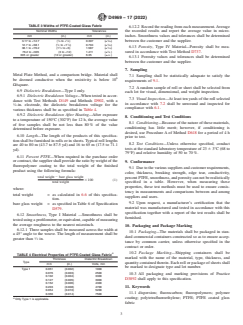
- Breaking strength (≥ 80% of the specified value)
- Edge tear resistance
- Conductivity (for Type VI)
- PTFE content by weight
- Surface smoothness (Type I)
- Porosity (Type IV)
- Testing and Inspection: Standardized ASTM methods are referenced for quality assurance-including tests for dielectric breakdown voltage, air permeability, and physical measurements.
- Production and Quality: Only woven glass fabrics are used as substrates, and when necessary, additives enhance dispersion for required performance.
- Packaging and Marking: Materials are to be shipped in containers suitable for commercial transport, and each shipment must be clearly marked with material type, thickness, quantity, and lot number.
Applications
PTFE-coated glass fabrics in accordance with ASTM D4969-17(2022) are recognized for their unique combination of mechanical strength, high-temperature resistance, chemical inertness, and dielectric properties. Common application areas include:
- Electrical insulation: Used in high-performance cables, dielectric barriers, and substrates in electronics due to excellent non-conductivity and thermal properties.
- Release sheets and liners: Ideal for molding operations in the plastics and rubber industries, thanks to their non-stick and temperature-resistant surface.
- Mechanical components: Employed as flexible, tear-resistant sheets in demanding environments requiring chemical and abrasion resistance.
- Chemical processing: Utilized for linings and gaskets where both chemical resistance and mechanical durability are essential.
- Antistatic and ESD protection: Type VI (conductive) fabrics are used in situations where static discharge control is necessary.
Related Standards
Several ASTM and international standards provide supporting terminology, test methods, or material specifications relevant to PTFE-coated glass fabrics:
- ASTM D883: Terminology relating to plastics
- ASTM D123: Terminology relating to textiles
- ASTM D149: Test method for dielectric breakdown voltage
- ASTM D257: Test methods for DC resistance or conductance of insulating materials
- ASTM D579: Specification for greige woven glass fabrics
- ASTM D902: Test methods for flexible resin-coated electrical insulation (withdrawn)
- ASTM D737: Test method for air permeability of textile fabrics
- ASTM D751: Test methods for coated fabrics
- ISO 12086-2 and ISO 13000-1/-2: International references for fluoropolymer dispersions and PTFE semi-finished products (note: these do not duplicate the full scope of ASTM D4969-17)
In summary, ASTM D4969-17(2022) standardizes the requirements for PTFE-coated glass fabrics, ensuring consistency and performance for industries relying on the unique benefits of PTFE and glass fabric composites.
Relations
- Effective Date
- 01-Feb-2024
- Effective Date
- 01-Nov-2023
- Effective Date
- 01-Jan-2020
- Effective Date
- 01-Jan-2020
- Effective Date
- 01-Aug-2019
- Effective Date
- 15-Apr-2019
- Effective Date
- 01-Feb-2019
- Effective Date
- 01-Dec-2018
- Effective Date
- 01-Nov-2018
- Effective Date
- 15-Aug-2017
- Effective Date
- 01-Mar-2017
- Effective Date
- 01-Jul-2016
- Effective Date
- 15-Sep-2015
- Effective Date
- 01-Sep-2015
- Effective Date
- 01-Sep-2015
Get Certified
Connect with accredited certification bodies for this standard

Control Union Certifications
Global certification for agriculture and sustainability.

Hohenstein Institut
Textile testing and certification.

Bureau Veritas Bangladesh
Bureau Veritas certification services in Bangladesh.
Sponsored listings
Frequently Asked Questions
ASTM D4969-17(2022) is a technical specification published by ASTM International. Its full title is "Standard Specification for Polytetrafluoroethylene–(PTFE) Coated Glass Fabric". This standard covers: ABSTRACT This specification covers glass fabric impregnated, coated, and sintered on both sides with PTFE to a specified maximum nominal thickness. It does not pertain to structural fabric, single-sided PTFE coatings, or materials used for laminates. The PTFE-coated glass fabric is for electrical, chemical, and mechanical uses. The base material used in the manufacture of the products of this specification shall be a woven glass fabric. The glass fabric is impregnated or coated with polytetrafluoroethylene. When necessary, additives are used to aid the dispersion to achieve the required properties and performance of the final product. The glass fabric shall be tested for color, thickness, breaking strength, edge tear, conductivity, percent PTFE, smoothness, and porosity. SCOPE 1.1 This specification covers glass fabric impregnated, coated, and sintered on both sides with PTFE to a nominal thickness of 0.318 mm (0.015 in.) or less. 1.2 The PTFE-coated glass fabric is for electrical, chemical, and mechanical uses. 1.3 The PTFE-coated glass fabric of this specification does not pertain to structural fabric, single-sided PTFE coatings, or materials used for laminates. 1.4 The values stated in SI units as detailed in IEEE/ASTM SI-10. Note 1: There is no ISO standard that covers information included in this specification. The dielectric test is mentioned in ISO 12086-2 and ISO 13000-1 and -2. 1.5 This international standard was developed in accordance with internationally recognized principles on standardization established in the Decision on Principles for the Development of International Standards, Guides and Recommendations issued by the World Trade Organization Technical Barriers to Trade (TBT) Committee.
ABSTRACT This specification covers glass fabric impregnated, coated, and sintered on both sides with PTFE to a specified maximum nominal thickness. It does not pertain to structural fabric, single-sided PTFE coatings, or materials used for laminates. The PTFE-coated glass fabric is for electrical, chemical, and mechanical uses. The base material used in the manufacture of the products of this specification shall be a woven glass fabric. The glass fabric is impregnated or coated with polytetrafluoroethylene. When necessary, additives are used to aid the dispersion to achieve the required properties and performance of the final product. The glass fabric shall be tested for color, thickness, breaking strength, edge tear, conductivity, percent PTFE, smoothness, and porosity. SCOPE 1.1 This specification covers glass fabric impregnated, coated, and sintered on both sides with PTFE to a nominal thickness of 0.318 mm (0.015 in.) or less. 1.2 The PTFE-coated glass fabric is for electrical, chemical, and mechanical uses. 1.3 The PTFE-coated glass fabric of this specification does not pertain to structural fabric, single-sided PTFE coatings, or materials used for laminates. 1.4 The values stated in SI units as detailed in IEEE/ASTM SI-10. Note 1: There is no ISO standard that covers information included in this specification. The dielectric test is mentioned in ISO 12086-2 and ISO 13000-1 and -2. 1.5 This international standard was developed in accordance with internationally recognized principles on standardization established in the Decision on Principles for the Development of International Standards, Guides and Recommendations issued by the World Trade Organization Technical Barriers to Trade (TBT) Committee.
ASTM D4969-17(2022) is classified under the following ICS (International Classification for Standards) categories: 59.080.40 - Coated fabrics. The ICS classification helps identify the subject area and facilitates finding related standards.
ASTM D4969-17(2022) has the following relationships with other standards: It is inter standard links to ASTM D883-24, ASTM D883-23, ASTM D883-20, ASTM D149-20, ASTM D883-19c, ASTM D883-19a, ASTM D883-19, ASTM D883-18a, ASTM D883-18, ASTM D883-17, ASTM D123-17, ASTM D737-04(2016), ASTM D123-15b, ASTM D123-15a, ASTM D3892-15. Understanding these relationships helps ensure you are using the most current and applicable version of the standard.
ASTM D4969-17(2022) is available in PDF format for immediate download after purchase. The document can be added to your cart and obtained through the secure checkout process. Digital delivery ensures instant access to the complete standard document.
Standards Content (Sample)
This international standard was developed in accordance with internationally recognized principles on standardization established in the Decision on Principles for the
Development of International Standards, Guides and Recommendations issued by the World Trade Organization Technical Barriers to Trade (TBT) Committee.
Designation:D4969 −17 (Reapproved 2022)
Standard Specification for
Polytetrafluoroethylene–(PTFE) Coated Glass Fabric
This standard is issued under the fixed designation D4969; the number immediately following the designation indicates the year of
original adoption or, in the case of revision, the year of last revision. A number in parentheses indicates the year of last reapproval. A
superscript epsilon (´) indicates an editorial change since the last revision or reapproval.
1. Scope D751 Test Methods for Coated Fabrics
D883 Terminology Relating to Plastics
1.1 This specification covers glass fabric impregnated,
D902 Test Methods for Flexible Resin-Coated Glass Fabrics
coated, and sintered on both sides with PTFE to a nominal
and Glass Fabric Tapes Used for Electrical Insulation
thickness of 0.318 mm (0.015 in.) or less.
(Withdrawn 2020)
1.2 The PTFE-coated glass fabric is for electrical, chemical,
D1424 Test Method for Tearing Strength of Fabrics by
and mechanical uses.
Falling-Pendulum (Elmendorf-Type) Apparatus
D3892 Practice for Packaging/Packing of Plastics
1.3 The PTFE-coated glass fabric of this specification does
not pertain to structural fabric, single-sided PTFE coatings, or D4441 Specification for Aqueous Dispersions of Polytetra-
fluoroethylene
materials used for laminates.
IEEE/ASTM SI-10 Standard for Use of the International
1.4 The values stated in SI units as detailed in IEEE/ASTM
System of Units (SI): The Modern Metric System
SI-10.
2.2 ISO Standard:
NOTE 1—There is no ISO standard that covers information included in
ISO 12086-2 Plastics—Fluoropolymer Dispersions and
this specification. The dielectric test is mentioned in ISO 12086-2 and
MouldingandExtrusionMaterials—Part2:Preparationof
ISO 13000-1 and -2.
Test Specimens and Determination of Properties
1.5 This international standard was developed in accor-
ISO 13000-1 and -2 Plastics—Polytetrafluoroethylene
dance with internationally recognized principles on standard-
(PTFE) Semi-Finished Products
ization established in the Decision on Principles for the
Development of International Standards, Guides and Recom-
3. Terminology
mendations issued by the World Trade Organization Technical
Barriers to Trade (TBT) Committee. 3.1 Definitions:
3.1.1 Definitions of terms relating to plastics used in this
2. Referenced Documents
specification shall be in accordance with Definitions D883.
2.1 ASTM Standards: Definitions of terms relating to textiles used in this specifica-
D123 Terminology Relating to Textiles tion shall be in accordance with Terminology D123.
D149 Test Method for Dielectric Breakdown Voltage and 3.1.2 structural fabric, n—PTFE-coated fabric to a thick-
DielectricStrengthofSolidElectricalInsulatingMaterials ness of greater than 0.381 mm (0.015 in.).
at Commercial Power Frequencies
3.1.3 lot, n—one production run or a uniform blend of two
D257 Test Methods for DC Resistance or Conductance of
or more production runs.
Insulating Materials
D374 Test Methods for Thickness of Solid Electrical Insu-
4. Classification
lation (Metric) D0374_D0374M
4.1 There shall be six types of PTFE-coated glass fabrics as
D579 Specification for Greige Woven Glass Fabrics
described in Table 1.
D618 Practice for Conditioning Plastics for Testing
D737 Test Method for Air Permeability of Textile Fabrics 4.2 Use a one-line system to specify materials covered by
this specification. The system uses redefined cells to refer to
specific aspects of this specification, as illustrated below as
This specification is under the jurisdiction of Committee D20 on Plastics and is
follows.
the direct responsibility of Subcommittee D20.15 on Thermoplastic Materials.
Current edition approved May 1, 2022. Published May 2022. Originally
approved in 1989. Last previous edition approved in 2017 as D4969 – 17. DOI:
10.1520/D4969-17R22.
2 3
For referenced ASTM standards, visit the ASTM website, www.astm.org, or The last approved version of this historical standard is referenced on
contact ASTM Customer Service at service@astm.org. For Annual Book of ASTM www.astm.org.
Standards volume information, refer to the standard’s Document Summary page on Available fromAmerican National Standards Institute (ANSI), 25 W. 43rd St.,
the ASTM website. 4th Floor, New York, NY 10036, http://www.ansi.org.
*A Summary of Changes section appears at the end of this standard
Copyright © ASTM International, 100 Barr Harbor Drive, PO Box C700, West Conshohocken, PA 19428-2959. United States
D4969−17 (2022)
TABLE 1 PTFE-Coated Glass Fabric Types
Type Name General Description and Common Application
I Premium Smooth, defect-free, primarily used as a dielectric application, release sheet,
and Military Specification material.
II Standard Regular-grade material primarily used for mechanical applications where
temperature and easy-release characteristics are required.
III Mechanical Regular-grade material primarily used for mechanical applications where
smoothness is not a critical requirement.
IV Porous Permeable material, with a range of porosity primarily used as a release sheet in
molding.
V Tear resistant Smooth, flexible, and tear-resistant material for mechanical applications requiring
flexible materials.
VI Conductive Regular-grade material primarily used for static discharge.
6. Physical Requirements
Specification
Standard Number Type Grade Class Special
6.1 The coating shall penetrate and adhere to the fabric and
Block Notes
Example: ASTM D4969-XX IV – – , shall be substantially free of wrinkles, creases, blisters, and
other imperfections.
For this example, the line call out would be: ASTM
D4969 – XX, IV– – , Porosity 15–30 CFM, and would specify
6.2 Color:
a Type IV porous product which is referenced in Table 1 with
6.2.1 The material will have a natural color that varies from
nogradeorclasssincethesesubcategoriesdonotappearinthis
off-white to dark brown when viewed by the unaided eye. The
specification. A comma is used as the separator between the
usual color is tan.
standard number and the type. Separators are not needed
6.2.2 If color is required by the customer, specify it.
between the type, grade, and class because they are, in turn,
6.2.3 Color will be uniform from roll to roll within a lot.
Roman numerals, Arabic digits, and uppercase letters, as
6.2.4 Other colors for products that contain pigments,
providedinSectionB8of Form and Style forASTM Standards.
fillers, and additives will be agreed upon between the suppliers
Provision for “Special Notes” is included so that other infor-
and the customers.
mation can be provided when required. An example would be
6.3 Thickness—The thickness of the glass fabric is depen-
in this specification where porosity would be defined as 15–30
dent on glass style and percent PTFE coating. Tolerances are
CFM. When special notes are used, they shall be preceded by
typically 610 % of the finished thickness. Thickness shall be
a comma.
tested in accordance with Test Methods D374.
5. Materials and Manufacture
NOTE2—Typically,glassandcoatedglassproductsaremanufacturedto
a weight per unit area.
5.1 Glass Fabric—The base material used in the manufac-
ture of the products of this specification shall be a woven glass
6.4 Breaking Strength—When tested in accordance with
fabric produced in accordance with Specification D579.A
Methods D902, the breaking strength shall be at least 80 % of
guideline for generally acceptable substrate fabrics for the
the specified value stated in Table 6 of Specification D579.
common thickness of PTFE/glass fabr
...