

ASTM F3072-14(2020)
(Guide)Standard Guide for Intermediate Wilderness GPS/GNSS Use (GPS/GNSS-IIW) Endorsement
General Information
- Abstract
SIGNIFICANCE AND USE
4.1 This guide establishes the minimum knowledge, skills, and abilities required to use a GPS/GNSS receiver to navigate in the wilderness. A person trained to this guide shall be endorsed for Intermediate Wilderness GPS/GNSS Use (GPS/GNSS-IIW Endorsed).
4.1.1 Every person who is endorsed for Intermediate Wilderness GPS/GNSS Use shall have met the requirements of this guide.
4.2 This guide is the second level of training for wilderness GPS/GNSS use, and only establishes the minimum knowledge, skills, and abilities required for a person to navigate with a GPS/GNSS receiver in a wilderness environment. No other skills are included or implied.
4.3 In addition to meeting the requirements of this guide, a person endorsed for Intermediate Wilderness GPS/GNSS Use shall also be adequately trained to travel and work in a wilderness environment.
4.4 Depending on the regulations or policies of the AHJ, additional knowledge, skills, or abilities may be required before a person who meets the requirements in this guide may use a GPS/GNSS receiver to navigate in a wilderness environment.
4.4.1 Nothing in this guide precludes an AHJ from adding additional requirements for its own members.
4.5 This guide by itself is not a complete training document. It only specifies the knowledge, skills, and abilities required for an individual to be endorsed for Intermediate Wilderness GPS/GNSS Use. This guide may, however, be used in the development of, or as part of, a complete training document or program.
4.6 Though this guide establishes only minimum training, it does not imply that a person endorsed for Intermediate Wilderness GPS/GNSS Use is a “trainee,” “probationary,” or other similar term member of an organization. The AHJ is responsible for determining the requirements and qualifications for member or employee ratings.
4.7 This guide can be used to evaluate a document to determine if its content includes the necessary topics for training a person to be endorsed ...
SCOPE
1.1 This guide establishes the minimum knowledge, skills, and abilities required to use a GPS/GNSS2 receiver to navigate in the wilderness.
1.2 This guide applies to the use of a GPS/GNSS receiver on land, on and off roads, and on small bodies of water, wherever GPS/GNSS signals can be received.
1.3 This guide applies to the use of a GPS/GNSS receiver in disaster areas where local positioning aids or references may be lost or damaged.
1.4 This guide does not apply to the use of a GPS/GNSS receiver on large bodies of water, at sea, or in the air.
1.5 This guide does not imply that a GPS/GNSS receiver is a replacement for a map and compass. Use of the latter is strongly recommended as a backup for GPS/GNSS navigation.
1.6 This standard does not purport to address all of the safety concerns, if any, associated with its use. It is the responsibility of the user of this standard to establish appropriate safety, health, and environmental practices and determine the applicability of regulatory limitations prior to use.
1.7 This international standard was developed in accordance with internationally recognized principles on standardization established in the Decision on Principles for the Development of International Standards, Guides and Recommendations issued by the World Trade Organization Technical Barriers to Trade (TBT) Committee.
- Status
- Published
- Publication Date
- 31-Mar-2020
- Technical Committee
- F32 - Search and Rescue
- Drafting Committee
- F32.03 - Personnel, Training and Education


Overview
ASTM F3072-14(2020), Standard Guide for Intermediate Wilderness GPS/GNSS Use (GPS/GNSS-IIW) Endorsement, establishes the minimum knowledge, skills, and abilities needed to use a GPS/GNSS receiver for navigation in wilderness environments. Published by ASTM International, this guide serves as the second level of training for those who require reliable navigation across land, off-road, and small bodies of water, specifically where GPS/GNSS signals are accessible. The standard is a useful reference for individuals, organizations, and authorities having jurisdiction (AHJ) looking to evaluate or develop robust training programs for wilderness navigation.
Key Topics
This internationally recognized guide covers several fundamental and practical areas for wilderness GPS/GNSS operation:
- Minimum Competency Requirements: Specifies essential knowledge, skills, and abilities for effective use of GPS/GNSS receivers.
- Applicable Environments: Focuses on use in land-based and small-waterbody wilderness settings, including disaster areas where conventional navigation aids may be lost or damaged.
- Scope Limitations: Not intended for navigation on large bodies of water, at sea, or in aerial environments.
- Use of Backup Tools: Emphasizes that GPS/GNSS receivers should not replace traditional navigation methods such as map and compass, which are strongly recommended as backups.
- Assessment and Certification: Outlines methods (written/oral exams, demonstrations) for evaluating individuals seeking GPS/GNSS-IIW endorsement.
- Customization by AHJ: Allows regulatory organizations to add requirements beyond the standard's scope to better suit their operational needs.
Applications
This standard has valuable applications in a range of domains where wilderness navigation is critical:
- Search and Rescue Operations: Teams and individuals can use this guide to ensure reliable navigation in unfamiliar or hazardous terrain, particularly where other aids are unavailable or destroyed.
- Field Research and Environmental Surveys: Researchers, wildlife biologists, and environmental professionals benefit from standardized GPS/GNSS navigation skills when working off-grid.
- Outdoor Recreation and Expedition Leaders: Hikers, campers, mountaineers, and guides can use this standard to demonstrate proficiency and ensure group safety during remote area travel.
- Disaster Response: Emergency personnel deploying in post-disaster zones can maintain effective mobility and coordination when landmarks and infrastructure are compromised.
- Training Program Development: Organizations can use this guide to build or assess comprehensive training curricula to certify members or employees in intermediate wilderness GPS/GNSS use.
Related Standards
ASTM F3072-14(2020) references and complements several other important ASTM standards:
- ASTM F1633: Guide for Techniques in Land Search (withdrawn, but historically referenced for terminology and techniques).
- ASTM F1773: Terminology relating to climbing, mountaineering, search and rescue equipment, and practices.
- ASTM F2209: Guide for Training of Land Search Team Members.
- ASTM F3071: Guide for Basic Wilderness GPS/GNSS Use (GPS/GNSS-IW) Endorsement, which is a prerequisite for the intermediate standard.
Summary
ASTM F3072-14(2020) is a critical standard for organizations and individuals needing validated skills in GPS/GNSS-based navigation for wilderness environments. By specifying the minimum requirements for intermediate use, it helps promote safe, effective, and consistent navigation practices across search and rescue operations, outdoor leadership, research, and disaster response. For anyone seeking to establish or improve their wilderness navigation credentials, or to implement or assess a GPS/GNSS training program, this standard delivers clear, internationally recognized guidance.
Relations
- Effective Date
- 01-Apr-2020
- Effective Date
- 01-Dec-2015
- Effective Date
- 01-May-2010
- Effective Date
- 01-Oct-2009
- Effective Date
- 01-Nov-2008
- Effective Date
- 01-May-2004
- Effective Date
- 01-Nov-2003
- Effective Date
- 10-Apr-2003
- Effective Date
- 10-Jul-1997
- Refers
ASTM F1773-97 - Standard Terminology Relating to Climbing and Mountaineering Equipment and Practices - Effective Date
- 01-Jan-1997
- Effective Date
- 01-Apr-2020
- Effective Date
- 01-Apr-2020
- Effective Date
- 01-Apr-2020
- Effective Date
- 01-Apr-2020
Get Certified
Connect with accredited certification bodies for this standard

ANCE
Mexican certification and testing association.

Intertek Slovenia
Intertek testing, inspection, and certification services in Slovenia.

LNE (Laboratoire National de Métrologie et d'Essais)
French national laboratory for metrology and testing.
Sponsored listings
Frequently Asked Questions
ASTM F3072-14(2020) is a guide published by ASTM International. Its full title is "Standard Guide for Intermediate Wilderness GPS/GNSS Use (GPS/GNSS-IIW) Endorsement". This standard covers: SIGNIFICANCE AND USE 4.1 This guide establishes the minimum knowledge, skills, and abilities required to use a GPS/GNSS receiver to navigate in the wilderness. A person trained to this guide shall be endorsed for Intermediate Wilderness GPS/GNSS Use (GPS/GNSS-IIW Endorsed). 4.1.1 Every person who is endorsed for Intermediate Wilderness GPS/GNSS Use shall have met the requirements of this guide. 4.2 This guide is the second level of training for wilderness GPS/GNSS use, and only establishes the minimum knowledge, skills, and abilities required for a person to navigate with a GPS/GNSS receiver in a wilderness environment. No other skills are included or implied. 4.3 In addition to meeting the requirements of this guide, a person endorsed for Intermediate Wilderness GPS/GNSS Use shall also be adequately trained to travel and work in a wilderness environment. 4.4 Depending on the regulations or policies of the AHJ, additional knowledge, skills, or abilities may be required before a person who meets the requirements in this guide may use a GPS/GNSS receiver to navigate in a wilderness environment. 4.4.1 Nothing in this guide precludes an AHJ from adding additional requirements for its own members. 4.5 This guide by itself is not a complete training document. It only specifies the knowledge, skills, and abilities required for an individual to be endorsed for Intermediate Wilderness GPS/GNSS Use. This guide may, however, be used in the development of, or as part of, a complete training document or program. 4.6 Though this guide establishes only minimum training, it does not imply that a person endorsed for Intermediate Wilderness GPS/GNSS Use is a “trainee,” “probationary,” or other similar term member of an organization. The AHJ is responsible for determining the requirements and qualifications for member or employee ratings. 4.7 This guide can be used to evaluate a document to determine if its content includes the necessary topics for training a person to be endorsed ... SCOPE 1.1 This guide establishes the minimum knowledge, skills, and abilities required to use a GPS/GNSS2 receiver to navigate in the wilderness. 1.2 This guide applies to the use of a GPS/GNSS receiver on land, on and off roads, and on small bodies of water, wherever GPS/GNSS signals can be received. 1.3 This guide applies to the use of a GPS/GNSS receiver in disaster areas where local positioning aids or references may be lost or damaged. 1.4 This guide does not apply to the use of a GPS/GNSS receiver on large bodies of water, at sea, or in the air. 1.5 This guide does not imply that a GPS/GNSS receiver is a replacement for a map and compass. Use of the latter is strongly recommended as a backup for GPS/GNSS navigation. 1.6 This standard does not purport to address all of the safety concerns, if any, associated with its use. It is the responsibility of the user of this standard to establish appropriate safety, health, and environmental practices and determine the applicability of regulatory limitations prior to use. 1.7 This international standard was developed in accordance with internationally recognized principles on standardization established in the Decision on Principles for the Development of International Standards, Guides and Recommendations issued by the World Trade Organization Technical Barriers to Trade (TBT) Committee.
SIGNIFICANCE AND USE 4.1 This guide establishes the minimum knowledge, skills, and abilities required to use a GPS/GNSS receiver to navigate in the wilderness. A person trained to this guide shall be endorsed for Intermediate Wilderness GPS/GNSS Use (GPS/GNSS-IIW Endorsed). 4.1.1 Every person who is endorsed for Intermediate Wilderness GPS/GNSS Use shall have met the requirements of this guide. 4.2 This guide is the second level of training for wilderness GPS/GNSS use, and only establishes the minimum knowledge, skills, and abilities required for a person to navigate with a GPS/GNSS receiver in a wilderness environment. No other skills are included or implied. 4.3 In addition to meeting the requirements of this guide, a person endorsed for Intermediate Wilderness GPS/GNSS Use shall also be adequately trained to travel and work in a wilderness environment. 4.4 Depending on the regulations or policies of the AHJ, additional knowledge, skills, or abilities may be required before a person who meets the requirements in this guide may use a GPS/GNSS receiver to navigate in a wilderness environment. 4.4.1 Nothing in this guide precludes an AHJ from adding additional requirements for its own members. 4.5 This guide by itself is not a complete training document. It only specifies the knowledge, skills, and abilities required for an individual to be endorsed for Intermediate Wilderness GPS/GNSS Use. This guide may, however, be used in the development of, or as part of, a complete training document or program. 4.6 Though this guide establishes only minimum training, it does not imply that a person endorsed for Intermediate Wilderness GPS/GNSS Use is a “trainee,” “probationary,” or other similar term member of an organization. The AHJ is responsible for determining the requirements and qualifications for member or employee ratings. 4.7 This guide can be used to evaluate a document to determine if its content includes the necessary topics for training a person to be endorsed ... SCOPE 1.1 This guide establishes the minimum knowledge, skills, and abilities required to use a GPS/GNSS2 receiver to navigate in the wilderness. 1.2 This guide applies to the use of a GPS/GNSS receiver on land, on and off roads, and on small bodies of water, wherever GPS/GNSS signals can be received. 1.3 This guide applies to the use of a GPS/GNSS receiver in disaster areas where local positioning aids or references may be lost or damaged. 1.4 This guide does not apply to the use of a GPS/GNSS receiver on large bodies of water, at sea, or in the air. 1.5 This guide does not imply that a GPS/GNSS receiver is a replacement for a map and compass. Use of the latter is strongly recommended as a backup for GPS/GNSS navigation. 1.6 This standard does not purport to address all of the safety concerns, if any, associated with its use. It is the responsibility of the user of this standard to establish appropriate safety, health, and environmental practices and determine the applicability of regulatory limitations prior to use. 1.7 This international standard was developed in accordance with internationally recognized principles on standardization established in the Decision on Principles for the Development of International Standards, Guides and Recommendations issued by the World Trade Organization Technical Barriers to Trade (TBT) Committee.
ASTM F3072-14(2020) is classified under the following ICS (International Classification for Standards) categories: 33.070.40 - Satellite. The ICS classification helps identify the subject area and facilitates finding related standards.
ASTM F3072-14(2020) has the following relationships with other standards: It is inter standard links to ASTM F3072-14, ASTM F1773-09(2015), ASTM F2209-10, ASTM F1773-09, ASTM F1633-97(2008), ASTM F1773-97(2004), ASTM F1633-97(2003), ASTM F2209-03, ASTM F1633-97, ASTM F1773-97, ASTM F2685-14(2022), ASTM F3144-15(2022), ASTM F3070-14(2022), ASTM F3221-16. Understanding these relationships helps ensure you are using the most current and applicable version of the standard.
ASTM F3072-14(2020) is available in PDF format for immediate download after purchase. The document can be added to your cart and obtained through the secure checkout process. Digital delivery ensures instant access to the complete standard document.
Standards Content (Sample)
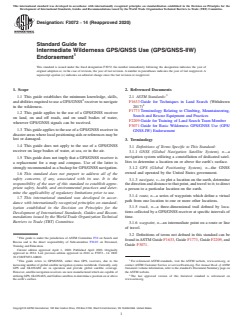
This international standard was developed in accordance with internationally recognized principles on standardization established in the Decision on Principles for the
Development of International Standards, Guides and Recommendations issued by the World Trade Organization Technical Barriers to Trade (TBT) Committee.
Designation: F3072 − 14 (Reapproved 2020)
Standard Guide for
Intermediate Wilderness GPS/GNSS Use (GPS/GNSS-IIW)
Endorsement
This standard is issued under the fixed designation F3072; the number immediately following the designation indicates the year of
original adoption or, in the case of revision, the year of last revision. A number in parentheses indicates the year of last reapproval. A
superscript epsilon (´) indicates an editorial change since the last revision or reapproval.
1. Scope 2. Referenced Documents
1.1 This guide establishes the minimum knowledge, skills,
2.1 ASTM Standards:
and abilities required to use a GPS/GNSS receiver to navigate F1633 Guide for Techniques in Land Search (Withdrawn
in the wilderness.
2017)
F1773 Terminology Relating to Climbing, Mountaineering,
1.2 This guide applies to the use of a GPS/GNSS receiver
Search and Rescue Equipment and Practices
on land, on and off roads, and on small bodies of water,
F2209 Guide for Training of Land Search Team Member
wherever GPS/GNSS signals can be received.
F3071 Guide for Basic Wilderness GPS/GNSS Use (GPS/
1.3 This guide applies to the use of a GPS/GNSS receiver in
GNSS-IW) Endorsement
disasterareaswherelocalpositioningaidsorreferencesmaybe
lost or damaged.
3. Terminology
1.4 This guide does not apply to the use of a GPS/GNSS
3.1 Definitions of Terms Specific to This Standard:
receiver on large bodies of water, at sea, or in the air.
3.1.1 GNSS (Global Navigation Satellite System), n—a
navigation system utilizing a constellation of dedicated satel-
1.5 This guide does not imply that a GPS/GNSS receiver is
lites to determine a location on or above the earth’s surface.
a replacement for a map and compass. Use of the latter is
strongly recommended as a backup for GPS/GNSS navigation.
3.1.2 GPS (Global Positioning System), n—the GNSS
owned and operated by the United States government.
1.6 This standard does not purport to address all of the
safety concerns, if any, associated with its use. It is the
3.1.3 navigate, v—to plot a location on the earth, determine
responsibility of the user of this standard to establish appro-
thedirectionanddistancetothatpoint,andtraveltoit;todirect
priate safety, health, and environmental practices and deter-
a person to a particular location on the earth.
mine the applicability of regulatory limitations prior to use.
3.1.4 route, n—a series of waypoints which define a virtual
1.7 This international standard was developed in accor-
path from one location to one or more other locations.
dance with internationally recognized principles on standard-
3.1.5 track, n—a three-dimensional trail defined by loca-
ization established in the Decision on Principles for the
tions collected by a GPS/GNSS receiver at specific intervals of
Development of International Standards, Guides and Recom-
time.
mendations issued by the World Trade Organization Technical
Barriers to Trade (TBT) Committee.
3.1.6 waypoint, n—an intermediate point on a route or line
of travel.
3.2 Definitions of terms not defined in this standard can be
This guide is under the jurisdiction of ASTM Committee F32 on Search and
found inASTM Guide F1633, Guide F1773, Guide F2209, and
Rescue and is the direct responsibility of Subcommittee F32.03 on Personnel,
Guide F3071.
Training and Education.
Current edition approved April 1, 2020. Published April 2020. Originally
approved in 2014. Last previous edition approved in 2014 as F3072 – 14. DOI:
10.1520/F3072-14R20.
2 3
This guide refers to GPS/GNSS, rather than GPS, receivers, due to the For referenced ASTM standards, visit the ASTM website, www.astm.org, or
increasing number of global satellite navigation systems worldwide. Currently, only contact ASTM Customer Service at service@astm.org. For Annual Book of ASTM
GPS and GLONASS are in operation and provide global satellite coverage. Standards volume information, refer to the standard’s Document Summary page on
However, satellite navigation receivers are now manufactured which are capable of the ASTM website.
utilizingGPS,GLONASS,andGalileosatellitestodetermineapositiononorabove The last approved version of this historical standard is referenced on
the earth’s surface. www.astm.org.
Copyright © ASTM International, 100 Barr Harbor Drive, PO Box C700, West Conshohocken, PA 19428-2959. United States
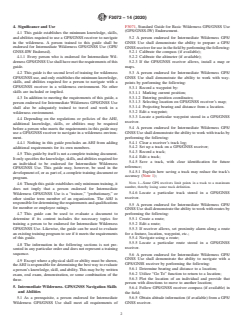
F3072 − 14 (2020)
4. Significance and Use F3071, Standard Guide for Basic Wilderness GPS/GNSS Use
(GPS/GNSS-IW) Endorsement.
4.1 This guide establishes the minimum knowledge, skills,
and abilities required to use a GPS/GNSS receiver to navigate 5.2 A person endorsed for Intermediate Wilderness GPS/
in the wilderness. A person trained to this guide shall be GNSS Use shall demonstrate the ability to prepare a GPS/
endorsed for Intermediate Wilderness GPS/GNSS Use (GPS/ GNSSreceiverforuseinthefieldbyperformingthefollowing:
GNSS-IIW Endorsed). 5.2.1 Calibrate the compass (if available);
4.1.1 Every person who is endorsed for Intermediate Wil-
5.2.2 Calibrate the altimeter (if available);
dernessGPS/GNSSUseshallhavemettherequirementsofthis 5.2.3 If the GPS/GNSS receiver allows, install a map or
guide.
maps.
4.2 This guide is the second level of training for wilderness
5.3 A person endorsed for Intermediate Wilderness GPS/
GPS/GNSS use, and only establishes the minimum knowledge,
GNSS Use shall demonstrate the
...