

ASTM D7414-22
(Test Method)Standard Test Method for Condition Monitoring of Oxidation in In-Service Petroleum and Hydrocarbon Based Lubricants by Trend Analysis Using Fourier Transform Infrared (FT-IR) Spectrometry
General Information
- Abstract
SIGNIFICANCE AND USE
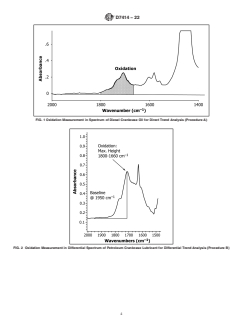
5.1 A large number of compounds, such as aldehydes, ketones, esters, and carboxylic acids, are produced when oils react with atmospheric oxygen. Oxidation is measured using a common FT-IR spectral feature between 1800 cm–1 and 1670 cm–1 caused by the absorption of the carbonyl group present in most oxidation compounds. These oxidation products may lead to increased viscosity (causing oil thickening problems), acidity (causing acidic corrosion), and formation of sludge and varnish (leading to filter plugging, fouling of critical oil clearances and valve friction). Monitoring of oxidation products is therefore an important parameter in determining overall machinery health and should be considered in conjunction with data from other tests such as atomic emission (AE) and atomic absorption (AA) spectroscopy for wear metal analysis (Test Method D5185) and physical property tests (Test Methods D445), base reserve (Test Method D2896 and D4739), acid number tests (Test Methods D664 and D974) and other FT-IR oil analysis methods for nitration (Test Method D7624), sulfate by-products (Test Method D7415), and additive depletion (Test Method D7412), which also assess elements of the oil’s condition, see Refs (1-6).
SCOPE
1.1 This test method covers monitoring oxidation in in-service petroleum and hydrocarbon based lubricants such as in diesel crankcase, motor, hydraulic, gear and compressor oils, as well as other types of lubricants that are prone to oxidation.
1.2 This test method uses Fourier Transform Infrared (FT-IR) spectrometry for monitoring build-up of oxidation products in in-service petroleum and hydrocarbon based lubricants as a result of normal machinery operation. Petroleum and hydrocarbon based lubricants react with oxygen in the air to form a number of different chemical species, including aldehydes, ketones, esters, and carboxylic acids. This test method is designed as a fast, simple spectroscopic check for monitoring of oxidation in in-service petroleum and hydrocarbon based lubricants with the objective of helping diagnose the operational condition of the machine based on measuring the level of oxidation in the oil.
1.3 Acquisition of FT-IR spectral data for measuring oxidation in in-service oil and lubricant samples is described in Practice D7418. In this test method, measurement and data interpretation parameters for oxidation using both direct trend analysis and differential (spectral subtraction) trend analysis are presented.
1.4 This test method is based on trending of spectral changes associated with oxidation of in-service petroleum and hydrocarbon based lubricants. Warnings or alarm limits can be set on the basis of a fixed minimum value for a single measurement or, alternatively, can be based on a rate of change of the response measured, see Ref (1).2
1.4.1 For direct trend analysis, values are recorded directly from absorption spectra and reported in units of absorbance per 0.1 mm pathlength.
1.4.2 For differential trend analysis, values are recorded from the differential spectra (spectrum obtained by subtraction of the absorption spectrum of the reference oil from that of the in-service oil) and reported in units of 100*absorbance per 0.1 mm pathlength (or equivalently absorbance units per centimetre).
1.4.3 In either case, maintenance action limits should be determined through statistical analysis, history of the same or similar equipment, round robin tests, or other methods in conjunction with the correlation of oxidation changes to equipment performance.
Note 1: It is not the intent of this test method to establish or recommend normal, cautionary, warning, or alert limits for any machinery. Such limits should be established in conjunction with advice and guidance from the machinery manufacturer and maintenance group.
1.5 This test method is for petroleum and hydrocarbon based lubricants and is not applicable for ester based oils, including polyol es...
- Status
- Published
- Publication Date
- 30-Sep-2022
- Technical Committee
- D02 - Petroleum Products, Liquid Fuels, and Lubricants
Buy Documents
ASTM D7414-22 - Standard Test Method for Condition Monitoring of Oxidation in In-Service Petroleum and Hydrocarbon Based Lubricants by Trend Analysis Using Fourier Transform Infrared (FT-IR) Spectrometry
REDLINE ASTM D7414-22 - Standard Test Method for Condition Monitoring of Oxidation in In-Service Petroleum and Hydrocarbon Based Lubricants by Trend Analysis Using Fourier Transform Infrared (FT-IR) Spectrometry
Overview
ASTM D7414-22 is the Standard Test Method for Condition Monitoring of Oxidation in In-Service Petroleum and Hydrocarbon Based Lubricants by Trend Analysis Using Fourier Transform Infrared (FT-IR) Spectrometry. Developed by ASTM International, this standard outlines procedures for evaluating the oxidative degradation of lubricants during service through FT-IR spectrometric analysis. It is a key tool for monitoring oil condition, supporting effective predictive maintenance strategies, and improving the operational health of machinery by detecting the buildup of oxidation products such as aldehydes, ketones, esters, and carboxylic acids.
Key Topics
Oxidation Monitoring by FT-IR
This test method measures the presence of oxidation products in lubricants, which result when oils interact with atmospheric oxygen. The critical FT-IR spectral region for analysis is between 1800 cm⁻¹ and 1670 cm⁻¹, which relates to the carbonyl group commonly present in oxidation compounds.Direct and Differential Trend Analysis
- Direct trend analysis records values directly from the absorption spectra.
- Differential trend analysis involves comparing the spectra of in-service oil to reference oil (fresh oil), reporting the values based on the difference.
Implications of Oxidation
Elevated levels of oxidation products can lead to:- Increased oil viscosity (oil thickening)
- Higher acidity (potential for acidic corrosion)
- Formation of sludge and varnish (filter plugging, fouling, and valve friction) Monitoring these changes is essential for timely maintenance actions and prolonging machinery life.
Data Interpretation and Action Limits
The standard provides guidelines for trending oxidation levels and emphasizes that maintenance action limits should be established based on statistical analysis, historical machine data, and manufacturer recommendations.
Applications
ASTM D7414-22 is applicable to a broad range of in-service petroleum and hydrocarbon-based lubricants including:
- Diesel engine crankcase oils
- Motor oils
- Hydraulic fluids
- Gear oils
- Compressor lubricants
Common practical applications:
- Machinery Health Monitoring: Early detection of lubricant degradation prevents equipment failure and costly downtime.
- Predictive Maintenance Programs: Integrates with other monitoring techniques such as wear metal analysis (using AE or AA spectroscopy), viscosity testing, base reserves, and acid number tests for comprehensive oil condition assessment.
- Industrial and Automotive Maintenance: Ensures optimal performance and longevity of engines and industrial machinery by tracking oxidation trends and identifying when oil changes or corrective actions are required.
This method is not suitable for ester-based oils, including polyol or phosphate esters.
Related Standards
Several other ASTM standards complement ASTM D7414-22 and offer a robust framework for oil condition monitoring:
- ASTM D445 - Test Method for Kinematic Viscosity
- ASTM D664 / D974 - Acid Number Testing
- ASTM D2896 / D4739 - Base Number Testing
- ASTM D5185 - Wear Metal Analysis by ICP-AES
- ASTM D7412 - Monitoring Phosphate Antiwear Additives by FT-IR
- ASTM D7415 - Monitoring Sulfate By-Products by FT-IR
- ASTM D7418 - Practice for Set-Up and Operation of FT-IR for Oil Condition Monitoring
- ASTM D7624 - Monitoring Nitration by FT-IR
These related standards can be used alongside ASTM D7414-22 for a comprehensive lubricant condition monitoring program, enhancing machinery reliability and maintenance efficiency.
Keywords: ASTM D7414, FT-IR spectrometry, lubricant oxidation monitoring, oil condition, predictive maintenance, machinery health, hydrocarbon lubricants, trend analysis, in-service oil analysis, lubricant degradation, industrial maintenance.
Relations
- Effective Date
- 01-Apr-2024
- Refers
ASTM D4175-23a - Standard Terminology Relating to Petroleum Products, Liquid Fuels, and Lubricants - Effective Date
- 15-Dec-2023
- Effective Date
- 01-Nov-2023
- Refers
ASTM D4175-23e1 - Standard Terminology Relating to Petroleum Products, Liquid Fuels, and Lubricants - Effective Date
- 01-Jul-2023
- Effective Date
- 01-Apr-2018
- Effective Date
- 01-May-2017
- Effective Date
- 15-Dec-2016
- Effective Date
- 01-Dec-2014
- Effective Date
- 01-Jul-2014
- Effective Date
- 01-Jul-2014
- Effective Date
- 01-May-2014
- Effective Date
- 01-May-2013
- Effective Date
- 01-May-2013
- Effective Date
- 15-Apr-2012
- Effective Date
- 15-Apr-2012
Buy Documents
ASTM D7414-22 - Standard Test Method for Condition Monitoring of Oxidation in In-Service Petroleum and Hydrocarbon Based Lubricants by Trend Analysis Using Fourier Transform Infrared (FT-IR) Spectrometry
REDLINE ASTM D7414-22 - Standard Test Method for Condition Monitoring of Oxidation in In-Service Petroleum and Hydrocarbon Based Lubricants by Trend Analysis Using Fourier Transform Infrared (FT-IR) Spectrometry
Get Certified
Connect with accredited certification bodies for this standard

Element Materials Technology
Materials testing and product certification.

ABS Group Brazil
ABS Group certification services in Brazil.

ABS Quality Evaluations Inc.
American Bureau of Shipping quality certification.
Sponsored listings
Frequently Asked Questions
ASTM D7414-22 is a standard published by ASTM International. Its full title is "Standard Test Method for Condition Monitoring of Oxidation in In-Service Petroleum and Hydrocarbon Based Lubricants by Trend Analysis Using Fourier Transform Infrared (FT-IR) Spectrometry". This standard covers: SIGNIFICANCE AND USE 5.1 A large number of compounds, such as aldehydes, ketones, esters, and carboxylic acids, are produced when oils react with atmospheric oxygen. Oxidation is measured using a common FT-IR spectral feature between 1800 cm–1 and 1670 cm–1 caused by the absorption of the carbonyl group present in most oxidation compounds. These oxidation products may lead to increased viscosity (causing oil thickening problems), acidity (causing acidic corrosion), and formation of sludge and varnish (leading to filter plugging, fouling of critical oil clearances and valve friction). Monitoring of oxidation products is therefore an important parameter in determining overall machinery health and should be considered in conjunction with data from other tests such as atomic emission (AE) and atomic absorption (AA) spectroscopy for wear metal analysis (Test Method D5185) and physical property tests (Test Methods D445), base reserve (Test Method D2896 and D4739), acid number tests (Test Methods D664 and D974) and other FT-IR oil analysis methods for nitration (Test Method D7624), sulfate by-products (Test Method D7415), and additive depletion (Test Method D7412), which also assess elements of the oil’s condition, see Refs (1-6). SCOPE 1.1 This test method covers monitoring oxidation in in-service petroleum and hydrocarbon based lubricants such as in diesel crankcase, motor, hydraulic, gear and compressor oils, as well as other types of lubricants that are prone to oxidation. 1.2 This test method uses Fourier Transform Infrared (FT-IR) spectrometry for monitoring build-up of oxidation products in in-service petroleum and hydrocarbon based lubricants as a result of normal machinery operation. Petroleum and hydrocarbon based lubricants react with oxygen in the air to form a number of different chemical species, including aldehydes, ketones, esters, and carboxylic acids. This test method is designed as a fast, simple spectroscopic check for monitoring of oxidation in in-service petroleum and hydrocarbon based lubricants with the objective of helping diagnose the operational condition of the machine based on measuring the level of oxidation in the oil. 1.3 Acquisition of FT-IR spectral data for measuring oxidation in in-service oil and lubricant samples is described in Practice D7418. In this test method, measurement and data interpretation parameters for oxidation using both direct trend analysis and differential (spectral subtraction) trend analysis are presented. 1.4 This test method is based on trending of spectral changes associated with oxidation of in-service petroleum and hydrocarbon based lubricants. Warnings or alarm limits can be set on the basis of a fixed minimum value for a single measurement or, alternatively, can be based on a rate of change of the response measured, see Ref (1).2 1.4.1 For direct trend analysis, values are recorded directly from absorption spectra and reported in units of absorbance per 0.1 mm pathlength. 1.4.2 For differential trend analysis, values are recorded from the differential spectra (spectrum obtained by subtraction of the absorption spectrum of the reference oil from that of the in-service oil) and reported in units of 100*absorbance per 0.1 mm pathlength (or equivalently absorbance units per centimetre). 1.4.3 In either case, maintenance action limits should be determined through statistical analysis, history of the same or similar equipment, round robin tests, or other methods in conjunction with the correlation of oxidation changes to equipment performance. Note 1: It is not the intent of this test method to establish or recommend normal, cautionary, warning, or alert limits for any machinery. Such limits should be established in conjunction with advice and guidance from the machinery manufacturer and maintenance group. 1.5 This test method is for petroleum and hydrocarbon based lubricants and is not applicable for ester based oils, including polyol es...
SIGNIFICANCE AND USE 5.1 A large number of compounds, such as aldehydes, ketones, esters, and carboxylic acids, are produced when oils react with atmospheric oxygen. Oxidation is measured using a common FT-IR spectral feature between 1800 cm–1 and 1670 cm–1 caused by the absorption of the carbonyl group present in most oxidation compounds. These oxidation products may lead to increased viscosity (causing oil thickening problems), acidity (causing acidic corrosion), and formation of sludge and varnish (leading to filter plugging, fouling of critical oil clearances and valve friction). Monitoring of oxidation products is therefore an important parameter in determining overall machinery health and should be considered in conjunction with data from other tests such as atomic emission (AE) and atomic absorption (AA) spectroscopy for wear metal analysis (Test Method D5185) and physical property tests (Test Methods D445), base reserve (Test Method D2896 and D4739), acid number tests (Test Methods D664 and D974) and other FT-IR oil analysis methods for nitration (Test Method D7624), sulfate by-products (Test Method D7415), and additive depletion (Test Method D7412), which also assess elements of the oil’s condition, see Refs (1-6). SCOPE 1.1 This test method covers monitoring oxidation in in-service petroleum and hydrocarbon based lubricants such as in diesel crankcase, motor, hydraulic, gear and compressor oils, as well as other types of lubricants that are prone to oxidation. 1.2 This test method uses Fourier Transform Infrared (FT-IR) spectrometry for monitoring build-up of oxidation products in in-service petroleum and hydrocarbon based lubricants as a result of normal machinery operation. Petroleum and hydrocarbon based lubricants react with oxygen in the air to form a number of different chemical species, including aldehydes, ketones, esters, and carboxylic acids. This test method is designed as a fast, simple spectroscopic check for monitoring of oxidation in in-service petroleum and hydrocarbon based lubricants with the objective of helping diagnose the operational condition of the machine based on measuring the level of oxidation in the oil. 1.3 Acquisition of FT-IR spectral data for measuring oxidation in in-service oil and lubricant samples is described in Practice D7418. In this test method, measurement and data interpretation parameters for oxidation using both direct trend analysis and differential (spectral subtraction) trend analysis are presented. 1.4 This test method is based on trending of spectral changes associated with oxidation of in-service petroleum and hydrocarbon based lubricants. Warnings or alarm limits can be set on the basis of a fixed minimum value for a single measurement or, alternatively, can be based on a rate of change of the response measured, see Ref (1).2 1.4.1 For direct trend analysis, values are recorded directly from absorption spectra and reported in units of absorbance per 0.1 mm pathlength. 1.4.2 For differential trend analysis, values are recorded from the differential spectra (spectrum obtained by subtraction of the absorption spectrum of the reference oil from that of the in-service oil) and reported in units of 100*absorbance per 0.1 mm pathlength (or equivalently absorbance units per centimetre). 1.4.3 In either case, maintenance action limits should be determined through statistical analysis, history of the same or similar equipment, round robin tests, or other methods in conjunction with the correlation of oxidation changes to equipment performance. Note 1: It is not the intent of this test method to establish or recommend normal, cautionary, warning, or alert limits for any machinery. Such limits should be established in conjunction with advice and guidance from the machinery manufacturer and maintenance group. 1.5 This test method is for petroleum and hydrocarbon based lubricants and is not applicable for ester based oils, including polyol es...
ASTM D7414-22 is classified under the following ICS (International Classification for Standards) categories: 75.100 - Lubricants, industrial oils and related products. The ICS classification helps identify the subject area and facilitates finding related standards.
ASTM D7414-22 has the following relationships with other standards: It is inter standard links to ASTM D445-24, ASTM D4175-23a, ASTM D445-23, ASTM D4175-23e1, ASTM D5185-18, ASTM D664-11a(2017), ASTM D445-16, ASTM D974-14e1, ASTM D445-14e1, ASTM D445-14, ASTM E177-14, ASTM E691-13, ASTM E177-13, ASTM D445-12, ASTM D974-12. Understanding these relationships helps ensure you are using the most current and applicable version of the standard.
ASTM D7414-22 is available in PDF format for immediate download after purchase. The document can be added to your cart and obtained through the secure checkout process. Digital delivery ensures instant access to the complete standard document.
Standards Content (Sample)
This international standard was developed in accordance with internationally recognized principles on standardization established in the Decision on Principles for the
Development of International Standards, Guides and Recommendations issued by the World Trade Organization Technical Barriers to Trade (TBT) Committee.
Designation: D7414 − 22
Standard Test Method for
Condition Monitoring of Oxidation in In-Service Petroleum
and Hydrocarbon Based Lubricants by Trend Analysis
Using Fourier Transform Infrared (FT-IR) Spectrometry
This standard is issued under the fixed designation D7414; the number immediately following the designation indicates the year of
original adoption or, in the case of revision, the year of last revision. A number in parentheses indicates the year of last reapproval. A
superscript epsilon (´) indicates an editorial change since the last revision or reapproval.
1. Scope* 1.4.2 For differential trend analysis, values are recorded
from the differential spectra (spectrum obtained by subtraction
1.1 This test method covers monitoring oxidation in in-
of the absorption spectrum of the reference oil from that of the
service petroleum and hydrocarbon based lubricants such as in
in-service oil) and reported in units of 100*absorbance per
diesel crankcase, motor, hydraulic, gear and compressor oils,
0.1 mm pathlength (or equivalently absorbance units per cen-
as well as other types of lubricants that are prone to oxidation.
timetre).
1.2 This test method uses Fourier Transform Infrared (FT-
1.4.3 In either case, maintenance action limits should be
IR)spectrometryformonitoringbuild-upofoxidationproducts
determined through statistical analysis, history of the same or
in in-service petroleum and hydrocarbon based lubricants as a
similar equipment, round robin tests, or other methods in
result of normal machinery operation. Petroleum and hydro-
conjunction with the correlation of oxidation changes to
carbon based lubricants react with oxygen in the air to form a
equipment performance.
number of different chemical species, including aldehydes,
NOTE 1—It is not the intent of this test method to establish or
ketones, esters, and carboxylic acids. This test method is
recommendnormal,cautionary,warning,oralertlimitsforanymachinery.
designed as a fast, simple spectroscopic check for monitoring
Suchlimitsshouldbeestablishedinconjunctionwithadviceandguidance
of oxidation in in-service petroleum and hydrocarbon based
from the machinery manufacturer and maintenance group.
lubricants with the objective of helping diagnose the opera-
1.5 This test method is for petroleum and hydrocarbon
tionalconditionofthemachinebasedonmeasuringthelevelof
based lubricants and is not applicable for ester based oils,
oxidation in the oil.
including polyol esters or phosphate esters.
1.3 Acquisition of FT-IR spectral data for measuring oxida-
1.6 The values stated in SI units are to be regarded as
tion in in-service oil and lubricant samples is described in
standard. No other units of measurement are included in this
Practice D7418. In this test method, measurement and data
standard.
interpretation parameters for oxidation using both direct trend
–1
1.6.1 Exception—The unit for wave numbers is cm .
analysis and differential (spectral subtraction) trend analysis
1.7 This standard does not purport to address all of the
are presented.
safety concerns, if any, associated with its use. It is the
1.4 This test method is based on trending of spectral
responsibility of the user of this standard to establish appro-
changes associated with oxidation of in-service petroleum and
priate safety, health, and environmental practices and deter-
hydrocarbon based lubricants. Warnings or alarm limits can be
mine the applicability of regulatory limitations prior to use.
set on the basis of a fixed minimum value for a single
1.8 This international standard was developed in accor-
measurement or, alternatively, can be based on a rate of change
dance with internationally recognized principles on standard-
of the response measured, see Ref (1).
ization established in the Decision on Principles for the
1.4.1 For direct trend analysis, values are recorded directly
Development of International Standards, Guides and Recom-
fromabsorptionspectraandreportedinunitsofabsorbanceper
mendations issued by the World Trade Organization Technical
0.1 mm pathlength.
Barriers to Trade (TBT) Committee.
This test method is under the jurisdiction of ASTM Committee D02 on
2. Referenced Documents
Petroleum Products, Liquid Fuels, and Lubricants and is the direct responsibility of
Subcommittee D02.96.03 on FTIR Testing Practices and Techniques Related to 2.1 ASTM Standards:
In-Service Lubricants.
Current edition approved Oct. 1, 2022. Published October 2022. Originally
approved in 2009. Last previous edition approved in 2021 as D7414 – 21. DOI: For referenced ASTM standards, visit the ASTM website, www.astm.org, or
10.1520/D7414-22. contact ASTM Customer Service at service@astm.org. For Annual Book of ASTM
The boldface numbers in parentheses refer to a list of references at the end of Standards volume information, refer to the standard’s Document Summary page on
this standard. the ASTM website.
*A Summary of Changes section appears at the end of this standard
Copyright © ASTM International, 100 Barr Harbor Drive, PO Box C700, West Conshohocken, PA 19428-2959. United States
D7414 − 22
D445 Test Method for Kinematic Viscosity of Transparent 5. Significance and Use
and Opaque Liquids (and Calculation of Dynamic Viscos-
5.1 A large number of compounds, such as aldehydes,
ity)
ketones, esters, and carboxylic acids, are produced when oils
D664 Test Method for Acid Number of Petroleum Products
react with atmospheric oxygen. Oxidation is measured using a
by Potentiometric Titration –1
common FT-IR spectral feature between 1800 cm and
D974 Test Method for Acid and Base Number by Color- –1
1670 cm caused by the absorption of the carbonyl group
Indicator Titration
present in most oxidation compounds. These oxidation prod-
D2896 Test Method for Base Number of Petroleum Products
ucts may lead to increased viscosity (causing oil thickening
by Potentiometric Perchloric Acid Titration
problems), acidity (causing acidic corrosion), and formation of
D4175 Terminology Relating to Petroleum Products, Liquid
sludge and varnish (leading to filter plugging, fouling of
Fuels, and Lubricants
critical oil clearances and valve friction). Monitoring of oxi-
D4739 Test Method for Base Number Determination by
dation products is therefore an important parameter in deter-
Potentiometric Hydrochloric Acid Titration
mining overall machinery health and should be considered in
D5185 Test Method for Multielement Determination of
conjunction with data from other tests such as atomic emission
Used and Unused Lubricating Oils and Base Oils by
(AE) and atomic absorption (AA) spectroscopy for wear metal
Inductively Coupled Plasma Atomic Emission Spectrom-
analysis(TestMethodD5185)andphysicalpropertytests(Test
etry (ICP-AES)
Methods D445), base reserve (Test Method D2896 and
D7412 Test Method for Condition Monitoring of Phosphate
D4739), acid number tests (Test Methods D664 and D974) and
Antiwear Additives in In-Service Petroleum and Hydro-
other FT-IR oil analysis methods for nitration (Test Method
carbon Based Lubricants byTrendAnalysis Using Fourier
D7624), sulfate by-products (Test Method D7415), and addi-
Transform Infrared (FT-IR) Spectrometry
tive depletion (Test Method D7412), which also assess ele-
D7415 Test Method for Condition Monitoring of Sulfate
ments of the oil’s condition, see Refs (1-6).
By-Products in In-Service Petroleum and Hydrocarbon
Based Lubricants by TrendAnalysis Using Fourier Trans-
6. Interferences
form Infrared (FT-IR) Spectrometry
6.1 Refer to Practice D7418 for a list of common interfer-
D7418 Practice for Set-Up and Operation of Fourier Trans-
ents affecting the quality of all FTIR generated spectra.
form Infrared (FT-IR) Spectrometers for In-Service Oil
Condition Monitoring
6.2 When the sample has increased baseline (soot >2.5 %)
D7624 TestMethodforConditionMonitoringofNitrationin
or interferent peak present, follow the optional procedure in
In-Service Petroleum and Hydrocarbon-Based Lubricants
Practice D7418 Section 11 depending on measurement accu-
by Trend Analysis Using Fourier Transform Infrared
racy needs.
(FT-IR) Spectrometry
E131 Terminology Relating to Molecular Spectroscopy
7. Apparatus
E177 Practice for Use of the Terms Precision and Bias in
7.1 Fourier transform infrared spectrometer equipped with
ASTM Test Methods
sample cell, filter (optional) and pumping system (optional) as
E691 Practice for Conducting an Interlaboratory Study to
specified in Practice D7418.
Determine the Precision of a Test Method
7.2 FT-IR Spectral Acquisition Parameters—Set FT-IR
3. Terminology
spectral acquisition parameters according to instructions in
3.1 Definitions—For definitions of terms relating to infrared
Practice D7418.
spectroscopy used in this test method, refer to Terminology
E131. For definitions of terms related to in-service oil condi-
8. Sampling
tion monitoring, refer to Practice D7418 and Terminology
8.1 Obtain a sample of the in-service oil and a sample of the
D4175.
reference oil (required only for differential trend analysis)
3.2 machinery health, n—qualitative expression of the op-
according to the protocol described in Practice D7418.
erational status of a machine subcomponent, component, or
entire machine, used to communicate maintenance and opera-
9. Preparation and Maintenance of Apparatus
tional
...
This document is not an ASTM standard and is intended only to provide the user of an ASTM standard an indication of what changes have been made to the previous version. Because
it may not be technically possible to adequately depict all changes accurately, ASTM recommends that users consult prior editions as appropriate. In all cases only the current version
of the standard as published by ASTM is to be considered the official document.
Designation: D7414 − 21 D7414 − 22
Standard Test Method for
Condition Monitoring of Oxidation in In-Service Petroleum
and Hydrocarbon Based Lubricants by Trend Analysis
Using Fourier Transform Infrared (FT-IR) Spectrometry
This standard is issued under the fixed designation D7414; the number immediately following the designation indicates the year of
original adoption or, in the case of revision, the year of last revision. A number in parentheses indicates the year of last reapproval. A
superscript epsilon (´) indicates an editorial change since the last revision or reapproval.
1. Scope*
1.1 This test method covers monitoring oxidation in in-service petroleum and hydrocarbon based lubricants such as in diesel
crankcase, motor, hydraulic, gear and compressor oils, as well as other types of lubricants that are prone to oxidation.
1.2 This test method uses Fourier Transform Infrared (FT-IR) spectrometry for monitoring build-up of oxidation products in
in-service petroleum and hydrocarbon based lubricants as a result of normal machinery operation. Petroleum and hydrocarbon
based lubricants react with oxygen in the air to form a number of different chemical species, including aldehydes, ketones, esters,
and carboxylic acids. This test method is designed as a fast, simple spectroscopic check for monitoring of oxidation in in-service
petroleum and hydrocarbon based lubricants with the objective of helping diagnose the operational condition of the machine based
on measuring the level of oxidation in the oil.
1.3 Acquisition of FT-IR spectral data for measuring oxidation in in-service oil and lubricant samples is described in Practice
D7418. In this test method, measurement and data interpretation parameters for oxidation using both direct trend analysis and
differential (spectral subtraction) trend analysis are presented.
1.4 This test method is based on trending of spectral changes associated with oxidation of in-service petroleum and hydrocarbon
based lubricants. Warnings or alarm limits can be set on the basis of a fixed minimum value for a single measurement or,
alternatively, can be based on a rate of change of the response measured, see Ref (1).
1.4.1 For direct trend analysis, values are recorded directly from absorption spectra and reported in units of absorbance per 0.1 mm
pathlength.
1.4.2 For differential trend analysis, values are recorded from the differential spectra (spectrum obtained by subtraction of the
absorption spectrum of the reference oil from that of the in-service oil) and reported in units of 100*absorbance per 0.1 mm
pathlength (or equivalently absorbance units per centimetre).
1.4.3 In either case, maintenance action limits should be determined through statistical analysis, history of the same or similar
equipment, round robin tests, or other methods in conjunction with the correlation of oxidation changes to equipment performance.
This test method is under the jurisdiction of ASTM Committee D02 on Petroleum Products, Liquid Fuels, and Lubricants and is the direct responsibility of Subcommittee
D02.96.03 on FTIR Testing Practices and Techniques Related to In-Service Lubricants.
Current edition approved Dec. 1, 2021Oct. 1, 2022. Published January 2022October 2022. Originally approved in 2009. Last previous edition approved in 20182021 as
D7414 – 18.D7414 – 21. DOI: 10.1520/D7414-21.10.1520/D7414-22.
The boldface numbers in parentheses refer to a list of references at the end of this standard.
*A Summary of Changes section appears at the end of this standard
Copyright © ASTM International, 100 Barr Harbor Drive, PO Box C700, West Conshohocken, PA 19428-2959. United States
D7414 − 22
NOTE 1—It is not the intent of this test method to establish or recommend normal, cautionary, warning, or alert limits for any machinery. Such limits
should be established in conjunction with advice and guidance from the machinery manufacturer and maintenance group.
1.5 This test method is for petroleum and hydrocarbon based lubricants and is not applicable for ester based oils, including polyol
esters or phosphate esters.
1.6 The values stated in SI units are to be regarded as standard. No other units of measurement are included in this standard.
–1
1.6.1 Exception—The unit for wave numbers is cm .
1.7 This standard does not purport to address all of the safety concerns, if any, associated with its use. It is the responsibility
of the user of this standard to establish appropriate safety, health, and environmental practices and determine the applicability of
regulatory limitations prior to use.
1.8 This international standard was developed in accordance with internationally recognized principles on standardization
established in the Decision on Principles for the Development of International Standards, Guides and Recommendations issued
by the World Trade Organization Technical Barriers to Trade (TBT) Committee.
2. Referenced Documents
2.1 ASTM Standards:
D445 Test Method for Kinematic Viscosity of Transparent and Opaque Liquids (and Calculation of Dynamic Viscosity)
D664 Test Method for Acid Number of Petroleum Products by Potentiometric Titration
D974 Test Method for Acid and Base Number by Color-Indicator Titration
D2896 Test Method for Base Number of Petroleum Products by Potentiometric Perchloric Acid Titration
D4175 Terminology Relating to Petroleum Products, Liquid Fuels, and Lubricants
D4739 Test Method for Base Number Determination by Potentiometric Hydrochloric Acid Titration
D5185 Test Method for Multielement Determination of Used and Unused Lubricating Oils and Base Oils by Inductively
Coupled Plasma Atomic Emission Spectrometry (ICP-AES)
D7412 Test Method for Condition Monitoring of Phosphate Antiwear Additives in In-Service Petroleum and Hydrocarbon Based
Lubricants by Trend Analysis Using Fourier Transform Infrared (FT-IR) Spectrometry
D7415 Test Method for Condition Monitoring of Sulfate By-Products in In-Service Petroleum and Hydrocarbon Based
Lubricants by Trend Analysis Using Fourier Transform Infrared (FT-IR) Spectrometry
D7418 Practice for Set-Up and Operation of Fourier Transform Infrared (FT-IR) Spectrometers for In-Service Oil Condition
Monitoring
D7624 Test Method for Condition Monitoring of Nitration in In-Service Petroleum and Hydrocarbon-Based Lubricants by Trend
Analysis Using Fourier Transform Infrared (FT-IR) Spectrometry
E131 Terminology Relating to Molecular Spectroscopy
E177 Practice for Use of the Terms Precision and Bias in ASTM Test Methods
E691 Practice for Conducting an Interlaboratory Study to Determine the Precision of a Test Method
3. Terminology
3.1 Definitions—For definitions of terms relating to infrared spectroscopy used in this test method, refer to Terminology E131. For
definitions of terms related to in-service oil condition monitoring, refer to Practice D7418 and Terminology D4175.
3.2 machinery health, n—qualitative expression of the operational status of a machine subcomponent, component, or entire
machine, used to communicate maintenance and operational recommendations or requirements in order to continue operation,
schedule maintenance, or take immediate maintenance action.
4. Summary of Test Method
4.1 This test method uses FT-IR spectrometry to monitor oxidation levels in in-service petroleum and hydrocarbon based
lubricants. The FT-IR spectra of in-service oil samples are collected according to the protocol for either direct trend analysis or
differential trend analysis described in Practice D7418, and the levels of oxidation are measured using the peak height or area
measurements described herein.
For referenced ASTM standards, visit the ASTM website, www.astm.org, or contact ASTM Customer Service at service@astm.org. For Annual Book of ASTM Standards
volume information, refer to the standard’s Document Summary page on the ASTM website.
D7414 − 22
5. Significance and Use
5.1 A large number of compounds, such as aldehydes, ketones, esters, and carboxylic acids, are produced when oils react with
–1 –1
atmospheric oxygen. Oxidation is measured using a common FT-IR spectral feature between 1800 cm and 1670 cm1670 cm
caused by the absorption of the carbonyl group present in most oxidation compounds. These oxidation products may lead to
increased viscosity (causing oil thickening problems), acidity (causing acidic corrosion), and formation of sludge and varnish
(leading to filter plugging, fouling of critical oil clearances and valve friction). Monitoring of oxidation products is therefore an
important parameter in determining overall machinery health and should be considered in conjunction with data from other tests
such as atomic emission (AE) and atomic absorption (AA) spectroscopy for wear metal analysis (Test Method D5185) and physical
property tests (Test Methods D445), base reserve (Test Method D2896 and D4739), acid number tests (Test Methods D664 and
D974) and other FT-IR oil analysis methods for nitration (Test Method D7624), sulfate by-products (Test Method D7415), and
additive depletion (Test Method D7412), which also assess elements of the oil’s condition, see Refs (1-6).
6. Interferences
6.1 Various additive packages, especially those containing esters and carboxylic acids, such as some viscosity index improvers,
pour point depressants, and rust inhibitors, can give false positives for oxidation. In addition, oils mixed with any synthetic ester
based oil products will also give very high values for oxidation. One should trend the in-service oil against the new oil to help
identifyRefer to Practice D7418 these interferences. In some oils the contributions from additive packages and synthetic ester based
oils may be so h
...