

ASTM D1593-22
(Specification)Standard Specification for Nonrigid Vinyl Chloride Plastic Film and Sheeting
General Information
- Abstract
ABSTRACT
This specification covers nonrigid, unsupported vinyl chloride plastic film and sheeting in which the resin portion of the composition contains at least 90 % vinyl chloride. The remaining 10 % may include one or more monomers copolymerized with vinyl chloride, or consist of other resins mechanically blended together with poly(vinyl chloride) or copolymers thereof. The film and sheeting covered herein shall be 0.075 to 0.25 mm (3 to 10 mils) in thickness for film and greater than 0.25 mm in thickness for sheet, and shall include the stabilizers and plasticizers necessary to meet the requirements of this specification. The material may be transparent, translucent, or opaque, and may be plain, printed, embossed, or otherwise surface treated. This specification designates three general-purpose types of vinyl chloride film and sheeting - calendered, extruded, and cast. The materials shall be tested for its tensile strength and elongation at rapture, tear resistance, volatile loss, water extraction, low temperature impact, burning rate, shrinkage, and color fastness to rubbing.
SCOPE
1.1 This specification covers nonrigid, unsupported vinyl chloride plastic film and sheeting in which the resin portion of the composition contains at least 90 % vinyl chloride. The remaining 10 % can include one or more monomers copolymerized with vinyl chloride, or consist of other resins mechanically blended together with poly(vinyl chloride) or copolymers thereof.
1.2 The vinyl chloride plastic film and sheeting covered herein shall be 0.075 to 0.25 mm (3 to 10 mils) in thickness for film and greater than 0.25 mm in thickness for sheeting. The film and sheeting shall include the stabilizers and plasticizers necessary to meet the requirements of this specification. This specification covers transparent, translucent, or opaque film and sheeting that is plain, printed, embossed, or otherwise surface treated.
1.3 The values stated in SI units are to be regarded as the standard.
1.4 The following safety hazards caveat pertains only to the test methods portion, Section 10, of this specification: This standard does not purport to address all of the safety concerns, if any, associated with its use. It is the responsibility of the user of this standard to establish appropriate safety, health, and environmental practices and determine the applicability of regulatory limitations prior to use.
Note 1: There is no known ISO equivalent to this standard.
1.5 This international standard was developed in accordance with internationally recognized principles on standardization established in the Decision on Principles for the Development of International Standards, Guides and Recommendations issued by the World Trade Organization Technical Barriers to Trade (TBT) Committee.
- Status
- Published
- Publication Date
- 31-Aug-2022
- Technical Committee
- D20 - Plastics
- Drafting Committee
- D20.19 - Film, Sheeting, and Molded Products
Buy Documents

ASTM D1593-22 - Standard Specification for Nonrigid Vinyl Chloride Plastic Film and Sheeting
REDLINE ASTM D1593-22 - Standard Specification for Nonrigid Vinyl Chloride Plastic Film and Sheeting
Overview
ASTM D1593-22 is the international standard specification for nonrigid vinyl chloride plastic film and sheeting. Developed by ASTM International, this standard sets forth requirements for vinyl chloride films and sheets primarily composed of at least 90% vinyl chloride resin. The materials addressed by ASTM D1593-22 are nonrigid, unsupported films and sheets that may be transparent, translucent, or opaque and are available plain, printed, embossed, or surface treated. The standard is widely referenced across industries utilizing flexible PVC films and sheet materials for a range of applications.
Key Topics
Material Composition
- Requires a minimum of 90% vinyl chloride content in the resin portion.
- Permits up to 10% of other monomers or mechanically blended resins.
Thickness Specifications
- Film: 0.075 to 0.25 mm (3 to 10 mils)
- Sheeting: Over 0.25 mm
Types of Nonrigid Vinyl Chloride Films/Sheets
- Type I: Calendered
- Type II: Extruded
- Type III: Cast
Physical and Performance Requirements
- Uniform composition, color, transparency/opacity, and surface finish.
- Free from pinholes, undispersed raw materials, and visual defects.
- Key properties tested include:
- Tensile strength and elongation at rupture
- Tear resistance
- Volatile loss
- Water extraction
- Low-temperature impact resistance
- Burning rate
- Shrinkage
- Color fastness to rubbing
Dimensional Tolerances
- Detailed allowances for thickness, width, and roll length depending on material type and manufacturing method.
Testing and Inspection
- Specifies conditioning and testing in controlled lab environments.
- Methods for sampling, testing, and acceptance of materials.
Applications
Nonrigid vinyl chloride plastic film and sheeting are widely used in:
- Packaging (flexible bags, wraps, protective covers)
- Medical and healthcare products (fluid bags, drapes, barriers)
- Automotive interiors and protective films
- Construction (protective coverings, vapor barriers, surface protection)
- Industrial curtains, aprons, pedal mats, and liners
- Decorative films for furniture and printed signage
Manufacturers, quality assurance professionals, and specifiers rely on ASTM D1593-22 to ensure consistent material quality, fitness for use, and product compliance. The standard’s testing and classification methods help in evaluating the suitability of flexible PVC films and sheeting for specific end uses.
Related Standards
Several ASTM standards are frequently referenced or used in conjunction with ASTM D1593-22 to assess and specify vinyl chloride plastic film and sheeting. These include:
- ASTM D618 - Practice for Conditioning Plastics for Testing
- ASTM D882 - Test Method for Tensile Properties of Thin Plastic Sheeting
- ASTM D1004 / D1922 - Test Methods for Tear Resistance
- ASTM D1203 - Test Methods for Volatile Loss from Plastics
- ASTM D1239 - Test Method for Resistance of Plastic Films to Extraction by Chemicals
- ASTM D1505 / D792 - Test Methods for Density and Specific Gravity of Plastics
- ASTM D1790 - Test Method for Brittleness Temperature by Impact
- ASTM D635 - Test Method for Rate of Burning of Plastics
- ASTM D4804 - Test Method for Flammability Characteristics
- ASTM D6988 - Guide for Determination of Thickness of Plastic Film
Keywords: nonrigid vinyl chloride, PVC film, plastic sheeting, flexible plastic film, ASTM D1593, calendered PVC, extruded PVC, cast PVC, quality standards for plastics
By adhering to ASTM D1593-22, stakeholders in the plastics industry can ensure compliance, safety, and performance in products using nonrigid vinyl chloride plastic film and sheeting.
Relations
- Effective Date
- 01-Feb-2024
- Refers
ASTM D1203-23 - Standard Test Methods for Volatile Loss from Plastics Using Activated Carbon Methods - Effective Date
- 01-Nov-2023
- Effective Date
- 01-Nov-2023
- Effective Date
- 01-Apr-2020
- Effective Date
- 01-Jan-2020
- Effective Date
- 01-Dec-2019
- Effective Date
- 01-Aug-2019
- Effective Date
- 01-May-2019
- Effective Date
- 15-Apr-2019
- Effective Date
- 01-Feb-2019
- Effective Date
- 01-Dec-2018
- Effective Date
- 01-Nov-2018
- Refers
ASTM D1600-18 - Standard Terminology for Abbreviated Terms Relating to Plastics (Withdrawn 2024) - Effective Date
- 01-Jan-2018
- Effective Date
- 15-Aug-2017
- Refers
ASTM D1203-16 - Standard Test Methods for Volatile Loss From Plastics Using Activated Carbon Methods - Effective Date
- 01-Apr-2016
Buy Documents
ASTM D1593-22 - Standard Specification for Nonrigid Vinyl Chloride Plastic Film and Sheeting
REDLINE ASTM D1593-22 - Standard Specification for Nonrigid Vinyl Chloride Plastic Film and Sheeting
Get Certified
Connect with accredited certification bodies for this standard

DIN CERTCO
DIN Group product certification.

Smithers Quality Assessments
US management systems and product certification.
Sponsored listings
Frequently Asked Questions
ASTM D1593-22 is a technical specification published by ASTM International. Its full title is "Standard Specification for Nonrigid Vinyl Chloride Plastic Film and Sheeting". This standard covers: ABSTRACT This specification covers nonrigid, unsupported vinyl chloride plastic film and sheeting in which the resin portion of the composition contains at least 90 % vinyl chloride. The remaining 10 % may include one or more monomers copolymerized with vinyl chloride, or consist of other resins mechanically blended together with poly(vinyl chloride) or copolymers thereof. The film and sheeting covered herein shall be 0.075 to 0.25 mm (3 to 10 mils) in thickness for film and greater than 0.25 mm in thickness for sheet, and shall include the stabilizers and plasticizers necessary to meet the requirements of this specification. The material may be transparent, translucent, or opaque, and may be plain, printed, embossed, or otherwise surface treated. This specification designates three general-purpose types of vinyl chloride film and sheeting - calendered, extruded, and cast. The materials shall be tested for its tensile strength and elongation at rapture, tear resistance, volatile loss, water extraction, low temperature impact, burning rate, shrinkage, and color fastness to rubbing. SCOPE 1.1 This specification covers nonrigid, unsupported vinyl chloride plastic film and sheeting in which the resin portion of the composition contains at least 90 % vinyl chloride. The remaining 10 % can include one or more monomers copolymerized with vinyl chloride, or consist of other resins mechanically blended together with poly(vinyl chloride) or copolymers thereof. 1.2 The vinyl chloride plastic film and sheeting covered herein shall be 0.075 to 0.25 mm (3 to 10 mils) in thickness for film and greater than 0.25 mm in thickness for sheeting. The film and sheeting shall include the stabilizers and plasticizers necessary to meet the requirements of this specification. This specification covers transparent, translucent, or opaque film and sheeting that is plain, printed, embossed, or otherwise surface treated. 1.3 The values stated in SI units are to be regarded as the standard. 1.4 The following safety hazards caveat pertains only to the test methods portion, Section 10, of this specification: This standard does not purport to address all of the safety concerns, if any, associated with its use. It is the responsibility of the user of this standard to establish appropriate safety, health, and environmental practices and determine the applicability of regulatory limitations prior to use. Note 1: There is no known ISO equivalent to this standard. 1.5 This international standard was developed in accordance with internationally recognized principles on standardization established in the Decision on Principles for the Development of International Standards, Guides and Recommendations issued by the World Trade Organization Technical Barriers to Trade (TBT) Committee.
ABSTRACT This specification covers nonrigid, unsupported vinyl chloride plastic film and sheeting in which the resin portion of the composition contains at least 90 % vinyl chloride. The remaining 10 % may include one or more monomers copolymerized with vinyl chloride, or consist of other resins mechanically blended together with poly(vinyl chloride) or copolymers thereof. The film and sheeting covered herein shall be 0.075 to 0.25 mm (3 to 10 mils) in thickness for film and greater than 0.25 mm in thickness for sheet, and shall include the stabilizers and plasticizers necessary to meet the requirements of this specification. The material may be transparent, translucent, or opaque, and may be plain, printed, embossed, or otherwise surface treated. This specification designates three general-purpose types of vinyl chloride film and sheeting - calendered, extruded, and cast. The materials shall be tested for its tensile strength and elongation at rapture, tear resistance, volatile loss, water extraction, low temperature impact, burning rate, shrinkage, and color fastness to rubbing. SCOPE 1.1 This specification covers nonrigid, unsupported vinyl chloride plastic film and sheeting in which the resin portion of the composition contains at least 90 % vinyl chloride. The remaining 10 % can include one or more monomers copolymerized with vinyl chloride, or consist of other resins mechanically blended together with poly(vinyl chloride) or copolymers thereof. 1.2 The vinyl chloride plastic film and sheeting covered herein shall be 0.075 to 0.25 mm (3 to 10 mils) in thickness for film and greater than 0.25 mm in thickness for sheeting. The film and sheeting shall include the stabilizers and plasticizers necessary to meet the requirements of this specification. This specification covers transparent, translucent, or opaque film and sheeting that is plain, printed, embossed, or otherwise surface treated. 1.3 The values stated in SI units are to be regarded as the standard. 1.4 The following safety hazards caveat pertains only to the test methods portion, Section 10, of this specification: This standard does not purport to address all of the safety concerns, if any, associated with its use. It is the responsibility of the user of this standard to establish appropriate safety, health, and environmental practices and determine the applicability of regulatory limitations prior to use. Note 1: There is no known ISO equivalent to this standard. 1.5 This international standard was developed in accordance with internationally recognized principles on standardization established in the Decision on Principles for the Development of International Standards, Guides and Recommendations issued by the World Trade Organization Technical Barriers to Trade (TBT) Committee.
ASTM D1593-22 is classified under the following ICS (International Classification for Standards) categories: 83.140.10 - Films and sheets. The ICS classification helps identify the subject area and facilitates finding related standards.
ASTM D1593-22 has the following relationships with other standards: It is inter standard links to ASTM D883-24, ASTM D1203-23, ASTM D883-23, ASTM D1204-14(2020), ASTM D883-20, ASTM D4804-19a, ASTM D883-19c, ASTM D4804-19, ASTM D883-19a, ASTM D883-19, ASTM D883-18a, ASTM D883-18, ASTM D1600-18, ASTM D883-17, ASTM D1203-16. Understanding these relationships helps ensure you are using the most current and applicable version of the standard.
ASTM D1593-22 is available in PDF format for immediate download after purchase. The document can be added to your cart and obtained through the secure checkout process. Digital delivery ensures instant access to the complete standard document.
Standards Content (Sample)
This international standard was developed in accordance with internationally recognized principles on standardization established in the Decision on Principles for the
Development of International Standards, Guides and Recommendations issued by the World Trade Organization Technical Barriers to Trade (TBT) Committee.
Designation:D1593 −22
Standard Specification for
Nonrigid Vinyl Chloride Plastic Film and Sheeting
This standard is issued under the fixed designation D1593; the number immediately following the designation indicates the year of
original adoption or, in the case of revision, the year of last revision. A number in parentheses indicates the year of last reapproval. A
superscript epsilon (´) indicates an editorial change since the last revision or reapproval.
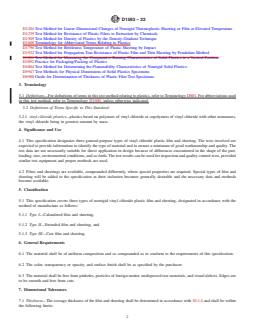
1. Scope* mendations issued by the World Trade Organization Technical
Barriers to Trade (TBT) Committee.
1.1 This specification covers nonrigid, unsupported vinyl
chloride plastic film and sheeting in which the resin portion of
2. Referenced Documents
the composition contains at least 90 % vinyl chloride. The
2.1 ASTM Standards:
remaining 10 % can include one or more monomers copoly-
D618 Practice for Conditioning Plastics for Testing
merizedwithvinylchloride,orconsistofotherresinsmechani-
D635 Test Method for Rate of Burning and/or Extent and
cally blended together with poly(vinyl chloride) or copolymers
Time of Burning of Plastics in a Horizontal Position
thereof.
D792 Test Methods for Density and Specific Gravity (Rela-
1.2 The vinyl chloride plastic film and sheeting covered
tive Density) of Plastics by Displacement
herein shall be 0.075 to 0.25 mm (3 to 10 mils) in thickness for
D882 Test Method for Tensile Properties of Thin Plastic
film and greater than 0.25 mm in thickness for sheeting. The
Sheeting
film and sheeting shall include the stabilizers and plasticizers
D883 Terminology Relating to Plastics
necessary to meet the requirements of this specification. This
D1004 Test Method for Tear Resistance (Graves Tear) of
specification covers transparent, translucent, or opaque film
Plastic Film and Sheeting
and sheeting that is plain, printed, embossed, or otherwise
D1203 Test Methods for Volatile Loss from Plastics Using
surface treated.
Activated Carbon Methods
D1204 Test Method for Linear Dimensional Changes of
1.3 The values stated in SI units are to be regarded as the
Nonrigid Thermoplastic Sheeting or Film at Elevated
standard.
Temperature
1.4 The following safety hazards caveat pertains only to the
D1239 Test Method for Resistance of Plastic Films to
test methods portion, Section 10, of this specification: This
Extraction by Chemicals
standard does not purport to address all of the safety concerns,
D1505 Test Method for Density of Plastics by the Density-
if any, associated with its use. It is the responsibility of the user
Gradient Technique
of this standard to establish appropriate safety, health, and
D1600 Terminology forAbbreviatedTerms Relating to Plas-
environmental practices and determine the applicability of
tics
regulatory limitations prior to use.
D1790 Test Method for Brittleness Temperature of Plastic
NOTE 1—There is no known ISO equivalent to this standard. Sheeting by Impact
D1922 Test Method for Propagation Tear Resistance of
1.5 This international standard was developed in accor-
Plastic Film and Thin Sheeting by Pendulum Method
dance with internationally recognized principles on standard-
D3892 Practice for Packaging/Packing of Plastics
ization established in the Decision on Principles for the
D4804 Test Method for Determining the Flammability Char-
Development of International Standards, Guides and Recom-
acteristics of Nonrigid Solid Plastics
D5947 Test Methods for Physical Dimensions of Solid
Plastics Specimens
This specification is under the jurisdiction of ASTM Committee D20 on
Plastics and is the direct responsibility of Subcommittee D20.19 on Film, Sheeting,
and Molded Products. For referenced ASTM standards, visit the ASTM website, www.astm.org, or
Current edition approved Sept. 1, 2022. Published September 2022. Originally contact ASTM Customer Service at service@astm.org. For Annual Book of ASTM
approved in 1958. Last previous edition approved in 2019 as D1593 - 19. DOI: Standards volume information, refer to the standard’s Document Summary page on
10.1520/D1593-22. the ASTM website.
*A Summary of Changes section appears at the end of this standard
Copyright © ASTM International, 100 Barr Harbor Drive, PO Box C700, West Conshohocken, PA 19428-2959. United States
D1593−22
D6988 GuideforDeterminationofThicknessofPlasticFilm 6.2 The color, transparency or opacity, and surface finish
Test Specimens shall be as specified by the purchaser.
6.3 The material shall be free from pinholes, particles of
3. Terminology
foreign matter, undispersed raw materials, and visual defects.
3.1 Definitions—For definitions of terms in this test method
Edges are to be smooth and free from cuts.
relating to plastics, refer to Terminology D883. For abbrevia-
tions used in this test method, refer to Terminology D1600,
7. Dimensional Tolerances
unless otherwise indicated.
7.1 Thickness—The average thickness of the film and sheet-
3.2 Definitions of Terms Specific to This Standard:
ing shall be determined in accordance with 10.1.4 and shall be
3.2.1 vinyl chloride plastics—plastics based on polymers of
within the following limits:
vinyl chloride or copolymers of vinyl chloride with other
7.1.1 Type I—610 % of the specified thickness.
monomers, the vinyl chloride being in greatest amount by
7.1.2 Type II—615 % of the specified thickness.
mass.
7.1.3 Type III—610 % of the specified thickness.
7.1.4 Average gauge for embossed film and sheeting shall
4. Significance and Use
be determined in accordance with 10.1.4.2.
4.1 This specification designates three general-purpose
7.2 Average Thickness Based on Yield per Roll—The aver-
types of vinyl chloride plastic film and sheeting. The tests
age thickness based on yield shall be determined in accordance
involved are expected to provide information to identify the
with 10.1.4 and shall be within the following limits:
type of material and to ensure a minimum of good workman-
7.2.1 Type I—65 % of the specified thickness.
ship and quality. The test data are not necessarily suitable for
7.2.2 Type II—610 % of the specified thickness.
direct application in design because of differences encountered
in the shape of the part, loading, size, environmental 7.2.3 Type III—65 % of the specified thickness.
conditions, and so forth. The test results can be used for
7.3 Width—The film and sheeting shall be held to a toler-
inspection and quality control tests, provided similar test
ance of 612 or –0 mm (+ ⁄2 or –0 in.) for Types I and II, and
equipment and proper methods are used.
+19 or –0 mm (+ ⁄4 or –0 in.) for Type III, of the width
4.2 Films and sheetings are available, compounded
specified by the purchaser. This tolerance shall apply when the
differently, where special properties are required. Special types
material is in roll form on the core.
of film and sheeting will be added to the specification as their
7.4 Length—The length of material for Types I and II,
inclusion becomes generally desirable and the necessary data
excluding that which has been subjected to embossing,
and methods become available.
printing, and so forth, shall be continuous in any one roll. Four
heat-sealed splices shall be allowed for Type III sheeting. The
5. Classification
total length in a roll shall be as specified by the purchaser.
5.1 This specification covers three types of nonrigid vinyl
chloride plastic film and sheeting, designated in accordance
8. Requirements
with the method of manufacture as follows:
8.1 Test specimens shall conform to the requirements pre-
5.1.1 Type I—Calendered film and sheeting,
scribed in Table 1.
5.1.2 Type II—Extruded film and sheeting, and
5.1.3 Type III—Cast film and sheeting.
9. Sampling
...
This document is not an ASTM standard and is intended only to provide the user of an ASTM standard an indication of what changes have been made to the previous version. Because
it may not be technically possible to adequately depict all changes accurately, ASTM recommends that users consult prior editions as appropriate. In all cases only the current version
of the standard as published by ASTM is to be considered the official document.
Designation: D1593 − 19 D1593 − 22
Standard Specification for
Nonrigid Vinyl Chloride Plastic Film and Sheeting
This standard is issued under the fixed designation D1593; the number immediately following the designation indicates the year of
original adoption or, in the case of revision, the year of last revision. A number in parentheses indicates the year of last reapproval. A
superscript epsilon (´) indicates an editorial change since the last revision or reapproval.
1. Scope*
1.1 This specification covers nonrigid, unsupported vinyl chloride plastic film and sheeting in which the resin portion of the
composition contains at least 90 % vinyl chloride. The remaining 10 % can include one or more monomers copolymerized with
vinyl chloride, or consist of other resins mechanically blended together with poly(vinyl chloride) or copolymers thereof.
1.2 The vinyl chloride plastic film and sheeting covered herein shall be 0.075 to 0.25 mm (3 to 10 mils) in thickness for film and
greater than 0.25 mm in thickness for sheeting. The film and sheeting shall include the stabilizers and plasticizers necessary to meet
the requirements of this specification. This specification covers transparent, translucent, or opaque film and sheeting that is plain,
printed, embossed, or otherwise surface treated.
1.3 The values stated in SI units are to be regarded as the standard.
1.4 The following safety hazards caveat pertains only to the test methods portion, Section 10, of this specification: This standard
does not purport to address all of the safety concerns, if any, associated with its use. It is the responsibility of the user of this
standard to establish appropriate safety, health, and environmental practices and determine the applicability of regulatory
limitations prior to use.
NOTE 1—There is no known ISO equivalent to this standard.
1.5 This international standard was developed in accordance with internationally recognized principles on standardization
established in the Decision on Principles for the Development of International Standards, Guides and Recommendations issued
by the World Trade Organization Technical Barriers to Trade (TBT) Committee.
2. Referenced Documents
2.1 ASTM Standards:
D618 Practice for Conditioning Plastics for Testing
D635 Test Method for Rate of Burning and/or Extent and Time of Burning of Plastics in a Horizontal Position
D792 Test Methods for Density and Specific Gravity (Relative Density) of Plastics by Displacement
D882 Test Method for Tensile Properties of Thin Plastic Sheeting
D883 Terminology Relating to Plastics
D1004 Test Method for Tear Resistance (Graves Tear) of Plastic Film and Sheeting
D1203 Test Methods for Volatile Loss from Plastics Using Activated Carbon Methods
This specification is under the jurisdiction of ASTM Committee D20 on Plastics and is the direct responsibility of Subcommittee D20.19 on Film, Sheeting, and Molded
Products.
Current edition approved Nov. 1, 2019Sept. 1, 2022. Published December 2019September 2022. Originally approved in 1958. Last previous edition approved in 20132019
as D1593 - 13.D1593 - 19. DOI: 10.1520/D1593-19.10.1520/D1593-22.
For referenced ASTM standards, visit the ASTM website, www.astm.org, or contact ASTM Customer Service at service@astm.org. For Annual Book of ASTM Standards
volume information, refer to the standard’s Document Summary page on the ASTM website.
*A Summary of Changes section appears at the end of this standard
Copyright © ASTM International, 100 Barr Harbor Drive, PO Box C700, West Conshohocken, PA 19428-2959. United States
D1593 − 22
D1204 Test Method for Linear Dimensional Changes of Nonrigid Thermoplastic Sheeting or Film at Elevated Temperature
D1239 Test Method for Resistance of Plastic Films to Extraction by Chemicals
D1505 Test Method for Density of Plastics by the Density-Gradient Technique
D1600 Terminology for Abbreviated Terms Relating to Plastics
D1790 Test Method for Brittleness Temperature of Plastic Sheeting by Impact
D1922 Test Method for Propagation Tear Resistance of Plastic Film and Thin Sheeting by Pendulum Method
D3801 Test Method for Measuring the Comparative Burning Characteristics of Solid Plastics in a Vertical Position
D3892 Practice for Packaging/Packing of Plastics
D4804 Test Method for Determining the Flammability Characteristics of Nonrigid Solid Plastics
D5947 Test Methods for Physical Dimensions of Solid Plastics Specimens
D6988 Guide for Determination of Thickness of Plastic Film Test Specimens
3. Terminology
3.1 Definitions—For definitions of terms in this test method relating to plastics, refer to Terminology D883. For abbreviations used
in this test method, refer to Terminology D1600, unless otherwise indicated.
3.2 Definitions of Terms Specific to This Standard:
3.2.1 vinyl chloride plastics—plastics based on polymers of vinyl chloride or copolymers of vinyl chloride with other monomers,
the vinyl chloride being in greatest amount by mass.
4. Significance and Use
4.1 This specification designates three general-purpose types of vinyl chloride plastic film and sheeting. The tests involved are
expected to provide information to identify the type of material and to ensure a minimum of good workmanship and quality. The
test data are not necessarily suitable for direct application in design because of differences encountered in the shape of the part,
loading, size, environmental conditions, and so forth. The test results can be used for inspection and quality control tests, provided
similar test equipment and proper methods are used.
4.2 Films and sheetings are available, compounded differently, where special properties are required. Special types of film and
sheeting will be added to the specification as their inclusion becomes generally desirable and the necessary data and methods
become available.
5. Classification
5.1 This specification covers three types of nonrigid vinyl chloride plastic film and sheeting, designated in accordance with the
method of manufacture as follows:
5.1.1 Type I—Calendered film and sheeting,
5.1.2 Type II—Extruded film and sheeting, and
5.1.3 Type III—Cast film and sheeting.
6. General Requirements
6.1 The material shall be of uniform composition and so compounded as to conform to the requirements of this specification.
6.2 The color, transparency or opacity, and surface finish shall be as specified by the purchaser.
6.3 The material shall be free from pinholes, particles of foreign matter, undispersed raw materials, and visual defects. Edges are
to be smooth and free from cuts.
7. Dimensional Tolerances
7.1 Thickness—The average thickness of the film and sheeting shall be determined in accordance with 10.1.4 and shall be within
the following limits:
D1593 − 22
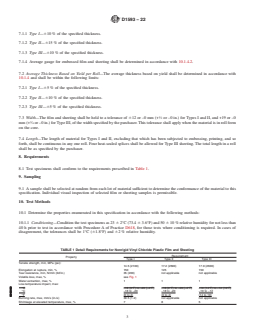
7.1.1 Type I—610 % of the specified thickness.
7.1.2 Type II—615 % of the specified thickness.
7.1.3 Type III—610 % of the specified thickness.
7.1.4 Average gauge for embossed film and sheeting shall be determined in accordance with 10.1.4.2.
7.2 Average Thickness Based on Yield per Roll—The average thickness based on yield shall be determined in accordance with
10.1.4 and shall be within the following limits:
7.2.1 Type I—65 % of the specified thickness.
7.2.2 Type II—610 % of the specified thickness.
7.2.3 Type III—65 % of the specified thickness.
7.3 Width—The film and sheeting shall be held to a tolerance of 612 or –0 mm (+ ⁄2 or –0 in.) for Types I and II, and +19 or –0
mm (+ ⁄4 or –0 in.) for Type III, of the width specified by the purchaser. This tolerance shall apply when the material is in roll form
on the core.
7.4 Length—The length of material for Types I and II, excluding that which has been subjected to embossing, printing, and so
forth, shall be continuous in any one roll. Four heat-sealed splices shall be allowed for Type III sheeting. The total length in a roll
shall be as specified by the purchaser.
8. Requirements
8.1 Test specimens shall conform to the requirements prescribed in Table 1.
9. Sampling
9.1 A sample shall be sel
...