

ASTM D2457-21
(Test Method)Standard Test Method for Specular Gloss of Plastic Films and Solid Plastics
General Information
- Abstract
SIGNIFICANCE AND USE
4.1 Specular gloss is used primarily as a measure of the shiny appearance of films and surfaces. Precise comparisons of gloss values are meaningful only when they refer to the same measurement procedure and same general type of material. In particular, gloss values for transparent films should not be compared with those for opaque films, and vice versa. Gloss is a complex attribute of a surface which cannot be completely measured by any single number.
4.2 Specular gloss usually varies with surface smoothness and flatness. It is sometimes used for comparative measurements of these surface properties.
SCOPE
1.1 This test method describes procedures for the measurement of gloss of plastic films and solid plastics, both opaque and transparent. It contains four separate gloss angles (Note 1):
1.1.1 60-deg, recommended for intermediate-gloss films,
1.1.2 20-deg, recommended for high-gloss films,
1.1.3 45-deg, recommended for intermediate and low-gloss films,
1.1.4 85-deg, recommended for intermediate and low gloss films, and
1.1.5 75-deg, recommended for plastic siding and soffit.
Note 1: The 85-deg, 75-deg, 60-deg, and 20-deg apparatus and method of measurement duplicate those in Test Method D523 and D3679; those for the 45° procedure are similarly taken from Test Method C346.
1.2 This standard does not purport to address all of the safety concerns, if any, associated with its use. It is the responsibility of the user of this standard to establish appropriate safety, health, and environmental practices and determine the applicability of regulatory limitations prior to use.
Note 2: There is no known ISO equivalent to this standard.
1.3 This international standard was developed in accordance with internationally recognized principles on standardization established in the Decision on Principles for the Development of International Standards, Guides and Recommendations issued by the World Trade Organization Technical Barriers to Trade (TBT) Committee.
- Status
- Published
- Publication Date
- 30-Apr-2021
- Technical Committee
- D20 - Plastics
- Drafting Committee
- D20.40 - Optical Properties
Overview
ASTM D2457-21: Standard Test Method for Specular Gloss of Plastic Films and Solid Plastics establishes reliable procedures for measuring the specular gloss-commonly perceived as shininess-of both transparent and opaque plastic films and solid plastics. Developed by ASTM International, this test method enables quantitative assessments of surface gloss, a key visual property in many commercial and industrial applications. This standard supports uniformity and comparability in gloss measurements, provided that procedures and material types remain consistent.
Key Topics
- Scope: Applies to the measurement of gloss for plastic films and solid plastics, including both opaque and transparent specimens.
- Gloss Angles: Includes procedures for different measurement geometries:
- 20-degree: Recommended for high-gloss films
- 60-degree: Standard for intermediate-gloss films
- 45-degree: Used for intermediate and low-gloss films
- 85-degree: Suitable for intermediate and low-gloss films
- 75-degree: Specifically recommended for plastic siding and soffit
- Significance: Gloss is a complex surface attribute stemming from surface smoothness and flatness. It cannot be fully encapsulated by a single numerical value and should not be used to compare fundamentally different materials such as transparent versus opaque films.
- Methodology: The test relies on specific apparatus setup using defined angles of incidence and reflection to ensure consistent and accurate gloss measurement.
Applications
- Quality Control: Used by manufacturers to evaluate the surface finish of plastic products, ensuring consistency across production batches.
- Product Design: Assists designers and engineers in tailoring the surface appearance of plastic components for consumer products, packaging materials, automotive parts, and construction panels.
- Comparative Analysis: Supports comparative testing between samples, provided the same material types and procedures are employed. Essential for validating changes in production processes or raw materials.
- Industrial Standards Compliance: Frequently referenced in procurement specifications, regulatory guidelines, and quality management systems within plastics, packaging, and building materials industries.
Related Standards
- ASTM D523: Standard Test Method for Specular Gloss; used for a range of non-plastic substrates but references similar apparatus and procedures for some angles.
- ASTM C346: Test Method for 45-Degree Specular Gloss of Ceramic Materials; the 45-degree geometry procedure in D2457 is derived from this method.
- ASTM D3679: Specification for Rigid Poly(Vinyl Chloride) (PVC) Siding; incorporates the 75-degree gloss method for building product applications.
- ASTM E284: Terminology of Appearance; provides definitions for terms used in gloss and appearance measurement.
- ASTM E1347 and E1349: Test methods for color and reflectance measurements, which can support further analysis on surfaces tested for gloss.
- ASTM E691 and E2935: Practices for determining measurement precision and equivalence across laboratories.
Practical Value
Adopting ASTM D2457-21 ensures objective and repeatable measurement of specular gloss, a critical attribute for product appeal and function. It underpins trust in product quality claims and facilitates harmonization of technical communication among manufacturers, suppliers, and customers. By specifying geometry, calibration, specimen handling, and reporting requirements, the standard delivers robust foundation for gloss assessment-vital for appearance-sensitive industries working with plastic films and solid plastics.
Keywords: ASTM D2457-21, specular gloss, plastic film gloss, solid plastics gloss measurement, gloss test method, plastic surface appearance, ASTM gloss standards
Relations
- Effective Date
- 01-Apr-2024
- Effective Date
- 01-May-2020
- Refers
ASTM E2935-17 - Standard Practice for Conducting Equivalence Testing in Laboratory Applications - Effective Date
- 01-Oct-2017
- Refers
ASTM E2935-16 - Standard Practice for Conducting Equivalence Testing in Laboratory Applications - Effective Date
- 15-Nov-2016
- Effective Date
- 01-Nov-2015
- Refers
ASTM E2935-15 - Standard Practice for Conducting Equivalence Testing in Laboratory Applications - Effective Date
- 01-Oct-2015
- Refers
ASTM E2935-14 - Standard Practice for Conducting Equivalence Testing in Laboratory Applications - Effective Date
- 01-Oct-2014
- Effective Date
- 01-May-2014
- Effective Date
- 01-Jan-2014
- Effective Date
- 01-Nov-2013
- Effective Date
- 01-Nov-2013
- Refers
ASTM E2935-13 - Standard Practice for Conducting Equivalence Testing in Laboratory Applications - Effective Date
- 01-Aug-2013
- Effective Date
- 01-Jun-2013
- Effective Date
- 01-May-2013
- Effective Date
- 01-Jan-2013
Get Certified
Connect with accredited certification bodies for this standard

DIN CERTCO
DIN Group product certification.

Smithers Quality Assessments
US management systems and product certification.
Sponsored listings
Frequently Asked Questions
ASTM D2457-21 is a standard published by ASTM International. Its full title is "Standard Test Method for Specular Gloss of Plastic Films and Solid Plastics". This standard covers: SIGNIFICANCE AND USE 4.1 Specular gloss is used primarily as a measure of the shiny appearance of films and surfaces. Precise comparisons of gloss values are meaningful only when they refer to the same measurement procedure and same general type of material. In particular, gloss values for transparent films should not be compared with those for opaque films, and vice versa. Gloss is a complex attribute of a surface which cannot be completely measured by any single number. 4.2 Specular gloss usually varies with surface smoothness and flatness. It is sometimes used for comparative measurements of these surface properties. SCOPE 1.1 This test method describes procedures for the measurement of gloss of plastic films and solid plastics, both opaque and transparent. It contains four separate gloss angles (Note 1): 1.1.1 60-deg, recommended for intermediate-gloss films, 1.1.2 20-deg, recommended for high-gloss films, 1.1.3 45-deg, recommended for intermediate and low-gloss films, 1.1.4 85-deg, recommended for intermediate and low gloss films, and 1.1.5 75-deg, recommended for plastic siding and soffit. Note 1: The 85-deg, 75-deg, 60-deg, and 20-deg apparatus and method of measurement duplicate those in Test Method D523 and D3679; those for the 45° procedure are similarly taken from Test Method C346. 1.2 This standard does not purport to address all of the safety concerns, if any, associated with its use. It is the responsibility of the user of this standard to establish appropriate safety, health, and environmental practices and determine the applicability of regulatory limitations prior to use. Note 2: There is no known ISO equivalent to this standard. 1.3 This international standard was developed in accordance with internationally recognized principles on standardization established in the Decision on Principles for the Development of International Standards, Guides and Recommendations issued by the World Trade Organization Technical Barriers to Trade (TBT) Committee.
SIGNIFICANCE AND USE 4.1 Specular gloss is used primarily as a measure of the shiny appearance of films and surfaces. Precise comparisons of gloss values are meaningful only when they refer to the same measurement procedure and same general type of material. In particular, gloss values for transparent films should not be compared with those for opaque films, and vice versa. Gloss is a complex attribute of a surface which cannot be completely measured by any single number. 4.2 Specular gloss usually varies with surface smoothness and flatness. It is sometimes used for comparative measurements of these surface properties. SCOPE 1.1 This test method describes procedures for the measurement of gloss of plastic films and solid plastics, both opaque and transparent. It contains four separate gloss angles (Note 1): 1.1.1 60-deg, recommended for intermediate-gloss films, 1.1.2 20-deg, recommended for high-gloss films, 1.1.3 45-deg, recommended for intermediate and low-gloss films, 1.1.4 85-deg, recommended for intermediate and low gloss films, and 1.1.5 75-deg, recommended for plastic siding and soffit. Note 1: The 85-deg, 75-deg, 60-deg, and 20-deg apparatus and method of measurement duplicate those in Test Method D523 and D3679; those for the 45° procedure are similarly taken from Test Method C346. 1.2 This standard does not purport to address all of the safety concerns, if any, associated with its use. It is the responsibility of the user of this standard to establish appropriate safety, health, and environmental practices and determine the applicability of regulatory limitations prior to use. Note 2: There is no known ISO equivalent to this standard. 1.3 This international standard was developed in accordance with internationally recognized principles on standardization established in the Decision on Principles for the Development of International Standards, Guides and Recommendations issued by the World Trade Organization Technical Barriers to Trade (TBT) Committee.
ASTM D2457-21 is classified under the following ICS (International Classification for Standards) categories: 83.140.10 - Films and sheets. The ICS classification helps identify the subject area and facilitates finding related standards.
ASTM D2457-21 has the following relationships with other standards: It is inter standard links to ASTM D3679-24, ASTM E1347-06(2020), ASTM E2935-17, ASTM E2935-16, ASTM E1347-06(2015), ASTM E2935-15, ASTM E2935-14, ASTM C346-87(2014), ASTM D523-14, ASTM E284-13b, ASTM D3679-13, ASTM E2935-13, ASTM E284-13a, ASTM E691-13, ASTM E1349-06(2013). Understanding these relationships helps ensure you are using the most current and applicable version of the standard.
ASTM D2457-21 is available in PDF format for immediate download after purchase. The document can be added to your cart and obtained through the secure checkout process. Digital delivery ensures instant access to the complete standard document.
Standards Content (Sample)
This international standard was developed in accordance with internationally recognized principles on standardization established in the Decision on Principles for the
Development of International Standards, Guides and Recommendations issued by the World Trade Organization Technical Barriers to Trade (TBT) Committee.
Designation: D2457 − 21
Standard Test Method for
Specular Gloss of Plastic Films and Solid Plastics
This standard is issued under the fixed designation D2457; the number immediately following the designation indicates the year of
original adoption or, in the case of revision, the year of last revision. A number in parentheses indicates the year of last reapproval. A
superscript epsilon (´) indicates an editorial change since the last revision or reapproval.
1. Scope* E284 Terminology of Appearance
E691 Practice for Conducting an Interlaboratory Study to
1.1 This test method describes procedures for the measure-
Determine the Precision of a Test Method
ment of gloss of plastic films and solid plastics, both opaque
E1347 Test Method for Color and Color-Difference Mea-
and transparent. It contains four separate gloss angles (Note 1):
surement by Tristimulus Colorimetry
1.1.1 60-deg, recommended for intermediate-gloss films,
E1349 Test Method for Reflectance Factor and Color by
1.1.2 20-deg, recommended for high-gloss films,
Spectrophotometry Using Bidirectional (45°:0° or 0°:45°)
1.1.3 45-deg, recommended for intermediate and low-gloss
Geometry
films,
E2935 Practice for Conducting Equivalence Tests for Com-
1.1.4 85-deg, recommended for intermediate and low gloss
paring Testing Processes
films, and
1.1.5 75-deg, recommended for plastic siding and soffit.
3. Terminology
NOTE 1—The 85-deg, 75-deg, 60-deg, and 20-deg apparatus and
3.1 Definitions—For definitions of terms used in this test
method of measurement duplicate those inTest Method D523 and D3679;
method, see Terminology E284.
those for the 45° procedure are similarly taken from Test Method C346.
1.2 This standard does not purport to address all of the
4. Significance and Use
safety concerns, if any, associated with its use. It is the
4.1 Specular gloss is used primarily as a measure of the
responsibility of the user of this standard to establish appro-
shiny appearance of films and surfaces. Precise comparisons of
priate safety, health, and environmental practices and deter-
gloss values are meaningful only when they refer to the same
mine the applicability of regulatory limitations prior to use.
measurement procedure and same general type of material. In
NOTE 2—There is no known ISO equivalent to this standard.
particular, gloss values for transparent films should not be
1.3 This international standard was developed in accor-
compared with those for opaque films, and vice versa. Gloss is
dance with internationally recognized principles on standard-
a complex attribute of a surface which cannot be completely
ization established in the Decision on Principles for the
measured by any single number.
Development of International Standards, Guides and Recom-
4.2 Specular gloss usually varies with surface smoothness
mendations issued by the World Trade Organization Technical
and flatness. It is sometimes used for comparative measure-
Barriers to Trade (TBT) Committee.
ments of these surface properties.
2. Referenced Documents
5. Apparatus
2.1 ASTM Standards:
5.1 Instrumental Components—Each apparatus (Note 3)
C346 Test Method for 45-deg Specular Gloss of Ceramic
shall consist of an incandescent light source furnishing an
Materials
incident beam, means for locating the surface of the specimen,
D523 Test Method for Specular Gloss
and a receptor located to receive the required pyramid of rays
D3679 Specification for Rigid Poly(Vinyl Chloride) (PVC)
reflected by the specimen. The receptor shall be a photosensi-
Siding
tive device responding to visible radiation.
NOTE 3—The 75-, 60-, and 20-deg procedures require apparatus
This test method is under the jurisdiction ofASTM Committee D20 on Plastics
identical to that specified in Test Method D523. The 45° procedure
and is the direct responsibility of Subcommittee D20.40 on Optical Properties.
requires apparatus like that specified in Test Method C346.
Current edition approved May 1, 2021. Published June 2021. Originally
5.2 Geometric Conditions—The axis of the incident beam
approved in 1965. Last previous edition approved in 2013 as D2457 – 13. DOI:
10.1520/D2457-21.
shallbeatoneofthespecifiedanglesfromtheperpendicularto
For referenced ASTM standards, visit the ASTM website, www.astm.org, or
the specimen surface. The axis of the receptor shall be at the
contact ASTM Customer Service at service@astm.org. For Annual Book of ASTM
mirror reflection of the axis of the incident beam. With a flat
Standards volume information, refer to the standard’s Document Summary page on
the ASTM website. piece of polished black glass or other front-surface mirror in
*A Summary of Changes section appears at the end of this standard
Copyright © ASTM International, 100 Barr Harbor Drive, PO Box C700, West Conshohocken, PA 19428-2959. United States
D2457 − 21
TABLE 1 Angular Dimensions and Tolerances of Geometry of Source and Receptor Field Stops
Source Field Stop Receptor Field Stop
In Plane of Measurement, Perpendicular to Plane of Perpendicular to Plane of
Geometry, deg Incidence Angle, deg In Plane of Measurement, deg
deg Measurement, deg Measurement, deg
75 75 ± 0.1 3.0 max
60 60±0.1 0.75±0.25 3.0 max 4.4±0.1 11.7±0.2
20 20 ± 0.1 0.75 ± 0.25 3.0 max 1.80 ± 0.05 3.6 ± 0.1
45 45±0.1 1.4±0.4 3.0±1.0 8.0±0.1 10.0±0.2
specimen position, an image of the source shall be formed at 6.2 Secondary Working Standards of ceramic tile, glass,
the center of the receptor field stop (receptor window). The
porcelain enamel, or other materials having hard, flat, and
length of the illuminated area of the specimen shall be equal to uniform surfaces may be calibrated from the primary standard
not more than one third of the distance from the center of this
onaglossmeterdeterminedtobeinstrictconformancewiththe
area to the receptor field stop. The angular dimensions and
requirements prescribed in 5.2.
tolerances of the geometry of the source and receptor shall be
as indicated in Table 1.The angular dimensions of the receptor
7. Preparation and Selection of Test Specimens
field stop are measured from the center of the test surface. The
7.1 This test method does not cover preparation techniques.
angular dimensions of the source field stop are mostly easily
Whenever a test for gloss requires the preparation of a test
measured by the specimen-to-window angular size of the
specimen, report the technique of specimen preparation.
mirror image of the source formed in the receptor field stop.
(See Fig. 1 for a generalized illustration of the dimensions.)
7.2 Test results have been found to be seriously affected by
The tolerances are chosen so that errors of no more than one
surface warpage, waviness, or curvature. Ensure that specimen
gloss unit at any point on the scale will result from errors in the
surfaces have good planarity. Perform tests with the directions
source and receptor aperture.
of machine marks, or similar texture effects, both parallel and
5.3 Vignetting—There shall be no vignetting of rays that lie perpendicular to the plane of the axes of the incident and
reflected beams, unless otherwise specified. (Note that this
within the field angles specified in 5.2.
does not avoid the second-surface reflection.)
5.4 Spectral Conditions—Results should not differ signifi-
cantly from those obtained with a source-filter-photocell com-
7.3 Surface test areas shall be kept free of soil and abrasion.
bination that is spectrally corrected to yield CIE luminous
Gloss is due chiefly to reflection at the surface; therefore,
efficiency with CIE Source C. Since specular reflection is, in
anything that changes the surface physically or chemically is
general, spectrally nonselective, spectral corrections need be
likely to affect gloss.
applied only to highly chromatic, low-gloss specimens upon
agreement of users of this test method.
8. Mounting Films for Measurement
5.5 Measurement Mechanism—The receptor-measurement
8.1 Any nonrigid film must be mounted in a device that will
mechanism shall give a numerical indication that is propor-
hold it flat, but will not stretch the film while it is measured.
tional to the light flux passing the receptor field stop within 61
Three different filmholding devices have each proved satisfac-
percent of full-scale reading.
tory for at least some types of films:
6. Reference Standards 8.1.1 Vacuum Plate (see Fig. 2) is required for stiff films.
Connect the vacuum plate by rubber tube to a vacuum pump or
6.1 Primary Working Standards may be highly polished,
vacuum line. With thin, soft films it is sometimes necessary to
plane, black glass surfaces. The specular reflectance, in
use a valve and pressure gage and to limit the vacuum so as to
percent, (R ) of such surfaces shall be computed by the
s
keep from collapsing the soft film into the pores of the ground
following equation:
plate.
R percent 5 (1)
~ !
s
8.1.2 Flat Plate with two-side pressure-sensitive tape (see
Fig. 3). Make sure each specimen is pulled smooth, but not
2 2
cos i 2 =n 2 sin i
50 stretched before holding it by the two strips of adhesive tape.
FF G
2 2
cos i1=n 2 sin i
Replace the tape whenever it loses its adhesiveness.
2 2 2
n cosi 2 =n 2 sin i 8.1.3 Telescoping Ring or Hoop (see Fig. 4)—To mount the
F G G
2 2 2 specimen in the telescoping ring, lay the flexible film over the
n cosi1=n 2 sin i
base (male) section and drop the top over the base. Push down
where:
carefully,takingcaretopullthetestfilmtautwithoutstretching
i = the specular (incidence) angle, and
it. Measure the taut area.
n = the index of refraction of the surface.
8.2 Backing for Films That Transmit Light—A matt black
Multiply the computed R at each angle by the scale factors
s
backing or (even better) a black cavity must be placed behind
shown in Table 2.
any film that transmits light. Erroneous measurements will
NOTE 4—On the 45 and 60° scales, a perfect mirror measures 1000. occur without a suitable trap or backing.
D2457 − 21
FIG. 1 Diagram of Glossmeter Showing Essential Components and Dimensions
A
TABLE 2 Scale Factors for Gloss Standards, Perfect Mirror and Perfect Matt White
Scale Factors (multiply
Value for Black Glass when
Geometry R of black glass Value for Perfect Mirror Value for Perfect Matt White
s
n = 1.540
standard by)
60° 10.0 95.8 1000 2.1
20° 20.3 92.3 2030 1.4
45° 10.0 55.9 1000 5.4
A
The latter are useful for estimating corrections to gloss readings for reflection from sample backing (see Note 6).
FIG. 2 Vacuum Plate Used to Hold Films Flat
9. Procedure the prior setting, the intervening results should be rejected. To
calibrate, adjust the instrument to read correctly the gloss of a
9.1 Operate the glossmeter in accordance with the manufac-
highly polished standard, and then read the gloss of a standard
turer’s instructions.
having poorer image-forming characteristics. If the instrument
9.2 Calibrate the instrument at the start and completion of
reading for the second standard does not agree within 1 percent
every period of glossmeter operation and during the operation
of its assigned value, do not use the instrument without
at sufficiently frequent intervals to assure that the instrument
readjustment, preferably by the manufacturer.
response is p
...
This document is not an ASTM standard and is intended only to provide the user of an ASTM standard an indication of what changes have been made to the previous version. Because
it may not be technically possible to adequately depict all changes accurately, ASTM recommends that users consult prior editions as appropriate. In all cases only the current version
of the standard as published by ASTM is to be considered the official document.
Designation: D2457 − 13 D2457 − 21
Standard Test Method for
Specular Gloss of Plastic Films and Solid Plastics
This standard is issued under the fixed designation D2457; the number immediately following the designation indicates the year of
original adoption or, in the case of revision, the year of last revision. A number in parentheses indicates the year of last reapproval. A
superscript epsilon (´) indicates an editorial change since the last revision or reapproval.
1. Scope*
1.1 This test method describes procedures for the measurement of gloss of plastic films and solid plastics, both opaque and
transparent. It contains four separate gloss angles (Note 1):
1.1.1 60-deg, recommended for intermediate-gloss films,
1.1.2 20-deg, recommended for high-gloss films,
1.1.3 45-deg, recommended for intermediate and low-gloss films,
1.1.4 85-deg, recommended for intermediate and low gloss films, and
1.1.5 75-deg, recommended for plastic siding and soffit.
NOTE 1—The 85-deg, 75-deg, 60-deg, and 20-deg apparatus and method of measurement duplicate those in Test Method D523 and D3679; those for the
45° procedure are similarly taken from Test Method C346.
1.2 This standard does not purport to address all of the safety concerns, if any, associated with its use. It is the responsibility
of the user of this standard to establish appropriate safety safety, health, and healthenvironmental practices and determine the
applicability of regulatory limitations prior to use.
NOTE 2—There is no known ISO equivalent to this standard.
1.3 This international standard was developed in accordance with internationally recognized principles on standardization
established in the Decision on Principles for the Development of International Standards, Guides and Recommendations issued
by the World Trade Organization Technical Barriers to Trade (TBT) Committee.
2. Referenced Documents
2.1 ASTM Standards:
C346 Test Method for 45-deg Specular Gloss of Ceramic Materials
D523 Test Method for Specular Gloss
D3679 Specification for Rigid Poly(Vinyl Chloride) (PVC) Siding
E284 Terminology of Appearance
E691 Practice for Conducting an Interlaboratory Study to Determine the Precision of a Test Method
This test method is under the jurisdiction of ASTM Committee D20 on Plastics and is the direct responsibility of Subcommittee D20.40 on Optical Properties.
Current edition approved April 1, 2013May 1, 2021. Published April 2013June 2021. Originally approved in 1965. Last previous edition approved in 20082013 as
ε1
D2457 – 08D2457 – 13. . DOI: 10.1520/D2457-13.10.1520/D2457-21.
For referenced ASTM standards, visit the ASTM website, www.astm.org, or contact ASTM Customer Service at service@astm.org. For Annual Book of ASTM Standards
volume information, refer to the standard’s Document Summary page on the ASTM website.
*A Summary of Changes section appears at the end of this standard
Copyright © ASTM International, 100 Barr Harbor Drive, PO Box C700, West Conshohocken, PA 19428-2959. United States
D2457 − 21
TABLE 1 Angular Dimensions and Tolerances of Geometry of Source and Receptor Field Stops
Source Field Stop Receptor Field Stop
In Plane of Measurement, Perpendicular to Plane of Perpendicular to Plane of
Geometry, deg Incidence Angle, deg In Plane of Measurement, deg
deg Measurement, deg Measurement, deg
75 75 ± 0.1 3.0 max
60 60 ± 0.1 0.75 ± 0.25 3.0 max 4.4 ± 0.1 11.7 ± 0.2
20 20 ± 0.1 0.75 ± 0.25 3.0 max 1.80 ± 0.05 3.6 ± 0.1
45 45 ± 0.1 1.4 ± 0.4 3.0 ± 1.0 8.0 ± 0.1 10.0 ± 0.2
E1347 Test Method for Color and Color-Difference Measurement by Tristimulus Colorimetry
E1349 Test Method for Reflectance Factor and Color by Spectrophotometry Using Bidirectional (45°:0° or 0°:45°) Geometry
E2935 Practice for Conducting Equivalence Tests for Comparing Testing Processes
3. Terminology
3.1 Definitions—For definitions of terms used in this test method, see Terminology E284.
4. Significance and Use
4.1 Specular gloss is used primarily as a measure of the shiny appearance of films and surfaces. Precise comparisons of gloss
values are meaningful only when they refer to the same measurement procedure and same general type of material. In particular,
gloss values for transparent films should not be compared with those for opaque films, and vice versa. Gloss is a complex attribute
of a surface which cannot be completely measured by any single number.
4.2 Specular gloss usually varies with surface smoothness and flatness. It is sometimes used for comparative measurements of
these surface properties.
5. Apparatus
5.1 Instrumental Components—Each apparatus (Note 3) shall consist of an incandescent light source furnishing an incident beam,
means for locating the surface of the specimen, and a receptor located to receive the required pyramid of rays reflected by the
specimen. The receptor shall be a photosensitive device responding to visible radiation.
NOTE 3—The 75-, 60-, and 20-deg procedures require apparatus identical to that specified in Test Method D523. The 45° procedure requires apparatus
like that specified in Test Method C346.
5.2 Geometric Conditions—The axis of the incident beam shall be at one of the specified angles from the perpendicular to the
specimen surface. The axis of the receptor shall be at the mirror reflection of the axis of the incident beam. With a flat piece of
polished black glass or other front-surface mirror in specimen position, an image of the source shall be formed at the center of the
receptor field stop (receptor window). The length of the illuminated area of the specimen shall be equal to not more than one third
of the distance from the center of this area to the receptor field stop. The angular dimensions and tolerances of the geometry of
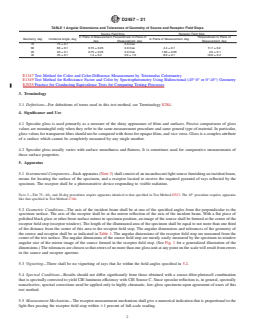
the source and receptor shall be as indicated in Table 1. The angular dimensions of the receptor field stop are measured from the
center of the test surface. The angular dimensions of the source field stop are mostly easily measured by the specimen-to-window
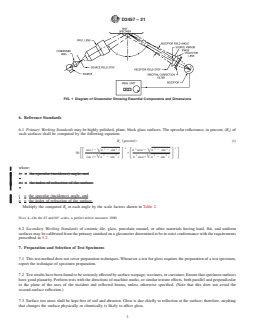
angular size of the mirror image of the source formed in the receptor field stop. (See Fig. 1 for a generalized illustration of the
dimensions.) The tolerances are chosen so that errors of no more than one gloss unit at any point on the scale will result from errors
in the source and receptor aperture.
5.3 Vignetting—There shall be no vignetting of rays that lie within the field angles specified in 5.2.
5.4 Spectral Conditions—Results should not differ significantly from those obtained with a source-filter-photocell combination
that is spectrally corrected to yield CIE luminous efficiency with CIE Source C. Since specular reflection is, in general, spectrally
nonselective, spectral corrections need be applied only to highly chromatic, low-gloss specimens upon agreement of users of this
test method.
5.5 Measurement Mechanism—The receptor-measurement mechanism shall give a numerical indication that is proportional to the
light flux passing the receptor field stop within 61 percent of full-scale reading.
D2457 − 21
FIG. 1 Diagram of Glossmeter Showing Essential Components and Dimensions
6. Reference Standards
6.1 Primary Working Standards may be highly polished, plane, black glass surfaces. The specular reflectance, in percent, (R ) of
s
such surfaces shall be computed by the following equation:
R ~percent!5 (1)
s
2 2
2 2 2 2 2
cos i 2=n 2 sin i n cosi 2=n 2 sin i
50 1
FF G F G G
2 2 2 2 2
= =
cos i1 n 2 sin i n cosi1 n 2 sin i
where:
i = the specular (incidence) angle, and
n = the index of refraction of the surface.
i = the specular (incidence) angle, and
n = the index of refraction of the surface.
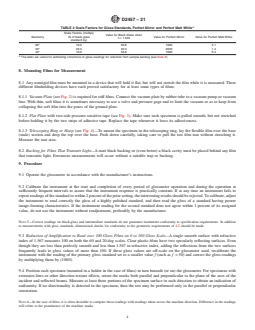
Multiply the computed R at each angle by the scale factors shown in Table 2.
s
NOTE 4—On the 45 and 60° scales, a perfect mirror measures 1000.
6.2 Secondary Working Standards of ceramic tile, glass, porcelain enamel, or other materials having hard, flat, and uniform
surfaces may be calibrated from the primary standard on a glossmeter determined to be in strict conformance with the requirements
prescribed in 5.2.
7. Preparation and Selection of Test Specimens
7.1 This test method does not cover preparation techniques. Whenever a test for gloss requires the preparation of a test specimen,
report the technique of specimen preparation.
7.2 Test results have been found to be seriously affected by surface warpage, waviness, or curvature. Ensure that specimen surfaces
have good planarity. Perform tests with the directions of machine marks, or similar texture effects, both parallel and perpendicular
to the plane of the axes of the incident and reflected beams, unless otherwise specified. (Note that this does not avoid the
second-surface reflection.)
7.3 Surface test areas shall be kept free of soil and abrasion. Gloss is due chiefly to reflection at the surface; therefore, anything
that changes the surface physically or chemically is likely to affect gloss.
D2457 − 21
A
TABLE 2 Scale Factors for Gloss Standards, Perfect Mirror and Perfect Matt White
Scale Factors (multiply
Value for Black Glass when
Geometry R of black glass Value for Perfect Mirror Value for Perfect Matt White
s
n = 1.540
standard by)
60° 10.0 95.8 1000 2.1
20° 20.3 92.3 2030 1.4
45° 10.0 55.9 1000 5.4
A
The latter are useful for estimating corrections to gloss readings for reflection from sample backing (see Note 6).
8. Mounting Films for Measurement
8.1 Any nonrigid film must be mounted in a device that will hold it flat, but will not stretch the film while it is measured. Three
different filmholding devices have each proved satisfactory for at least some types of films:
8.1.1 Vacuum Plate (see Fig. 2) is required for stiff films. Connect the vacuum plate by rubber tube to a vacuum pump or vacuum
line. With thin, soft films it is sometimes necessary to use a valve and pressure gage and to limit the vacuum so as to keep from
collapsing the soft film into the pores of the ground plate.
8.1.2 Flat Plate with two-side pressure-sensitive tape (see Fig. 3). Make sure each specimen is pulled smooth, but not stretched
before holding it by the two strips of adhesive tape. Replace the tape whenever it loses its adhesiveness.
8.1.3 Telescoping Ring or Hoop (see Fig. 4)—To mount the specimen in the telescoping ring, lay the flexible film over the base
(male) section and drop the top over the base. Push down carefully, taking care to pull the test film taut without stretching it.
Measure the taut area.
8.2 Backing for Films That Transmit Light—A matt black backing or (even better) a black cavity must be placed behind any film
that transmits light. Erroneous measurements will occur without a suitable trap or backing.
9. Procedure
9.1 Operate the glossmeter in accordance with the manufacturer’s instructions.
9.2 Calibrate the instrument at the start and completion of every period of glossmeter operation and during the operation at
sufficiently frequent intervals to assure that the instrument response is practically constant. If at any time an instrument fails to
repeat readings of the standard to within 2 percent of the prior setting, the intervening results should be rejected. To calibrate, adjust
the instrument to read correctly the gloss of a highly polished standard, and then read the gloss of a standard having poorer
image-forming characteristics. If the instrument reading for the second standard does not agree within 1 percent of its assigned
value, do not use the instrument without readjustment, preferably by the manufacturer.
NOTE 5—Correct readings on black-glass and intermediate standards do not guarantee instrument conformity to specification requirements. In ad
...