


SIST EN 60310:2004
(Main)Railway applications - Traction transformers and inductors on board rolling stock
Railway applications - Traction transformers and inductors on board rolling stock
Applies to traction transformers installed on board rolling stock and to the various types of inductors inserted in the power and auxiliary circuits of electric vehicles.
Bahnanwendungen - Transformatoren und Drosselspulen auf Bahnfahrzeugen
Applications ferroviaires - Transformateurs de traction et bobines d'inductance à bord du matériel roulant
S'applique aux transformateurs de traction à bord des matériels roulants et aux divers types de bobines d'inductances insérées dans les circuits de puissance ou auxiliaires des véhicules à moteurs électriques.
Železniške naprave – Transformatorji in dušilke vlečnih tokokrogov na voznih sredstvih (IEC 60310:2004)
General Information
- Status
- Withdrawn
- Publication Date
- 31-Aug-2004
- Withdrawal Date
- 31-Mar-2026
- Technical Committee
- ŽEN - Electrical applications for railways
- Current Stage
- 9900 - Withdrawal (Adopted Project)
- Start Date
- 30-Mar-2026
- Due Date
- 22-Apr-2026
- Completion Date
- 01-Apr-2026
Relations
- Replaces
SIST EN 60310:2001 - Railway applications - Traction transformers and inductors on rolling stock - Effective Date
- 28-Jan-2023
- Effective Date
- 28-Jan-2023
- Refers
SIST EN 61373:1999 - Railway applications - Rolling stock equipment - Shock and vibration tests - Effective Date
- 03-Feb-2026
- Effective Date
- 03-Feb-2026
- Effective Date
- 03-Feb-2026
- Effective Date
- 03-Feb-2026
- Effective Date
- 03-Feb-2026
- Effective Date
- 03-Feb-2026
- Effective Date
- 03-Feb-2026
- Effective Date
- 03-Feb-2026
- Effective Date
- 03-Feb-2026
- Effective Date
- 06-May-2014
- Revised
SIST EN 60310:2001 - Railway applications - Traction transformers and inductors on rolling stock - Effective Date
- 13-May-2010



Get Certified
Connect with accredited certification bodies for this standard

Intertek Testing Services NA Inc.
Intertek certification services in North America.

UL Solutions
Global safety science company with testing, inspection and certification.

ANCE
Mexican certification and testing association.
Sponsored listings
Frequently Asked Questions
SIST EN 60310:2004 is a standard published by the Slovenian Institute for Standardization (SIST). Its full title is "Railway applications - Traction transformers and inductors on board rolling stock". This standard covers: Applies to traction transformers installed on board rolling stock and to the various types of inductors inserted in the power and auxiliary circuits of electric vehicles.
Applies to traction transformers installed on board rolling stock and to the various types of inductors inserted in the power and auxiliary circuits of electric vehicles.
SIST EN 60310:2004 is classified under the following ICS (International Classification for Standards) categories: 29.180 - Transformers. Reactors; 45.060.10 - Tractive stock. The ICS classification helps identify the subject area and facilitates finding related standards.
SIST EN 60310:2004 has the following relationships with other standards: It is inter standard links to SIST EN 60310:2001, SIST EN 60310:2016, SIST EN 61373:1999, SIST HD 566 S1:1998, SIST EN 60289:1997, SIST EN 60076-2:1997, SIST EN 60076-1:1997, SIST EN 60077-1:2003, SIST EN 60076-3:2002, SIST EN 60076-5:2001, SIST EN 61287-1:2007, SIST EN 60310:2016, SIST EN 60310:2001. Understanding these relationships helps ensure you are using the most current and applicable version of the standard.
SIST EN 60310:2004 is available in PDF format for immediate download after purchase. The document can be added to your cart and obtained through the secure checkout process. Digital delivery ensures instant access to the complete standard document.
Standards Content (Sample)
SLOVENSKI SIST EN 60310:2004
STANDARD
september 2004
Železniške naprave – Transformatorji in dušilke vlečnih tokokrogov na voznih
sredstvih (IEC 60310:2004)
Railway applications - Traction transformers and inductors on board rolling stock
(IEC 60310:2004)
ICS 29.180; 45.060.10 Referenčna številka
© Standard je založil in izdal Slovenski inštitut za standardizacijo. Razmnoževanje ali kopiranje celote ali delov tega dokumenta ni dovoljeno
EUROPEAN STANDARD EN 60310
NORME EUROPÉENNE
EUROPÄISCHE NORM April 2004
ICS 45.060 Supersedes EN 60310:1996
English version
Railway applications –
Traction transformers and inductors on board rolling stock
(IEC 60310:2004)
Applications ferroviaires - Bahnanwendungen –
Transformateurs de traction et bobines Transformatoren und Drosselspulen
d'inductance à bord du matériel roulant auf Bahnfahrzeugen
(CEI 60310:2004) (IEC 60310:2004)
This European Standard was approved by CENELEC on 2004-03-01. CENELEC members are bound to
comply with the CEN/CENELEC Internal Regulations which stipulate the conditions for giving this European
Standard the status of a national standard without any alteration.
Up-to-date lists and bibliographical references concerning such national standards may be obtained on
application to the Central Secretariat or to any CENELEC member.
This European Standard exists in three official versions (English, French, German). A version in any other
language made by translation under the responsibility of a CENELEC member into its own language and
notified to the Central Secretariat has the same status as the official versions.
CENELEC members are the national electrotechnical committees of Austria, Belgium, Cyprus, Czech
Republic, Denmark, Estonia, Finland, France, Germany, Greece, Hungary, Iceland, Ireland, Italy, Latvia,
Lithuania, Luxembourg, Malta, Netherlands, Norway, Poland, Portugal, Slovakia, Slovenia, Spain, Sweden,
Switzerland and United Kingdom.
CENELEC
European Committee for Electrotechnical Standardization
Comité Européen de Normalisation Electrotechnique
Europäisches Komitee für Elektrotechnische Normung
Central Secretariat: rue de Stassart 35, B - 1050 Brussels
© 2004 CENELEC - All rights of exploitation in any form and by any means reserved worldwide for CENELEC members.
Ref. No. EN 60310:2004 E
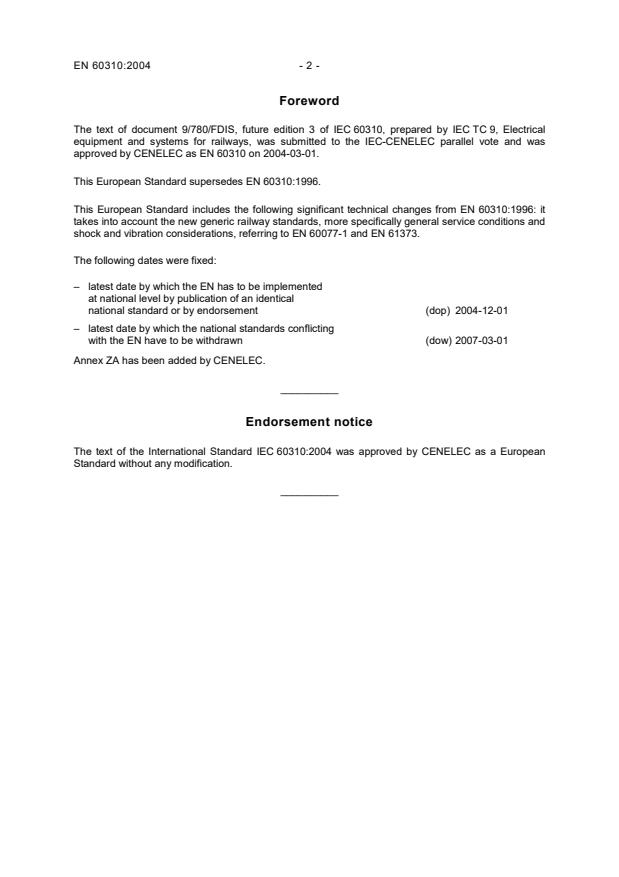
Foreword
The text of document 9/780/FDIS, future edition 3 of IEC 60310, prepared by IEC TC 9, Electrical
equipment and systems for railways, was submitted to the IEC-CENELEC parallel vote and was
approved by CENELEC as EN 60310 on 2004-03-01.
This European Standard supersedes EN 60310:1996.
This European Standard includes the following significant technical changes from EN 60310:1996: it
takes into account the new generic railway standards, more specifically general service conditions and
shock and vibration considerations, referring to EN 60077-1 and EN 61373.
The following dates were fixed:
– latest date by which the EN has to be implemented
at national level by publication of an identical
national standard or by endorsement (dop) 2004-12-01
– latest date by which the national standards conflicting
with the EN have to be withdrawn (dow) 2007-03-01
Annex ZA has been added by CENELEC.
__________
Endorsement notice
The text of the International Standard IEC 60310:2004 was approved by CENELEC as a European
Standard without any modification.
__________
- 3 - EN 60310:2004
Annex ZA
(normative)
Normative references to international publications
with their corresponding European publications
The following referenced documents are indispensable for the application of this document. For dated
references, only the edition cited applies. For undated references, the latest edition of the referenced
document (including any amendments) applies.
NOTE Where an international publication has been modified by common modifications, indicated by (mod), the relevant
EN/HD applies.
Publication Year Title EN/HD Year
IEC 60076-1 1993 Power transformers EN 60076-1 1997
(mod) Part 1: General + A11 1997
+ A12 2002
IEC 60076-2 1993 Part 2: Temperature rise EN 60076-2 1997
(mod)
IEC 60076-3 2000 Part 3: Insulation levels, dielectric tests EN 60076-3 2001
+ corr. December 2000 and external clearances in air
IEC 60076-5 2000 Part 5: Ability to withstand short circuit EN 60076-5 2000
IEC 60077-1 1999 Railway applications - Electric equipment EN 60077-1 2002
(mod) for rolling stock
Part 1: General service conditions and
general rules
IEC 60085 1984 Thermal evaluation and classification of HD 566 S1 1990
electrical insulation
IEC 60289 (mod) 1988 Reactors EN 60289 1994
+ A11 2002
IEC 60850 2000 Railway applications - Supply voltages of - -
traction systems
IEC 61133 1992 Railway applications - Testing of rolling - -
stock after completion of construction and
before entry into service
IEC 61287-1 1995 Power convertors installed on board - -
rolling stock
Part 1: Characteristics and test methods
IEC 61373 1999 Railway applications - Rolling stock EN 61373 1999
equipment - Shock and vibration tests
NORME
CEI
INTERNATIONALE IEC
INTERNATIONAL
Troisième édition
STANDARD
Third edition
2004-02
Applications ferroviaires –
Transformateurs de traction et bobines
d'inductance à bord du matériel roulant
Railway applications –
Traction transformers and inductors
on board rolling stock
© IEC 2004 Droits de reproduction réservés ⎯ Copyright - all rights reserved
Aucune partie de cette publication ne peut être reproduite ni No part of this publication may be reproduced or utilized in any
utilisée sous quelque forme que ce soit et par aucun procédé, form or by any means, electronic or mechanical, including
électronique ou mécanique, y compris la photocopie et les photocopying and microfilm, without permission in writing from
microfilms, sans l'accord écrit de l'éditeur. the publisher.
International Electrotechnical Commission, 3, rue de Varembé, PO Box 131, CH-1211 Geneva 20, Switzerland
Telephone: +41 22 919 02 11 Telefax: +41 22 919 03 00 E-mail: inmail@iec.ch Web: www.iec.ch
CODE PRIX
U
Commission Electrotechnique Internationale PRICE CODE
International Electrotechnical Commission
ɆɟɠɞɭɧɚɪɨɞɧɚɹɗɥɟɤɬɪɨɬɟɯɧɢɱɟɫɤɚɹɄɨɦɢɫɫɢɹ
Pour prix, voir catalogue en vigueur
For price, see current catalogue
60310 © IEC:2004 – 3 –
CONTENTS
FOREWORD.5
1 Scope.9
2 Normative references .9
3 Terms and definitions .11
3.1 Definitions for transformers .11
3.2 Definitions for inductors.11
3.3 Definitions for inductance .13
4 Tappings .15
4.1 Principal tapping .15
5 Rated voltages of transformer windings .15
5.1 Rated line-side voltage.15
5.2 Rated secondary voltage .17
6 Rated power .17
7 Cooling.17
7.1 Identification of transformers and inductors according to cooling method.17
8 Limits of temperature rise .19
8.1 Classification of insulating materials.19
8.2 Limits of temperature-rise.21
9 Rating plates .23
9.1 Transformer rating plate .23
9.2 Inductor rating plate .23
10 Tests .25
10.1 Categories of tests .25
10.2 Tests on transformers .25
10.3 Tests on inductors.43
Annex A (informative) List of items for which an agreement between user and
manufacturer is needed or for which further information or specifications shall be given
by the user or by the manufacturer .53
Table 1 – Letter symbols.17
Table 2 – Order of symbols.19
Table 3 – Limits of temperature-rise (K) .21
Table 4 – List of checks and tests to be made on traction transformers.27
Table 5 – Tolerances .27
Table 6 – Reference temperatures .35
Table 7 – Dielectric test voltages for windings directly connected to the contact line.37
Table 8 – Dielectric test voltage U’ in volts (induced voltage or separate source
voltage withstand test) for other windings (r.m.s.) .39
Table 9 – List of checks and tests to be made on inductors.43
Table 10 – Tolerances .43
60310 © IEC:2004 – 5 –
INTERNATIONAL ELECTROTECHNICAL COMMISSION
___________
RAILWAY APPLICATIONS –
TRACTION TRANSFORMERS AND INDUCTORS
ON BOARD ROLLING STOCK
FOREWORD
1) The International Electrotechnical Commission (IEC) is a worldwide organization for standardization comprising
all national electrotechnical committees (IEC National Committees). The object of IEC is to promote
international co-operation on all questions concerning standardization in the electrical and electronic fields. To
this end and in addition to other activities, IEC publishes International Standards, Technical Specifications,
Technical Reports, Publicly Available Specifications (PAS) and Guides (hereafter referred to as
“IEC Publication(s)”). Their preparation is entrusted to technical committees; any IEC National Committee
interested in the subject dealt with may participate in this preparatory work. International, governmental and
non-governmental organizations liaising with the IEC also participate in this preparation. IEC collaborates
closely with the International Organization for Standardization (ISO) in accordance with conditions determined
by agreement between the two organizations.
2) The formal decisions or agreements of IEC on technical matters express, as nearly as possible, an international
consensus of opinion on the relevant subjects since each technical committee has representation from all
interested IEC National Committees.
3) IEC Publications have the form of recommendations for international use and are accepted by IEC National
Committees in that sense. While all reasonable efforts are made to ensure that the technical content of
IEC Publications is accurate, IEC cannot be held responsible for the way in which they are used or for any
misinterpretation by any end user.
4) In order to promote international uniformity, IEC National Committees undertake to apply IEC Publications
transparently to the maximum extent possible in their national and regional publications. Any divergence
between any IEC Publication and the corresponding national or regional publication shall be clearly indicated in
the latter.
5) IEC provides no marking procedure to indicate its approval and cannot be rendered responsible for any
equipment declared to be in conformity with an IEC Publication.
6) All users should ensure that they have the latest edition of this publication.
7) No liability shall attach to IEC or its directors, employees, servants or agents including individual experts and
members of its technical committees and IEC National Committees for any personal injury, property damage or
other damage of any nature whatsoever, whether direct or indirect, or for costs (including legal fees) and
expenses arising out of the publication, use of, or reliance upon, this IEC Publication or any other
IEC Publications.
8) Attention is drawn to the Normative references cited in this publication. Use of the referenced publications is
indispensable for the correct application of this publication.
9) Attention is drawn to the possibility that some of the elements of this IEC Publication may be the subject of
patent rights. IEC shall not be held responsible for identifying any or all such patent rights.
International Standard IEC 60310 has been prepared by IEC technical committee 9: Electrical
equipment and systems for railways.
This third edition cancels and replaces the second edition issued in 1991 and constitutes a
technical revision. This edition includes the following significant technical changes from the
previous edition: it takes into account the new generic railway standards, more specifically
general service conditions and shock and vibration considerations, referring to IEC 60077-1
and IEC 61373.
60310 © IEC:2004 – 7 –
The text of this standard is based on the following documents:
FDIS Report on voting
9/780/FDIS 9/784/RVD
Full information on the voting for the approval of this standard can be found in the report on
voting indicated in the above table.
This publication has been drafted in accordance with the ISO/IEC Directives, Part 2.
The committee has decided that the contents of this publication will remain unchanged until
2009. At this date, the publication will be
• reconfirmed;
• withdrawn;
• replaced by a revised edition, or
• amended.
60310 © IEC:2004 – 9 –
INTERNATIONAL ELECTROTECHNICAL COMMISSION
___________
RAILWAY APPLICATIONS –
TRACTION TRANSFORMERS AND INDUCTORS
ON BOARD ROLLING STOCK
1 Scope
This International Standard applies to traction transformers installed on board rolling stock
and to the various types of inductors inserted in the power and auxiliary circuits of electric
vehicles.
NOTE 1 The term “inductor” is used in this standard with the same meaning as the term “reactor” mentioned in
IEC 60050(421), IEC 60050(811) and IEC 60289.
The inductors mentioned in the first paragraph may be:
– filter inductors;
– smoothing inductors;
– commutation inductors;
– protection inductors in static power convertors;
– inductive shunts for traction motors;
– inductors used for transition between tap changer notches;
– braking circuit inductors;
– interference suppression inductors.
NOTE 2 The requirements of IEC 60076 are applicable to traction transformers where they do not conflict with
this standard, or with the specialized IEC publications dealing with traction applications.
NOTE 3 For transformers and inductors for static power convertors, reference should also be made to IEC 61287.
This standard can also be applied, after agreement between user and manufacturer, to the
traction transformers of three-phase a.c. line-side powered vehicles and to the transformers
inserted in the single-phase or polyphase auxiliary circuits of vehicles, except for instrument
transformers and transformers of a rated output below 1 kVA single-phase or 5 kVA
polyphase.
This standard does not cover accessories such as tap changers, resistors, heat exchangers,
fans, etc., intended for mounting on the transformers or inductors, which shall be tested
separately according to relevant rules.
When tap changers are an integral part of the transformers, they cannot be separated while
the latter are tested.
For service conditions, refer to IEC 60077-1, Clause 7.
2 Normative references
The following referenced documents are indispensable for the application of this document.
For dated references, only the edition cited applies. For undated references, the latest edition
of the referenced document (including any amendments) applies.
60310 © IEC:2004 – 11 –
IEC 60076-1:1993, Power transformers – Part 1: General
IEC 60076-2:1993, Power transformers – Part 2: Temperature rise
IEC 60076-3:2000, Power transformers – Part 3: Insulation levels, dielectric tests and
external clearances in air
IEC 60076-5:2000, Power transformers – Part 5: Ability to withstand short circuit
IEC 60077-1:1999, Railway applications – Electric equipment for rolling stock – Part 1:
General service conditions and general rules
IEC 60085:1984, Thermal evaluation and classification of electrical insulation
IEC 60289:1988, Reactors
IEC 60850:2000, Railway applications – Supply voltage of traction systems
IEC 61133:1992, Electric traction – Rolling stock – Test methods for electric and
thermal/electric rolling stock on completion of construction and before entry into service
IEC 61287-1:1995, Power convertors installed on board rolling stock – Part 1:
Characteristics and test methods
IEC 61373:1999, Railway applications – Rolling stock equipment – Shock and vibration
tests
3 Terms and definitions
For the purposes of this document, the terms and definitions given in IEC 60076 and
IEC 60289 together with the following definitions apply.
3.1 Definitions for transformers
3.1.1
classification of transformers
depending on arrangements made for on-load variation of the secondary voltage of the
traction circuits, traction transformers can be classified as:
– fixed ratio transformers;
– transformers with low-voltage tapping;
– transformers with high-voltage tapping.
3.2 Definitions for inductors
3.2.1
classification of inductors
according to their utilisation, inductors can be classified as follows:
– Inductors for alternating current
Inductors that carry alternating current, such as transition inductors used for transition
between tappings of tap changers, inductors for a.c. commutator motor braking circuits,
interference suppression inductors, etc.
60310 © IEC:2004 – 13 –
– Inductors for direct current
Inductors that carry direct current with small or negligible a.c. components, such as d.c.
filter inductors, inductive shunts for traction motors, inductors for d.c. motor braking
circuits, etc.
– Inductors for pulsating current
Inductors that carry direct current with a significant periodic ripple, such as smoothing
inductors for traction motors, etc.
– Inductors for convertors
Inductors inserted inside electronic power convertors for purposes of commutation,
protection or filtering.
3.3 Definitions for inductance
Values of inductance for inductors are related to the different classes of utilisation and are
defined as follows, with the understanding that they shall include an indication of the nature
and value of the current used in their measurement.
3.3.1
a.c. inductance
derived from the measurement of the alternating current carried by the inductor when it is
supplied by a sinusoidal alternating voltage of specified value and frequency
3.3.2
transient inductance
derived from the oscillographic record of current in the inductor or from the measurement of
the variation of magnetic flux; for example, the test could be carried out with direct current
either by means of a sudden closing of the circuit or by a sudden short-circuiting of the
inductor
3.3.3
incremental inductance
derived from a record of the terminal voltage when a specified pulsating current is passing
through the inductor
NOTE It should be mentioned that the ripple factor of a pulsating current, expressed as a percentage, is
conventionally defined by the formula:
I − I
max min
× 100
I + I
max min
where I and I respectively represent the maximum and minimum values of the current wave.
max min
3.3.4
rated values of inductors
the rated values and service conditions (current, voltage, frequency, duration, duty cycle,
ventilation, etc.) shall be either guaranteed by the manufacturer, or submitted by the
manufacturer for the agreement of the user, before execution of the tests
3.3.5
rated voltage U
N
the voltage at rated frequency assigned to be applied between the line terminals of a winding
60310 © IEC:2004 – 15 –
3.3.6
maximum operating voltage U
max
the highest voltage at rated frequency at which the inductor shall be capable of operating
continuously without exceeding the specified temperature rises
3.3.7
rated insulation voltage U
Nm
the voltage at rated frequency assigned to be applied between either terminal of a winding
and any other circuit or conductive part external to the winding
3.3.8
rated power Q
N
the reactive power specified for operation at rated voltage and frequency
3.3.9
rated current I
N
the current of the inductor derived from rated power and rated voltage.
4 Tappings
In order to permit variation of the voltage ratio of the transformer, one or more of its windings
may be equipped with intermediate tappings, which shall be indicated on the diagram and in
the specification, with a statement of their maximum operating characteristics.
4.1 Principal tapping
The principal tapping is that which enables the rated traction motor voltage to be obtained
at the terminals of the motors when they are taking their rated current, the transformer
line-side winding being supplied at rated voltage and frequency.
When both line-side windings and traction windings have intermediate tappings, the
principal tappings shall be indicated.
For multi-system vehicles, the principal tappings may be different for each system.
The no-load voltage ratio shall be defined for the principal tapping and for other tappings.
5 Rated voltages of transformer windings
5.1 Rated line-side voltage
The rated line-side voltage is the r.m.s. voltage applicable in normal operating conditions to
the line-side winding group. If this winding has tappings, the rated voltage shall be referred to
the principal tapping.
Unless otherwise agreed between user and manufacturer, the rated line-side voltage is
specified as being equal to the nominal voltage of the traction system.
NOTE IEC 60850 gives the list of the nominal voltages of traction systems.
60310 © IEC:2004 – 17 –
5.2 Rated secondary voltage
The rated voltage of a secondary winding of a transformer is the r.m.s. no-load voltage at the
terminals of the winding when the principal tapping of the line-side winding of the transformer
is fed at its rated voltage and frequency.
6 Rated power
Traction transformers usually have several secondary windings (e.g. traction, auxiliaries, train
heating). The specification of the transformer shall indicate the rated power, in kilovolt-
amperes, of each winding defined as the product of the rated voltage of this winding and its
rated current.
The rating of a transformer is referred to a continuous duty.
The rated current of a winding is the current this winding can sustain permanently without
exceeding the temperature-rise limit stated in Clause 8. For a traction winding, the rated
current shall correspond to the principal tapping. This definition of rated current applies when
other windings, which are normally on load, deliver their rated loads.
NOTE The rated power of the line-side winding of a transformer can be less than the sum of the rated powers of
its various secondary windings; this is permissible, for example, for the transformer of a single way connected
static convertor or for a traction transformer having a secondary for train heating which is only used during the cold
season.
7 Cooling
7.1 Identification of transformers and inductors according to cooling method
7.1.1 Identification symbols
Transformers and inductors shall be identified according to the cooling method employed.
Letter symbols for use in connection with each cooling method shall be as given in Table 1.
Table 1 – Letter symbols
Kind of cooling medium Symbol
Mineral oil or synthetic insulating liquid with fire-point ≤ 300 °C O
K
Synthetic insulating liquid with fire-point > 300 °C
L
Synthetic insulating liquid having a fire-point greater than its boiling-point
G
Gas
Water W
Air A
Kind of circulation Symbol
Natural N
Forced (non-directed oil) F
Forced-directed oil D
In transformers and inductors with forced-directed oil circulation, a certain proportion of the
forced-oil flow is channelled so as to pass through the windings. Some windings, however,
may have a non-directed oil flow, for instance separate tapping windings, auxiliary windings
and stabilizing windings.
60310 © IEC:2004 – 19 –
7.1.2 Arrangement of symbols
7.1.2.1 Enclosed transformers and inductors
Transformers and inductors shall be identified by symbols of four letters for each cooling
method for which a rating is specified by the manufacturer.
The order in which the symbols shall be used is given in Table 2. Oblique strokes shall be
used to separate the group symbols for different cooling methods.
Table 2 – Order of symbols
st nd rd th
1 letter 2 letter 3 letter 4 letter
Indicating the cooling medium that is in contact with the Indicating the cooling medium that is in contact with the
winding external cooling system
Type of cooling medium Type of circulation Type of cooling medium Type of circulation
For example, an oil-immersed transformer with forced-directed oil circulation and forced-air
circulation would be designated by ODAF.
For oil-immersed transformers in which the alternatives of natural or forced cooling with non-
directed oil flow are possible, typical designations are: ONAN/ONAF, ONAN/OFAF.
For a dry-type transformer in a non-ventilated protective enclosure with natural air cooling
inside and outside the enclosure, the designation is: ANAN.
7.1.2.2 Non-enclosed transformers and inductors
Dry-type transformers and inductors without protective enclosures are identified by two
symbols only for the cooling medium that is in contact with the windings or the surface coating
of windings with an overall coating (e.g. epoxy resin).
The cooling method of a dry-type transformer without a protective enclosure or with a
ventilated enclosure and with natural air cooling is designated by: AN.
7.1.3 Air cooling
When transformers or inductors are cooled by the draught of air caused by the motion of the
vehicle or by a forced-air cooling system which is not tested with the transformer or inductor,
the air flow (or velocity) on which the rated power of the equipment is based shall be indicated
by the user.
8 Limits of temperature rise
8.1 Classification of insulating materials
The different classes of solid materials used at present for the insulation of the windings of
transformers and inductors to which this standard applies are listed in Table 3. They are
defined in IEC 60085.
60310 © IEC:2004 – 21 –
The thermal class of the solid materials used for the insulation of the windings of an air- or
gas-cooled dry-type transformer or inductor shall be indicated by the manufacturer.
8.2 Limits of temperature-rise
The temperature-rises above the ambient air of the components of transformers and inductors
submitted to temperature-rise tests shall not exceed the values given in Table 3.
Table 3 – Limits of temperature-rise (K)
Temperature-rise
Part of the Thermal class of
Limit temperatures
apparatus windings
Duty class 1 Duty class 2
Windings (average) A 75 75 120
E 95 95
B 130 105 170
F 155 130 195
H 180 160 220
200 200 180 240
220 220 200 260
250 250 230 290
O liquid 65 65 105
K liquid 150 150 190
NOTE For directed oil flow, the temperature-rises in windings may be increased by 5 K.
For type O liquids, the limit temperature-rise of thermal class A only is permitted. For type K liquids, the limit
temperature-rise for both the winding and the liquid is the lower tabled for either.
Higher limits may be adopted by agreement between user and manufacturer when certain insulating materials
are used (moisture repellent stabilized paper, thermally stabilized paper, special insulating liquids, etc.).
Temperature-rise limits for gas filled units both in gas and in the associated windings are to be defined by
agreement between user and manufacturer, taking into account the characteristics of the gas used. For the
windings, the limits shall not exceed the limit temperatures indicated in the Table.
Two alternatives are given for temperature-rises, corresponding to duty class 1 (normal duty)
and duty class 2 (heavy duty). Duty class 2 corresponds to operating cycles where the
transformers or inductors are at full load for extended periods in their life span.
Limit temperatures in Table 3 are given for guidance only. Temperature-rises are the ruling
limits.
NOTE 1 The temperature-rises given for duty class 1 take into account that on board traction equipment is not
continuously loaded and has considerable periods at reduced load and at no-load. This reduces the ageing of the
insulation materials taken into account in IEC 60085. Moreover, for duty class 1 for on board traction equipment, it
is considered correct to base the temperature-rises on the maximum daily average of ambient temperatures, which
is considered to be + 25 °C for all maximum ambient temperatures up to 50 °C. This limit is reduced to 40 °C for
duty class 2. For higher maximum ambient, for both duties, the temperature–rises shall be reduced by the
difference in excess of the maximum values indicated (40 °C for class 2 and 50 °C for class 1 respectively).
“Ambient” in this context means the ambient from which the cooling is taken.
NOTE 2 The rated power for the equipment should be related to the Joule integral of the load current according to
the actual duty. Should it not correspond, the actual rated power on which the temperature–rise test is based may
be fixed by agreement between user and manufacturer.
60310 © IEC:2004 – 23 –
Temperature-rises resulting from Table 3 apply to temperatures measured:
– by the method of variation of resistance to calculate the average winding temperature;
– by thermometer (bulb or electrical) for parts other than windings.
The temperature-rise of the cores and other parts of transformers or inductors shall in no case
reach a value that may damage these parts or adjacent ones.
In the case of K liquids, the type of liquid shall be subject to approval by the purchaser.
9 Rating plates
9.1 Transformer rating plate
Each transformer shall be provided with a rating plate showing at least the items indicated
below, unless otherwise agreed between user and manufacturer:
– manufacturer's name;
– manufacturer's serial number;
– date of manufacturing;
– connection diagram;
– principal tappings;
– rated power and voltage of each winding;
– rated frequency;
– cooling medium and type;
– volume of cooling medium;
– identification of cooling method;
– total mass.
9.2 Inductor rating plate
Each inductor shall be provided with a rating plate showing at least the items indicated below,
unless otherwise agreed between purchaser and manufacturer:
– manufacturer's name;
– manufacturer's serial number;
– type of inductor;
– rated current (r.m.s. value, or mean direct current for smoothing inductors);
– value of the inductance (at one or more specified reference current values);
– rated frequency;
– cooling medium and type;
– identification of cooling method;
– total mass.
60310 © IEC:2004 – 25 –
10 Tests
10.1 Categories of tests
10.1.1 General
There are three categories of tests:
– type tests;
– routine tests;
– investigation tests.
Descriptions of the different tests belonging to each category are given below.
10.1.2 Type tests
Type tests are carried out on a single piece of equipment of a given design. The test shall be
carried out on one unit chosen among the first batch produced.
Bulk production equipment shall be deemed to have passed the type tests and shall be
exempted from them if the manufacturer produces duly signed certificates of type tests
already carried out on identical equipment constructed on a previous occasion.
Optional type tests are to be carried out only if they have been expressly specified in the
order.
10.1.3 Routine tests
Routine tests are carried out on all equipment of the same order. For certain equipment, after
agreement between user and manufacturer, the routine tests may be replaced by tests carried
out on a few items of equipment taken at random from the order.
10.1.4 Investigation tests
Investigation tests are special tests of an optional character carried out on a single equipment
in order to obtain additional information on its performance; they are only to be carried out if
they have been expressly specified in the order.
The results of these tests shall not influence the acceptance of the equipment unless
agreement to the contrary has been specified in the order.
10.2 Tests on transformers
10.2.1 General – List of tests
The checks, measurements and tests to be made on traction transformers are indicated in
Table 4, which also stipulates the category of the test and the clauses to which reference
should be made.
As far as practicable, the tests on transition inductors which cannot be dissociated from the
transformer shall be carried out together with the tests on the latter. User and manufacturer
shall agree on the tests to be made, if necessary, on these inductors as separate equipment,
so as to ensure that they fulfil all requirements of this standard.
60310 © IEC:2004 – 27 –
Table 4 – List of checks and tests to be made on traction transformers
Clause or Subclause
Nature of test
Type Routine Investigation
Preliminary checks – –
Measurement of winding resistance 10.2.4 10.2.4 –
Measurement of voltage ratios 10.2.5 10.2.5 –
Measurement of no-load primary current and 10.2.6.1 10.2.6.2 –
losses
Measurement of impedance voltage 10.2.7 10.2.7 –
Measurement of load losses 10.2.8.2 10.2.8.3 –
Determination of total losses 10.2.9 –
Temperature-rise 10.2.10
Dielectric: –
induced voltage withstand 10.2.11.1 –
separate source voltage withstand 10.2.11.2
full wave impulse voltage withstand 10.2.11.3 –
Behaviour under short-circuit conditions
(optional) 10.2.12
Shock and vibration withstand 10.2.13 –
For tests on traction transformers forming a part of a static convertor, reference should also
be made to IEC 61287.
NOTE As checks on the effectiveness of the means of protection against surges of internal origin, ingress of rain,
snow or sand, etc., can only be accurately carried out on completed vehicles, reference should be made to
IEC 61133 if any tests are considered necessary.
10.2.2 Tolerances
Table 5 gives tolerances applicable to certain rated quantities and to other quantities when
they are the subject of manufacturer's guarantees referring to this standard.
When a tolerance in one direction is omitted, there is no limit on the value in that direction.
Table 5 – Tolerances
Quantity (and subclause) Tolerance
1 a) Total losses +10 % of the total losses
b) Component losses +15 % of each component loss provided that the tolerance on
(10.2.6, 10.2.8, 10.2.9) total losses is not exceeded
2 Voltage ratio at no-load on the principal
±0,5 % of the ratio declared on the rating plate, or a
tapping (rated voltage ratio (10.2.5)
percentage of the declared ratio equal to 1/10 of the actual
percentage impedance voltage at rated load, whichever is the
lesser value
1)
3 Impedance voltage
±15 % of the declared impedance voltage for that tapping
(for principal tapping)(10.2.7).
4 No-load current (10.2.6)
+30 % of the declared no-load current
1)
For other tappings, tolerance shall be subject to agreement between user and manufacturer
For special applications, the tolerance may be reduced to 10 % by agreement between purchaser and
supplier.
60310 © IEC:2004 – 29 –
10.2.3 Preliminary checks (routine test)
A check shall be made of the circuit diagram, terminal markings, voltage vector relationship
(for three-phase transformers), polarities and the particulars on the rating plate.
10.2.4 Measurement of winding resistance (type and routine tests)
The resistance of each winding between accessible terminals shall be measured when cold
with direct current. Reference should be made to IEC 60076 for the precautions to be taken
for the minimization of self-inductive effects and the proper determination of the temperature
of the windings. The temperature at which the measurement is taken shall also be recorded.
For type tests:
a) If a winding is provided with tappings for the regulation of the voltage of the traction
circuit, the total resistance of the live portion of the said winding shall be measured for
each tapping.
b) If certain auxiliary windings have several sections, the resistance of each shall be
measured.
For routine tests:
– measurement a) may be limited to the principal tapping of the winding;
– measurement b) may only be carried out on the whole of the auxiliary winding.
10.2.5 Measurement of voltage ratios (type and routine tests)
The various voltage ratios between pairs of windings shall be measured for all accessible
tappings of these windings.
If a transformer with a high-voltage control has several traction secondary windings and if
correct voltage ratios have been recorded during measurement made between these
secondary windings, it will be sufficient to measure the voltage ratio between one of these
secondary windings and the line-side winding for all the tappings of the latter.
The measurement of the voltage ratio of a fixed ratio traction transformer forming a part of a
transformer with high-voltage control is a type test.
10.2.6 Measurement of no-load primary current and losses (type and routine tests)
Measurement shall be made at rated frequency, the waveform of the applied voltage being
approximately sinusoidal.
In case of a non-sinusoidal test voltage, reference should be made to IEC 60076 for the
method of correction which may be used. The voltage shall be applied to a suitable winding of
the transformer; if the transformer has high-voltage control, the tap changer and the primary
of the fixed ratio traction transformer shall remain in circuit but, in any case, all other windings
shall be open-circuited.
60310 © IEC:2004 – 31 –
10.2.6.1 Type test
The measurement of the no-load current and losses shall be made for line-side voltages of
0,8 U, 0,9 U and 1,1 U (U being the rated line-side voltage).
If the transformer has high-voltage control, the measurements shall be made for three
positions of the tap changer, one of them corresponding to the principal tapping.
10.2.6.2 Routine test
The measurements shall be made as in 10.2.6.1, but only for rated voltage U and for the
principal tapping.
10.2.7 Measurement of impedance voltages (type and routine tests)
Due to the diversity of winding arrangements of traction transformers, all the combinations in
pairs of windings on which impedance voltages are to be measured shall be fixed by
agreement between user and manufacturer. The type tests should provide sufficient data to
allow plotting of the on-load characteristics of the transformer on all positions of the tap
changing equipment as well as for calculating the fault currents.
Impedance voltages shall be measured according to the procedure in IEC 60076 for the
following combinations of windings:
a) line-side winding to all traction windings in common (type and routine);
b) line-side winding to each group of windings commutating at, or almost, the same time
(type test);
c) line-side winding to each independent traction winding separately (type and routine tests);
d) line-side winding to each auxiliary winding separately (type test).
In type tests a), b) and c), measurements shall be taken on all tappings, while for type test d)
and for the routine tests measurements need only be taken on the principal tapping for the
line-side winding and on a specified tapping for the auxiliary windings.
If additional measurements on other tappings or in other combinations of windings are
required, these shall be agreed between user and manufacturer.
The impedance voltage shall be measured at rated frequency using an approximately
sinusoidal voltage supply. The measurements may be made at any current between 25 % and
100 % of the rated current. In no case shall the voltage applied to any winding exceed 50 % of
the rated voltage of the said winding or the current through it exceed its rated value.
The measured value shall be corrected by increasing it in the ratio of rated current to test
current. The values so derived shall be corrected to the appropriate reference temperature
indicated in 10.2.9.
60310 © IEC:2004 – 33 –
10.2.8 Measurement of load losses (type and routine tests)
10.2.8.1 General
Load losses shall be recorded during the impedance voltage type and routine tests (see
10.2.7) and the values so obtained shall be corrected by multiplying them by the square of the
ratio of rated current to test current.
The load losses so derived shall be corrected to the appropriate reference temperature given
in 10.2.9, taking the I R (R = d.c. resistance) as varying directly with resistance and all the
other losses varying inversely with resistance. Resistance shall be determined as specified in
10.2.4.
Load losses shall be determined for the following combinations in pairs of windings:
a) line-side winding/all traction secondary windings in parallel or in series, as appropriate;
b) line-side winding/each one of the auxiliary secondary windings.
For the determination of load losses of transformers forming a part of a static convertor,
reference should be made to IEC 61287.
NOTE The total losses for all circuits cannot be obtained by simple arithmetic addition of the losses measured on
pairs of windings as prescribed above.
They may in some cases be calculated from the d.c. resistance of each winding and the appropriate current, adding
the additional losses derived from the tests.
10.2.8.2 Type test
Load losses shall be determined for combinations a) and b) defined in 10.2.8.1. For combi-
nation a), the determination shall be made for three positions of the tap changing equipment
corresponding respectively:
– to the principal tapping;
– to the tapping giving the highest load losses in the traction windings;
– to another tapping.
10.2.8.3 Routine test
Load losses shall be determined for combination a) of 10.2.8.1 only and limited to the
principal tapping.
10.2
...
Questions, Comments and Discussion
Ask us and Technical Secretary will try to provide an answer. You can facilitate discussion about the standard in here.
Loading comments...