

SIST EN 17724:2025
(Main)Plant biostimulants - Terminology
General Information
- Abstract
This document defines terms and definitions referred to in the plant biostimulant field and consists of six subclauses:
3.1 Claims
3.2 Terms relating to components
3.3 Terms relating to the application method
3.4 Terms relating to sampling
3.5 Terms relating to the physical form
3.6 Others terms relating to plant biostimulants
- Status
- Published
- Public Enquiry End Date
- 02-Jun-2023
- Publication Date
- 06-Jan-2025
- Technical Committee
- KAT - Soil quality
- Current Stage
- 6060 - National Implementation/Publication (Adopted Project)
- Start Date
- 20-Dec-2024
- Due Date
- 24-Feb-2025
- Completion Date
- 07-Jan-2025

Overview - EN 17724:2024 (Plant biostimulants - Terminology)
EN 17724:2024 is a CEN European standard prepared by CEN/TC 455 that defines terms and definitions used in the plant biostimulant field. Adopted November 2024, it supersedes CEN/TS 17724:2022 and supports implementation of Regulation (EU) 2019/1009 (Fertilising Products Regulation). The document organizes terminology into six focused subclauses and provides a harmonized vocabulary for industry, regulators and researchers working with plant biostimulants.
Key topics and requirements (Terminology and scope)
This terminology standard does not set test methods but establishes clear, consistent definitions to support claims, testing and communication. Main topics include:
- Claims (3.1) - general principles for product claims, definition of “claim”, applicant R&D activities, and the types of trials used to substantiate claims (field trial, controlled conditions trial, protected crop condition).
- Terms relating to components (3.2) - vocabulary for substances and formulations (e.g., chelated plant nutrient, substance, bioavailability).
- Application method (3.3) - standard terms for how biostimulants are applied (spray, soil drench, seed treatment, etc. - as referenced broadly in the clause headings).
- Sampling (3.4) - terminology for sample collection and trial design (e.g., trial series, strip trial, replicate).
- Physical form (3.5) - common descriptors for product form and presentation.
- Other biostimulant-specific concepts (3.6) - agronomic and quality vocabulary such as nutrient use efficiency, plant nutrition processes, quality trait, tolerance to abiotic stress, stress marker, and priming effect.
Representative definitions included: “plant biostimulant” (product that stimulates plant nutrition processes independently of nutrient content to improve nutrient use efficiency, abiotic stress tolerance, quality traits or nutrient availability), and classifications of abiotic stress (thermal, light, mechanical, water, chemical).
Practical applications - who uses EN 17724:2024
- Manufacturers and product developers - to write consistent labels and substantiated claims.
- Regulatory authorities and conformity assessors - to interpret claims under the Fertilising Products Regulation.
- Laboratories and trial designers - to align trial descriptions, sampling and reporting with accepted terminology.
- Farm advisors and growers - to better understand product claims and compare products.
- Researchers and standardization bodies - to harmonize terminology across publications and standards.
Related standards and references
- Supports implementation of Regulation (EU) 2019/1009 (Fertilising Products Regulation).
- Cross-references other CEN documents such as EN 17700‑1:2024 and EN 17700‑3:2024 for trial quality criteria and agronomic markers.
- ISO and IEC terminology resources (ISO OBP, IEC Electropedia) are noted for broader standardization context.
Using EN 17724:2024 ensures consistent, SEO‑relevant vocabulary for “plant biostimulants”, “nutrient use efficiency”, “abiotic stress”, “field trial” and related search terms across regulatory, commercial and scientific communications.
Relations
- Effective Date
- 01-Feb-2025
- Effective Date
- 28-Jan-2026
- Effective Date
- 28-Jan-2026
- Effective Date
- 28-Jan-2026
- Effective Date
- 28-Jan-2026
- Effective Date
- 28-Jan-2026
- Effective Date
- 28-Jan-2026
- Effective Date
- 28-Jan-2026
- Effective Date
- 28-Jan-2026
- Effective Date
- 28-Jan-2026
- Effective Date
- 28-Jan-2026
- Effective Date
- 28-Jan-2026
- Effective Date
- 28-Jan-2026
- Effective Date
- 28-Jan-2026
- Effective Date
- 28-Jan-2026
Get Certified
Connect with accredited certification bodies for this standard

Control Union Certifications
Global certification for agriculture and sustainability.

ECOCERT
Organic and sustainability certification.

FSC International
Forest Stewardship Council certification.
Sponsored listings
Frequently Asked Questions
SIST EN 17724:2025 is a standard published by the Slovenian Institute for Standardization (SIST). Its full title is "Plant biostimulants - Terminology". This standard covers: This document defines terms and definitions referred to in the plant biostimulant field and consists of six subclauses: 3.1 Claims 3.2 Terms relating to components 3.3 Terms relating to the application method 3.4 Terms relating to sampling 3.5 Terms relating to the physical form 3.6 Others terms relating to plant biostimulants
This document defines terms and definitions referred to in the plant biostimulant field and consists of six subclauses: 3.1 Claims 3.2 Terms relating to components 3.3 Terms relating to the application method 3.4 Terms relating to sampling 3.5 Terms relating to the physical form 3.6 Others terms relating to plant biostimulants
SIST EN 17724:2025 is classified under the following ICS (International Classification for Standards) categories: 01.040.65 - Agriculture (Vocabularies); 65.080 - Fertilizers. The ICS classification helps identify the subject area and facilitates finding related standards.
SIST EN 17724:2025 has the following relationships with other standards: It is inter standard links to SIST-TS CEN/TS 17724:2023, SIST EN 17700-5:2025, SIST EN 17711:2025, SIST EN 17700-4:2025, SIST EN 17717:2025, SIST EN 17719:2025, SIST EN 17720:2025, SIST EN 17716:2025, SIST EN 17721:2025, SIST EN 17723:2025, SIST EN 17709:2025, SIST EN 17700-3:2025, SIST EN 17707:2025, SIST EN 17725:2025, SIST EN 17712:2025. Understanding these relationships helps ensure you are using the most current and applicable version of the standard.
SIST EN 17724:2025 is associated with the following European legislation: EU Directives/Regulations: 2019/1009; Standardization Mandates: M/564, M/564 Amd 1. When a standard is cited in the Official Journal of the European Union, products manufactured in conformity with it benefit from a presumption of conformity with the essential requirements of the corresponding EU directive or regulation.
SIST EN 17724:2025 is available in PDF format for immediate download after purchase. The document can be added to your cart and obtained through the secure checkout process. Digital delivery ensures instant access to the complete standard document.
Standards Content (Sample)
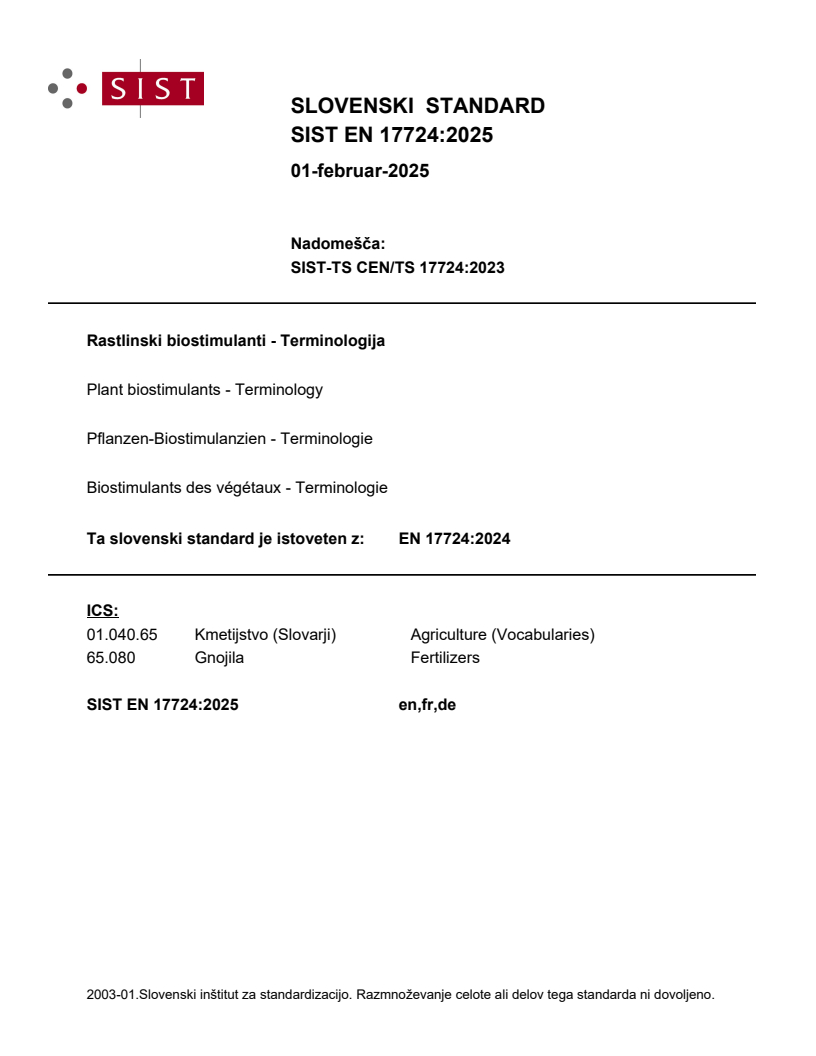
SLOVENSKI STANDARD
01-februar-2025
Nadomešča:
SIST-TS CEN/TS 17724:2023
Rastlinski biostimulanti - Terminologija
Plant biostimulants - Terminology
Pflanzen-Biostimulanzien - Terminologie
Biostimulants des végétaux - Terminologie
Ta slovenski standard je istoveten z: EN 17724:2024
ICS:
01.040.65 Kmetijstvo (Slovarji) Agriculture (Vocabularies)
65.080 Gnojila Fertilizers
2003-01.Slovenski inštitut za standardizacijo. Razmnoževanje celote ali delov tega standarda ni dovoljeno.
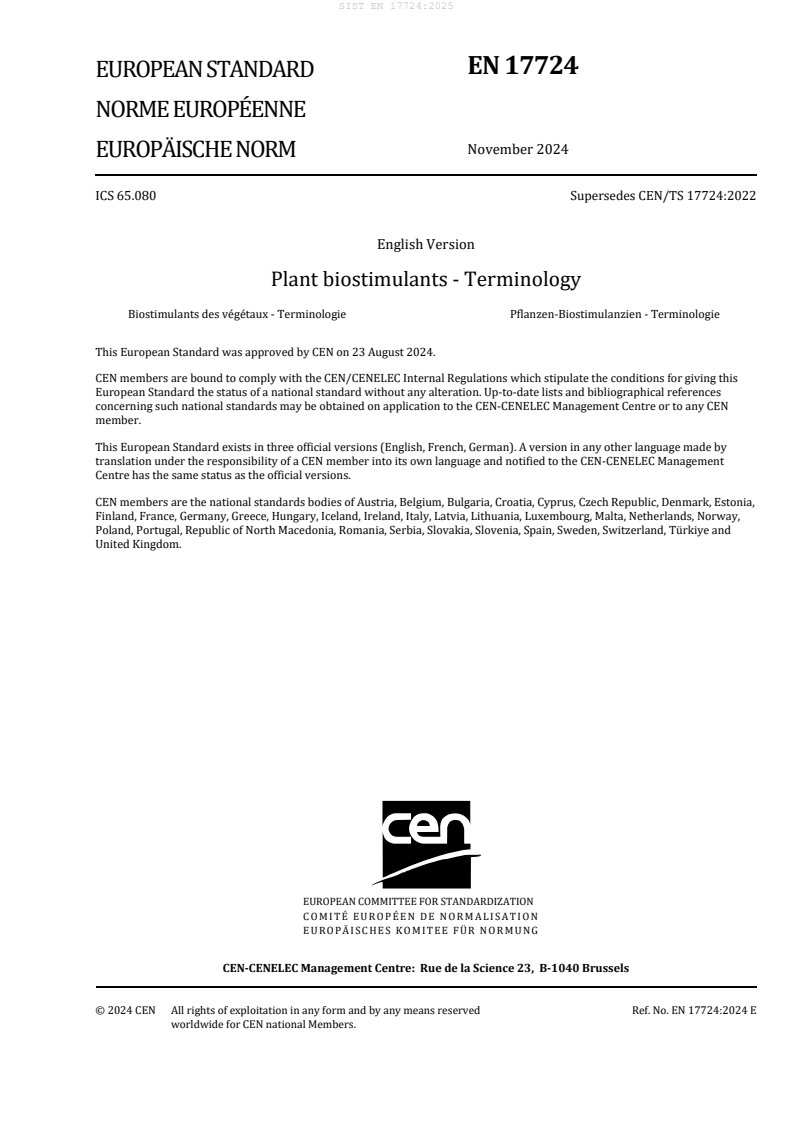
EN 17724
EUROPEAN STANDARD
NORME EUROPÉENNE
November 2024
EUROPÄISCHE NORM
ICS 65.080 Supersedes CEN/TS 17724:2022
English Version
Plant biostimulants - Terminology
Biostimulants des végétaux - Terminologie Pflanzen-Biostimulanzien - Terminologie
This European Standard was approved by CEN on 23 August 2024.
CEN members are bound to comply with the CEN/CENELEC Internal Regulations which stipulate the conditions for giving this
European Standard the status of a national standard without any alteration. Up-to-date lists and bibliographical references
concerning such national standards may be obtained on application to the CEN-CENELEC Management Centre or to any CEN
member.
This European Standard exists in three official versions (English, French, German). A version in any other language made by
translation under the responsibility of a CEN member into its own language and notified to the CEN-CENELEC Management
Centre has the same status as the official versions.
CEN members are the national standards bodies of Austria, Belgium, Bulgaria, Croatia, Cyprus, Czech Republic, Denmark, Estonia,
Finland, France, Germany, Greece, Hungary, Iceland, Ireland, Italy, Latvia, Lithuania, Luxembourg, Malta, Netherlands, Norway,
Poland, Portugal, Republic of North Macedonia, Romania, Serbia, Slovakia, Slovenia, Spain, Sweden, Switzerland, Türkiye and
United Kingdom.
EUROPEAN COMMITTEE FOR STANDARDIZATION
COMITÉ EUROPÉEN DE NORMALISATION
EUROPÄISCHES KOMITEE FÜR NORMUNG
CEN-CENELEC Management Centre: Rue de la Science 23, B-1040 Brussels
© 2024 CEN All rights of exploitation in any form and by any means reserved Ref. No. EN 17724:2024 E
worldwide for CEN national Members.
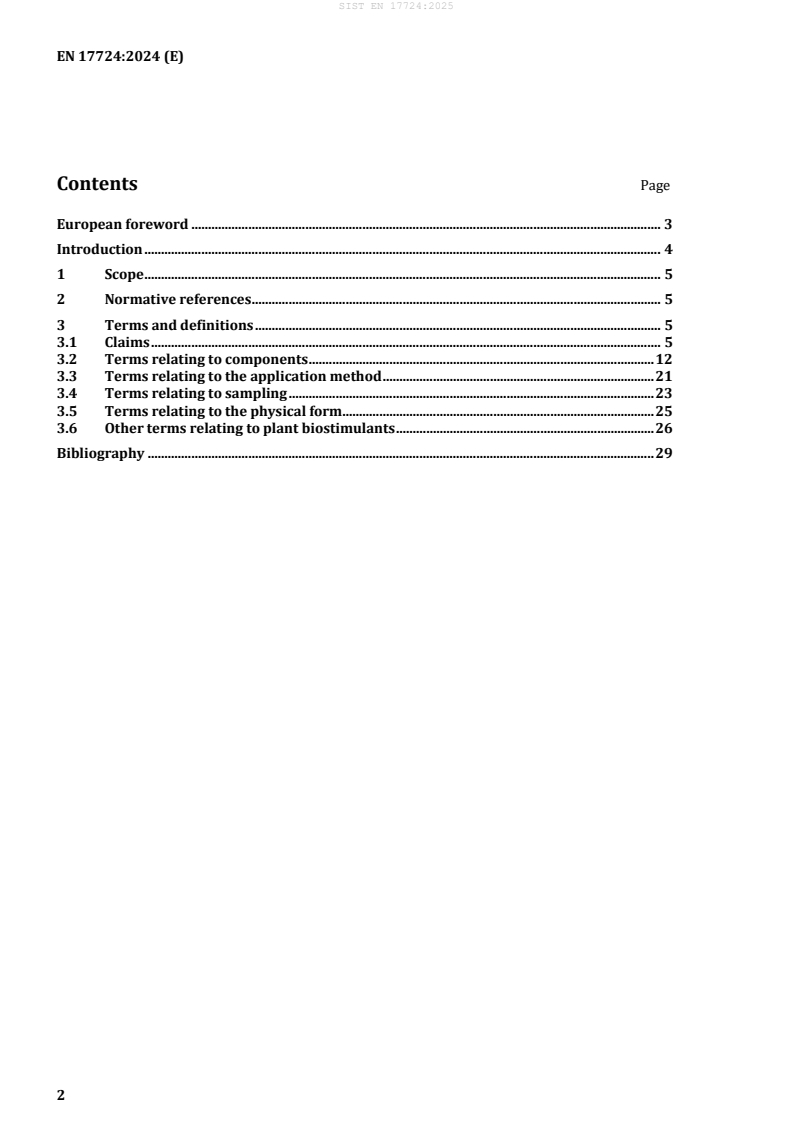
Contents Page
European foreword . 3
Introduction . 4
1 Scope . 5
2 Normative references . 5
3 Terms and definitions . 5
3.1 Claims . 5
3.2 Terms relating to components . 12
3.3 Terms relating to the application method . 21
3.4 Terms relating to sampling . 23
3.5 Terms relating to the physical form . 25
3.6 Other terms relating to plant biostimulants . 26
Bibliography . 29
European foreword
This document (EN 17724:2024) has been prepared by Technical Committee CEN/TC 455 “Plant
biostimulants”, the secretariat of which is held by AFNOR.
This European Standard shall be given the status of a national standard, either by publication of an
identical text or by endorsement, at the latest by May 2025, and conflicting national standards shall be
withdrawn at the latest by May 2025.
Attention is drawn to the possibility that some of the elements of this document may be the subject of
patent rights. CEN shall not be held responsible for identifying any or all such patent rights.
This document supersedes CEN/TS 17724:2022.
— addition of new terms and definitions and revision of others;
— the European foreword and the Introduction have been updated.
This document has been prepared under a standardization request addressed to CEN by the European
Commission. The Standing Committee of the EFTA States subsequently approves these requests for its
Member States.
Any feedback and questions on this document should be directed to the users’ national standards body.
A complete listing of these bodies can be found on the CEN website.
According to the CEN-CENELEC Internal Regulations, the national standards organisations of the
following countries are bound to implement this European Standard: Austria, Belgium, Bulgaria, Croatia,
Cyprus, Czech Republic, Denmark, Estonia, Finland, France, Germany, Greece, Hungary, Iceland, Ireland,
Italy, Latvia, Lithuania, Luxembourg, Malta, Netherlands, Norway, Poland, Portugal, Republic of North
Macedonia, Romania, Serbia, Slovakia, Slovenia, Spain, Sweden, Switzerland, Türkiye and the United
Kingdom.
Introduction
The European Committee for Standardization (CEN) was requested by the European Commission (EC) to
draft European Standards or European Standardization deliverables to support the implementation of
Regulation (EU) 2019/1009 of 5 June 2019 [1] laying down rules on the making available on the market
of EU fertilising products (“FPR” or “Fertilising Products Regulation”).
This standardization request, presented as SR M/564 and relevant amendments, also contributes to the
Communication on “Innovating for Sustainable Growth: A Bio economy for Europe”. The interest in plant
biostimulants has increased significantly in Europe as a valuable tool to use in agriculture.
Standardization was identified as having an important role in order to promote the use of biostimulants.
The work of CEN/TC 455 seeks to improve the reliability of the supply chain, thereby improving the
confidence of farmers, industry, and consumers in biostimulants, and will promote and support
commercialisation of the European biostimulant industry.
1 Scope
This document defines terms and definitions referred to in the plant biostimulant field and consists of six
subclauses:
3.1 Claims
3.2 Terms relating to components
3.3 Terms relating to the application method
3.4 Terms relating to sampling
3.5 Terms relating to the physical form
3.6 Others terms relating to plant biostimulants
2 Normative references
There are no normative references in this document.
3 Terms and definitions
For the purposes of this document, the following terms and definitions apply.
ISO and IEC maintain terminology databases for use in standardization at the following addresses:
— ISO Online browsing platform: available at https://www.iso.org/obp
— IEC Electropedia: available at https://www.electropedia.org
3.1 Claims
3.1.1 General principles
3.1.1.1
applicant R&D activities
data derived from R&D activities performed by the applicant
Note 1 to entry: R&D can be related to the research and development of the plant biostimulant product
development, testing and validation, irrespective of the environment in which the data has been generated (e.g.
under controlled conditions, protected crop or field conditions).
Note 2 to entry: If the applicant has performed the R&D activities with its own technical resources or if the
applicant has subcontracted the R&D activities, as long as the owner of the outcome data from the R&D activities is
and can be proven to be the applicant.
3.1.1.2
bioavailability
degree to which substances can be absorbed/adsorbed by a plant or microbe and made available at a site
of physiological activity and which is thus able to have a biological effect
3.1.1.3
claim
effect(s) of the product that could be asserted on the product label of a plant biostimulant after the
conformity assessment procedure
3.1.1.4
crop
cultivated plant(s) including all components of the plant (above ground parts and below ground parts),
mushrooms, microalgae and macroalgae
3.1.1.5
field trial
trial performed under open field conditions (outdoors) or protected crop conditions according to
common farming practices for a specific crop
Note 1 to entry: Field trial refers to conditions, without full control of climate conditions, according to common
farming practices like plastic tunnels for strawberries, etc.
3.1.1.6
general principle
rule establishing the parameters, requirements and quality criteria applicable to all plant biostimulants
for carrying out the tests necessary to justify the claim
3.1.1.7
plant
live plant and live parts of plants, including fresh fruit, vegetables and seeds
Note 1 to entry: It also includes microalgae, macroalgae and mushrooms.
3.1.1.8
plant biostimulant
product stimulating plant nutrition processes independently of the product’s nutrient content with the
sole aim of improving one or more of the following characteristics of the plant or the plant rhizosphere:
— nutrient use efficiency,
— tolerance to abiotic stress,
— quality traits,
— availability of confined nutrient in soil or rhizosphere
3.1.1.9
controlled conditions trial
trial carried out in a specific place like a glasshouse, a climatic chamber, etc., where all or some parts of
the environmental parameters can be controlled or can be measured (like soil, temperature, light,
humidity, etc.)
3.1.1.10
protected crop condition
crop cultivation in greenhouses or plastic tunnels with or without specific control of climate conditions
according to the farming practice
EXAMPLE Cucumber or tomato cultivation.
3.1.1.11
plant nutrient
chemical element used by the plant for growth and development, classified as a primary macronutrient,
secondary macronutrient or micronutrient per the quantity required by the plant
Note 1 to entry:
Primary macronutrients – nitrogen (N), phosphorus (P), potassium (K),
secondary macronutrients – calcium (Ca), magnesium (Mg), sodium (Na), sulphur (S),
micronutrients – boron (B), cobalt (Co), copper (Cu), iron (Fe), manganese (Mn), molybdenum (Mo), zinc (Zn).
3.1.1.12
trial series
grouping of a number of independent field trials, carried out with plants, which have the same objectives,
experimental design, protocol and parameters to prove the consistency of a result
Note 1 to entry: Trials done in controlled conditions are excluded.
Note 2 to entry: It can be conducted in different locations and/or over a number of consecutive years, as long as it
satisfies the quality criteria described in EN 17700-1:2024 [7] (same protocol, same crop, control, timing).
EXAMPLE Strip trials, replicated trials.
3.1.1.13
strip trial
specific trial carried out using minimum two treatments, next to each other, in the same field, to compare
a control with a plant biostimulant treatment without replicates
3.1.1.14
replicate
identical and independent repetition of each treatment in the same trial and under the same agronomic
management practices like plant variety choice and fertilizers and plant protection products application
3.1.1.15
agronomic marker
measurable plant trait used to validate the claim
Note 1 to entry: EN 17700-3:2024, Clause 6 [8] provides different agronomic markers.
3.1.1.16
stress marker
physiological, biochemical and/or molecular traits associated with a plant response to a specific stress
EXAMPLE Antioxidants, reactive oxygen species (ROS), gene expression or, metabolites related to abiotic
stress, relative water content, heat shock proteins, electrolyte leakage, chlorophyll fluorescence, lipid peroxides.
Note 1 to entry: A subdivision of the three traits is seen below:
— biochemical traits (antioxidants, lipid peroxidation, reduction in reactive oxygen species (ROS), reduction in
free radicals),
— molecular traits (genes, transcription factors, metabolic pathways related to abiotic stress),
— physiological traits: electrolyte leakage, relative water content, reduced stress symptoms.
3.1.2
nutrient use efficiency
measure of a plant’s ability to acquire and utilize nutrients from the environment for a desired outcome
based on (a) nutrient availability (b) uptake efficiency and/or (c) utilization efficiency
Note 1 to entry: Nutrient use efficiency is a complex trait: it depends on the ability of the plant to take up the
nutrients from the soil or growing media and the fertilizer applied, but also on nutrient transport, storage,
mobilization, and use within the plant, among other factors.
3.1.2.1
chelated plant nutrient
complexed plant nutrient
composition based on an inorganic form of the plant nutrient and a chelating or complexing agent,
resulting in a product that enhances the nutrient availability to plants
EXAMPLE A composition of chelated or complexed plant nutrient is a salt or oxide.
3.1.2.2
nutrient assimilation
uptake of nutrients into cells and tissues and consequent building up into more complex substances
EXAMPLE Converting available nitrogen into biomass.
3.1.2.3
nutrient availability
measure of the capacity of an available nutrient to be acquired by the plant
3.1.2.4
available nutrient
element either present in the soil solution or exchangeable on soil colloids
3.1.2.5
nutrient uptake
acquisition of nutrients by the plant
3.1.2.6
plant development
complex process by which the size, composition and organization of a plant changes during its life,
encompassing seed germination, vegetative growth, formation of flowers, bloom, fruit set and maturation
(embryo development)
3.1.2.7
plant metabolism
various biochemical reactions occurring in a living plant cell in order to maintain life and growth
3.1.2.8
plant nutrition
supply and absorption of chemical compounds needed for plant growth and metabolism
3.1.2.9
plant nutrition process
mechanism by which nutrients are utilized or converted to cellular constituents and used for energetic
or metabolic purposes
3.1.2.10
quality
desired attributes of cultivated organisms in terms of human or animal nutrition, marketing, aesthetics,
composition, agronomical trait, or technical property
3.1.2.11
substance
chemical element and its compounds in the natural state or obtained by any manufacturing process,
including any additives necessary to preserve its stability and any impurity deriving from the process
used, but excluding any solvent which can be separated without affecting the stability of the substance or
changing its composition
3.1.2.12
uptake efficiency
measure of the plant’s capacity to acquire nutrients from the environment
3.1.2.13
utilization efficiency
measure of the plant’s capacity to transform and valorise acquired nutrients into more complex
substances
EXAMPLE Organic compounds, plant biomass.
3.1.3
tolerance to abiotic stress
ability to endure abiotic stress
3.1.3.1
abiotic stress
negative impact of non-living factors on the plant in a specific crop environment
Note 1 to entry: Crop tolerance to abiotic stress can apply to one or more (multiple or combined) of the following
stress categories:
1) thermal stress,
2) light stress,
3) mechanical stress,
4) water stress,
5) chemical stress.
3.1.3.1.1
chemical stress
negative impact of chemicals (supra-optimal or sub-optimal chemical compounds or presence) on the
plant in a specific crop environment
EXAMPLE Salt stress, mineral toxicity induced by heavy metals or excessive application of mineral nutrients,
adverse pH conditions, ozone stress, phytotoxic effects of xenobiotics.
3.1.3.1.2
light stress
negative impact of light intensity and/or spectrum on the plant in a specific crop environment
EXAMPLE High irradiance or low irradiance, UV radiation.
3.1.3.1.3
mechanical stress
negative impact of a mechanical force on the plant or the root zone in a specific crop environment
EXAMPLE Wind, hail, agricultural operations.
3.1.3.1.4
thermal stress
negative impact of temperature (supra-optimal and sub-optimal temperature) on the plant in a specific
crop environment
EXAMPLE Heat stress or cold stress such as chilling and freezing stress.
3.1.3.1.5
water stress
negative impact of water or high solutes concentration, or excessive transpiration on the plant in a
specific crop environment
EXAMPLE Drought, high air vapour pressure deficit, flooding.
3.1.3.2
priming effect
biochemical signalling induced by a first stress exposure that leads to enhanced defence system to a later
stress
Note 1 to entry: Priming effect results in a faster and stronger induction of basal defence mechanisms to abiotic
stresses. Biostimulants can act as a priming stimulus. Some priming effects have been shown to pass down plant
generations allowing a local population to improve fitness to the immediate environment.
3.1.3.3
xenobiotic
chemical substance found within an organism that is not naturally produced or expected to be present
within the organism
EXAMPLE Heavy metals, ozone.
3.1.4
quality trait
desired attribute(s) of a crop regarding agronomical and/or marketable traits
3.1.4.1
agronomical trait
property related to plant phenotype such as state, relative development, or amount of a plant organ (or
part), a plant cycle stage or a plant component that has proven contribution to one or more key
performance characteristics in plant production such as yield, plant value, end use or quality parameter
EXAMPLE Photosynthetic activity, flower number, root length, root density, foliar biomass, germination rate,
flower fertility, root growth, root development, seedling emergence, dry matter content, tillering, vigour, plant
biomass, uniformity of flowering, anticipation of flowering, uniformity in fruit set, increase in fruit set or tuber set,
fruit number, pod size, pod length, spikelet size, spike length, increase of seed protein content and increase in
antioxidants.
3.1.4.2
marketable trait
property which can improve the marketable value and/or marketable part of the crop such as nutritional,
organoleptic, techno-functional properties, and physical characteristics of the harvest
EXAMPLE Colour, size, shape, uniformity, sugar content, oil content, skin firmness.
3.1.4.3
nutritional property
content of substances that are valuable for food or feed use because:
a) they provide energy;
b) they are needed for growth;
c) a deficit of them causes characteristic bio-chemical or physiological changes to occur
EXAMPLE Protein, fat, carbohydrates, vitamins, minerals.
3.1.4.4
organoleptic property
property related to an attribute perceptible by the senses
EXAMPLE Appearance, basic taste, acidity, odour, flavour, colour.
3.1.4.5
techno-functional property
physico-chemical characteristic of plants or plant parts which influences a transformation process or any
downstream use in such sectors as food, feed, energy, cosmetics, pharmaceuticals, building materials
EXAMPLE Starch content, fibre strength, allantoin content, flavonoid content.
3.1.5 Availability of confined nutrients in the soil or rhizosphere
3.1.5.1
available nutrient
element either present in the soil solution or exchangeable on soil colloids
3.1.5.2
confined nutrient
element present in the solid and gaseous phases of the soil, elsewhere than on soil colloids
3.1.5.3
improvement of availability of confined nutrients in the soil or rhizosphere
moving soil nutrients from the pool of confined nutrients to the pool of available nutrients
3.1.5.4
nitrogen fixation
biochemical process by which molecular nitrogen (N ) is converted into ammonia or into other nitrogen
compounds, which are available to the living organisms including plants and microorganisms, in soils,
phyllosphere or in aquatic systems
3.1.5.5
nutrient uptake
quantity of nutrient taken up from the external environment into a plant
3.1.5.6
phosphate solubilization
ability of some organic substances, beneficial microorganisms and other substances which help beneficial
microorganisms to solubilize inorganic phosphorus from insoluble compounds in order to improve the
uptake of phosphorous
3.1.5.7
rhizosphere
volume of soil around living roots that is influenced by root activities
3.1.5.8
soil
layer of unconsolidated material consisting of weathered material particles, dead and living organic
matter, air space, and soil solution
3.1.5.9
soil colloid
finer size fraction of the soil (clay and organic matter), being also considered as the most chemically active
portion of the soil because of its large surface area and the chemical structure of the materials involved
3.1.5.10
soil solution
liquid phase of the soil and its solutes
3.2 Terms relating to components
3.2.1
macroalgae
informal term for a large, diverse group of polyphyletic photosynthetic organisms that are not necessarily
closely related to each other
Note 1 to entry: Most are aquatic and autotrophic.
3.2.2
microorganism
any microbiological entity, including lower fungi, bacteria and viruses, cellular or non-cellular, capable of
replication or of transferring genetic material
[SOURCE: Regulation (EC) No 1107/2009, Article 3, point 15 [3]]
3.2.2.1
Azospirillum spp.
Gram-negative bacteria that belong to the Alphaproteobacteria phylum
Note 1 to entry: Azospirillum is a Gram-negative, microaerophilic, non-fermentative and nitrogen-fixing bacterial
genus. Azospirillum are Gram-negative, do not form spores and have a slightly twisted oblong-rod shape.
Azospirillum have at least one flagellum and sometimes multiple flagella. The genus has about 20 species, the
relationships between all the species have not been resolved in detail, however, they most likely constitute a
coherent group.
Note 2 to entry: Azospirillum bacteria are aerobic non-fermentative chemoorganotrophs, vibroid, they produce
several hormones, mainly auxins (not described for all species yet), and most of them are diazotrophic (fix
atmospheric nitrogen gas into a more usable form).
3.2.2.2
Azotobacter spp.
genus of Gram-negative, free-living, non-symbiotic, aerobic soil bacteria
Note 1 to entry: This is a genus of usually motile, oval or spherical bacteria that form thick-walled cysts and may
produce large quantities of capsular slime. They are aerobic, free-living soil microbes that play an important role in
the nitrogen cycle in nature, binding atmospheric nitrogen, which is inaccessible to plants, and releasing nitrogen
forms available to plants. The phylogeny of the genus is not resolved in detail, so this standard restricts in this
context Azotobacter spp. to the species Azotobacter chroococcum, Azotobacter vinelandii and Azotobacter beijerinckii
which most likely comprise a coherent group within Pseudomonadaceae.
3.2.2.3
anaerobic bacteria
any microorganism capable of both aerobic and anaerobic metabolism or that only lives and grows in the
absence of molecular oxygen
[SOURCE: EN ISO 11139:2018, 3.114, modified [10]]
[SOURCE: EN ISO 11139:2018, 3.186, modified [10]]
3.2.2.4
bacteria
single-celled prokaryotic microorganisms, spherical, spiral or rod-shaped, that typically live in soil, water,
organic matter, or in the plants and/or in the bodies of animals
Note 1 to entry: Mostly reproduce by fission but can reproduce also via other methods.
Note 2 to entry: These single-celled organisms show a simple internal structure that lacks a nucleus and contains
DNA that either floats freely in a twisted, thread-like mass called the nucleoid, or in separate, circular pieces called
plasmids.
Note 3 to entry: Bacterial cells are generally surrounded by two protective coverings: an outer wall and an inner
cell membrane. Some bacteria, like mycoplasmas, do not have a cell wall at all. Others have a third more protective
layer called the capsule. Whip-like extensions often cover the surfaces of bacteria, long ones are called flagella
(singular: flagellum) and short ones called pili (singular: pilum). Their role consists in helping bacteria to move and
interact with their environment (e.g. their host).
EXAMPLE Examples of reproductions are conidia, budding, cysts and endospores.
3.2.2.5
coagulase-positive staphylococci
bacteria that form typical and/or atypical colonies on the surface of Baird-Parker agar and show a
positive coagulase reaction or a specific rabbit plasma reaction on Rabbit Plasma Fibrinogen (RPF) agar
Note 1 to entry: Colony size varies between 1 mm and 2 mm in diameter.
3.2.2.6
colony
localized visible accumulation of microbial mass (such as prokaryotes, bacteria, micromycetes, yeasts and
fungi) or organisms (such as Dreissena species) developed on or in a solid nutrient medium from a viable
particle or organism
Note 1 to entry: Frequently, microcolonies from nearby viable particles, before becoming visible, fuse into one
macrocolony. The number of visible colonies is, therefore, usually an underestimate of the number of viable
particles.
[SOURCE: ISO 6107:2021, 3.119 [9]]
3.2.2.7
enterococci
bacteria which are able to reduce 2,3,5-triphenyltetrazolium chloride to formazan on the surface of a
selective culture medium containing sodium azide (Slanetz-Bartley agar) and to hydrolyse esculin at
44 °C on a medium containing bile salts (Bile Esculin Azide agar), resulting in blackening of the medium
under the conditions specified in this document
3.2.2.8
Escherichia coli
Gram-negative rod, motile, smooth colonies, member of Enterobacteriaceae
Note 1 to entry: The main characteristics for identification are catalase positive, oxidase negative, fermentation of
lactose, production of indole, growth on selective agar containing bile salts with characteristic colonies.
Note 2 to entry: E. coli can be isolated from moist environmental sources (air, water, soil) and is a faecal
contamination indicator.
3.2.2.8.1
ß-glucuronidase-positive E. coli
bacteria which form typical blue to blue-green colony on Tryptone-Bile-Glucuronide agar (TBX) after
incubation at 44 °C ± 1 °C for 24 hours
3.2.2.9
microalgae
diverse group of microscopic polyphyletic photosynthetic organisms that are not necessarily closely
related to each other
Note 1 to entry: Most are aquatic and autotrophic.
Note 2 to entry: Can be single-celled or groups of cells joined together.
Note 3 to entry: Microalgae are distinguished from macroalgae in that microalgae are microscopic.
3.2.2.10
Listeria monocytogenes
microorganisms which form typical colonies on solid selective media and which display the
morphological, physiological and biochemical characteristics described when tests are carried out in
accordance with this document
Note 1 to entry: L. monocytogenes is a Gram-positive, non-spore forming, rod-shaped bacterium that belongs to the
genus Listeria, phylum Firmicutes.
Note 2 to entry: L. monocytogenes is a ubiquitous bacterial pathogen that causes serious localized and generalized
infections in humans.
Note 3 to entry: L. monocytogenes are catalase positive and oxidase negative. They produce flagella when grown at
a temperature between 20 °C and 25 °C but not at 37 °C. They produce a β-hemolysin on blood agar plates, which is
part of the CAMP (Christie, Atkins, and Munch-Petersen) diagnostic test.
Note 4 to entry: L. monocytogenes can grow at temperatures between −0,4 °C and 50 °C, with an optimum
temperature of 30 °C to 37 °C. They can withstand freezing, but they are inactivated by heating at 60 °C for 30 min.
Note 5 to entry: L. monocytogenes are facultative anaerobes that utilize glucose, lactose, and rhamnose under
aerobic conditions and can ferment several hexoses and pentoses under anaerobic conditions.
Note 6 to entry: L. monocytogenes can grow over a pH range of 4 to 9,5 and a water activity of 0,90 to 0,97. They
can also grow in 10 % sodium chloride.
[SOURCE: EN ISO 11290-1:2017, 3.1, modified by addition of notes to entry 1 to 6 [11]]
3.2.2.11
mould
mesophilic aerobic filamentous microorga
...