

SIST EN 1994-2:2026/oprA1:2026
(Amendment)Eurocode 4 - Design of composite steel and concrete structures - Part 2: Bridges
- Abstract
EN 1994-2 gives design rules for steel-concrete composite bridges or members of bridges, supplementary to the general rules given in EN 1994-1-1.
- Status
- Not Published
- Public Enquiry End Date
- 26-Nov-2026
- Technical Committee
- KON - Structures
- Current Stage
- 4020 - Public enquire (PE) (Adopted Project)
- Start Date
- 25-Sep-2026
- Due Date
- 12-Feb-2027

SIST EN 1994-2:2026/oprA1:2026 is the Slovenian draft amendment to EN 1994-2:2026, published by SIST from work prepared by CEN. It updates the Eurocode rules for the design of steel-concrete composite bridges and bridge members, for engineers and other professionals who design, check, specify or review composite bridge structures.
What does SIST EN 1994-2:2026/oprA1:2026 specify?
SIST EN 1994-2:2026/oprA1:2026 specifies proposed changes to EN 1994-2:2026, the Eurocode part for bridges. The underlying standard gives design rules for steel-concrete composite bridges or bridge members, supplementary to the general rules in EN 1994-1-1.
This draft amendment is organized as a foreword plus targeted modifications to the main clauses:
- Clause 0 - Introduction
- Clause 3 - Terms, definitions and symbols
- Clause 5 - Materials
- Clause 7 - Structural analysis
- Clause 8 - Ultimate limit states
- Clause 9 - Serviceability limit states
- Clause 11 - Composite plates
In practice, that means the document is not a full bridge-design standard on its own. It is an update package for the existing bridge Eurocode text.
What are the key requirements of SIST EN 1994-2:2026/oprA1:2026?
Notation and references
Clause 3 revises several terms, symbols and references so the bridge rules use the same notation as related Eurocode parts. For a designer, that matters because calculations, notes and software outputs must match the updated symbols.
- Clause 3.2 changes the reference to EN 1990-1.
- Clause 3.2 updates the list of symbols for shear, bending, fatigue and reinforcement notation.
- Clause 3.2 also adds new symbols used for composite bridge checks, including fatigue-related factors and a revised distance symbol for filler beam cross sections.
Materials and structural analysis
Clause 5.1 clarifies how the bridge part relies on the material rules in EN 1994-1-1, except where those rules are limited to buildings. Clause 7 adjusts the structural analysis text for bridge use.
- Clause 5.1 points bridge users back to EN 1994-1-1 for the general material rules.
- Clause 7.4.2.5 updates the temperature-related coefficient used in analysis.
- For practice, this means bridge analysts should check that their calculation models and thermal actions follow the amended bridge-specific value and the referenced general rules.
Ultimate limit states and fatigue
Clause 8 updates the wording for bending-shear interaction, longitudinal shear notation and fatigue expressions. This is important because bridge safety checks often depend on consistent treatment of shear, composite action and repeated loading.
- Clause 8.3.3 directs the bending and shear interaction check to EN 1994-1-1:2026.
- Clause 8.3.4 replaces the longitudinal shear notation with the updated symbol.
- Clauses 8.7.3 to 8.7.7 revise fatigue wording, figure labels and formulas so stress-range checks use the updated notation.
Serviceability limit states and detailing
Clause 9 strengthens the wording for creep and microcracking control, and Clause 11 adjusts composite plate wording. These changes matter for durability, crack control and detailing clarity.
- Clause 9.2.2 links the compressive stress limit for characteristic loading to EN 1992-1-1:2023, with National Annex values allowed.
- Clause 9.5.3 updates the reinforcing bar diameter symbol.
- Clause 11.4 clarifies where items are placed on the flange outstand part.
What terms does SIST EN 1994-2:2026/oprA1:2026 define?
- EN 1990-1 - The referenced Eurocode basis for actions and structural design rules used in the updated definitions.
- Ultimate limit states (ULS) - The safety checks for resistance and stability, where failure must be prevented.
- Serviceability limit states (SLS) - The usability checks that control cracking, deformation and other performance issues in normal use.
- Compressive stress reduction factor - The factor added in Clause 3 for serviceability-related stress checks.
- Damage equivalent normal stress range - The fatigue parameter used for repeated normal-stress effects in bridge components.
- Damage equivalent shear stress range - The fatigue parameter used for repeated shear-stress effects.
- Steel reinforcing bar diameter symbol - The updated symbol used for the size of reinforcing bars in bridge detailing.
- National Annex - The national document that can set permitted national choices where the Eurocode allows them.
Who uses SIST EN 1994-2:2026/oprA1:2026?
This amendment is used by structural engineers, bridge designers, checking engineers and specification writers working on steel-concrete composite bridges. It is also relevant to quality managers, reviewers and public authorities that need to verify which Eurocode text applies to bridge projects.
The main industry context is bridge construction and bridge design. The document helps teams keep analysis, fatigue assessment, serviceability checks and detailing aligned with the latest bridge-specific Eurocode wording.
What changed in SIST EN 1994-2:2026/oprA1:2026 from the previous edition?
This draft amendment will modify EN 1994-2:2026. The foreword notes that some changes are purely editorial corrections to improve the document.
Main changes include:
- an update to the introduction clause list
- revised terms, symbols and references in Clause 3
- a clarification in Clause 5.1 on how EN 1994-1-1 applies
- an updated thermal coefficient in Clause 7
- revised bending-shear, fatigue and symbol wording in Clause 8
- a new serviceability stress-control wording in Clause 9
- wording and notation fixes for composite plates in Clause 11
Which standards are used with SIST EN 1994-2:2026/oprA1:2026?
- EN 1994-1-1:2026 - Provides the general composite steel and concrete rules that EN 1994-2 uses and refers back to.
- EN 1990-1 - Supplies the basis referenced in the updated terms and definitions.
- EN 1992-1-1:2023 - Provides the table used for the serviceability compressive stress limit in Clause 9.2.2.
What does the SIST EN 1994-2:2026/oprA1:2026 document contain?
The document contains a European foreword and a structured list of amendments to Clauses 0, 3, 5, 7, 8, 9 and 11. It updates symbols, definitions, clause text, figure labels and formula references, especially in the fatigue and serviceability parts.
It also includes changes to specific figures and formulas in Clause 8, so users checking fatigue design will need the amended text, not just the base standard. In practice, the document is mainly a technical correction and alignment package for the bridge Eurocode.
Relations
- Effective Date
- 24-Jun-2026
Get Certified
Connect with accredited certification bodies for this standard

DIBt (Deutsches Institut für Bautechnik)
German Institute for Building Technology.
DIN CERTCO
DIN Group product certification.
Zavod za gradbeništvo Slovenije (ZAG) - Inšpekcija
ZAG inspection body for construction products, structures, and materials.
Sponsored listings
Frequently Asked Questions
SIST EN 1994-2:2026/oprA1:2026 is a draft published by the Slovenian Institute for Standardization (SIST). Its full title is "Eurocode 4 - Design of composite steel and concrete structures - Part 2: Bridges". This standard covers: EN 1994-2 gives design rules for steel-concrete composite bridges or members of bridges, supplementary to the general rules given in EN 1994-1-1.
EN 1994-2 gives design rules for steel-concrete composite bridges or members of bridges, supplementary to the general rules given in EN 1994-1-1.
SIST EN 1994-2:2026/oprA1:2026 is classified under the following ICS (International Classification for Standards) categories: 91.080.13 - Steel structures; 91.080.40 - Concrete structures; 93.040 - Bridge construction. The ICS classification helps identify the subject area and facilitates finding related standards.
SIST EN 1994-2:2026/oprA1:2026 has the following relationships with other standards: It is inter standard links to kSIST FprEN 1994-2:2025. Understanding these relationships helps ensure you are using the most current and applicable version of the standard.
SIST EN 1994-2:2026/oprA1:2026 is available in PDF format for immediate download after purchase. The document can be added to your cart and obtained through the secure checkout process. Digital delivery ensures instant access to the complete standard document.
Standards Content (Sample)
SLOVENSKI STANDARD
01-november-2026
Evrokod 4 - Projektiranje sovprežnih konstrukcij iz jekla in betona - 2. del: Mostovi
Eurocode 4 - Design of composite steel and concrete structures - Part 2: Bridges
Eurocode 4 - Bemessung und Konstruktion von Verbundtragwerken aus Stahl und Beton
- Teil 2: Brücken
Eurocode 4 - Calcul des structures mixtes acier-béton - Partie 2: Ponts
Ta slovenski standard je istoveten z: EN 1994-2:2026/prA1
ICS:
91.080.13 Jeklene konstrukcije Steel structures
91.080.13 Jeklene konstrukcije Steel structures
91.080.40 Betonske konstrukcije Concrete structures
93.040 Gradnja mostov Bridge construction
2003-01.Slovenski inštitut za standardizacijo. Razmnoževanje celote ali delov tega standarda ni dovoljeno.
DRAFT
EUROPEAN STANDARD
EN 1994-2:2026
NORME EUROPÉENNE
EUROPÄISCHE NORM
prA1
September 2026
ICS
English Version
Eurocode 4 - Design of composite steel and concrete
structures - Part 2: Bridges
Eurocode 4 - Calcul des structures mixtes acier-béton - Eurocode 4 - Bemessung und Konstruktion von
Partie 2: Ponts Verbundtragwerken aus Stahl und Beton - Teil 2:
Brücken
This draft amendment is submitted to CEN members for enquiry. It has been drawn up by the Technical Committee CEN/TC 250.
This draft amendment A1, if approved, will modify the European Standard EN 1994-2:2026. If this draft becomes an amendment,
CEN members are bound to comply with the CEN/CENELEC Internal Regulations which stipulate the conditions for inclusion of
this amendment into the relevant national standard without any alteration.
This draft amendment was established by CEN in three official versions (English, French, German). A version in any other
language made by translation under the responsibility of a CEN member into its own language and notified to the CEN-CENELEC
Management Centre has the same status as the official versions.
CEN members are the national standards bodies of Austria, Belgium, Bulgaria, Croatia, Cyprus, Czech Republic, Denmark, Estonia,
Finland, France, Germany, Greece, Hungary, Iceland, Ireland, Italy, Latvia, Lithuania, Luxembourg, Malta, Netherlands, Norway,
Poland, Portugal, Republic of North Macedonia, Romania, Serbia, Slovakia, Slovenia, Spain, Sweden, Switzerland, Türkiye and
United Kingdom.
Recipients of this draft are invited to submit, with their comments, notification of any relevant patent rights of which they are
aware and to provide supporting documentation.
Warning : This document is not a European Standard. It is distributed for review and comments. It is subject to change without
notice and shall not be referred to as a European Standard.
EUROPEAN COMMITTEE FOR STANDARDIZATION
COMITÉ EUROPÉEN DE NORMALISATION
EUROPÄISCHES KOMITEE FÜR NORMUNG
CEN-CENELEC Management Centre: Rue de la Science 23, B-1040 Brussels
© 2026 CEN All rights of exploitation in any form and by any means reserved Ref. No. EN 1994-2:2026/prA1:2026 E
worldwide for CEN national Members.
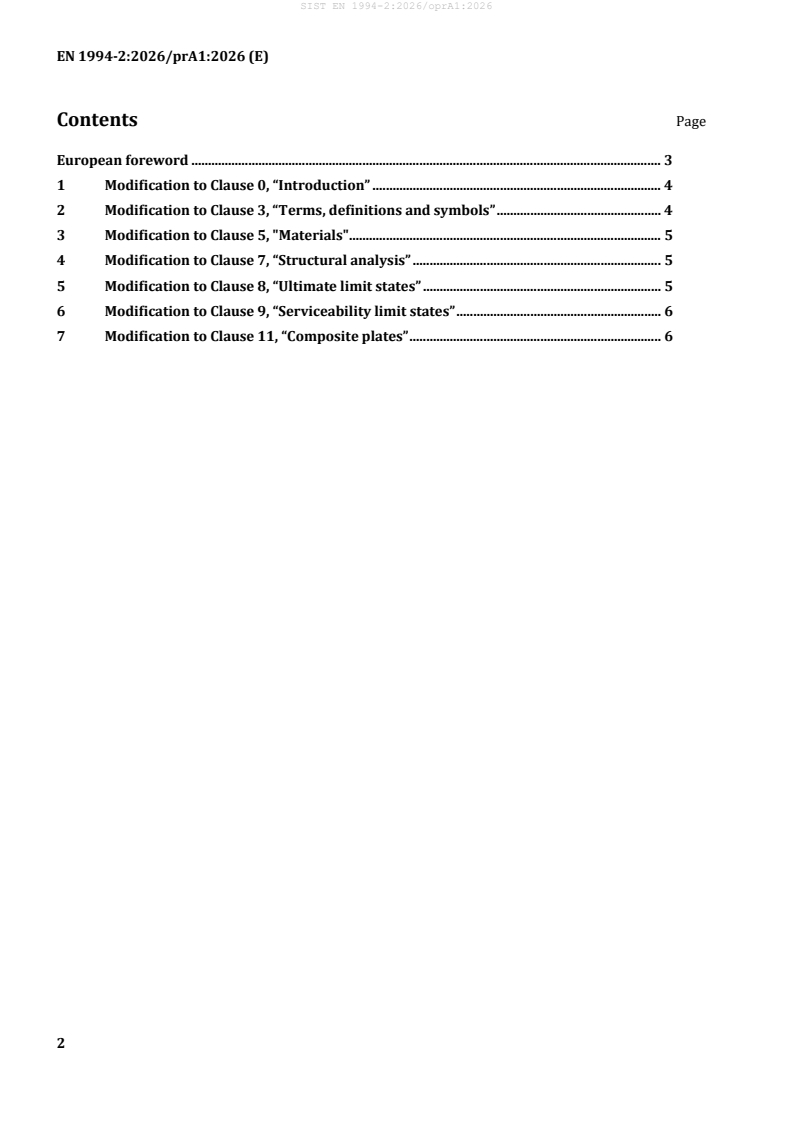
Contents Page
European foreword . 3
1 Modification to Clause 0, “Introduction” . 4
2 Modification to Clause 3, “Terms, definitions and symbols” . 4
3 Modification to Clause 5, "Materials" . 5
4 Modification to Clause 7, “Structural analysis” . 5
5 Modification to Clause 8, “Ultimate limit states” . 5
6 Modification to Clause 9, “Serviceability limit states” . 6
7 Modification to Clause 11, “Composite plates” . 6
European foreword
This document (EN 1994-2:2026/prA1:2026) has been prepared by Technical Committee CEN/TC 250
“Structural Eurocodes”, the secretariat of which is held by BSI.
This document is currently submitted to the CEN Enquiry
This document will amend to EN 1994-2:2026.
NOTE Some modifications are purely editorial corrections to improve the quality of the document and these
will not be tagged in the consolidated publication, as noted after the modification.
The first generation of EN Eurocodes was published between 2002 and 2007. This document forms part
of the second generation of the Eurocodes, which have been prepared under Mandate M/515 issued to
CEN by the European Commission and the European Free Trade Association.
The Eurocodes have been drafted to be used in conjunction with relevant execution, material, product
and test standards, and to identify requirements for execution, materials, products and testing that are
relied upon by the Eurocodes.
...