

SIST EN 1316-2:2013
(Main)Hardwood round timber - Qualitative classification - Part 2: Poplar
- Abstract
This European Standard specifies a qualitative classification and grade designations for felled round timber of poplar in the form of long poles or logs. The classifications describe quality classes of round timbers for which the intended use is not known. This classification is applicable to all merchantable clones of poplar.
- Status
- Published
- Public Enquiry End Date
- 30-Mar-2010
- Publication Date
- 27-Dec-2012
- Technical Committee
- LLZ - Les, lesni izdelki in zaščita lesa
- Current Stage
- 6060 - National Implementation/Publication (Adopted Project)
- Start Date
- 08-Nov-2012
- Due Date
- 13-Jan-2013
- Completion Date
- 28-Dec-2012



SIST EN 1316-2:2013 is the Slovenian adoption of the European Standard EN 1316-2:2012 prepared by CEN. It specifies a qualitative classification and grade designations for felled poplar round timber in the form of long poles or logs, for use when the intended end use is not yet known.
What does SIST EN 1316-2:2013 specify?
SIST EN 1316-2:2013 sets a grading system for poplar round timber and explains how to assign quality classes. It applies to merchantable poplar clones and is intended for timber that is being assessed as roundwood, not as sawn timber or another processed product.
The document is organized into:
- Scope
- Normative references
- Terms and definitions
- Qualitative classification
- Table of rules for grading
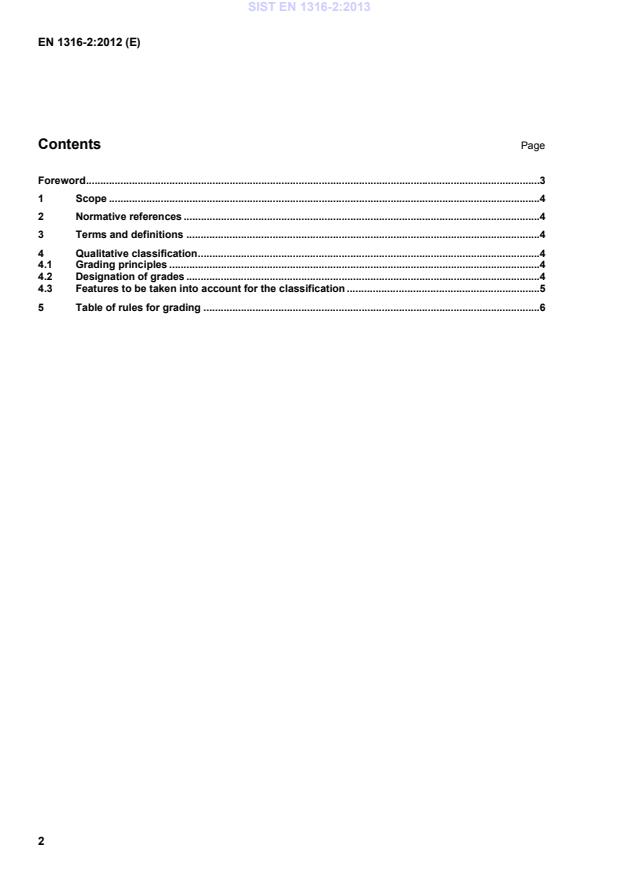
The classification section gives the grading principles, the class designation format, and the features used in grading. The final table brings those rules together for practical sorting of poplar long poles and logs.
What are the key requirements of SIST EN 1316-2:2013?
SIST EN 1316-2:2013 grades each long pole, log, or individualized portion of round timber by its dimensions and by the presence, size, and distribution of specific features. In practice, this means the grader must look at the timber piece as a whole and judge whether any defect or feature is enough to move it to a lower class.
Grading is by quality class, not by intended use
SIST EN 1316-2:2013 classifies timber for which the intended use is unknown. The grades are Po-A, Po-B, and Po-C:
- Po-A is the exceptional quality class
- Po-B is the normal quality class
- Po-C covers timber that cannot be placed in the other classes
For Po-C, more than 40 % of the wood volume must still be usable. That matters in buying and sorting because Po-C is not waste timber, but it is the lowest accepted class in this scheme.
A single failing feature can downgrade the piece
SIST EN 1316-2:2013 states that a long pole, log, or portion of roundwood is downgraded if it fails any one feature requirement. That means graders cannot average out defects across the piece - one serious defect is enough to lower the grade.
Measurements follow named EN methods
SIST EN 1316-2:2013 requires features to be measured according to EN 1309-2, EN 1310, and EN 1311. Length and diameter are measured according to EN 1309-2. In practice, this keeps grading consistent between buyers, sellers, and inspectors.
The grading rules are set out in Table 1
SIST EN 1316-2:2013 uses Table 1 for the detailed limits on:
- dimensions
- sound knots
- unsound knots
- simple sweep
- ovality
- heart shake
- ring shake
- frost crack
- rot
- insect attack
Table 1 is the practical sorting tool. A grader uses it to decide whether the timber belongs in Po-A, Po-B, or Po-C.
Some features may be handled by contract
SIST EN 1316-2:2013 allows contract-based culling for specific features such as bark pocket, burl, buckle, felling shake, shear, dote, rot, canker, carbonized wood, scar, foreign bodies, mistletoe, bird peck, and dry side. That matters because buyers can tighten or adapt acceptance rules for a particular order.
Bark reduction can be agreed separately
SIST EN 1316-2:2013 notes that contractors need to agree on bark reduction. This affects how diameter is interpreted and should be settled before grading starts, especially when timber is being purchased by specification.
What terms does SIST EN 1316-2:2013 define?
- Round timber - Timber in log form, before sawing, that is assessed as a whole piece.
- Long pole - A long piece of felled poplar round timber covered by the grading rules.
- Log - A round timber piece covered by the same qualitative classification.
- Qualitative classification - Grading based on visible timber features and dimensions rather than on a final end use.
- Grade designation - The standardized class name, written as Po-A, Po-B, or Po-C.
- Theoretical crosscut point - A point used to individualize a portion of round timber for grading.
Who uses SIST EN 1316-2:2013?
SIST EN 1316-2:2013 is used by people who buy, sell, inspect, or sort poplar round timber. That includes forest owners, log yard operators, timber merchants, procurement teams, quality inspectors, and sawmill or veneer-log buyers.
It is especially relevant when timber is sold before its final use is decided. The document gives a common language for contract sorting and acceptance checking.
What changed in SIST EN 1316-2:2013 from the previous edition?
SIST EN 1316-2:2013 supersedes EN 1316-2:1997. The foreword states these main changes:
- Clause 4 was completely revised
- classes A to C were defined
- Table 1 was revised and new features were added
- editorial revision was made
Which standards are used with SIST EN 1316-2:2013?
SIST EN 1316-2:2013 refers to these standards for terminology and measurement:
- EN 844-1:1995 - general terms common to round timber and sawn timber
- EN 844-2:1997 - general terms relating to round timber
- EN 844-5:1997 - terms relating to dimensions of round timber
- EN 844-7:1997 - terms relating to anatomical structure of timber
- EN 844-8:1997 - terms relating to features of round timber
- EN 844-10:1998 - terms relating to stain and fungal attack
- EN 1309-2 - measurement of dimensions and volume calculation rules for round timber
- EN 1310 - measurement of features
- EN 1311 - measurement of biological degrade
The foreword also names EN 1316-1 as the companion part of the same qualitative classification series, covering oak and beech.
What does the SIST EN 1316-2:2013 document contain?
SIST EN 1316-2:2013 contains a short classification scheme and one main grading table for poplar round timber. The main working content is in Clause 4 and Table 1, which together describe how to judge dimensions and visible features against the three quality classes.
For practical use, the document supports:
- grading in the yard or forest
- contract specification for poplar roundwood
- inspection of logs and long poles
- consistent quality sorting before further processing
Relations
- Effective Date
- 01-Jan-2013
- Effective Date
- 22-Jul-2026
- Effective Date
- 28-Jan-2026
- Effective Date
- 28-Jan-2026
- Effective Date
- 28-Jan-2026
- Effective Date
- 28-Jan-2026
- Effective Date
- 28-Jan-2026
- Effective Date
- 28-Jan-2026
- Effective Date
- 28-Jan-2026
- Effective Date
- 28-Jan-2026
Get Certified
Connect with accredited certification bodies for this standard

Gozdarski inštitut Slovenije
Slovenian Forestry Institute. Forest management certification support, timber testing.
Sponsored listings
Frequently Asked Questions
SIST EN 1316-2:2013 is a standard published by the Slovenian Institute for Standardization (SIST). Its full title is "Hardwood round timber - Qualitative classification - Part 2: Poplar". This standard covers: This European Standard specifies a qualitative classification and grade designations for felled round timber of poplar in the form of long poles or logs. The classifications describe quality classes of round timbers for which the intended use is not known. This classification is applicable to all merchantable clones of poplar.
This European Standard specifies a qualitative classification and grade designations for felled round timber of poplar in the form of long poles or logs. The classifications describe quality classes of round timbers for which the intended use is not known. This classification is applicable to all merchantable clones of poplar.
SIST EN 1316-2:2013 is classified under the following ICS (International Classification for Standards) categories: 79.040 - Wood, sawlogs and sawn timber. The ICS classification helps identify the subject area and facilitates finding related standards.
SIST EN 1316-2:2013 has the following relationships with other standards: It is inter standard links to SIST EN 1316-2:2003, SIST EN 1309-2:2006, SIST EN 1311:2001, SIST EN 844-1:1998, SIST EN 844-2:1998, SIST EN 844-7:2003, SIST EN 844-5:1998, SIST EN 1310:2001, SIST EN 844-8:1999, SIST EN 844-10:2003. Understanding these relationships helps ensure you are using the most current and applicable version of the standard.
SIST EN 1316-2:2013 is available in PDF format for immediate download after purchase. The document can be added to your cart and obtained through the secure checkout process. Digital delivery ensures instant access to the complete standard document.
Standards Content (Sample)
2003-01.Slovenski inštitut za standardizacijo. Razmnoževanje celote ali delov tega standarda ni dovoljeno.Laub-Rundholz - Qualitäts-Sortierung - Teil 2: PappelBois ronds feuillus - Classement qualitatif - Partie 2: PeuplierHardwood round timber - Qualitative classification - Part 2: Poplar79.040Les, hlodovina in žagan lesWood, sawlogs and sawn timberICS:Ta slovenski standard je istoveten z:EN 1316-2:2012SIST EN 1316-2:2013en,fr,de01-januar-2013SIST EN 1316-2:2013SLOVENSKI
STANDARDSIST EN 1316-2:20031DGRPHãþD
EUROPEAN STANDARD NORME EUROPÉENNE EUROPÄISCHE NORM
EN 1316-2
October 2012 ICS 79.040 Supersedes EN 1316-2:1997English Version
Hardwood round timber - Qualitative classification - Part 2: Poplar
Bois ronds feuillus - Classement qualitatif - Partie 2: Peuplier
Laub-Rundholz - Qualitäts-Sortierung - Teil 2: Pappel This European Standard was approved by CEN on 18 August 2012.
CEN members are bound to comply with the CEN/CENELEC Internal Regulations which stipulate the conditions for giving this European Standard the status of a national standard without any alteration. Up-to-date lists and bibliographical references concerning such national standards may be obtained on application to the CEN-CENELEC Management Centre or to any CEN member.
This European Standard exists in three official versions (English, French, German). A version in any other language made by translation under the responsibility of a CEN member into its own language and notified to the CEN-CENELEC Management Centre has the same status as the official versions.
CEN members are the national standards bodies of Austria, Belgium, Bulgaria, Croatia, Cyprus, Czech Republic, Denmark, Estonia, Finland, Former Yugoslav Republic of Macedonia, France, Germany, Greece, Hungary, Iceland, Ireland, Italy, Latvia, Lithuania, Luxembourg, Malta, Netherlands, Norway, Poland, Portugal, Romania, Slovakia, Slovenia, Spain, Sweden, Switzerland, Turkey and United Kingdom.
EUROPEAN COMMITTEE FOR STANDARDIZATION
COMITÉ EUROPÉEN DE NORMALISATION EUROPÄISCHES KOMITEE FÜR NORMUNG
Management Centre:
Avenue Marnix 17,
B-1000 Brussels © 2012 CEN All rights of exploitation in any form and by any means reserved worldwide for CEN national Members. Ref. No. EN 1316-2:2012: ESIST EN 1316-2:2013
...