

SIST EN ISO 13397-3:2000
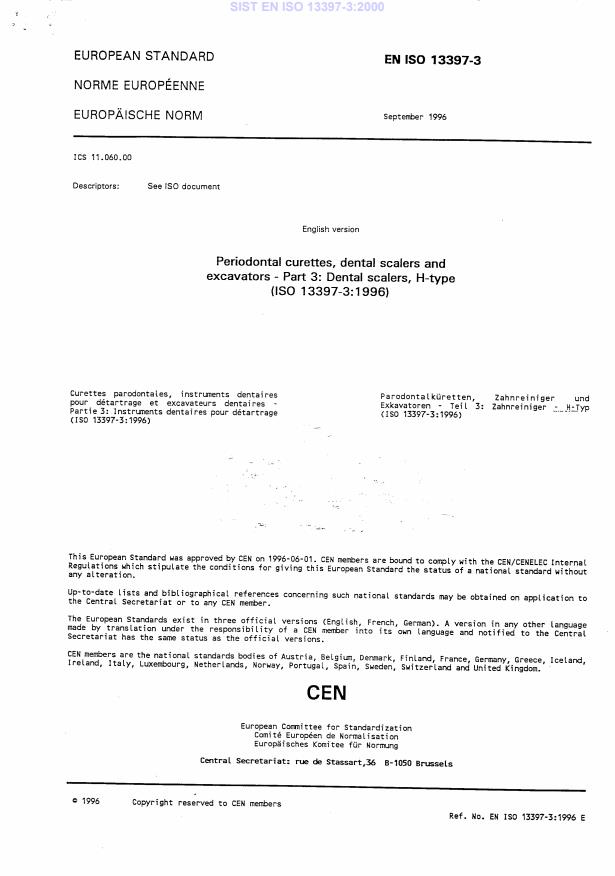
(Main)Periodontal curettes, dental scalers and excavators - Part 3: Dental scalers, H-type (ISO 13397-3:1996)
- Abstract
Gives the dimensions for H-type dental scalers.
- Status
- Published
- Publication Date
- 31-Dec-1999
- Technical Committee
- VAZ - Healthcare
- Current Stage
- 6060 - National Implementation/Publication (Adopted Project)
- Start Date
- 01-Jan-2000
- Due Date
- 01-Jan-2000
- Completion Date
- 01-Jan-2000


SIST EN ISO 13397-3:2000 is the Slovenian standard for H-type dental scalers, published by SIST and identical to EN ISO 13397-3:1996. It specifies the dimensions and design presentation for these hand instruments used to remove calculus and other accretions from tooth surfaces, mainly for manufacturers, inspectors, buyers and dental equipment users who need a common size reference.
What does SIST EN ISO 13397-3:2000 specify?
SIST EN ISO 13397-3:2000 specifies the dimensions for H-type dental scalers. The document focuses on a family of hand instruments and ties those dimensions to the drawings and measurement points used to check them in practice.
The standard is organized into four clauses: Scope, Normative references, Definitions, and Design and dimensions. Clause 4 is the core of the document, and it works together with ISO 13397-1 for general requirements.
What are the key requirements of SIST EN ISO 13397-3:2000?
SIST EN ISO 13397-3:2000 requires H-type dental scalers to conform to the designs shown in Figures 1 to 5 and to the dimensions in Table 1. In practice, this means a manufacturer cannot rely on general appearance alone - the instrument has to match the specified H-type form and size.
- Clause 4 links the part to ISO 13397-1. The general requirements for dental scalers are given in ISO 13397-1, so this part is used together with the base part of the series.
- The overall length is limited to 178 mm. This gives a clear upper limit for all designs, which matters for handling, packaging and dimensional inspection.
- Table 1 sets the dimensional profile for each H-type. The table identifies types H3 to H9 and distinguishes chisel, cleoid and sickle forms, so users can select and verify the correct instrument variant.
- Table 2 fixes how each dimension is measured. It defines the measurement point for blade width, blade thickness, blade length, blade height, shank height, length to first bend, radius of blade, blade angle and offset angle. This matters because the same instrument can only be checked consistently if everyone measures from the same reference points.
- Blade angle and offset angle have specific geometric meanings. The blade angle is taken relative to the centreline of the blade, shank or instrument as appropriate, while the offset angle is read in plan view at the first bend. This is important for comparing working shape, not just size.
- The document relies on defined terminology from ISO 1942-3. That keeps the instrument vocabulary consistent across dental standards and reduces ambiguity in specifications and purchasing documents.
- A measurement method from ISO 13397-1 is referenced for most dental hand instruments. This supports practical inspection and helps laboratories and quality teams use the same approach.
What terms does SIST EN ISO 13397-3:2000 define?
Dental scaler - A hand instrument used to remove calculus and other accretions from tooth surfaces.
Glaze surface - The working surface of the instrument that is formed during production of the cutting edge(s).
H-type - The family of dental scalers covered by this part, with variants shown as H3 to H9.
Blade angle - The angle between the glaze surface and the centreline of the blade, shank or instrument, depending on the measurement.
Offset angle - The angle, seen in plan view, between the shank centreline and a tangent line at the first bend.
Length to first bend - The distance from the datum point to the highest point on the first bend of the shank.
Who uses SIST EN ISO 13397-3:2000?
SIST EN ISO 13397-3:2000 is used by dental instrument manufacturers, quality control teams, test laboratories and procurement staff who need to specify or verify H-type scalers. It is also useful for dental equipment suppliers and buyers who compare products against a common dimensional standard before acceptance.
Which standards are used with SIST EN ISO 13397-3:2000?
- ISO 1942-3:1989 - Supplies dental vocabulary used for the terminology in this part.
- ISO 13397-1:1995 - Gives the general requirements for dental scalers and includes a measurement method in Annex A.
- ISO 13397-2 - Covers periodontal curettes, Gr-type, within the same instrument family.
- ISO 13397-4 - Covers dental excavators, Discoid-type, as another part of the series.
What does the SIST EN ISO 13397-3:2000 document contain?
The document contains the scope, two normative references, two definitions, and the dimensional specification for H-type dental scalers. Figures 1 to 5 show the instrument forms for the different H-types, including chisel, cleoid and sickle variants.
Table 1 lists the dimensional scheme for each type, and Table 2 explains the measurement points used for inspection. Together, these parts support design control, dimensional checking and product comparison in manufacture and quality assurance.
Relations
- Effective Date
- 28-Jan-2026
Get Certified
Connect with accredited certification bodies for this standard

BSI Group
BSI (British Standards Institution) is the business standards company that helps organizations make excellence a habit.

TÜV Rheinland
TÜV Rheinland is a leading international provider of technical services.

TÜV SÜD
TÜV SÜD is a trusted partner of choice for safety, security and sustainability solutions.
Sponsored listings
Frequently Asked Questions
SIST EN ISO 13397-3:2000 is a standard published by the Slovenian Institute for Standardization (SIST). Its full title is "Periodontal curettes, dental scalers and excavators - Part 3: Dental scalers, H-type (ISO 13397-3:1996)". This standard covers: Gives the dimensions for H-type dental scalers.
Gives the dimensions for H-type dental scalers.
SIST EN ISO 13397-3:2000 is classified under the following ICS (International Classification for Standards) categories: 11.060.20 - Dental equipment. The ICS classification helps identify the subject area and facilitates finding related standards.
SIST EN ISO 13397-3:2000 has the following relationships with other standards: It is inter standard links to SIST EN 1639:2010. Understanding these relationships helps ensure you are using the most current and applicable version of the standard.
SIST EN ISO 13397-3:2000 is available in PDF format for immediate download after purchase. The document can be added to your cart and obtained through the secure checkout process. Digital delivery ensures instant access to the complete standard document.
Standards Content (Sample)
Contents
- 1 Scope
- 2 Normative references
- 4 Design and dimensions
- Annex A of IS0 13397-I provides details of one
- 4.1 Overall length
- 3 Definitions
1 Scope
nitions apply.
This part of IS0 13397 specifies the dimensions for 3.1 dental scaler: Hand instrument for removing H-type dental scalers.
calculus and other accretions from the surface of teeth.
2 Normative references
3.2 glaze surface: Working surface of the instru- The following standards contain provisions which, ment formed during production of the cutting edge(s).
through reference in this text, constitute provisions of this part of IS0 13397. At the time of publication, the editions indicated were valid. All standards are
4 Design and dimensions
subject to revision, and parties to agreements based on this part of IS0 13397 are encouraged to investi- General requirements for dental scalers are specified gate the possibility of applying the most recent ediin IS0 13397-I. tions of the standards indicated below. Members of Dental scalers shall have the designs shown in figures IEC and IS0 maintain registers of currently valid 1 to 5 and the dimensions as given in table 1. The International Standards.
points of measurement associated with the dimen- I SO 1942-3: 1989, Dental vocabulary - Part 3: Dental sions are listed in table 2. instruments.
Annex A of IS0 13397-I provides details of one
method of measurement applicable to most types of Periodontal cure ttes, dental IS0 13397-l :I 995, dental hand instrument.
- Part I: General requirescalers and excavators men ts.
...