

SIST EN 13766:2019+A1:2020
(Main)Thermoplastic multi-layer (non-vulcanized) hoses and hose assemblies for the transfer of liquid petroleum gas and liquefied natural gas - Specification
General Information
- Abstract
This document specifies requirements for two types of thermoplastic multi-layer (non-vulcanized) transfer hoses and hose assemblies for carrying liquefied petroleum gas and liquefied natural gas. Each type is subdivided into two classes, one for onshore duties, and the other for offshore.
This document is applicable for hose sizes from 25 mm to 250 mm, working pressures from 10,5 bar to 25 bar and operating temperatures from - 196 °C to + 45 °C.
NOTE Offshore LNG hose assemblies are also specified in EN 1474-2 [1].
- Status
- Published
- Publication Date
- 14-May-2020
- Technical Committee
- IPMA - Polimer materials and products
- Current Stage
- 6060 - National Implementation/Publication (Adopted Project)
- Start Date
- 12-May-2020
- Due Date
- 17-Jul-2020
- Completion Date
- 15-May-2020


Overview
SIST EN 13766:2019+A1:2020 specifies the requirements for thermoplastic multi-layer (non-vulcanized) hoses and hose assemblies designed for the transfer of liquefied petroleum gas (LPG) and liquefied natural gas (LNG). Covering both onshore and offshore applications, this European standard details two types of hoses, each subdivided by use environment, and outlines their dimensions, construction, performance criteria, and testing protocols. The standard applies to hose sizes ranging from 25 mm to 250 mm internal diameter, with working pressures between 10.5 bar and 25 bar and operating temperature ranges from -196 °C to +45 °C. Adherence to this standard helps ensure the reliable and safe handling of LPG and LNG in demanding industrial environments.
Key Topics
Classification and Scope
- Two types of hoses, each for onshore (Class A) and offshore (Class B) duties.
- Covers multiple sizes, pressures, and temperature ranges for broad industrial versatility.
Materials and Construction
- Multi-layer thermoplastic construction with internal and external stainless steel wire helices.
- Specific material qualifications to ensure compatibility with cryogenic and pressurized gases.
Performance Requirements
- Includes rigorous requirements for physical properties such as burst pressure, proof pressure, bend radius, and crush recovery.
- Electrical continuity mandated for safety in explosive environments.
- Resistance to flammability, ozone, and thermal aging for long-term reliability.
Testing and Marking
- Comprehensive testing regimes: type tests, routine tests, and batch tests per defined intervals.
- Clear and permanent marking requirements for traceability, safety, and compliance.
Applications
Transfer of LPG and LNG:
These hose assemblies are crucial for the safe and efficient transfer of liquefied petroleum gas and liquefied natural gas between storage, transport, and processing facilities.Onshore and Offshore Use:
Hoses specified by this standard are used in loading and unloading at port terminals, onboard vessels, and in industrial processing plants, with separate classifications for marine and land-based operations.Industrial Compliance and Safety:
By following SIST EN 13766:2019+A1:2020 requirements, operators achieve a higher level of safety, reliability, and regulatory compliance in handling hazardous cryogenic and pressurized gases.Maintenance and Inspection:
The detailed test procedures and marking criteria facilitate easier inspection, maintenance, and lifecycle tracking of hose assemblies.
Related Standards
EN 1474-2:
Specifies additional requirements for offshore LNG hose assemblies, particularly regarding the design and testing of marine transfer hoses.EN ISO 1402:
Defines methods for hydrostatic testing of rubber and plastic hoses and assemblies.EN ISO 527-1, EN ISO 13934-1:
Detail the methods for testing tensile properties of plastics and fabrics, supporting the material requirements in the standard.EN ISO 8031:
Outlines procedures for measuring electrical resistance in hose assemblies.
Adopting SIST EN 13766:2019+A1:2020 supports safer, more efficient operations in the LPG and LNG industries, minimizing risk and optimizing compliance with European safety and quality standards for hose assemblies. This standard is essential for manufacturers, operators, and stakeholders involved in the storage, transfer, and handling of liquefied gases.
Relations
- Effective Date
- 28-Jan-2026
- Effective Date
- 28-Jan-2026
- Effective Date
- 28-Jan-2026
- Refers
SIST EN ISO 8330:2014 - Rubber and plastics hoses and hose assemblies - Vocabulary (ISO 8330:2014) - Effective Date
- 28-Jan-2026
- Effective Date
- 28-Jan-2026
- Effective Date
- 28-Jan-2026
- Effective Date
- 28-Jan-2026
- Effective Date
- 28-Jan-2026
- Effective Date
- 28-Jan-2026
- Effective Date
- 28-Jan-2026
- Effective Date
- 28-Jan-2026
- Effective Date
- 28-Jan-2026
- Effective Date
- 28-Jan-2026
- Effective Date
- 12-Feb-2020
- Effective Date
- 12-Feb-2020
Get Certified
Connect with accredited certification bodies for this standard

DIN CERTCO
DIN Group product certification.

Element Materials Technology
Materials testing and product certification.
ABS Group Brazil
ABS Group certification services in Brazil.
Sponsored listings
Frequently Asked Questions
SIST EN 13766:2019+A1:2020 is a standard published by the Slovenian Institute for Standardization (SIST). Its full title is "Thermoplastic multi-layer (non-vulcanized) hoses and hose assemblies for the transfer of liquid petroleum gas and liquefied natural gas - Specification". This standard covers: This document specifies requirements for two types of thermoplastic multi-layer (non-vulcanized) transfer hoses and hose assemblies for carrying liquefied petroleum gas and liquefied natural gas. Each type is subdivided into two classes, one for onshore duties, and the other for offshore. This document is applicable for hose sizes from 25 mm to 250 mm, working pressures from 10,5 bar to 25 bar and operating temperatures from - 196 °C to + 45 °C. NOTE Offshore LNG hose assemblies are also specified in EN 1474-2 [1].
This document specifies requirements for two types of thermoplastic multi-layer (non-vulcanized) transfer hoses and hose assemblies for carrying liquefied petroleum gas and liquefied natural gas. Each type is subdivided into two classes, one for onshore duties, and the other for offshore. This document is applicable for hose sizes from 25 mm to 250 mm, working pressures from 10,5 bar to 25 bar and operating temperatures from - 196 °C to + 45 °C. NOTE Offshore LNG hose assemblies are also specified in EN 1474-2 [1].
SIST EN 13766:2019+A1:2020 is classified under the following ICS (International Classification for Standards) categories: 23.040.70 - Hoses and hose assemblies; 75.200 - Petroleum products and natural gas handling equipment; 83.140.30 - Plastics pipes and fittings for non fluid use. The ICS classification helps identify the subject area and facilitates finding related standards.
SIST EN 13766:2019+A1:2020 has the following relationships with other standards: It is inter standard links to SIST EN ISO 1402:2010, SIST EN 10088-3:2015, SIST EN ISO 527-1:2019, SIST EN ISO 8330:2014, SIST EN ISO 4671:2022, SIST EN ISO 8031:2010, SIST EN ISO 7326:2016, SIST EN ISO 13934-1:2013, SIST EN ISO 10619-1:2018, SIST EN ISO 1043-1:2012, SIST EN ISO 10619-2:2021, SIST EN ISO 148-1:2017, SIST EN 1473:2021, SIST EN 13766:2019, SIST EN 13766:2019/oprA1:2019. Understanding these relationships helps ensure you are using the most current and applicable version of the standard.
SIST EN 13766:2019+A1:2020 is available in PDF format for immediate download after purchase. The document can be added to your cart and obtained through the secure checkout process. Digital delivery ensures instant access to the complete standard document.
Standards Content (Sample)
SLOVENSKI STANDARD
01-julij-2020
Plastomerne večslojne (nevulkanizirane) cevi in cevni priključki za pretok
utekočinjenega naftnega plina in utekočinjenega zemeljskega plina - Specifikacija
Thermoplastic multi-layer (non-vulcanized) hoses and hose assemblies for the transfer of
liquid petroleum gas and liquefied natural gas - Specification
Thermoplastische, mehrlagige (nicht vulkanisierte) Schläuche und Schlauchleitungen für
die Förderung von Flüssiggas und verflüssigtem Erdgas - Spezifikation
Tuyaux et flexibles en thermoplastique multicouches (non vulcanisés) utilisés pour le
dépotage de gaz pétrolier liquide et gaz naturel liquifié - Spécification
Ta slovenski standard je istoveten z: EN 13766:2018+A1:2020
ICS:
75.200 Oprema za skladiščenje Petroleum products and
nafte, naftnih proizvodov in natural gas handling
zemeljskega plina equipment
83.140.30 Polimerne cevi in fitingi za Plastics pipes and fittings for
snovi, ki niso tekočine non fluid use
2003-01.Slovenski inštitut za standardizacijo. Razmnoževanje celote ali delov tega standarda ni dovoljeno.
EN 13766:2018+A1
EUROPEAN STANDARD
NORME EUROPÉENNE
May 2020
EUROPÄISCHE NORM
ICS 23.040.70 Supersedes EN 13766:2018
English Version
Thermoplastic multi-layer (non-vulcanized) hoses and
hose assemblies for the transfer of liquid petroleum gas
and liquefied natural gas - Specification
Tuyaux et flexibles en thermoplastique multicouches Thermoplastische, mehrlagige (nicht vulkanisierte)
(non vulcanisés) utilisés pour le dépotage de gaz Schläuche und Schlauchleitungen für die Förderung
pétrolier liquide et gaz naturel liquifié - Spécification von Flüssiggas und verflüssigtem Erdgas -
Spezifikation
This European Standard was approved by CEN on 9 November 2018 and includes Amendment 1 approved by CEN on 24
February 2020.
CEN members are bound to comply with the CEN/CENELEC Internal Regulations which stipulate the conditions for giving this
European Standard the status of a national standard without any alteration. Up-to-date lists and bibliographical references
concerning such national standards may be obtained on application to the CEN-CENELEC Management Centre or to any CEN
member.
This European Standard exists in three official versions (English, French, German). A version in any other language made by
translation under the responsibility of a CEN member into its own language and notified to the CEN-CENELEC Management
Centre has the same status as the official versions.
CEN members are the national standards bodies of Austria, Belgium, Bulgaria, Croatia, Cyprus, Czech Republic, Denmark, Estonia,
Finland, France, Germany, Greece, Hungary, Iceland, Ireland, Italy, Latvia, Lithuania, Luxembourg, Malta, Netherlands, Norway,
Poland, Portugal, Republic of North Macedonia, Romania, Serbia, Slovakia, Slovenia, Spain, Sweden, Switzerland, Turkey and
United Kingdom.
EUROPEAN COMMITTEE FOR STANDARDIZATION
COMITÉ EUROPÉEN DE NORMALISATION
EUROPÄISCHES KOMITEE FÜR NORMUNG
CEN-CENELEC Management Centre: Rue de la Science 23, B-1040 Brussels
© 2020 CEN All rights of exploitation in any form and by any means reserved Ref. No. EN 13766:2018+A1:2020 E
worldwide for CEN national Members.
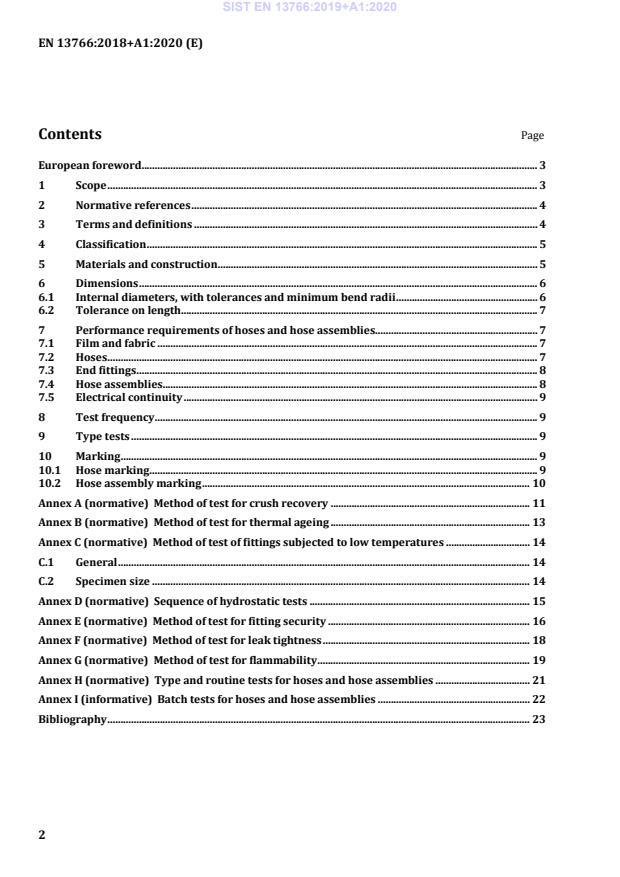
Contents Page
European foreword . 3
1 Scope . 3
2 Normative references . 4
3 Terms and definitions . 4
4 Classification . 5
5 Materials and construction . 5
6 Dimensions . 6
6.1 Internal diameters, with tolerances and minimum bend radii . 6
6.2 Tolerance on length. 7
7 Performance requirements of hoses and hose assemblies . 7
7.1 Film and fabric . 7
7.2 Hoses . 7
7.3 End fittings . 8
7.4 Hose assemblies. 8
7.5 Electrical continuity . 9
8 Test frequency . 9
9 Type tests . 9
10 Marking . 9
10.1 Hose marking . 9
10.2 Hose assembly marking . 10
Annex A (normative) Method of test for crush recovery . 11
Annex B (normative) Method of test for thermal ageing . 13
Annex C (normative) Method of test of fittings subjected to low temperatures . 14
C.1 General . 14
C.2 Specimen size . 14
Annex D (normative) Sequence of hydrostatic tests . 15
Annex E (normative) Method of test for fitting security . 16
Annex F (normative) Method of test for leak tightness . 18
Annex G (normative) Method of test for flammability . 19
Annex H (normative) Type and routine tests for hoses and hose assemblies . 21
Annex I (informative) Batch tests for hoses and hose assemblies . 22
Bibliography . 23
European foreword
This document (EN 13766:2018+A1:2020) has been prepared by Technical Committee CEN/TC 218 “Rubber
and plastics hoses and hose assemblies”, the secretariat of which is held by BSI.
This European Standard shall be given the status of a national standard, either by publication of an
identical text or by endorsement, at the latest by November 2020, and conflicting national standards shall
be withdrawn at the latest by November 2020.
Attention is drawn to the possibility that some of the elements of this document may be the subject of patent
rights. CEN shall not be held responsible for identifying any or all such patent rights.
This document includes Amendment 1 approved by CEN on 24 February 2020.
This document supersedes !EN 13766:2018".
The start and finish of text introduced or altered by amendment is indicated in the text by tags !".
The main changes compared to the previous version are as follows:
— the safety warning has been moved from the Scope to Clause 7 “Performance requirements of hoses and
hose assemblies”;
— the normative references (Clause 2) have been updated;
— the tolerances for the minimum working temperature in Table 1 “Pressure and temperature range” have
been removed;
— in Clause 5, “Materials and construction”, a requirement has been added that the manufacturer shall
establish that the materials used are suitable for the cryogenic liquids to be carried;
— the requirement for the electrical resistance between end fittings (Clause 7) has been modified;
— Clause 10 “Marking” has been updated;
— the title of Annex A has been changed to “Method of test for crush recovery” and tolerances for the test
force have been added;
— requirements have been added to Annex D “Sequence of hydrostatic tests”;
— in Annex E “Method of test for fitting security”, the wording concerning a “cycle” has been clarified and
the requirements for the end of the test after completion of 20 cycles have been rewritten;
— Annex G “Method of test for flammability” has been added;
— the requirements for type tests, routine tests and batch tests (Annexes H and I) have been updated;
— the document has been editorially revised.
According to the CEN-CENELEC Internal Regulations, the national standards organisations of the following
countries are bound to implement this European Standard: Austria, Belgium, Bulgaria, Croatia, Cyprus, Czech
Republic, Denmark, Estonia, Finland, France, Germany, Greece, Hungary, Iceland, Ireland, Italy, Latvia,
Lithuania, Luxembourg, Malta, Netherlands, Norway, Poland, Portugal, Republic of North Macedonia,
Romania, Serbia, Slovakia, Slovenia, Spain, Sweden, Switzerland, Turkey and the United Kingdom.
1 Scope
This document specifies requirements for two types of thermoplastic multi-layer (non-vulcanized) transfer
hoses and hose assemblies for carrying liquefied petroleum gas and liquefied natural gas. Each type is
subdivided into two classes, one for onshore duties, and the other for offshore.
This document is applicable for hose sizes from 25 mm to 250 mm, working pressures from 10,5 bar to 25
bar and operating temperatures from –196 °C to +45 °C.
NOTE Offshore LNG hose assemblies are also specified in EN 1474-2 [1].
2 Normative references
The following documents are referred to in the text in such a way that some or all of their content constitutes
requirements of this document. For dated references, only the edition cited applies. For undated references,
the latest edition of the referenced document (including any amendments) applies.
EN 10088-3:2014, Stainless steels - Part 3: Technical delivery conditions for semi-finished products, bars, rods,
wire, sections and bright products of corrosion resisting steels for general purposes
EN ISO 148-1, Metallic materials - Charpy pendulum impact test - Part 1: Test method (ISO 148-1)
EN ISO 527-1, Plastics - Determination of tensile properties - Part 1: General principles (ISO 527-1)
EN ISO 1043-1, Plastics - Symbols and abbreviated terms - Part 1: Basic polymers and their special
characteristics (ISO 1043-1)
EN ISO 1402:2009, Rubber and plastics hoses and hose assemblies - Hydrostatic testing (ISO 1402)
EN ISO 4671, Rubber and plastics hoses and hose assemblies - Methods of measurement of the dimensions of
hoses and the lengths of hose assemblies (ISO 4671)
EN ISO 7326, Rubber and plastics hoses - Assessment of ozone resistance under static conditions (ISO 7326)
EN ISO 8031:2009, Rubber and plastics hoses and hose assemblies - Determination of electrical resistance and
conductivity (ISO 8031:2009)
EN ISO 8330:2014, Rubber and plastics hoses and hose assemblies - Vocabulary (ISO 8330:2014)
EN ISO 10619-1, Rubber and plastics hoses and tubing - Measurement of flexibility and stiffness - Part 1:
Bending tests at ambient temperature (ISO 10619-1)
!EN ISO 10619-2, Rubber and plastics hoses and tubing - Measurement of flexibility and stiffness - Part 2:
Bending tests at sub-ambient temperatures (ISO 10619-2)"
EN ISO 13934-1, Textiles - Tensile properties of fabrics - Part 1: Determination of maximum force and
elongation at maximum force using the strip method (ISO 13934-1)
3 Terms and definitions
For the purposes of this document, the terms and definitions given in EN ISO 8330:2014 apply.
ISO and IEC maintain terminological databases for use in standardization at the following addresses:
— IEC Electropedia: available at http://www.electropedia.org/
— ISO Online browsing platform: available at http://www.iso.org/obp
4 Classification
Hoses shall be classified according to their usage, working pressure and working temperature range as given
in Table 1.
Table 1 — Pressure and temperature range
Classification
Pressure/temperature
a b a b
Class A Class B Class A Class B
Type 1 Type 1 Type 2 Type 2
Maximum working 25 20 13 10,5
pressure (bar)
Proof pressure (bar) 37,5 30 19,5 15,8
Minimum burst pressure 100 100 52 52,5
(bar)
Working temperature –50 to +45 –50 to +45 –196 to +45 –196 to +45
range (°C)
NOTE 1 1 bar = 0,1 MPa
NOTE 2 Due to pressurization during test and operations the temperature of the fluid could increase.
The indicated temperatures are measured at atmospheric pressure.
a
Class A is for use onshore.
b
Class B is for use offshore.
Upon agreement with the manufacturer, lower min. and/or higher max. temperatures are allowed
depending on the materials used and the compatibility at those temperatures with the fluid conveyed. Other
properties and requirements mentioned in the standard still have to be met.
5 Materials and construction
The manufacturer shall establish that the materials used are suitable for the cryogenic liquids to be carried.
Hoses shall be constructed as shown in Figure 1 and shall consist of the following:
a) Class A:
1) An internal wire helix of stainless steel conforming to EN 10088-3:2014, numbers 1.4306, 1.4401,
1.4404 or 1.4436;
2) A multi-ply wall of layers of films and fabrics made of thermoplastics that in combination give the
required properties specified in Table 1 and provide a complete seal;
3) An external wire helix of stainless steel conforming to EN 10088-3:2014, numbers 1.4306, 1.4401,
1.4404 or 1.4436.
b) Class B:
1) An internal wire helix of stainless steel conforming to EN 10088-3:2014, numbers 1.4401, 1.4404 or
1.4436;
2) A multi-ply wall of layers of films and fabrics made of thermoplastics that in combination give the
required properties specified in Table 1 and provide a complete seal;
3) An external wire helix of stainless steel conforming to EN 10088-3:2014, numbers 1.4401, 1.4404 or
1.4436.
By agreement between manufacturer and purchaser, the outer layer may have colour identification.
Key
1 internal wire
2 film
3 fabric
4 external wire
Figure 1 — Section of a typical thermoplastic multilayer hose
6 Dimensions
6.1 Internal diameters, with tolerances and minimum bend radii
When measured in accordance with EN ISO 4671, the values of the internal diameter of the hose shall
conform to Table 2. When tested by the method described in EN ISO 10619-1 the value of the minimum bend
radius shall be as given in Table 2. The hose shall show no sign of permanent deformation of the cross
section i.e. kinking.
Table 2 — Dimensions and minimum bend radius
Dimensions in millimetres
Internal diameter Tolerance Minimum bend radius
25 ±1 150
32 ±1 175
38 ±1 175
40 ±1 200
50 ±1 200
65 ±2 200
75 ±2 250
80 ±2 250
100 ±2 500
150 ±2 660
200 ±3 910
250 ±3 2 500
6.2 Tolerance on length
When
...