

oSIST prEN 1191:2025
(Main)Windows and doors - Resistance to repeated opening and closing - Test method
General Information
- Abstract
This document specifies the method to determine the resistance to repeated opening and closing of windows and pedestrian doorsets when subjected to repeated opening and closing.
It applies to all construction materials and operating systems for any window or pedestrian doorset, including gaskets and building hardware, in normal operating conditions.
The parts concerned in the testing are the frame, the opening component (including any additional moving components e.g. a secondary sash/leaf) and any building hardware directly involved in the opening and closing process, including operating devices, for example, the handle.
The testing does not include any building hardware whose operation is not directly involved in the opening and closing of the moving components: added-on fastening systems such as peg-stays or cabin hooks or bolts, nor, unless specified, any independently installed stops (not connected to the complete assembly) such as a wall or ground-mounted stop.
NOTE 1 Certain types of products can require more detailed testing procedures contained in the normative annexes of this document. Any other products follow the procedures of the main part of this document:
− Annex A applies to tilt and turn, tilt-first, turn-only, or tilt-only windows and door-height windows;
− Annex B applies to sliding, lift and slide or lift and slide and tilt windows and door-height windows;
− Annex C applies to tilt and slide windows and door-height windows;
− Annex D applies to fold and slide windows and door-height windows;
− Annex E applies to horizontal and vertical pivot windows and door-height windows;
− Annex F applies to vertical sliding windows;
− Annex G applies to side-hung casements and top-hung windows, opening outwards (including reversible windows);
− Annex H applies to single and double action hinged or pivoted pedestrian doorsets excluding power operated doorsets;
− Annex I applies to power operated single action hinged or pivoted pedestrian doorsets.
NOTE 2 In this document, the term door-height window is used for windows that are used for the passage of pedestrians, i.e. as a pedestrian doorset.
- Status
- Not Published
- Public Enquiry End Date
- 30-Mar-2025
- Technical Committee
- ISTP - Doors and windows
- Current Stage
- 4020 - Public enquire (PE) (Adopted Project)
- Start Date
- 03-Feb-2025
- Due Date
- 23-Jun-2025
- Completion Date
- 31-Mar-2025

Overview
oSIST prEN 1191:2025 is a European draft standard developed by CEN (European Committee for Standardization) that sets out a test method to determine the resistance of windows and pedestrian doorsets to repeated opening and closing. The standard applies to all construction materials and operating systems, ensuring performance evaluation under normal operating conditions. This document is essential for manufacturers, laboratories, architects, and builders aiming to ensure product mechanical durability and reliability in real-world applications.
Key Topics
Scope and Applicability:
oSIST prEN 1191:2025 covers all types of windows and pedestrian doors, regardless of frame material (e.g., wood, metal, PVC), sash type, or hardware configuration. It includes both manually and power-operated units, provided their operation directly involves the opening and closing mechanism.Components Tested:
- Frame
- Opening component(s), including secondary sashes or leaves
- Building hardware directly connected to the movement (e.g., hinges, handles, latches)
- Gaskets and seals engaged in normal operation
Excluded are non-integrated accessories and hardware that do not directly influence the opening/closing, such as external stops, bolts, or pegs.
Test Procedures:
- Focuses on simulating repeated cycling of opening and closing under controlled conditions
- Establishes requirements for cycle count, operational speed (velocity), applied force, and environmental conditions (temperature and humidity)
- Outlines how to prepare specimens, measure forces and movements, and record results
Product Variants and Annexes:
Detailed normative annexes (A–I) specify procedures for the full range of typical window and doorset types, such as:- Tilt and turn, sliding, fold and slide, pivot, and casement windows
- Side-hung, top-hung, and power-operated pedestrian doors
Failure and Performance Criteria:
Establishes how to identify product failure, including excessive operating force, deformation, or inability to close securely.
Applications
Product Development and Quality Assurance:
Window and door manufacturers utilize oSIST prEN 1191:2025 to verify the mechanical durability of new and existing designs. Passing these tests can form the basis for product guarantees and help reduce service claims associated with early hardware or frame failure.Compliance and Certification:
Compliance with oSIST prEN 1191:2025 supports CE marking and other regulatory or market entry requirements within Europe. The standard’s requirements are referenced in numerous product and fire safety standards.Performance Specification in Construction:
Architects and specifiers rely on test results per oSIST prEN 1191:2025 when selecting windows and doorsets for high-traffic areas in commercial, residential, and public buildings, ensuring long-term reliability.Laboratory Testing:
Accredited test laboratories use this method to issue test reports and certifications, often in support of combined performance assessments (e.g., fire resistance, smoke control, and durability).
Related Standards
For comprehensive product evaluation, oSIST prEN 1191:2025 should be considered alongside other CEN and EN standards on doors and windows, including:
- EN 12400: Windows and pedestrian doors - Mechanical durability - Requirements and classification
- EN 16034 / EN 16035: Fire and smoke resistant doors, windows, and building hardware
- EN 12046-1 / EN 12046-2: Determination of operating forces (Windows and Doors)
- EN 13115: Windows - Mechanical properties classification
- EN 179 / EN 1125: Emergency exit devices - Requirements and test methods
These standards provide further detail on safety features, fire and smoke control, classifications, and specific hardware performance.
Conclusion
oSIST prEN 1191:2025 provides a unified, repeatable method for assessing the resistance to repeated opening and closing of windows and doors. Its application ensures that products are durable, reliable, and suitable for real-world use, increasing building safety, user satisfaction, and lifecycle value. Adhering to this standard enables manufacturers and stakeholders to meet strict European market and safety requirements, enhance product quality, and build user confidence in window and door products.
Relations
- Revises
SIST EN 1191:2013 - Windows and doors - Resistance to repeated opening and closing - Test method - Effective Date
- 28-Feb-2024
Get Certified
Connect with accredited certification bodies for this standard

DIBt (Deutsches Institut für Bautechnik)
German Institute for Building Technology.
DIN CERTCO
DIN Group product certification.

Aboma Certification B.V.
Specialized in construction, metal, and transport sectors.
Sponsored listings
Frequently Asked Questions
oSIST prEN 1191:2025 is a draft published by the Slovenian Institute for Standardization (SIST). Its full title is "Windows and doors - Resistance to repeated opening and closing - Test method". This standard covers: This document specifies the method to determine the resistance to repeated opening and closing of windows and pedestrian doorsets when subjected to repeated opening and closing. It applies to all construction materials and operating systems for any window or pedestrian doorset, including gaskets and building hardware, in normal operating conditions. The parts concerned in the testing are the frame, the opening component (including any additional moving components e.g. a secondary sash/leaf) and any building hardware directly involved in the opening and closing process, including operating devices, for example, the handle. The testing does not include any building hardware whose operation is not directly involved in the opening and closing of the moving components: added-on fastening systems such as peg-stays or cabin hooks or bolts, nor, unless specified, any independently installed stops (not connected to the complete assembly) such as a wall or ground-mounted stop. NOTE 1 Certain types of products can require more detailed testing procedures contained in the normative annexes of this document. Any other products follow the procedures of the main part of this document: − Annex A applies to tilt and turn, tilt-first, turn-only, or tilt-only windows and door-height windows; − Annex B applies to sliding, lift and slide or lift and slide and tilt windows and door-height windows; − Annex C applies to tilt and slide windows and door-height windows; − Annex D applies to fold and slide windows and door-height windows; − Annex E applies to horizontal and vertical pivot windows and door-height windows; − Annex F applies to vertical sliding windows; − Annex G applies to side-hung casements and top-hung windows, opening outwards (including reversible windows); − Annex H applies to single and double action hinged or pivoted pedestrian doorsets excluding power operated doorsets; − Annex I applies to power operated single action hinged or pivoted pedestrian doorsets. NOTE 2 In this document, the term door-height window is used for windows that are used for the passage of pedestrians, i.e. as a pedestrian doorset.
This document specifies the method to determine the resistance to repeated opening and closing of windows and pedestrian doorsets when subjected to repeated opening and closing. It applies to all construction materials and operating systems for any window or pedestrian doorset, including gaskets and building hardware, in normal operating conditions. The parts concerned in the testing are the frame, the opening component (including any additional moving components e.g. a secondary sash/leaf) and any building hardware directly involved in the opening and closing process, including operating devices, for example, the handle. The testing does not include any building hardware whose operation is not directly involved in the opening and closing of the moving components: added-on fastening systems such as peg-stays or cabin hooks or bolts, nor, unless specified, any independently installed stops (not connected to the complete assembly) such as a wall or ground-mounted stop. NOTE 1 Certain types of products can require more detailed testing procedures contained in the normative annexes of this document. Any other products follow the procedures of the main part of this document: − Annex A applies to tilt and turn, tilt-first, turn-only, or tilt-only windows and door-height windows; − Annex B applies to sliding, lift and slide or lift and slide and tilt windows and door-height windows; − Annex C applies to tilt and slide windows and door-height windows; − Annex D applies to fold and slide windows and door-height windows; − Annex E applies to horizontal and vertical pivot windows and door-height windows; − Annex F applies to vertical sliding windows; − Annex G applies to side-hung casements and top-hung windows, opening outwards (including reversible windows); − Annex H applies to single and double action hinged or pivoted pedestrian doorsets excluding power operated doorsets; − Annex I applies to power operated single action hinged or pivoted pedestrian doorsets. NOTE 2 In this document, the term door-height window is used for windows that are used for the passage of pedestrians, i.e. as a pedestrian doorset.
oSIST prEN 1191:2025 is classified under the following ICS (International Classification for Standards) categories: 91.060.50 - Doors and windows. The ICS classification helps identify the subject area and facilitates finding related standards.
oSIST prEN 1191:2025 has the following relationships with other standards: It is inter standard links to SIST EN 1191:2013. Understanding these relationships helps ensure you are using the most current and applicable version of the standard.
oSIST prEN 1191:2025 is available in PDF format for immediate download after purchase. The document can be added to your cart and obtained through the secure checkout process. Digital delivery ensures instant access to the complete standard document.
Standards Content (Sample)
SLOVENSKI STANDARD
01-marec-2025
Okna in vrata - Odpornost pri ponavljajočem odpiranju in zapiranju - Preskusna
metoda
Windows and doors - Resistance to repeated opening and closing - Test method
Fenster und Türen - Dauerfunktionsprüfung - Prüfverfahren
Fenêtres et portes - Résistance à l'ouverture et fermeture répétée - Méthode d'essai
Ta slovenski standard je istoveten z: prEN 1191
ICS:
91.060.50 Vrata in okna Doors and windows
2003-01.Slovenski inštitut za standardizacijo. Razmnoževanje celote ali delov tega standarda ni dovoljeno.
DRAFT
EUROPEAN STANDARD
prEN 1191
NORME EUROPÉENNE
EUROPÄISCHE NORM
January 2025
ICS 91.060.50 Will supersede EN 1191:2012
English Version
Windows and doors - Resistance to repeated opening and
closing - Test method
Fenêtres et portes - Résistance à l'ouverture et Fenster und Türen - Dauerfunktionsprüfung -
fermeture répétée - Méthode d'essai Prüfverfahren
This draft European Standard is submitted to CEN members for enquiry. It has been drawn up by the Technical Committee
CEN/TC 33.
If this draft becomes a European Standard, CEN members are bound to comply with the CEN/CENELEC Internal Regulations
which stipulate the conditions for giving this European Standard the status of a national standard without any alteration.
This draft European Standard was established by CEN in three official versions (English, French, German). A version in any other
language made by translation under the responsibility of a CEN member into its own language and notified to the CEN-CENELEC
Management Centre has the same status as the official versions.
CEN members are the national standards bodies of Austria, Belgium, Bulgaria, Croatia, Cyprus, Czech Republic, Denmark, Estonia,
Finland, France, Germany, Greece, Hungary, Iceland, Ireland, Italy, Latvia, Lithuania, Luxembourg, Malta, Netherlands, Norway,
Poland, Portugal, Republic of North Macedonia, Romania, Serbia, Slovakia, Slovenia, Spain, Sweden, Switzerland, Türkiye and
United Kingdom.
Recipients of this draft are invited to submit, with their comments, notification of any relevant patent rights of which they are
aware and to provide supporting documentation.
Warning : This document is not a European Standard. It is distributed for review and comments. It is subject to change without
notice and shall not be referred to as a European Standard.
EUROPEAN COMMITTEE FOR STANDARDIZATION
COMITÉ EUROPÉEN DE NORMALISATION
EUROPÄISCHES KOMITEE FÜR NORMUNG
CEN-CENELEC Management Centre: Rue de la Science 23, B-1040 Brussels
© 2025 CEN All rights of exploitation in any form and by any means reserved Ref. No. prEN 1191:2025 E
worldwide for CEN national Members.
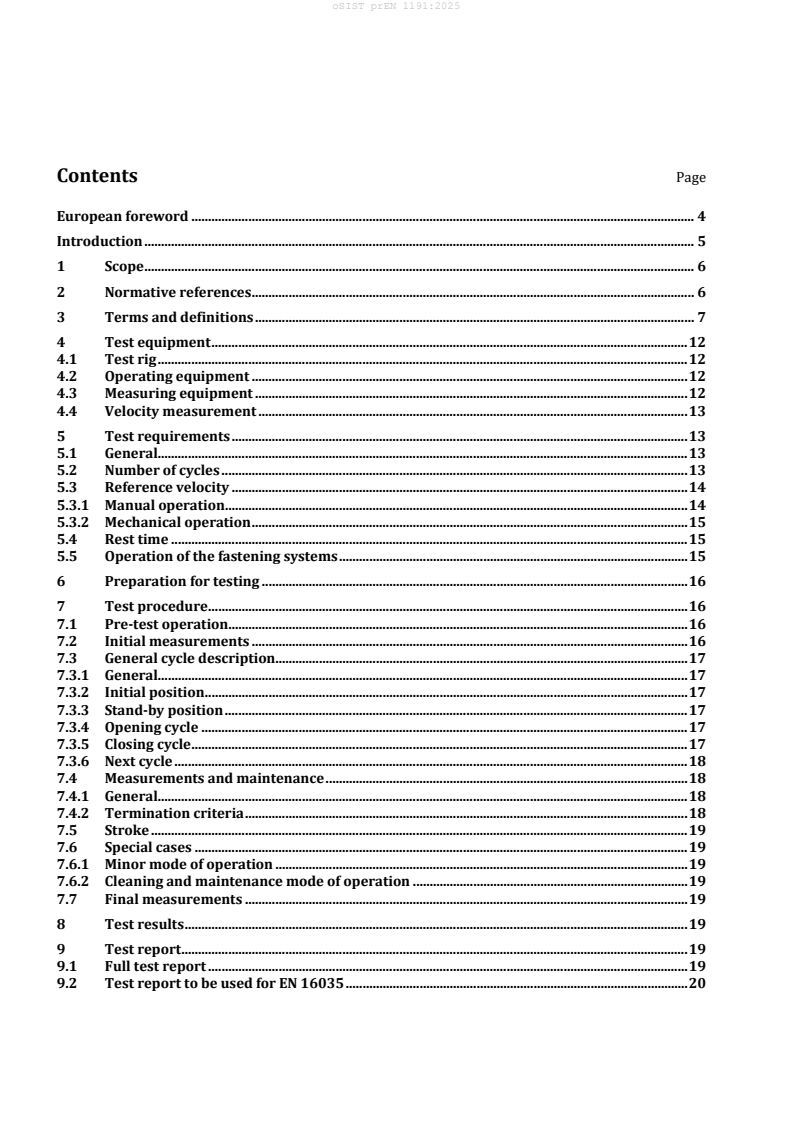
Contents Page
European foreword . 4
Introduction . 5
1 Scope . 6
2 Normative references . 6
3 Terms and definitions . 7
4 Test equipment . 12
4.1 Test rig . 12
4.2 Operating equipment . 12
4.3 Measuring equipment . 12
4.4 Velocity measurement . 13
5 Test requirements . 13
5.1 General. 13
5.2 Number of cycles . 13
5.3 Reference velocity . 14
5.3.1 Manual operation . 14
5.3.2 Mechanical operation . 15
5.4 Rest time . 15
5.5 Operation of the fastening systems . 15
6 Preparation for testing . 16
7 Test procedure . 16
7.1 Pre-test operation. 16
7.2 Initial measurements . 16
7.3 General cycle description. 17
7.3.1 General. 17
7.3.2 Initial position . 17
7.3.3 Stand-by position . 17
7.3.4 Opening cycle . 17
7.3.5 Closing cycle . 17
7.3.6 Next cycle . 18
7.4 Measurements and maintenance . 18
7.4.1 General. 18
7.4.2 Termination criteria . 18
7.5 Stroke . 19
7.6 Special cases . 19
7.6.1 Minor mode of operation . 19
7.6.2 Cleaning and maintenance mode of operation . 19
7.7 Final measurements . 19
8 Test results . 19
9 Test report . 19
9.1 Full test report . 19
9.2 Test report to be used for EN 16035 . 20
prEN 1191:2024 (E)
Annex A (normative) Test procedures for tilt and turn, tilt-first, turn-only or tilt-only windows
and door-height windows . 21
Annex B (normative) Test procedures for sliding, lift and slide or lift and slide and tilt windows
and door-height windows . 27
Annex C (normative) Test procedures for tilt and slide windows and door-height windows . 32
Annex D (normative) Test procedures for fold and slide windows and door-height windows . 37
Annex E (normative) Test procedures for horizontal or vertical pivot windows and door-height
windows . 40
Annex F (normative) Test procedures for Vertical sliding windows . 42
Annex G (normative) Test procedures for side-hung and top-hung windows, opening outwards
(including reversible windows) . 44
Annex H (normative) Test procedures for side-hung pedestrian doorsets excluding power
operated doors . 47
Annex I (normative) Test procedures for power-operated (automatic) side-hung pedestrian
doorsets . 52
Bibliography . 53
prEN 1191:2024 (E)
European foreword
This document (prEN 1191:2024) has been prepared by Technical Committee CEN/TC 33 “Doors,
windows, shutters, building hardware and curtain walling”, the secretariat of which is held by AFNOR.
This document is currently submitted to the CEN Enquiry.
This document will supersede EN 1191:2012.
prEN 1191:2024 includes the following significant technical changes with respect to EN 1191:2012:
— terms and definitions moved from annexes to Clause 3;
— failure criteria incorporated from EN 14600:2005 ;
— self-closing speed for windows (table 2) copied from EN 16034:2014, A.4;
— Definitions reduced to those not present in EN 12519:2018;
— termination criteria incorporated;
— test reports related to building hardware (supporting EN 16035) introduced.
Withdrawn. Withdrawal effective since 2016-02-02.
prEN 1191:2024 (E)
Introduction
This document describes one of the test methods that are called up in the product standards for windows
and pedestrian doorsets.
The annexes of this document are to be in line with the relevant building hardware standards but they
are not direct copies of them.
prEN 1191:2024 (E)
1 Scope
This document specifies the method to be used to determine the resistance to repeated opening and
closing of windows and pedestrian doorsets when subjected to repeated opening and closing.
It applies to all construction materials and operating systems for any window or pedestrian doorset,
including gaskets and building hardware, in normal operating conditions.
The parts concerned in the testing are the frame, the opening component (including any additional
moving components e.g. an inactive sash/leaf) and all essential and directly involved building hardware,
including operating devices, for example, the handle.
The testing does not include any hardware whose operation is not directly involved in the opening and
closing of the moving components: added-on fastening systems such as peg-stays or cabin hooks or bolts,
nor, unless specified, any independently installed stops (not connected to the complete assembly) such
as a wall or ground-mounted stop.
NOTE 1 The annexes provide more details on the testing procedures that can differ from the main part of this
document and are normative:
− Annex A applies to tilt and turn, tilt-first, turn-only, or tilt-only windows and door-height windows;
− Annex B applies to sliding, lift and slide or lift and slide and tilt windows and door-height windows;
− Annex C applies to tilt and slide windows and door-height windows;
− Annex D applies to fold and slide windows and door-height windows;
− Annex E applies to horizontal and vertical pivot windows and door-height windows;
− Annex F applies to vertical sliding windows;
− Annex G applies to side-hung casements and top-hung windows, opening outwards (including reversible
windows);
− Annex H applies to side-hung single and double action pedestrian doorsets excluding power operated doors;
− Annex I applies to power-operated (automatic) side-hung single action pedestrian doorsets.
NOTE 2 In this document, the term door-height window is used for windows that are used for the passage of
pedestrians, i.e. as a pedestrian doorset.
2 Normative references
The following documents are referred to in the text in such a way that some or all of their content
constitutes requirements of this document. For dated references, only the edition cited applies. For
undated references, the latest edition of the referenced document (including any amendments) applies.
EN 179, Building hardware — Emergency exit devices operated by a lever handle or push pad, for use on
escape routes — Requirements and test methods
EN 1125, Building hardware — Panic exit devices operated by a horizontal bar, for use on escape routes —
Requirements and test methods
EN 1154:1996, Building hardware — Controlled door closing devices — Requirements and test methods
As impacted by EN 1154:1996/A1:2002 and EN 1154:1996/A1:2002/AC:2006.
prEN 1191:2024 (E)
EN 1158:1997, Building hardware — Door coordinator devices — Requirements and test methods
EN 1634-1:2014+A1:2018, Fire resistance and smoke control tests for door and shutter assemblies,
openable windows and elements of building hardware — Part 1: Fire resistance test for door and shutter
assemblies and openable windows
EN 1634-3, Fire resistance and smoke control tests for door and shutter assemblies, openable windows and
elements of building hardware — Part 3: Smoke control test for door and shutter assemblies
EN 12046-1, Operating forces — Test method — Part 1: Windows
EN 12046-2, Operating forces — Test method — Part 2: Doors
EN 12217, Doors — Operating forces — Requirements and classification
EN 12400, Windows and pedestrian doors — Mechanical durability — Requirements and classification
EN 12519:2018, Windows and pedestrian doors — Terminology
EN 13115:2020, Windows - Classification of mechanical properties — Racking, torsion and operating forces
3 Terms and definitions
For the purposes of this document, the terms and definitions given in EN 12519 and the following apply.
ISO and IEC maintain terminology databases for use in standardization at the following addresses:
— ISO Online browsing platform: available at https://www.iso.org/obp/
— IEC Electropedia: available at https://www.electropedia.org/
3.1
moving component
window sash or door leaf which is moved, opened or closed
3.2
active moving component
leaf of a multi-leafed window or door, intended to be moved first to provide opening
3.3
inactive moving component
leaf of a multi-leafed window or door, intended to be moved after the active leaf
3.4
mode of operation
motion of the moving component as either translatory or rotary
Note 1 to entry: Some hardware systems allow for a combination of several modes of operation, for example, Tilt
and turn windows or folding windows which combine rotary and translatory operations.
As impacted by EN 1158:1997/A1:2002 and EN 1158:1997/A1:2002/AC:2006.
prEN 1191:2024 (E)
3.5
main mode of operation
intended principal type of operation and distance or angular travel as specified by the manufacturer
Note 1 to entry: Windows or pedestrian doorsets can feature multiple main modes of operation, such as tilting and
sliding.
3.6
minor mode of operation
secondary type of operation intended for occasional use
Note 1 to entry: Operating the moving component for cleaning or maintenance purposes is not considered a main
or minor mode of operation.
3.7
cleaning or maintenance mode of operation
additional type of operation not in everyday use
3.8
cycle
series of operations
Note 1 to entry: Involving opening a moving component, including releasing any fastening systems, moving open
to the open position, returning to the closed position and re-engaging any fastening systems. The cycle can consist
of several modes of operation that might be tested separately or combined.
Note 2 to entry: For example, a tilt and slide window can be tested in a cycle combining the tilting and sliding
operations or it can be tested separately by carrying out the tilt cycles first and then the sliding cycles.
3.9
part cycle
series of operations applicable to a single mode of operation and/or limited distance or angular travel
3.10
number of cycles
quantity of cycles completed applied to the cycle or part cycle accordingly
3.11
operating device
building hardware component, for example, the window or door handle, enabling the user to operate the
fastening system and/or the moving component
3.12
fastening system
building hardware component or set that keeps the moving component in the closed and fastened
position, i.e. latched and/or locked and/or electric systems
3.13
closing edge
outermost edge of the moving component furthest from the axis of rotation
3.14
reference velocity
actual velocity of the moving components
prEN 1191:2024 (E)
3.15
reference velocity
velocity of the closing edge
3.16
rest time
time in seconds of a stationary period for the following:
— between one change of direction of operation;
— between the completion of a moving component’s operation and the subsequent fastening system’s
operation;
— between the completion of a fastening system’s operation and the subsequent moving component’s
operation;
— between two cycles
3.17
power operated pedestrian doorset and window
doorset for pedestrian passage only or a window with one or more moving components that is moved, at
least in one direction, by an external energy supply (e.g. electrically) instead of manual or stored
mechanical energy
3.18
positive control
sash operation via the hardware that enables the sash to be manoeuvred from the closed position into
the tilted position, and from the tilted position into the closed position
Note 1 to entry: The sliding position can also be reached by means of operating the hardware.
3.19
lifting action
action in which the active sash is raised from the lowered position into the lifted position via the
hardware
Note 1 to entry: During this action the sash can be moved a limited distance away from the frame in the direction
of the opening position.
3.20
closed
characteristic when the movable parts rest in or at the fixed part in a way in which they may be fastened
(latched and/or locked)
[SOURCE: EN 12519:2018, 2.7]
3.21
locked
characteristic when the movable part is further restrained in the closed position by additional operations
(of e.g. handle, key, automatic device(s) or electronic device(s)) to engage integrated locking devices (e.g.
nutbolts or deadbolts) which will affect the product’s characteristics
[SOURCE: EN 12519:2018, 3.40]
prEN 1191:2024 (E)
3.22
open tilt position
position in which the opening edge of the sash is held in the final tilt position by means of the projecting
mechanism
3.23
sliding position
position in which the active sash can be moved linearly to the side (‘in-line’), i.e. translatory operation
Note 1 to entry: Windows or door-height windows with a lifting function are lifted.
3.24
open position
position in which the moving component is in a defined aperture or the maximum opening of the operated
window
3.25
reversed position
position in which the moving component has been rotated past the open position until the internal and
external faces of the moving component are inverted
3.26
closed tilt position
position in which the opening edge of the sash is at the mid-point between the closed position and open
position with the sash vertical
3.27
fastened closed position
〈sliding, lift and slide or lift and slide and tilt windows and door-height windows〉 position in which the
active sashes espagnolette-side rests up against the frame and the hardware is locked
Note 1 to entry: Windows or door-height windows with a lifting function are positioned in the lowered position.
Note 2 to entry: See Annex B.
3.28
fastened closed position
〈tilt and slide windows and door-height windows〉 position in which the active sash lies up against the
frame on all sides; the hardware is locked and the window unit is completely closed
Note 1 to entry: See Annex C.
3.29
fastened closed position
〈horizontal or vertical pivot windows and door-height windows〉 position in which the moving
component is resting against the frame or compresses the gaskets on all sides, and the hardware is
effectively engaged
Note 1 to entry: See Annex E.
3.30
fastened closed position
〈vertical sliding windows 〉 position in which the opening edge of the sash is in contact with the weather
seal, the sash is at the full extent of its closing movement and the fastening system effectively engaged
prEN 1191:2024 (E)
Note 1 to entry: See Annex F.
3.31
fastened closed position
〈side-hung and top-hung windows, opening outwards including reversible windows〉 position in which
the moving component is resting against the frame or compresses the gaskets on all sides, and the
hardware is effectively engaged
Note 1 to entry: See Annex G.
3.32
closed position
〈power-operated (automatic) side-hung pedestrian doorsets〉 position in which movable parts rest in or
at the fixed part in a way in which they may be fastened (latched and/or locked)
Note 1 to entry: The fastening system, if any, is automatically engaged or locked.
Note 2 to entry: See Annex I.
3.33
limiting restrictor
device intended to limit the movement of a moving component to a predetermined position or positions
3.34
tilt latch
releasable device or devices, that hold the sash in a vertical position when engaged
3.35
door set
building component which is designed and used to close a permanent opening in separating elements
and supplied complete with all essential parts from a single source, and for which the main intended use
is the access of pedestrians
[SOURCE: EN 12519:2018, 3.15]
3.36
striking plate
plate attached to the frame or the secondary leaf to keep the latch or lock bolts
3.37
door leaf
hinged, pivoted or sliding part within the door frame of a door assembly or door set
[SOURCE: EN 12519:2018, 3.12]
3.38
active leaf
leaf of a multi-leaved hinged or pivoted doorset, intended to be moved first to provide opening
[SOURCE: EN 12519:2018, 3.1]
3.39
passive leaf
leaf of a multi-leafed doorset, intended to be moved after the active leaf
prEN 1191:2024 (E)
[SOURCE: EN 12519:2018, 3.47]
3.40
side-hung pedestrian doorset
hinged or pivoted pedestrian doorsets
3.41
door coordinating device
mechanism which ensures the correct sequence of closing of double leaf single action pedestrian doorsets
with rebated meeting stiles so that the inactive leaf always closes before the active leaf
3.42
carry bar
component that ensures, in the case of the inactive leaf being operated first, that the active leaf is moved
beyond the waiting position and that is installed on double-leaf pedestrian doorsets with rebated meeting
stiles in connection with door-coordinating devices
3.43
automatic operator for side-hung pedestrian doors
unit comprising motor, control system and all other electrical, electronic and mechanical components
required to power a side-hung door
4 Test equipment
4.1 Test rig
The test rig shall be designed and constructed to be capable of adjustment for test specimens and shall
be sufficiently rigid to withstand the induced forces without undue deflection.
Alternatively test specimen linked to EN 16034 can be tested in supporting construction as described in
EN 1634-1 in order to get a maximum range of direct application.
A sub-frame may be used into which the test specimen is mounted.
4.2 Operating equipment
Motion controlled actuators as hydraulic, pneumatic or electric torque and linear cylinders or any
appropriate mechanisms, having features consistent with, shall be used:
a) the reference velocities to be used;
b) the mass of the moving component and the friction forces involved;
c) the applied loads, if relevant, to produce dynamic forces;
d) the duration of the test.
4.3 Measuring equipment
The following equipment shall be used:
— cycle counter;
— velocity and time measurement equipment accurate to ± 5 %;
— force and mass measuring equipment accurate to ± 2 %;
prEN 1191:2024 (E)
— dynamometer and torque-meter accurate to ± 3 %;
— measuring tape, EC-precision class II;
NOTE Directive 2014/32/EU of the European Parliament contains information on measuring tapes and
classifications thereof to be found on the European market.
— dial gauges and callipers accurate to ± 0,1 mm.
4.4 Velocity measurement
The measurement of the reference velocity shall be carried out over a measuring distance with a
maximum of 70 mm for turning and sliding and a max of 30 mm for tilting. The end of the measuring
+5
distance shall be at a distance of 5 mm from the moving component’s position where the reference
−0
velocity shall be reached. In the case of asymmetrically positioned moving components, the reference
velocity shall be measured on the main closing edge.
NOTE Individual velocity measurements have been identified and are shown in the relevant annexes.
5 Test requirements
5.1 General
Windows and door-height windows shall be according to all specifications described in this document,
unless stated otherwise in the relevant annex.
Tilt and turn, tilt-first, turn-only, or tilt-only windows and door-height windows shall be according to
Annex A.
Sliding, lift and slide or lift and slide and tilt windows and door-height windows shall be according to
Annex B.
Tilt and slide windows and door-height windows shall be according to Annex C.
Fold and slide windows and door-height windows shall be according to Annex D.
Horizontal and vertical pivot windows and door-height windows shall be according to Annex E.
Vertical sliding windows shall be according to Annex F.
Side-hung casements and top-hung windows, opening outwards (including reversible windows) shall be
according to Annex G.
Side-hung single and double action pedestrian doorsets excluding power operated doors shall be
according to Annex H.
Power-operated (automatic) side-hung single action pedestrian doorsets shall be according to Annex I.
The test results obtained following the relevant parts of this document may be used to classify:
— the durability of self-closing performance according to EN 13501-2 of openable windows and
pedestrian doorsets and/or
— the resistance against repeated opening and closing according to EN 12400 of openable windows
and doorsets.
5.2 Number of cycles
The number of cycles shall be according to EN 12400.
prEN 1191:2024 (E)
The cycle is repeated either for a specified number of times or until failure occurs or the operating force
set for the test is exceeded.
The number of cycles is either set prior to starting the test or the test is carried out until failure occurs.
Each part cycle shall have the same number of part cycles as required for the mode of operation.
NOTE The lowest number of part cycles causing failure is used for classification purposes.
If the test specimen can be operated in more than one main mode of operation, for example, tilting and
sliding, the cycle may be tested in part cycles accordingly. In doing so, the part cycles shall be carried out
in such a manner that no steps from the cycle are repeated.
All part cycles shall be carried out on the same test specimen.
5.3 Reference velocity
5.3.1 Manual operation
The reference velocity of a manually operated moving component depends on its mass and on its
operation which can be translatory, rotary, or tilting.
The reference velocities specified in Table 1 shall apply with a tolerance of ± 10 %.
Windows that are manual operated using a drive that is manual driven (e.g. hand operated spindle) shall
follow 5.3.2.2.
Self-closing openable windows shall be tested with the reference velocities given in Table 2 as
appropriate.
Non-self-closing doorsets shall be tested with the speed given in Table 1.
Self-closing single action side-hung pedestrian doorsets shall be tested according to H.1.5.
Table 1 — Reference velocities for manually operated moving components
Operation
Mass (M)
Translatory Rotary Tilt
kg
m/s m/s m/s
M ≤ 65 0,25 0,50 0,50
65 < M ≤ 100 0,20 0,35 0,50
100 < M ≤ 150 0,16 0,30 0,41
150 < M ≤ 200 0,14 0,25 0,35
200 < M ≤ 300 0,12 0,20 0,29
M > 300 0,10 0,18 0,25
NOTE A consistent energy of 2,03 J (translatory), 1,56 J (rotary) and 3,125 J (tilt mode) is the basis for
calculating the respective mass and velocity.
Table 2 — Reference velocities for self-closing openable windows
Maximum mean average speed Opening width
All sizes
m/s
With controlled closing devices 0,3 10° ± 2°
prEN 1191:2024 (E)
With uncontrolled closing
0,3 30° ± 2°
devices
Windows with vertical
0,15 300 mm
opening/closing movement
Hold window in open position for 20 s ± 2 s before allowing to close with speed as listed above
When coordinating devices are installed, every second opening movement shall be operated via the
inactive sash
5.3.2 Mechanical operation
5.3.2.1 Self-closing devices
The closing force shall be sufficient that a latch, where present, engages. If the moving component is
mechanically operated, for example, via self-weight, springs or any other mechanism and if the velocity
is adjustable, the reference velocity shall be set in accordance with the provisions laid down for opening
and closing in the relevant product standard. For controlled door closing devices, opening and closing
shall be set as specified in EN 1154. The uncontrolled door closing devices should refer to
prEN 15887:2009 . If no product standard is available, or the product standard does not include any
provisions for opening and closing, the reference velocity during a cycle or a part cycle shall be set as
defined in Table 1. If not adjustable, the reference velocity shall be the actual velocity.
5.3.2.2 Power-operation
The velocities for power-operated doorsets/windows shall be set to a present level by the client or as
stated in a relevant product standard, e.g. EN 16361 or a supporting standard like EN 16005.
5.4 Rest time
This shall be at least 1 s but shall not exceed 4 s for manually operated moving components. For motor
operated moving components, the rest time shall be established with the client prior to the test.
5.5 Operation of the fastening systems
For manually operated fastening systems the operating force applied by the operating equipment shall
not exceed 150 % of the last measurement of the operating forces necessary to release and secure the
fastening systems (see 7.4). If deemed necessary during the test, subsequent adjustments of the operating
equipment may be carried out in order to enable the test to proceed.
This operating force shall be determined in accordance with EN 12046-1 or EN 12046-2.
The operating forces shall be measured with moderate velocity, in a jerk-free and jolt-free manner.
The same specifications shall apply to the operation of the hardware during the repeated opening and
closing test, unless specified otherwise in the system specifications.
A load on the hardware’s espagnolette by means of overtwisting is not intended. The motion-sequence
shall be carried out ‘path-controlled’ to the target positions in order to satisfy the operational cycle.
Ensure that the moving component is in the closed position before the operation equipment applies a
force on the operating device. EN 13115:2020, Table 1 specifies the resistance to operating forces for
each class, for example, a hand operating device with a measured operating torque of between 5 Nm and
10 Nm represents Class 1, therefore a force of not greater than 1,5 × 100 N ± 10 N = 150 ± 10 N shall be
applied as the (gasket) compression force (not applicable for doors).
This standard was not published and is included for informational purposes.
prEN 1191:2024 (E)
For power operated fastening systems (either partially or totally) the amplitude of the force shall be that
set by the mechanism itself.
6 Preparation for testing
Test specimens shall be stored and tested in a non-destructive environment within the ranges of 15 °C to
30 °C and 25 % to 75 % RH.
Specimens which are intended to be glazed should be supplied with all glazing carried out in accordance
with the client’s specification, or an adequately rigid timber, plastic or metal material may be used with
additional weights.
The rigidity of substitute infills shall be comparable to the original material.
Any additional weights are to be mounted equally on the outside and inside of the infilled panel so that
the centre of gravity and mass replicate the replaced glazed unit. The mounting of the infilling that
replaces the glazing unit shall be representative to the glazing system.
The mass of the moving component shall be measured prior to testing.
In respect of the type, number and position of fixing devices, the installation of the specimen in the testing
or sub-frame shall comply with the relevant code of practice, if any, or if none, with the manufacturer’s
instruction for installation in buildings. These fixings shall not hinder the operation of the opening
components, nor of any hardware involved in the test.
Windows or pedestrian doorsets designed to be incorporated in, or form part of a proprietary wall or
partition system, should be installed in such a system and the composite construction fitted into the test
surround.
Test equipment shall act at the position of normal operation. The operating device shall not increase the
weight of the moving part (sash/leaf) by more than 5 %.
Adjustment and lubrication in accordance with the manufacturer's instructions shall be carried out
before the test.
Conducting away of any heat (for example, cooling or extending the rest time) shall be carried out as
agreed between the testing laboratory and the manufacturer.
7 Test procedure
7.1 Pre-test operation
With the test specimen installed in accordance with Clause 6, and before taking initial measurements, the
moving component shall be subjected manually or automatically, if power operated, to five operating
cycles.
7.2 Initial measurements
All necessary measurements shall be taken and documented, especially:
— the operating forces in accordance with EN 12046-1 or EN 12046-2;
— the mass of the moving component;
— the dead load applied to the operating point.
prEN 1191:2024 (E)
7.3 General cycle description
7.3.1 General
The orientation of the test specimen shall be appropriate for its intended use.
In the case of cycles, all main modes of operation are repeated to the specified number of cycles or until
failure.
The following sequence according to 7.3.2, 7.3.3, 7.3.4, 7.3.5 and 7.3.6 applies.
7.3.2 Initial position
The initial position of the moving component is the closed and fastened position.
7.3.3 Stand-by position
The fastening system is released via the operating equipment with moderate velocity as intended in use;
this is then followed by the rest time.
7.3.4 Opening cycle
7.3.4.1 Opening system without restrictor
On completion of the rest time, the moving component is set in motion accelerating in a jerk-free and jolt-
free manner.
The reference velocity in accordance with Table 1 shall be reached at an opening angle of 60 ° or 60 % of
the stroke, and held up to an opening angle of 70° or 70 % of the stroke. Subsequently, the moving
component shall be brought slowly to a halt via the operating equipment in a jerk-free and jolt-free
manner by the time it has reached its designated final position. Once the predetermined opening is
reached, the rest time specified in 5.4 shall be applied.
7.3.4.2 Opening system with restrictor
On completion of the rest time, the moving component is set in motion accelerating in a jerk-free and jolt-
free manner.
+5
The reference velocity in accordance with Table 1 shall be reached 5 mm before the
−0
stopping/restricting position. After this, the moving component shall move freely into the
stopping/restricting hardware at the open position.
The rest time specified in 5.4 shall then be applied.
7.3.5 Closing cycle
7.3.5.1 General
On completion of the rest time, the moving component is set in motion via the operating equipment
accelerating in a jerk-free and jolt-free manner. The reference velocity in accordance with Table 1 shall
+5
be achieved mm before reaching the closed position. After this, the moving component shall move
−0
freely into the closed position. If the fastening system does not automatically engage, the fastening system
shall subsequently be locked via the operating equipment with moderate velocity as intended in use; this
is then followed by the rest time.
For doorsets with doorclosers: The closing force shall be sufficient that a latch, where present, engages.
7.3.5.2 Possible fastening conditions
a) Case A
prEN 1191:2024 (E)
Pedestrian doorsets or windows with latches and/or with automatic fastening devices: after reaching the
closed position in the usual operating mode and during the test, the latch or fastening systems engage
automatically. In this case no additional fastening system shall be engaged.
b) Case B
Pedestrian doorsets or windows without latches and/or without automatic fastening devices: after
reaching the closed position in the usual operating mode and during the test, the fastening system shall
be engaged by means of the operating equipment at the end of each closing cycle.
The component should ‘move freely’ means that dynamic opening and closing forces should be applied.
Ensure that the moving component is in the closed position, before the operation equipment applies a
force on the operating device. EN 13115:2020, Table 1 specifies the resistance to operating forces for
each class, for example, a hand operating device with a measured operating torque of between 5 Nm and
10 Nm, represents Class 1. Therefore, a force not greater than 1,5 × 100 N ± 10 N = 150 ± 10 N should be
applied as the (gasket) compression force.
7.3.6 Next cycle
On completion of the rest time, the next cycle or part cycle starts.
NOTE In the case of cycles, all main modes of operation are repeated to the specified number of part cycles or
until failure.
7.4 Measurements and maintenance
7.4.1 General
For doorsets and windows not intended for use where fire and/or smoke characteristics are required:
After every period, equal to 2 500 cycles or 25 % of the specified number of cycles, whichever is the
greater, the test is halted and the specimen is examined and the operation forces are measured.
Lubrication and adjustment of the test specimen hardware in accordance with the client’s maintenance
instructions can be carried out during the test, and the test is resumed in the defined conditions for the
next period. Adjustments and exchange of components shall be stated in the test report.
For doorsets and windows with fire and/or smoke characteristics or in escape routes and/or durability
of self closing: After every period, equal to 2 500 cycles or 25 % of the specified number of cycles,
whichever is the greater, the test is halted and the specimen is examined and the operation forces are
measured, within the number of cycles intended to be declared, only lubrication is allowed; after that,
adjustments and exchange of components may be done to continue the test, but stated in the test report.
7.4.2 Termination criteria
The test is completed if any of the following conditions occurs:
— material failure of any component that is essential to the function of the test specimen;
— the test specimen is not functional in relation to its operating forces, that is, the initial and final
operating forces do not fall within the same classification band given in EN 13115 or EN 12217
(see 5.5) (it is permissible for the manufacturer to claim a lower class);
— the specified number of cycles have been carried out;
— the test specimen is not openable or not closable;
— after test, the self closing mechanism shall still be functional and the window or doorset openable;
prEN 1191:2024 (E)
— hinged doorsets with fire resistance and/or smoke control and hinged or sliding windows with
fire resistance and/or smok
...