

SIST-TS CEN/TS 17240:2019
(Main)Intelligent transport systems - ESafety - ECall end to end conformance testing for IMS packet switched based systems
General Information
- Abstract
This document defines the key actors in the eCall chain of service provision using IMS over packet switched networks (such as LTE/4G) as:
1) In-vehicle system (3.20) (IVS)/vehicle,
2) Mobile network Operator (MNO),
3) Public safety answering point (3.27) (PSAP),
and to provide conformance tests for actor groups 1) - 3).
NOTE 1 Conformance tests are not appropriate nor required for vehicle occupants (3.36), although they are the recipient of the service.
NOTE 2 Third party eCall systems (TPS eCall) are not within the scope of this deliverable. This is because the core TPS-eCall (3.32) standard (EN 16102) does not specify the communications link between the vehicle and the TPS service provider (3.29).
NOTE 3 These conformance tests are based on the appropriate conformance tests from EN 16454 which was published before Internet Protocol multimedia Systems (IMS) packet switched networks were available. This deliverable therefore replicates the appropriate tests from EN 16454 (and acknowledge their source); adapt and revise Conformance Test Protocols (CTP) from EN 16454 to an IMS paradigm; or provide new additional tests that are required for the IMS paradigm. Some 14 112-eCall (Pan European eCall) tests provided in EN 16454 are specific to GSM/UMTS circuit switched communications and not appropriate for the IMS paradigm and are therefore excluded from this deliverable.
This document therefore provides a suite of ALL conformance tests for IVS equipment, MNO’s, and PSAPS, required to ensure and demonstrate compliance to CEN/TS 17184.
NOTE 4 Because in the event of non-viability or non-existence of an IMS supporting network at any particular time/location, IMS-eCall systems revert to CS networked eCall systems eCall via GSM/UMTS, IVS and PSAPs need to support, and prove compliance to both IMS and CS switched networks.
The Scope covers conformance testing (and approval) of new engineering developments, products and systems, and does not imply testing associated with individual installations in vehicles or locations.
- Status
- Published
- Publication Date
- 09-Dec-2018
- Technical Committee
- ITC - Information technology
- Current Stage
- 6060 - National Implementation/Publication (Adopted Project)
- Start Date
- 20-Nov-2018
- Due Date
- 25-Jan-2019
- Completion Date
- 10-Dec-2018


Overview
SIST-TS CEN/TS 17240:2019 covers end-to-end conformance testing for eCall services in intelligent transport systems using Internet Protocol Multimedia Subsystem (IMS) over packet switched networks such as LTE and 4G. This standard, developed by SIST and harmonized with European technical specifications, defines how core eCall actors-namely the in-vehicle system (IVS), mobile network operator (MNO), and public safety answering point (PSAP)-should be tested to demonstrate compliance to the eCall requirements for IP-based networks.
The standard addresses the growing need to transition eCall emergency services from legacy GSM/UMTS circuit switched technologies to modern IMS-based, packet-switched communication. By establishing rigorous conformance testing protocols, SIST-TS CEN/TS 17240:2019 ensures the reliability, interoperability, and quality of eCall deployments across Europe.
Key Topics
- Actors in IMS-eCall Chain: Focuses on end-to-end conformance testing for IVS (in-vehicle equipment), MNOs, and PSAPs.
- IMS and Packet Switched Networks: Addresses conformance specifically for eCall systems operating over IP multimedia networks (IMS) such as LTE/4G, rather than older circuit-switched systems.
- Conformance Testing Protocols: Adopts, adapts, and extends tests from EN 16454, ensuring they are suitable and compliant for the IMS paradigm while excluding tests relevant only to GSM/UMTS.
- Scope and Limitations:
- Excludes occupants of the vehicle and third-party eCall systems from direct conformance testing.
- Applies only to new engineering developments and systemic product approvals, not to installation-level testing within individual vehicles or specific locations.
- Fallback Capability: Recognizes the need for IVS and PSAPs to maintain support for both IMS and legacy circuit switched eCall operations for full compliance and service continuity.
Applications
Practical uses of SIST-TS CEN/TS 17240:2019 include:
- Automotive Manufacturers: Ensure in-vehicle eCall systems (IVS) comply with European safety mandates for IMS-based emergency calling.
- Mobile Network Operators (MNOs): Validate network readiness and capability to support, route, and manage eCall traffic over LTE/4G IMS packet-switched networks.
- Public Safety Answering Points (PSAPs): Guarantee proper reception, interpretation, and response to eCall data and voice sessions initiated over packet-switched networks.
- System Integrators and Test Labs: Use comprehensive conformance test suites for approval and certification of new eCall systems and updates, ensuring end-to-end interoperability.
- Regulators and Standardization Bodies: Reference a harmonized European test framework to enforce and monitor compliance in intelligent transportation safety systems.
Related Standards
SIST-TS CEN/TS 17240:2019 works alongside and references several key standards in intelligent transport systems and eSafety, including:
- EN 15722: Specifies the eCall minimum set of data required for emergency calls.
- EN 16062: Defines eCall high-level application protocols (HLAP) for GSM/UMTS circuit-switched networks.
- EN 16072: Outlines pan-European eCall operating requirements.
- EN 16454: Provides the base suite of conformance tests for eCall systems, adapted and extended for IMS within this standard.
- CEN/TS 17184: Establishes HLAP for eCall over IMS packet switched networks, to which conformance is demonstrated.
Keywords: intelligent transport systems, eCall, IMS, packet switched networks, LTE, 4G, conformance testing, PSAP, in-vehicle system, mobile network operator, emergency call, ESafety, end-to-end interoperability.
Relations
- Effective Date
- 01-Mar-2025
- Effective Date
- 28-Jan-2026
- Effective Date
- 28-Jan-2026
- Effective Date
- 28-Jan-2026
- Effective Date
- 28-Jan-2026
- Refers
SIST EN 16454:2024 - Intelligent transport systems - ESafety - ECall end to end conformance testing - Effective Date
- 28-Jan-2026
- Effective Date
- 28-Jan-2026
- Effective Date
- 28-Jan-2026
Get Certified
Connect with accredited certification bodies for this standard

BSI Group
BSI (British Standards Institution) is the business standards company that helps organizations make excellence a habit.

NYCE
Mexican standards and certification body.
Sponsored listings
Frequently Asked Questions
SIST-TS CEN/TS 17240:2019 is a technical specification published by the Slovenian Institute for Standardization (SIST). Its full title is "Intelligent transport systems - ESafety - ECall end to end conformance testing for IMS packet switched based systems". This standard covers: This document defines the key actors in the eCall chain of service provision using IMS over packet switched networks (such as LTE/4G) as: 1) In-vehicle system (3.20) (IVS)/vehicle, 2) Mobile network Operator (MNO), 3) Public safety answering point (3.27) (PSAP), and to provide conformance tests for actor groups 1) - 3). NOTE 1 Conformance tests are not appropriate nor required for vehicle occupants (3.36), although they are the recipient of the service. NOTE 2 Third party eCall systems (TPS eCall) are not within the scope of this deliverable. This is because the core TPS-eCall (3.32) standard (EN 16102) does not specify the communications link between the vehicle and the TPS service provider (3.29). NOTE 3 These conformance tests are based on the appropriate conformance tests from EN 16454 which was published before Internet Protocol multimedia Systems (IMS) packet switched networks were available. This deliverable therefore replicates the appropriate tests from EN 16454 (and acknowledge their source); adapt and revise Conformance Test Protocols (CTP) from EN 16454 to an IMS paradigm; or provide new additional tests that are required for the IMS paradigm. Some 14 112-eCall (Pan European eCall) tests provided in EN 16454 are specific to GSM/UMTS circuit switched communications and not appropriate for the IMS paradigm and are therefore excluded from this deliverable. This document therefore provides a suite of ALL conformance tests for IVS equipment, MNO’s, and PSAPS, required to ensure and demonstrate compliance to CEN/TS 17184. NOTE 4 Because in the event of non-viability or non-existence of an IMS supporting network at any particular time/location, IMS-eCall systems revert to CS networked eCall systems eCall via GSM/UMTS, IVS and PSAPs need to support, and prove compliance to both IMS and CS switched networks. The Scope covers conformance testing (and approval) of new engineering developments, products and systems, and does not imply testing associated with individual installations in vehicles or locations.
This document defines the key actors in the eCall chain of service provision using IMS over packet switched networks (such as LTE/4G) as: 1) In-vehicle system (3.20) (IVS)/vehicle, 2) Mobile network Operator (MNO), 3) Public safety answering point (3.27) (PSAP), and to provide conformance tests for actor groups 1) - 3). NOTE 1 Conformance tests are not appropriate nor required for vehicle occupants (3.36), although they are the recipient of the service. NOTE 2 Third party eCall systems (TPS eCall) are not within the scope of this deliverable. This is because the core TPS-eCall (3.32) standard (EN 16102) does not specify the communications link between the vehicle and the TPS service provider (3.29). NOTE 3 These conformance tests are based on the appropriate conformance tests from EN 16454 which was published before Internet Protocol multimedia Systems (IMS) packet switched networks were available. This deliverable therefore replicates the appropriate tests from EN 16454 (and acknowledge their source); adapt and revise Conformance Test Protocols (CTP) from EN 16454 to an IMS paradigm; or provide new additional tests that are required for the IMS paradigm. Some 14 112-eCall (Pan European eCall) tests provided in EN 16454 are specific to GSM/UMTS circuit switched communications and not appropriate for the IMS paradigm and are therefore excluded from this deliverable. This document therefore provides a suite of ALL conformance tests for IVS equipment, MNO’s, and PSAPS, required to ensure and demonstrate compliance to CEN/TS 17184. NOTE 4 Because in the event of non-viability or non-existence of an IMS supporting network at any particular time/location, IMS-eCall systems revert to CS networked eCall systems eCall via GSM/UMTS, IVS and PSAPs need to support, and prove compliance to both IMS and CS switched networks. The Scope covers conformance testing (and approval) of new engineering developments, products and systems, and does not imply testing associated with individual installations in vehicles or locations.
SIST-TS CEN/TS 17240:2019 is classified under the following ICS (International Classification for Standards) categories: 35.240.60 - IT applications in transport. The ICS classification helps identify the subject area and facilitates finding related standards.
SIST-TS CEN/TS 17240:2019 has the following relationships with other standards: It is inter standard links to SIST EN 17240:2025, SIST EN 16072:2015, SIST EN 15722:2020, SIST-TS CEN/TS 17184:2018, SIST EN 16062:2023, SIST EN 16454:2024, SIST-TS CEN/TS 17249-5:2022, SIST-TS CEN/TS 17642:2021. Understanding these relationships helps ensure you are using the most current and applicable version of the standard.
SIST-TS CEN/TS 17240:2019 is associated with the following European legislation: EU Directives/Regulations: 2010/40/EU. When a standard is cited in the Official Journal of the European Union, products manufactured in conformity with it benefit from a presumption of conformity with the essential requirements of the corresponding EU directive or regulation.
SIST-TS CEN/TS 17240:2019 is available in PDF format for immediate download after purchase. The document can be added to your cart and obtained through the secure checkout process. Digital delivery ensures instant access to the complete standard document.
Standards Content (Sample)
SLOVENSKI STANDARD
01-januar-2019
Inteligentni transportni sistemi - e-Varnost - Preskušanje skladnosti e-klica v zvezi
pošiljatelj-prejemnik za paketno preklopne sisteme IMS
Intelligent transport systems - ESafety - ECall end to end conformance testing for IMS
packet switched based systems
Intelligente Verkehrssysteme - eSicherheit - eCall Ende-zu-Ende Konformitätsprüfungen
für IMS-paketvermittelnde Systeme
Systèmes de transport intelligents - eSécurité - eCall: Essais de conformité du système «
eCall » de bout en bout pour les systèmes IMS basés sur la commutation de paquets
Ta slovenski standard je istoveten z: CEN/TS 17240:2018
ICS:
35.240.60 Uporabniške rešitve IT v IT applications in transport
prometu
2003-01.Slovenski inštitut za standardizacijo. Razmnoževanje celote ali delov tega standarda ni dovoljeno.
CEN/TS 17240
TECHNICAL SPECIFICATION
SPÉCIFICATION TECHNIQUE
October 2018
TECHNISCHE SPEZIFIKATION
ICS 35.240.60
English Version
Intelligent transport systems - ESafety - ECall end to end
conformance testing for IMS packet switched based
systems
Systèmes de transport intelligents - eSécurité - eCall: Intelligente Verkehrssysteme - eSicherheit - eCall
Essais de conformité du système " eCall " de bout en Ende-zu-Ende Konformitätsprüfungen für IMS-
bout pour les systèmes IMS basés sur la commutation paketvermittelnde Systeme
de paquets
This Technical Specification (CEN/TS) was approved by CEN on 20 August 2018 for provisional application.
The period of validity of this CEN/TS is limited initially to three years. After two years the members of CEN will be requested to
submit their comments, particularly on the question whether the CEN/TS can be converted into a European Standard.
CEN members are required to announce the existence of this CEN/TS in the same way as for an EN and to make the CEN/TS
available promptly at national level in an appropriate form. It is permissible to keep conflicting national standards in force (in
parallel to the CEN/TS) until the final decision about the possible conversion of the CEN/TS into an EN is reached.
CEN members are the national standards bodies of Austria, Belgium, Bulgaria, Croatia, Cyprus, Czech Republic, Denmark, Estonia,
Finland, Former Yugoslav Republic of Macedonia, France, Germany, Greece, Hungary, Iceland, Ireland, Italy, Latvia, Lithuania,
Luxembourg, Malta, Netherlands, Norway, Poland, Portugal, Romania, Serbia, Slovakia, Slovenia, Spain, Sweden, Switzerland,
Turkey and United Kingdom.
EUROPEAN COMMITTEE FOR STANDARDIZATION
COMITÉ EUROPÉEN DE NORMALISATION
EUROPÄISCHES KOMITEE FÜR NORMUNG
CEN-CENELEC Management Centre: Rue de la Science 23, B-1040 Brussels
© 2018 CEN All rights of exploitation in any form and by any means reserved Ref. No. CEN/TS 17240:2018 E
worldwide for CEN national Members.
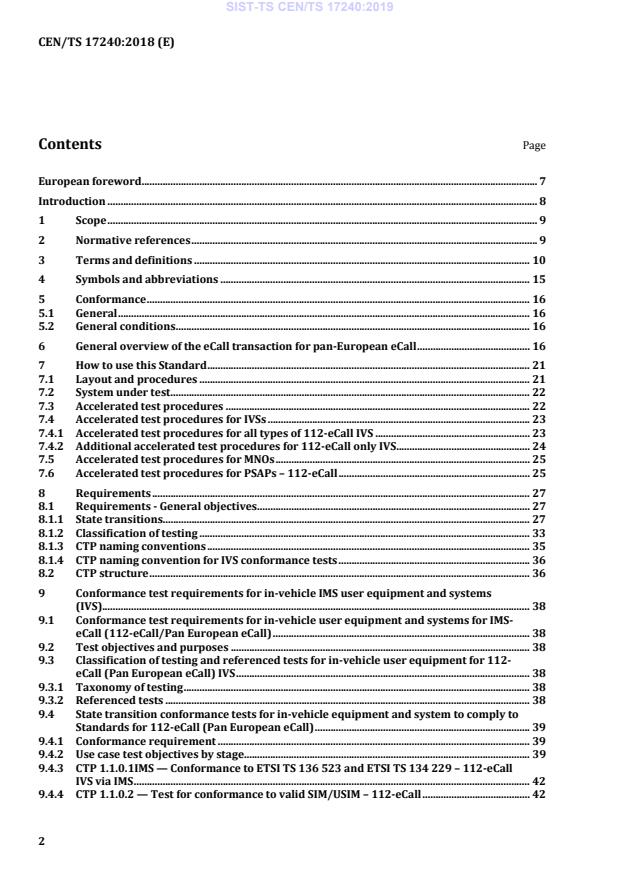
Contents Page
European foreword . 7
Introduction . 8
1 Scope . 9
2 Normative references . 9
3 Terms and definitions . 10
4 Symbols and abbreviations . 15
5 Conformance . 16
5.1 General . 16
5.2 General conditions . 16
6 General overview of the eCall transaction for pan-European eCall . 16
7 How to use this Standard . 21
7.1 Layout and procedures . 21
7.2 System under test . 22
7.3 Accelerated test procedures . 22
7.4 Accelerated test procedures for IVSs . 23
7.4.1 Accelerated test procedures for all types of 112-eCall IVS . 23
7.4.2 Additional accelerated test procedures for 112-eCall only IVS . 24
7.5 Accelerated test procedures for MNOs . 25
7.6 Accelerated test procedures for PSAPs – 112-eCall . 25
8 Requirements . 27
8.1 Requirements - General objectives . 27
8.1.1 State transitions. 27
8.1.2 Classification of testing . 33
8.1.3 CTP naming conventions . 35
8.1.4 CTP naming convention for IVS conformance tests . 36
8.2 CTP structure . 36
9 Conformance test requirements for in-vehicle IMS user equipment and systems
(IVS). 38
9.1 Conformance test requirements for in-vehicle user equipment and systems for IMS-
eCall (112-eCall/Pan European eCall) . 38
9.2 Test objectives and purposes . 38
9.3 Classification of testing and referenced tests for in-vehicle user equipment for 112-
eCall (Pan European eCall) IVS . 38
9.3.1 Taxonomy of testing . 38
9.3.2 Referenced tests . 38
9.4 State transition conformance tests for in-vehicle equipment and system to comply to
Standards for 112-eCall (Pan European eCall) . 39
9.4.1 Conformance requirement . 39
9.4.2 Use case test objectives by stage . 39
9.4.3 CTP 1.1.0.1IMS — Conformance to ETSI TS 136 523 and ETSI TS 134 229 – 112-eCall
IVS via IMS . 42
9.4.4 CTP 1.1.0.2 — Test for conformance to valid SIM/USIM – 112-eCall . 42
9.4.5 CTP 1.1.0.3 — Automatic eCall triggering does not occur when engine control OFF –
112-eCall IVS . 43
9.4.6 CTP 1.1.1.1 — Power on and self test – 112-eCall IVS . 44
9.4.7 CTP 1.1.2.1 — Test for automatic activation of eCall . 45
9.4.8 CTP 1.1.2.2 — Automatically triggered eCall in progress was not disconnected upon
a new eCall trigger – 112-eCall IVS . 46
9.4.9 CTP 1.1.2.3 — Post-Lateral-crash performance of automatic trigger – IVS . 47
9.4.10 CTP 1.1.2.4 — Post-frontal-crash performance of automatic trigger - IVS . 48
9.4.11 CTP 1.1.2.5 — Performance of automatic trigger – Different crash types . 49
9.4.12 CTP 1.1.3.1 — eCall manually activated – 112-eCall IVS . 50
9.4.13 CTP 1.1.3.2 — Manually triggered eCall in progress was not disconnected upon a
new eCall trigger – 112-eCall IVS . 51
9.4.14 CTP 1.1.4.1 — Test eCall activated – 112-eCall IVS . 52
9.4.15 CTP 1.1.5.1 — Network registration – 112-eCall IVS . 53
9.4.16 CTP 1.1.5.2 — Manual termination of eCall by vehicle occupants not allowed
(automatically triggered eCall) – 112-eCall IVS . 54
9.4.17 CTP 1.1.5.3 — Manual termination of eCall by vehicle occupants not allowed
(manually triggered eCall) – 112-eCall IVS . 55
9.4.18 CTP 1.1.5.4 — Automatically triggered eCall in progress was not disconnected when
ignition is switched to OFF – 112-eCall IVS . 56
9.4.19 CTP 1.1.5.5 — Manually triggered eCall in progress was not disconnected when
engine control is switched to OFF – 112-eCall IVS . 57
9.4.20 CTP 1.1.5.6-IMS — Priority over conflicting communication – 112-eCall IVS . 58
9.4.21 CTP 1.1.5.7 — Network registration is re-tried when network registration attempt
was not successful – 112-eCall IVS . 59
9.4.22 CTP 1.1.6.1-IMS — SIP Invite sent . 59
9.4.23 CTP 1.1.7.1-IMS — Establish session with urn:service:sos.ecall.automatic – 112-eCall
IVS . 60
9.4.24 CTP 1.1.8.1-IMS — Establish session with urn:service:sos.ecall.manual – 112-eCall
IVS . 61
9.4.25 CTP 1.1.9.1-IMS — Set-up call to test address – 112-eCall IVS . 62
9.4.26 CTP 1.1.10.1-IMS — eCall is attempted when no networks are available (limited
service condition) – 112-eCall IVS . 63
9.4.27 CTP 1.1.10.2-IMS — Re-dial attempt completed within 2 min after eCall is dropped –
112-eCall IVS . 63
9.4.28 CTP 1.1.10.3 –IMS — ALLOW ACK Received . 63
9.4.29 CTP 1.1.15.1-IMS — Voice link Established – 112-eCall IVS . 64
9.4.30 CTP 1.1.15.2-IMS — Verify MSD Received – 112-eCall IVS . 65
9.4.31 CTP 1.1.16.1 — Clear down call automatically – PE eCall IVS . 65
9.4.32 CTP 1.1.16.2-IMS — IVS clears down the eCall upon T2 expiry – 112-eCall IVS . 66
9.4.33 CTP 1.1.16.3-IMS — IVS registers recent eCalls – 112-eCall IVS . 67
9.4.34 CTP 1.1.17.1-IMS — Call-back allowed and able to be answered by IVS – 112-eCall IVS . 68
9.4.35 CTP 1.1.17.2-IMS — Call-back answered by IVS in the event of abnormal termination
– 112-eCall IVS . 69
9.4.36 CTP 1.1.17.3-IMS — MSD transfer occurs upon PSAP request during call-back – 112-
eCall IVS . 70
9.4.37 CTP 1.1.17.4-IMS — Remain registered for ≥ 1 hr – 112-eCall IVS . 71
9.5 State transition test scripts for in-vehicle equipment and system to comply to
Standards for 112-eCall (Pan European eCall) – additional tests for eCall only
systems . 71
9.5.1 General . 71
9.5.2 CTP 1.1.1.2-IMS — IVS does not perform registration after power-up – 112-eCall only
IVS . 73
9.5.3 CTP 1.1.1.3-IMS — IVS periodically scans and maintains a list of available PLMNs –
112-eCall only . 73
9.5.4 CTP1.1.10.4 — Verify that PLMN registration procedure is executed upon initiating
an eCall – 112-eCall only IVS . 74
9.5.5 CTP 1.1.17.5-IMS — Remain registered for ≥ 1 hr ≤ 12 hr – 112-eCall only IVS . 75
10 Conformance tests for mobile network operators . 75
10.1 Test objectives and purposes . 75
10.1.1 General . 75
10.1.2 Default assumptions . 76
10.2 Taxonomy of testing and referenced tests . 76
10.3 Use case conformance tests for mobile network operator systems to comply to
Standards for 112-eCall (Pan European eCall) . 76
10.3.1 Conformance requirement . 76
10.3.2 Use case test objectives by stage . 76
10.4 State transition test scripts for mobile network operators to demonstrate
compliance with 112-eCall (Pan European eCall) standards . 77
10.4.1 General . 77
10.4.2 CTP 2.0.1 — Keep SIMs/USIMs alive even though not in regular operation – MNO . 79
10.4.3 CTP 2.0.2-IMS — MNO supports general eCall relevant requirements . 80
10.4.4 CTP 2.0.3 — Decommission SIM/USIM - MNO . 81
10.4.5 CTP 2.0.4-IMS — Support IMS-eCall routing – MNO . 81
10.4.6 CTP 2.1.1 — Accept registration – Home network – MNO . 82
10.4.7 CTP 2.1.2 — Accept registration – Roaming –MNO . 82
10.4.8 CTP 2.2.1.1-IMS — Establish IMS-eCall (automatically initiated) – MNO . 83
10.4.9 CTP 2.2.1.2-IMS — Route call to ‘most appropriate’ PSAP – MNO . 84
10.4.10 CTP 2.2.1.3-IMS — Provide IMS emergency data/caller ID – MNO . 85
10.4.11 CTP 2.2.2.1-IMS — Receive IMS-eCall (manual initiated) – MNO . 86
10.4.12 CTP 2.2.3.1-IMS — Test for receiving test eCall . 86
10.4.13 CTP 2.2.3.2 — Route call to non-emergency number – MNO . 86
10.4.14 CTP 2.2.3.3 — Provide CLI for test eCall – MNO. 87
10.4.15 CTP 2.3.1 — Call in progress–MNO . 87
10.4.16 CTP 2.5.1 — Support call-back – MNO . 88
10.4.17 CTP 2.6.1 — Maintain registration for 1-12 h – MNO . 88
10.4.18 CTP 2.7.1 — Maintain call records - MNO . 88
11 Conformance tests for PSAP systems . 88
11.1 Test objectives and purposes . 88
11.2 Taxonomy of testing and referenced tests . 89
11.2.1 Taxonomy of testing . 89
11.2.2 Referenced tests . 89
11.3 Use case conformance tests for PSAP systems to comply to Standards for 112-eCall
(Pan European eCall) . 89
11.3.1 Conformance requirement . 89
11.3.2 Use case test objectives by stage . 89
11.4 State transition conformance tests for PSAPs – 112-eCall . 90
11.4.1 General . 90
11.4.2 CTP 3.1.0.1-IMS — Provide MNOs with appropriate routing data – Member State/
PSAP IMS-eCall . 92
11.4.3 CTP 3.1.0.2 — Maintain map geo-information – PSAP IMS-eCall . 93
11.4.4 CTP 3.1.1.1-IMS — Receive automatically initiated eCall – PSAP IMS-eCall . 94
11.4.5 CTP 3.1.1.2-IMS — Receive manually initiated eCall – PSAP IMS-eCall . 95
11.4.6 CTP 3.1.2-IMS — Interpret IMS emergency data- Caller ID and location – PSAP IMS-
eCall . 96
11.4.7 CTP 3.1.3.2-IMS — PSAP equipment failure – PSAP IMS-eCall . 96
11.4.8 CTP 3.1.5.2-IMS — Route to operator after T4 expiration – PSAP 112-eCall . 96
11.4.9 CTP 3.1.7.1-IMS — Receive MSD – PSAP IMS-eCall . 97
11.4.10 CTP 3.1.7.2-IMS — Verify status bit in AL-ACK upon positive ACK– PSAP 112-
eCall . 98
11.4.11 CTP 3.1.7.4-IMS — Verify transfer of corrupted MSD – PSAP IMS-eCall . 98
11.4.12 CTP 3.1.7.5-IMS — Verify PSAP behaviour when MSD format check fails– PSAP
IMS-eCall . 99
11.4.13 CTP 3.1.8 — ACK – PSAP IMS-eCall . 99
11.4.14 CTP 3.1.9-IMS — Route voice and MSD to operator – PSAP IMS-eCall . 100
11.4.15 CTP 3.1.10-IMS — Display IMS-eCall data and MSD to operator – PSAP IMS-eCall . 101
11.4.16 CTP 3.1.11-IMS — Decode VIN – PSAP IMS-eCall . 102
11.4.17 CTP 3.1.12-IMS — Talk to vehicle occupants – PSAP IMS-eCall . 103
11.4.18 CTP 3.1.13-IMS — Request new MSD before call cleardown – PSAP IMS-eCall . 104
11.4.19 CTP 3.1.14.1 — Call cleardown – PSAP IMS-eCall . 105
11.4.20 CTP 3.1.14.2-IMS — Verify status bit in AL-ACK upon cleardown - PSAP –112-
eCall . 105
11.4.21 CTP 3.1.15-IMS — Call-back to vehicle – PSAP 112-eCall .
11.4.22 CTP 3.1.16-IMS — Request new MSD after call cleardown – PSAP IMS-eCall . 107
12 Marking, labelling and packaging . 107
13 Declaration of patents and intellectual property . 108
Annex A (normative) Proforma conformance test report for 112-eCall (Pan European eCall)
in-vehicle system (IVS) . 109
A.1 Conformance test report . 109
A.1.1 System under test: . . 109
A.1.2 System under test identification . 109
A.1.3 Testing environment . 110
A.1.4 Limits and reservation . 110
A.1.5 Comments . 110
A.2 SUT conformance status . 110
A.3 Static conformance summary . 111
A.4 Dynamic conformance summary . 111
A.5 Static conformance review report . 111
A.6 Test campaign report . 112
A.7 Observations . 113
Annex B (normative) ProForma conformance test report for mobile network operator
(MNO) . 114
B.1 Conformance test report . 114
B.1.1 System under test: . . 114
B.1.2 System under test identification . 114
B.1.3 Testing environment . 115
B.1.4 Limits and reservation . 115
B.1.5 Comments . 115
B.2 SUT conformance status . 115
B.3 Static conformance summary . 116
B.4 Dynamic conformance summary . 116
B.5 Static conformance review report . 116
B.6 Test campaign report . 117
B.7 Observations . 117
Annex C (normative) ProForma conformance test report for public service answering point
(PSAP) . 118
C.1 Conformance test report . 118
C.1.1 System under test: . . 118
C.1.2 System under test identification. 118
C.1.3 Testing environment . 119
C.1.4 Limits and reservation . 119
C.1.5 Comments . 119
C.2 SUT conformance status . 119
C.3 Static conformance summary . 120
C.4 Dynamic conformance summary . 120
C.5 Static conformance review report . 120
C.6 Test campaign report . 121
C.7 Observations . 122
Bibliography . 123
European foreword
This document (CEN/TS 17240:2018) has been prepared by Technical Committee CEN/TC 278
“Intelligent transport systems”, the secretariat of which is held by NEN.
Attention is drawn to the possibility that some of the elements of this document may be the subject of
patent rights. CEN shall not be held responsible for identifying any or all such patent rights.
According to the CEN/CENELEC Internal Regulations, the national standards organisations of the
following countries are bound to announce this Technical Specification: Austria, Belgium, Bulgaria,
Croatia, Cyprus, Czech Republic, Denmark, Estonia, Finland, Former Yugoslav Republic of Macedonia,
France, Germany, Greece, Hungary, Iceland, Ireland, Italy, Latvia, Lithuania, Luxembourg, Malta,
Netherlands, Norway, Poland, Portugal, Romania, Serbia, Slovakia, Slovenia, Spain, Sweden, Switzerland,
Turkey and the United Kingdom.
Introduction
An eCall is an emergency call generated either automatically via activation of in-vehicle sensors or
manually by the vehicle occupants ; when activated, to provide notification and relevant location
(3.36)
information to the most appropriate Public Safety Answering points (PSAP), by means of mobile wireless
communications networks and carries a defined standardized minimum set of data , notifying that
(3.22) (3.21)
there has been an incident that requires response from the emergency services and establishes an audio
channel between the occupants of the vehicle and the most appropriate PSAP .
(3.23)
NOTE 1 EN 15722 specifies a standardized MSD for eCall, EN 16062 specifies high level application protocols for
eCall and EN 16072 specifies pan-European eCall operating requirements. For third party systems, EN 16102
specifies third party services supporting eCall operating requirements. (See EC Communication on eCall
Implementation 2009 [COM(2009) 434 final] for more information.)
The operating requirements for pan-European eCall are made using Public Land Mobile Networks
(PLMN) (such as GSM and 3G), as specified in a number of ETSI standards and technical specifications.
While EN 16062 provided high level application protocols (HLAP) for eCall using GSM/UMTS circuit
switched networks, a new Standards Deliverable CEN/TS 17184 has been developed for the provision of
eCall using IMS packet switched networks.
European Regulations require support of eCall by vehicle manufacturers , other eCall IVS
(3.35)
manufacturers, MNO’s and PSAPs. (See Clause 2, Normative References).
This Standards Deliverable provides a complete suite for the support of IMS-eCall and may be used to test
IMS-eCall aspects of eCall service provision. Where appropriate, the tests of EN 16454 are replicated,
(3.13)
revised or replaced. EN 16454 Conformance Tests that are required in a GSM/UMTS environment but not
appropriate in an IMS environment are removed. Where new conformance tests are required for IMS,
they have been added as new tests. The reference numbering of conformance tests in this environment
are consistent with those in EN 16454 with the addition of the letters “IMS”.
This deliverable provides tests to enable actors in the eCall chain to be able to claim conformance to the
IMS-eCall standards, even though they are unable to control the behaviour of systems of other actors in
the eCall chain
NOTE 2 Conformance tests in this document allow demonstration that a system complies with the IMS-eCall
Standards. Compliance to Standards is a prerequisite to providing an interoperable compliant system, but do not by
themselves demonstrate that a system will function nor guarantee the quality of service.
NOTE 3 The term PSAP (Public Safety Assistance Point), which is most widely used in the eCall documentation,
European Commission documents, etc., is used throughout this document and equates to the term emergency call
response centre used in the ITS Implementation Directive.
(3.15)
The European Committee for Standardization (CEN) draws attention to the fact that it is claimed that
compliance with this European Standard may involve the use of patents concerning eCall given in
EN 16062 and various ETSI standards for the network access device and cellular mobile networks.
(3.24)
CEN takes no position concerning the evidence, validity and scope of these patent rights.
1 Scope
This document defines the key actors in the eCall chain of service provision using IMS over packet
switched networks (such as LTE/4G) as:
1) In-vehicle system (IVS)/vehicle,
(3.20)
2) Mobile network Operator (MNO),
3) Public safety answering point (PSAP),
(3.27)
and to provide conformance tests for actor groups 1) – 3).
NOTE 1 Conformance tests are not appropriate nor required for vehicle occupants , although they are the
(3.36)
recipient of the service.
NOTE 2 Third party eCall systems (TPS eCall) are not within the scope of this deliverable. This is because the
core TPS-eCall (3.32) standard (EN 16102) does not specify the communications link between the vehicle and the TPS
service provider (3.29).
NOTE 3 These conformance tests are based on the appropriate conformance tests from EN 16454 which was
published before Internet Protocol multimedia Systems (IMS) packet switched networks were available. This
deliverable therefore replicates the appropriate tests from EN 16454 (and acknowledge their source); adapt and
revise Conformance Test Protocols (CTP) from EN 16454 to an IMS paradigm; or provide new additional tests that
are required for the IMS paradigm. Some 14 112-eCall (Pan European eCall) tests provided in EN 16454 are specific
to GSM/UMTS circuit switched communications and not appropriate for the IMS paradigm and are therefore
excluded from this deliverable.
This document therefore provides a suite of ALL conformance tests for IVS equipment, MNO’s, and PSAPS,
required to ensure and demonstrate compliance to CEN/TS 17184.
NOTE 4 Because in the event of non-viability or non-existence of an IMS supporting network at any particular
time/location, IMS-eCall systems revert to CS networked eCall systems eCall via GSM/UMTS, IVS and PSAPs need to
support, and prove compliance to both IMS and CS switched networks.
The Scope covers conformance testing (and approval) of new engineering developments, products and
systems, and does not imply testing associated with individual installations in vehicles or locations.
2 Normative references
The following documents are referred to in the text in such a way that some or all of their content
constitutes requirements of this document. For dated references, only the edition cited applies. For
undated references, the latest edition of the referenced document (including any amendments) applies.
EN 15722, Intelligent transport systems — ESafety — ECall minimum set of data
EN 16062, Intelligent transport systems — ESafety — eCall high level application requirements (HLAP)
using GSM/UMTS circuit switched networks
EN 16072:2015, Intelligent transport systems — ESafety — Pan—European eCall operating requirements
EN 16454, Intelligent transport systems — ESafety — ECall end to end conformance testing
CEN/TS 17184:2018, Intelligent transport systems — eSafety — eCall High level application Protocols
(HLAP) using IMS packet switched networks
ETSI TS 102 936-1, eCall Network Access Device (NAD) conformance specification; Part 1: Protocol test
specification
ETSI TS 102 936-2, eCall Network Access Device (NAD) conformance specification; Part 2: Test suites
ETSI TR 102 937, eCall communications equipment; Conformance to EU vehicle regulations, R&TTE, EMC &
LV Directives, and EU regulations for eCall implementation
ETSI TS 122 003 (2017-03), Digital cellular telecommunications system (Phase 2+) (GSM); Universal
Mobile Telecommunications System (UMTS); LTE; Circuit Teleservices supported by a Public Land Mobile
Network (PLMN) (3GPP TS 22.003 version 14.0.0 Release 14)
ETSI TS 122 011, Digital cellular telecommunications system (Phase 2+) (GSM); Universal Mobile
Telecommunications System (UMTS); LTE; Service accessibility (3GPP TS 22.011 version 14.7.0 Release 14)
ETSI TS 123 122, Digital cellular telecommunications system (Phase 2+) (GSM); Universal Mobile
Telecommunications System (UMTS); LTE; Non-Access-Stratum (NAS) functions related to Mobile Station
(MS) in idle mode (3GPP TS 23.122 version 14.4.0 Release 14)
ETSI TS 124 008, Digital cellular telecommunications system (Phase 2+) (GSM); Universal Mobile
Telecommunications System (UMTS); LTE; Mobile radio interface Layer 3 specification; Core network
protocols; Stage 3 (3GPP TS 24.008 version 8.20.0 Release 8)
ETSI TS 131 102, Universal Mobile Telecommunications System (UMTS); LTE; Characteristics of the
Universal Subscriber Identity Module (USIM) application (3GPP TS 31.102 version 14.4.0 Release 14)
ETSI TS 134 123-1 (2018-01), Universal Mobile Telecommunications System (UMTS); User Equipment (UE)
conformance specification; Part 1: Protocol conformance specification (3GPP TS 34.123-1 version 14.3.0
Release 14)
3 Terms and definitions
For the purposes of this document, the following terms and definitions apply.
ISO and IEC maintain terminological databases for use in standardization at the following addresses:
• IEC Electropedia: available at http://www.electropedia.org/
• ISO Online browsing platform: available at http://www.iso.org/obp
3.1
single European emergency call number supporting ‘Teleservice 12’
Note 1 to entry: See ETSI TS 122 003.
3.2
call clear-down
act of ending a call, following call completion, which is signalled in accordance with ISUP (ISDN User Part)
‘Release Cause Codes’ (usually achieved by hanging up the receiver or pressing ‘end call’ or similar on
screen)
3.3
contracting MNO
mobile network operator which has responsibility for provisioning and managing a specific SIM
3.4
cellular network
wireless communications network consisting of multiple adjacent access points (cells) with the capability
of homogeneous transfer of a communications session instance to an adjacent cell without significant
interruption to the session
3.5
conformance test point
point which may be an actual instantiation of equipment performing a conformance test process ‘live’,
using ‘live’ equipment or may be equipment/systems that simulate behaviour of equipment at the point
being tested in order to stimulate or observe the behaviour resultant from the stimulation and note the
result of that simulation
3.6
data
representations of static or dynamic objects in a formalized manner suitable for communication,
interpretation, or processing by humans or by machines
3.7
data concept
concept of a group of data structures (i.e. object class, property, value domain, data elements ,
(3.6) (3.8)
message, interface dialogue, association) referring to abstractions or things in the natural world that can
be identified with explicit boundaries and meaning and whose properties and behaviour all follow the
same rules
3.8
data element
single unit of information of interest (such as a fact, proposition, observation, etc.) about some (entity)
class of interest (e.g. a person, place, process, property, concept, state, event) considered to be indivisible
in a particular context
3.9
eCall
emergency call generated either automatically via activation of in-vehicle sensors or manually by the
vehicle occupants , which, when activated, provides notification and relevant location information to
(3.36)
the most appropriate Public Safety Answering Point, by means of mobile wireless communications
networks, carries a defined standardized minimum set of data (MSD) notifying that there has been an
(3.21)
incident that requires response from the emergency services, and establishes an audio channel between
the occupants of the vehicle and the most appropriate Public Safety Answering point
3.10
eCall+
provision of eCall service plus availability of wireless communication network to undertake other
(3.13)
application services
---------------------- P
...