


SIST-TS ISO/TS 31050:2023
(Main)Risk management - Guidelines for managing emerging risk to enhance resilience
Risk management - Guidelines for managing emerging risk to enhance resilience
This document gives guidance on managing emerging risks that an organization can face. This document complements ISO 31000.
This document is applicable to any organization, at any stage and to any activity of the organization. Its application can be customized to suit different organizations or the context of different organizations.
Management du risque — Lignes directrices relatives à la gestion des risques émergents afin d'améliorer la résilience
Le présent document donne des recommandations relatives au management des risques émergents auxquels un organisme peut être confronté. Le présent document complète l’ISO 31000.
Le présent document est applicable à tout organisme, à tout stade et à toute activité de l’organisme. Son application peut être personnalisée afin de s’ajuster à différents organismes ou au contexte de différents organismes.
Obvladovanje tveganja - Smernice za vodenje nastajajočih tveganj za povečanje odpornosti
Ta dokument podaja smernice za vodenje nastajajočih tveganj, s katerimi se lahko sooča organizacija. Dokument dopolnjuje standard ISO 31000.
Dokument se lahko uporablja v vseh organizacijah, ne glede na življenjski ciklus, v katerem so, in za vse njihove dejavnosti. Njegova uporaba je prilagojena, da ustreza različnim organizacijam ali njihovim različnim kontekstom.
General Information
- Status
- Published
- Publication Date
- 08-Nov-2023
- Technical Committee
- VZK - Quality management and quality assurance
- Current Stage
- 6060 - National Implementation/Publication (Adopted Project)
- Start Date
- 13-Oct-2023
- Due Date
- 18-Dec-2023
- Completion Date
- 09-Nov-2023
Overview
ISO/TS 31050:2023 - Risk management - Guidelines for managing an emerging risk to enhance resilience - is a Technical Specification (first edition, 2023) that complements ISO 31000. It provides guidance for identifying, assessing and managing emerging risks - new or evolving threats and opportunities characterized by limited data and high uncertainty - with the aim of improving organizational resilience. The document is applicable to any organization, at any stage and can be customized to different contexts.
Key topics and technical requirements
The specification focuses on practical, knowledge-driven risk management under uncertainty. Key topics include:
- Nature and characterization of emerging risks
- Newness, limited verifiable data, measurement and time dimensions, volatility and development pathways.
- Principles (how to apply ISO 31000 to emerging risks)
- Integrated, structured and comprehensive, customized, inclusive, dynamic, best-available information, human and cultural factors, continual improvement.
- Risk management process
- Apply ISO 31000 steps specifically for emerging risks: communication and consultation; defining scope, context and risk criteria; risk assessment (identification, analysis, evaluation); risk treatment; monitoring and review; recording and reporting.
- Enhancing resilience
- Capability development, resilience indicators and alignment of treatments to improve absorption, adaptation and recovery.
- Risk intelligence and knowledge cycle
- Gathering data, converting data to information and knowledge, creating intelligence to support strategic, tactical and operational decisions.
- Supporting materials (informative annexes)
- Examples of context changes, templates for emerging risk descriptions and resilience indicators, systemic risks, and a knowledge/risk intelligence cycle.
Practical applications and users
ISO/TS 31050:2023 is designed for organizations that need to anticipate and manage risks that are:
- Novel, rapidly evolving or poorly understood
- Likely to have significant consequences for objectives or operations
Primary users include:
- Risk managers and enterprise risk management (ERM) teams
- Organizational resilience and business continuity professionals
- Senior leaders and boards for strategic decision‑making
- Security, compliance and operational teams integrating emerging-risk monitoring
- Consultants and auditors advising on risk frameworks
Benefits include earlier detection of signals, improved preparedness, better stakeholder communication and more resilient decision-making.
Related standards
- ISO 31000 - Risk management - Guidelines (core framework)
- ISO 22316 - Organizational resilience - Principles and attributes
- ISO 22300 - Security and resilience - Vocabulary
- IEC 31010 - Risk management - Risk assessment techniques
Keywords: ISO/TS 31050:2023, emerging risks, risk management, ISO 31000, organizational resilience, risk intelligence, resilience indicators.



Frequently Asked Questions
SIST-TS ISO/TS 31050:2023 is a technical specification published by the Slovenian Institute for Standardization (SIST). Its full title is "Risk management - Guidelines for managing emerging risk to enhance resilience". This standard covers: This document gives guidance on managing emerging risks that an organization can face. This document complements ISO 31000. This document is applicable to any organization, at any stage and to any activity of the organization. Its application can be customized to suit different organizations or the context of different organizations.
This document gives guidance on managing emerging risks that an organization can face. This document complements ISO 31000. This document is applicable to any organization, at any stage and to any activity of the organization. Its application can be customized to suit different organizations or the context of different organizations.
SIST-TS ISO/TS 31050:2023 is classified under the following ICS (International Classification for Standards) categories: 03.100.01 - Company organization and management in general. The ICS classification helps identify the subject area and facilitates finding related standards.
SIST-TS ISO/TS 31050:2023 is available in PDF format for immediate download after purchase. The document can be added to your cart and obtained through the secure checkout process. Digital delivery ensures instant access to the complete standard document.
Standards Content (Sample)
SLOVENSKI STANDARD
01-december-2023
Obvladovanje tveganja - Smernice za vodenje nastajajočih tveganj za povečanje
odpornosti
Risk management - Guidelines for managing emerging risk to enhance resilience
Management du risque — Lignes directrices relatives à la gestion des risques émergents
afin d'améliorer la résilience
Ta slovenski standard je istoveten z: ISO/TS 31050:2023
ICS:
03.100.01 Organizacija in vodenje Company organization and
podjetja na splošno management in general
2003-01.Slovenski inštitut za standardizacijo. Razmnoževanje celote ali delov tega standarda ni dovoljeno.
TECHNICAL ISO/TS
SPECIFICATION 31050
First edition
2023-10
Risk management — Guidelines for
managing an emerging risk to enhance
resilience
Management du risque — Lignes directrices relatives à la gestion des
risques émergents afin d'améliorer la résilience
Reference number
© ISO 2023
All rights reserved. Unless otherwise specified, or required in the context of its implementation, no part of this publication may
be reproduced or utilized otherwise in any form or by any means, electronic or mechanical, including photocopying, or posting on
the internet or an intranet, without prior written permission. Permission can be requested from either ISO at the address below
or ISO’s member body in the country of the requester.
ISO copyright office
CP 401 • Ch. de Blandonnet 8
CH-1214 Vernier, Geneva
Phone: +41 22 749 01 11
Email: copyright@iso.org
Website: www.iso.org
Published in Switzerland
ii
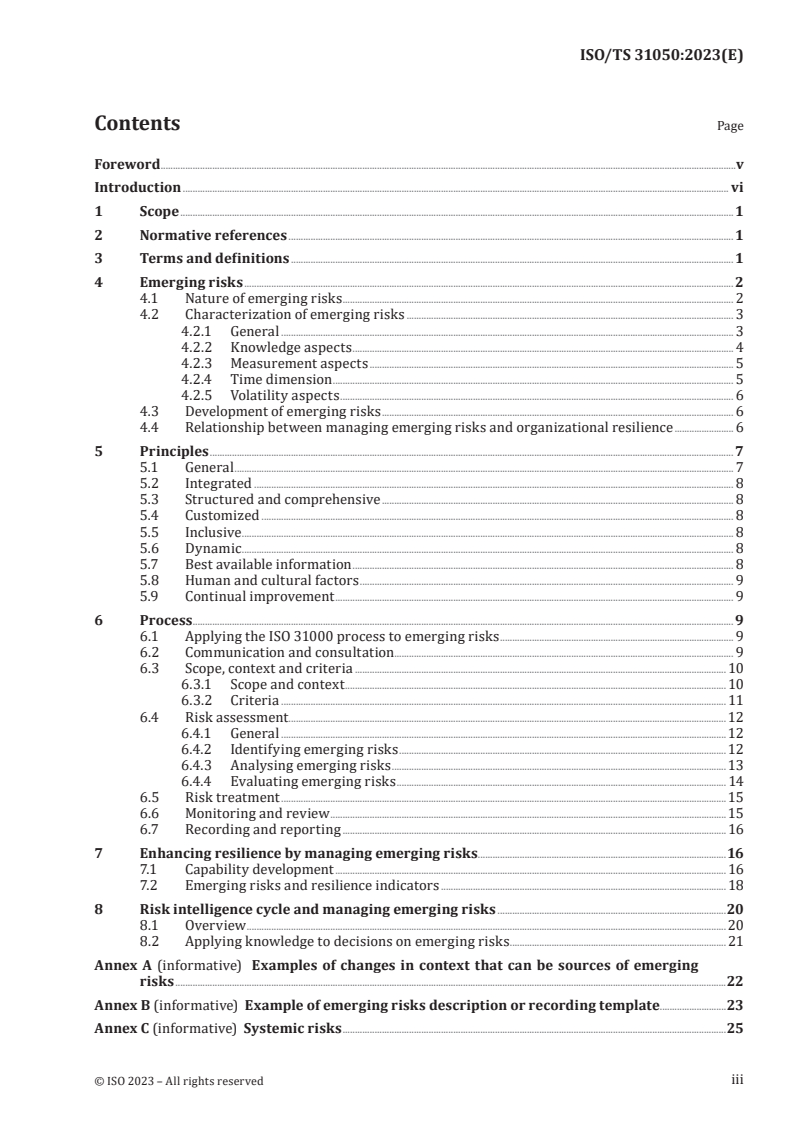
Contents Page
Foreword .v
Introduction . vi
1 Scope . 1
2 Normative references . 1
3 Terms and definitions . 1
4 Emerging risks . 2
4.1 Nature of emerging risks . 2
4.2 Characterization of emerging risks . 3
4.2.1 General . 3
4.2.2 Knowledge aspects . 4
4.2.3 Measurement aspects . 5
4.2.4 Time dimension . 5
4.2.5 Volatility aspects . 6
4.3 Development of emerging risks . 6
4.4 Relationship between managing emerging risks and organizational resilience . 6
5 Principles . 7
5.1 General . 7
5.2 Integrated . 8
5.3 Structured and comprehensive . 8
5.4 Customized . 8
5.5 Inclusive . 8
5.6 Dynamic . 8
5.7 Best available information . 8
5.8 Human and cultural factors . 9
5.9 Continual improvement . 9
6 Process . . 9
6.1 Applying the ISO 31000 process to emerging risks . 9
6.2 Communication and consultation. 9
6.3 Scope, context and criteria . 10
6.3.1 Scope and context . 10
6.3.2 Criteria . 11
6.4 Risk assessment . 12
6.4.1 General .12
6.4.2 Identifying emerging risks .12
6.4.3 Analysing emerging risks . 13
6.4.4 Evaluating emerging risks . 14
6.5 Risk treatment .15
6.6 Monitoring and review .15
6.7 Recording and reporting . 16
7 Enhancing resilience by managing emerging risks.16
7.1 Capability development . 16
7.2 Emerging risks and resilience indicators . 18
8 Risk intelligence cycle and managing emerging risks .20
8.1 Overview . 20
8.2 Applying knowledge to decisions on emerging risks . 21
Annex A (informative) Examples of changes in context that can be sources of emerging
risks .22
Annex B (informative) Example of emerging risks description or recording template .23
Annex C (informative) Systemic risks .25
iii
Annex D (informative) Example factors that can influence managing emerging risks .26
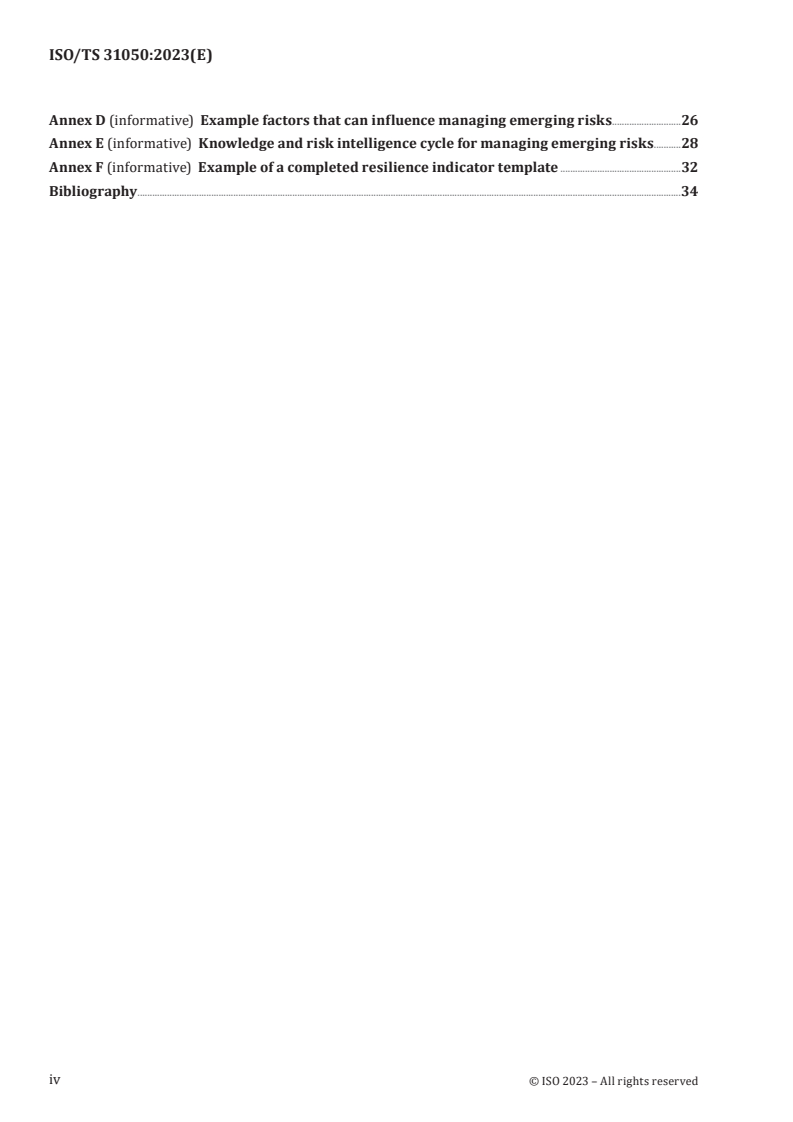
Annex E (informative) Knowledge and risk intelligence cycle for managing emerging risks.28
Annex F (informative) Example of a completed resilience indicator template .32
Bibliography .34
iv
Foreword
ISO (the International Organization for Standardization) is a worldwide federation of national standards
bodies (ISO member bodies). The work of preparing International Standards is normally carried out
through ISO technical committees. Each member body interested in a subject for which a technical
committee has been established has the right to be represented on that committee. International
organizations, governmental and non-governmental, in liaison with ISO, also take part in the work.
ISO collaborates closely with the International Electrotechnical Commission (IEC) on all matters of
electrotechnical standardization.
The procedures used to develop this document and those intended for its further maintenance are
described in the ISO/IEC Directives, Part 1. In particular, the different approval criteria needed for the
different types of ISO document should be noted. This document was drafted in accordance with the
editorial rules of the ISO/IEC Directives, Part 2 (see www.iso.org/directives).
ISO draws attention to the possibility that the implementation of this document may involve the use
of (a) patent(s). ISO takes no position concerning the evidence, validity or applicability of any claimed
patent rights in respect thereof. As of the date of publication of this document, ISO had not received
notice of (a) patent(s) which may be required to implement this document. However, implementers are
cautioned that this may not represent the latest information, which may be obtained from the patent
database available at www.iso.org/patents. ISO shall not be held responsible for identifying any or all
such patent rights.
Any trade name used in this document is information given for the convenience of users and does not
constitute an endorsement.
For an explanation of the voluntary nature of standards, the meaning of ISO specific terms and
expressions related to conformity assessment, as well as information about ISO’s adherence to
the World Trade Organization (WTO) principles in the Technical Barriers to Trade (TBT), see
www.iso.org/iso/foreword.html.
This document was prepared by Technical Committee ISO/TC 262, Risk management, in collaboration
with Technical Committee ISO/TC 292, Security and resilience.
Any feedback or questions on this document should be directed to the user’s national standards body. A
complete listing of these bodies can be found at www.iso.org/members.html.
v
Introduction
Emerging risks are characterized by their newness, insufficient data, and a lack of verifiable information
and knowledge needed for decision-making related to them. As these risks can develop with the
potential for large threats and opportunities, appropriate management of emerging risks should be
established as a part of an organization’s risk management. It should include changes in circumstances
or conditions related to multiple aspects of the organization’s external context and the implications for
its internal context.
Emerging risks can include, for example:
— risks arising from unrecognized changes in organizational contexts;
— risks created by innovation or social and technological development;
— risks related to new sources or previously unrecognized sources of risk;
— risks from new or modified processes, products or services.
Consequences of emerging risks can include, for example:
— exposure to unforeseen hazards and threats with uncertain outcomes;
— increased exposure to hazards and threats from known risk sources;
— lost or gained opportunities.
Managing the emerging risk should be knowledge-focused and dependent on the need to accumulate
verifiable data and information, especially when these are limited or inconsistent. With interpretation,
this information forms knowledge and creates intelligence for strategic, tactical and operational
decision-making.
To this aim, this document provides guidelines for applying ISO 31000 to managing emerging risks to
enhance organizational resilience. The focus is on emerging risks potentially having the most significant
consequences for the organization and its objectives. Applying the ISO 31000 principles and process to
managing the emerging risk requires an understanding of the different aspects of the context in which
the organization operates. In particular, this applies to the following:
— the continual scanning of changing circumstances or conditions that can result in an emerging
risk helps to develop knowledge and provide the intelligence needed for strategic, tactical and
operational decision-making;
— the identification of changes in an organizational context is often an early indicator or signal that
identifies vulnerabilities and the sources of emerging risks;
— managing emerging risks relies on the application of the ISO 31000 principles under conditions of
extreme uncertainty, increasing volatility, complexity and ambiguity within the multiple aspects of
the context in which the organization operates.
Specific guidance is provided on:
— how to understand the nature and characteristics of emerging risks (see Clause 4);
— how the principles of risk management apply to emerging risks (see Clause 5);
— how the ISO 31000 risk management process is applied to emerging risks (see Clause 6);
— how resilience can be enhanced by managing emerging risks (see Clause 7);
— how to use the risk intelligence cycle for emerging risks (see Clause 8).
Further details are provided in Annexes A to F.
vi
The application of this document helps organizations to benefit from:
— increased awareness, reducing the likelihood of failing to anticipate emerging risks;
— early recognition of emerging risks and increased level of preparedness and resilience;
— timely dissemination of data and exchange of information among stakeholders;
— alignment of actions on emerging risks across all aspects of organizational contexts.
vii
TECHNICAL SPECIFICATION ISO/TS 31050:2023(E)
Risk management — Guidelines for managing an emerging
risk to enhance resilience
1 Scope
This document gives guidance on managing emerging risks that an organization can face. This
document complements ISO 31000.
This document is applicable to any organization, at any stage and to any activity of the organization. Its
application can be customized to suit different organizations or the context of different organizations.
2 Normative references
The following documents are referred to in the text in such a way that some or all of their content
constitutes requirements of this document. For dated references, only the edition cited applies. For
undated references, the latest edition of the referenced document (including any amendments) applies.
ISO 22300, Security and resilience — Vocabulary
ISO 22316, Security and resilience — Organizational resilience — Principles and attributes
ISO 31000, Risk management — Guidelines
IEC 31010, Risk management — Risk assessment techniques
3 Terms and definitions
For the purposes of this document, the terms and definitions given in ISO 22300, ISO 22316, ISO 31000,
IEC 31010 and the following apply.
ISO and IEC maintain terminology databases for use in standardization at the following addresses:
— ISO Online browsing platform: available at https:// www .iso .org/ obp
— IEC Electropedia: available at https:// www .electropedia .org/
3.1
resilience attribute
feature or characteristic of an organization’s ability to absorb and adapt to a changing context
3.2
knowledge
outcome of the assimilation of information through learning
Note 1 to entry: Knowledge can be acquired through research, experience or education.
Note 2 to entry: Knowledge includes information, facts, principles, theories and practices related to a field of
work or study.
Note 3 to entry: Knowledge can be individual or collective. Collective knowledge is gained from people
collaborating and releasing their tacit and subconscious knowledge.
[SOURCE: ISO 56000:2020, 3.4.1]
3.3
intelligence
result of gathering, analysing and interpreting data, information and knowledge (3.2)
Note 1 to entry: Intelligence can be of different kinds, e.g. (but not limited to) market, technology, competition,
intellectual property or business.
[SOURCE: ISO 56006:2021, 3.1]
3.4
organizational resilience
ability of an organization to absorb, recover and adapt in a changing context
[SOURCE: ISO 22300:2021, 3.1.167, modified — “recover” has been added and "environment" has been
replaced with "context" in the definition.]
3.5
radical innovation
breakthrough innovation
innovation with a high degree of change
Note 1 to entry: Change can relate to the entity or its impact.
Note 2 to entry: Radical innovation is at the other end of the continuum to incremental innovation.
[SOURCE: ISO 56000:2020, 3.1.1.1]
3.6
disruptive innovation
innovation initially addressing less demanding needs, displacing established offerings
Note 1 to entry: Compared to established offerings, disruptive innovations are initially simpler offerings with
lower performance and they are generally more cost effective, requiring fewer resources and offered at lower
cost.
Note 2 to entry: Disruption occurs when a significant ratio of users or customers have adopted the innovation.
Note 3 to entry: Disruptive innovations can create new markets and value networks by addressing new users
and deploying new business and value realization models.
[SOURCE: ISO 56000:2020, 3.1.1.2]
4 Emerging risks
4.1 Nature of emerging risks
The nature of emerging risks (see the examples in Annex A and the example of data to be collected
about them in Annex B) can include:
— risks that have not been previously recognized or experienced by an organization;
— familiar risks in a new or unfamiliar context where the existing knowledge is not applicable;
— significantly evolving risk;
— systemic risks (see Annex C);
— a novel combination of risks.
If an organization does not consider emerging risks, it does not mean that the organization will not
be affected. In many cases, it is initially not possible to formulate scenarios of interest, to estimate
event likelihood, to anticipate consequences or to identify control options. To better understand the
nature of the particular emerging risk, the nature of similar risks that are better understood should be
considered.
The above risks can stem from changes of context in which the organization seeks to meet its objectives,
such as:
— organizational relationships;
— access to capital and capabilities;
— interactions or interdependencies with societal, geopolitical, environmental, economic,
technological, legal, perception (see Annex D) and ethical factors;
— the internal governance, cultural and operational aspects of its business.
Emerging risks should be proactively identified and characterized from observing changes in
organizational contexts. Emerging risks are typically represented by a set of new circumstances or
conditions, not previously recognized, or changes in the characteristics of already identified risks. The
changes can be related to, for example:
— societal norms;
— organizational culture;
— perceptions;
— data, or information interpreted from data, about a risk or the way that risk evolves.
NOTE There are occasions when risks emerge with little prior visibility in the context.
4.2 Characterization of emerging risks
4.2.1 General
Effective and efficient management of the emerging risk requires the continual acquisition of knowledge
about the organization’s function, context, experience, access to data and emerging risk characteristics
(e.g. by applying the risk intelligence cycle, see Clause 8 and Annex E). The data, information and
knowledge acquired should be recorded appropriately (see 6.7 and Annex B).
The following factors can be of particular importance for the new knowledge about emerging risks:
a) possible deviations from the expected outcomes or consequences, either positive or negative, and
their likelihood;
b) sources and nature of risks;
c) other factors, such as the rate of development of risk and detectability.
Where the organization has not previously experienced particular changes in its context, it is
possible that data related to those changes are limited or that all characteristics of emerging risks
are not evident (e.g. for systemic risks, see Annex C). Understanding the characteristics of emerging
risks context depends upon available knowledge relating to nature and source, quantity and time, in
a volatile, uncertain context, complex and ambiguous circumstances. Consequently, the knowledge
acquired can be insufficient to identify changes in characteristics and potential sources of risk or, if an
emerging issue has been identified, to determine the likelihood and consequences of deviations from
expectations.
Due to high uncertainty, the interpretation of data and information can be biased by individual
perceptions (see Annex D).
Emerging risk characteristics should be categorized, for example, by considering the following elements:
— knowledge elements, including, for example:
— unknown changes in organizational contexts;
— weak signals of change subject to interpretation and bias;
— insufficient data to determine likelihood and consequences;
— volatility elements, including, for example:
— conditions or circumstances likely to change, rapidly or unpredictably;
— impact of change and consequences of an unknown variable;
— instability of data and information;
— uncertainty elements, including, for example:
— transition from early warnings and signals to emerging risks;
— determination of sources of emerging risks;
— complexity elements, including, for example:
— high level of interconnectedness of systems, parts or processes;
— unknown interdependencies throughout the organization’s context;
— interactions of emerging risks with other risks or activities that can result in non-linear effects;
— the systemic nature of certain risks (see Annex C);
— large degree of complexity of potential decisions and consequences;
— ambiguity elements, including, for example:
— limited data open to multiple interpretations and individual perceptions;
— lack of precedence for the development of knowledge and intelligence;
— lack of clarity on the cause and effect of changes in contexts;
— time dimension elements, including, for example:
— velocity of change in the organization’s context;
— rate of change in characteristics of emerging risks;
— controllability elements, including, for example, the effects of factors out of the organization’s
control, both in internal and external contexts;
— behavioural elements, including, for example, the effects of unexpected changes in contexts, people,
systems or processes (see Annex D).
Not all of the above characteristics apply necessarily to all emerging risks and are not unique to
emerging risks. The above categories, however, do represent a common theme for emerging risks,
which should be considered when managing them.
4.2.2 Knowledge aspects
Knowledge relating to emerging risks should be based on the quantity and quality of data available
and their usability as credible information to support decision-making. In order to manage emerging
risks effectively, the use of systems that can gather and interpret data about capabilities, possibilities,
changes and trends in the external context should be considered, taking into account that the knowledge
about emerging risk characteristics and their influence on the organization’s objectives can depend on
the data still missing or that are limited.
It should be noted that in the absence of adequate knowledge, understanding of emerging risks
can be influenced by individual perceptions, cognitive bias, group dynamics, misinformation or
misinterpretation, preventing the reliable assessment of likelihoods and consequences. In such cases,
[4]
the focus of managing emerging risks should be on assessing their plausibility and enhancing the
[5]
organization’s resilience .
As emerging risks evolve, knowledge about them and their characteristics also evolves with time.
NOTE Initially, there can be little understanding of the potential for issues arising from particular
circumstances. As data and information are collected and interpreted, knowledge increases, enabling
organizations to identify emerging risks and make decisions about their potential consequences.
This should be defined within the risk intelligence cycle. The application of knowledge as strategic
intelligence and improved decision-making should be systematic. See Clause 8 and Annex E.
4.2.3 Measurement aspects
The quality (e.g. integrity, reliability, accuracy, timely, relevancy) of available data and information
is essential for acquiring the knowledge necessary to assign values to the measurable elements of
emerging risk characteristics, including consequences and likelihood. The organization should establish
a system for timely acquisition of relevant data on weak signals or early warnings, as well their analysis
and analysis of changes in emerging risk characteristics. This analysis should include the ambiguity of
information, its limitations related to understanding the development of emerging risks, and trends
and patterns in the organization’s context, indicating the source of possible emerging risks.
4.2.4 Time dimension
Characterizing emerging risks should include the time dimensions, such as the rate at which
information necessary to understand and manage risk becomes available. Understanding the time-
related characteristics of emerging risks also influences data collection and analysis, the interpretation
of information and the creation of knowledge for timely decision-making in managing emerging risks.
Time until the necessary information becomes available also affects risk management control options
and the extent of expertise required.
Key time indicators as characteristics of emerging risks should include:
a) the rate (velocity) of change in conditions or circumstances;
b) the rate of development of an emerging risk;
c) the lead time from a change in circumstances or conditions to the identification of an emerging
risk;
d) the time to reach the maturity of data essential to information, knowledge and intelligence;
e) the time between context changes and the appearance of weak signals or early warnings;
f) the time from risk identification to event occurrence.
4.2.5 Volatility aspects
The emerging risk characteristics potentially leading to uncertain or unexpected changes and volatility
in the emerging risk can include:
— sudden recognition that circumstances are not understood well enough and that the organization is
unaware of potentially important data;
— unexpected and unanticipated step changes in contexts, capabilities and understanding of the
implications of those changes;
— rapid and unpredictable variability and unforeseen changes in the organizational context.
Information should be continually updated to increase the understanding of the reasons for these
changes. The characteristics and knowledge should be included as part of effective and efficient
decision-making on emerging risks.
4.3 Development of emerging risks
Understanding the various aspects of the organizational context should be considered as the key to
effective identification, analysis and evaluation of the emerging risk (see 4.1). Changes in any or all
these environmental aspects create changes in the organizational context with the potential to impact
organizational objectives, either positively or negatively.
Weak signals and first indicators of change in any aspect of the organization’s context are precursors
to potential emerging risk. In these circumstances, organizations should monitor identified changes in
any aspect of their context and continually gather and analyse data to determine the significance of a
change in any element or aspect, and to develop scenarios.
Close monitoring and review of changes in contexts, and increasing availability of data such as
likelihood, rate of change, magnitude and volatility of occurrence, time horizons and aspects of the
organization’s context, all contribute to clarity and a better understanding of identified issues and
potential emerging risks.
During the initial stages of an emerging risk development, the organization, especially one having
little or no previous knowledge or experience with emerging risks, should be aware that data can
be unavailable, limited, inconsistent, inaccurate or false. The process of interpretation of data into
verifiable information for decision-making should be, therefore, focused on reducing significant
uncertainties.
Although the continual monitoring and review of changes in characteristics of an emerging risk will
generally increase the quality and quantity of data collected, the organization should be aware of
circumstances where not all changes in its context can be identified or covered by the scenario analysis.
4.4 Relationship between managing emerging risks and organizational resilience
Organizational resilience enables an organization to deliver its objectives, survive and prosper. The
changes in the organizational context are often early indicators or are those that identify threats and
opportunities, vulnerabilities and the sources of an emerging risk.
With respect to possible threats, organizational resilience allows organizations to prepare for them,
absorb their impacts, recover from them and adapt to the changing conditions. With respect to possible
opportunities, organizational resilience allows organizations to adapt to gain from change, create
internal value and take measured risks confidently (see ISO 22316).
Efficient and effective managing of emerging risks should help to preclude and mitigate possible failures
to exploit opportunities or experience adverse effects on the organization’s important objectives, or
even the organization’s survival.
Therefore, the organizations should adopt and apply the principles of resilience and resilience
indicators (see Annex F). They should develop capabilities and attributes that enhance their ability to
survive and prosper. An organization’s ability to anticipate, prepare and respond to change should be
the key requirement for effectively managing emerging risks. Resilient organizations should, thus, be
characterized by their abilities that include the following:
— Anticipation: The ability to prepare for unexpected or unlikely events by developing foresight
capabilities and functions that are necessary to deal with any kind of unexpected event, both
favourable and adverse. This also means being ready to take advantage of potential opportunities
offered by changes in external contexts before competitors.
— Resistance and recovery: The ability to resist adverse situations and recover after disturbances and
return to a normal state beyond the maintenance and restoration of organizational functionality,
focusing on the advancement of organizational processes and capabilities.
— Adaptation: The ability to effectively develop situation-specific responses, adapt to disruptive
events and ultimately engage in transformative activities to capitalize on disruptive events.
Determining an organization’s level of resilience prior to a disruptive event should be measured and
dependent upon the extent to which an organization has successfully managed a similar unexpected
event. Organizational resilience should include capability through which effective anticipation and
adaptation to emerging risks can be achieved.
5 Principles
5.1 General
The core of risk management and its purpose is value creation and protection. To achieve this, ISO 31000
outlines a set of principles, see Figure 1 a). These principles are equally applicable to the managing of
emerging risk.
a) Principles b) Process
Figure 1 — Principles and process in ISO 31000
Subclauses 5.2 to 5.9 give additional recommendations for applying those principles to managing
emerging risk. When applying these principles, the organization should ensure that emerging risks:
— are reviewed continually during their emerging stages to improve knowledge and understanding of
their characteristics and state;
— are assessed considering a broad range of possible future situations.
In addition, the organization should ensure that threats and opportunities are adequately managed,
recognizing the limitations, inconsistency, and variability of information and data.
5.2 Integrated
There is no additional guidance in addition to that provided in ISO 31000.
5.3 Structured and comprehensive
The organization should apply an agile approach where necessary for collecting and interpreting data,
producing information and converting knowledge into intelligence for use by decision-makers (see
Clause 8 and Annex E).
The organization should explicitly consider whether the acquisition of data (both structured and
unstructured) and their interpretation as information and the knowledge applied satisfies the
requirement of a comprehensive approach to risk management.
The approach should emphasize the importance of consistent identification work and communication
about emerging risks.
5.4 Customized
The organization should ensure its risk management framework and process are customized to reflect
the volatility, uncertainty, complexity and ambiguity of emerging risks consistent with its mission,
objectives and strategies.
5.5 Inclusive
The organization should identify and engage relevant stakeholders with an interest in the emerging
risk in an appropriate and timely manner to improve the extent of the organization’s knowledge by
learning from the experiences of different stakeholders that the organization can apply.
Even when data quality is poor and information is limited, the organization should continue to recognize
the credibility of the information if the source has sufficient credibility and expertise.
5.6 Dynamic
The organization should consider the potential for unexpected and disruptive changes in context. It
should develop a timely capability to anticipate, detect and respond to change. The organization should,
therefore, remain sufficiently agile, flexible and adaptable to accommodate plausible changes in the
external context.
The organization should ensure its risk management framework includes components designed to
anticipate and respond to changing circumstances and that sufficient flexibility exists within the risk
management process. The members of the organization should be able to adapt and apply different
tools and techniques to address the characteristics of emerging risks.
5.7 Best available information
Recognizing the lack of history and relevant current information when assessing emerging risks,
the organization should ensure the ongoing development of data gathering and verification and data
analysis to extract information relating to emerging risks to source the best information for decision-
making.
Clause 8 provides additional guidance on how to gather all available data and produce valuable
intelligence for decision-making regarding emerging risks.
5.8 Human and cultural factors
The organization should recognize that the lack of facts related to emerging risks can invalidate
established views. For this reason, information on emerging risks can significantly impact human
culture and behaviour. Therefore, the contribution of internal and external experts should be valued.
The organization should recognize that the availability and interpretation of data into credible
information can change significantly as emerging risks develop. Early perceptions can prove incorrect,
and previously established beliefs can be challenged.
5.9 Continual improvement
The organization should ensure that emerging risk management leads to new opportunities for
society and business, new learning and new experiences, including a critical review of the results of
previous risk analyses. The organization should explicitly identify this new level of understanding as
a catalyst for knowledge development, new and improved processes, and practices in and beyond risk
management.
The organization should ensure continual improvement leads to effective and efficient management
of emerging risks. These improvements should include data collation, information transformation and
sharing, and knowledge creation and enhancement while applying the risk management process.
Effective management of the emerging risk calls for foresight, which is also required for effective market
intelligence work, and new product and service development in both the public and private sectors.
Management of the emerging risk is fundamental to success in developing objectives and delivering
service to meet current requirements while preparing for the future.
6 Process
6.1 Applying the ISO 31000 process to emerging risks
The organization should apply the risk management process described in ISO 31000:2018, Clause 6
[see Figure 1 b)] to manage emerging risks. It should integrate activities into its structure, system,
operations and processes. The relevance of emerging risks should be considered at all levels and within
each organization’s function.
The application of the ISO 31000 process to emerging risks should use a structured approach with
sufficient flexibility to adapt to the latest information as emerging risk understanding grows. For
example, knowledge gained from risk analysis can be applied to anticipate changes in context.
Emerging risks can influence each other and other risks faced by the organization. The organization
should consider emerging risks as part of a broader system rather than as discrete and individual
issues by considering possible interdependencies and interconnectedness. An approach which analyses
dependencies, relationships and interconnection should yield a thorough understanding beyond just
examining the individual risk components without a view of the whole system.
The risk intelligence cycle described in Clause 8 and Annex E can assist organizations and their decision-
makers in applying the risk management process described in ISO 31000.
6.2 Communication and consultation
In addition to ISO 31000:2018, 6.2, the following recommendations apply.
The organization should identify internal and external stakeholders and establish communication paths
so that when action is needed, the means of communication are already established. As with any risk,
stakeholders should include those who should be kept informed, those who will be consulted and those
who will participate in the different elements of the risk management process. Stakeholders can change
over time, and different stakeholders can be across different risk management elements. For example,
a wide range of unique experience and expertise can help identify emerging risks, while analysis of a
particular risk can require specific subject matter experts.
Engaging with relevant stakeholders assists in the id
...
TECHNICAL ISO/TS
SPECIFICATION 31050
First edition
2023-10
Risk management — Guidelines for
managing an emerging risk to enhance
resilience
Management du risque — Lignes directrices relatives à la gestion des
risques émergents afin d'améliorer la résilience
Reference number
© ISO 2023
All rights reserved. Unless otherwise specified, or required in the context of its implementation, no part of this publication may
be reproduced or utilized otherwise in any form or by any means, electronic or mechanical, including photocopying, or posting on
the internet or an intranet, without prior written permission. Permission can be requested from either ISO at the address below
or ISO’s member body in the country of the requester.
ISO copyright office
CP 401 • Ch. de Blandonnet 8
CH-1214 Vernier, Geneva
Phone: +41 22 749 01 11
Email: copyright@iso.org
Website: www.iso.org
Published in Switzerland
ii
Contents Page
Foreword .v
Introduction . vi
1 Scope . 1
2 Normative references . 1
3 Terms and definitions . 1
4 Emerging risks . 2
4.1 Nature of emerging risks . 2
4.2 Characterization of emerging risks . 3
4.2.1 General . 3
4.2.2 Knowledge aspects . 4
4.2.3 Measurement aspects . 5
4.2.4 Time dimension . 5
4.2.5 Volatility aspects . 6
4.3 Development of emerging risks . 6
4.4 Relationship between managing emerging risks and organizational resilience . 6
5 Principles . 7
5.1 General . 7
5.2 Integrated . 8
5.3 Structured and comprehensive . 8
5.4 Customized . 8
5.5 Inclusive . 8
5.6 Dynamic . 8
5.7 Best available information . 8
5.8 Human and cultural factors . 9
5.9 Continual improvement . 9
6 Process . . 9
6.1 Applying the ISO 31000 process to emerging risks . 9
6.2 Communication and consultation. 9
6.3 Scope, context and criteria . 10
6.3.1 Scope and context . 10
6.3.2 Criteria . 11
6.4 Risk assessment . 12
6.4.1 General .12
6.4.2 Identifying emerging risks .12
6.4.3 Analysing emerging risks . 13
6.4.4 Evaluating emerging risks . 14
6.5 Risk treatment .15
6.6 Monitoring and review .15
6.7 Recording and reporting . 16
7 Enhancing resilience by managing emerging risks.16
7.1 Capability development . 16
7.2 Emerging risks and resilience indicators . 18
8 Risk intelligence cycle and managing emerging risks .20
8.1 Overview . 20
8.2 Applying knowledge to decisions on emerging risks . 21
Annex A (informative) Examples of changes in context that can be sources of emerging
risks .22
Annex B (informative) Example of emerging risks description or recording template .23
Annex C (informative) Systemic risks .25
iii
Annex D (informative) Example factors that can influence managing emerging risks .26
Annex E (informative) Knowledge and risk intelligence cycle for managing emerging risks.28
Annex F (informative) Example of a completed resilience indicator template .32
Bibliography .34
iv
Foreword
ISO (the International Organization for Standardization) is a worldwide federation of national standards
bodies (ISO member bodies). The work of preparing International Standards is normally carried out
through ISO technical committees. Each member body interested in a subject for which a technical
committee has been established has the right to be represented on that committee. International
organizations, governmental and non-governmental, in liaison with ISO, also take part in the work.
ISO collaborates closely with the International Electrotechnical Commission (IEC) on all matters of
electrotechnical standardization.
The procedures used to develop this document and those intended for its further maintenance are
described in the ISO/IEC Directives, Part 1. In particular, the different approval criteria needed for the
different types of ISO document should be noted. This document was drafted in accordance with the
editorial rules of the ISO/IEC Directives, Part 2 (see www.iso.org/directives).
ISO draws attention to the possibility that the implementation of this document may involve the use
of (a) patent(s). ISO takes no position concerning the evidence, validity or applicability of any claimed
patent rights in respect thereof. As of the date of publication of this document, ISO had not received
notice of (a) patent(s) which may be required to implement this document. However, implementers are
cautioned that this may not represent the latest information, which may be obtained from the patent
database available at www.iso.org/patents. ISO shall not be held responsible for identifying any or all
such patent rights.
Any trade name used in this document is information given for the convenience of users and does not
constitute an endorsement.
For an explanation of the voluntary nature of standards, the meaning of ISO specific terms and
expressions related to conformity assessment, as well as information about ISO’s adherence to
the World Trade Organization (WTO) principles in the Technical Barriers to Trade (TBT), see
www.iso.org/iso/foreword.html.
This document was prepared by Technical Committee ISO/TC 262, Risk management, in collaboration
with Technical Committee ISO/TC 292, Security and resilience.
Any feedback or questions on this document should be directed to the user’s national standards body. A
complete listing of these bodies can be found at www.iso.org/members.html.
v
Introduction
Emerging risks are characterized by their newness, insufficient data, and a lack of verifiable information
and knowledge needed for decision-making related to them. As these risks can develop with the
potential for large threats and opportunities, appropriate management of emerging risks should be
established as a part of an organization’s risk management. It should include changes in circumstances
or conditions related to multiple aspects of the organization’s external context and the implications for
its internal context.
Emerging risks can include, for example:
— risks arising from unrecognized changes in organizational contexts;
— risks created by innovation or social and technological development;
— risks related to new sources or previously unrecognized sources of risk;
— risks from new or modified processes, products or services.
Consequences of emerging risks can include, for example:
— exposure to unforeseen hazards and threats with uncertain outcomes;
— increased exposure to hazards and threats from known risk sources;
— lost or gained opportunities.
Managing the emerging risk should be knowledge-focused and dependent on the need to accumulate
verifiable data and information, especially when these are limited or inconsistent. With interpretation,
this information forms knowledge and creates intelligence for strategic, tactical and operational
decision-making.
To this aim, this document provides guidelines for applying ISO 31000 to managing emerging risks to
enhance organizational resilience. The focus is on emerging risks potentially having the most significant
consequences for the organization and its objectives. Applying the ISO 31000 principles and process to
managing the emerging risk requires an understanding of the different aspects of the context in which
the organization operates. In particular, this applies to the following:
— the continual scanning of changing circumstances or conditions that can result in an emerging
risk helps to develop knowledge and provide the intelligence needed for strategic, tactical and
operational decision-making;
— the identification of changes in an organizational context is often an early indicator or signal that
identifies vulnerabilities and the sources of emerging risks;
— managing emerging risks relies on the application of the ISO 31000 principles under conditions of
extreme uncertainty, increasing volatility, complexity and ambiguity within the multiple aspects of
the context in which the organization operates.
Specific guidance is provided on:
— how to understand the nature and characteristics of emerging risks (see Clause 4);
— how the principles of risk management apply to emerging risks (see Clause 5);
— how the ISO 31000 risk management process is applied to emerging risks (see Clause 6);
— how resilience can be enhanced by managing emerging risks (see Clause 7);
— how to use the risk intelligence cycle for emerging risks (see Clause 8).
Further details are provided in Annexes A to F.
vi
The application of this document helps organizations to benefit from:
— increased awareness, reducing the likelihood of failing to anticipate emerging risks;
— early recognition of emerging risks and increased level of preparedness and resilience;
— timely dissemination of data and exchange of information among stakeholders;
— alignment of actions on emerging risks across all aspects of organizational contexts.
vii
TECHNICAL SPECIFICATION ISO/TS 31050:2023(E)
Risk management — Guidelines for managing an emerging
risk to enhance resilience
1 Scope
This document gives guidance on managing emerging risks that an organization can face. This
document complements ISO 31000.
This document is applicable to any organization, at any stage and to any activity of the organization. Its
application can be customized to suit different organizations or the context of different organizations.
2 Normative references
The following documents are referred to in the text in such a way that some or all of their content
constitutes requirements of this document. For dated references, only the edition cited applies. For
undated references, the latest edition of the referenced document (including any amendments) applies.
ISO 22300, Security and resilience — Vocabulary
ISO 22316, Security and resilience — Organizational resilience — Principles and attributes
ISO 31000, Risk management — Guidelines
IEC 31010, Risk management — Risk assessment techniques
3 Terms and definitions
For the purposes of this document, the terms and definitions given in ISO 22300, ISO 22316, ISO 31000,
IEC 31010 and the following apply.
ISO and IEC maintain terminology databases for use in standardization at the following addresses:
— ISO Online browsing platform: available at https:// www .iso .org/ obp
— IEC Electropedia: available at https:// www .electropedia .org/
3.1
resilience attribute
feature or characteristic of an organization’s ability to absorb and adapt to a changing context
3.2
knowledge
outcome of the assimilation of information through learning
Note 1 to entry: Knowledge can be acquired through research, experience or education.
Note 2 to entry: Knowledge includes information, facts, principles, theories and practices related to a field of
work or study.
Note 3 to entry: Knowledge can be individual or collective. Collective knowledge is gained from people
collaborating and releasing their tacit and subconscious knowledge.
[SOURCE: ISO 56000:2020, 3.4.1]
3.3
intelligence
result of gathering, analysing and interpreting data, information and knowledge (3.2)
Note 1 to entry: Intelligence can be of different kinds, e.g. (but not limited to) market, technology, competition,
intellectual property or business.
[SOURCE: ISO 56006:2021, 3.1]
3.4
organizational resilience
ability of an organization to absorb, recover and adapt in a changing context
[SOURCE: ISO 22300:2021, 3.1.167, modified — “recover” has been added and "environment" has been
replaced with "context" in the definition.]
3.5
radical innovation
breakthrough innovation
innovation with a high degree of change
Note 1 to entry: Change can relate to the entity or its impact.
Note 2 to entry: Radical innovation is at the other end of the continuum to incremental innovation.
[SOURCE: ISO 56000:2020, 3.1.1.1]
3.6
disruptive innovation
innovation initially addressing less demanding needs, displacing established offerings
Note 1 to entry: Compared to established offerings, disruptive innovations are initially simpler offerings with
lower performance and they are generally more cost effective, requiring fewer resources and offered at lower
cost.
Note 2 to entry: Disruption occurs when a significant ratio of users or customers have adopted the innovation.
Note 3 to entry: Disruptive innovations can create new markets and value networks by addressing new users
and deploying new business and value realization models.
[SOURCE: ISO 56000:2020, 3.1.1.2]
4 Emerging risks
4.1 Nature of emerging risks
The nature of emerging risks (see the examples in Annex A and the example of data to be collected
about them in Annex B) can include:
— risks that have not been previously recognized or experienced by an organization;
— familiar risks in a new or unfamiliar context where the existing knowledge is not applicable;
— significantly evolving risk;
— systemic risks (see Annex C);
— a novel combination of risks.
If an organization does not consider emerging risks, it does not mean that the organization will not
be affected. In many cases, it is initially not possible to formulate scenarios of interest, to estimate
event likelihood, to anticipate consequences or to identify control options. To better understand the
nature of the particular emerging risk, the nature of similar risks that are better understood should be
considered.
The above risks can stem from changes of context in which the organization seeks to meet its objectives,
such as:
— organizational relationships;
— access to capital and capabilities;
— interactions or interdependencies with societal, geopolitical, environmental, economic,
technological, legal, perception (see Annex D) and ethical factors;
— the internal governance, cultural and operational aspects of its business.
Emerging risks should be proactively identified and characterized from observing changes in
organizational contexts. Emerging risks are typically represented by a set of new circumstances or
conditions, not previously recognized, or changes in the characteristics of already identified risks. The
changes can be related to, for example:
— societal norms;
— organizational culture;
— perceptions;
— data, or information interpreted from data, about a risk or the way that risk evolves.
NOTE There are occasions when risks emerge with little prior visibility in the context.
4.2 Characterization of emerging risks
4.2.1 General
Effective and efficient management of the emerging risk requires the continual acquisition of knowledge
about the organization’s function, context, experience, access to data and emerging risk characteristics
(e.g. by applying the risk intelligence cycle, see Clause 8 and Annex E). The data, information and
knowledge acquired should be recorded appropriately (see 6.7 and Annex B).
The following factors can be of particular importance for the new knowledge about emerging risks:
a) possible deviations from the expected outcomes or consequences, either positive or negative, and
their likelihood;
b) sources and nature of risks;
c) other factors, such as the rate of development of risk and detectability.
Where the organization has not previously experienced particular changes in its context, it is
possible that data related to those changes are limited or that all characteristics of emerging risks
are not evident (e.g. for systemic risks, see Annex C). Understanding the characteristics of emerging
risks context depends upon available knowledge relating to nature and source, quantity and time, in
a volatile, uncertain context, complex and ambiguous circumstances. Consequently, the knowledge
acquired can be insufficient to identify changes in characteristics and potential sources of risk or, if an
emerging issue has been identified, to determine the likelihood and consequences of deviations from
expectations.
Due to high uncertainty, the interpretation of data and information can be biased by individual
perceptions (see Annex D).
Emerging risk characteristics should be categorized, for example, by considering the following elements:
— knowledge elements, including, for example:
— unknown changes in organizational contexts;
— weak signals of change subject to interpretation and bias;
— insufficient data to determine likelihood and consequences;
— volatility elements, including, for example:
— conditions or circumstances likely to change, rapidly or unpredictably;
— impact of change and consequences of an unknown variable;
— instability of data and information;
— uncertainty elements, including, for example:
— transition from early warnings and signals to emerging risks;
— determination of sources of emerging risks;
— complexity elements, including, for example:
— high level of interconnectedness of systems, parts or processes;
— unknown interdependencies throughout the organization’s context;
— interactions of emerging risks with other risks or activities that can result in non-linear effects;
— the systemic nature of certain risks (see Annex C);
— large degree of complexity of potential decisions and consequences;
— ambiguity elements, including, for example:
— limited data open to multiple interpretations and individual perceptions;
— lack of precedence for the development of knowledge and intelligence;
— lack of clarity on the cause and effect of changes in contexts;
— time dimension elements, including, for example:
— velocity of change in the organization’s context;
— rate of change in characteristics of emerging risks;
— controllability elements, including, for example, the effects of factors out of the organization’s
control, both in internal and external contexts;
— behavioural elements, including, for example, the effects of unexpected changes in contexts, people,
systems or processes (see Annex D).
Not all of the above characteristics apply necessarily to all emerging risks and are not unique to
emerging risks. The above categories, however, do represent a common theme for emerging risks,
which should be considered when managing them.
4.2.2 Knowledge aspects
Knowledge relating to emerging risks should be based on the quantity and quality of data available
and their usability as credible information to support decision-making. In order to manage emerging
risks effectively, the use of systems that can gather and interpret data about capabilities, possibilities,
changes and trends in the external context should be considered, taking into account that the knowledge
about emerging risk characteristics and their influence on the organization’s objectives can depend on
the data still missing or that are limited.
It should be noted that in the absence of adequate knowledge, understanding of emerging risks
can be influenced by individual perceptions, cognitive bias, group dynamics, misinformation or
misinterpretation, preventing the reliable assessment of likelihoods and consequences. In such cases,
[4]
the focus of managing emerging risks should be on assessing their plausibility and enhancing the
[5]
organization’s resilience .
As emerging risks evolve, knowledge about them and their characteristics also evolves with time.
NOTE Initially, there can be little understanding of the potential for issues arising from particular
circumstances. As data and information are collected and interpreted, knowledge increases, enabling
organizations to identify emerging risks and make decisions about their potential consequences.
This should be defined within the risk intelligence cycle. The application of knowledge as strategic
intelligence and improved decision-making should be systematic. See Clause 8 and Annex E.
4.2.3 Measurement aspects
The quality (e.g. integrity, reliability, accuracy, timely, relevancy) of available data and information
is essential for acquiring the knowledge necessary to assign values to the measurable elements of
emerging risk characteristics, including consequences and likelihood. The organization should establish
a system for timely acquisition of relevant data on weak signals or early warnings, as well their analysis
and analysis of changes in emerging risk characteristics. This analysis should include the ambiguity of
information, its limitations related to understanding the development of emerging risks, and trends
and patterns in the organization’s context, indicating the source of possible emerging risks.
4.2.4 Time dimension
Characterizing emerging risks should include the time dimensions, such as the rate at which
information necessary to understand and manage risk becomes available. Understanding the time-
related characteristics of emerging risks also influences data collection and analysis, the interpretation
of information and the creation of knowledge for timely decision-making in managing emerging risks.
Time until the necessary information becomes available also affects risk management control options
and the extent of expertise required.
Key time indicators as characteristics of emerging risks should include:
a) the rate (velocity) of change in conditions or circumstances;
b) the rate of development of an emerging risk;
c) the lead time from a change in circumstances or conditions to the identification of an emerging
risk;
d) the time to reach the maturity of data essential to information, knowledge and intelligence;
e) the time between context changes and the appearance of weak signals or early warnings;
f) the time from risk identification to event occurrence.
4.2.5 Volatility aspects
The emerging risk characteristics potentially leading to uncertain or unexpected changes and volatility
in the emerging risk can include:
— sudden recognition that circumstances are not understood well enough and that the organization is
unaware of potentially important data;
— unexpected and unanticipated step changes in contexts, capabilities and understanding of the
implications of those changes;
— rapid and unpredictable variability and unforeseen changes in the organizational context.
Information should be continually updated to increase the understanding of the reasons for these
changes. The characteristics and knowledge should be included as part of effective and efficient
decision-making on emerging risks.
4.3 Development of emerging risks
Understanding the various aspects of the organizational context should be considered as the key to
effective identification, analysis and evaluation of the emerging risk (see 4.1). Changes in any or all
these environmental aspects create changes in the organizational context with the potential to impact
organizational objectives, either positively or negatively.
Weak signals and first indicators of change in any aspect of the organization’s context are precursors
to potential emerging risk. In these circumstances, organizations should monitor identified changes in
any aspect of their context and continually gather and analyse data to determine the significance of a
change in any element or aspect, and to develop scenarios.
Close monitoring and review of changes in contexts, and increasing availability of data such as
likelihood, rate of change, magnitude and volatility of occurrence, time horizons and aspects of the
organization’s context, all contribute to clarity and a better understanding of identified issues and
potential emerging risks.
During the initial stages of an emerging risk development, the organization, especially one having
little or no previous knowledge or experience with emerging risks, should be aware that data can
be unavailable, limited, inconsistent, inaccurate or false. The process of interpretation of data into
verifiable information for decision-making should be, therefore, focused on reducing significant
uncertainties.
Although the continual monitoring and review of changes in characteristics of an emerging risk will
generally increase the quality and quantity of data collected, the organization should be aware of
circumstances where not all changes in its context can be identified or covered by the scenario analysis.
4.4 Relationship between managing emerging risks and organizational resilience
Organizational resilience enables an organization to deliver its objectives, survive and prosper. The
changes in the organizational context are often early indicators or are those that identify threats and
opportunities, vulnerabilities and the sources of an emerging risk.
With respect to possible threats, organizational resilience allows organizations to prepare for them,
absorb their impacts, recover from them and adapt to the changing conditions. With respect to possible
opportunities, organizational resilience allows organizations to adapt to gain from change, create
internal value and take measured risks confidently (see ISO 22316).
Efficient and effective managing of emerging risks should help to preclude and mitigate possible failures
to exploit opportunities or experience adverse effects on the organization’s important objectives, or
even the organization’s survival.
Therefore, the organizations should adopt and apply the principles of resilience and resilience
indicators (see Annex F). They should develop capabilities and attributes that enhance their ability to
survive and prosper. An organization’s ability to anticipate, prepare and respond to change should be
the key requirement for effectively managing emerging risks. Resilient organizations should, thus, be
characterized by their abilities that include the following:
— Anticipation: The ability to prepare for unexpected or unlikely events by developing foresight
capabilities and functions that are necessary to deal with any kind of unexpected event, both
favourable and adverse. This also means being ready to take advantage of potential opportunities
offered by changes in external contexts before competitors.
— Resistance and recovery: The ability to resist adverse situations and recover after disturbances and
return to a normal state beyond the maintenance and restoration of organizational functionality,
focusing on the advancement of organizational processes and capabilities.
— Adaptation: The ability to effectively develop situation-specific responses, adapt to disruptive
events and ultimately engage in transformative activities to capitalize on disruptive events.
Determining an organization’s level of resilience prior to a disruptive event should be measured and
dependent upon the extent to which an organization has successfully managed a similar unexpected
event. Organizational resilience should include capability through which effective anticipation and
adaptation to emerging risks can be achieved.
5 Principles
5.1 General
The core of risk management and its purpose is value creation and protection. To achieve this, ISO 31000
outlines a set of principles, see Figure 1 a). These principles are equally applicable to the managing of
emerging risk.
a) Principles b) Process
Figure 1 — Principles and process in ISO 31000
Subclauses 5.2 to 5.9 give additional recommendations for applying those principles to managing
emerging risk. When applying these principles, the organization should ensure that emerging risks:
— are reviewed continually during their emerging stages to improve knowledge and understanding of
their characteristics and state;
— are assessed considering a broad range of possible future situations.
In addition, the organization should ensure that threats and opportunities are adequately managed,
recognizing the limitations, inconsistency, and variability of information and data.
5.2 Integrated
There is no additional guidance in addition to that provided in ISO 31000.
5.3 Structured and comprehensive
The organization should apply an agile approach where necessary for collecting and interpreting data,
producing information and converting knowledge into intelligence for use by decision-makers (see
Clause 8 and Annex E).
The organization should explicitly consider whether the acquisition of data (both structured and
unstructured) and their interpretation as information and the knowledge applied satisfies the
requirement of a comprehensive approach to risk management.
The approach should emphasize the importance of consistent identification work and communication
about emerging risks.
5.4 Customized
The organization should ensure its risk management framework and process are customized to reflect
the volatility, uncertainty, complexity and ambiguity of emerging risks consistent with its mission,
objectives and strategies.
5.5 Inclusive
The organization should identify and engage relevant stakeholders with an interest in the emerging
risk in an appropriate and timely manner to improve the extent of the organization’s knowledge by
learning from the experiences of different stakeholders that the organization can apply.
Even when data quality is poor and information is limited, the organization should continue to recognize
the credibility of the information if the source has sufficient credibility and expertise.
5.6 Dynamic
The organization should consider the potential for unexpected and disruptive changes in context. It
should develop a timely capability to anticipate, detect and respond to change. The organization should,
therefore, remain sufficiently agile, flexible and adaptable to accommodate plausible changes in the
external context.
The organization should ensure its risk management framework includes components designed to
anticipate and respond to changing circumstances and that sufficient flexibility exists within the risk
management process. The members of the organization should be able to adapt and apply different
tools and techniques to address the characteristics of emerging risks.
5.7 Best available information
Recognizing the lack of history and relevant current information when assessing emerging risks,
the organization should ensure the ongoing development of data gathering and verification and data
analysis to extract information relating to emerging risks to source the best information for decision-
making.
Clause 8 provides additional guidance on how to gather all available data and produce valuable
intelligence for decision-making regarding emerging risks.
5.8 Human and cultural factors
The organization should recognize that the lack of facts related to emerging risks can invalidate
established views. For this reason, information on emerging risks can significantly impact human
culture and behaviour. Therefore, the contribution of internal and external experts should be valued.
The organization should recognize that the availability and interpretation of data into credible
information can change significantly as emerging risks develop. Early perceptions can prove incorrect,
and previously established beliefs can be challenged.
5.9 Continual improvement
The organization should ensure that emerging risk management leads to new opportunities for
society and business, new learning and new experiences, including a critical review of the results of
previous risk analyses. The organization should explicitly identify this new level of understanding as
a catalyst for knowledge development, new and improved processes, and practices in and beyond risk
management.
The organization should ensure continual improvement leads to effective and efficient management
of emerging risks. These improvements should include data collation, information transformation and
sharing, and knowledge creation and enhancement while applying the risk management process.
Effective management of the emerging risk calls for foresight, which is also required for effective market
intelligence work, and new product and service development in both the public and private sectors.
Management of the emerging risk is fundamental to success in developing objectives and delivering
service to meet current requirements while preparing for the future.
6 Process
6.1 Applying the ISO 31000 process to emerging risks
The organization should apply the risk management process described in ISO 31000:2018, Clause 6
[see Figure 1 b)] to manage emerging risks. It should integrate activities into its structure, system,
operations and processes. The relevance of emerging risks should be considered at all levels and within
each organization’s function.
The application of the ISO 31000 process to emerging risks should use a structured approach with
sufficient flexibility to adapt to the latest information as emerging risk understanding grows. For
example, knowledge gained from risk analysis can be applied to anticipate changes in context.
Emerging risks can influence each other and other risks faced by the organization. The organization
should consider emerging risks as part of a broader system rather than as discrete and individual
issues by considering possible interdependencies and interconnectedness. An approach which analyses
dependencies, relationships and interconnection should yield a thorough understanding beyond just
examining the individual risk components without a view of the whole system.
The risk intelligence cycle described in Clause 8 and Annex E can assist organizations and their decision-
makers in applying the risk management process described in ISO 31000.
6.2 Communication and consultation
In addition to ISO 31000:2018, 6.2, the following recommendations apply.
The organization should identify internal and external stakeholders and establish communication paths
so that when action is needed, the means of communication are already established. As with any risk,
stakeholders should include those who should be kept informed, those who will be consulted and those
who will participate in the different elements of the risk management process. Stakeholders can change
over time, and different stakeholders can be across different risk management elements. For example,
a wide range of unique experience and expertise can help identify emerging risks, while analysis of a
particular risk can require specific subject matter experts.
Engaging with relevant stakeholders assists in the identification of emerging risks and enables
stakeholders to provide information to support decisions and provide feedback on their implementation.
It enables information and knowledge about emerging risks to be shared with and among different
stakeholders (e.g. experts, regulators, shareholders, consumers, media, partners, suppliers, public
services, the general public). In this way, they can reach a common understanding of the risks and the
reasons behind any actions required to manage them.
There can be little knowledge of the implications of an emerging risk when it is first identified, and
it is, therefore, likely that different perspectives and perceptions appear about its significance to the
organization. Communication is essential for dealing with the different perceptions which can arise
(e.g. from the influence of social media or the presentation of false or misleading information in media
sources).
Rapidly developing emerging risks can necessitate swift decision-making, reinforcing the need for
enhanced communication and consultation. The possibility that other organizations or stakeholders
(e.g. partners, customers, suppliers) have experienced similar situations should be considered in order
to try to obtain relevant data and information.
The organization should:
— establish an
...
Questions, Comments and Discussion
Ask us and Technical Secretary will try to provide an answer. You can facilitate discussion about the standard in here.
Loading comments...