

SIST EN 13508-1:2013
(Main)Investigation and assessment of drain and sewer systems outside buildings - Part 1: General Requirements
General Information
- Abstract
This European Standard is applicable to the investigation and assessment of drain and sewer systems outside buildings. It is applicable to drain and sewer systems, which operate essentially under gravity, from the point where the sewage leaves a building or roof drainage system, or enters a road gully, to the point where it is discharged into a treatment works or receiving water. Drains and sewers below buildings are included provided that they do not form part of the drainage system of the building.
This part of this European Standard specifies general requirements for the investigation and assessment of drain and sewer systems outside buildings.
- Status
- Published
- Publication Date
- 13-Nov-2013
- Technical Committee
- IOVO - Water supply and waste water engineering
- Current Stage
- 6060 - National Implementation/Publication (Adopted Project)
- Start Date
- 11-Nov-2013
- Due Date
- 16-Jan-2014
- Completion Date
- 14-Nov-2013

Overview
EN 13508-1:2012 - Investigation and assessment of drain and sewer systems outside buildings (Part 1: General Requirements) is a CEN European Standard that defines the general requirements for examining and evaluating external drain and sewer networks. The standard applies to gravity-operated drains and sewers from the point sewage leaves a building or enters a road gully up to discharge at a treatment works or receiving water. Pipes below buildings are included only when they are not part of the building’s internal drainage. EN 13508-1:2012 supports integrated sewer system management and complements related standards such as EN 752 and EN 13508‑2.
Key Topics
- Scope and applicability: Gravity sewers and external drainage systems, limits of applicability (from building exit/gully to treatment/receiving water).
- Integrated sewer system management: Framework for investigation feeding rehabilitation, operation and maintenance planning.
- Investigation planning: Determine purpose and scope, review existing information, update inventory and asset records.
- Hydraulic investigations: Flow and water level measurement, rainfall measurement, hydraulic calculations and modelling techniques.
- Environmental investigations: Wastewater quality monitoring, pollution impact on receiving waters, leaktightness testing, groundwater impact, odour/noise surveys.
- Structural investigations: Inspection programme development, visual inspection methods, condition assessment techniques.
- Operational investigations: Review of operational activities, events and maintenance records.
- Assessment and reporting: Identification of performance deficiencies, causes and consequences (e.g., subsidence, flooding, groundwater and surface water pollution), resilience considerations and recommended reporting content.
Applications
EN 13508-1:2012 is used to:
- Develop condition assessment programmes and asset inventories for sewer networks.
- Guide hydraulic and environmental monitoring campaigns and modelling.
- Inform rehabilitation prioritisation, maintenance planning and risk management.
- Support preparation of integrated sewer system management plans, operational strategies and project specifications.
Typical users:
- Water utilities and sewer asset managers
- Civil and drainage engineers
- Environmental consultants and urban planners
- Local authorities and regulators
- Contractors performing inspection, monitoring and rehabilitation works
Related Standards
- EN 752:2008 - Drain and sewer systems outside buildings (framework for design, construction, rehabilitation, maintenance, operation)
- EN 13508‑2 - Visual inspection coding system (complements Part 1 for inspection coding)
- EN 14654 (all parts) - Management and control of cleaning operations in drains and sewers
EN 13508-1:2012 provides a consistent, practical basis for investigating external sewer systems, improving asset resilience and protecting public health and the environment.
Relations
- Effective Date
- 01-Dec-2013
- Effective Date
- 28-Jan-2026
- Effective Date
- 28-Jan-2026
- Effective Date
- 28-Jan-2026
- Effective Date
- 28-Jan-2026
- Effective Date
- 28-Jan-2026
- Effective Date
- 28-Jan-2026
- Effective Date
- 28-Jan-2026
- Effective Date
- 28-Jan-2026
- Effective Date
- 28-Jan-2026
- Effective Date
- 28-Jan-2026
Get Certified
Connect with accredited certification bodies for this standard

DIBt (Deutsches Institut für Bautechnik)
German Institute for Building Technology.
DIN CERTCO
DIN Group product certification.
Zavod za gradbeništvo Slovenije (ZAG) - Inšpekcija
ZAG inspection body for construction products, structures, and materials.
Sponsored listings
Frequently Asked Questions
SIST EN 13508-1:2013 is a standard published by the Slovenian Institute for Standardization (SIST). Its full title is "Investigation and assessment of drain and sewer systems outside buildings - Part 1: General Requirements". This standard covers: This European Standard is applicable to the investigation and assessment of drain and sewer systems outside buildings. It is applicable to drain and sewer systems, which operate essentially under gravity, from the point where the sewage leaves a building or roof drainage system, or enters a road gully, to the point where it is discharged into a treatment works or receiving water. Drains and sewers below buildings are included provided that they do not form part of the drainage system of the building. This part of this European Standard specifies general requirements for the investigation and assessment of drain and sewer systems outside buildings.
This European Standard is applicable to the investigation and assessment of drain and sewer systems outside buildings. It is applicable to drain and sewer systems, which operate essentially under gravity, from the point where the sewage leaves a building or roof drainage system, or enters a road gully, to the point where it is discharged into a treatment works or receiving water. Drains and sewers below buildings are included provided that they do not form part of the drainage system of the building. This part of this European Standard specifies general requirements for the investigation and assessment of drain and sewer systems outside buildings.
SIST EN 13508-1:2013 is classified under the following ICS (International Classification for Standards) categories: 91.140.80 - Drainage systems; 93.030 - External sewage systems. The ICS classification helps identify the subject area and facilitates finding related standards.
SIST EN 13508-1:2013 has the following relationships with other standards: It is inter standard links to SIST EN 13508-1:2004, SIST EN 14654-4:2021, SIST EN 13508-2:2003+A1:2011, SIST EN 14654-3:2021, SIST EN ISO 14814:2006, SIST EN 752:2009, SIST EN 752:2017, SIST EN 14654-2:2013, SIST EN 14654-2:2021, SIST EN 14654-1:2014, SIST EN 14654-1:2021. Understanding these relationships helps ensure you are using the most current and applicable version of the standard.
SIST EN 13508-1:2013 is available in PDF format for immediate download after purchase. The document can be added to your cart and obtained through the secure checkout process. Digital delivery ensures instant access to the complete standard document.
Standards Content (Sample)
2003-01.Slovenski inštitut za standardizacijo. Razmnoževanje celote ali delov tega standarda ni dovoljeno.Ugotavljanje in ocenjevanje stanja drenažnih in kanalizacijskih sistemov zunaj stavb - 1. del: Splošne zahteveUntersuchung und Beurteilung von Entwässerungssystemen außerhalb von Gebäuden - Teil 1: Allgemeine AnforderungenInvestigation et évaluation des réseaux d'assainissement à l'extérieur des bâtiments - Partie 1: Exigences généralesInvestigation and assessment of drain and sewer systems outside buildings - Part 1: General Requirements93.030Zunanji sistemi za odpadno vodoExternal sewage systems91.140.80Drenažni sistemiDrainage systemsICS:Ta slovenski standard je istoveten z:EN 13508-1:2012SIST EN 13508-1:2013en,de01-december-2013SIST EN 13508-1:2013SLOVENSKI
STANDARDSIST EN 13508-1:20041DGRPHãþD
EUROPEAN STANDARD NORME EUROPÉENNE EUROPÄISCHE NORM
EN 13508-1
October 2012 ICS 93.030 Supersedes EN 13508-1:2003English Version
Investigation and assessment of drain and sewer systems outside buildings - Part 1: General Requirements
Investigation et évaluation des réseaux d'assainissement à l'extérieur des bâtiments - Partie 1: Exigences générales
Untersuchung und Beurteilung von Entwässerungssystemen außerhalb von Gebäuden - Teil 1: Allgemeine Anforderungen This European Standard was approved by CEN on 18 August 2012.
CEN members are bound to comply with the CEN/CENELEC Internal Regulations which stipulate the conditions for giving this European Standard the status of a national standard without any alteration. Up-to-date lists and bibliographical references concerning such national standards may be obtained on application to the CEN-CENELEC Management Centre or to any CEN member.
This European Standard exists in three official versions (English, French, German). A version in any other language made by translation under the responsibility of a CEN member into its own language and notified to the CEN-CENELEC Management Centre has the same status as the official versions.
CEN members are the national standards bodies of Austria, Belgium, Bulgaria, Croatia, Cyprus, Czech Republic, Denmark, Estonia, Finland, Former Yugoslav Republic of Macedonia, France, Germany, Greece, Hungary, Iceland, Ireland, Italy, Latvia, Lithuania, Luxembourg, Malta, Netherlands, Norway, Poland, Portugal, Romania, Slovakia, Slovenia, Spain, Sweden, Switzerland, Turkey and United Kingdom.
EUROPEAN COMMITTEE FOR STANDARDIZATION
COMITÉ EUROPÉEN DE NORMALISATION EUROPÄISCHES KOMITEE FÜR NORMUNG
Management Centre:
Avenue Marnix 17,
B-1000 Brussels © 2012 CEN All rights of exploitation in any form and by any means reserved worldwide for CEN national Members. Ref. No. EN 13508-1:2012: ESIST EN 13508-1:2013
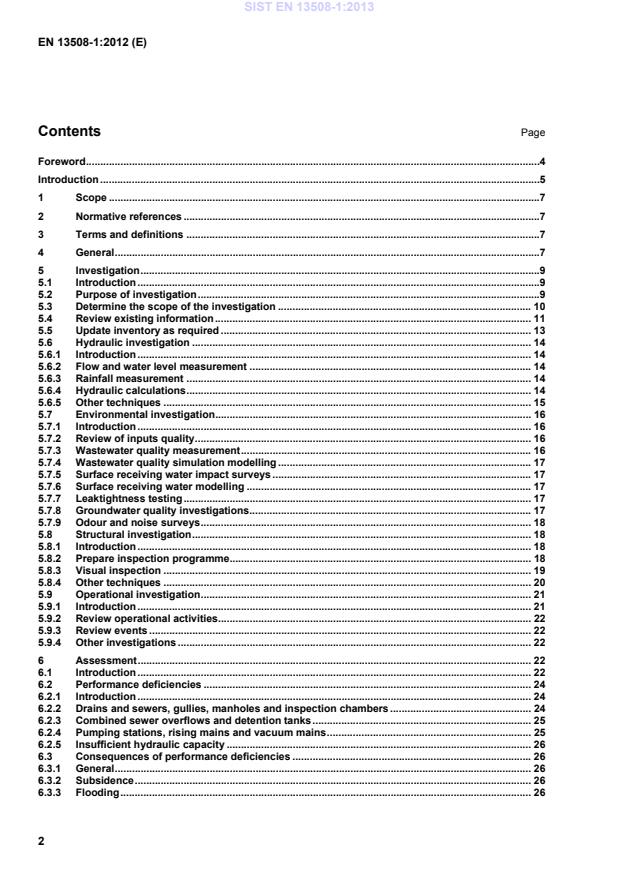
Sources of additional information . 28A.1 Austria . 28A.2 Denmark . 28A.3 Finland . 28A.4 France . 29A.5 Germany . 29A.6 Netherlands . 30A.7 Norway . 32A.8 Sweden . 32A.9 United Kingdom . 32Bibliography . 33 SIST EN 13508-1:2013
According to the CEN/CENELEC Internal Regulations, the national standards organisations of the following countries are bound to implement this European Standard: Austria, Belgium, Bulgaria, Croatia, Cyprus, Czech Republic, Denmark, Estonia, Finland, Former Yugoslav Republic of Macedonia, France, Germany, Greece, Hungary, Iceland, Ireland, Italy, Latvia, Lithuania, Luxembourg, Malta, Netherlands, Norway, Poland, Portugal, Romania, Slovakia, Slovenia, Spain, Sweden, Switzerland, Turkey and the United Kingdom. SIST EN 13508-1:2013
Introduction Drain and sewer systems are part of the overall wastewater system that provides a service to the community.
This can be briefly described as: removal of wastewater from premises for public health and hygienic reasons; prevention of flooding in urbanised areas; protection of the environment. The overall wastewater system has four successive functions: collection; transport;
treatment;
discharge. Drain and sewer systems provide for the collection and transport of wastewater.
Historically, drain and sewer systems were installed because there was a need to remove the polluted water to prevent diseases.
Traditionally, drain and sewer systems were constructed to collect and transport all types of wastewater together, irrespective of the initial source. This led to difficulties in handling the peak flows in times of heavy rainfall and to the introduction of combined sewer overflows, which discharged polluted water to surface receiving waters. Although many drain and sewer systems started out as combined systems there are arguments for considering the separation of foul wastewater and surface water. The pollutant effects are not the same and the separation of effluents allows for the different treatment for each element of wastewater, providing more environmentally friendly solutions.
This concept is included in the approach of integrated sewer system management. EN 752 provides a framework for the design, construction, rehabilitation, maintenance and operation of drain and sewer systems outside buildings. This is illustrated in the upper part of Figure 1. EN 752 is supported by more detailed standards for the investigation, design, construction, organisation and control of drain and sewer systems such as those listed in the lower part of the diagram.
This standard is one of a number of standards which support the general principles set out in EN 752. The relationship between these standards is illustrated in Figure 1.
Figure 1 — Relationship between EN 752 and other drain and sewer standards SIST EN 13508-1:2013
3 Terms and definitions For the purposes of this document, the following term and definition together with those given in EN 752:2008 apply. 3.1 resilience ability of a component or group of components to continue to perform or quickly recover from an endangering incident 4 General EN 752:2008, Clause 6, describes the process for integrated sewer system management. This process involves the integrated planning of the rehabilitation, maintenance and operation of existing drain and sewer systems.
This European Standard specifies general requirements for the investigation and assessment of aspects of the integrated sewer system management procedure (see Figure 2) to establish the condition of drain and sewer systems. This process can be applied to the development of the integrated sewer system management plan in accordance with EN 752:2008, Clause 6, as well as in the development of programmes of work and projects in accordance with EN 14654 (all parts).
Figure 2 — Integrated sewer system management process The investigation and assessment can be used in developing the integrated sewer system management plan which includes the new development plan, rehabilitation plan, operational plan and maintenance plan. It can also be used in the development of any programmes and projects to implement the integrated sewer system management plan (see EN 14654, all parts). The approach can also be applied at different levels of complexity across a sewer system. For example, it can be applied at a strategic level across a large catchment (e.g. a whole city) and then at a more detailed level in the major sub-catchments and also at the still more detailed level of individual components. The performance of the system can be measured in terms of the functional requirements of the system listed in EN 752:2008, 5.1 (for example protection from flooding, protection of surface receiving waters and maintaining the flow etc.). In some cases, it is only possible to determine the performance at one of the strategic or sub-catchment levels of detail (for example protection from flooding). In other cases, performance can be determined at the component level (for example maintaining the flow). The investigation and assessment of a drain and sewer system and its components is a necessary part of the process of the establishment of the condition and the performance of the system. The components can include: a) gravity drains, sewers and ancillary structures such as manholes, inspection chambers, combined sewer overflows, tanks and outfalls; b) pumping installation including rising mains, vacuum mains and associated control and monitoring equipment; c) gullies and associated structures such as grit separators, light liquid separators and grease separators. SIST EN 13508-1:2013
Investigation 5.1 Introduction The process of investigation of drain and sewer systems is outlined in EN 752:2008, 6.2. This process is summarised in Figure 3. This process involves the investigation of the hydraulic, environmental, structural and operational condition of the system. This should be in an integrated manner as the results from many of the investigations will cover more than one of these aspects.
The stages of the investigation are described in more detail in Figure 3.
Figure 3 — The process for investigation (based on EN 752:2008, Figure 6) 5.2 Purpose of investigation Prior to commencing the investigation, the purpose of the investigation should be established. The purpose of the investigation can include: a) an investigation to establish an overview of the condition and performance of a drain and sewer system in order to produce an integrated sewer system management plan in accordance with EN 752:2008, Clause 6;
b) a more detailed investigation in order to establish a programme of measures to implement the proposals in an integrated sewer system management plan in accordance with EN 14654 (all parts);
d) the investigation of a drain or sewer system following an incident in order to determine the maintenance requirements;
e) an investigation of the resilience of a drain or sewer system to various hazards or threats.
5.3 Determine the scope of the investigation The scope of the investigation should be determined, including: a) the geographical extent of the investigation; b) the level of detail at which the system is to be investigated (e.g. at strategic level of whole catchment, more detailed level of sub-catchment or detailed level of components); c) which components of the system are to be included in the investigation; d) which aspects of condition or performance are to be investigated for example: 1) protection from flooding (see EN 752:2008, 5.1.2); 2) maintainability (see EN 752:2008, 5.1.3); 3) protection of surface receiving waters (see EN 752:2008, 5.1.4);
4) protection of groundwater (see EN 752:2008, 5.1.5); 5) prevention of odours and toxic, explosive and corrosive gases (see EN 752:2008, 5.1.6); 6) prevention of noise and vibration (see EN 752:2008, 5.1.7); 7) sustainable use of products and materials (see EN 752:2008, 5.1.8); 8) sustainable use of energy (see EN 752:2008, 5.1.9); 9) structural integrity and design life (see EN 752:2008, 5.1.10); 10) maintaining the flow (see EN 752:2008, 5.1.11); 11) watertightness (see EN 752:2008, 5.1.12); 12) not endangering adjacent structures and utility services (see EN 752:2008, 5.1.13); 13) inputs quality (see EN 752:2008, 5.1.14). e) the extent to which each aspect of condition or performance is investigated; f) the interactions with other parts of drain and sewer systems;
g) the external influences on the system and its components (e.g. soil conditions, traffic loads); h) the interactions with other infrastructure (e.g. other utility services, urban environment); i) the resilience of the system.
Past performance can be established from existing records, including: i) records of flooding incidents;
ii) pipe blockage incidents;
iii) sewer collapse incidents;
iv) rising mains failures;
v) disease, injury or fatal incidents to operators;
vi) disease, injury or fatal incidents to members of the public;
vii) sewer damage incidents;
viii) compliance with discharge consents into and out of the system;
ix) closed circuit television (CCTV) survey and visual inspection data;
x) wastewater related odour complaint incidents;
xi) hydraulic performance analysis;
xii) performance of mechanical/electrical equipment;
xiii) results of monitoring, performance and condition of flow control structures;
xiv) sewer surcharge incidents; xv) groundwater contamination incidents.
Information about possible future changes in the systems should also include: new developments; other infrastructure works. The costs and benefits of collecting information and carrying out investigations should be considered, taking into account the known performance problems in the system and any requirements of the relevant authority. 5.4 Review existing information The collection and review of all available relevant information about the sewer system shall be carried out and is the basis from which all other investigations are subsequently planned. This information should include historical records. In addition to the performance information listed in 5.3, examples are: a) inventory, including the items listed in 5.5;
b) relevant permits and legal requirements;
c) previous operational, maintenance, structural and safety measures to overcome the problems and associated costs; SIST EN 13508-1:2013
e) previous inspections;
f) previous hydraulic measurements (flow, depth, velocity); g) results of previous hydraulic calculations or hydraulic models;
h) previous assessments of environmental impact;
i) existing drain and sewer condition data;
j) receiving water quality and use; k) groundwater levels and velocities; l) ground type and conditions including infiltration capacity;
m) groundwater protection zones;
n) previous test information; o) characterisation of wastewater;
p) information on proposed new development or redevelopment within the catchment area; q) records and forecasts of traffic volumes;
r) results of previous investigations. Some of this information can be available from as-constructed drawings.
This information should be assessed to determine what further information is required in order to carry out the investigation.
Before use, the quality of the information should be assessed taking into account whether it is: 1) complete; 2) compatible; 3) accurate; 4) at a suitable scale; 5) consistent; 6) current; 7) credible. Where there is insufficient information, the inventory should first be updated where required (see 5.5) and any other information should then be collected during the hydraulic investigation (see 5.6), environmental investigation (see 5.7), structural investigation (see 5.8), and operational investigation (see 5.9). SIST EN 13508-1:2013
The inventory information is used by all the other investigations. Where the review of existing information (see 5.4) concludes that the inventory is incomplete it shall be updated so that a sufficient record of the drain and sewer system is available to carry out the other investigations. After review and updating, the inventory of the system should contain the following information, for example: a) For each drain or sewer system: 1) the type of system (e.g. combined system or separate system); 2) whether the system is a gravity system, a pressure system or a vacuum system. b) For each drain or sewer pipe: 1) the location of the pipe; 2) the depth of cover and invert levels at the upstream and the downstream ends of the pipe; 3) the shape, size (e.g. diameter) and material. c) For each manhole or inspection chamber: 1) the cover level and invert levels; 2) the dimensions and materials; 3) the connecting pipes.
d) For each pumping station; 1) the number and the flow and discharge pressure characteristics of the pumps; 2) the dimensions of the wet well. e) For each other ancillary structure: 1) the dimensions of the structure; 2) the connecting pipes; 3) details of ancillary equipment (e.g. valves, flow controls). The survey method used should reflect the scale and level of the investigation and can include: i) physical surveys (e.g. to determine the dimensions of accessible pipes, chambers and other features); ii) terrestrial survey techniques (e.g. to determine the location and level of the features); iii) global positioning system (GPS) for the position and level of surface features; iv) light detection and ranging (Lidar) is a technique for the determination of the surface profile of the ground from aerial surveys. SIST EN 13508-1:2013
The investigation techniques include: a) flow and water level measurement; b) rainfall measurement;
c) hydraulic calculations; d) other techniques. 5.6.2 Flow and water level measurement Velocity and depth sensors can be used in drains and sewers to measure the flows. Long or short term flow measurements can be used to:
a) investigate the hydraulic characteristics of foul wastewater flows; b) investigate the extent and location of entry infiltration; c) investigate the extent and location of any other extraneous water e.g. flow through gaps in manhole tops (between the cover and frame) or wrong connections; d) in combination with rainfall measurement (see 5.6.3) to validate hydraulic calculations (see 5.6.4). The sensors used should be selected so that they are capable of achieving an acceptable accuracy over the full range of flow conditions expected. Measurement sites should be selected so that they avoid excessive turbulence or other factors which could lead to unacceptable measurement errors. Periodic checks should be carried out of the accuracy of the sensors.
5.6.3 Rainfall measurement
Rainfall measurement is commonly used in conjunction with flow measurement (see 5.6.2) to investigate the surface water and other rainfall related flows in the drains and sewers. The rainfall intensity should be measured at time intervals appropriate to the sewer flow simulation model being used.
Rainfall intensity across the catchment of a drain and sewer system can be measured using a network of recording raingauges which should be spaced sufficiently closely to measure the spatial variation in the rainfall. Where possible, use should be made of official meteorological recording stations. However, where these do not provide sufficient coverage, additional raingauges should be provided. Raingauges should be selected that are capable of accurately recording the expected rainfall intensities. The raingauge sites should be selected to minimise the effects of any local meteorological effects (e.g. local cross winds) that could adversely affect the accuracy of the measurements.
Alternatively temporary or permanent rainfall radar stations, calibrated from raingauge data, can be used to measure the rainfall intensity. The spatial resolution of the measurements will depend on the capabilities of the radar and the distance from the radar station.
5.6.4 Hydraulic calculations Hydraulic calculations should be carried out where: SIST EN 13508-1:2013
d) physical changes are proposed to the system.
Hydraulic calculations can be carried out at various levels of complexity from simple hand calculations to detailed mathematical models. The choice of method will depend on the scope of the investigation. In many cases it is not possible to understand the hydraulics of the system without using a mathematical model. The model should be based on an as-built report updated after onsite investigation of the main works.
A variety of sewer flow simulation models have been developed to assist in the investigation of drain and sewer systems. In all cases, the runoff process has been simplified.
Some models can also simulate surface flooding by one of two approaches: a simple 1-dimensional approach in which the flow is routed along a single predefined flow path; more complex 2-dimensional approaches in which the flow is routed across a surface which simulates the ground surface profile including any barriers (e.g. walls, embankments).
Calibration and/or validation of the models shall be carried out whenever sufficient information is available. The procedures used depend on the sewer flow simulation model used. If suitable agreement between the model and the measurements is not obtained, the model input data should be checked and then the sewer records. Having identified possible causes of error, it will often be necessary to confirm these by site inspection and then adjust the model accordingly. Data shall not be modified without justification based on an inspection of the system.
5.6.5 Other techniques
Other investigations can include: a) Infra-red inspections – Groundwater infiltration is typically at lower temperatures than the wastewater flow in the sewer. Infra-red inspection can be used to identify locations where parts of the flow are at a lower temperature than the main flow and therefore potentially identify locations where there is infiltration. b) Effluent dilution measurement – The extent of groundwater infiltration into the sewer system can also be determined by using sewer quality measurements (see 5.7.3) to estimate the dilution of effluent in dry weather flow.
c) Leaktightness testing (see 5.7.7) – Where infiltration is seasonal, depending on the groundwater level, the location of leaks during periods of low groundwater levels can identify locations where infiltration is likely to be found during higher groundwater periods. d) Visual inspection (see 5.8.3) – Infiltration that occurs above the level of the flow in the sewer can be observed from visual inspection of the sewer. However, visual inspection cannot establish conclusively whether the whole structure is leaktight unless the whole of the pipe wall is visible and there is a high groundwater level at the time of the inspection. Visual inspections can also be used to provide information to estimate the pipeline roughness including, for example, the extent of deposits in the pipeline, and any deviations in line or level. e) Testing for wrong connections – Smoke testing, sound testing, tracers and temperature measurements can be used to identify wrong connections.
The investigation can include: review of inputs quality; wastewater quality measurement;
wastewater quality simulation modelling;
surface receiving water impact surveys; leaktightness testing; groundwater quality investigations; odour and noise surveys.
The scale of the investigation should reflect the risk of environmental impact (see Clause 6) with regard to:
a) the possible sources of pollution (e.g. the presence of particularly toxic components in the wastewater, mechanical equipment that makes noise or a discharge from a long rising main that would be a source of septic sewage that might produce odours); b) the existence of pathways that might exist to transfer these (e.g. the presence of a combined sewer overflow, a damaged pipe, a permeable soil around the pipe, or a ventilated cover); and
c) the nature and use of the receptors that might be impacted (e.g. a receiving water that is used for abstraction of drinking water, an aquifer protection zone or houses near to a source of noise or odour). 5.7.2 Review of inputs quality The location of trade effluent sources and contaminated surface water sources shall be identified and the nature, quality, quantity and the potential environmental hazards reviewed to evaluate possible sources of pollution in the wastewater. Possible sources of information include: a) information in trade effluent permits;
b) results from trade effluent monitoring samples; c) results from other inputs sampling.
Where necessary, surveys shall be carried out to provide any data not available from records. 5.7.3 Wastewater quality measurement The concentrations of a variety of determinants contained in wastewater can be established. This is usually carried out by the collection and analysis of wastewater samples. Samples can be individual samples taken manually or an auto-sampler can be used to collect samples at predetermined intervals for later collection and analysis. A number of sensors are now available that can undertake continuous monitoring of some determinants without the need to collect and analyse samples. Where these are used, care should be taken to ensure that they are suitable for installation in a sewer environment.
Wastewater quality measurements can be used independently or they can be used to calibrate and/or validate wastewater quality simulations models (see 5.7.4).
5.7.4 Wastewater quality simulation modelling
Wastewater quality simulation models can be used to estimate the quality of any wastewater discharged into the environment (e.g. from surface water outfalls or combined sewer overflows).
Wastewater quality simulation models should be based on validated sewer flow simulation model of the system (see 5.6.4) and should be calibrated and validated by the use of measurements of wastewater quality (see 5.7.3), flow measurements and rainfall measurements (see 5.6.3). Different data sets should be used for calibration and validation.
5.7.5 Surface receiving water impact surveys The impact of sewer systems on receiving waters can be an aesthetic impact, or a bio-chemical/ecological impact. Surveys can be undertaken to quantify the aesthetic pollution, to measure the concentrations of various determinants (e.g. BOD, TSS or Ammonia) in the surface receiving waters. The possibility of other sources of any pollution should be considered. Surveys can sometimes identify whether the impact is due to the drain or sewer system. However, in some cases this can only be established by means of a surface receiving water impact model. 5.7.6 Surface receiving water modelling Models of the surface receiving water can be used to investigate the impact of any wastewater discharged into the environment (e.g. from surface water outfalls or combined sewer overflows). Surface receiving water impact models should be based on validated flow simulation model of the surface receiving water and should be calibrated and validated by the use of measurements of water quality (see 5.7.3), flow measurements (see 5.6.2) and rainfall measurements (see 5.6.3). Different data sets should be used for calibration and validation. 5.7.7 Leaktightness testing Investigations can be required to determine where leakage from drains and sewers is affecting groundwater quality, giving priority to drains or sewers which pass through aquifer protection zones or where they carry particularly hazardous substances.
The following test methods are available for leaktightness testing:
a) the pressure test with air; b) the pressure test with water; c) the vacuum test;
d) infiltration measurements.
Testing requirements and acceptance criteria for existing drains and sewers can be specified by the relevant authority. EN 1610 [1] gives test requirements for new pipelines including pressure tests with air and with water. These can also be used for existing pipelines with or without modification. 5.7.8 Groundwater quality investigations Measurements of groundwater quality can be used to identify the potential impact of the drain and sewer system on aquifers. The possibility of other sources of any pollution (e.g. surface spillage of chemicals) should SIST EN 13508-1:2013
Noise and/or vibration surveys can be undertaken to establish the source and impact of any noise or vibration that could be related to the sewer system.
5.8 Structural investigation 5.8.1 Introduction The aim of the structural investigation is to establish the structural integrity of the components of the drain or sewer system. This is usually undertaken by means of an inspection programme using visual inspection. This can be supplemented where appropriate by other more specialist techniques. These are illustrated in Figure 4.
5.8.2 Prepare inspection programme An inspection programme can involve the inspection of all components or a sample of components. The approach taken will depend on the purpose of the investigations (see 5.2). Sampling techniques can also be used to prioritise the inspection where the inspection of all components is being phased over an extended period. Where a sample of components is inspected, the objectives of the inspection programme can influence the sampling regime. The objectives of the inspection programme typically include the following: a) To obtain an overview of the condition of the whole system (e.g. the average proportion of pipes or manholes in poor condition). In this case the sample shall be selected so that it is representative of the whole system.
b) To identify locations where structural rehabilitation (renovation, repair or replacement) is necessary. In this case the sample would ideally be biased towards those parts of the system in poor condition.
c) Visual inspection of those parts of the system where the consequences of structural failure are highest.
d) Visual inspection carried out as part of the hydraulic, environmental or operational investigations. This can also influence the inspection programme.
The sampling approaches for one objective can be incompatible with the approach for another objective. Where there is a number of different objectives the sample selection needs to be considered carefully, for example, in some cases the use of a stratified sampling approach in which the system is divided into different groups of assets with similar attributes, called cohorts. Inspection of a representative sample of the assets in each cohort is then carried out. The proportion of assets inspected in each cohort can be varied to reflect the different objectives while maintaining a statistically representative sample. For structural investigation methods see Figure 4.
Figure 4 — Structural investigation methods 5.8.3 Visual inspection The condition of the system shall be observed and recorded as accurately and comprehensively as practicable. A uniform coding system complying with the requirements of EN 13508-2 shall be used to ensure that the results can be compared.
The observations recorded shall include all those that could affect the structural integrity of the system.
Exa
...