


oSIST prEN 1779:2025
(Main)Non-destructive testing - Leak testing - Criteria for method and technique selection
Non-destructive testing - Leak testing - Criteria for method and technique selection
This document specifies criteria for the selection of the most suitable method and technique for the assessment of leak tightness by indication or measurement of a gas leakage. Annex A, normative, allows a comparison of standard test methods. Leak detection using hydrostatic tests, electromagnetic methods is not included in this document.
This document is applicable to equipment which can be evacuated or pressurized.
Zerstörungsfreie Prüfung - Dichtheitsprüfung - Kriterien zur Auswahl eines Prüfverfahrens
Dieses Dokument legt die Kriterien für die Auswahl der geeignetsten Methoden und Verfahren zur Beurteilung der Dichtheit durch Anzeige oder Messung einer Gasleckage fest. Der normative Anhang A ermöglicht einen Vergleich der Standardprüfverfahren. Dichtheitsprüfungen mit hydrostatischen und elektromagnetischen Verfahren werden in diesem Dokument nicht behandelt.
Dieses Dokument gilt für Einrichtungen, die evakuiert oder unter Druck gesetzt werden können.
Essais non destructifs - Contrôle d’étanchéité - Critères de choix d’une méthode et d’une technique
technique d’évaluation de l’étanchéité par indication ou mesurage d’une fuite gazeuse. L’Annexe A, normative, permet de comparer des techniques de contrôle normalisées. Le contrôle de l’étanchéité par épreuve hydrostatique ou par des méthodes électromagnétiques ne figure pas dans ce document.
Le présent document s’applique aux équipements sous vide ou sous pression.
Neporušitveno preskave - Preskus tesnosti - Kriteriji za izbiro metode in postopka
General Information
- Status
- Not Published
- Public Enquiry End Date
- 30-Jan-2025
- Technical Committee
- PKG - Testing of metallic materials
- Current Stage
- 5020 - Formal vote (FV) (Adopted Project)
- Start Date
- 08-Jun-2026
- Due Date
- 27-Jul-2026

Relations
- Effective Date
- 22-Apr-2026
- Effective Date
- 20-Dec-2023
Overview
oSIST prEN 1779:2025: Non-destructive testing - Leak testing - Criteria for method and technique selection is a European standard developed by CEN/TC 138. It provides detailed guidance on selecting appropriate non-destructive leak detection methods and techniques, primarily focused on the indication or measurement of gas leakage. The standard excludes hydrostatic and electromagnetic testing methods and is applicable to equipment that can be either pressurized or evacuated. Practical for a broad range of industrial sectors, oSIST prEN 1779:2025 helps users select the most fitting leak testing solution based on the specifics of their component or system and operational requirements.
Key Topics
Leak Testing Methods
The standard outlines various non-destructive leak testing methods, including those using tracer gases (such as helium or ammonia) and bubble techniques. It also covers pressure decay and pressure rise methods, vacuum box testing, and sniffing techniques with gas detectors. Ultrasonic and thermographic techniques are referenced as supplementary options.Criteria for Selection
Key considerations for leak test method and technique selection include:- The required range of detectable leakage rates
- Whether the need is total leakage measurement, localization of leaks, or both
- Design, size, and accessibility of the test object
- Operating conditions, including pressure, temperature, and type of gas
- Safety, environmental, and material compatibility
Influence of Operational Conditions
oSIST prEN 1779:2025 explains how factors such as pressure, temperature, and the nature of test gas influence leakage measurement. The standard stresses the importance of aligning test conditions as closely as possible with actual operating conditions to ensure reliable results.Personnel Qualification
The standard recommends that operators performing leak testing be qualified according to EN ISO 9712:2022, ensuring competence and consistency in test execution.Tightness Requirements
Leak tightness is defined and measured as the gas flow rate through defects under specific conditions, typically reported in pascal cubic metre per second (Pa·m³/s). Guidance is provided for calculating and specifying leak tightness based on system function and operating environment.
Applications
oSIST prEN 1779:2025 is relevant wherever non-destructive leak testing of gas-tight components is required, including:
Manufacturing and Maintenance
- Pressure vessels, piping, tanks, and HVAC systems
- Medical devices such as cardiac pacemakers
- Gas cylinders and containers
- Electronics enclosures and assemblies
Plant Operations and Quality Control
- Ensuring product safety by confirming leak tightness
- Verifying integrity of assembled systems before commissioning
- Detecting and locating faults during maintenance or in-service inspections
Aerospace, Automotive, and Energy Sectors
- Testing of pressurised and evacuated components critical for safety
- Ensuring compliance with legal, contractual, or industry-specific leakage requirements
Related Standards
EN ISO 20484:2017: Non-destructive testing - Leak testing - Vocabulary
Provides the foundational terminology for leak testing.EN ISO 9712:2022: Non-destructive testing - Qualification and certification of NDT personnel
Specifies qualification requirements for non-destructive testing personnel.EN ISO 20485: Leak testing methods using tracer gas techniques
Details tracer gas methods referenced in oSIST prEN 1779:2025.EN 1593: Leak testing - Bubble emission techniques
Addresses specific bubble-based inspection techniques.
These standards complement oSIST prEN 1779:2025, offering additional technical detail and supporting best practices for non-destructive leak testing.
Keywords: non-destructive testing, leak testing, leak tightness, tracer gas, leak detection, gas leakage, pressure testing, industrial testing standards, CEN, oSIST prEN 1779:2025, equipment leak assessment, method selection criteria
Get Certified
Connect with accredited certification bodies for this standard

IMP NDT d.o.o.
Non-destructive testing services. Radiography, ultrasonic, magnetic particle, penetrant, visual inspection.
Inštitut za kovinske materiale in tehnologije
Institute of Metals and Technology. Materials testing, metallurgical analysis, NDT.
Q Techna d.o.o.
NDT and quality assurance specialist. 30+ years experience. NDT personnel certification per ISO 9712, nuclear and thermal power plant inspections, QA/
Sponsored listings
Frequently Asked Questions
oSIST prEN 1779:2025 is a draft published by the Slovenian Institute for Standardization (SIST). Its full title is "Non-destructive testing - Leak testing - Criteria for method and technique selection". This standard covers: This document specifies criteria for the selection of the most suitable method and technique for the assessment of leak tightness by indication or measurement of a gas leakage. Annex A, normative, allows a comparison of standard test methods. Leak detection using hydrostatic tests, electromagnetic methods is not included in this document. This document is applicable to equipment which can be evacuated or pressurized.
This document specifies criteria for the selection of the most suitable method and technique for the assessment of leak tightness by indication or measurement of a gas leakage. Annex A, normative, allows a comparison of standard test methods. Leak detection using hydrostatic tests, electromagnetic methods is not included in this document. This document is applicable to equipment which can be evacuated or pressurized.
oSIST prEN 1779:2025 is classified under the following ICS (International Classification for Standards) categories: 19.100 - Non-destructive testing. The ICS classification helps identify the subject area and facilitates finding related standards.
oSIST prEN 1779:2025 has the following relationships with other standards: It is inter standard links to SIST EN 1779:2000/A1:2004, SIST EN 1779:2000. Understanding these relationships helps ensure you are using the most current and applicable version of the standard.
oSIST prEN 1779:2025 is available in PDF format for immediate download after purchase. The document can be added to your cart and obtained through the secure checkout process. Digital delivery ensures instant access to the complete standard document.
Standards Content (Sample)
SLOVENSKI STANDARD
01-januar-2025
Neporušitveno preskušanje - Preskus tesnosti - Kriteriji za izbiro metode in
postopka
Non-destructive testing - Leak testing - Criteria for method and technique selection
Zerstörungsfreie Prüfung - Dichtheitsprüfung - Kriterien zur Auswahl eines
Prüfverfahrens
Essais non destructifs - Contrôle d’étanchéité - Critères de choix d’une méthode et d’une
technique
Ta slovenski standard je istoveten z: prEN 1779
ICS:
19.100 Neporušitveno preskušanje Non-destructive testing
2003-01.Slovenski inštitut za standardizacijo. Razmnoževanje celote ali delov tega standarda ni dovoljeno.
DRAFT
EUROPEAN STANDARD
prEN 1779
NORME EUROPÉENNE
EUROPÄISCHE NORM
November 2024
ICS 19.100 Will supersede EN 1779:1999
English Version
Non-destructive testing - Leak testing - Criteria for method
and technique selection
Essais non destructifs - Contrôles d'étanchéité - Zerstörungsfreie Prüfung - Dichtheitsprüfung -
Critères de choix de la méthode et de la technique Kriterien zur Auswahl eines Prüfverfahrens
This draft European Standard is submitted to CEN members for enquiry. It has been drawn up by the Technical Committee
CEN/TC 138.
If this draft becomes a European Standard, CEN members are bound to comply with the CEN/CENELEC Internal Regulations
which stipulate the conditions for giving this European Standard the status of a national standard without any alteration.
This draft European Standard was established by CEN in three official versions (English, French, German). A version in any other
language made by translation under the responsibility of a CEN member into its own language and notified to the CEN-CENELEC
Management Centre has the same status as the official versions.
CEN members are the national standards bodies of Austria, Belgium, Bulgaria, Croatia, Cyprus, Czech Republic, Denmark, Estonia,
Finland, France, Germany, Greece, Hungary, Iceland, Ireland, Italy, Latvia, Lithuania, Luxembourg, Malta, Netherlands, Norway,
Poland, Portugal, Republic of North Macedonia, Romania, Serbia, Slovakia, Slovenia, Spain, Sweden, Switzerland, Türkiye and
United Kingdom.
Recipients of this draft are invited to submit, with their comments, notification of any relevant patent rights of which they are
aware and to provide supporting documentation.
Warning : This document is not a European Standard. It is distributed for review and comments. It is subject to change without
notice and shall not be referred to as a European Standard.
EUROPEAN COMMITTEE FOR STANDARDIZATION
COMITÉ EUROPÉEN DE NORMALISATION
EUROPÄISCHES KOMITEE FÜR NORMUNG
CEN-CENELEC Management Centre: Rue de la Science 23, B-1040 Brussels
© 2024 CEN All rights of exploitation in any form and by any means reserved Ref. No. prEN 1779:2024 E
worldwide for CEN national Members.
prEN 1779:2024 (E)
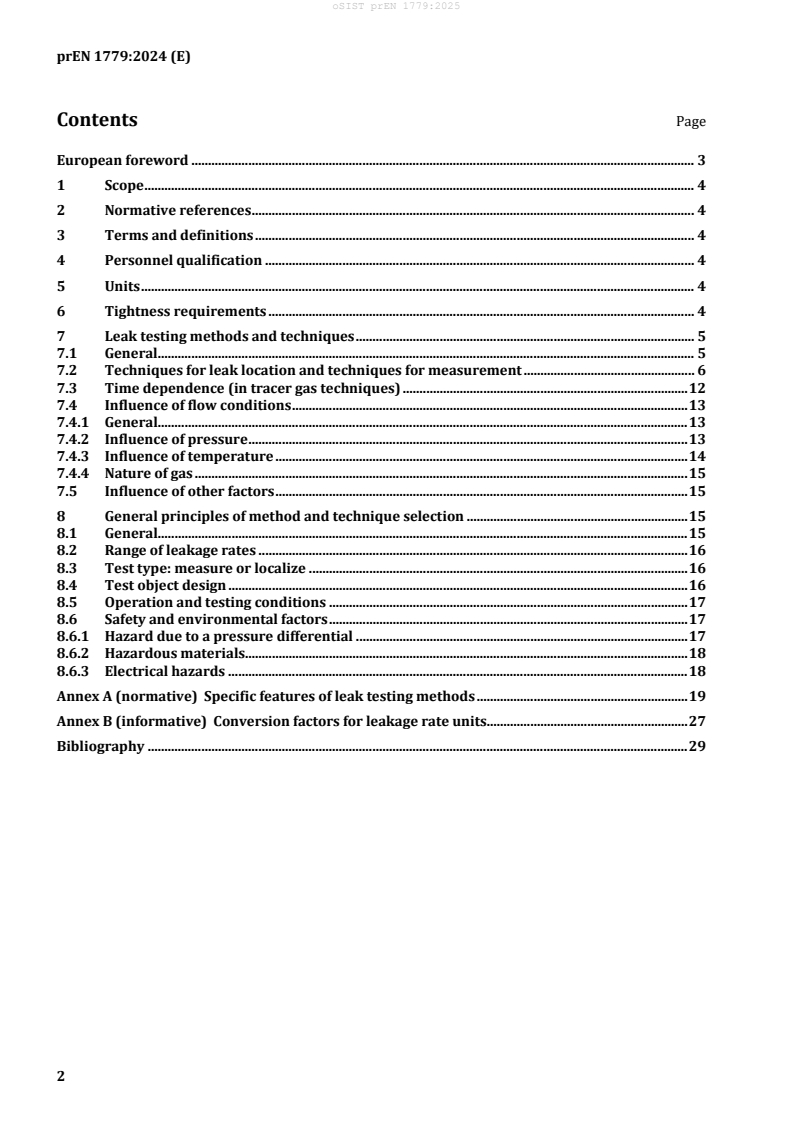
Contents Page
European foreword . 3
1 Scope . 4
2 Normative references . 4
3 Terms and definitions . 4
4 Personnel qualification . 4
5 Units . 4
6 Tightness requirements . 4
7 Leak testing methods and techniques . 5
7.1 General. 5
7.2 Techniques for leak location and techniques for measurement . 6
7.3 Time dependence (in tracer gas techniques) . 12
7.4 Influence of flow conditions . 13
7.4.1 General. 13
7.4.2 Influence of pressure . 13
7.4.3 Influence of temperature . 14
7.4.4 Nature of gas . 15
7.5 Influence of other factors . 15
8 General principles of method and technique selection . 15
8.1 General. 15
8.2 Range of leakage rates . 16
8.3 Test type: measure or localize . 16
8.4 Test object design . 16
8.5 Operation and testing conditions . 17
8.6 Safety and environmental factors . 17
8.6.1 Hazard due to a pressure differential . 17
8.6.2 Hazardous materials. 18
8.6.3 Electrical hazards . 18
Annex A (normative) Specific features of leak testing methods . 19
Annex B (informative) Conversion factors for leakage rate units. 27
Bibliography . 29
prEN 1779:2024 (E)
European foreword
This document (prEN 1779:2024) has been prepared by Technical Committee CEN/TC 138 “Non-
destructive testing”, the secretariat of which is held by DIN (Germany).
This document is currently submitted to the CEN Enquiry.
This document will supersede EN 1779:1999.
prEN 1779:2024 includes the following significant technical changes with respect to EN 1779:1999:
a) update of the normative references;
b) Table 2 updated and figures added;
c) 8.1 added.
prEN 1779:2024 (E)
1 Scope
This document specifies criteria for the selection of the most suitable method and technique for the
assessment of leak tightness by indication or measurement of a gas leakage. Annex A, normative, allows
a comparison of standard test methods. Leak detection using hydrostatic tests, electromagnetic methods
is not included in this document.
This document can be used for equipment which can be evacuated or pressurized.
2 Normative references
The following documents are referred to in the text in such a way that some or all of their content
constitutes requirements of this document. For dated references, only the edition cited applies. For
undated references, the latest edition of the referenced document (including any amendments) applies.
EN ISO 20484:2017, Non-destructive testing — Leak testing — Vocabulary (ISO 20484:2017)
3 Terms and definitions
For the purposes of this document, the terms and definitions given in EN ISO 20484:2017, and the
following apply.
ISO and IEC maintain terminological databases for use in standardization at the following addresses:
• IEC Electropedia: available at https://www.electropedia.org/
• ISO Online browsing platform: available at https://www.iso.org/obp
4 Personnel qualification
It is assumed that leak testing is performed by qualified and capable personnel. In order to prove this
qualification, it is recommended to certify the personnel in accordance with EN ISO 9712:2022.
5 Units
The leakage rate is defined as the pV-throughput of a specific fluid which passes through a leak under
specific conditions and is expressed in pascal cubic metre per second.
In the past, the leakage rate was expressed in various units, these are given in informative Annex B,
Table B.1.
6 Tightness requirements
The leak tightness of an object is usually determined by measurement of its gas leakage rate.
Leak tightness is commonly described as the flow rate of fluid into or from the test object. For a gas, leak
tightness may be conveniently indicated by the variation of pressure with time under specified
conditions.
For testing, however, i.e. when drafting specifications and procedures, the leak tightness shall be
expressed as leakage rate in units of gas throughput (Pa·m /s) for a specific gas at specified temperature
and at specified pressure conditions.
Zero leakage rate shall not be specified. The required leak tightness shall be related to the function of the
object under consideration.
prEN 1779:2024 (E)
−4 3
EXAMPLE 1 Leakage rates in the order of 5 × 10 Pa·m /s are acceptable for compressed air cylinders. This
corresponds to a pressure variation of 5000 Pa in a 10 l volume in 24 h or 0,5 l loss measured at atmospheric
pressure.
−10 3 3
EXAMPLE 2 A leakage rate of 10 Pa·m /s is typical for cardiac pacemakers. This corresponds to a loss of 1 cm
every 30 years approximately.
The total tightness of a system can be considered in terms of tightness for all components of that system.
To meet requirements the sum of the leakage rates for each component plus the sum of the leakage rates
at each connecting point shall be less than the overall allowable leakage rate of the system.
The tightness of component or system shall be specified under normal operating conditions.
NOTE 1 The most significant influence on tightness is given by the nature and pressure of the gas, and by the
operating temperature.
The suitability of the system for a given task is indicated by the functional tightness.
NOTE 2 To take into account factors that are unquantifiable, it might be advisable to adopt leak tightness values
lower than this by a factor from three to ten.
7 Leak testing methods and techniques
7.1 General
The leak tightness of an object is usually determined by measurement of its gas leakage rate.
Leak tightness is commonly described as the flow rate of fluid into or from the test object. For a gas, leak
tightness may be conveniently indicated by the variation of pressure with time under specified
conditions.
The actual gas flow through the leaks of the test object, which has been determined in a leak test, shall be
converted to the leakage rate with that under operating conditions.
The following considerations shall be applied to all methods by which leakage rates are determined. A
review of the methods and techniques is given in Table 1.
prEN 1779:2024 (E)
Table 1 — Leak testing — Overview of methods and techniques
Flow Extent of
Applicability Techniques
direction test
Location B.1, B.2.2, B.4, C.3
Local
area
Measurement B.2.1, B.3, D.3
Gas flow
out of
object
Location C.1, C.2
Total
area
B.3, B.5, B.6, B.7, C.1,
Measurement
D.1, D.3, D.4
Location A.3
Local
area
Measurement A.2, D.3
Gas flow
into object
Location
Total
area
Measurement A.1, D.2, D.3, D.4
Application of Table 1:
1) Choose the appropriate flow direction for test.
2) Define the extent of the investigation: total or local area.
3) Define the aim of test: location or measurement.
4) Choose the appropriate method (A to D, from the normative
Annex A).
5) Check any practical difficulties associated with the test.
NOTE Some techniques used for location can also give an estimate
of the leakage size, but they are not allowed to demonstrate the
compliance with the specifications.
7.2 Techniques for leak location and techniques for measurement
It is usually not possible to establish in one step the total leakage of a component (or a system) and the
location of the leaks. Two techniques shall, therefore, be considered: measurement of the overall leakage
rate or location of leaks for possible elimination.
Examples of total (or integral) techniques include the measurement of the pressure variation with time
within the object and the accumulation of gas escaping from the object over a period of time.
One technique for leak location involves probing the object with a suitable tracer gas or sniffing the
surface of an object filled with tracer gas.
In the selection of an appropriate technique for leak assessment, the conditions of the test (pressure,
vacuum, type of gas, etc.) should be carefully considered. Some guidance is given in Clause 8.
prEN 1779:2024 (E)
Table 2 — Overview of methods and techniques
Techniques Principle Diagram
The object (1)
is evacuated
and
connected to
the detector
(3); the object
is placed in a
A.1 Vacuum (total)
chamber (4)
containing
the tracer gas
(2) or
completely
immersed in
tracer gas
The object (1)
is evacuated
and
connected to
the detector
(3); the
Vacuum
A.2 suspect areas
(partial)
are covered
by a suitable,
gas-tight
enclosure
filled with
tracer gas (2)
The object (1)
is evacuated
and
connected to
the detector
A.3 Vacuum (local) (3); the
suspect
points are
sprayed (4)
with the
tracer gas (2)
The object (1)
is previously
evacuated
and then
Chemical
filled with
B.1 detection by
NH gas (2);
ammonia
the points to
be checked
are covered
by paint or a
prEN 1779:2024 (E)
Techniques Principle Diagram
strip which
chemically
reacts with
ammonia and
changes
colour (3)
The
component
(1) is filled
with tracer
gas (2); a
Vacuum box vacuum box
with internal (4) is applied
B.2.1
tracer gas to outer
pressure surface,
evacuated
and
connected to
the detector
(3)
A vacuum box
(4),
connected to
a detector (3),
is applied to
Vacuum box by
one surface of
B.2.2 spray gun on
the object (1)
opposite side
and the other
wall side is
sprayed (5)
with the
tracer gas (2)
The object (1)
is pressurized
Pressure with tracer
B.3 increase by gas (2) and
accumulation then placed in
a chamber
(4):
prEN 1779:2024 (E)
Techniques Principle Diagram
or the areas
to be tested
are covered
with gas tight
bags (4):
Tracer gas(2)
will flow
through leaks
into the
external
volume (4),
causing a
concentration
increase: this
is measured
with a tracer
gas detector
(3), after an
accumulation
period
The object (1)
is pressurized
with tracer
gas (2). The
gas escaping
B.4 Sniffing through the
leaks is
detected
using a
sampling
probe (4)
Step 1:
The object (1)
Sealed objects
is placed in a
by
chamber (3)
B.5 Pressurization-
and
evacuation
pressurized
(bombing)
with tracer
gas (2)
prEN 1779:2024 (E)
Techniques Principle Diagram
Step 2:
After the
“bombing”
period, the
object (1) is
placed in a
vacuum
chamber (3)
connected to
a detector (2)
The sealed
object (1),
filled with
tracer gas, is
placed in a
chamber (3).
The chamber
is evacuated
Sealed objects to a pressure
B.6 with external lower than
vacuum the object
internal
pressure and
the tracer gas
flowing
through the
leak into the
chamber is
measured (2).
The object,
pressurized
with tracer
gas, is
surrounded
by a hood in
which a
B.7 Carrier gas carrier gas
flows. Tracer
gas escaping
from leaks is
detected at
the exhaust of
the carrier
gas line.
prEN 1779:2024 (E)
Techniques Principle Diagram
The
pressurized
Bubble test by
C.1 object is
immersion
completely
submerged
The outer
surface of the
object is
covered with
a suitable
Bubble test by surfactant.
C.2 liquid The pressure
application within the
object is
increased: the
leakages are
shown by a
growing foam
The outer
Bubble test
surface of the
C.3 with vacuum
object is
box
covered with
The test
object is
pressurized
and sealed.
The reduction
of the total
D.1 Pressure decay
pressure
value, over a
specified
period of
time, is
measured
prEN 1779:2024 (E)
Techniques Principle Diagram
The test
object is
evacuated
and sealed.
The increase
of the total
D.2 Pressure rise
pressure
value, over a
specified
period of
time, is
measured.
The test
object is
pressurized
or evacuated
and the area
to be tested is
enclosed in a
rigid
(bell) Pressure chamber.
D.3
measured as
change
a pressure
change in the
chamber Any
leakage is
measured as
a pressure
change in the
chamber
A pressure
difference is
generated
across the
object
Flow measure- boundary.
D.4
ment The gas flow,
necessary to
hold constant
the pressure
difference, is
measured.
Additionally, ultrasonic and thermographic tools are applicable for leak detection.
7.3 Time dependence (in tracer gas techniques)
The measuring device shall be placed on the opposite side of the boundary to that probed with tracer gas.
The tracer gas can be detected only when it has crossed the boundary. Time shall be allowed, therefore,
for stabilization. The time taken by the gas to cross the boundary depends on the nature of gas, the
prEN 1779:2024 (E)
pressure difference and the geometry of the leak path. It also depends on the temperature, the cleanliness
of the object, etc.
NOTE Small leaks can require a long stabilization time. If the flow through the leak is impeded by successive
obstacles, such as multiple seals or double weld beads, the test time can be very long.
7.4 Influence of flow conditions
7.4.1 General
The usual laws governing gas flow shall be used to calculate variation in leakage rate, as a function of
pressure, temperature, and type of gas.
NOTE In quantitative leak detection two different flow regimes are normally considered. These are the regimes
of viscous laminar or molecular flow.
The boundaries between these regimes are not precisely defined. Care shall be taken therefore in the
selection of any of the formulas given in 7.4.2, 7.4.3 and 7.4.4.
For practical purposes it is generally accepted that for helium leakage rates less than or equal
−7 3
Pa·m /s, conditions for molecular flow apply. For helium leakage rates greater than
−5 3
10 Pa·m /s, conditions for viscous laminar flow apply in the case of a single capillary leak.
For the different flow regimes, the dependence of leakage rate on pressure, temperature and type of gas
is different.
7.4.2 Influence of pressure
For a given leak, the dimensions of which are unchanged by the applied pressure, the following formulae
shall be used to take into account the effect of pressure change on flow rate. See Figure 1 for illustration:
Molecular flow:
p
q = q (1)
2 1
p
with pressure differences:
pp− p (2)
2 BA
2 2
pp− p (3)
1 BA
1 1
Viscous laminar flow:
()pp−
BA pp
2 2 22
q q q (4)
2 1 1
∆p
()pp−
1 p
BA
1 1
with pressure averages:
p + p
BA
p = (5)
p + p
BA
p = (6)
==
=
=
prEN 1779:2024 (E)
where
are different downstream pressures in pascals;
p , p
A A
1 2
are different upstream pressures in pascals;
p , p
B B
1 2
are the leakage rates in Pa·m /s associated with
q , q
1 2
the two pressure differences.
Figure 1 — Leak
7.4.3 Influence of temperature
For a given leak, the dimensions of which are not altered by the temperature change, the following
formulae shall be used to take into account the effect of temperature on flow rate:
Molecular flow
T
= × (7)
q q
T T
T
Viscous laminar flow
η
T
= × (8)
q q
T T
η
T
or approximately
T
= × (9)
q q
T T
T
where
prEN 1779:2024 (E)
are the different temperatures, in Kelvins;
T , T
1 2
are the leakage rates in Pa·m /s associated with
,
q q
T T
1 2
T and T ;
1 2
are the different dynamic viscosities in Pa.s
,
η η
T T
1 2
associated with T and T
1 2.
7.4.4 Nature of gas
For a given leak, the leakage rate for two different gases is given by the following formulae:
Molecular flow
M
G
= × (10)
q q
GG
M
G
Viscous laminar flow
η
G
= × (11)
q q
GG
η
G
where
are the leakage rates in Pa·m /s associated with
,
q q
G G
1 2
gases G and G ;
1 2
, are the molar masses, in kilogram per mole of the
M M
G G
1 2
gases G and G ;
1 2
are the dynamic viscosities in Pa·s associated
,
η η
G G
1 2
with gases G and G
1 2.
7.5 Influe
...