

SIST EN 12896-1:2026
(Main)Public transport - Reference data model - Part 1: Common concepts
- Abstract
This document incorporates data structures used by all other data domains of Transmodel. It is composed of the following data packages:
- versions and validity;
- responsibility;
- generic framework;
- reusable components;
- explicit frames referring to generic data.
The data structures represented in this part are either generic patterns that can be explicitly reused in other domains (e.g., a generic model for version frames, a generic grouping mechanism, etc.) or are referenced by different other parts (e.g., service calendar model).
This document itself is composed of the following parts:
- main document representing the data model for the concepts shared by the different domains covered by Transmodel (normative);
- Annex A containing the data dictionary and attribute tables, i.e., the list of all the concepts present in the main document, together with their definitions (normative);
- Annex B, indicating the data model evolutions (informative),
- Annex C, presenting the Transmodel development history (informative),
- Annex D, describing all conventions, methodology and notations for conceptual modelling (informative),
- Annex E, providing a clear overview to help readers understand the core principles, structure, and purpose of Transmodel (informative),
- Annex F, providing information on the Functional domains and Modes of operation (informative).
- Annex G, providing details of the significant technical changes between this document and EN 12896-1:2015 (informative).
- Status
- Published
- Public Enquiry End Date
- 15-Feb-2026
- Publication Date
- 13-Sep-2026
- Technical Committee
- ITC - Information technology
- Current Stage
- 6060 - National Implementation/Publication (Adopted Project)
- Start Date
- 13-Aug-2026
- Due Date
- 18-Oct-2026
- Completion Date
- 14-Sep-2026

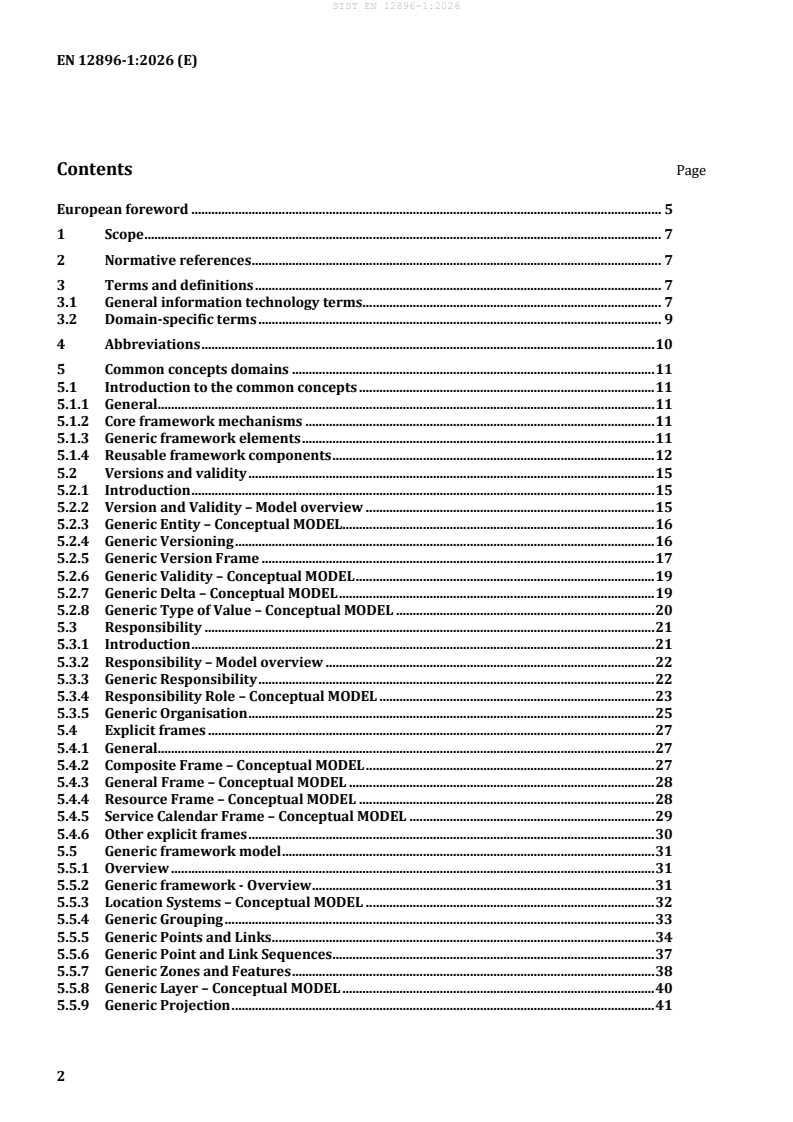
SIST EN 12896-1:2026 is the Slovenian edition of EN 12896-1:2026 published by SIST and CEN. It defines the common concepts of Transmodel, the European reference data model for public transport, and sets out the data structures reused across the other Transmodel data domains. It is intended for public transport organisations, authorities, operators, and software suppliers that need a shared conceptual model for data, interfaces, and databases.
What does SIST EN 12896-1:2026 specify?
SIST EN 12896-1:2026 specifies the shared Transmodel concepts that other public transport data domains build on. Its scope is the common data foundation: versioning and validity, responsibility, the generic framework, reusable components, and explicit frames that refer to generic data.
The document is organized as a normative main body plus annexes that explain, define, and contextualize the model. Clause 5 covers the common concepts domains, and Clause 6 covers reusable components.
| Part | What it covers |
|---|---|
| Main document | Normative data model for concepts shared by the different Transmodel domains |
| Annex A | Normative data dictionary and attribute tables for the concepts in the main document |
| Annex B | Informative data model evolutions |
| Annex C | Informative Transmodel development history |
| Annex D | Informative conventions, methodology, and notations for conceptual modelling |
| Annex E | Informative overview of the core principles, structure, and purpose of Transmodel |
| Annex F | Informative Functional domains and Modes of operation |
| Annex G | Informative significant technical changes between this document and EN 12896-1:2015 |
The scope is deliberately generic. The model provides patterns that can be reused explicitly in later parts, such as version frames and grouping mechanisms, and it also includes structures that other parts reference directly, such as the service calendar model.
What are the key requirements of SIST EN 12896-1:2026?
SIST EN 12896-1:2026 is not a product specification; it is a conceptual model that tells users how to structure shared public transport data. The main practical value is consistency: different systems can describe the same things in the same way.
Versioning and validity
Clause 5.2 defines generic entity, generic versioning, generic version frame, generic validity, generic delta, and generic type of value. In practice, this gives a way to track what changed, when it applies, and which version of an object a system is using.
That matters when timetable data, fleet data, or organisational data changes over time. A modeler can keep older and current values distinct instead of overwriting them or mixing time-dependent information.
Responsibility and organisation
Clause 5.3 covers generic responsibility, responsibility role, and generic organisation, including contact details. It provides a common way to record who is responsible for a dataset, a frame, or an action.
In practice, this helps when data is shared across operators, authorities, or departments. It makes accountability and contact routing part of the model rather than an informal note outside it.
Explicit frames
Clause 5.4 defines composite frame, general frame, resource frame, service calendar frame, and other explicit frames. These frames package related concepts into named structures.
That matters for exchange and implementation because systems can send or process one frame type at a time. It helps keep exchanges focused on the data needed for a specific purpose, such as resources or service calendars.
Generic framework model
Clause 5.5 is the shared structural layer of the standard. It includes grouping, points and links, point and link sequences, zones and features, layers, projections, place, path and navigation, assignment, loggable object, event, security list, accessibility, alternative text, and views.
In practice, this is the base for describing locations, networks, paths, map-like structures, access rules, and logged events in a consistent way. Later Transmodel parts can reuse these patterns instead of defining their own versions.
Reusable components
Clause 6 defines reusable components that can be used in any Transmodel functional package. The document groups them into modes, place and organisation, time elements, vehicle types, vehicles and fleets, equipment, message handling, and general elements.
This matters because common ideas such as transport mode, service calendar, vehicle type, fleet, notice, service restriction, booking arrangements, and schematic map are modeled once and then reused. That reduces duplication and makes interfaces easier to align across functions.
Time-related models
Clause 6.4 states that the reusable time element models describe temporal components for PT conceptual models. The Service Calendar model qualifies DAY TYPEs, OPERATING DAYs, and SERVICE CALENDARs; the Availability Condition model defines standardized validity conditions; and the Transfer Times model specifies transfer times between services.
This is important when systems have to calculate operating days, publish service calendars, or set transfer rules. It gives a shared way to express time-dependent service behavior.
Vehicle, equipment, and message content
Clauses 6.5 to 6.8 cover vehicle types, vehicles and fleets, equipment, the reusable message model, and publication scope. The document also includes deck plan, seating plan, seat affinity, deck path, and several equipment models.
In practice, this allows one model to describe vehicle configuration, onboard facilities, messages, and publication boundaries. That is useful for fleet management, passenger-facing information, and interface design.
Modelling rules and dictionary support
Annex A provides the data dictionary and attribute tables, while Annex D explains the conventions and UML-based notation used in the EN 12896 series. These annexes matter because they tell readers how to interpret the concepts and diagrams consistently.
What terms does SIST EN 12896-1:2026 define?
- Conceptual data model - A description of a real-world domain in terms of entities, relationships, and attributes in an implementation-independent way.
- Data domain - A data structure made up of related data used together by a functional area.
- Interoperability - The ability of subsystems to interact according to predefined interface rules.
- Public Transport (PT) - The transport field covered by the standard and its Transmodel data structures.
- Fare management - All activities related to collecting money from passengers.
- Operations monitoring and control / real-time control - Real-time activities for driving, monitoring, and controlling transport operations, including support actions such as traffic light priority and delay advice.
- Automatic Vehicle Monitoring (AVM) - Computer-aided support often used for operations monitoring and control.
- Tactical planning / scheduling - Activities for vehicle scheduling, driver scheduling, and rostering.
Who uses SIST EN 12896-1:2026?
SIST EN 12896-1:2026 is used by organisations that need a common data language for public transport information systems. It is especially relevant when one party specifies the data model and another builds or operates the system.
Typical users include:
- public transport organisations that specify, acquire, and operate information systems
- public authorities and transport operators that need interoperable data structures
- software suppliers, system designers, and developers working on public transport products
- teams defining databases, interfaces, and modular system architectures
- organisations working on network and stop description, scheduling, real-time information, fare management, passenger information, personnel management, management information, multi-model operations, multiple operator environments, and fleets and equipment
In practice, users apply it to decide which Transmodel concepts they adopt, which they do not adopt, and how to describe those choices in a specification or tender.
What changed in SIST EN 12896-1:2026 from the previous edition?
SIST EN 12896-1:2026 replaces SIST EN 12896-1:2017. The European edition supersedes EN 12896-1:2016, and Annex G gives the significant technical changes between this document and EN 12896-1:2015.
The document states that the new edition consolidates and extends several core models, including:
- Generic Type of Value
- Generic Section
- Generic Layer
- Generic Place
- Generic Path & Navigation
- Generic Assignment
- Generic Loggable Object
- Generic Event
- Generic Security List
- View
- Alternative Text
- Role models
- Reusable Message
- Publication Scope
- Check Constraint
- Transport Mode of Operation
- Fleet
- Fleet Equipment
- Transport Organisation
- Additional Organisations
- Employee
It also notes further functional changes, including new functional models and extensions to version frames.
Which standards are used with SIST EN 12896-1:2026?
The document refers to several Transmodel-derived standards and related specifications that use the same conceptual basis:
- SIRI - Service Interface for Real-time Information, used for real-time public transport information exchange.
- IFOPT - Identification of Fixed Objects in Public Transport, referenced as a related Transmodel-based standard and as the former home of Check Constraint.
- NeTEx - Network and Timetable Exchange, used for network and timetable data exchange.
- OJP - Open Journey Planner, used for journey-planning exchanges.
- OpRa - Operating Raw Data and statistics exchange, used for operational raw data and statistics.
Annex E also frames Transmodel as the common basis from which these implementations are derived.
What does the SIST EN 12896-1:2026 document contain?
SIST EN 12896-1:2026 contains a conceptual data model, not a physical database design. Its content is mainly class diagrams, model overviews, data dictionary entries, and attribute tables.
It also includes:
- examples of RESPONSIBILITY SETs
- model overviews for versioning, responsibility, explicit frames, and the generic framework
- views for deck plan spatial coordinates, associating a deck plan with a vehicle type, and onboard facilities
- schematic map models for a network, an interchange, and an onboard seating layout
- modelling conventions, methodology, and notation rules in Annex D
- development history and technical change summaries in Annexes C and G
For implementers, this means the document is useful as a design reference for data models, interfaces, specifications, and modular system architecture.
Relations
- Effective Date
- 01-Oct-2026
- Effective Date
- 30-Sep-2026
- Effective Date
- 25-Aug-2026
- Effective Date
- 25-Aug-2026
- Referred By
SIST EN 12896-7:2026 - Public transport - Reference data model - Part 7: Driver management - Effective Date
- 25-Aug-2026
- Effective Date
- 25-Aug-2026
- Referred By
SIST EN 12896-2:2026 - Public transport - Reference data model - Part 2: Public transport network - Effective Date
- 15-Jul-2026
- Effective Date
- 08-Jul-2026
- Effective Date
- 08-Jul-2026
- Effective Date
- 08-Jul-2026
- Effective Date
- 08-Jul-2026
- Referred By
SIST EN 12896-10:2023 - Public transport - Reference data model - Part 10: Alternative Modes - Effective Date
- 08-Jul-2026
- Effective Date
- 08-Jul-2026
- Effective Date
- 08-Jul-2026
- Effective Date
- 08-Jul-2026
Get Certified
Connect with accredited certification bodies for this standard

BSI Group
BSI (British Standards Institution) is the business standards company that helps organizations make excellence a habit.

NYCE
Mexican standards and certification body.
Sponsored listings
Frequently Asked Questions
SIST EN 12896-1:2026 is a standard published by the Slovenian Institute for Standardization (SIST). Its full title is "Public transport - Reference data model - Part 1: Common concepts". This standard covers: This document incorporates data structures used by all other data domains of Transmodel. It is composed of the following data packages: - versions and validity; - responsibility; - generic framework; - reusable components; - explicit frames referring to generic data. The data structures represented in this part are either generic patterns that can be explicitly reused in other domains (e.g., a generic model for version frames, a generic grouping mechanism, etc.) or are referenced by different other parts (e.g., service calendar model). This document itself is composed of the following parts: - main document representing the data model for the concepts shared by the different domains covered by Transmodel (normative); - Annex A containing the data dictionary and attribute tables, i.e., the list of all the concepts present in the main document, together with their definitions (normative); - Annex B, indicating the data model evolutions (informative), - Annex C, presenting the Transmodel development history (informative), - Annex D, describing all conventions, methodology and notations for conceptual modelling (informative), - Annex E, providing a clear overview to help readers understand the core principles, structure, and purpose of Transmodel (informative), - Annex F, providing information on the Functional domains and Modes of operation (informative). - Annex G, providing details of the significant technical changes between this document and EN 12896-1:2015 (informative).
This document incorporates data structures used by all other data domains of Transmodel. It is composed of the following data packages: - versions and validity; - responsibility; - generic framework; - reusable components; - explicit frames referring to generic data. The data structures represented in this part are either generic patterns that can be explicitly reused in other domains (e.g., a generic model for version frames, a generic grouping mechanism, etc.) or are referenced by different other parts (e.g., service calendar model). This document itself is composed of the following parts: - main document representing the data model for the concepts shared by the different domains covered by Transmodel (normative); - Annex A containing the data dictionary and attribute tables, i.e., the list of all the concepts present in the main document, together with their definitions (normative); - Annex B, indicating the data model evolutions (informative), - Annex C, presenting the Transmodel development history (informative), - Annex D, describing all conventions, methodology and notations for conceptual modelling (informative), - Annex E, providing a clear overview to help readers understand the core principles, structure, and purpose of Transmodel (informative), - Annex F, providing information on the Functional domains and Modes of operation (informative). - Annex G, providing details of the significant technical changes between this document and EN 12896-1:2015 (informative).
SIST EN 12896-1:2026 is classified under the following ICS (International Classification for Standards) categories: 35.240.60 - IT applications in transport. The ICS classification helps identify the subject area and facilitates finding related standards.
SIST EN 12896-1:2026 has the following relationships with other standards: It is inter standard links to SIST EN 12896-1:2017, SIST-TP CEN/TR 18359:2026, SIST EN 12896-5:2026, SIST EN 12896-3:2026, SIST EN 12896-7:2026, SIST EN 12896-4:2026, SIST EN 12896-2:2026, SIST-TS CEN/TS 15531-1:2009, SIST-TS CEN/TS 16614-1:2020, SIST-TS CEN/TS 16614-4:2020, SIST-TS CEN/TS 16614-1:2014, SIST EN 12896-10:2023, SIST EN 15531-1:2015, SIST-TS CEN/TS 17402:2020, SIST-TS CEN/TS 16614-4:2026. Understanding these relationships helps ensure you are using the most current and applicable version of the standard.
SIST EN 12896-1:2026 is associated with the following European legislation: EU Directives/Regulations: 2016/797/EU. When a standard is cited in the Official Journal of the European Union, products manufactured in conformity with it benefit from a presumption of conformity with the essential requirements of the corresponding EU directive or regulation.
SIST EN 12896-1:2026 is available in PDF format for immediate download after purchase. The document can be added to your cart and obtained through the secure checkout process. Digital delivery ensures instant access to the complete standard document.
Standards Content (Sample)
Contents
- 1 Scope
- 2 Normative references
- 3 Terms and definitions
- 3.1 General information technology terms
- 3.2 Domain-specific terms
- 4 Abbreviations
- 5 Common concepts domains
- 5.1 Introduction to the common concepts
- 5.2 Versions and validity
- 5.3 Responsibility
- 5.4 Explicit frames
- 5.5 Generic framework model
- 6 Reusable Components
- 6.1 General
- 6.2 Reusable Components – Modes
- 6.3 Reusable Components – Place & Organisation
- 6.4 Reusable Components – Time Element Models
- 6.5 Reusable Components – Vehicle Types
- 6.6 Reusable Components – Vehicles and Fleets
- 6.7 Reusable Components – Equipment
- 6.8 Reusable Message Model
- 6.9 Reusable General Elements
- Annex A
- Annex B
- Annex C
- Annex D
- 1 CC Common concepts
- 5 FM Fare management
- 6 PI Passenger information TD Trip description
- 7 DM Driver management
- 10 AM (NM) SJ
- Annex E
- Annex F
- Annex G
- Annex D / Conventions and Methodology for New annex outlines the key conventions and
- Annex E / Understanding transmodel New annex detailing the applicability of the
- Annex F / Functional domains and Modes of New annex describes the functional domains and
- Annex G / Significant technical changes between New annex
- Bibliography
1 Scope
This document incorporates data structures used by all other data domains of Transmodel. It is composed of the following data packages:
- versions and validity;
- responsibility;
- generic framework;
- reusable components;
- explicit frames referring to generic data.
The data structures represented in this part are either generic patterns that can be explicitly reused in other domains (e.g., a generic model for version frames, a generic grouping mechanism, etc.) or are referenced by different other parts (e.g., service calendar model). This document itself is composed of the following parts:
- main document representing the data model for the concepts shared by the different domains covered by Transmodel (normative);
- Annex A containing the data dictionary and attribute tables, i.e., the list of all the concepts present in the main document, together with their definitions (normative);
- Annex B, indicating the data model evolutions (informative),
- Annex C, presenting the Transmodel development history (informative),
- Annex D, describing all conventions, methodology and notations for conceptual modelling (informative),
- Annex E, providing a clear overview to help readers understand the core principles, structure, and purpose of Transmodel (informative),
- Annex F, providing information on the Functional domains and Modes of operation (informative).
- Annex G, providing details of the significant technical changes between this document and EN 12896-1:2015 (informative).
2 Normative references
There are no normative references in this document.
3 Terms and definitions
For the purposes of this document, the following terms and definitions. ISO and IEC maintain terminology databases for use in standardization at the following addresses:
- ISO Online browsing platform: available at https://www.iso.org/obp/
- IEC Electropedia: available at https://www.electropedia.org/
3.1 General information technology terms
3.1.1.
attribute property of an entity
SIST EN 12896-1:2026 EN 12896-1:2026 (E) 3.1.2.
conceptual data model admitted term description of a real world domain in terms of entities, relationships and attributes, in an implementation independent manner, which should provide a structure on which the rest of the development of an application system can be based 3.1.3.
conceptual level conceptual data model in the context of data modelling 3.1.4.
database collection of data; often used in the sense of the physical implementation of a data model 3.1.5.
data domain data structure (in this document, a part of the Reference data model for public transport) made up of data related to each other, through the fact that there is a functional area or group of functions using this data set as a whole 3.1.6.
data model description of a real world domain in terms of data and relationships 3.1.7.
entity object (data) that has its own existence (as opposed to an attribute) 3.1.8.
function activity, or in this document, sub-activity of a functional area 3.1.9.
functional area arbitrarily defined set of activities, used, in this European Standard, to define the objectives and limits of the data model 3.1.10.
GDF database database containing geographical information on the road network in a particular application area, possibly including information on the location of public transport points, links and services (routes) 3.1.11.
interoperability ability of (sub)systems to interact with other (sub)systems according to a set of predefined rules (interface) 3.1.12.
logical data model data design, that takes into account the type of database to be used, but does not consider means of utilization of space or access
SIST EN 12896-1:2026 EN 12896-1:2026 (E) 3.1.13.
logical denormalized model relational data model that is not fully normalized, i.e., does not completely follow the normalization rules and thus can be redundant 3.1.14.
logical level logical data model in the context of data modelling 3.1.15.
relational data model type of logical data model giving the information as series of tables (relations) and attributes Note to entry: It will have the following characteristics: 1. all attribute values are atomic; 2. all “tuples” (rows/occurrences) are distinct; 3. no part of the primary key may be null; 4. foreign key values will correspond to an existing primary key in another relation or be null.
3.1.16.
object oriented data model data structure expressed according to principles that allow for a direct implementation as an objectoriented database, where information is represented in form of objects, i.e., respecting the principle of encapsulation meaning in particular that each data is accessed or modified through operations (methods) belonging to it
3.2 Domain-specific terms
NOTE Terms which are also used as the names of Transmodel ENTITies are not included here. 3.2.1.
fare management all activities related to the collection of money from passengers 3.2.2.
management information all activities allowing the company management to collect the information necessary to meet problemsolving needs Note to entry: Data of operational systems are filtered and aggregated for this purpose, and made available to the user interactively, or in the form of pre-defined reports and summaries. Such functions are in principle related to all functional areas of a company, with particular reference to the management of statistical results. 3.2.3.
operations monitoring and control / real-time control all activities related to the transportation process, i.e., real-time functions related to the driving and transportation of passengers according to given instructions, including the monitoring of the driving process and its control in case of deviations, as well as all activities that support the driving process (traffic light priority, track switching, bay selection, advance/delay advice etc.) Note to entry: Such functions are often assisted by computer-aided tools, known as Automated Vehicle Monitoring (AVM)
SIST EN 12896-1:2026 EN 12896-1:2026 (E) 3.2.4.
passenger information all activities related to informing the users either about the planned or about the actual transportation services 3.2.5.
personnel disposition all activities related to the mid-term and short-term management of drivers 3.2.6.
tactical planning / scheduling all activities related to the tactical planning of transportation, split into vehicle scheduling, driver scheduling, rostering
4 Abbreviations
API Application Programming Interface AVM Automatic Vehicle Monitoring CC Common Concepts GIS Geographical Information System GPS Global Positioning System HTTP Hypertext Transfer Protocol IFOPT Identification of Fixed Objects in Public Transport ISO International Standards Organisation IT Information Technology NeTEx Network and Timetable Exchange PT Public Transport PTO Public Transport Operator OJP Open Journey Planner OpRa Operating Raw Data and statistics exchange RC Reusable Component SIRI Service Interface for Real-time Information TM Transmodel UML Unified Modelling Language URI Uniform Resource Identifier URL Universal Resource Locator VDV Verband Deutscher Verkehrsunternehmen (Germany) WGS World Geodetic Standard
SIST EN 12896-1:2026 EN 12896-1:2026 (E)
5 Common concepts domains
5.1 Introduction to the common concepts
5.1.1 General
This section describes the common concepts and components (CC) of Transmodel that are shared by all Transmodel functional parts. This data domain has three main aspects: a core framework, a set of generic framework elements, and a set of reusable components.
5.1.2 Core framework mechanisms
The Core framework provides mechanisms for common aspects of all Transmodel objects that are needed for effective data management and exchange, such as versioning, validity, grouping, and responsibility tracking. The mechanisms, implemented through common super types and containers, and specialised in the various Transmodel functional modules, can be understood and implemented uniformly for all Transmodel components, rather than on an ad hoc basis. The framework splits into:
Versions and Validity model: describes the successive versions of data elements and the conditions to be attached to elements to precisely know when they should be used:
- generic entity model;
- generic version model;
- generic version frame model;
- generic validity model;
- generic type of value model;
- generic delta model.
Responsibility model: describes the type of responsibility or role the different organisations may have over the data:
- generic responsibility model;
- generic responsibility role model;
- generic organisation model.
5.1.3 Generic framework elements
Generic framework: describes a number of generic objects and representational mechanisms that are not specific to transport but which are specialised or used by Transmodel transport related objects. This part splits into:
- generic location model;
- generic grouping model;
- generic point and link model;
- generic point and link sequence model;
SIST EN 12896-1:2026 EN 12896-1:2026 (E) - generic section model; - generic zone model; - generic feature model; - generic layer model; - generic projection model; - generic place model; - generic path & navigation model; - generic assignment model; - generic loggable object model; - generic event model.` - generic security list model; - alternative text model;
5.1.4 Reusable framework components
Reusable components: Certain common low-level components, for example TRANSPORT MODE, SERVICE CALENDAR, DAY TYPE, etc. are not specific to any particular functional part of Transmodel but are widely used in several different functional areas. Such components are defined centrally as part of the common concepts.
The Reusable components models describe generic and reusable objects specific to public transport. These are organised into a number of functional areas:
- Reusable mode models characterising the different transport modes;
- transport mode model;
- transport submode model;
- travel means model;
- transport mode of operation model;
- Reusable place & organisation models characterising the places and organisations related to in public transport;
- topographic place model;
- topographic projection model;
- transport organisations model;
- additional organisations model;
- employee model;
SIST EN 12896-1:2026 EN 12896-1:2026 (E) - Reusable role models characterising the roles acted by organisations and individuals in public transport; - common role model; - service organisation role model; - administrative organisation role model; - technology organisation role model; - messaging role model; - transport user role model; - employee role model; - Reusable time element models characterising commonly used temporal concepts; - service calendar model; - availability condition model; - transfer timing model; - Reusable vehicle type models characterising vehicle types; - deck plan model; - deck path model; - seating plan model; - seating affinity model; - vehicle type model; - fleet equipment profile model; - train type model; - train element type model; - Reusable vehicle models characterising vehicles; - vehicle model; - fleet model; - train composition model; - Reusable equipment models characterising commonly used equipment concepts; - facility model;
SIST EN 12896-1:2026 EN 12896-1:2026 (E) - generic equipment model; - actual vehicle equipment model; - energy equipment model; - spot equipment model; - deck sensor equipment model; - vehicle passenger equipment model; - recharging equipment model; - Reusable message models characterising messages and their scope; - notice model; - notice assignment model; - message model; - publication scope model; - Reusable general elements characterising low level features such as text annotations; - alternative name model.
- service restriction model;
- environmental properties model;
- booking arrangements model;
- accessibility model;
- check constraint model;
- schematic map model; The Explicit frames model describes the mechanisms useful to build coherent sets of versioned data. Part 1 presents explicit frames for data from the common concepts domain.
- composite frame model;
- general frame model;
- resource frame model;
- service calendar frame model; The present document is structured according to the model structure as shown above.
SIST EN 12896-1:2026 EN 12896-1:2026 (E)
5.2 Versions and validity
5.2.1 Introduction
Information systems for public transport operation typically require the definition of many different types of data, produced by different organisations or operating divisions, and are subject to a multistage lifecycle; from planning through to production and realization in real-time. These data are continuously evolving and are subject to a variety of different validity conditions as to when they are current, and as to which data are needed for a particular purpose. Transmodel includes uniform version and validity mechanisms to address these requirements; the mechanisms are part of the Transmodel framework and that can be applied to all data elements throughout their various lifecycles. The versioning model allows successive versions of data elements to be identified, allowing the finegrained identification of just those elements that have changed, and the auditing of changes. All references can also be versioned so that for composite data sets that comprise a number of related elements it is possible to be precise as to which version of each element is required. The versioning model also allows schemes where the responsibility for maintaining different parts of the data is split among several organisations and systems, each providing its partial data separately. In this case, references to external data are not explicitly versioned, but instead the correct version of the different referenced entities are deduced from validity conditions when combining the data. A version frame mechanism provides a versionable container that allows a coherent set of related elements to be managed as a set or exchanged. Since pragmatically actual systems that contain data to be exchanged differ in the sophistication of their support for versioning, the mechanisms are designed so that they may be used either just in a course-grained manner at the level of the whole data set, or if support is available, in a more powerful way at the level of the individual data element. The validity model allows conditions to be attached to elements as to when they are current or the circumstances in which they should be used. Validity conditions can be attached to specific elements and also, through version frames, to whole sets of objects so that it is possible to be explicit about the exact conditions governing the coherence and relevance of data. This makes it possible for systems to express the currency conditions for data they require and to describe the validity of data that is returned by a system.
5.2.2 Version and Validity – Model overview
The versioning mechanisms are part of the core Transmodel framework, and are provided by a common set of modules that are referenced by all other Transmodel modules. The fundamental models are described in detail in the following sections.
- the ENTITY model describes the Transmodel basic object structure;
- the VERSION model adds in version control elements and attributes. VERSION FRAMES group multiple instances of versions of entities that make up a coherent version set;
- the RESPONSIBILITY model adds in metadata for ENTITY ownership and roles for data management;
- the VALIDITY package defines generic validity conditions for use in the framework;
- the DELTA package refers to the detailed changes of a given ENTITY IN VERSION from one VERSION to the next one.
SIST EN 12896-1:2026 EN 12896-1:2026 (E)
5.2.3 Generic Entity – Conceptual MODEL
The entity ENTITY represents an actual object instance of data present in an exchanged data set. An ENTITY may represent any instance of a CLASS IN REPOSITORY, corresponding to an instance of the object as stored in a specific database. All Transmodel objects are formal descendants of ENTITY. CLASSes IN REPOSITORY can be grouped into sets of coherent versions using a CLASS IN FRAME. CLASS IN REPOSITORY and CLASS IN FRAME are part of the Transmodel conceptual model and help to make clear the difference between classes of objects effectively present in a repository (CLASS IN REPOSITORY) and classes of objects grouped to be managed as a coherent set (e.g., to be exchanged). Instances of objects are ENTITies, more precisely a repository may contain many versions of an ENTITY. The TYPE of ENTITY defines a set of sub-categories that can be used to make arbitrary classifications of a specific ENTITY. Thus, it is really a “category of ENTITY” rather a class or type. TYPE OF ENTITY is an abstract mechanism that is present in Transmodel to indicate the possibility of categorization. Actual Transmodel objects generally have a more specific categorization, e.g., TYPE OF POINT, etc. that specifies a category that is specific to the ENTITY type.
Figure 1 – Generic Entity – Conceptual MODEL
5.2.4 Generic Versioning
5.2.4.1 Overview
The modelling of versions in Transmodel is in effect a version description model, not a model of a version management system. It allows for fine grained versioning, and uses a uniform and generic approach that can be used for any time of complex data object. This versioning mechanism is available on all Transmodel elements, but not mandatory, thus allowing legacy systems without any versioning mechanism to use Transmodel in a basic manner simply by omitting the detailed versioning attributes. In practice, versioning will be often just done at an aggregate level and not that of the individual data instance. Public transport data are in a permanent process of evolution; schedule and operational data typically undergo a regular cycle of planning, distribution and execution, while reference data describing the network, such as stop and line data, will change if the network or physical environment is modified. It is therefore necessary to be able to organise data elements to support such a lifecycle, with multiple versions of a given element being in use concurrently, and different assemblies of data referencing
SIST EN 12896-1:2026 EN 12896-1:2026 (E) different versions for different purposes. This is achieved in Transmodel with VERSIONs and VERSION FRAMEs.
5.2.4.2 Generic Version – Conceptual MODEL
Each state of an object, or a set of objects, is called a VERSION. VERSIONs of an object may be consecutive or competitive. Consecutive VERSIONs describe the successive states of an object, while competitive VERSIONs describe an alternative version to use in particular circumstances, i.e., under specific VALIDITY CONDITIONs (cf. Generic VALIDITY – conceptual model below). For example, there may be for a single line at the same time competitive versions of the line; a simulated line (for planning work or for study), and the operational line for particular operating periods.
The VERSION describes the identifier and purpose of a version state. The actual version state of the objects is described by an instance of ENTITY IN VERSION. Thus, in a given repository or documents there will be a single instance of each Transmodel ENTITY and one or multiple instances of ENTITY IN VERSIONs for that ENTITY; these will be tried together by a common identifier and differentiated by distinct VERSION identifiers. For example, an instance of the entity SCHEDULED STOP POINT may have multiple SCHEDULED STOP POINT IN VERSION instances, etc.
The purpose of the VERSION may be categorised with an arbitrary classification using a TYPE OF VERSION, for example planning, scheduled, operational, etc.
Figure 2 – Generic version – Conceptual MODEL
...