

SIST EN 12896-10:2023
(Main)Public transport - Reference data model - Part 10: Alternative Modes
General Information
- Abstract
This part of the EN12896-X series (Transmodel-Part 10) takes into account the conceptual data model for the 'new modes' (vehicle pooling, vehicle sharing, taxis, vehicle rental) elaborated within CEN TS 17413 (Models and Definitions for New Modes) and is dedicated to be amended and re- published as a reference data model for the alternative modes of transport (Part 10 of the Public Transport Reference Data Model).
This new publication takes into account the revision of the conceptual model (published as CEN TS 17413) by the project team TC278 PT0303 working on the implementation of the 'new modes' model (NeTEx-Part5).
EN12896-10, supplementing the series of EN12896-X, establishes the semantic reference for the alternative modes data domain and thus facilitates the integration of these modes into the overall mobility environment, in particular into multimodal travel services (e.g. trip planning systems).
- Status
- Published
- Public Enquiry End Date
- 09-May-2022
- Publication Date
- 28-Mar-2023
- Technical Committee
- ITC - Information technology
- Current Stage
- 6060 - National Implementation/Publication (Adopted Project)
- Start Date
- 21-Mar-2023
- Due Date
- 26-May-2023
- Completion Date
- 29-Mar-2023

Overview
SIST EN 12896-10:2023 (EN 12896‑10:2022 / Transmodel Part 10) is the European reference data model for alternative modes of public transport - including vehicle pooling, vehicle sharing, taxis and vehicle rental. The standard extends Transmodel V6 to provide a coherent, UML‑based semantic reference that supports integration of these new mobility services into the overall mobility ecosystem and multimodal travel services (e.g., trip planners). It supersedes CEN/TS 17413 and aligns with NeTEx Part 5 and SIRI for data exchange and implementation.
Key technical topics and requirements
- Conceptual reference data model for alternative modes: entities, relationships and attributes described in UML and modular form for clarity and reuse.
- Domain coverage: definitions and data structures for vehicle sharing, vehicle rental, vehicle pooling (including taxis), cycle sharing/rental and associated mobility services.
- Data requirements: detailed requirements for semantic data elements needed to describe offers, operational services, access modes, park-and-ride facilities and service characteristics.
- Normative deliverables: includes a normative data dictionary (Annex A) and extensions to common Transmodel concepts (Annex B).
- Use cases and revisions: informative use cases (Annex C) and documented revisions incorporating CEN/TS 17413 and NeTEx‑related refinements (Annex D/E).
- Interoperability focus: designed to enable consistent data exchange with NeTEx (Part 5) and SIRI implementations, supporting EU regulatory requirements related to alternative modes (e.g., EU Delegated Regulation references).
Practical applications and who uses this standard
- Public transport authorities and mobility planners integrating car sharing, bike sharing, taxi and rental services into multimodal networks.
- Software vendors and system integrators building trip planning, journey‑planning and mobility‑as‑a‑service (MaaS) platforms who need consistent semantics for alternative modes.
- Data modelers and API designers implementing NeTEx Part 5 / SIRI exchange formats for alternative mode data.
- Operators of vehicle sharing/rental/pooling services who must publish standardized service metadata to enable cross‑platform aggregation and interoperability.
- Policy makers and implementers ensuring compliance with EU data publication and mobility information regulations.
Related standards and integration
- Builds on: EN 12896‑1..9 (Transmodel core parts) - Common Concepts, network, timing, operations, fares, passenger information, driver management, management information.
- Implementation alignment: NeTEx Part 5 (data exchange format) and SIRI (real‑time interfaces).
- Replaces: CEN/TS 17413:2019 / 2020 as the approved Transmodel extension for alternative modes.
This standard is essential for anyone implementing interoperable data exchange for new mobility services and for integrating alternative modes into multimodal journey planning and public transport information systems. Keywords: EN 12896‑10, Transmodel, alternative modes, vehicle sharing, car sharing, NeTEx Part 5, multimodal travel, data model, public transport reference data model.
Relations
- Effective Date
- 01-May-2023
- Refers
SIST EN 12896-2:2026 - Public transport - Reference data model - Part 2: Public transport network - Effective Date
- 08-Jul-2026
- Effective Date
- 08-Jul-2026
- Effective Date
- 08-Jul-2026
- Effective Date
- 08-Jul-2026
- Effective Date
- 08-Jul-2026
- Refers
SIST EN 12896-2:2017 - Public transport - Reference data model - Part 2: Public transport network - Effective Date
- 28-Jan-2026
- Effective Date
- 28-Jan-2026
- Effective Date
- 28-Jan-2026
- Effective Date
- 28-Jan-2026
- Effective Date
- 28-Jan-2026
- Effective Date
- 28-Jan-2026
- Effective Date
- 28-Jan-2026
- Effective Date
- 28-Jan-2026
- Effective Date
- 28-Jan-2026
Get Certified
Connect with accredited certification bodies for this standard

BSI Group
BSI (British Standards Institution) is the business standards company that helps organizations make excellence a habit.

NYCE
Mexican standards and certification body.
Sponsored listings
Frequently Asked Questions
SIST EN 12896-10:2023 is a standard published by the Slovenian Institute for Standardization (SIST). Its full title is "Public transport - Reference data model - Part 10: Alternative Modes". This standard covers: This part of the EN12896-X series (Transmodel-Part 10) takes into account the conceptual data model for the 'new modes' (vehicle pooling, vehicle sharing, taxis, vehicle rental) elaborated within CEN TS 17413 (Models and Definitions for New Modes) and is dedicated to be amended and re- published as a reference data model for the alternative modes of transport (Part 10 of the Public Transport Reference Data Model). This new publication takes into account the revision of the conceptual model (published as CEN TS 17413) by the project team TC278 PT0303 working on the implementation of the 'new modes' model (NeTEx-Part5). EN12896-10, supplementing the series of EN12896-X, establishes the semantic reference for the alternative modes data domain and thus facilitates the integration of these modes into the overall mobility environment, in particular into multimodal travel services (e.g. trip planning systems).
This part of the EN12896-X series (Transmodel-Part 10) takes into account the conceptual data model for the 'new modes' (vehicle pooling, vehicle sharing, taxis, vehicle rental) elaborated within CEN TS 17413 (Models and Definitions for New Modes) and is dedicated to be amended and re- published as a reference data model for the alternative modes of transport (Part 10 of the Public Transport Reference Data Model). This new publication takes into account the revision of the conceptual model (published as CEN TS 17413) by the project team TC278 PT0303 working on the implementation of the 'new modes' model (NeTEx-Part5). EN12896-10, supplementing the series of EN12896-X, establishes the semantic reference for the alternative modes data domain and thus facilitates the integration of these modes into the overall mobility environment, in particular into multimodal travel services (e.g. trip planning systems).
SIST EN 12896-10:2023 is classified under the following ICS (International Classification for Standards) categories: 35.240.60 - IT applications in transport. The ICS classification helps identify the subject area and facilitates finding related standards.
SIST EN 12896-10:2023 has the following relationships with other standards: It is inter standard links to SIST-TS CEN/TS 17413:2020, SIST EN 12896-2:2026, SIST EN 12896-1:2026, SIST EN 12896-4:2026, SIST EN 12896-3:2026, SIST EN 12896-5:2026, SIST EN 12896-2:2017, SIST EN 12896-3:2017, SIST EN 12896-4:2019, SIST EN 12896-5:2019, SIST EN 12896-1:2017, SIST-TS CEN/TS 17402:2020, SIST-TS CEN/TS 16614-5:2022, SIST-TS CEN/TS 16614-4:2020, SIST-TS CEN/TS 16614-1:2020. Understanding these relationships helps ensure you are using the most current and applicable version of the standard.
SIST EN 12896-10:2023 is associated with the following European legislation: EU Directives/Regulations: 2010/40/EU. When a standard is cited in the Official Journal of the European Union, products manufactured in conformity with it benefit from a presumption of conformity with the essential requirements of the corresponding EU directive or regulation.
SIST EN 12896-10:2023 is available in PDF format for immediate download after purchase. The document can be added to your cart and obtained through the secure checkout process. Digital delivery ensures instant access to the complete standard document.
Standards Content (Sample)
SLOVENSKI STANDARD
01-maj-2023
Nadomešča:
SIST-TS CEN/TS 17413:2020
Javni prevoz - Referenčni podatkovni model - 10. del: Alternativni načini
Public transport - Reference data model - Part 10: Alternative Modes
Öffentlicher Verkehr - Datenreferenzmodell - Teil 10: Alternative Modi
Transports publics - Modèle de données de référence - Partie 10 : Modes alternatifs
Ta slovenski standard je istoveten z: EN 12896-10:2022
ICS:
35.240.60 Uporabniške rešitve IT v IT applications in transport
prometu
2003-01.Slovenski inštitut za standardizacijo. Razmnoževanje celote ali delov tega standarda ni dovoljeno.
EN 12896-10
EUROPEAN STANDARD
NORME EUROPÉENNE
November 2022
EUROPÄISCHE NORM
ICS 35.240.60 Supersedes CEN/TS 17413:2020
English Version
Public transport - Reference data model - Part 10:
Alternative Modes
Transports publics - Modèle de données de référence - Öffentlicher Verkehr - Datenreferenzmodell - Teil 10:
Partie 10 : Modes alternatifs Alternative Modi
This European Standard was approved by CEN on 18 September 2022.
CEN members are bound to comply with the CEN/CENELEC Internal Regulations which stipulate the conditions for giving this
European Standard the status of a national standard without any alteration. Up-to-date lists and bibliographical references
concerning such national standards may be obtained on application to the CEN-CENELEC Management Centre or to any CEN
member.
This European Standard exists in three official versions (English, French, German). A version in any other language made by
translation under the responsibility of a CEN member into its own language and notified to the CEN-CENELEC Management
Centre has the same status as the official versions.
CEN members are the national standards bodies of Austria, Belgium, Bulgaria, Croatia, Cyprus, Czech Republic, Denmark, Estonia,
Finland, France, Germany, Greece, Hungary, Iceland, Ireland, Italy, Latvia, Lithuania, Luxembourg, Malta, Netherlands, Norway,
Poland, Portugal, Republic of North Macedonia, Romania, Serbia, Slovakia, Slovenia, Spain, Sweden, Switzerland, Türkiye and
United Kingdom.
EUROPEAN COMMITTEE FOR STANDARDIZATION
COMITÉ EUROPÉEN DE NORMALISATION
EUROPÄISCHES KOMITEE FÜR NORMUNG
CEN-CENELEC Management Centre: Rue de la Science 23, B-1040 Brussels
© 2022 CEN All rights of exploitation in any form and by any means reserved Ref. No. EN 12896-10:2022 E
worldwide for CEN national Members.
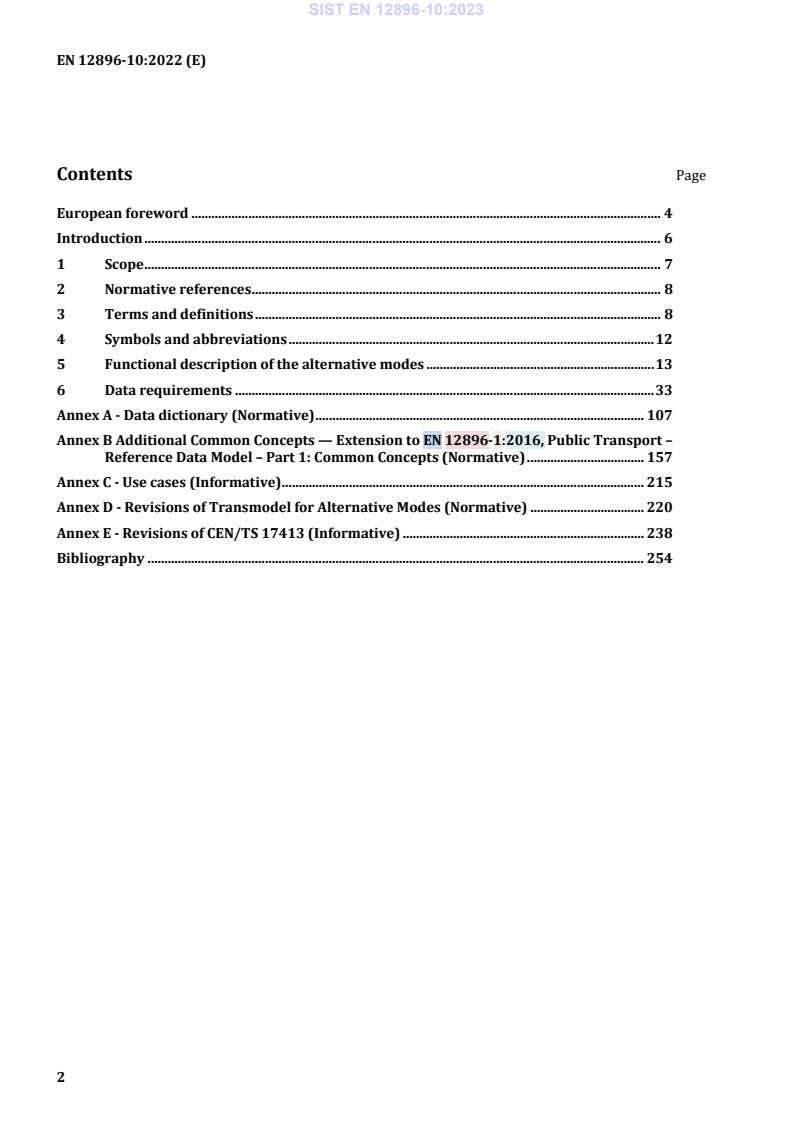
Contents Page
European foreword . 4
Introduction . 6
1 Scope . 7
2 Normative references . 8
3 Terms and definitions . 8
4 Symbols and abbreviations . 12
5 Functional description of the alternative modes . 13
6 Data requirements . 33
Annex A - Data dictionary (Normative) . 107
Annex B Additional Common Concepts — Extension to EN 12896-1:2016, Public Transport –
Reference Data Model – Part 1: Common Concepts (Normative) . 157
Annex C - Use cases (Informative) . 215
Annex D - Revisions of Transmodel for Alternative Modes (Normative) . 220
Annex E - Revisions of CEN/TS 17413 (Informative) . 238
Bibliography . 254
European foreword
This document (EN 12896-10:2022) has been prepared by Technical Committee CEN/TC 278 “Intelligent
Transport Systems”, the secretariat of which is held by NEN.
This European Standard shall be given the status of a national standard, either by publication of an
identical text or by endorsement, at the latest by May 2023, and conflicting national standards shall be
withdrawn at the latest by May 2023.
Attention is drawn to the possibility that some of the elements of this document may be the subject of
patent rights. CEN shall not be held responsible for identifying any or all such patent rights.This document
supersedes CEN/TS 17413:2019.
In comparison with the previous edition, the following technical modifications have been made:
This new publication takes into account the revision of the conceptual model by the project team TC278
PT0303 working on the implementation of the 'alternative modes' model.
EN12896-10, complementing the series of EN12896-x, establishes the semantic reference for the
alternative modes data domain and thus facilitates the integration of these modes into the overall
mobility environment, in particular into multimodal travel services (e.g., trip planning systems).
This document has been prepared under a mandate given to CEN by the European Commission and the
European Free Trade Association, and supports essential requirements of EU Directive(s).
The European Delegated Regulation EU 1926/2017 requires the publication of information related to the
alternative modes of transport, in particular by means of data exchange standards derived from
Transmodel (EN12896). Based on the conceptual data model published by CEN TS 17413 (already based
upon Transmodel) a data exchange format is elaborated as NeTEx – Part 5. Transmodel – Part 10
concerns the alternative modes aspects and completes the Transmodel eco-system ensuring coherence
between the semantic model (Transmodel) and its implementation (as NeTEx/SIRI).
Public Transport Reference Data Model (EN12896) - Part 10 introduces extensions of Transmodel v6.
Most of them have been elaborated within CEN TC278 WG17 and published as CEN TS 17413:2019.The
implementation of this model as NeTEx-Part 5 generates further refinements of the conceptual model.
EN12896-10 includes both achievements and creates a coherent set of standards (Transmodel-NeTEx-
SIRI).
The series is composed of the following documents:
— Public transport – Reference data model – Part 1: Common concepts;
— Public transport – Reference data model – Part 2: Public transport network;
— Public transport – Reference data model – Part 3: Timing information and vehicle scheduling;
— Public transport – Reference data model – Part 4: Operations monitoring and control;
— Public transport – Reference data model – Part 5: Fare management;
— Public transport – Reference data model – Part 6: Passenger information;
— Public transport – Reference data model – Part 7: Driver management;
— Public transport – Reference data model – Part 8: Management information & statistics; and
— Public transport – Reference data model – Part 9: Informative documentation [CEN/TR].
Together these create version 6 of the European Standard EN 12896, known as “Transmodel”.
According to the CEN-CENELEC Internal Regulations, the national standards organisations of the
following countries are bound to implement this European Standard: Austria, Belgium, Bulgaria, Croatia,
Cyprus, Czech Republic, Denmark, Estonia, Finland, France, Germany, Greece, Hungary, Iceland, Ireland,
Italy, Latvia, Lithuania, Luxembourg, Malta, Netherlands, Norway, Poland, Portugal, Republic of North
Macedonia, Romania, Serbia, Slovakia, Slovenia, Spain, Sweden, Switzerland, Türkiye and the United
Kingdom.
Introduction
This document presents the following items:
— Rationale for the Transmodel Standard;
— Use of the Transmodel Standard;
— Applicability of the Transmodel Standard;
— Conformance Statement;
— Transmodel Origins;
— Reference to the Previous Version and Other Documents.
The data structures represented in Part 1 are generic patterns that are referenced by different other
parts.
Part 2 of this European Standard presents space-related data structures.
Part 3 presents time-related data structures referring to the time-related Tactical Planning Components
and to Vehicle Scheduling.
Part 4 presents data referring to daily operations (i.e., to operational days), different from those planned
for day types (space-related data structures and tactical planning components) and including operational
raw data referring to operations follow-up.
Part 5 presents fares structures including sales, validation and control.
Part 6 presents Passenger Information (planned and real-time).
Part 7 presents Driver Management including Driver Scheduling (day-type related driver schedules),
Rostering (ordering of driver duties into sequences according to some chosen methods) and Driving
Personnel Disposition (assignment of logical drivers to physical drivers and recording of driver
performance).
Part 8 presents Management Information and Statistics.
Part 9 presents the Informative documentation.
Part 10 (this part) presents the data structures for alternative modes.
1 Scope
1.1 General Scope of the Standard
The main objective of the present standard is to present the Reference Data Model for Public Transport,
based on:
• the Reference Data Model, EN12896, known as Transmodel V6,
incorporating the requirements of
• EN 15531-1 to -3 and TS 15531-4 and -5: Service interface for real-time information relating to
public transport operations (SIRI),
• TS 16614-1 to 5: Network and Timetable Exchange (NeTEx).
A particular attention is drawn to the data model structure and methodology:
• the data model is described in a modular form in order to facilitate the understanding and the
use of the model,
• the data model is entirely described in UML.
In particular, a Reference Data Model kernel is described, referring to the data domain:
• Network Description: routes, lines, journey patterns, timing patterns, service patterns, scheduled
stop points and stop places.
Furthermore, the following functional domains are considered:
• Timing Information and Vehicle Scheduling (runtimes, vehicle journeys, day type-related vehicle
schedules)
• Passenger Information (planned and real-time)
• Fare Management (fare structure, sales, validation, control)
• Operations Monitoring and Control: operating day-related data, vehicle follow-up , control actions
• Management Information and Statistics (including data dedicated to service performance indicators).
• Driver Management:
o Driver Scheduling (day-type related driver schedules),
o Rostering (ordering of driver duties into sequences according to some chosen methods),
o Driving Personnel Disposition (assignment of logical drivers to physical drivers and recording
of driver performance).
This part corresponds to the Transmodel V6.0 Alternative Modes
The data modules dedicated to cover most functions of the above domains are specified.
Several concepts are shared by the different functional domains. This data domain is called “Common
Concepts”.
1.2 Functional Domain Description
The different functional domains taken into account in the present standard and of which the data have
been represented as the reference data model are described in “Public Transport Reference Data Model
- Part 1: Common Concepts”.
They are:
• Public Transport Network and Stop Description
• Timing Information and Vehicle scheduling
• Passenger information
• Fare Management
• Operations monitoring and control
• Management information
• Personnel Management: Driver Scheduling, Rostering, Personnel Disposition.
The aspects of multi-modal operation and multiple operators’ environment are also taken into account.
The functional domains related to the present document are described in chapter 5 below.
1.3 Particular Scope of this Document
This document defines new modes in a reference data model, in order to allow integration of these modes
into urban multimodal travel services (e.g., trip planning systems).
2 Normative references
The following documents are referred to in the text in such a way that some or all of their content
constitutes requirements of this document. For dated references, only the edition cited applies. For
undated references, the latest edition of the referenced document (including any amendments) applies.
EN 12896-1, Public transport - Reference data model - Part 1: Common concepts
EN 12896-2, Public transport - Reference data model - Part 2: Public transport network
EN 12896-3, Public Transport — Reference Data Model — Part 3: Timing Information and Vehicle
Scheduling
EN 12896-4, Public Transport — Reference Data Model — Part 4: Operations Monitoring and Control
EN 12896-5, Public Transport — Reference Data Model — Part 5: Fare Management
3 Terms and definitions
3.1 General Terms and definitions
The following generic terms (extract based on Transmodel) are used.
3.1.1
attribute
property of an entity.
3.1.2
conceptual data model
description of a real-world domain in terms of entities, relationships and attributes in an implementation
independent manner in order to provide a structure on which the rest of the development of an
application system can be based.
3.1.3
conceptual level
in the context of data modelling, the conceptual data model.
3.1.4
database
collection of data; often used in the sense of the physical implementation of a data model.
3.1.5
data domain
data structure made up of data related to each other, through the fact that there is a functional area or
group of functions using this data set as a whole.
3.1.6
data model
description of a real-world domain in terms of data and relationships.
3.1.7
entity
object (data) that has its own existence (as opposed to an attribute).
3.1.8
fare management
all activities related to the collection of money from passengers.
3.1.9
function
activity.
3.1.10
functional area
arbitrarily defined set of activities used to define the objectives and limits of the data model.
3.1.11
interoperability
ability of (sub)systems to interact with other (sub)systems according to a set of predefined rules
(interface).
3.1.12
logical data model
data design that takes into account the type of database to be used but which does not consider means of
utilisation of space or access.
3.1.13
logical level
in the context of data modelling, the logical data model.
3.1.14
object-oriented data model
data structure expressed according to principles that allow for a direct implementation as an object-
oriented database, where information is represented in form of objects, i.e., respecting the principle of
encapsulation meaning in particular that each data is accessed or modified through operations (methods)
belonging to it.
3.2 Domain specific terms and definitions
3.2.1
access mode
a characterisation of the traveller movement (e.g., walking, cycling, etc) enabling the traveller to reach
public transport or to carry out a whole trip.
3.2.2
alternative mode
any publicly advertised mode of operation different from the conventional mode of operation, in
particular vehicle sharing, vehicle rental and vehicle pooling.
3.2.3
car pooling
• vehicle pooling applied to cars, consisting in sharing a privately owned car for a trip between a
defined driver who is already engaged in the trip and at least another traveller.
3.2.4
car rental
vehicle rental applied to cars, consisting in making car(s) available at specified agencies with the
constraint to bring them back at specified agencies.
3.2.5
car sharing
vehicle sharing applied to cars consisting, the short-term use of a vehicle for a specific journey or time
where the car might be taken from and parked at different places in the urban area.
3.2.6
conventional mode
legacy mode of operation which is provided as a scheduled and/or flexible publicly advertised transport
offer relying on a set of features: drivers are employees; the fleet is owned by an operator or an authority;
the network topology is defined well in advance and is based on lines and journey patterns.
Note 1 to entry: the distinction between alternative and conventional mode of operation relies on the fact that one
or more of the conditions as above may not be fulfilled. Moreover, the difference is in the mode of operation rather
than the way the traveller is served.
3.2.7
cycle rental
vehicle rental applied to cycles, consisting in making cycle(s) available at specified agencies with the
constraint to bring them back at specified agencies.
3.2.8
cycle sharing
vehicle sharing applied to cycles consisting of short-term cycle rental where the cycle can be taken from
and parked at different places in the urban area.
3.2.9
flexible transport mode
passenger transport operation linked to a fixed network/schedule but offering flexibility, in order for
instance, to optimise the service or to satisfy passenger demand.
3.2.10
mobility service
alternative mode of transport service available over a widespread area, for example car-pooling, rental,
etc.
3.2.11
operational service
activities performed by actors in charge of operation of a service.
3.2.12
park and ride
activity allowing travellers to transfer between personal/alternative mode and conventional mode.
3.2.13
park and ride facility
location dedicated to travellers allowing them a modal transfer, in particular to leave/pick up their
personal vehicles before/after a trip on public transport.
3.2.14
personal mode
private mode of operation excluding any publicly advertised use.
3.2.15
public transport
any means of transport advertised and available for use by the general public.
3.2.16
scheduled mode
passenger transport operation following a fixed schedule and fixed routes.
3.2.17
taxi
type of vehicle pooling operation where the vehicle is driven by a driver providing services to travellers
for commercial reasons.
3.2.18
taxi stand
A set of spots where any taxi is able to safely stop for a short period of time to load passengers.
3.2.19
traveller information provision
activity consisting in the provision of information on the rules/conditions related to a traveller service
and concerning the available transportation means.
3.2.20
traveller service
activity (in general, initiated by users) in view of facilitating/enabling a trip.
3.2.21
walking mode
walking is considered as access mode so the traveller walks to a stop to get to the transport option.
3.2.22
vehicle pooling
particular mode of operation of a privately-owned vehicle consisting in sharing the vehicle for a trip
between a defined driver who is already engaged in the trip and at least another traveller.
3.2.23
vehicle rental
particular mode of operation of a vehicle fleet (in general privately owned) consisting in making it
available at specified agencies with the constraint to bring them back at specified agencies.
3.2.24
vehicle sharing
short term vehicle rental where the vehicle can be taken from and parked at different places in the urban
area, often without the constraint of bringing the vehicle back to a dedicated specific location.
3.2.25
vehicle with driver
vehicle operating on demand such as a taxi, chauffeured car or dispatched mini-cab.
4 Abbreviations
CCAM cooperative, connected and automated mobility
EU European Union
GDF geographic data files
GNSS global navigation satellite system
INSPIRE infrastructure for spatial information in Europe
ITS intelligent transport systems
MaaS mobility as a service
U-ITS urban ITS
5 Functional description of the alternative modes
5.1 Introduction
This document describes an extension of the Public Transport Reference Data Model, known as
Transmodel (EN12896), which provides definitions and a conceptual data model for the "conventional
transport " domain. This clause provides a clarification as regards the "conventional transport mode" vs.
"alternative transport mode".
5.2 Categorisation of modes of transport
'Mode' is any means of transport used or available. It is split into 'vehicle mode' and 'access mode'.
'Vehicle mode' is a characterisation of the public transport operation according to the means of transport,
e.g., bus, tram, metro, train, ferry, ship, or bicycle.
'Access mode' (e.g., walking, cycling, private car driving, etc) is a characterisation of the traveller
movement (e.g., walk, bicycle, etc) enabling them to reach the 'vehicle mode' or to carry out a whole trip.
Figure 1 — Categorisation of transport modes
A distinction is made between 'vehicle mode' and 'vehicle type'. Each 'vehicle mode' may correspond to
a range of 'vehicle types' (e.g. to the 'vehicle mode' 'bus' may correspond 'standard', 'articulated, minibus','
double-deck' buses).
A further, finer categorisation of transport modes is provided by the concept of 'submode', which is a
variant of a 'mode'. For example, for the mode 'rail', possible submodes are 'international rail' or 'domestic
rail'; for the mode 'bus', the example of submode is 'regional bus', for the mode 'car', examples of
submodes are 'electric car', 'conventional car', 'self-driven car'.
This document takes over these normative definitions and provides a further clarification as regards the
term 'public transport'.
For this document 'public transport' has to be understood as any means of transport, advertised and
available for use by the general public.
5.2.1 Alternative mode of operation
5.2.1.1 Overview
Modes and submodes being defined as 'transport means' may be characterised in terms of types of
operation, i.e., ways they are operated.
This document distinguishes the following types of 'mode of operation':
• conventional mode of operation: the legacy mode of operation which is provided as a scheduled
and/or flexible publicly advertised flexible transport offer. This mode of operation is either following
a fixed schedule and fixed routes or linked to a fixed network/schedule but offering flexibility, in
order for instance, to optimise the service or to satisfy passenger demand;
• alternative mode of operation: any publicly advertised mode of operation different from the
conventional mode of operation, in particular vehicle sharing, vehicle rental and vehicle pooling; and
• personal mode of operation: a private mode of transport excluding any publicly advertised use.
The scope of Transmodel is the conventional mode of operation, including both scheduled and flexible
mode of operation. The distinction between alternative and conventional mode of operation relies on the
fact that a conventional mode relies on a set of features: drivers are employees and the fleet is owned by
an operator or an authority and the network topology is defined well in advance and is based on lines
and journey patterns; whereas the alternative modes may not fulfil one or more of these features.
This document concerns the alternative mode of operation.
Figure 2 — Operation types for transportation modes
5.2.1.2 Wording convention
In this document, alternative mode of operation, alternative mode and new mode are used as synonyms
(with a preference to alternative mode).
Conventional mode of operation is used as synonym of conventional mode, flexible mode of operation is
synonymous to flexible mode, scheduled mode of operation as synonymous to scheduled mode.
5.2.1.3 Transport modes in Commission Delegated Regulation (EU) 2017/1926
The Commission Delegated Regulation (EU) 2017/1926), partitions the transport modes into Scheduled,
Demand Responsive, and Personal. Rather than a definition, examples for these concepts are provided.
Scheduled modes: Air, rail including high speed rail, conventional rail, light rail, long-distance coach,
maritime including ferry, metro, tram, bus, trolley-bus.
Demand-responsive modes: Shuttle bus, shuttle ferry, taxi, car-sharing, car-pooling, car-hire, bike-
sharing, bike-hire.
Personal modes: Car, motorcycle, cycle.
The table below provides the correspondence of the different concepts and terms in use with the concepts
of this document.
Table 1 — Concepts and terms
Mode of Type of mode of operation Specification covering Type of mode The Commission
operation data requirements according to the Delegated Regulation
Commission (EU) 2017/1926:
Delegated Regulation examples
(EU) 2017/1926
Conventional
mode of
operation
Scheduled mode of Transmodel Scheduled mode Air, rail including
operation high speed rail,
conventional rail,
light rail, long-
distance coach,
maritime including
ferry, metro, tram,
bus, trolley-bus.
Flexible mode of Transmodel Demand-responsive Shuttle bus, shuttle
operation mode ferry
Alternative
mode of
operation
Vehicle sharing (car This document Demand-responsive car-sharing, bike-
sharing, cycle sharing) mode sharing
Vehicle pooling This document Demand-responsive car-pooling, taxi
mode
(carpooling)
Vehicle rental (car This document Demand-responsive car-hire, bike-hire.
rental, cycle rental) mode
(partly)
Personal Personal mode Car, motorcycle,
mode of cycle.
operation
5.2.2 Limits of the specification
This document concentrates on data domains of use for the alternative modes of operation: vehicle
sharing, vehicle pooling.
Vehicle rental and taxi are only partly considered.
The correspondence with the Commission Delegated Regulation (EU) 2017/1926 is provided in the table
above.
This document does not cover Flexible Transport, as it is already covered by EN12896.
Two following types of usage as regards cycle sharing car sharing and car-pooling have been identified:
the mobility of persons; and the transportation of goods. This document considers mobility of persons
only.
Types of vehicles considered are referred to in clauses 5.5.1 and 5.6
The data model focuses at the functional domain (Traveller) Information Provision mainly, in order to
satisfy the requirements of the Delegated Regulation (EU) 2017/1926 mentioned above and covers partly
data requirements of the functional domain Traveller Services (see figure 3).
Operational Services are not in scope of this document.
5.3 Links to Mobility as a service
5.3.1 Mobility as a service (MaaS)
Since the advent of the personal computer, the internet and more lately, the smartphone, consumer
experiences have become increasingly integrated, and there has become an expectation of greater
integration.
Increasingly, and especially in the urban setting, multiple modes of transport are used; and with the
advent of car sharing, carpooling, cycle sharing, the number of modes, and mode combinations, have
multiplied.
By applying the same ‘integrated service’ logic to the transport sector, because of technology change and
the opening up and sharing of transport datasets, considerable ‘value’ can be added to the travellers
experience by the provision of “mobility as a service” (MaaS), i.e. using a digital interface to source and
manage the provision of transport related service(s) to meet the mobility requirements of a customer. A
MaaS Provider offers its customer the travel experience using any, and probably multiple, types of
transport service, public or private, in order to optimise the travel experience.
Tailored travel options can be provided using the fastest route, the lowest cost route, most direct route,
most environmentally friendly, or most accessible service for persons with reduced mobility, or those
travelling with children.
One MaaS possibility is the scenario where MaaS Providers offer consumers a service focussed on vehicle
transport e.g., taxi, car sharing and carpooling services. The other possibility is a scenario where
consumers are offered a fully intermodal service, i.e., combining different modes of transport.
The MaaS Provider uses data from multiple travel service providers to create a value proposition that
comprises a ‘bundle’ of different mobility services to meet a travel requirement.
5.3.2 Cooperative, connected and automated mobility (CCAM)
The potential for MaaS is enhanced by changes in mobility consumption, the adoption of new mobility
models (and this may lead to a move away from car ownership).
Modern vehicles are already connected devices, but the advent of Cooperative Intelligent Transport
Systems (C-ITS), will allow road users and traffic managers to share information and use it to coordinate
their actions.
Automated vehicles, and their full integration in the overall transport system (automated mobility),
significantly advance the capabilities of, and desirability to the user, of MaaS, by assisting the MaaS
provider to be able to offer options that are seen by the traveller to be better than their previous options.
5.3.3 Reference data model for alternative modes
In order to achieve MaaS, and utilise the associated capabilities of CCAM for MaaS, it is necessary to
exchange and have access to relevant data. The Commission Delegated Regulation (EU) 2017/1926
requires that Member States facilitate the easy exchange and reuse of data for the provision of
comprehensive travel information services. Transport authorities, transport operators, infrastructure
managers or transport on demand service providers as appropriate need access to static data,
corresponding metadata and information on the quality of the data accessible to users through a national
or common access point.
This document defines a reference data model, in order to allow integration of emerging transport modes
into multimodal services (e.g., trip planning systems).
5.4 Functions and aspects related to the alternative modes
5.4.1 Introduction
As a result of an alternative mode of operation, new services are operated and proposed to travellers.
This section describes new services through particular aspects and functions characterising these
services.
The following 3 aspects are mostly relevant:
• types of vehicles: cycles, cars, cycle types, car types, etc, in particular characterised by their
equipment,
• modes of operation: pooling, sharing, rental, personal,
• types of transportation: persons, goods.
Figure 3 — Aspects and functions of related to alternative modes
The functional domains by which alternative modes are mostly concerned are grouped into the following
categories;
• (traveller) information provision: activities consisting in the provision of information to the traveller
on the rules/conditions related to a traveller service,
• traveller services: activities (in general initiated by users) in view of facilitating/enabling a trip,
• operational services: activities performed by actors in charge of operation of a service.
• The following sections describe the functional domains by functions (activities) in more detail,
providing a short definition of each function. As mentioned above in 0 the primary goal of the
following sections is to illustrate the scope of the developed conceptual data model mainly focusing
at information provision.
• Specifics of each particular mode of operation is described in the corresponding sections (cycle rental,
cycle sharing, private cycling, car sharing, car rental, carpooling) in clauses 5.5, 5.6 and 5.7.
5.4.2 Information provision functions
5.4.2.1 Introduction
The following functions are dedicated to the provision of information to travellers. Some of the functions
are applicable to the private modes of operation. In most of the cases, information provision may be
general (referring to a whole area), or specific, related to a particular user query with specific parameters.
5.4.2.2 Booking information
This activity consists in the provision of information on booking rules and additional data allowing the
user to take the decision to book a service. The following information is considered as relevant:
• booking methods: description how to book (by internet, through an agency, etc)
• booking conditions: information on how long in advance booking may take place, whether a
guarantee is necessary, etc
• contact information: URL, address, etc. of the booking contact
• available number/type of vehicles per station; and,
• usage rules: this relates to the service that is going to be booked: time-related conditions, location of
check in/out stations, penalties, user profile, etc. used in the booking operation.
There are two circumstances concerning booking access to a vehicle. Firstly, there is the occasion when
the vehicle is required immediately due to unforeseen circumstances or the failure of other transport
modes; in this case there might not be a vehicle available in an optimum location or indeed a vehicle
available at all. Secondly, it should be possible to notify the service provider of the requirement for a car
share; in this case a vehicle should be available of the required type and at the optimum location;
however, it is likely that a different set of charges will apply.
5.4.2.3 Service availability information
This activity consists in the provision of information on the availability of a particular mode of operation,
e.g., opening hours of agencies for vehicle rental, opening hours of off-street vehicle parking locations,
etc. The information may be either static or dynamic.
5.4.2.4 Alternative mode vehicle availability information
This activity consists in the provision of either static or dynamic information on availability of vehicles at
areas dedicated to the alternative modes. The static information corresponds to the capacity of areas
(planned vehicle availability) dedicated to alternative modes.
The dynamic availability (actual presence of an available vehicle) may be derived from the information
provided by vehicle location information (see 5.4.2.6) and the planned vehicle availability (capacity of a
given area).
5.4.2.5 Infrastructure access information
This activity consists of the provision of information describing where to find and how to access a
dedicated location for an alternative mode, for example, vehicle sharing or rental, and the dedicated
location where the vehicle can be released after use. The information is static.
5.4.2.6 Vehicle location information
This activity consists of the provision of dynamic information describing where to find a vehicle or where
a vehicle has been dropped off. This information is also relevant to the Personal mode.
5.4.2.7 Vehicle access information
This activity consists in the provision of information describing how to unlock vehicle prior to use and
secure it after use, in particular for vehicle sharing and rental. The information may be either static or
dynamic.
5.4.2.8 Fares information
This activity consists in the provision of information on fare rules, pricing rules (hourly/weekly/monthly
fee), discounts etc. The information is in general static.
5.4.2.9 Payment information
This activity consists in the provision of information on payment means and methods, payment locations.
The information is in general static.
This information involves:
• payment methods: cash, credit card, mobile payment, etc.;
• payment guarantees: credit card guarantee, banking, ID registration.
5.4.2.10 Alternative mode area equipment information
This activity consists in the provision of information on equipment present at locations dedicated to
alternative modes, in particular secure storage facilities and battery recharging equipment, but also
ticketing equipment, information desks, etc. The information may be static (planned presence of the
equipment) or dynamic (status of the equipment).
5.4.2.11 Alternative modes parking area information
This activity consists in the provision of information about the alternative modes areas where a vehicle
may be parked and left unattended (dropped off) and on the number of available parking slots for
dropping-off alternative mode vehicles. This information is dynamic.
5.4.2.12 Registration information
This activity consists in the provision of information on the registration process to be accepted and
recognised as a user.
The following information is of interest for the registration process:
• ID information: name, surname, date of birth, place of birth, address of residence
• Contact information: e-mail address of the alternative mode service, mobile number of the user, e-
mail addresses of the user;
• Additional information, such as payment information: credit card, bank account (this is mainly for
payment guarantee).
5.4.2.13 Repair facility information
This activity consists in providing information about locations where repair and/or maintenance of
vehicle is possible. A description of the possible type of repair may be provided, e.g., mending punctures,
replacing chains and fixing lights. This information may be static or dynamic (availability status of such
facilities).
5.4.3 Traveller Services
5.4.3.1 Introduction
The following sections provide examples of Traveller Services and this list is not exhaustive, and provides
examples of functions typically encountered in the context of new modes; e.g., trip planning and traveller
guidance functions are not described here as they are extensively described in standards related to
conventional modes.
5.4.3.2 Booking
Booking is a traveller service which may be electronic and non-electronic dedicated to the reservation of
a vehicle or a trip for users in specific dates and time as part of the urban mobility.
5.4.3.3 Registration
Registration is a traveller service considered as the virtual or physical first identification of users to
access a traveller or transportation service. The registration process can be undertaken remotely using
internet platform via PC or mobile access, or physically at specific locations.
5.4.3.4 Vehicle access control
Vehicle access control is a traveller service consisting in verifications and mechanisms to unlock and
relock either an alternative vehicle mode.
5.4.3.5 Stopping place access control
Stopping place access control is an activity consisting in controlling and granting/denying access to a
particular stopping place to vehicles operating as alternative or personal modes.
5.4.3.6 Payment
Payment is a traveller service of payment of a transport service. In the context of alternative modes, the
process is mostly carried out using electronic payment procedures.
5.4.3.7 Trip planning
Modern computer-aided travel tools assist potential travellers in preparing their trips, particularly in
answering specific TRIP REQUESTs. Such a trip planning function identifies the origin and destination
places of an intended trip and proposes one or several trip solutions. The proposition takes into account
the user’s constraints or preferences, such as minimal trip duration, minimal number of interchanges,
cheapest fare, etc., and involves an optimisation process using such parameters.
After specification of the trip origin and destination, the system proposes a “trip pattern”, composed of
access or connection walks/transfers to a number of public transport modes including alternative modes.
Given a trip pattern proposal, it is possible to compute a precise duration of the trip (taking into account,
for instance, the latest arrival time requested by the traveller) or a mean duration. It is also possible to
calculate the corresponding costs, the suitability for a person of reduced mobility, etc.
The trip pattern components are explicitly linked to accessibility features; if such features are known they
are populated ensuring that the trip pattern is suitable for the traveller according to specific needs.
If the request is made for a trip taking place on the same day, it is possible to take into account the
monitored situation to refine the proposal. The trip pattern proposal will be influenced by service
modifications due to control actions (e.g., service cancelled or shortened because of a protest) and the
timing proposal will be based on actual (monitored) passing times.
5.4.4 Operational services
5.4.4.1 Vehicle shipping
Vehicle shipping is an activity consisting in cross-city vehicle shipping for any purpose, though
particularly to ensure that vehicle sharing stations have sufficient vehicles for sharing and that the
stations have sufficient spaces for vehicles to be released.
5.4.4.2 Repairing and maintenance
Repairing and maintenance is the provision of facilities for the repairing of all types of vehicles in
dedicated areas with access to tools and spare parts.
5.4.4.3 Recharging and refuelling
Recharging and refuelling is the process of charging (possibly at a sharing station) of electric vehicles and
the refuelling of liquid powered vehicles when required.
5.5 Cycling
5.5.1 Introduction
This section describes specific additional aspects of cycling.
Cycling is the operation of a cycle by a user to carry out a trip. Different modes of operation are described
as: cycle rental; cycle-sharing; and private cycling.
The modelling of the information related to cycling can be used to provide traveller services; for instance,
existing route planning algorithms may use cycling data to compute multi-modal trip plans including
cycle rental and cycle sharing.
Cycle sharing, and cycle rental are both based on a commercial relationship between a user and an
organisation making cycles available, which is not the case for private cycling.
The following types of cycles are considered in this document:
• Classical cycle: vehicle composed of wheels attached to a frame. It is powered by human muscles; and,
• Cycle with electric propulsion: vehicle with a low powered electric motor; falling in this category are:
electric bikes; but also balancing scooter, hoverboard, motorised unicycles etc.
----------
...