


oSIST prEN 12896-1:2026
(Main)Public transport - Reference data model - Part 1: Common concepts
Public transport - Reference data model - Part 1: Common concepts
This document incorporates data structures used by all other data domains of Transmodel. It is composed of the following data packages:
- versions and validity;
- responsibility;
- generic framework;
- reusable components;
- explicit frames referring to generic data.
The data structures represented in this part are either generic patterns that can be explicitly reused in other domains (e.g., a generic model for version frames, a generic grouping mechanism, etc.) or are referenced by different other parts (e.g., service calendar model).
This document itself is composed of the following parts:
- main document representing the data model for the concepts shared by the different domains covered by Transmodel (normative);
- Annex A containing the data dictionary and attribute tables, i.e., the list of all the concepts present in the main document, together with their definitions (normative);
- Annex B, indicating the data model evolutions (informative),
- Annex C, presenting the Transmodel development history (informative),
- Annex D, describing all conventions, methodology and notations for conceptual modelling (informative),
- Annex E, providing a clear overview to help readers understand the core principles, structure, and purpose of Transmodel (informative),
- Annex F, providing information on the Functional domains and Modes of operation (informative).
- Annex G, providing details of the significant technical changes between this document and EN 12896-1:2015 (informative).
Öffentlicher Verkehr - Datenreferenzmodell - Teil 1: Gemeinsame Konzepte
Transports publics - Modèle de données de référence - Partie 1: Concepts communs
Le présent document reprend les structures de données utilisées par tous les autres domaines de données de Transmodel. Il se compose des packages de données suivants:
- versions et validité;
- responsabilité;
- cadre générique;
- composants réutilisables;
- cadres explicites relatifs aux données génériques.
Les structures de données représentées dans la présente partie sont soit des modèles génériques qui peuvent être explicitement réutilisés dans d'autres domaines (par exemple, un modèle générique de cadres de versions, une méthode de groupement générique, etc.), soit référencées par différentes autres parties (par exemple, modèle de calendrier de services).
Le présent document est lui-même constitué des parties suivantes:
- le corps du document, représentant le modèle de données pour les concepts communs aux différents domaines couverts par Transmodel (partie normative);
- l'Annexe A (normative), contenant le dictionnaire de données et les tableaux des attributs, à savoir la liste et la définition de l'ensemble des concepts présents dans le corps du document;
- l'Annexe B (informative), indiquant les évolutions du modèle de données;
- l'Annexe C (informative), présentant l'historique du développement de Transmodel;
- l'Annexe D (informative), décrivant l'ensemble des conventions, méthodologies et notations en ce qui concerne la modélisation conceptuelle;
- l'Annexe E (informative), donnant une vue d'ensemble claire visant à aider les lecteurs à comprendre les principes fondamentaux, la structure et l'objet de Transmodel;
- l'Annexe F (informative), fournissant des informations sur les domaines fonctionnels et les modes d'exploitation;
- l'Annexe G (informative), décrivant en détail les modifications techniques majeures entre le présent document et l'EN 12896-1:2015.
Javni prevoz - Referenčni podatkovni model - 1. del: Splošni pojmi
General Information
- Status
- Not Published
- Public Enquiry End Date
- 15-Feb-2026
- Technical Committee
- ITC - Information technology
- Current Stage
- 4020 - Public enquire (PE) (Adopted Project)
- Start Date
- 10-Dec-2025
- Due Date
- 29-Apr-2026
- Completion Date
- 09-Feb-2026

Relations
- Effective Date
- 19-Jun-2024
Overview
oSIST prEN 12896-1:2026 - Public Transport Reference Data Model: Common Concepts is a European Standard developed by the European Committee for Standardization (CEN). This standard provides a comprehensive, modular reference data model for public transport information systems. Built on the foundations of Transmodel V5.1 (EN 12896) and IFOPT (EN 28701), and harmonized with key standards such as SIRI (EN 15531) and NeTEx (TS 16614), oSIST prEN 12896-1:2026 defines common concepts that ensure interoperability, data consistency, and scalability across public transport applications.
The standard focuses on the structural and methodological aspects of a unified data model, fully described in UML and organized in a modular format. This approach facilitates both the understanding and adoption of consistent public transport data management practices-essential for the seamless exchange and integration of network, timetable, fare, operational, and management data.
Key Topics
Modular Data Model Architecture
- UML-based, fully modular design for extensibility and clarity
- Core "kernel" addresses foundational network description and fixed object identification
Functional Domains and Common Concepts
- Network description-routes, lines, journey patterns, scheduled stop points, and stop places
- Timing and vehicle scheduling-runtimes, day types, vehicle journeys
- Passenger information-planned and real-time data management
- Operations monitoring and control-vehicle follow-up, control actions
- Fare management-definition of fare structures, access rights, sales, validation, and control
- Management information and statistics-service performance indicators and related data
- Driver management-scheduling, rostering, assignment, and performance tracking
Reusable Components
- Location systems, transport modes, vehicle types, facilities, equipment, and organizational roles
- Time element models-service calendars, availability, transfer times
- Message and notification frameworks for communication
Layered Network Representation
- Multi-layered functional and spatial views for comprehensive network mapping
- Projections for integrating spatial datasets from different sources
Applications
oSIST prEN 12896-1:2026 provides significant practical benefits for stakeholders in the public transport domain:
Public Transport Operators and Authorities
- Streamlined exchange of network, timetable, and operational data
- Basis for interoperable real-time passenger information systems and journey planners
- Efficient integration of multi-modal transport data (including rail, bus, and more)
IT Vendors and Systems Integrators
- Standardized data structures for scalable, maintainable public transport solutions
- Facilitation of seamless connections between back-office planning, operations, and customer-facing systems
Transport Planners and Policy Makers
- Reliable data model supporting analysis, performance monitoring, and decision-making
- Statistical and management information to improve service levels and efficiency
Smart Mobility and MaaS (Mobility as a Service) Providers
- Unified framework for combining and exchanging data from diverse networks
- Enhanced support for multi-operator and cross-border services
Related Standards
oSIST prEN 12896-1:2026 harmonizes with and extends several key European standards:
- EN 12896 (Transmodel V5.1) – Reference Data Model for Public Transport
- EN 28701 (IFOPT) – Identification of Fixed Objects for Public Transport
- EN 15531 / TS 15531 (SIRI) – Service Interface for Real-time Information
- TS 16614 (NeTEx) – Network and Timetable Exchange
This alignment provides a robust, future-proof foundation for integrated public transport information systems across Europe and supports evolving smart mobility initiatives.
Keywords: public transport data model, reference data model, oSIST prEN 12896-1:2026, Transmodel, IFOPT, SIRI, NeTEx, CEN standards, public transport interoperability, transport IT solutions
Get Certified
Connect with accredited certification bodies for this standard

BSI Group
BSI (British Standards Institution) is the business standards company that helps organizations make excellence a habit.

NYCE
Mexican standards and certification body.
Sponsored listings
Frequently Asked Questions
oSIST prEN 12896-1:2026 is a draft published by the Slovenian Institute for Standardization (SIST). Its full title is "Public transport - Reference data model - Part 1: Common concepts". This standard covers: This document incorporates data structures used by all other data domains of Transmodel. It is composed of the following data packages: - versions and validity; - responsibility; - generic framework; - reusable components; - explicit frames referring to generic data. The data structures represented in this part are either generic patterns that can be explicitly reused in other domains (e.g., a generic model for version frames, a generic grouping mechanism, etc.) or are referenced by different other parts (e.g., service calendar model). This document itself is composed of the following parts: - main document representing the data model for the concepts shared by the different domains covered by Transmodel (normative); - Annex A containing the data dictionary and attribute tables, i.e., the list of all the concepts present in the main document, together with their definitions (normative); - Annex B, indicating the data model evolutions (informative), - Annex C, presenting the Transmodel development history (informative), - Annex D, describing all conventions, methodology and notations for conceptual modelling (informative), - Annex E, providing a clear overview to help readers understand the core principles, structure, and purpose of Transmodel (informative), - Annex F, providing information on the Functional domains and Modes of operation (informative). - Annex G, providing details of the significant technical changes between this document and EN 12896-1:2015 (informative).
This document incorporates data structures used by all other data domains of Transmodel. It is composed of the following data packages: - versions and validity; - responsibility; - generic framework; - reusable components; - explicit frames referring to generic data. The data structures represented in this part are either generic patterns that can be explicitly reused in other domains (e.g., a generic model for version frames, a generic grouping mechanism, etc.) or are referenced by different other parts (e.g., service calendar model). This document itself is composed of the following parts: - main document representing the data model for the concepts shared by the different domains covered by Transmodel (normative); - Annex A containing the data dictionary and attribute tables, i.e., the list of all the concepts present in the main document, together with their definitions (normative); - Annex B, indicating the data model evolutions (informative), - Annex C, presenting the Transmodel development history (informative), - Annex D, describing all conventions, methodology and notations for conceptual modelling (informative), - Annex E, providing a clear overview to help readers understand the core principles, structure, and purpose of Transmodel (informative), - Annex F, providing information on the Functional domains and Modes of operation (informative). - Annex G, providing details of the significant technical changes between this document and EN 12896-1:2015 (informative).
oSIST prEN 12896-1:2026 is classified under the following ICS (International Classification for Standards) categories: 35.240.60 - IT applications in transport. The ICS classification helps identify the subject area and facilitates finding related standards.
oSIST prEN 12896-1:2026 has the following relationships with other standards: It is inter standard links to SIST EN 12896-1:2017. Understanding these relationships helps ensure you are using the most current and applicable version of the standard.
oSIST prEN 12896-1:2026 is associated with the following European legislation: EU Directives/Regulations: 2016/797/EU. When a standard is cited in the Official Journal of the European Union, products manufactured in conformity with it benefit from a presumption of conformity with the essential requirements of the corresponding EU directive or regulation.
oSIST prEN 12896-1:2026 is available in PDF format for immediate download after purchase. The document can be added to your cart and obtained through the secure checkout process. Digital delivery ensures instant access to the complete standard document.
Standards Content (Sample)
SLOVENSKI STANDARD
01-februar-2026
Javni prevoz - Referenčni podatkovni model - 1. del: Splošni pojmi
Public transport - Reference data model - Part 1: Common concepts
Öffentlicher Verkehr - Datenreferenzmodell - Teil 1: Gemeinsame Konzepte
Transports publics - Modèle de données de référence - Partie 1: Concepts communs
Ta slovenski standard je istoveten z: prEN 12896-1
ICS:
35.240.60 Uporabniške rešitve IT v IT applications in transport
prometu
2003-01.Slovenski inštitut za standardizacijo. Razmnoževanje celote ali delov tega standarda ni dovoljeno.
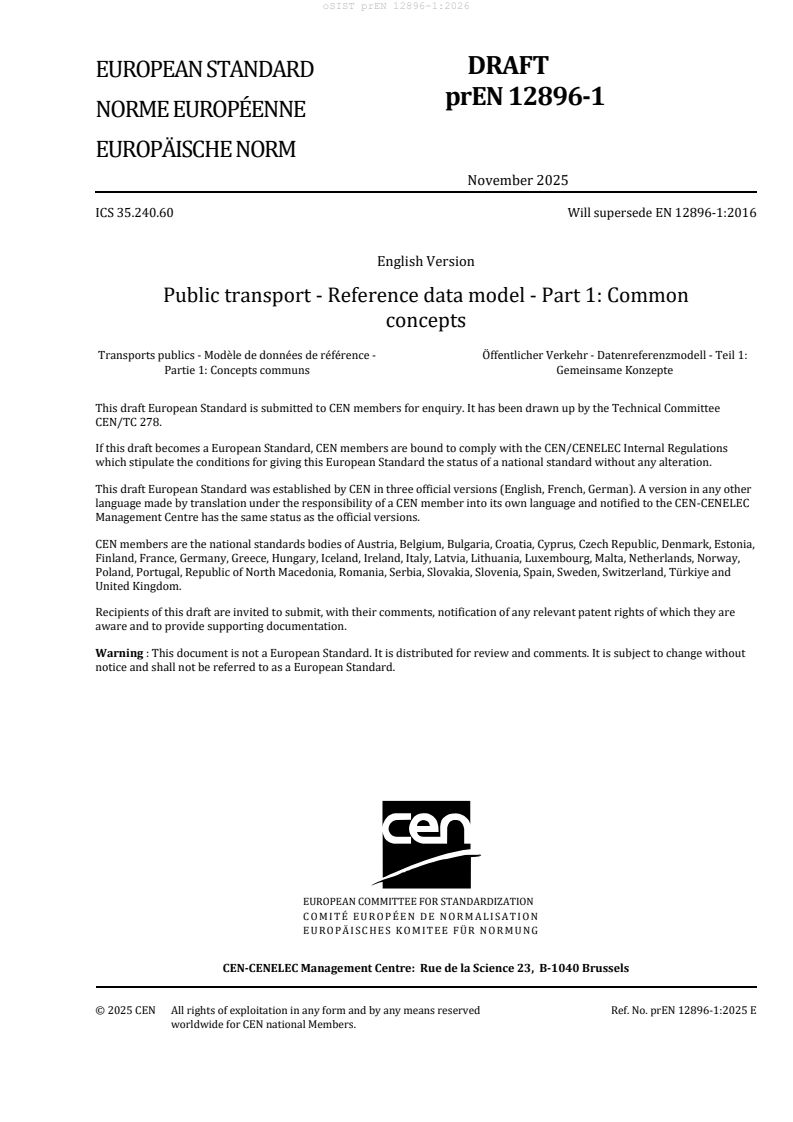
DRAFT
EUROPEAN STANDARD
prEN 12896-1
NORME EUROPÉENNE
EUROPÄISCHE NORM
November 2025
ICS 35.240.60 Will supersede EN 12896-1:2016
English Version
Public transport - Reference data model - Part 1: Common
concepts
Transports publics - Modèle de données de référence - Öffentlicher Verkehr - Datenreferenzmodell - Teil 1:
Partie 1: Concepts communs Gemeinsame Konzepte
This draft European Standard is submitted to CEN members for enquiry. It has been drawn up by the Technical Committee
CEN/TC 278.
If this draft becomes a European Standard, CEN members are bound to comply with the CEN/CENELEC Internal Regulations
which stipulate the conditions for giving this European Standard the status of a national standard without any alteration.
This draft European Standard was established by CEN in three official versions (English, French, German). A version in any other
language made by translation under the responsibility of a CEN member into its own language and notified to the CEN-CENELEC
Management Centre has the same status as the official versions.
CEN members are the national standards bodies of Austria, Belgium, Bulgaria, Croatia, Cyprus, Czech Republic, Denmark, Estonia,
Finland, France, Germany, Greece, Hungary, Iceland, Ireland, Italy, Latvia, Lithuania, Luxembourg, Malta, Netherlands, Norway,
Poland, Portugal, Republic of North Macedonia, Romania, Serbia, Slovakia, Slovenia, Spain, Sweden, Switzerland, Türkiye and
United Kingdom.
Recipients of this draft are invited to submit, with their comments, notification of any relevant patent rights of which they are
aware and to provide supporting documentation.
Warning : This document is not a European Standard. It is distributed for review and comments. It is subject to change without
notice and shall not be referred to as a European Standard.
EUROPEAN COMMITTEE FOR STANDARDIZATION
COMITÉ EUROPÉEN DE NORMALISATION
EUROPÄISCHES KOMITEE FÜR NORMUNG
CEN-CENELEC Management Centre: Rue de la Science 23, B-1040 Brussels
© 2025 CEN All rights of exploitation in any form and by any means reserved Ref. No. prEN 12896-1:2025 E
worldwide for CEN national Members.
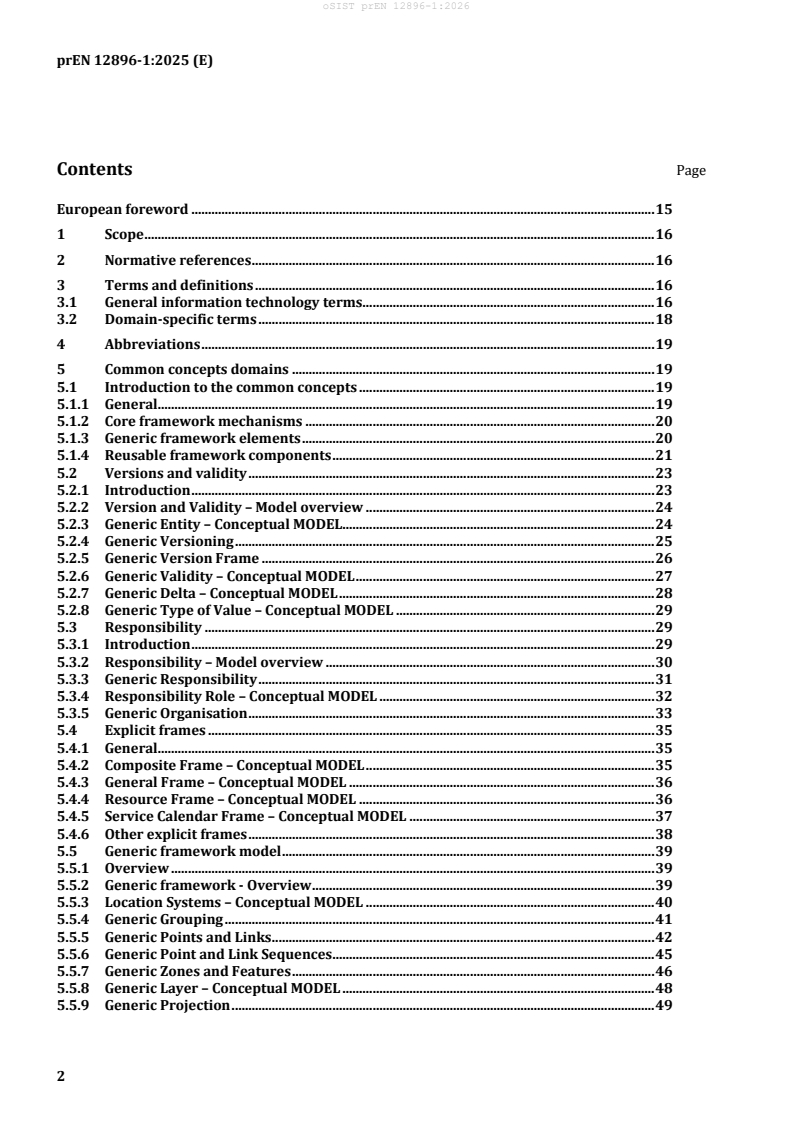
prEN 12896-1:2025 (E)
Contents Page
European foreword . 15
1 Scope . 16
2 Normative references . 16
3 Terms and definitions . 16
3.1 General information technology terms. 16
3.2 Domain-specific terms . 18
4 Abbreviations . 19
5 Common concepts domains . 19
5.1 Introduction to the common concepts . 19
5.1.1 General. 19
5.1.2 Core framework mechanisms . 20
5.1.3 Generic framework elements . 20
5.1.4 Reusable framework components . 21
5.2 Versions and validity . 23
5.2.1 Introduction . 23
5.2.2 Version and Validity – Model overview . 24
5.2.3 Generic Entity – Conceptual MODEL. 24
5.2.4 Generic Versioning . 25
5.2.5 Generic Version Frame . 26
5.2.6 Generic Validity – Conceptual MODEL . 27
5.2.7 Generic Delta – Conceptual MODEL . 28
5.2.8 Generic Type of Value – Conceptual MODEL . 29
5.3 Responsibility . 29
5.3.1 Introduction . 29
5.3.2 Responsibility – Model overview . 30
5.3.3 Generic Responsibility . 31
5.3.4 Responsibility Role – Conceptual MODEL . 32
5.3.5 Generic Organisation . 33
5.4 Explicit frames . 35
5.4.1 General. 35
5.4.2 Composite Frame – Conceptual MODEL . 35
5.4.3 General Frame – Conceptual MODEL . 36
5.4.4 Resource Frame – Conceptual MODEL . 36
5.4.5 Service Calendar Frame – Conceptual MODEL . 37
5.4.6 Other explicit frames . 38
5.5 Generic framework model . 39
5.5.1 Overview . 39
5.5.2 Generic framework - Overview . 39
5.5.3 Location Systems – Conceptual MODEL . 40
5.5.4 Generic Grouping . 41
5.5.5 Generic Points and Links . 42
5.5.6 Generic Point and Link Sequences . 45
5.5.7 Generic Zones and Features . 46
5.5.8 Generic Layer – Conceptual MODEL . 48
5.5.9 Generic Projection . 49
prEN 12896-1:2025 (E)
5.5.10 Generic Place – Conceptual MODEL . 54
5.5.11 Generic Path and Navigation MODEL – Conceptual Model . 54
5.5.12 Generic Assignment – Conceptual MODEL . 55
5.5.13 Generic Loggable Object – Conceptual MODEL . 56
5.5.14 Generic Event – Conceptual MODEL . 57
5.5.15 Generic Security List – Conceptual MODEL . 57
5.5.16 Generic Accessibility . 58
5.5.17 Alternative Text – Conceptual MODEL . 61
5.5.18 Generic Views – Conceptual MODEL . 62
6 Reusable Components . 62
6.1 General . 62
6.2 Reusable Components – Modes . 63
6.2.1 General . 63
6.2.2 Transport Mode – Conceptual MODEL . 63
6.2.3 Transport Submode – Conceptual MODEL . 63
6.2.4 The Transport Mode of Operation – Conceptual MODEL . 64
6.3 Reusable Components – Place & Organisation. 65
6.3.1 General . 65
6.3.2 Topographic Place – Conceptual MODEL. 66
6.3.3 Transport Organisation . 66
6.3.4 Additional Organisation – Conceptual MODEL . 68
6.3.5 Employee – Conceptual MODEL . 69
6.3.6 Role Models . 69
6.4 Reusable Components – Time Element Models . 75
6.4.1 Service Calendar . 75
6.4.2 Availability Condition – Conceptual MODEL . 77
6.4.3 Transfer Times – Conceptual MODEL . 78
6.5 Reusable Components – Vehicle Types . 79
6.5.1 General . 79
6.5.2 Vehicle Type – Conceptual MODEL . 79
6.5.3 Train Types – Conceptual MODEL . 80
6.5.4 Train Element Type – Conceptual MODEL . 82
6.5.5 Fleet Equipment – Conceptual MODEL . 83
6.5.6 Deck Plan - MODEL . 84
6.5.7 Seating Plan – Conceptual MODEL . 89
6.5.8 Seat Affinity – Conceptual MODEL . 90
6.5.9 Deck Path – Conceptual MODEL . 91
6.6 Reusable Components – Vehicles and Fleets . 92
6.6.1 Vehicle – Conceptual MODEL . 92
6.6.2 Fleet – Conceptual MODEL . 93
6.6.3 Train Composition – Conceptual MODEL . 94
6.7 Reusable Components – Equipment . 95
6.7.1 General . 95
6.7.2 Facility – Conceptual MODEL . 96
6.7.3 Generic Equipment – Conceptual MODEL . 96
6.7.4 Actual Vehicle Equipment – Conceptual MODEL . 97
6.7.5 Onboard Vehicle Recharging Equipment Profile – Conceptual MODEL . 98
6.7.6 Energy Equipment – Conceptual MODEL . 99
6.7.7 Spot Equipment – Conceptual MODEL . 100
6.7.8 Vehicle Passenger Equipment – Conceptual MODEL . 101
6.7.9 Deck Sensor Equipment – Conceptual MODEL . 102
6.8 Reusable Message Model . 103
prEN 12896-1:2025 (E)
6.8.1 General. 103
6.8.2 Notice – Conceptual MODEL . 103
6.8.3 Notice Assignment – Conceptual MODEL . 104
6.8.4 Message – Conceptual MODEL . 105
6.8.5 Publication Scope – Conceptual MODEL . 106
6.9 Reusable General Elements . 107
6.9.1 General. 107
6.9.2 Alternative Name – Conceptual MODEL . 107
6.9.3 Service Restriction – Conceptual MODEL . 107
6.9.4 Environmental Properties – Conceptual MODEL . 108
6.9.5 Booking Arrangements – Conceptual MODEL. 108
6.9.6 Check Constraint – Conceptual MODEL . 109
6.9.7 Schematic Map – Conceptual MODEL . 110
Annex A (normative) Data dictionary . 116
A.1 Transmodel 6 - Data Dictionary and Attributes . 116
A.1.1 ACCEPTED DRIVER PERMIT . 116
A.1.2 ACCESS . 116
A.1.3 ACCESS END . 116
A.1.4 ACCESS MODE . 117
A.1.5 ACCESSIBILITY ASSESSMENT . 117
A.1.6 ACCESSIBILITY LIMITATION . 117
A.1.7 ACCOMMODATION . 118
A.1.8 ACTUAL VEHICLE EQUIPMENT . 118
A.1.9 ADMINISTRATIVE ORGANISATION ROLE . 118
A.1.10 ADMINISTRATIVE ZONE . 119
A.1.11 ADDRESS . 119
A.1.12 ADDRESSABLE PLACE . 119
A.1.13 ALTERNATIVE NAME . 120
A.1.14 ALTERNATIVE MODE OF OPERATION. 120
A.1.15 ALTERNATIVE TEXT . 121
A.1.16 ASSIGNMENT . 121
A.1.17 AUTHORITY . 121
A.1.18 AVAILABILITY CONDITION . 122
A.1.19 BATTERY EQUIPMENT . 122
A.1.20 BED EQUIPMENT . 122
A.1.21 BLACKLIST . 123
A.1.22 BOOKING ARRANGEMENT . 123
A.1.23 CAR MODEL PROFILE . 123
A.1.24 CHECK CONSTRAINT . 124
A.1.25 CHECK CONSTRAINT DELAY . 124
A.1.26 CHECK CONSTRAINT THROUGHPUT . 124
A.1.27 CLASS ATTRIBUTE . 125
A.1.28 CLASS IN FRAME . 125
A.1.29 CLASS IN REPOSITORY . 125
A.1.30 CLASS OF USE . 126
A.1.31 COMPLEX FEATURE . 126
A.1.32 COMPLEX FEATURE PROJECTION. 126
A.1.33 COMPOSITE FRAME . 126
A.1.34 COMPOUND TRAIN . 127
A.1.35 COMPOUND TRAIN COMPOSITION . 127
A.1.36 COMPOSITION IN COMPOUND TRAIN COMPOSITION . 127
A.1.37 CONDUCTOR ROLE . 127
prEN 12896-1:2025 (E)
A.1.38 CONTACT DETAILS . 128
A.1.39 CONTRACT . 128
A.1.40 CONTROL CENTRE . 128
A.1.41 CONVENTIONAL MODE OF OPERATION . 129
A.1.42 COUNTRY . 129
A.1.43 CUSTOMER SERVICE PROVIDER ROLE . 129
A.1.44 CUSTOMER SERVICE ROLE . 129
A.1.45 CYCLE MODEL PROFILE . 130
A.1.46 DATA COLLECTOR ROLE . 130
A.1.47 DATA SOURCE . 130
A.1.48 DAY OF WEEK . 131
A.1.49 DAY TYPE . 131
A.1.50 DAY TYPE ASSIGNMENT . 132
A.1.51 DECK PLAN . 132
A.1.52 DECK . 132
A.1.53 DECK COMPONENT . 133
A.1.54 DECK ENTRANCE . 133
A.1.55 DECK ENTRANCE COUPLE . 133
A.1.56 DECK ENTRANCE USAGE . 134
A.1.57 DECK LEVEL . 134
A.1.58 DECK NAVIGATION PATH . 134
A.1.59 DECK PLACE IN SEQUENCE . 135
A.1.60 DECK PATH JUNCTION . 135
A.1.61 DECK PATH LINK . 135
A.1.62 DECK PATH LINK END . 136
A.1.63 DECK SPACE . 136
A.1.64 DECK SPACE CAPACITY . 136
A.1.65 DECK VEHICLE ENTRANCE . 137
A.1.66 DECK WINDOW . 137
A.1.67 DELIVERY VARIANT . 137
A.1.68 DELTA . 137
A.1.69 DEPARTMENT . 138
A.1.70 DRIVER ROLE . 138
A.1.71 EMPLOYEE . 138
A.1.72 EMPLOYEE ROLE . 139
A.1.73 ENCUMBRANCE NEED . 139
A.1.74 ENTITY . 139
A.1.75 ENTITY IN VERSION. 140
A.1.76 ENTRANCE SENSOR . 140
A.1.77 ENVIRONMENT PROPERTIES . 140
A.1.78 EQUIPMENT . 140
A.1.79 EVENT. 141
A.1.80 FACILITY . 141
A.1.81 FACILITY REQUIREMENT . 142
A.1.82 FACILITY SET . 142
A.1.83 FLEET . 142
A.1.84 FLEXIBLE OPERATION. 142
A.1.85 GENERAL EVENT . 143
A.1.86 GENERAL FRAME . 143
A.1.87 GENERAL GROUP OF ENTITIES . 143
A.1.88 GENERAL OBSERVER ROLE . 143
A.1.89 GENERAL SECTION . 144
A.1.90 GENERAL ZONE . 144
prEN 12896-1:2025 (E)
A.1.91 GENERIC NAVIGATION PATH . 144
A.1.92 GENERIC PATH JUNCTION . 145
A.1.93 GENERIC PATH LINK . 145
A.1.94 GROUP OF ENTITIES . 146
A.1.95 GROUP OF LINKS . 146
A.1.96 GROUP OF LINK SEQUENCES . 146
A.1.97 GROUP OF OPERATORS . 146
A.1.98 GROUP OF POINTS . 147
A.1.99 GROUP OF TARIFF ZONES. 147
A.1.100 GROUP OF TIMEBANDS . 147
A.1.101 GROUP OF TOPOGRAPHIC PLACES . 148
A.1.102 GROUP OF TRAVEL MEANS . 148
A.1.103 INSTALLED EQUIPMENT . 148
A.1.104 LAYER. 148
A.1.105 LINE SHAPE . 149
A.1.106 LINK . 149
A.1.107 LINK IN LINK SEQUENCE . 149
A.1.108 LINK PROJECTION. 149
A.1.109 LINK SEQUENCE . 150
A.1.110 LOCATABLE SPOT . 150
A.1.111 PASSENGER SPOT . 150
A.1.112 LUGGAGE SPOT . 151
A.1.113 LOCATING SYSTEM . 151
A.1.114 LOCATION . 151
A.1.115 LOG . 152
A.1.116 LOG ENTRY . 152
A.1.117 LOGGABLE OBJECT . 152
A.1.118 LUGGAGE SPOT EQUIPMENT . 153
A.1.119 MANAGEMENT AGENT . 153
A.1.120 MANOEUVRING REQUIREMENT . 153
A.1.121 MEDICAL NEED . 154
A.1.122 MESSAGE . 154
A.1.123 MESSAGE PART . 154
A.1.124 MESSAGE PRIORITY . 154
A.1.125 METHOD OF BOOKING . 155
A.1.126 MOBILITY NEED . 155
A.1.127 MODE . 155
A.1.128 MODE OF OPERATION . 155
A.1.129 NOTICE . 156
A.1.130 NOTICE ASSIGNMENT . 156
A.1.131 ONBOARD SPACE . 157
A.1.132 ONBOARD STAY . 157
A.1.133 OPERATING DAY . 157
A.1.134 OPERATING PERIOD . 158
A.1.135 OPERATOR . 158
A.1.136 OPERATIONAL CONTEXT . 158
A.1.137 OPERATING DEPARTMENT . 159
A.1.138 ORGANISATION . 159
A.1.139 ORGANISATION DAY TYPE . 159
A.1.140 ORGANISATION PART . 160
A.1.141 ORGANISATION ROLE. 160
A.1.142 ORGANISATIONAL UNIT . 160
A.1.143 ORIENTATION TO TRAVEL . 160
prEN 12896-1:2025 (E)
A.1.144 OTHER DECK ENTRANCE . 161
A.1.145 OTHER DECK SPACE . 161
A.1.146 OTHER ORGANISATION . 161
A.1.147 OTHER TRAVEL MEANS . 162
A.1.148 PASSENGER ACCESSIBILITY NEED . 162
A.1.149 PASSENGER CARRYING REQUIREMENT . 162
A.1.150 PASSENGER ENTRANCE . 163
A.1.151 PASSENGER EQUIPMENT . 163
A.1.152 PASSENGER SPACE . 163
A.1.153 PASSENGER VEHICLE ACCOMMODATION . 163
A.1.154 PASSENGER VEHICLE SPOT . 164
A.1.155 PATH HEADING . 164
A.1.156 PATH INSTRUCTION . 164
A.1.157 PATH LINK IN SEQUENCE . 165
A.1.158 PATH LINK END . 165
A.1.159 PERSONAL MODE . 166
A.1.160 PERSONAL MODE OF OPERATION . 166
A.1.161 PLACE . 166
A.1.162 PLACE EQUIPMENT . 166
A.1.163 PLACE IN SEQUENCE . 167
A.1.164 POINT . 167
A.1.165 POINT IN LINK SEQUENCE . 167
A.1.166 POINT ON LINK . 167
A.1.167 POINT ON SECTION . 168
A.1.168 POINT PROJECTION . 168
A.1.169 POSTAL ADDRESS . 168
A.1.170 POWERED TRAIN . 169
A.1.171 PROJECTION . 169
A.1.172 PROPERTY OF DAY. 169
A.1.173 PSYCHOSENSORY NEED . 170
A.1.174 PUBLIC TRANSPORT MODE . 170
A.1.175 PUBLISHING ACTION . 171
A.1.176 PUBLICATION APPROVER ROLE .
...