


oSIST prEN IEC 60335-2-110:2026
(Main)Household and similar electrical appliances - Safety - Part 2-110: Particular requirements for commercial microwave appliances with insertion or contacting applicators
Household and similar electrical appliances - Safety - Part 2-110: Particular requirements for commercial microwave appliances with insertion or contacting applicators
This European Standard deals with the safety of microwave appliances intended for commercial use, their rated voltage being not more than 250 V for single-phase appliances connected between one phase and neutral and 480 V for other appliances.
Sicherheit elektrischer Geräte für den Hausgebrauch und ähnliche Zwecke - Teil 2-110: Besondere Anforderungen für gewerbliche Mikrowellengeräte mit Einführ- oder Kontaktapplikatoren (Antennensystemen)
Appareils électrodomestiques et analogues - Sécurité - Partie 2-110: Exigences particulières pour les appareils à micro-ondes à usage commercial avec applicateurs par insertion ou par contact
IEC 60335-2-110:2024 est disponible sous forme de IEC 60335-2-110:2024 RLV qui contient la Norme internationale et sa version Redline, illustrant les modifications du contenu technique depuis l'édition précédente.
L'IEC 60335-2-110:2024 traite de la sécurité des appareils à micro-ondes à usage commercial dont la tension assignée est inférieure ou égale à 250 V pour les appareils monophasés raccordés entre un conducteur de phase et le conducteur de neutre, et à 480 V pour les autres appareils.
Dans la mesure du possible, la présente norme traite des dangers courants que présentent ces types d'appareils.
Les appareils couverts par la présente norme comportent un applicateur ouvert destiné au traitement de la charge. Ils sont classés en trois types:
- les appareils avec applicateur par insertion, généralement destinés à l'élimination de l'humidité par insertion dans des trous au plancher, au mur ou au plafond;
- les appareils avec applicateur par contact de grande surface, généralement destinés au séchage de planchers, murs ou plafonds;
- les appareils avec applicateur par contact de petite surface, généralement destinés au décapage de peinture et au chauffage localisé.
Les appareils à micro-ondes avec applicateur par insertion, applicateur par contact de grande surface ou applicateur par contact de petite surface utilisent l'énergie électromagnétique sur une ou plusieurs bandes de fréquences ISM comprises entre 300 MHz et 30 GHz pour fournir de l'énergie à une charge externe qui est chauffée de manière à assurer le séchage, où le transport d'humidité peut conduire à la génération de forces causée par la formation de vapeur, la décomposition ou la modification chimique, la fusion ou la destruction d'organismes tels que les bactéries ou les champignons.
Les appareils avec applicateur par insertion et avec applicateur par contact de grande surface sont des appareils mobiles. Les appareils avec applicateur par contact de petite surface sont des appareils portatifs.
Les appareils qui utilisent une énergie non électrique relèvent du domaine d'application de la présente norme. La section à micro-ondes est considérée comme un appareil à moteur.
La justification de la barrière micro-ondes et des essais de fuite associés est décrite dans l'Annexe AA informative.
L'attention est attirée sur le fait que
- ces appareils peuvent rayonner de l'énergie micro-ondes à l'extérieur d'une zone restreinte, où ils sont utilisés. La présente norme prend en compte les exigences supplémentaires spécifiées par les organismes nationaux responsables de la protection contre les rayonnements non ionisants, selon lesquelles la puissance surfacique à l'extérieur de cette zone restreinte est limitée à une moyenne de 10 W/m2 par période de 6 min;
- ces appareils sont exclusivement destinés à traiter la charge dans les conditions de fonctionnement normal; autrement dit, la présente norme ne s'applique pas aux appareils ou systèmes qui ont recours à la propagation de micro-ondes en espace libre;
- pour les appareils destinés à être utilisés dans des pays tropicaux, des exigences particulières peuvent être nécessaires;
- dans de nombreux pays, des exigences complémentaires sont spécifiées par les organismes nationaux de la santé publique et par les organismes nationaux responsables de la protection des travailleurs et de la protection contre les rayonnements non ionisa
Gospodinjski in podobni električni aparati - Varnost - 2-110. del: Posebne zahteve za komercialne mikrovalovne aparate z vstavljivimi ali kontaktnimi nastavki
General Information
- Status
- Not Published
- Public Enquiry End Date
- 30-Jan-2026
- Technical Committee
- VGA - Safety of household and similar electrical appliances
- Current Stage
- 4020 - Public enquire (PE) (Adopted Project)
- Start Date
- 21-Nov-2025
- Due Date
- 10-Apr-2026
- Completion Date
- 04-Feb-2026
Relations
- Effective Date
- 28-Apr-2026
- Effective Date
- 28-Apr-2026
- Effective Date
- 28-Apr-2026
- Effective Date
- 28-Apr-2026
- Effective Date
- 15-Apr-2026
- Effective Date
- 15-Apr-2026
- Effective Date
- 10-Sep-2024
- Effective Date
- 30-Jul-2024
- Effective Date
- 30-Jul-2024
Overview
oSIST prEN IEC 60335-2-110:2026 is a European standard developed by CENELEC (CLC) that specifies the safety requirements for commercial microwave appliances with insertion or contacting applicators. These guidelines are crucial for equipment used in professional environments, such as moisture removal from construction elements, paint removal, and other industrial drying applications. The standard covers appliances with a rated voltage up to 250 V (single-phase) and up to 480 V (other appliances), ensuring a common level of safety for users and operators.
By providing clear definitions and requirements, oSIST prEN IEC 60335-2-110:2026 helps manufacturers, installers, and users of commercial microwave appliances protect against electrical, mechanical, thermal, fire, and radiation hazards.
Key Topics
Scope of Appliances: The standard focuses on commercial microwave appliances with open-ended applicators, including insertion applicators and contacting applicators (both large and small area types). These devices are primarily used for drying, heating, and removal processes in commercial or industrial settings but are not intended for food or beverage applications.
Safety Requirements: Provisions address general and specific hazards, including protection against electric shock, mechanical strength, resistance to moisture, and prevention of microwave leakage. Particular attention is given to the design and construction of microwave barriers, guards, and interlocks to ensure safe operation.
Definitions and Terminology: The document offers precise terminology for components such as applicators, microwave barriers, microwave guards, and various types of users (ordinary, instructed, skilled). Consistent use of these terms ensures clarity for everyone involved in the appliance lifecycle.
Testing Methods: oSIST prEN IEC 60335-2-110:2026 outlines conditions and methods for testing appliances, including instructions for operating test loads and verifying the correct functioning of safety mechanisms such as interlocks and barriers.
Applications
This standard is applicable to a wide range of commercial settings and industries, including:
- Construction and Remediation: Moisture removal or drying of walls, floors, and ceilings using insertion or large area contacting applicators, supporting restoration and maintenance work.
- Surface Treatment: Removal of paint or targeted spot-heating using small area contacting applicators.
- Non-Food Industrial Uses: Processes that require controlled heating, drying, or sterilization of materials using commercial microwave technology.
Organizations using or installing such appliances in their operations benefit from adopting this standard to ensure compliance with safety regulations, minimize risks to operators, and meet national health and labor protection requirements.
Who Should Implement This Standard?
- Manufacturers of commercial microwave appliances
- Facility managers and safety officers in the commercial or industrial sector
- Installation and service technicians
- Regulatory bodies responsible for workplace and radiation safety
Related Standards
For comprehensive compliance and enhanced safety, oSIST prEN IEC 60335-2-110:2026 should be used in conjunction with related standards:
- IEC 60335-1: General requirements for the safety of household and similar electrical appliances
- IEC 60335-2-90: Safety requirements for commercial microwave ovens and similar appliances
- IEC 60519-6: Industrial microwave heating equipment (not within the direct scope, but related)
- IEC 60601-1: Medical electrical equipment - General safety requirements (for medical settings)
- IEC 61010 Series: Safety for laboratory electrical equipment
Keywords: commercial microwave safety, insertion applicator, contacting applicator, industrial microwave, electrical appliance safety, CENELEC standard, non-food microwave equipment, microwave leakage protection, operator safety, industrial appliance compliance.
Adopting oSIST prEN IEC 60335-2-110:2026 supports a high level of safety and regulatory conformity for commercial microwave equipment, reflecting best practices in electrical standardization across Europe.

Frequently Asked Questions
oSIST prEN IEC 60335-2-110:2026 is a draft published by the Slovenian Institute for Standardization (SIST). Its full title is "Household and similar electrical appliances - Safety - Part 2-110: Particular requirements for commercial microwave appliances with insertion or contacting applicators". This standard covers: This European Standard deals with the safety of microwave appliances intended for commercial use, their rated voltage being not more than 250 V for single-phase appliances connected between one phase and neutral and 480 V for other appliances.
This European Standard deals with the safety of microwave appliances intended for commercial use, their rated voltage being not more than 250 V for single-phase appliances connected between one phase and neutral and 480 V for other appliances.
oSIST prEN IEC 60335-2-110:2026 is classified under the following ICS (International Classification for Standards) categories: 97.040.20 - Cooking ranges, working tables, ovens and similar appliances. The ICS classification helps identify the subject area and facilitates finding related standards.
oSIST prEN IEC 60335-2-110:2026 has the following relationships with other standards: It is inter standard links to SIST ISO 3864-1:2012, SIST EN ISO 3506-2:2020, SIST EN ISO 898-1:2013, SIST EN ISO 3506-1:2020, SIST EN ISO 3506-3:2025, SIST EN ISO 3506-4:2025, oSIST prEN IEC 60335-2-110:2026/oprAA:2026, SIST EN IEC 60335-2-110:2021/A1:2024, SIST EN IEC 60335-2-110:2021. Understanding these relationships helps ensure you are using the most current and applicable version of the standard.
oSIST prEN IEC 60335-2-110:2026 is available in PDF format for immediate download after purchase. The document can be added to your cart and obtained through the secure checkout process. Digital delivery ensures instant access to the complete standard document.
Standards Content (Sample)
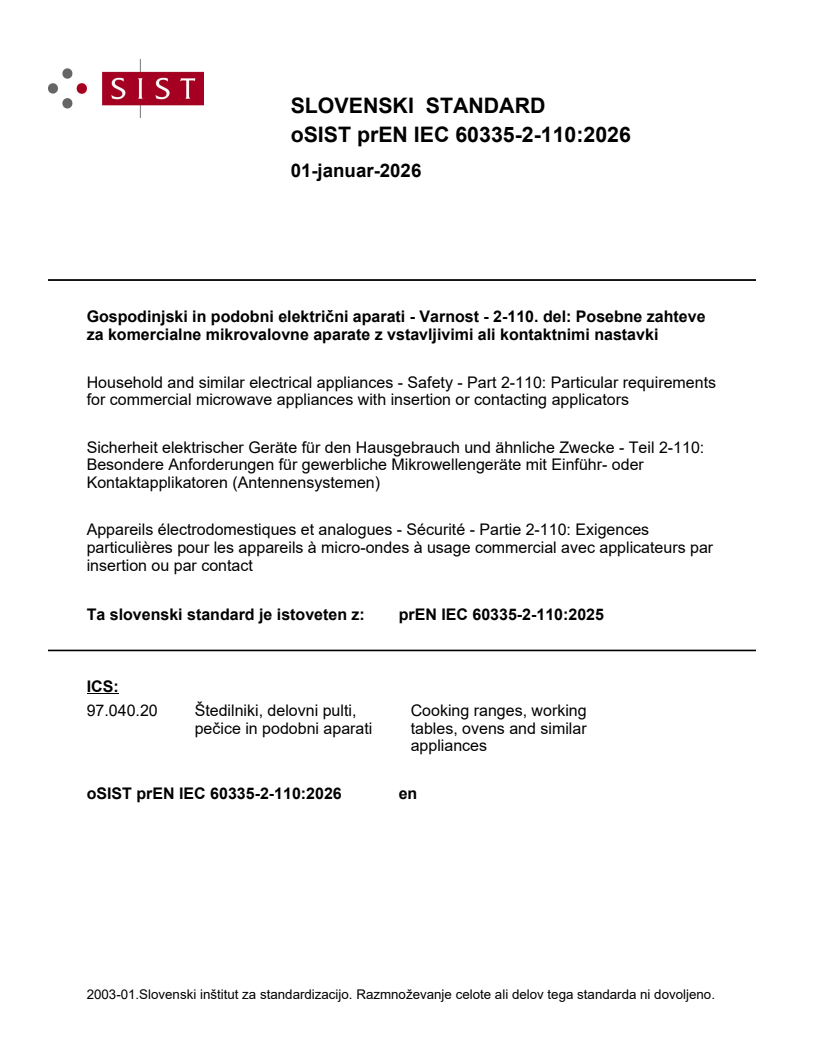
SLOVENSKI STANDARD
01-januar-2026
Gospodinjski in podobni električni aparati - Varnost - 2-110. del: Posebne zahteve
za komercialne mikrovalovne aparate z vstavljivimi ali kontaktnimi nastavki
Household and similar electrical appliances - Safety - Part 2-110: Particular requirements
for commercial microwave appliances with insertion or contacting applicators
Sicherheit elektrischer Geräte für den Hausgebrauch und ähnliche Zwecke - Teil 2-110:
Besondere Anforderungen für gewerbliche Mikrowellengeräte mit Einführ- oder
Kontaktapplikatoren (Antennensystemen)
Appareils électrodomestiques et analogues - Sécurité - Partie 2-110: Exigences
particulières pour les appareils à micro-ondes à usage commercial avec applicateurs par
insertion ou par contact
Ta slovenski standard je istoveten z: prEN IEC 60335-2-110:2025
ICS:
97.040.20 Štedilniki, delovni pulti, Cooking ranges, working
pečice in podobni aparati tables, ovens and similar
appliances
2003-01.Slovenski inštitut za standardizacijo. Razmnoževanje celote ali delov tega standarda ni dovoljeno.
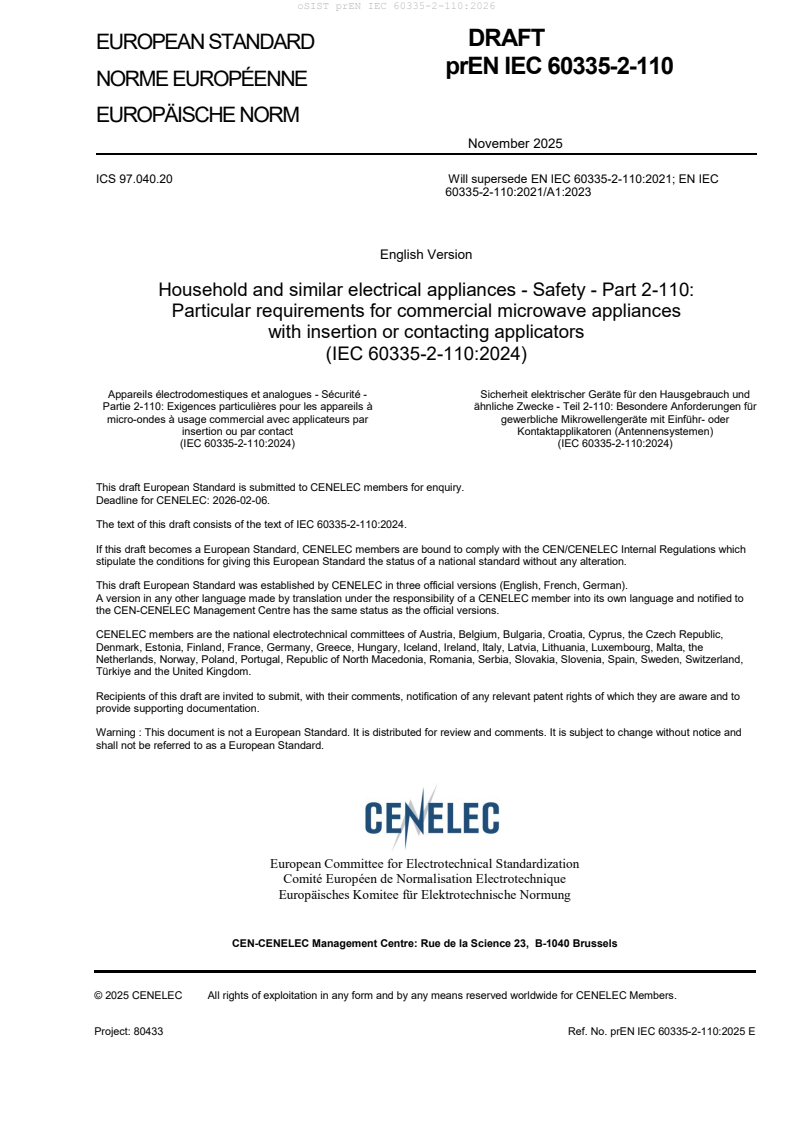
DRAFT
EUROPEAN STANDARD
prEN IEC 60335-2-110
NORME EUROPÉENNE
EUROPÄISCHE NORM
November 2025
ICS 97.040.20 Will supersede EN IEC 60335-2-110:2021; EN IEC
60335-2-110:2021/A1:2023
English Version
Household and similar electrical appliances - Safety - Part 2-110:
Particular requirements for commercial microwave appliances
with insertion or contacting applicators
(IEC 60335-2-110:2024)
Appareils électrodomestiques et analogues - Sécurité - Sicherheit elektrischer Geräte für den Hausgebrauch und
Partie 2-110: Exigences particulières pour les appareils à ähnliche Zwecke - Teil 2-110: Besondere Anforderungen für
micro-ondes à usage commercial avec applicateurs par gewerbliche Mikrowellengeräte mit Einführ- oder
insertion ou par contact Kontaktapplikatoren (Antennensystemen)
(IEC 60335-2-110:2024) (IEC 60335-2-110:2024)
This draft European Standard is submitted to CENELEC members for enquiry.
Deadline for CENELEC: 2026-02-06.
The text of this draft consists of the text of IEC 60335-2-110:2024.
If this draft becomes a European Standard, CENELEC members are bound to comply with the CEN/CENELEC Internal Regulations which
stipulate the conditions for giving this European Standard the status of a national standard without any alteration.
This draft European Standard was established by CENELEC in three official versions (English, French, German).
A version in any other language made by translation under the responsibility of a CENELEC member into its own language and notified to
the CEN-CENELEC Management Centre has the same status as the official versions.
CENELEC members are the national electrotechnical committees of Austria, Belgium, Bulgaria, Croatia, Cyprus, the Czech Republic,
Denmark, Estonia, Finland, France, Germany, Greece, Hungary, Iceland, Ireland, Italy, Latvia, Lithuania, Luxembourg, Malta, the
Netherlands, Norway, Poland, Portugal, Republic of North Macedonia, Romania, Serbia, Slovakia, Slovenia, Spain, Sweden, Switzerland,
Türkiye and the United Kingdom.
Recipients of this draft are invited to submit, with their comments, notification of any relevant patent rights of which they are aware and to
provide supporting documentation.
Warning : This document is not a European Standard. It is distributed for review and comments. It is subject to change without notice and
shall not be referred to as a European Standard.
European Committee for Electrotechnical Standardization
Comité Européen de Normalisation Electrotechnique
Europäisches Komitee für Elektrotechnische Normung
CEN-CENELEC Management Centre: Rue de la Science 23, B-1040 Brussels
© 2025 CENELEC All rights of exploitation in any form and by any means reserved worldwide for CENELEC Members.
Project: 80433 Ref. No. prEN IEC 60335-2-110:2025 E
prEN IEC 60335-2-110:2025 (E)
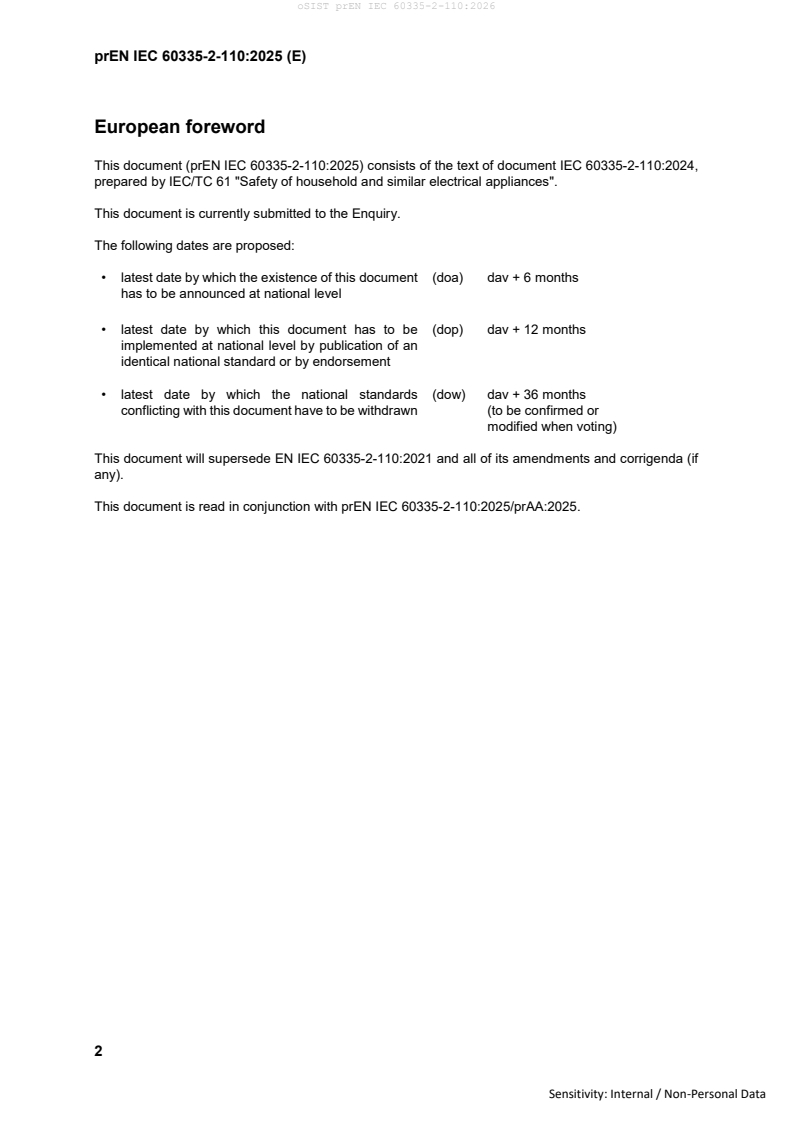
European foreword
This document (prEN IEC 60335-2-110:2025) consists of the text of document IEC 60335-2-110:2024,
prepared by IEC/TC 61 "Safety of household and similar electrical appliances".
This document is currently submitted to the Enquiry.
The following dates are proposed:
• latest date by which the existence of this document (doa) dav + 6 months
has to be announced at national level
• latest date by which this document has to be (dop) dav + 12 months
implemented at national level by publication of an
identical national standard or by endorsement
• latest date by which the national standards (dow) dav + 36 months
conflicting with this document have to be withdrawn (to be confirmed or
modified when voting)
This document will supersede EN IEC 60335-2-110:2021 and all of its amendments and corrigenda (if
any).
This document is read in conjunction with prEN IEC 60335-2-110:2025/prAA:2025.
Sensitivity: Internal / Non-Personal Data
IEC 60335-2-110 ®
Edition 2.0 2024-07
INTERNATIONAL
STANDARD
NORME
INTERNATIONALE
Household and similar electrical appliances – Safety –
Part 2-110: Particular requirements for commercial microwave appliances with
insertion or contacting applicators
Appareils électrodomestiques et analogues – Sécurité –
Partie 2-110: Exigences particulières pour les appareils à micro-ondes à usage
commercial avec applicateurs par insertion ou par contact
INTERNATIONAL
ELECTROTECHNICAL
COMMISSION
COMMISSION
ELECTROTECHNIQUE
INTERNATIONALE
ICS 97.040.20 ISBN 978-2-8322-9124-5
– 2 – IEC 60335-2-110:2024 © IEC 2024
CONTENTS
FOREWORD . 4
INTRODUCTION . 7
1 Scope . 8
2 Normative references . 9
3 Terms and definitions . 10
4 General requirement . 13
5 General conditions for the tests . 14
6 Classification . 14
7 Marking and instructions . 14
8 Protection against access to live parts . 18
9 Starting of motor-operated appliances . 18
10 Power input and current . 19
11 Heating . 19
12 Charging of metal-ion batteries . 19
13 Leakage current and electric strength at operating temperature . 19
14 Transient overvoltages . 19
15 Moisture resistance . 19
16 Leakage current and electric strength . 19
17 Overload protection of transformers and associated circuits . 20
18 Endurance . 20
19 Abnormal operation . 21
20 Stability and mechanical hazards . 22
21 Mechanical strength . 22
22 Construction . 24
23 Internal wiring . 27
24 Components . 27
25 Supply connection and external flexible cords . 27
26 Terminals for external conductors . 28
27 Provision for earthing . 28
28 Screws and connections . 29
29 Clearances, creepage distances and solid insulation . 29
30 Resistance to heat and fire . 30
31 Resistance to rusting . 30
32 Radiation, toxicity and similar hazards . 30
101 Protection against accessibility to microwave-containing regions . 31
Annexes . 40
Annex AA (informative) Rationales for the microwave barrier and associated leakage
tests . 41
Bibliography . 47
Figure 101 – Test rod for interlock concealment . 33
Figure 102 – Arrangement for measurement of microwave leakage . 34
IEC 60335-2-110:2024 © IEC 2024 – 3 –
Figure 103 – Construction site, overview of different applicator types and their use . 35
Figure 104 – Large area contacting applicator without traction drive . 36
Figure 105 – Large area contacting applicator with traction drive . 37
Figure 106 – Insertion applicator . 38
Figure 107 – Small area contacting applicator . 39
Table 101 – Assembling torques for screwed connections providing earthing continuity . 29
Table 102 – Specifications for microwave barriers . 32
– 4 – IEC 60335-2-110:2024 © IEC 2024
INTERNATIONAL ELECTROTECHNICAL COMMISSION
____________
HOUSEHOLD AND SIMILAR ELECTRICAL APPLIANCES –
SAFETY –
Part 2-110: Particular requirements for commercial microwave
appliances with insertion or contacting applicators
FOREWORD
1) The International Electrotechnical Commission (IEC) is a worldwide organization for standardization comprising
all national electrotechnical committees (IEC National Committees). The object of IEC is to promote international
co-operation on all questions concerning standardization in the electrical and electronic fields. To this end and
in addition to other activities, IEC publishes International Standards, Technical Specifications, Technical Reports,
Publicly Available Specifications (PAS) and Guides (hereafter referred to as “IEC Publication(s)”). Their
preparation is entrusted to technical committees; any IEC National Committee interested in the subject dealt with
may participate in this preparatory work. International, governmental and non-governmental organizations liaising
with the IEC also participate in this preparation. IEC collaborates closely with the International Organization for
Standardization (ISO) in accordance with conditions determined by agreement between the two organizations.
2) The formal decisions or agreements of IEC on technical matters express, as nearly as possible, an international
consensus of opinion on the relevant subjects since each technical committee has representation from all
interested IEC National Committees.
3) IEC Publications have the form of recommendations for international use and are accepted by IEC National
Committees in that sense. While all reasonable efforts are made to ensure that the technical content of IEC
Publications is accurate, IEC cannot be held responsible for the way in which they are used or for any
misinterpretation by any end user.
4) In order to promote international uniformity, IEC National Committees undertake to apply IEC Publications
transparently to the maximum extent possible in their national and regional publications. Any divergence between
any IEC Publication and the corresponding national or regional publication shall be clearly indicated in the latter.
5) IEC itself does not provide any attestation of conformity. Independent certification bodies provide conformity
assessment services and, in some areas, access to IEC marks of conformity. IEC is not responsible for any
services carried out by independent certification bodies.
6) All users should ensure that they have the latest edition of this publication.
7) No liability shall attach to IEC or its directors, employees, servants or agents including individual experts and
members of its technical committees and IEC National Committees for any personal injury, property damage or
other damage of any nature whatsoever, whether direct or indirect, or for costs (including legal fees) and
expenses arising out of the publication, use of, or reliance upon, this IEC Publication or any other IEC
Publications.
8) Attention is drawn to the Normative references cited in this publication. Use of the referenced publications is
indispensable for the correct application of this publication.
9) IEC draws attention to the possibility that the implementation of this document may involve the use of (a)
patent(s). IEC takes no position concerning the evidence, validity or applicability of any claimed patent rights in
respect thereof. As of the date of publication of this document, IEC had not received notice of (a) patent(s), which
may be required to implement this document. However, implementers are cautioned that this may not represent
the latest information, which may be obtained from the patent database available at https://patents.iec.ch. IEC
shall not be held responsible for identifying any or all such patent rights.
IEC 60335-2-110 has been prepared by subcommittee 61B: Safety of microwave appliances for
household and commercial use, of IEC technical committee 61: Safety of household and similar
electrical appliances. It is an International Standard.
This second edition cancels and replaces the first edition published in 2013 and
Amendment 1:2019. This edition constitutes a technical revision.
This edition includes the following significant technical changes with respect to the previous
edition:
– Subclause 7.1 has been improved in clarity.
– Subclauses 19.11.2 and 19.103 have been improved in clarity.
IEC 60335-2-110:2024 © IEC 2024 – 5 –
– Clause 28 has been modified to add screw requirements.
The text of this International Standard is based on the following documents:
Draft Report on voting
61B/688/CDV 61B/691A/RVC
Full information on the voting for its approval can be found in the report on voting indicated in
the above table.
The language used for the development of this International Standard is English.
This document was drafted in accordance with ISO/IEC Directives, Part 2, and developed in
accordance with ISO/IEC Directives, Part 1 and ISO/IEC Directives, IEC Supplement, available
at www.iec.ch/members_experts/refdocs. The main document types developed by IEC are
described in greater detail at www.iec.ch/publications.
A list of all parts of the IEC 60335 series, under the general title: Household and similar
electrical appliances – Safety, can be found on the IEC website.
This part 2 is to be used in conjunction with the latest edition of IEC 60335-1 and its
amendments unless that edition precludes it; in that case, the latest edition that does not
preclude it is used. It was established on the basis of the sixth edition (2020) of that standard.
NOTE 1 When "Part 1" is mentioned in this standard, it refers to IEC 60335-1.
This part 2 supplements or modifies the corresponding clauses in IEC 60335-1, so as to convert
that publication into the IEC standard: Particular requirements for commercial microwave
appliances with insertion or contacting applicators.
When a particular subclause of Part 1 is not mentioned in this part 2, that subclause applies as
far as is reasonable. When this standard states "addition", "modification" or "replacement", the
relevant text in Part 1 is to be adapted accordingly.
NOTE 2 The following numbering system is used:
– subclauses, tables and figures that are numbered starting from 101 are additional to those in Part 1;
– unless notes are in a new subclause or involve notes in Part 1, they are numbered starting from 101, including
those in a replaced clause or subclause;
– additional annexes are lettered AA, BB, etc.
NOTE 3 The following print types are used:
– requirements: in roman type;
– test specifications: in italic type;
– notes: in small roman type.
Words in bold in the text are defined in Clause 3. When a definition concerns an adjective, the adjective and the
associated noun are also in bold.
– 6 – IEC 60335-2-110:2024 © IEC 2024
The committee has decided that the contents of this document will remain unchanged until the
stability date indicated on the IEC website under webstore.iec.ch in the data related to the
specific document. At this date, the document will be
• reconfirmed,
• withdrawn, or
• revised.
NOTE 4 The attention of National Committees is drawn to the fact that equipment manufacturers and testing
organizations can need a transitional period following publication of a new, amended or revised IEC publication in
which to make products in accordance with the new requirements and to equip themselves for conducting new or
revised tests.
It is the recommendation of the committee that the content of this publication be adopted for implementation nationally
not earlier than 12 months or later than 36 months from the date of publication.
IMPORTANT – The "colour inside" logo on the cover page of this document indicates
that it contains colours which are considered to be useful for the correct understanding
of its contents. Users should therefore print this document using a colour printer.
IEC 60335-2-110:2024 © IEC 2024 – 7 –
INTRODUCTION
It has been assumed in the drafting of this International Standard that the execution of its
provisions is entrusted to appropriately qualified and experienced persons.
Guidance documents concerning the application of the safety requirements for appliances can
be accessed via TC 61 and SC 61B supporting documents on the IEC website
https://www.iec.ch/tc61/supportingdocuments
https://www.iec.ch/sc61b/supportingdocuments
This information is given for the convenience of users of this International Standard and does
not constitute a replacement for the normative text in this standard.
This standard recognizes the internationally accepted level of protection against hazards such
as electrical, mechanical, thermal, fire and radiation of appliances when operated as in normal
use taking into account the manufacturer's instructions. It also covers abnormal situations that
can be expected in practice and takes into account the way in which electromagnetic
phenomena can affect the safe operation of appliances.
This standard takes into account the requirements of IEC 60364 as far as possible so that there
is compatibility with the wiring rules when the appliance is connected to the supply mains.
However, national wiring rules can differ.
If an appliance within the scope of this standard also incorporates functions that are covered
by another part 2 of IEC 60335, the relevant part 2 is applied to each function separately, as
far as is reasonable. If applicable, the influence of one function on the other is taken into
account.
When a part 2 standard does not include additional requirements to cover hazards dealt with in
Part 1, Part 1 applies.
NOTE 1 This means that the technical committees responsible for the part 2 standards have determined that it is
not necessary to specify particular requirements for the appliance in question over and above the general
requirements.
This standard is a product family standard dealing with the safety of appliances and takes
precedence over horizontal and generic standards covering the same subject.
NOTE 2 Horizontal publications, basic safety publications and group safety publications covering a hazard are not
applicable since they have been taken into consideration when developing the general and particular requirements
for the IEC 60335 series of standards.
An appliance that complies with the text of this standard will not necessarily be considered to
comply with the safety principles of the standard if, when examined and tested, it is found to
have other features which impair the level of safety covered by these requirements.
An appliance employing materials or having forms of construction differing from those detailed
in the requirements of this standard may be examined and tested according to the intent of the
requirements and, if found to be substantially equivalent, may be considered to comply with the
standard.
NOTE 3 Standards dealing with non-safety aspects of household appliances are:
– IEC standards published by TC 59 concerning methods of measuring performance;
– CISPR 11, CISPR 14-1 and relevant IEC 61000-3 series standards concerning electromagnetic emissions;
– CISPR 14-2 concerning electromagnetic immunity;
– IEC standards published by TC 111 concerning environmental matters.
– 8 – IEC 60335-2-110:2024 © IEC 2024
HOUSEHOLD AND SIMILAR ELECTRICAL APPLIANCES –
SAFETY –
Part 2-110: Particular requirements for commercial microwave
appliances with insertion or contacting applicators
1 Scope
This clause of Part 1 is replaced by the following.
This part of IEC 60335 deals with the safety of microwave appliances intended for commercial
use, their rated voltage being not more than 250 V for single-phase appliances connected
between one phase and neutral and 480 V for other appliances.
As far as is practicable, this standard deals with the common hazards presented by these types
of appliances.
Appliances covered by this standard incorporate an open-ended applicator (as example an
overview is given in Figure 103) for treatment of the load. They are divided into three types:
– with insertion applicator, typically for moisture removal by insertion into holes in floors,
walls or ceilings (an example is given in Figure 106);
– with large area contacting applicator, typically for drying of floors, walls or ceilings
(examples are given in Figure 104 and Figure 105);
– with small area contacting applicator, typically for paint removal and spot-heating (an
example is given in Figure 107).
Microwave appliances with insertion applicator, large area contacting applicator or small
area contacting applicator are using electromagnetic energy in one or several of the ISM
frequency bands between 300 MHz and 30 GHz, for supplying energy to an external load which
is heated so that a resulting process of drying, moisture transport which can result in forces
due to formation of steam, decomposition or chemical modification, melting, or termination of
organisms such as bacteria or fungus occurs.
NOTE 101 ISM frequency bands are the electromagnetic frequencies established by the ITU and reproduced in
CISPR 11.
NOTE 102 Food and beverages are not loads in the meaning of this standard.
Appliances with insertion applicator and with large area contacting applicator are portable
appliances. Appliances with small area contacting applicator are handheld appliances.
Appliances that use non-electrical energy are within the scope of this standard. The microwave-
related portion is considered motor-operated.
The rationales for the microwave barrier and associated leakage tests are described in
informative Annex AA.
Attention is drawn to the fact that
– these appliances can radiate microwave energy outside a restricted area where they are
used. The additional requirements specified by national authorities responsible for the
protection for non-ionising radiation that the limit of power flux density is 10 W/m , averaged
over any time period of 6 min, outside this restricted area is taken into consideration in this
standard;
IEC 60335-2-110:2024 © IEC 2024 – 9 –
– these appliances are intended to exclusively treat the load in normal operation, i.e. this
standard does not apply to appliances or systems employing free space microwave
propagation;
– for appliances intended to be used in tropical countries, special requirements can be
necessary;
– in many countries, additional requirements are specified by the national health authorities,
and national authorities responsible for the protection of labour and for non-ionising
radiation protection.
This standard does not apply to
– household microwave ovens, including combination microwave ovens (IEC 60335-2-25);
– commercial microwave ovens with a cavity door, commercial combination microwave ovens
with a cavity door and commercial microwave ovens without a cavity door and with
transportation means (IEC 60335-2-90);
– industrial microwave heating equipment (IEC 60519-6);
– appliances for medical purposes (IEC 60601-1);
– appliances and equipment for laboratory use (IEC 61010 series);
– appliances intended to be used in locations where special conditions prevail, such as the
presence of a corrosive or explosive atmosphere (dust, vapour or gas);
Some of the specifications and tests in this standard are not applicable for other than 2 450 MHz
appliances.
2 Normative references
This clause of Part 1 is applicable except as follows.
Addition:
IEC 60335-2-90, Household and similar electrical appliances – Safety – Part 2-90: Particular
requirements for commercial microwave ovens
ISO 898-1, Mechanical properties of fasteners made of carbon steel and alloy steel – Part 1:
Bolts, screws and studs with specified property classes – Coarse thread and fine pitch thread
ISO 3506-1, Fasteners − Mechanical properties of corrosion-resistant stainless steel fasteners
− Part 1: Bolts, screws and studs with specified grades and property classes
ISO 3506-2, Fasteners − Mechanical properties of corrosion-resistant stainless steel fasteners
− Part 2: Nuts with specified grades and property classes
ISO 3506-3, Mechanical properties of corrosion-resistant stainless steel fasteners – Part 3: Set
screws and similar fasteners not under tensile stress
ISO 3506-4, Mechanical properties of corrosion-resistant stainless steel fasteners – Part 4:
Tapping screws
ISO 3864-1, Graphical symbols – Safety colours and safety signs – Part 1: Design principles
for safety signs and safety markings
ISO 7010, Graphical symbols – Safety colours and safety signs – Registered safety signs
– 10 – IEC 60335-2-110:2024 © IEC 2024
3 Terms and definitions
This clause of Part 1 is applicable except as follows.
3.1 Definitions relating to physical characteristics
3.1.7
Note 101 to entry: The rated frequency is the input frequency.
3.1.9
Modification:
Replace the first paragraph by the following.
heating operation of the appliance under the following conditions:
The appliance is operated according to the manufacturer’s instructions for intended use.
However, using a typical load for intended use can be impractical, since it can be part of a
building, unless the manufacturer makes useful and realistic such loads available for the tests.
If that is not the case, the appliance is operated under the following conditions:
The initial temperature of the test load which is used for microwave energy absorption shall be
(20 ± 5) °C.
The highest generator power settings are to be used.
Appliances with an insertion applicator for moisture removal are operated by insertion into
holes in floor, wall or ceiling structures under the following conditions:
a) The test load consists of a metal tank filled with water, having an open top water surface
exceeding that of the horizontal dimensions of the appliance by at least 70 mm on all sides
and having a water column height of at least 150 mm plus the length of the longest insertion
distance of the insertion applicator. At the top sides of the tank there are horizontal
supports of a microwave-transparent material, with a suitable opening for the applicator
antenna. The water level is adjusted so that the distance from the housing of the appliance
to the test load is the same as in its intended use.
Note 101 to entry: If it is obvious that good microwave impedance matching of the insertion applicator can be
obtained only if the hole into which it is inserted is not water-filled, a sleeve or similar of a highly microwave
transparent material such as PTFE is used around the insertion applicator. If wave propagation in the axial
direction occurs in the test set-up and the manufacturer can show that it is not possible in actual use, or
monitoring devices then shut down the insertion applicator, a thin-wall plastic tube with inner diameter
corresponding to the maximum hole diameter according to the manufacturer’s specification can be used.
b) Appliances with large area contacting applicator for drying of floor, wall or ceiling
structures are operated under the following conditions: the test load consists of a metal tank
filled with water, having an open top water surface exceeding that of the horizontal
dimensions of the appliance by at least 70 mm on all sides and having a water column height
of at least 150 mm. At the top of two opposite tank sides there are horizontal supports of a
microwave-transparent material, extending just so far inwards that the traction drive rests
on the support. The water level is adjusted so that the distance from the applicator to the
test load is the same as in its intended use. The proper reversal function of the traction
drive is tested under the following conditions: the appliance is operated on a horizontal
plywood surface with a thickness of 20 mm and an area sufficient to allow back and forth
movement between blocks representing walls.
Note 102 to entry: If needed for representative operation of the appliance, the horizontal supports are extended
as to activate the mechanical microwave interlocks.
Appliances with small area contacting applicator for paint removal and spot-heating are
operated under the following conditions:
IEC 60335-2-110:2024 © IEC 2024 – 11 –
The test load consists of a grinding wheel or grinding block made of fine-grained silicon carbide
at least 15 mm in thickness, and its length and width exceeding the corresponding dimensions
of the applicator opening by at least 30 mm; however this test load shall be so large that it can
be air-cooled from the underside without the appliance being influenced.
3.1.101
rated microwave power output
microwave power output assigned to the appliance by the manufacturer
Note 1 to entry: This can be lower than the available microwave power, due to intentional microwave power losses
in microwave absorbers (see Note in 101.1) and coaxial cables acting for protection of the microwave generator of
small area contacting applicators (see 22.101).
3.1.102
available microwave power
microwave generator nominal output under impedance matched condition which is obtained by
the generator manufacturer specification and measurement of its electrical input to the
generator in the appliance during the first 10 s of operation at maximum power
Note 1 to entry: Magnetrons will typically have a stationary power output 3 s after energising.
3.6 Definitions relating to parts of an appliance
3.6.101
applicator
structure which applies the microwave energy to the load
3.6.102
microwave transparent
property of a material having negligible absorption and reflection of microwaves
Note 1 to entry: The relative permittivity of a microwave transparent material is less than 7 and the relative loss
factor is less than 0,015.
3.6.103
insertion applicator
applicator for insertion into the load, in which all available microwave power is intended to
be absorbed
3.6.104
large area contacting applicator
applicator with a metallic enclosure, having at least one geometric non-metallic opening
through which microwave energy is applied to a closely located external load in which all
available microwave power is intended to be absorbed
3.6.105
small area contacting applicator
applicator with a metallic enclosure, having at least one geometric non-metallic opening or
appropriate device through which microwave energy is applied to a very closely located external
load in which all rated microwave power is intended to be absorbed
3.6.106
traction drive
means or system used to accomplish movement of an appliance with large area contacting
applicator on a floor
– 12 – IEC 60335-2-110:2024 © IEC 2024
3.6.107
microwave enclosure
overall structure that is intended to confine the microwave energy
Note 1 to entry: Barriers mounted outside the microwave enclosure are not considered a part of it.
3.6.108
microwave barrier
microwave transparent part of the microwave appliance that is mounted outside the
microwave enclosure for limiting access into it and can only be removed with the aid of tools
Note 1 to entry: A microwave barrier can be mounted between the microwave enclosure and the external cover
of the appliance.
Note 2 to entry: Devices such as an array of metal chains or hinged metal plates at the periphery of the opening of
an applicator intended to reduce microwave leakage are not considered microwave barriers.
Note 3 to entry: Microwave barriers cannot be hinged or flexed.
3.6.109
microwave guard
constructive part of the appliance that is mounted outside or at the microwave enclosure for
reducing microwave leakage by shielding and/or absorption and can only be removed with the
aid of tools
Note 1 to entry: Microwave guards can move or open when the applicator is brought into contact with the load.
Note 2 to entry: Devices such as an array of metal chains or hinged metal plates at the periphery of the opening of
an applicator intended to reduce microwave leakage are considered microwave guards.
3.6.110
maintenance door
constructive part of the appliance that can be opened or removed with the aid of tools to get
access for service and repair
3.6.111
microwave interlock
device or system that prevents the operation of the microwave generator if conditions of
microwave leakage occur or are likely to occur
Note 1 to entry: Examples of microwave interlock are switches which stop the microwave power when a contacting
applicator is lifted up or an insertion applicator is removed from its load during operation, and an integral leakage
monitor which does the same if there is insufficient proximity between an applicator and the load or if an attempt is
made to start the appliance without a load.
3.6.112
viewing opening
opening into the applicator through which the treatment can be visually monitored
3.8 Definitions relating to miscellaneous matters
3.8.101
load
object to be treated into which the applicator is introduced or put in close position to
3.8.102
instructed person
person who is instructed and monitored to know how to avoid any danger caused by the
operation of a microwave appliance with insertion applicator, large area contacting
applicator, or small area contacting applicator
IEC 60335-2-110:2024 © IEC 2024 – 13 –
3.8.103
skilled person
person with professional education, knowledge and experience to discern and to avoid any
danger caused by the operation of a microwave appliance with insertion applicator, large area
contacting applicator, or small area contacting applicator
3.8.104
ordinary person
person who is neither a skilled person nor an instructed person
3.8.105
intended use
any use of the appliance which is foreseeable, as described in the user instructions, and which
is consistent with such activities as operating, starting, stopping, connecting to or disconnecting
from the supply mains
3.8.106
user control
any control device requiring the operator’s actuation to perform specific functions
3.8.107
restricted area
space where the operation of the equipment takes place, plus any area outside this where the
exposure level from the equipment exceeds 10 W/m , averaged over any 6 min
Note 1 to entry: The restricted area is determined by measuring the microwave leakage through floor, wall or
ceiling structures of the treatment zone. The thickness of the load in the radially outgoing direction from the
applicator is considered only if the load is accessible from behind for microwave leakage measurements in normal
operation.
3.8.108
biased-off switch
switch that automatically returns to the off-position when its actuating member is released
3.8.109
start switch
biased-off switch that shall be actuated by the operator before the operation switch will
function
3.8.110
operation switch
biased-off switch designed so that it will automatically disconnect the microwave generator or
the supply main circuit when the operator’s actuating force is removed
4 General requirement
This clause of Part 1 is applicable except as follows.
4.101 Instead of the requirements on supervision of the microwave interlocks by monitored
microwave interlocks as in IEC 60335-2-90, this standard applies the concepts of restricted
area and microwave leakage checks of microwave interlock function for large area
contacting applicators and insertion applicators – and start switch as well as operation
switch for small area contacting applicators.
– 14 – IEC 60335-2-110:2024 © IEC 2024
5 General conditions for the tests
This clause of Part 1 is applicable except as follows.
5.3 Modification:
Instead of carrying out the tests in the order of clauses, the following sequence of clauses and
subclauses applies: Clause 32, 22.107, Clause 101, Clauses 7 to 17, Clause 20, Clause 21,
Clause 18, Clause 19, Clause 22 (except 22.107), Clauses 23 to 31.
NOTE 101 Clause 101 deals with the protection against leakage by basic design of microwave enclosures;
Clause 22 deals with the additional requirements applicable when handling and against improper handling of the
appliance, and against other hazards caused by the microwaves; 32.1 deals with the leakage measurement
instrumentation and handling, plus limiting values.
5.101 The microwave-related portion of the appliance is considered motor-operated.
6 Classification
This clause of Part 1 is applicable except as follows.
6.1 Modification:
Microwave appliances shall be class I.
6.2 Addition:
Large area contacting applicators and insertion applicators shall be at least IPX1. Small
area contacting applicators shall be at least IPX5.
7 Marking and instructions
This clause of Part 1 is applicable except as follows.
7.1
Modification:
Add the following new dashed item and text before the last dashed item of the first list of Part 1:
– substance of the following warnings, if applicable:
• WARNING: Switch off and remove plug from mains before adjusting, cleaning or if
the cord is entangled or damaged.
• WARNING: Keep the flexible supply cord away from the microwave-energised parts.
Addition:
Where appropriate IEC/ISO symbols or pictograms are available, they can be used.
Modification:
Add the following new text before the compliance paragraph:
Where appropriate, appliances shall be marked with symbols ISO 7000-0434A (2004-01) and
IEC 60417-6167 (2012-07).
IEC 60335-2-110:2024 © IEC 2024 – 15 –
Appliances shall be marked with the nominal frequency in megahertz of the ISM band in which
they operate.
Appliances shall be marked with the rated microwave power output.
Appliances shall be marked on an affixed inspection tag or label, with the date when the latest
complying microwave leakage and function test in accordance with the service manual was
carried out.
Compliance is checked by inspection.
7.6 Addition:
[symbol IEC 60417-6166 caution, non-ionizing electromagnetic
(2012-07)] radiation; caution, microwave
radiation
[symbol IEC 60417-6167 keep out of microwave radiation
(2012-07)]
[symbol ISO 7010-P004 no thoroughfare
(2011-05)]
7.12 Addition:
The instructions shall include the substance of the following.
– WARNING: If microwave barriers or microwave guards are damaged, the appliance must
not be operated until repairs by a skilled person have been carried out;
– WARNING: It is hazardous for anyone other than a skilled person to carry out any service
or repair operation that involves the removal of any cover or barrier which gives protection
against exposure to microwave energy;
– if smoke is observed, switch off or unplug the appliance;
– failure to maintain the appliance in a clean condition could lead to deterioration that could
adversely affect the life of the appliance and possibly result in a hazardous situation;
– the appliance shall not be cleaned with a water jet.
Appliances shall be operated only by instructed persons or skilled persons.
An instruction sheet shall be supplied with the appliance.
The instructions shall include:
a) those warnings required to be marked on the appliance tog
...
Questions, Comments and Discussion
Ask us and Technical Secretary will try to provide an answer. You can facilitate discussion about the standard in here.
Loading comments...