

SIST EN 50730:2025
(Main)Professional and commercial coffee machines - Methods for measuring energy consumption and productivity
General Information
- Abstract
This document defines methodologies to measure the energy consumption and productivity of coffee machines based on their characteristics.
This document applies to professional and commercial coffee machines used, for example, in kitchens and food preparation areas in restaurants, canteens, hotels, coffee shops, breakfast rooms.
This document does not apply to:
- household appliances;
- machines that use only coffee pods or coffee capsules;
- machines powered by non-electrical energy (i.e. gas);
- vending machines for hot beverages;
- milk refrigerators integrated or not into traditional machines;
- accessory equipment provided together with the machine (e.g. cup warmer, milk refrigerator) physically separated from the machine.
- Status
- Published
- Public Enquiry End Date
- 30-Jan-2024
- Publication Date
- 13-May-2025
- Technical Committee
- FGA - Consumer information related to household electrical appliances
- Current Stage
- 6060 - National Implementation/Publication (Adopted Project)
- Start Date
- 08-May-2025
- Due Date
- 13-Jul-2025
- Completion Date
- 14-May-2025

Overview - EN 50730:2025 (CLC)
EN 50730:2025 defines standardized methods to measure energy consumption and productivity of professional and commercial coffee machines. Prepared by CLC/TC 59X and approved by CENELEC, it applies to machines used in restaurants, hotels, canteens, coffee shops and similar food-preparation settings. The standard provides repeatable laboratory procedures, measurement conditions and calculation methods to compare machines on energy use and cup output.
Not applicable to: household appliances; machines using only pods/capsules; gas‑powered machines; vending machines for hot beverages; (integrated or separate) milk refrigerators; physically separated accessory equipment (e.g., cup warmers).
Key topics and technical requirements
- Test scope & definitions: clear classification of machine types (fully automatic, traditional, cold machine) and operating modes (ready machine, energy saving mode).
- Beverage parameters: requirements and measurement of beverage temperature, quantity (mass) and delivery time.
- Delivery cycles & buffer times: standardized sequences such as 6-2-20, 11-2-20, 21-2-20 and delivery control cycle 16-2-20; buffer times defined (SBT = 2 min, MBT = 20 min, LBT = 60 min).
- Testing conditions: ambient conditions, power supply voltage, water quality, laboratory measurement equipment and beaker specifications (ISO 7056 referenced).
- Test procedures: heating test, delivery tests, energy saving and delivery control tests, hydraulic circuit cleaning test, soft-off test, productivity test and ready condition test.
- Calculations: ready machine energy, energy per cup, energy in saving mode, productivity calculations and daily energy scenarios.
- Annexes: normative and informative annexes include conditions of use, example test reports, manufacturer information to supply to test labs, and worked calculation examples.
Practical applications - who uses EN 50730:2025
- Manufacturers - design validation, energy performance claims, product datasheets and in-house testing protocols.
- Test laboratories & certification bodies - repeatable test methods for compliance testing and verification.
- Purchasers and specifiers (hotels, restaurants, coffee chains) - objective comparisons of energy consumption and throughput when choosing equipment.
- Energy auditors & sustainability managers - estimating daily energy consumption and cost/CO₂ implications.
- Regulators & standards bodies - using harmonized methods for market surveillance and product policy.
Related standards & references
- ISO 7056:1981 (beaker specifications) is normative in EN 50730.
- Developed under CENELEC oversight (CLC/TC 59X); national adoption required by member bodies.
Keywords: EN 50730:2025, professional coffee machines, energy consumption measurement, productivity test methods, CLC, CENELEC.
Frequently Asked Questions
SIST EN 50730:2025 is a standard published by the Slovenian Institute for Standardization (SIST). Its full title is "Professional and commercial coffee machines - Methods for measuring energy consumption and productivity". This standard covers: This document defines methodologies to measure the energy consumption and productivity of coffee machines based on their characteristics. This document applies to professional and commercial coffee machines used, for example, in kitchens and food preparation areas in restaurants, canteens, hotels, coffee shops, breakfast rooms. This document does not apply to: - household appliances; - machines that use only coffee pods or coffee capsules; - machines powered by non-electrical energy (i.e. gas); - vending machines for hot beverages; - milk refrigerators integrated or not into traditional machines; - accessory equipment provided together with the machine (e.g. cup warmer, milk refrigerator) physically separated from the machine.
This document defines methodologies to measure the energy consumption and productivity of coffee machines based on their characteristics. This document applies to professional and commercial coffee machines used, for example, in kitchens and food preparation areas in restaurants, canteens, hotels, coffee shops, breakfast rooms. This document does not apply to: - household appliances; - machines that use only coffee pods or coffee capsules; - machines powered by non-electrical energy (i.e. gas); - vending machines for hot beverages; - milk refrigerators integrated or not into traditional machines; - accessory equipment provided together with the machine (e.g. cup warmer, milk refrigerator) physically separated from the machine.
SIST EN 50730:2025 is classified under the following ICS (International Classification for Standards) categories: 97.040.50 - Small kitchen appliances. The ICS classification helps identify the subject area and facilitates finding related standards.
SIST EN 50730:2025 is available in PDF format for immediate download after purchase. The document can be added to your cart and obtained through the secure checkout process. Digital delivery ensures instant access to the complete standard document.
Standards Content (Sample)
SLOVENSKI STANDARD
01-junij-2025
Profesionalni in komercialni kavni aparati - Metode za merjenje porabe energije in
produktivnosti
Professional and commercial coffee machines - Methods for measuring energy
consumption and productivity
Professionelle und gewerbliche Kaffeemaschinen - Messmethoden für Energieverbrauch
und Produktivität
Machines à café professionnelles et commerciales - Méthodes pour mesurer la
consommation énergétique et la productivité
Ta slovenski standard je istoveten z: EN 50730:2025
ICS:
97.040.50 Majhni gospodinjski aparati Small kitchen appliances
2003-01.Slovenski inštitut za standardizacijo. Razmnoževanje celote ali delov tega standarda ni dovoljeno.
EUROPEAN STANDARD EN 50730
NORME EUROPÉENNE
EUROPÄISCHE NORM April 2025
ICS 97.040.50
English Version
Professional and commercial coffee machines - Methods for
measuring energy consumption and productivity
Machines à café professionnelles et commerciales - Professionelle und gewerbliche Kaffeemaschinen -
Méthodes pour mesurer la consommation énergétique et la Messmethoden für Energieverbrauch und Produktivität
productivité
This European Standard was approved by CENELEC on 2025-02-10. CENELEC members are bound to comply with the CEN/CENELEC
Internal Regulations which stipulate the conditions for giving this European Standard the status of a national standard without any alteration.
Up-to-date lists and bibliographical references concerning such national standards may be obtained on application to the CEN-CENELEC
Management Centre or to any CENELEC member.
This European Standard exists in three official versions (English, French, German). A version in any other language made by translation
under the responsibility of a CENELEC member into its own language and notified to the CEN-CENELEC Management Centre has the
same status as the official versions.
CENELEC members are the national electrotechnical committees of Austria, Belgium, Bulgaria, Croatia, Cyprus, the Czech Republic,
Denmark, Estonia, Finland, France, Germany, Greece, Hungary, Iceland, Ireland, Italy, Latvia, Lithuania, Luxembourg, Malta, the
Netherlands, Norway, Poland, Portugal, Republic of North Macedonia, Romania, Serbia, Slovakia, Slovenia, Spain, Sweden, Switzerland,
Türkiye and the United Kingdom.
European Committee for Electrotechnical Standardization
Comité Européen de Normalisation Electrotechnique
Europäisches Komitee für Elektrotechnische Normung
CEN-CENELEC Management Centre: Rue de la Science 23, B-1040 Brussels
© 2025 CENELEC All rights of exploitation in any form and by any means reserved worldwide for CENELEC Members.
Ref. No. EN 50730:2025 E
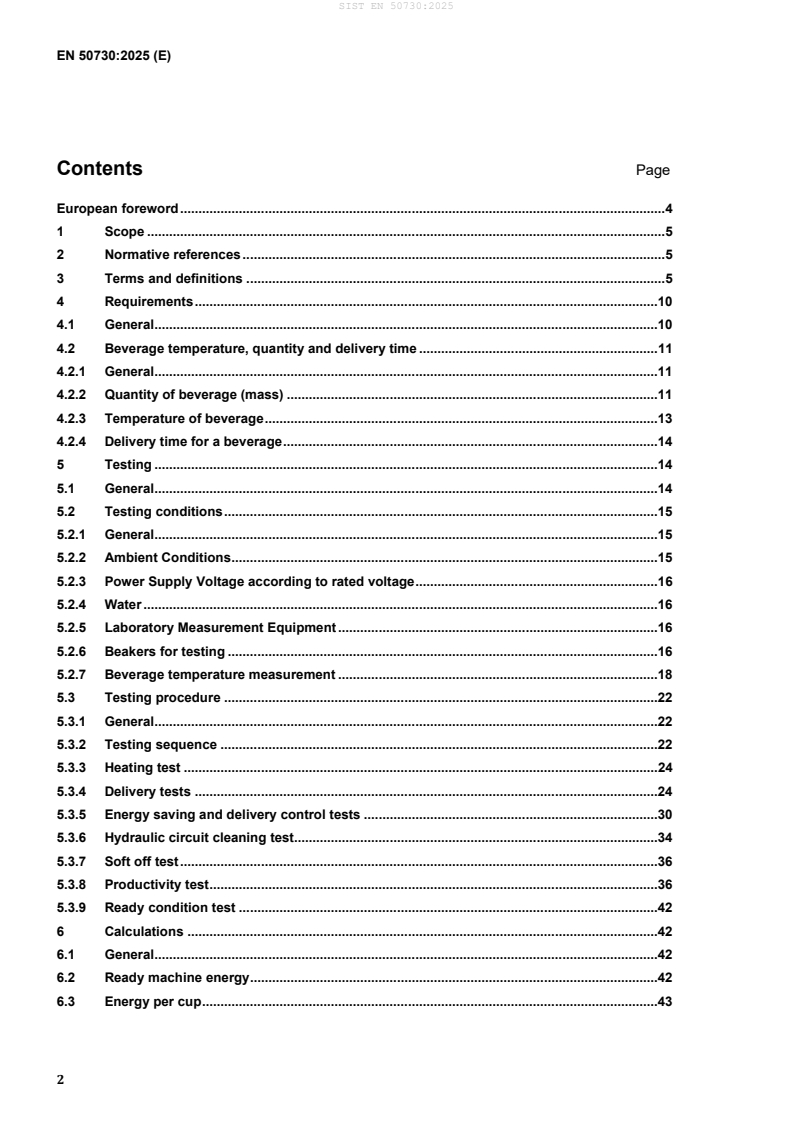
Contents Page
European foreword . 4
1 Scope . 5
2 Normative references . 5
3 Terms and definitions . 5
4 Requirements .10
4.1 General .10
4.2 Beverage temperature, quantity and delivery time .11
4.2.1 General .11
4.2.2 Quantity of beverage (mass) .11
4.2.3 Temperature of beverage .13
4.2.4 Delivery time for a beverage .14
5 Testing .14
5.1 General .14
5.2 Testing conditions .15
5.2.1 General .15
5.2.2 Ambient Conditions .15
5.2.3 Power Supply Voltage according to rated voltage .16
5.2.4 Water .16
5.2.5 Laboratory Measurement Equipment .16
5.2.6 Beakers for testing .16
5.2.7 Beverage temperature measurement .18
5.3 Testing procedure .22
5.3.1 General .22
5.3.2 Testing sequence .22
5.3.3 Heating test .24
5.3.4 Delivery tests .24
5.3.5 Energy saving and delivery control tests .30
5.3.6 Hydraulic circuit cleaning test.34
5.3.7 Soft off test .36
5.3.8 Productivity test .36
5.3.9 Ready condition test .42
6 Calculations .42
6.1 General .42
6.2 Ready machine energy .42
6.3 Energy per cup .43
6.4 Energy in energy saving mode . 44
6.5 Productivity calculations . 45
Annex A (normative) Conditions of use of measurements and calculations from this document 47
A.1 General . 47
A.1 Data validity domain . 47
A.2 Typical day . 47
A.3 Total daily energy consumption . 47
Annex B (informative) Example of test reports . 49
Annex C (normative) Information to be provided by the manufacturer to the laboratory . 52
Annex D (informative) Examples of calculations for energy consumption of a coffee machine and
energy per cup for each type of beverage, in one day of use of the coffee machine . 53
D.1 General . 53
D.2 Example of a day of use of a coffee machine . 54
D.3 Example of total number of cups delivered in a 24 h day of use of a coffee machine
depending on machine type and machine rating . 57
D.4 Example of number of cups representing mix of beverages delivered in a 24 h day of use
of a coffee machine depending on machine type, machine rating and deliverable beverages
...................................................................................................................................................... 58
D.5 Example of calculation of total energy in a 24 h day of use of a coffee machine . 59
European foreword
This document (EN 50730:2025) has been prepared by CLC/TC 59X “Performance of household and similar
electrical appliances”.
The following dates are fixed:
• latest date by which this document has to be (dop) 2026-04-30
implemented at national level by publication of
an identical national standard or by
endorsement
• latest date by which the national standards (dow) 2028-04-30
conflicting with this document have to be
withdrawn
Attention is drawn to the possibility that some of the elements of this document may be the subject of patent
rights. CENELEC shall not be held responsible for identifying any or all such patent rights.
Any feedback and questions on this document should be directed to the users’ national committee. A complete
listing of these bodies can be found on the CENELEC website.
1 Scope
This document defines methodologies to measure the energy consumption and productivity of coffee machines
based on their characteristics.
This document applies to professional and commercial coffee machines used, for example, in kitchens and food
preparation areas in restaurants, canteens, hotels, coffee shops, breakfast rooms.
This document does not apply to:
— household appliances;
— machines that use only coffee pods or coffee capsules;
— machines powered by non-electrical energy (i.e. gas);
— vending machines for hot beverages;
— milk refrigerators integrated or not into traditional machines;
— accessory equipment provided together with the machine (e.g. cup warmer, milk refrigerator) physically
separated from the machine.
2 Normative references
The following documents are referred to in the text in such a way that some or all of their content constitutes
requirements of this document. For dated references, only the edition cited applies. For undated references, the
latest edition of the referenced document (including any amendments) applies.
ISO 7056:1981, Plastics laboratory ware — Beakers
3 Terms and definitions
For the purposes of this document, the following terms and definitions apply
ISO and IEC maintain terminology databases for use in standardization at the following addresses:
• ISO Online browsing platform: available at https://www.iso.org/obp
• IEC Electropedia: available at https://www.electropedia.org/
3.1 Coffee machine types
3.1.1
fully automatic machine
coffee machine, other than a vending machine, in which the preparation of the coffee starting from the
ingredients up to the delivered beverage is fully controlled by the machine based on the input of the user
Note 1 to entry: The user typically places a cup underneath and presses a button, and the machine does the rest.
3.1.2
traditional machine
coffee machine in which the preparation of coffee requires pressurized hot water to pass through grinded coffee
by one or more interventions of the user in process of preparation and delivery of coffee
EXAMPLES For intervention of the user the examples are manually filling of grinded coffee in the portafilter and manually
emptying after the dispensing of the coffee.
Note 1 to entry: The user prepares coffee (properly grounded), put it into portafilter and mounts the portafilter on the coffee
machine, then presses the button.
3.1.3
cold machine
switched off machine, mounted inside the testing chamber, left at testing conditions for a time of
16h00 min ± 10 min from the end of a heating phase of the machine, all delivery groups on, that lasted at least
1h
3.2
end of beverage delivery
time when the continuous flow of the delivery of the liquid beverage stops
Note 1 to entry: This is not the last drop of beverage delivered.
Note 2 to entry: This is not applicable in case of steam wand hot milk.
3.3
delivery time
time from when the command to deliver a beverage is given to the machine to the end of beverage delivery
EXAMPLE For command to deliver a beverage: press a button, activate a lever.
Note 1 to entry: The delivery time ends when the continuous flow stops, not the last drop, see 3.2.
3.5 Milk
3.5.1
cold milk
UHT cow liquid milk with a level of fat of 2,5 % to 4 %, a temperature of 5 °C ± 2 °C
Note 1 to entry: UHT means Ultra High Temperature.
3.5.2
direct hot milk
milk delivered by coffee machine by heating up cold milk
Note1 to entry: Milk is heated up by steam or by heat exchanger inside the machine.
3.5.3
steam wand hot milk
milk heated up by steam from steam wand inserted into a beaker of cold milk
Note1 to entry: In some machines the control of steam from steam wand is automatic, in other machines it is a manual one.
3.6 Buffer times and delivery cycles
3.6.1
short buffer time
SBT
2 min between the starting of one delivery and the starting of the next one within the same delivery cycle
3.6.2
medium buffer time
MBT
20 min between the starting of the last delivery of one delivery cycle and the starting of the first delivery of the
next delivery cycle or the starting of the next test
3.6.3
long buffer time
LBT
60 min between the starting of the last delivery of one test and the starting of the first delivery of the next test or
the starting of the next test
3.6.4
delivery cycle 6-2-20
cycle of 6 deliveries of a beverage, the next delivery starting after 2 min from the start of the previous one, where
the cycle ends 20 min after the start of the last delivery
Note 1 to entry: See Figure 1 where each dot identifies the start of each delivery.
Note 2 to entry: Only one type of beverage is delivered within the same cycle.
Key
D1, D2, D3, D4, D5, D6 first delivery, second delivery, third delivery, fourth delivery, fifth delivery, sixth delivery
SBT 1, … SBT 5 short buffer time 1, … short buffer time 5
MBT medium buffer time
Figure 1 — Delivery cycle 6-2-20
3.6.5
delivery cycle 11-2-20
cycle of 11 deliveries of a beverage, the next delivery starting after 2 min from the start of the previous one,
where the cycle ends 20 min after the start of the last delivery
Note 1 to entry: See Figure 2 where each dot identifies the start of each delivery.
Note 2 to entry: Only one type of beverage is delivered within the same cycle.
Key
D1, … D11 first delivery, …., eleventh delivery
SBT 1, … SBT 10 short buffer time 1, … short buffer time 10
MBT medium buffer time
Figure 2 — delivery cycle 11-2-20
3.6.6
delivery cycle 21-2-20
cycle of 21 deliveries of a beverage, the next delivery starting after 2 min from the start of the previous one,
where the cycle ends 20 min after the start of the last delivery
Note 1 to entry: See Figure 3, where each dot identifies the start of each delivery.
Note 2 to entry: Only one type of beverage is delivered within the same cycle.
Key
D1, … D21 first delivery, …., twenty-first delivery
SBT 1, …. SBT 20 short buffer time 1, … short buffer time 20
MBT medium buffer time
Figure 3 — delivery cycle 21-2-20
3.6.7
delivery control cycle 16-2-20
cycle of 16 deliveries of beverages, the next delivery starting after 2 min from the start of the previous one,
where the cycle ends 20 min after the start of the last delivery
Note 1 to entry: See Figure 4, where each dot identifies the start of each delivery.
Note 2 to entry: Depending only one type of beverage is delivered within the same cycle.
Note 3 to entry: This is the cycle used to control the machine delivers any beverage, sequence and mix depending on the
machine, within their ranges in order to consider the machine in ready machine mode. This cycle is used for example on the
energy saving test, see 5.3.5.
Key
D1, … D16 first delivery, …., sixteenth delivery
SBT 1, …. SBT 15 short buffer time 1, … short buffer time 15
MBT medium buffer time
Figure 4 — delivery control cycle 16-2-20
3.7 Coffee machine modes
3.7.1
ready machine mode
mode, where each outlet of the coffee machine can deliver each of its deliverable beverages within the ranges
at any delivery for delivery time, temperature and quantity as specified in 4.2
Note 1 to entry: Applicable ranges according to 4.2: beverage temperature, quantity and delivery time.
3.7.2
energy saving mode
mode displayed by the machine where at least one outlet cannot deliver at least one of its deliverable beverages,
within the ranges at any delivery for delivery time, temperature and quantity as specified in 4.2
Note 1 to entry: Applicable ranges according to 4.2: beverage temperature, quantity and delivery time.
Note 2 to entry: The energy saving mode is a state of the machine where usually heating elements or other active elements
are energized with lower energy in order to save energy. The normal functioning of the machine is not available. Not all
coffee machines are provided with an energy saving mode.
Note 3 to entry: The machine can display something by a light (by colour, on, off, flashing), a message on a display as
described on the user manual.
Note 4 to entry: How the energy saving mode is displayed by the machine, is described in the operating instructions.
3.7.3
soft off mode
mode where the machine is electrically energized but not designed to delivery any beverage
EXAMPLE of functions available in soft off mode: Network connection, frost protection, timer function, connection of
payment systems, lighting, advertising.
Note 1 to entry: The machine is not able to deliver any beverage or not able to perform the intended functions of a coffee
machine.
Note 2 to entry: Internal, external, automatic or manual reactivation is required to bring the machine into a ready machine
mode.
Note 3 to entry: Heating elements are off.
Note 4 to entry: Pumps are off.
Note 5 to entry: The manufacturer shall specify to the laboratory how to identify the soft off mode (according to user manual)
using the table in Annex C.
3.8 Ready machine energy at heating, ready test, delivery of café crème and delivery of 2espr
3.8.1
E
Ready,Heating
energy used by the coffee machine as measured in the last 30 min of the heating test
Note 1 to entry: Heating test according to 5.3.3
3.8.2
E
Ready,Crème,1,
E
Ready,Crème,2,
E
Ready,Crème,3
energy used by the coffee machine as measured in the last 10 min of the medium buffer time of each of the
first, the second and the third correspondent delivery cycle 6-2-20 of cafè crème delivery test
Note 1 to entry: There are three delivery cycles for café crème, see 5.3.4.2
3.8.3
E
Ready,2espr,1,
E
Ready,2espr,2,
E
Ready,2espr,3
energy used by the coffee machine as measured in the last 10 min of the medium buffer time of each of the
first, the second and the third correspondent delivery cycle 21-2-20 of 2espr delivery test
Note 1 to entry: There are three delivery cycles for 2espr, see 5.3.4.3
3.8.4
E
Ready,Ready Condition
energy used by the coffee machine as measured during the ready condition test
Note 1 to entry: Ready condition test according to 5.3.9.
3.9
waking up time
elapsed (interval) time from when the command to exit from energy saving mode is given to the machine, to
the time when the machine is back into ready machine mode
EXAMPLE: For command to deliver a beverage are: press a button, activate a lever.
Note 1 to entry: Usually, the waking up time is indicated by the manufacturer, at least to the laboratory for testing. If not
indicated it is assumed to be 30 min.
3.10
coffee and milk
half of a “2espr” and half of steam wand hot milk or half of a “2espr” and half of a direct hot milk
Note 1 to entry: Made of 30 g of espresso and 100 g of hot milk.
Note 2 to entry: No test performed for this beverage, only calculation based on measurements and calculations for “2espr”
and steam wand hot milk or direct hot milk.
Note 3 to entry: It is intended to represent several types of coffee with milk beverages such as cappuccino, caffè latte, latte
macchiato, café con leche.
4 Requirements
4.1 General
Nominal values of mass of ground coffee as an ingredient of café crème and 2espr are according to Table 1.
Table 1 — Nominal values for ground coffee as an ingredient
Type of Quantity (mass)
beverage
[ g ]
café crème 8
2espr 12
The quantity of ground coffee as an ingredient is verified only during set up of a machine before start testing,
both for fully automatic machines and for stand-alone coffee grinders used for traditional machines
according to Table 2.
Table 2 — Verification of quantity of ground coffee
Type of Number of Total Quantity
beverage shots of (mass)
ground coffee
[ g ]
café crème 10 80 ± 5
2espr 10 120 ± 5
For fully automatic machines, the calibration procedure for café crème and 2espr is specified in the service
manual and this information shall be given to the laboratory by Annex C “Information to be provided by the
manufacturer to the laboratory” and stated in the test report.
4.2 Beverage temperature, quantity and delivery time
4.2.1 General
The three parameters to evaluate the delivery of any beverage are:
— temperature;
— quantity;
— delivery time.
4.2.2 Quantity of beverage (mass)
4.2.2.1 General
At any delivery i, the quantity m, measured in g, of the delivered beverage, shall be according to 4.2.2.2
i
(Table 3).
The value of the average quantity per delivery cycle, m , calculated according to Formula (1), shall be
av
according to 4.2.2.2 (Table 3).
4.2.2.2 Ranges of values for quantity
Table 3 — Quantity ranges
Beverage type Reference Average Quantity Quantity Notes
value Quantity
at any at any
[ g ] per Delivery Delivery Delivery
Cycle
minimum MAXIMUM
minimum value value
value
[ g ] [ g ]
[ g ]
café crème 130 125 100 150
2espr 60 50 40 90
coffee and milk 130 not not not Made of 30 g of espresso
applicable applicable applicable and 100 g of hot milk, see
definition for more
information.
hot water 200 190 180 220
powdered 200 190 180 220
direct hot milk 200 not 192 not No upper limit due to different
applicable applicable ways of adding steam
available.
steam wand 200 not 192 not Starting from 180 g ± 5 g.
hot milk applicable applicable
If it does not deliver at least
192 g, start from 192 g to
195 g.
2 × direct hot 400 not 384 not No upper limit due to different
milk applicable applicable ways of adding steam
available.
2 × steam 400 not 384 not Starting from 360 g ± 10 g.
wand hot milk applicable applicable
If it does not deliver at least
384 g, start from 384 g to
390 g
NOTE 1 “2 x direct hot milk” and “2 x steam wand hot milk” are only for productivity testing.
NOTE 2 No test performed for coffee and milk beverage, only calculation based on measurements and calculations
for “2espr” and steam wand hot milk or direct hot milk
4.2.2.3 Average quantity per delivery cycle, m
av
The average quantity per delivery cycle is calculated as
mm= (1)
av ∑ i
i=1
n
where
m is the quantity at the delivery “i”;
i
n is the total number of deliveries in a cycle;
m is the average quantity.
av
4.2.3 Temperature of beverage
4.2.3.1 General
At any delivery i, the temperature T of the delivered beverage, shall be according to 4.2.3.2 (Table 4).
i
The value of the arithmetic average temperature per delivery cycle T , calculated according to Formula (2),
av
shall be according to 4.2.3.2 (Table 4).
4.2.3.2 Ranges of values for temperature
Table 4 — Temperature ranges
Beverage type Reference Arithmetic Temperature Temperature
value at
Average at
any delivery
[ °C ] Temperature
any delivery
per minimum value
MAXIMUM value
Delivery cycle
[ °C ]
[ °C ]
minimum value
[ °C ]
café crème 75°C 70°C 60°C not applicable
2espr 75°C 70°C 60°C not applicable
not not applicable not applicable
coffee and milk not applicable
applicable
hot water 80°C 80°C 70°C not applicable
powdered 65°C 60°C 60°C not applicable
direct hot milk 60°C 60°C 50°C not applicable
steam wand hot milk 60°C 60°C 50°C 70°C
2 × direct hot milk 60°C 60°C 50°C not applicable
2 × steam wand hot milk 60°C 60°C 50°C 70°C
NOTE 1 “2 x direct hot milk” and “2 x steam wand hot milk” are only for productivity testing.
NOTE 2 No test performed for coffee and milk beverage, only calculation based on measurements and
calculations for “2espr” and steam wand hot milk or direct hot milk.
4.2.3.3 Average temperature per delivery cycle, T
av
The average temperature per delivery cycle of a specific beverage is the arithmetic average temperature on
each delivery cycle calculated as
(2)
TT=
av ∑ i
i=1
n
where
T is the temperature at the delivery “i”;
i
n is the total number of deliveries in a cycle;
T is the arithmetic average temperature.
av
4.2.4 Delivery time for a beverage
4.2.4.1 General
At any delivery, the delivery time shall be according to 4.2.4.2 (Table 5).
4.2.4.2 Ranges of values for delivery time
Table 5 — Time ranges
Beverage type Traditional machines Fully automatic machines
café crème from 15 s to 30 s from 20 s to 60 s
2espr from 15 s to 30 s from 10 s to 50 s
coffee and milk Not applicable Not applicable
hot water ≤ 120 s ≤ 120 s
powdered ≤ 120 s ≤ 120 s
direct hot milk ≤ 120 s ≤ 120 s
steam wand hot milk ≤ 120 s ≤ 120 s
2 × direct hot milk ≤ 120 s ≤ 120 s
2 × steam wand hot milk ≤ 120 s ≤ 120 s
NOTE 1 For all beverages except café crème and 2espr, the limit of 120 s is just to align
with correspondent delivery cycles and for the control of deliveries after energy saving mode.
NOTE 2 “2 x direct hot milk” and “2 x steam wand hot milk” are only for productivity
testing.
NOTE 3 No test performed for coffee and milk beverage, only calculation based on
measurements and calculations for “2espr” and steam wand hot milk or direct hot milk.
4.2.4.3 Average delivery time per delivery cycle
The average delivery time per delivery cycle of a specific beverage is the arithmetic average of the delivery time
of each delivery in that cycle for that specific beverage, calculated as
(3)
tt=
del,,av ∑ del i
i=1
n
where
t is the delivery time at the delivery “i”;
del,i
n is the total number of deliveries in a cycle;
t is the average delivery time.
del,av
NOTE The average delivery time is used to determine the minimum clock time for the productivity testing in case a
clock method is used for either café crème or 2espr.
5 Testing
5.1 General
These are professional and commercial machines for which the set-up is done by trained personnel.
The machine is to be set up by the manufacturer’s trained personnel prior to the start of testing (see also
Annex C).
The set-up of the machine cannot be changed any time during the test nor between one test and the next one.
In case set-up of the machine changes, all tests shall be repeated.
Beverage type named “powdered” is tested without ingredients and only by delivering hot water at conditions
specified in 4.2.2 for quantity, 4.2.3 for temperature and 4.2.4 for delivery time.
5.2 Testing conditions
5.2.1 General
The machine shall not be in contact with any surfaces (except the horizontal surface of the supporting structure).
The minimum distance from any side surface shall be at least 0,5 m. The space above coffee machine shall be
free up to the ceiling of the testing ambient where the machine is mounted. The distance from the top of machine
to the ceiling of the testing ambient shall be at least 0,5 m.
All ingredient reservoirs are filled with a quantity of ingredient of at least 50 % the nominal capacity (e.g. coffee
beans, powdered, cold milk); exception for reservoirs of prepared beverages that shall be empty before starting
testing.
All covers and doors shall be mounted and closed properly.
The machine is not to be covered; air inlet openings and integrated fans shall be able to operate properly
according to the normal operating conditions described in the user manual.
During all testing, any cup warmer shall be empty of cups or any other element that could absorb heat or obstruct
the flow of heat.
In case a coffee machine is provided with an active cup warmer, that shall be switched off during all testing.
NOTE An electric cup warmer is an example of an active cup warmer.
For traditional machines, all the portafilters shall be engaged on correspondent delivery group of the machine
at any stage of testing except when used to be empty or refilled with coffee.
For traditional machines: ground coffee is to be pressed into portafilter, with a coffee tamper (see Figure 5
example of coffee tamper) properly coupled with portafilter, using a force between 150 N and 200 N (a
dynamometric coffee tamper can be used).
In order to keep delivery time as constant as possible it helps to use a similar force value across all testing for
2espr or across all testing for café crème.
Key
A coffee tamper
B portafilter
Figure 5 — Example of coffee tamper
5.2.2 Ambient Conditions
Ambient temperature: 23 °C ± 2 °C.
All tests are carried out in a draught-free location.
Relative humidity: 55 % ± 20 %.
The rational for the tolerance of the relative humidity is:
a) The level of humidity does not have a significant impact on energy consumption;
b) A change of humidity might impact ground coffee therefore time of delivery therefore humidity shall be as
stable as possible during all testing.
5.2.3 Power Supply Voltage according to rated voltage
a) Single phase 230 V with a tolerance of ± 1 %, 50 Hz with a tolerance of ± 1 % or
b) tri-phase 400 V with a tolerance of ± 1 %, 50 Hz with a tolerance of ± 1 %.
5.2.4 Water
Pressure: 2,5 bar ± 0,5 bar only for machines connected to the water mains.
Hardness: 3 °f – 15 °f.
Inlet temperature: 23 °C ± 1 °C.
This is for machines with or without internal water tank. In case of internal water tank, those are the values to
be respected at the beginning of testing, prior to start testing. In case of re-filling, the same limits should be
respected.
5.2.5 Laboratory Measurement Equipment
— Temperature measurement equipment: 0,5 K accuracy, sampling rate ≥ 1Hz;
— Energy measurement equipment: 1 % accuracy, sampling rate ≥ 1 kHz;
— Voltage measurement equipment: 0,5 % accuracy;
— Weight measurement equipment: 0,1 g accuracy;
— Time measurement equipment: 0,1 s accuracy;
— Electrical energy consumption is measured in kWh at the three decimal digit.
NOTE In other words, measured in Wh.
5.2.6 Beakers for testing
5.2.6.1 General
For testing, use plastic laboratory beakers according to Table 6:
Table 6 — Beverages and beakers
Type of beverage Beverage Nominal capacity of Maximum Handle
Nominal beaker acceptable
quantity
according to mass of beaker
[ g ]
ISO 7056:1981 [ g ]
[ ml ]
2espr 60 100 20 Without handle
Café Crème 130 250 40 Without handle
Not Not applicable Not applicable Not applicable
Coffee and milk
applicable
Hot water 200 250 40 Without handle
Hot water 200 250 70 With handle
Powdered 200 250 40 Without handle
Powdered 200 250 70 With handle
direct hot milk 200 250 40 Without handle
steam wand hot milk 200 250 70 With handle
2 × direct hot milk 400 500 60 Without handle
2 × steam wand hot milk 400 500 90 With handle
NOTE No test performed for coffee and milk beverage, only calculation based on measurements and
calculations for “2espr” and steam wand hot milk” or direct hot milk.
Beakers shall be made of Polypropylene PP or PMP.
Height and diameter of beakers shall be in accordance with ISO 7056:1981, 7.4, i.e. the ratio of overall height
to maximum body diameter shall lie between 1,0 and 1,4.
NOTE The 500 ml beaker provided with handle is helpful for the safety for the user in the lab.
5.2.6.2 Examples of beakers
For examples of beakers, see Figure 6.
a)
b)
Figure 6 — Examples of beakers
5.2.7 Beverage temperature measurement
5.2.7.1 General
The temperature of beverages shall be measured according to 5.2.7.2 to 5.2.7.6.
5.2.7.2 Where to measure temperature inside delivered beverage
The temperature of delivered beverage shall be measured at the centre of liquid (see Figure 7) with a tolerance
of ± 2 mm in vertical direction and ± 4 mm in horizontal direction.
Exception:
In case of steam wand hot milk, measure the temperature in the beaker at the centre of liquid with a tolerance
of ± 10 mm in vertical direction and ± 10 mm in horizontal direction.
Key
C centre of liquid
F foam
L liquid
h height of centre of liquid
c
h height of liquid
L
Figure 7 — Centre of liquid
5.2.7.3 Where to put beaker when measuring beverage temperature
The temperature of the delivered beverage shall be measured with the beaker on the test bench where the
coffee machine is positioned, at the same ambient conditions.
NOTE That means not to measure on cup warmer or on any warmer surface.
5.2.7.4 How to measure beverage temperature
The temperature of the delivered beverage shall be measured with one thermocouple immersed into the
delivered beverage.
The beverage shall not be shaken.
5.2.7.5 Timing to measure beverage temperature
Remove the beaker within 2 s from end of beverage delivery and put it on the test bench. Measure the
temperature within the time from 3 s to 10 s after the end of beverage delivery. Record the maximum value of
the beverage temperature.
If possible, track the beverage temperature continuously within the time from 3 s to 10 s after the end of
beverage delivery, and provide graphs.
Exception for steam wand hot milk and direct hot milk.
Remove the beaker within 5 s from end of beverage delivery and put it on the test bench. Measure the
maximum value of beverage temperature within the time from 6 s to 15 s after end of beverage delivery
If possible, track the beverage temperature continuously within the time from 6 s to 15 s after the end of
beverage delivery, and provide graphs.
5.2.7.6 Temperature of the beverage
The temperature of the beverage is the maximum value of beverage temperature measured according to 5.2.7.1
to 5.2.7.5.
5.2.7.7 Indicator probe position for steam wand hot milk
Insert an indicator probe into the milk, while warming the milk up, in order to detect the temperature at which
the steam flow from the steam wand shall be stopped.
See Figure 8 and Figure 9 for more examples.
This indicator probe shall not be in contact with any surfaces of the beaker nor with those of the steam wand.
The indicator probe shall be inside the milk and the position with a tolerance of ± 5 mm shall be:
a) In the middle of the vertical projection of steam wand immersed into milk;
b) On the horizontal plane, in the middle between outlet of steam wand and internal surface of beaker.
The value of temperature from this indicator probe is used only to determine when to stop the steam flow.
The temperature of the hot milk steam wand is defined according to 5.2.7.6.
The manufacturer shall define at which temperature indicated by the probe indicator the steam flow shall be
stopped, see Annex C for more details.
Key
C centre of liquid
F foam
L liquid
h
height of centre of liquid
c
h
height of liquid
L
SW steam wand
IPP indicator probe position inside liquid
Figure 8 — Indicator probe position
Key
SW steam wand
IP indicator probe
IPP indicator probe position inside liquid
Figure 9 — Example of indicator probe
5.3 Testing procedure
5.3.1 General
See Annex C for more information about the set-up of the machine.
Prior to start testing, beakers and ingredients (i.e. coffee beans) shall be placed into the testing chamber at the
testing conditions (see 5.2) and left at those conditions for at least 12 h.
Exception: this is not applicable to cold milk.
For traditional machines:
Make sure the shower is clean prior to mount the portafilter. In case any residual coffee is there, clean the
shower by using a soft brush. This is to be done after any delivery and prior to conduct the next one.
Testing activities shall be performed following the sequence specified in 5.3.2.
5.3.2 Testing sequence
Day 1:
Testing sequence on Day 1 of testing shall be according to Table 7 without any interruption between one test
and the next one.
In case of any interruption between one test and the next one, prior to start the next test the following tests shall
be performed:
1) a heating test according to 5.3.3 with the exception that the test is not required to start from a cold machine
and it is not required to measure the energy consumption;
2) a delivery control cycle test according to 5.3.5.2.
NOTE This is to verify the coffee machine reached the ready mode prior to conduct a delivery test for a specific
beverage.
Day 2:
Testing sequence on Day 2 of testing shall be according to Table 8 without any interruption between one test
and the next one.
The heating test shall be performed according to 5.3.3 with the exception that the test is not required to start
from a cold machine and it is not required to measure the energy consumption.
In case of any interruption between second delivery control cycle test and the hydraulic circuit cleaning test,
prior to start the hydraulic circuit cleaning test the following tests shall be performed:
1) a heating test according to 5.3.3 with the exception that the test is not required to start from a cold machine
and it is not required to measure the energy consumption;
2) a delivery control cycle test according to 5.3.5.2.
NOTE This is in order to verify the coffee machine reached the ready mode prior to conduct the sequence of tests of
hydraulic test, transition to soft off mode test and soft off mode test.
The sequence of tests of hydraulic test, transition to soft off mode test and soft off mode test shall have no
interruption.
Table 7 — Day 1
Test Clause No. of Testing Testing Buffer Total time Total
deliveries time, no time, time after per test cumulativ
per delivery delivery, no beverages each e time
[hh:mm]
cycle action by delivery, delivery
[hh:mm]
laboratory action from cycle
technician, laboratory
[hh:mm]
measure technician
energy
[ hh:mm ]
[ hh:mm]
a a
5.3.3 1:00 1:00
heating 1:00
b
café crème 5.3.4.2 6 0:10 0:30 1:30
0:20
b
delivery
b
6 0:10 0:30 2:00
0:20
b
6 0:10 0:30 2:30
0:20
c
ready 5.3.9 1:00 3:30
1:00
c
condition
b d
5.3.4.3 11 0:20 0:40 4:10
2espr delivery 0:20
d
11 0:20 0:40 4:50
0:20
d
11 0:20 0:40 5:30
0:20
powdered 5.3.4.4 6 0:10 0:20 0:30 6:00
delivery
direct hot milk 5.3.4.5 6 0:10 0:20 0:30 6:30
delivery
steam wand 5.3.4.5 6 0:10 0:20 0:30 7:00
hot milk
delivery
hot water 5.3.4.6 21 0:40 0:20 1:00 8:00
delivery
TOTAL 2:00 2:40 3:20 8:00
a
The energy recorded in the last 30 min of blocks is E
Ready,Heating
b
The energy recorded in the last 10 min of blocks is used to calculate E
Ready,Creme
c
The energy recorded in the Ready condition test is used to calculate E according to 5.3.9.
Ready,Ready Test
d
The energy recorded in the last 10 min of blocks is used to calculate E
Ready,2espr
Table 8 — Day 2
Test Subcla No. of Testing Testing Testing Buffer Total Total
use deliveries per time, time, time, time time per cumula
delivery cycle beverages after test tive
no delivery, no
delivery, each time
according to no action delivery, [hh:mm]
action delivery
corresponding by action by [hh:mm]
from cycle
subclause laboratory laboratory
laboratory
technician, technician [hh:mm]
technician
measure
[hh:mm ]
energy [hh:mm ]
[hh:mm]
a
5.3.3 1:00 1:00 1:00
heating
first delivery 5.3.5.2 16 0:30 0:20 0:50 1:50
control cycle
energy 5.3.5.3 2:00 0:30 2:30 4:20
saving
second 5.3.5.2 16 0:30 0:20 0:50 5:10
delivery
control cycle
Hydraulic 5.3.6 0:30 0:30 5:40
circuit
cleaning
transition to 5.3.7.2 0:20 0:20 6:00
soft off mode
soft off mode 5.3.7.3 0:20 0:20 6:20
TOTAL 3:00 1:40 1:00 0:40 6:20
a
Heating is performed in order to have the machine reaching the ready mode prior to conduct the next tests.
5.3.3 Heating test
Starting from a cold machine, switch on the machine, measure energy and record energy versus time graphs
and their values for 1 h.
The energy for the heating phase, E , is the one measured in the total 1 h.
Heating
The E is measured during this testing according to definition in 3.8.1.
Ready,Heating
Record any indicator for the machine to be in ready machine mode:
a) What: i.e. temperature or pressure sensor;
b) When: record time that happen.
During this test no deliver
...