


oSIST prEN IEC 60619:2025
(Main)Electrically operated food preparation appliances - Methods for measuring the performance
Electrically operated food preparation appliances - Methods for measuring the performance
Elektrisch betriebene Küchenmaschinen - Prüfverfahren zur Bestimmung der Gebrauchseigenschaften
Appareils électriques pour la préparation de la nourriture - Méthodes de mesure de l'aptitude à la fonction
Električni aparati za pripravo hrane – Metode za merjenje učinkovitost delovanja
General Information
- Status
- Not Published
- Public Enquiry End Date
- 30-Oct-2025
- Technical Committee
- FGA - Consumer information related to household electrical appliances
- Current Stage
- 4020 - Public enquire (PE) (Adopted Project)
- Start Date
- 14-Aug-2025
- Due Date
- 01-Jan-2026
- Completion Date
- 05-Nov-2025
Relations
- Effective Date
- 03-Jan-2023
- Effective Date
- 03-Jan-2023
- Effective Date
- 03-Jan-2023
Overview
oSIST prEN IEC 60619:2025 establishes standardized methods for measuring the performance of electrically operated food preparation appliances intended for household use. Developed by the International Electrotechnical Commission (IEC) and European Committee for Electrotechnical Standardization (CLC), this standard provides clear guidelines for evaluating the functional efficiency of small kitchen appliances such as mixers, blenders, choppers, juicers, and more. The objective is to define reliable, repeatable test procedures for assessing appliance performance, supporting manufacturers, laboratories, and regulators in ensuring consistent quality across products.
Key Topics
Performance Measurement Methods
oSIST prEN IEC 60619:2025 defines a range of functional tests applicable to a variety of small kitchen appliances. Key subjects include:
- Whipping Cream: Methods for measuring the aeration, overrun, and foam stability from whipping operations.
- Beating: Procedures for mixing ingredients to ensure even distribution and quality dough consistency.
- Mixing and Kneading: Tests to evaluate an appliance’s ability to blend or knead ingredients thoroughly.
- Blending and Pureeing: Standardized processes to assess liquefying and chopping in liquid environments.
- Emulsifying: Guidance on how to measure the effectiveness of combining immiscible liquids (e.g., mayonnaise).
- Chopping, Slicing, Shredding: Specific tests for reducing food size, whether into particles, slices, or strips.
- Cutting French Fries, Juice Extraction: Measurements for appliances dedicated to cutting fries or separating juice from fruits.
- Splashing, Spillage, and Cleaning Time: Assessments for ingredient containment during operation and ease of cleaning after use.
General Conditions for Testing
- Standardizes test conditions (e.g., ingredient temperature, ambient temperature, appliance attachments).
- Emphasizes comparative testing-ideally performed in the same laboratory, with the same utensils and operator, to reduce variability.
- Recommends reporting detailed test results (e.g., settings, quantities, times, residuals) for transparency and repeatability.
Appliance Categories
- Differentiates between mono-function (single-task) and multi-function appliances, including both hand-held and countertop types.
- Recognizes the need for specific attachments or tools as directed by the manufacturer for various tests.
Terminology
- Standardizes definitions for common food preparation actions, such as whisking, kneading, emulsifying, and juicing, supporting clear communication and documentation.
Applications
The methods in oSIST prEN IEC 60619:2025 are practically valuable for:
- Manufacturers: Ensuring product claims regarding performance can be validated by recognized testing procedures, facilitating market access, and demonstrating compliance.
- Testing Laboratories: Providing standardized, reliable protocols for comparative appliance testing, supporting accurate benchmarking and quality assessment.
- Regulators and Market Surveillance: Offering objective test methods for assessing claims and resolving disputes related to appliance performance.
- Retailers and Buyers: Enhancing confidence in product labeling and performance claims, helping consumers make informed purchase decisions.
While primarily focused on household appliances, the standard’s performance methods are suitable for comparative assessments across brands and product lines. Note that oSIST prEN IEC 60619:2025 does not address safety requirements or apply to appliances designed exclusively for commercial or industrial use.
Related Standards
For a comprehensive approach to the evaluation of small kitchen appliances, oSIST prEN IEC 60619:2025 should be considered alongside the following:
- IEC 60661 - Standalone standard for grinding coffee performance.
- IEC 60335 series - Safety standards for household and similar electrical appliances.
- ISO/IEC Directives - General principles and rules for standardization processes.
By referencing oSIST prEN IEC 60619:2025, stakeholders position their products and services at the forefront of international quality, meeting evolving consumer and market expectations in the performance of electric kitchen appliances.

Frequently Asked Questions
oSIST prEN IEC 60619:2025 is a draft published by the Slovenian Institute for Standardization (SIST). Its full title is "Electrically operated food preparation appliances - Methods for measuring the performance". This standard covers: Electrically operated food preparation appliances - Methods for measuring the performance
Electrically operated food preparation appliances - Methods for measuring the performance
oSIST prEN IEC 60619:2025 is classified under the following ICS (International Classification for Standards) categories: 97.040.50 - Small kitchen appliances. The ICS classification helps identify the subject area and facilitates finding related standards.
oSIST prEN IEC 60619:2025 has the following relationships with other standards: It is inter standard links to SIST EN 60619:1998/A1:1998, SIST EN 60619:1998/A2:2005, SIST EN 60619:1998. Understanding these relationships helps ensure you are using the most current and applicable version of the standard.
oSIST prEN IEC 60619:2025 is available in PDF format for immediate download after purchase. The document can be added to your cart and obtained through the secure checkout process. Digital delivery ensures instant access to the complete standard document.
Standards Content (Sample)
SLOVENSKI STANDARD
01-oktober-2025
Električni aparati za pripravo hrane – Metode za merjenje učinkovitost delovanja
Electrically operated food preparation appliances - Methods for measuring the
performance
Elektrisch betriebene Küchenmaschinen - Prüfverfahren zur Bestimmung der
Gebrauchseigenschaften
Appareils électriques pour la préparation de la nourriture - Méthodes de mesure de
l'aptitude à la fonction
Ta slovenski standard je istoveten z: prEN IEC 60619:2025
ICS:
97.040.50 Majhni gospodinjski aparati Small kitchen appliances
2003-01.Slovenski inštitut za standardizacijo. Razmnoževanje celote ali delov tega standarda ni dovoljeno.
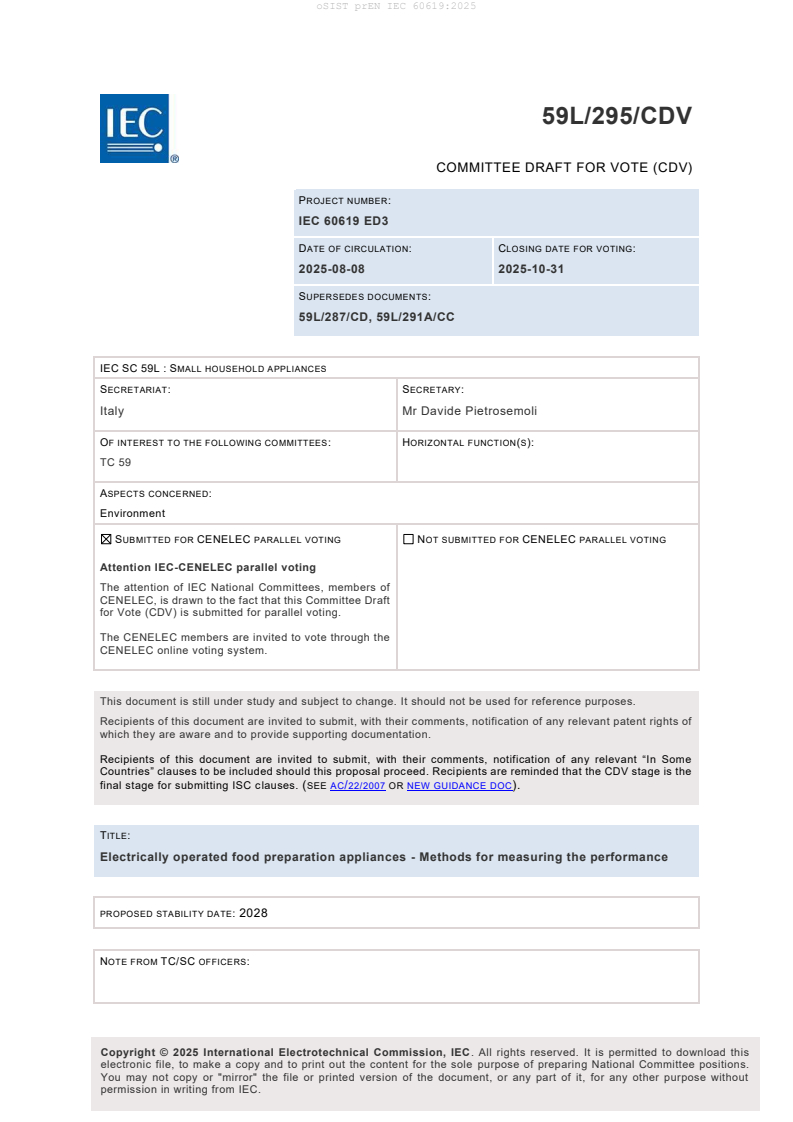
59L/295/CDV
COMMITTEE DRAFT FOR VOTE (CDV)
PROJECT NUMBER:
IEC 60619 ED3
DATE OF CIRCULATION: CLOSING DATE FOR VOTING:
2025-08-08 2025-10-31
SUPERSEDES DOCUMENTS:
59L/287/CD, 59L/291A/CC
IEC SC 59L : SMALL HOUSEHOLD APPLIANCES
SECRETARIAT: SECRETARY:
Italy Mr Davide Pietrosemoli
OF INTEREST TO THE FOLLOWING COMMITTEES: HORIZONTAL FUNCTION(S):
TC 59
ASPECTS CONCERNED:
Environment
SUBMITTED FOR CENELEC PARALLEL VOTING NOT SUBMITTED FOR CENELEC PARALLEL VOTING
Attention IEC-CENELEC parallel voting
The attention of IEC National Committees, members of
CENELEC, is drawn to the fact that this Committee Draft
for Vote (CDV) is submitted for parallel voting.
The CENELEC members are invited to vote through the
CENELEC online voting system.
This document is still under study and subject to change. It should not be used for reference purposes.
Recipients of this document are invited to submit, with their comments, notification of any relevant patent rights of
which they are aware and to provide supporting documentation.
Recipients of this document are invited to submit, with their comments, notification of any relevant “In Some
Countries” clauses to be included should this proposal proceed. Recipients are reminded that the CDV stage is the
final stage for submitting ISC clauses. (SEE AC/22/2007 OR NEW GUIDANCE DOC).
TITLE:
Electrically operated food preparation appliances - Methods for measuring the performance
PROPOSED STABILITY DATE: 2028
NOTE FROM TC/SC OFFICERS:
electronic file, to make a copy and to print out the content for the sole purpose of preparing National Committee positions.
You may not copy or "mirror" the file or printed version of the document, or any part of it, for any other purpose without
permission in writing from IEC.
IEC CDV 60619 © IEC 2025
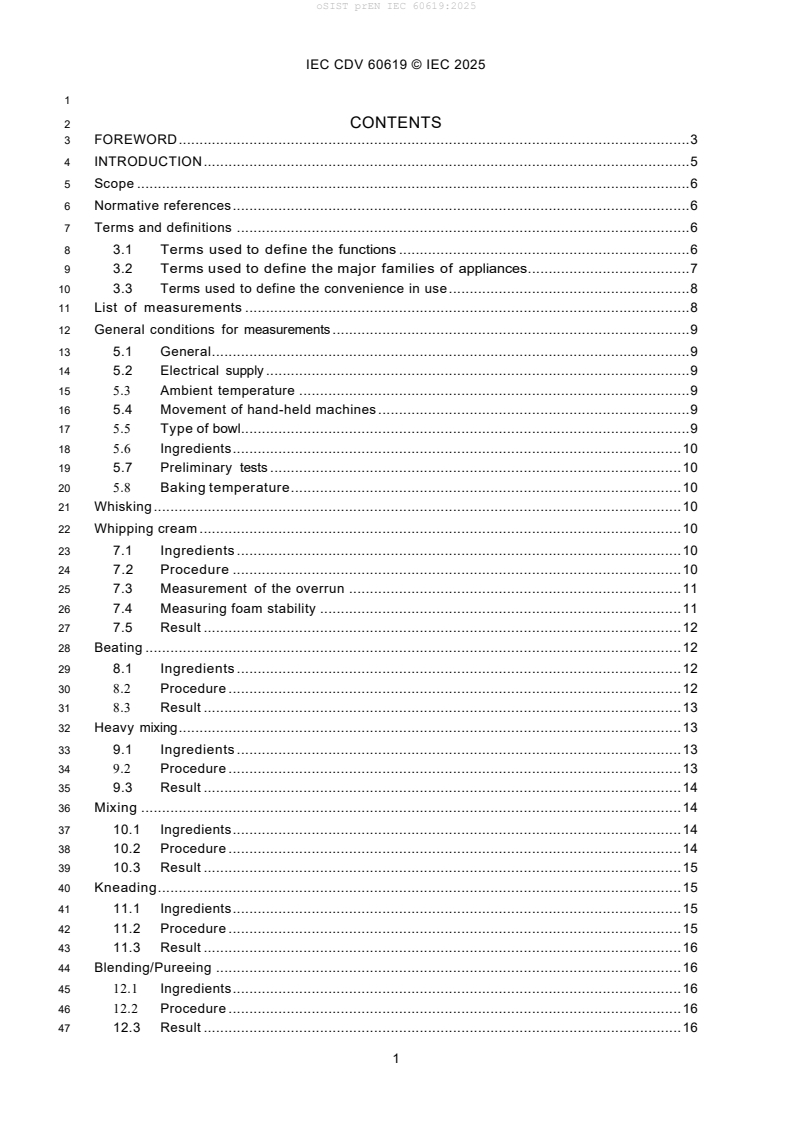
2 CONTENTS
3 FOREWORD . 3
4 INTRODUCTION . 5
5 Scope . 6
6 Normative references . 6
7 Terms and definitions . 6
8 3.1 Terms used to define the functions . 6
9 3.2 Terms used to define the major families of appliances . 7
10 3.3 Terms used to define the convenience in use . 8
11 List of measurements . 8
12 General conditions for measurements . 9
13 5.1 General . 9
14 5.2 Electrical supply . 9
15 5.3 Ambient temperature . 9
16 5.4 Movement of hand-held machines . 9
17 5.5 Type of bowl . 9
18 5.6 Ingredients . 10
19 5.7 Preliminary tests . 10
20 5.8 Baking temperature . 10
21 Whisking . 10
22 Whipping cream . 10
23 7.1 Ingredients . 10
24 7.2 Procedure . 10
25 7.3 Measurement of the overrun . 11
26 7.4 Measuring foam stability . 11
27 7.5 Result . 12
28 Beating . 12
29 8.1 Ingredients . 12
30 8.2 Procedure . 12
31 8.3 Result . 13
32 Heavy mixing . 13
33 9.1 Ingredients . 13
34 9.2 Procedure . 13
35 9.3 Result . 14
36 Mixing . 14
37 10.1 Ingredients . 14
38 10.2 Procedure . 14
39 10.3 Result . 15
40 Kneading . 15
41 11.1 Ingredients . 15
42 11.2 Procedure . 15
43 11.3 Result . 16
44 Blending/Pureeing . 16
45 12.1 Ingredients . 16
46 12.2 Procedure . 16
47 12.3 Result . 16
IEC CDV 60619 © IEC 2025
48 Emulsifying . 16
49 13.1 Ingredients . 16
50 13.2 Procedure . 17
51 13.3 Result . 17
52 Chopping . 17
53 14.1 Chopping of meat . 17
54 14.2 Chopping of onions . 17
55 14.3 Chopping of almonds . 18
56 Slicing . 19
57 15.1 Slicing of carrots . 19
58 15.2 Slicing of cucumber . 19
59 15.3 Slicing of leeks . 20
60 Shredding . 20
61 16.1 Shredding of carrots . 20
62 16.2 Shredding of cheese . 21
63 French fries chipping . 21
64 17.1 Ingredients . 21
65 17.2 Procedure . 21
66 17.3 Result . 22
67 Juice separation . 22
68 18.1 Ingredients . 22
69 18.2 Procedure . 22
70 18.3 Results . 22
71 Citrus juice extraction . 23
72 19.1 Ingredients . 23
73 19.2 Procedure . 23
74 19.3 Extractor efficiency . 23
75 19.4 Strainer efficiency . 23
76 19.5 Results . 24
77 Splashing and spillage . 24
78 20.1 Ingredients . 24
79 20.2 Procedure . 24
80 20.3 Result . 24
81 Cleaning efficiency and cleaning time . 24
82 21.1 Void. . 24
83 21.2 Procedure . 24
84 21.3 Results . 24
85 Figures . 25
86 Annex A (normative) Ingredients used for the purpose of this standard . 29
87 Annex B (informative) Information to be provided to the point of sale . 30
88 Bibliography . 31
IEC CDV 60619 © IEC 2025
92 INTERNATIONAL ELECTROTECHNICAL COMMISSION
93 ____________
95 ELECTRICALLY OPERATED FOOD PREPARATION
96 APPLIANCES -
97 MEASURING METHODS
101 FOREWORD
102 1) The International Electrotechnical Commission (IEC) is a worldwide organization for standardization comprising
103 all national electrotechnical committees (IEC National Committees). The object of IEC is to promote international
104 co-operation on all questions concerning standardization in the electrical and electronic fields. To this end and
105 in addition to other activities, IEC publishes International Standards, Technical Specifications, Technical Reports,
106 Publicly Available Specifications (PAS) and Guides (hereafter referred to as "IEC Publication(s)"). Their
107 preparation is entrusted to technical committees; any IEC National Committee interested in the subject dealt with
108 may participate in this preparatory work. International, governmental and non-governmental organizations liaising
109 with the IEC also participate in this preparation. IEC collaborates closely with the International Organization for
110 Standardization (ISO) in accordance with conditions determined by agreement between the two organizations.
111 2) The formal decisions or agreements of IEC on technical matters express, as nearly as possible, an international
112 consensus of opinion on the relevant subjects since each technical committee has representation from all
113 interested IEC National Committees.
114 3) IEC Publications have the form of recommendations for international use and are accepted by IEC National
115 Committees in that sense. While all reasonable efforts are made to ensure that the technical content of IEC
116 Publications is accurate, IEC cannot be held responsible for the way in which they are used or for any
117 misinterpretation by any end user.
118 4) In order to promote international uniformity, IEC National Committees undertake to apply IEC Publications
119 transparently to the maximum extent possible in their national and regional publications. Any divergence between
120 any IEC Publication and the corresponding national or regional publication shall be clearly indicated in the latter.
121 5) IEC itself does not provide any attestation of conformity. Independent certification bodies provide conformity
122 assessment services and, in some areas, access to IEC marks of conformity. IEC is not responsible for any
123 services carried out by independent certification bodies.
124 6) All users should ensure that they have the latest edition of this publication.
125 7) No liability shall attach to IEC or its directors, employees, servants or agents including individual experts and
126 members of its technical committees and IEC National Committees for any personal injury, property damage or
127 other damage of any nature whatsoever, whether direct or indirect, or for costs (including legal fees) and
128 expenses arising out of the publication, use of, or reliance upon, this IEC Publication or any other IEC Publications.
129 8) Attention is drawn to the Normative references cited in this publication. Use of the referenced publications is
130 indispensable for the correct application of this publication.
131 9) IEC draws attention to the possibility that the implementation of this document may involve the use of (a) patent(s).
132 IEC takes no position concerning the evidence, validity or applicability of any claimed patent rights in respect
133 thereof. As of the date of publication of this document, IEC had not received notice of (a) patent(s), which may
134 be required to implement this document. However, implementers are cautioned that this may not represent the
135 latest information, which may be obtained from the patent database available at https://patents.iec. IEC shall not
136 be held responsible for identifying any or all such patent rights.
137 IEC 60619 has been prepared by subcommittee 59L: Small household appliances, of IEC
138 technical committee 59: Performance of household and similar electrical appliances. It is an
139 International Standard.
140 This third edition cancels and replaces the second edition published in 1993, Amendment 1:
141 1995 and Amendment 2: 2004. This edition constitutes a technical revision.
142 This edition includes the following significant technical changes with respect to the previous
143 edition:
144 a) Deletion of test in clause 6;
145 b) Modified description of movement of handheld machines in subclause 5.4;
146 c) Fully revised test on whipping cream in clause 7.
147 d) Revised clause 15.
IEC CDV 60619 © IEC 2025
148 e) Clause 20 on grinding coffee has been removed, as there is a standalone IEC standard, IEC
149 60661
150 The text of this International Standard is based on the following documents:
Draft Report on voting
XX/XX/FDIS XX/XX/RVD
152 Full information on the voting for its approval can be found in the report on voting indicated in
153 the above table.
154 The language used for the development of this International Standard is English.
155 This document was drafted in accordance with ISO/IEC Directives, Part 2, and developed in
156 accordance with ISO/IEC Directives, Part 1 and ISO/IEC Directives, IEC Supplement, and the
157 ISO/IEC Directives, JTC 1 Supplement available at www.iec.ch/members_experts/refdocs. The
158 main document types developed by IEC are described in greater detail at
159 www.iec.ch/publications.
160 The committee has decided that the contents of this document will remain unchanged until the
161 stability date indicated on the IEC website under webstore.iec.ch in the data related to the
162 specific document. At this date, the document will be
163 • reconfirmed,
164 • withdrawn,
165 • replaced by a revised edition, or
166 • amended.
IEC CDV 60619 © IEC 2025
168 INTRODUCTION
IEC CDV 60619 © IEC 2025
170 ELECTRICALLY OPERATED FOOD PREPARATION APPLIANCES -
171 MEASURING METHODS
172 Scope
173 This International Standard applies to electrically operated food preparation appliances for
174 household use.
175 The purpose of this standard is to state and define test methods of measuring the functions
176 that can be carried out by means of household electrical food preparation appliances, which
177 are of interest to the user and to give some guidelines for the evaluation of test results.
178 Taking into account the lower grade of accuracy and repeatability, due to variations in
179 time and origin of test materials and ingredients and to the influence of the subjective
180 judgement of test operators, the described test methods may be applied more reliably for
181 comparative testing of a number of appliances at approximately the same time, in the same
182 laboratory, by the same operator and with the same utensils, rather than for testing of single
183 appliances in different laboratories.
184 As there is no definition of a given type or size of oven, and as a number of the tests involve
185 baking of the final product in order to make a determination of volume, a variation in results
186 can be expected between ovens used. All comparative tests should be undertaken in the
187 same oven.
188 This standard does not cover safety.
189 This standard does not apply to appliances designed exclusively for commercial or industrial
190 use.
191 Attention is drawn to the fact that sometimes the same result may be obtained using
192 different functions.
193 NOTE 1 The definition of other functions is under consideration.
194 Normative references
195 There are no normative references in this document.
196 Terms and definitions
197 For the purposes of this document, the following terms and definitions apply.
198 ISO and IEC maintain terminology databases for use in standardization at the following
199 addresses:
200 • IEC Electropedia: available at https://www.electropedia.org/
201 • ISO Online browsing platform: available at https://www.iso.org/obp
202 3.1 Terms used to define the functions
203 3.1.1
204 Whisking
205 to incorporate air and increase the volume of egg-whites.
206 3.1.2
207 whipping cream
208 to incorporate air and increase the volume of cream.
209 3.1.3
210 beating
211 to mix and incorporate air
212 EXAMPLE: beating of cake batter to produce dough
IEC CDV 60619 © IEC 2025
213 3.1.4
214 heavy mixing
215 to incorporate ingredients evenly into a heavy mixture without chopping
216 EXAMPLE: mixing of ingredients including dried fruits and glazed cherries to produce fruit cake dough
217 3.1.5
218 mixing
219 to combine ingredients evenly
220 EXAMPLE: mixing ingredients to produce pastry or pie
221 3.1.6
222 kneading
223 to work a heavy mixture to form a smooth, pliable mass
224 3.1.7
225 blending/pureeing
226 to make semi-solid ingredients liquid or to chop with liquid
227 EXAMPLE: chopping or liquidifying vegetables or fruits to produce babyfood, pureed fruit or soup
228 3.1.8
229 emulsifying
230 to combine together insoluble liquids so that one or more is suspended in droplets throughout
231 the other
232 EXAMPLE: combining egg and oil to produce mayonnaise
233 3.1.9
234 chopping
235 to reduce solid ingredients to small particles
236 EXAMPLE: chopping of meat to produce minced meat, chopping of onions to produce chopped onions,
237 chopping of almonds to produce chopped almonds
238 3.1.10
239 slicing
240 to cut into slices
241 EXAMPLE: slicing of vegetables to produce carrot slices, cucumber slices or leek slices
242 3.1.11
243 shredding
244 to reduce to small strips
245 EXAMPLE: cutting carrots to produce carrot shredds, cutting cheese to produce cheese shreds
246 3.1.12
247 cutting french fries
248 to cut potatoes into the shape of French fries
249 3.1.13
250 juice separation
251 to remove juice from fruit or vegetables by centrifugal force or a stainer by use of auger
252 citrus juice extraction
253 to remove juice from citrus fruits by applying fruit halves to a rotating cone
254 3.2 Terms used to define the major families of appliances
255 3.2.1
256 mono-function appliance
257 appliance designed to perform only one function
IEC CDV 60619 © IEC 2025
258 3.2.2
259 multi-function appliance
260 appliance designed to perform more than one function
261 NOTE 1 to entry: Appliances can be either hand-held type or countertop appliances.
262 NOTE 2 to entry: Sometimes, for some appliances, it may be necessary to change the attachments
263 or tools in order to perform the different functions.
264 3.3 Terms used to define the convenience in use
265 3.3.1
266 splashing and spillage
267 unintentional loss of ingredients during switching on and operation of an appliance
268 3.3.2
269 cleaning efficiency
270 effort necessary to empty, clean and dry an appliance (or separate parts), including the
271 disassembling of the appliance
272 3.3.3
273 cleaning time
274 time necessary to empty, clean and dry an appliance (or separate parts), including the
275 disassembling of the appliance
277 List of measurements
278 This standard covers the following functions:
279 – whisking (clause 6);
280 – whipping cream (clause 7);
281 – beating (clause 8);
282 – heavy mixing (clause 9);
283 – mixing (clause 10);
284 – kneading (clause 11);
285 – blending/pureeing (clause 12);
286 – emulsifying (clause 13);
287 – chopping of meat (subclause 14.1);
288 – chopping of onions (subclause 14.2);
289 – chopping of almonds (subclause 14.3);
290 – slicing of carrots (subclause 15.1);
291 – slicing of cucumbers (subclause 15.2);
292 – slicing of leeks (subclause 15.3);
293 – shredding of carrots (subclause 16.1);
294 – shredding of cheese (subclause 16.2);
295 – cutting french fries (clause 17);
296 – juice separation (clause 18);
297 – citrus juice extraction (clause 19);
298 – splashing and spillage (clause 20);
299 – cleaning efficiency and cleaning time (clause 21).
IEC CDV 60619 © IEC 2025
300 General conditions for measurements
301 Unless otherwise specified, the measurements are conducted under the following conditions.
302 5.1 General
303 The attachments, speed, tools and quantities of ingredients used shall be those
304 recommended by the manufacturer. In the absence of manufacturer's recommendations,
305 the quantities quoted shall be used. The ingredients specified have been selected primarily
306 to ensure uniform and reproducible results. A list of ingredients known to be suitable is given
307 in annex A. Unless otherwise stated, the appliance shall be operated in accordance with
308 the manufacturer's instructions.
309 All the tests from 6 to 20 shall be carried out three times (repeated twice), unless otherwise
310 stated in the specific clause.
311 A test report shall include the settings used for the respective test.
312 5.2 Electrical supply
313 The measurements shall be made at rated frequency and at a voltage which is within
314 ±1 % of the rated voltage or the mean of the rated voltage range.
315 For battery-powered appliances, the appliances are operated with batteries fully charged.
316 NOTE - If the rated voltage differs from the nominal supply voltage of the country concerned, measurements carried
317 out at rated voltage may be misleading. Therefore, for comparative testing the voltage used for the tests is to
318 conform to the nominal supply voltage and this shall be reported.
319 5.3 Ambient temperature
320 The ambient temperature and the temperature of all utensils and ingredients shall be
321 maintained at (23 ± 2) °C, unless otherwise specified.
322 NOTE - In tropical climates, the ambient temperature may be (27 ± 5) °C but the temperature should be recorded
323 5.4 Movement of hand-held machines
324 When whipping cream (clause 7) with a hand-held machine, a movement that describes the
325 shape of the arabic number eight (see Fig. 1) shall be used if possible; otherwise, the shape of
326 the bowl shall be followed. The number of complete movements should be between 45 and 60
327 per minute. The bowl shall not be moved or lifted during whipping. Touching walls, raising or
328 lowering the hand-held appliance should be avoided.
329 When processing cake batter (clause 8) with a hand-held machine, a movement that describes
330 the shape of the arabic number eight shall be used if possible; otherwise, the shape of the bowl
331 shall be followed. The number of complete movements should be between 30 and 40 per minute.
332 The bowl shall not be moved or lifted during beating. Touching walls, raising or lowering the
333 hand-held appliance should be avoided.
334 When kneading (clause 10) hand mixers shall be moved as necessary to achieve good
335 operation but at a speed not exceeding thirty movements per minute. The bowl shall not be
336 moved or lifted during kneading.
337 For other operations, hand-held machines shall be moved as necessary to achieve good
338 operation but at a speed not exceeding thirty movements per minute.
339 5.5 Type of bowl
340 For appliances supplied with a bowl, the measurements shall be made using this bowl.
341 Hand-held machines supplied with bowl and stand shall be operated in accordance with the
342 manufacturer's instructions. If no instructions are supplied and it is obvious that the bowl has
343 to be moved, this is allowed but shall be stated in the report.
344 For appliances not supplied with a bowl, one of the bowls shown in Figures 3, 4 and 5 shall
345 be used, choosing the most suitable for the function that has to be measured.
IEC CDV 60619 © IEC 2025
346 5.6 Ingredients
347 Ingredients are stated in the respective clauses.
348 Where it is required that minimum and maximum quantities have to be processed, care has
349 to be taken that the same proportion between all ingredients is maintained.
350 5.7 Preliminary tests
351 Sometimes and for some functions it may be necessary to carry out, for a given appliance
352 or for a series of appliances, some preliminary tests in order to find out the time and the
353 procedure to obtain the best result.
354 5.8 Baking temperature
355 Where in the standard it is required to bake the prepared mixture, the conventional heating
356 function of the oven shall be used, at a suitable temperature in accordance with the oven
357 manufacturer's instructions.
358 Whisking
359 VOID
360 Secretary’s note: Whisking egg white is very dependent on the eggs and not very reliable.
361 In various test measurements in Germany, we could show that the results are equal to
362 the whipping cream test, which gives a better repeatability. Hence, the German proposal
363 is to delete Clause 6 and focus on Clause 7.
364 Whipping cream
365 7.1 Ingredients
366 Fresh whipping cream, made from pasteurized milk and with a fat content of at least 30%
367 and carrageenan, is used. The fat content and manufacturer of the cream used shall be
368 stated in the report. Cream with the same fat content shall be used within a series of
369 measurements.
370 The cream used for a series of measurements should be obtained from the same
371 manufacturer. The cream used should be used within its shelf life.
372 The amount required for each individual measurement is taken from the refrigerator
373 immediately before the measurement begins. The temperature of the cream must be (7 ±
374 1) °C when it is taken out of the refrigerator.
375 7.2 Procedure
376 The ambient temperature and the temperature of all equipment shall be (23 ± 2) °C. The
377 cream is placed in the bowl and whipping shall begin immediately. The cream should be
378 weighed into the bowl exactly to the gram, ± 1 g.
379 NOTE 1: Even for devices with an integrated scale, the cream is weighed in separately.
380 The test includes whipping a standard amount of cream (200 g) as well as a maximum
381 amount of cream. The test is carried out three times for each of the two volumes.
382 NOTE 2: If the manufacturer's instructions state that the minimum amount to be whipped is >200 g, this must
383 be used as the standard amount.
384 The cream shall be whipped according to the instructions for use of the device (speed/level,
385 time, accessories if necessary), both for the standard quantity and for the maximum quantity
386 to be used.
387 NOTE 3: Only the accessories supplied and intended by the manufacturer for whipping cream are allowed for
388 the test.
389 If there is no sufficiently detailed specification in the instructions for use, the following
390 procedure shall be adopted:
391 – The speed/level shall be set that will give the most satisfactory result
IEC CDV 60619 © IEC 2025
392 The test is terminated when the incision made with a knife remains for at least 10 seconds.
393 If no incision that remains for at least 10 seconds can be observed after 10 minutes of
394 whipping, the test should also be terminated.
395 Note 4: See Fig. 2 for guidance on knife incision in whipped cream.
396 Supplied accessories are to be used according to the expert opinion of the test laboratory.
397 – To determine the maximum quantity, preliminary tests are carried out which, in the
398 opinion of the test laboratory, still provide an acceptable whipping result (see 7.5) at a
399 multiple of 100 g.
400 7.3 Measurement of the overrun
401 A Petri dish (see Figure 6), the mass and volume of which have been determined, is filled with
402 a sample taken from the whipped cream and weighed.
403 To measure the volume of the petri dish, proceed as follows:
404 The volume of the Petri dish is determined by filling it with water (15 ± 5 °C, containing 1% low -
405 foaming surfactant) and measuring the volume in Liters. The Petri dish must be filled to the
406 upper rim with water and the weight of the water required must be determined. A pipette should
407 be used to help with precise dosing.
408 NOTE 1 To avoid small ripples when adding the water with the pipette, it should be held under the water surface.
409 To take a sample, proceed as follows:
410 Sample is taken with a spatula with a silicone blade.
411 The sample is to be taken from different places on the edge of the bowl and transferred to the
412 petri dish. The places should be evenly distributed over the edge of the bowl. The sample is
413 taken across the entire depth of the bowl.
414 After each sample has been taken, the whipped cream should be transferred to the Petri dish,
415 avoiding air entrapment, until it is slightly overfilled. Any excess cream is scraped off with a
416 cake spatula (or similarly shaped object).
417 NOTE 2 When transferring the whipped cream, it is important to exert as little pressure as possible on the whipped
418 cream.
419 The mean and standard deviation of all measurements for the minimum and maximum quantity
420 are determined.
421 The following formula is used to determine the overrun:
𝑚 𝑚
𝑙 𝑐
−
𝑉 𝑉
𝑝 𝑝
𝑂= (1)
𝑚
𝑐
𝑉
𝑝
422 where
423 O is the Overrun,
424 m is the mass of the liquid expressed in g,
l
425 mc is the mass of the whipped cream, expressed in g,
426 V is the volume of the petri dish, expressed in l.
p
427 7.4 Measuring foam stability
428 As described in 7.3, 100 g ± 1 g of the cream is taken and transferred without pressure into a
429 prepared funnel (see Fig. 5). Cream that drips down is collected in a container of a known
430 weight.
IEC CDV 60619 © IEC 2025
431 After 15 minutes, the drained mass shall be weighed and the drained weight shall be noted.
432 7.5 Result
433 The test is considered to have a satisfactory result if:
434 – a whipping result has been achieved that maintains a knife incision for at least 10 seconds
435 and a homogeneous mass is present.
436 NOTE A homogeneous mass is present when no coagulation or phase separation has occurred due to flashover.
437 – a foam stability has been achieved that has a dripping weight of <1 g.
438 The following shall be stated in a test report:
439 – test has satisfactory or non-satisfactory result for standard quantity and maximum quantity;
440 NOTE If the standard quantity was deviated from (see 7.1), it is documented that no cream was whipped at the
441 standard quantity and the results of the minimum cream quantity according to the manufacturer's instructions is
442 recorded.
443 – maximum quantity tested
444 – the accessories used; if applicable, the standard cup used if no cup is included with the
445 device
446 – settings;
447 – whipping time;
448 – fat content and manufacturer of the cream used;
449 – overrun: mean and standard deviation.
450 – drained weight after 15 minutes
451 – qualitative description of non-whipped cream residues in the cup
452 Beating
453 8.1 Ingredients
454 The mass of ingredients to each egg is as follows:
455 – 50 g margarine;
456 – 50 g sugar;
457 – 50 g flour;
458 – 1 g baking powder or in accordance with the instructions of the manufacturer of the
459 baking powder.
460 Initial temperature (23 ± 2) °C.
461 8.2 Procedure
462 Tests of different amounts of ingredients are made to find the minimum and maximum
463 quantities that can be satisfactorily beaten.
464 The result is satisfactory when all ingredients are evenly distributed.
465 Record the weight of the bowl and its attachments. Make a dough based on three eggs.
466 Cut the margarine into cubes of approximately 20 mm. Place all the ingredients into the
467 bowl and beat until satisfactorily mixed. Scrape down the sides of the bowl once, if
468 necessary, with a spatula. Record the time needed for beating.
469 550 g of the dough is put into a long uncoated aluminium baking tin (see Figure 8).
470 Place the tin in the middle of a preheated oven at a suitable temperature according to
471 the oven manufacturer's instructions and bake until the cake is deemed to be done.
472 The baking time and the temperature have to be recorded.
473 After carefully scraping the bowl and its attachments, weigh these and calculate the residual
474 dough in the bowl and its attachments as a percentage of the total weight of the ingredients.
IEC CDV 60619 © IEC 2025
475 After the baking, the cake is taken out of the tin and turned upside down on a flat surface.
476 It is covered with the tin and left for 24 h at room temperature. After the resting time the
477 cake is weighed.
478 In order to determine the volume, the tin with the cake is filled up to the rim with mustard seeds.
479 The seeds are measured in a measuring bowl. The difference between the known volume of
480 the tin and the volume of the mustard seeds is the volume of the baked cake. If the cake
481 has risen over the tin the measurement should be made, for instance, by aid of additional
482 walls put on the top of the tin or by other suitable means, but without cutting the cake.
483 The cake has to be sliced evenly at different points (normally at 1/5, 2/5, 3/5 and 4/5 of its
484 length).
485 The test has to be repeated and the mean value is calculated.
486 8.3 Result
487 Record the following:
488 – the minimum and maximum quantities that give satisfactory results, expressed as the
489 number of eggs;
490 – the weight of residual dough in the working bowl and on its attachments;
491 – the baking time, the temperature and the type of the oven;
492 – the time taken to mix a dough of three eggs;
493 – volume of the baked cake;
494 – comments on the structure of the slices that has to be such that air pockets should be
495 of even size and distribution;
496 – the attachments and setting used.
497 Heavy mixing
498 9.1 Ingredients
499 The mass of ingredients to each egg is as follows:
500 – 45 g margarine;
501 – 45 g sugar;
502 – 85 g flour;
503 – 3,5 g baking powder;
504 – 50 g currants, after soaking in tea;
505 – 50 g mixed dried fruit according to national availability.
506 Initial temperature (23 ± 2) c.
507 9.2 Procedure
508 Tests of different amounts of ingredients are made to find the minimum and maximum
509 quantities that can be satisfactorily mixed.
510 A satisfactory result is when all ingredients are evenly distributed and the fruits are not
511 damaged.
512 Record the weight of the bowl and its attachments. Make a dough based on three eggs.
513 Cut the margarine into cubes of approximately 20 mm. Place all the ingredients except the
514 fruits into the bowl and process until satisfactorily mixed. At the end of the procedure
515 the fruits are added and the appliance is operated till the moment when the fruits are
516 distributed into the dough. Scrape down the sides of the bowl once, if necessary, with a
517 spatula. Record the time needed for mixing.
IEC CDV 60619 © IEC 2025
518 950 g of the dough is put into a long uncoated aluminium baking tin (see figure 8). Place
519 the tin in the middle of a preheated oven at a suitable temperature according to the oven
520 manufacturer's instructions and bake until the cake is deemed to be done. The baking time
521 and the temperature have to be recorded.
522 After carefully scraping the bowl and its attachments, weigh these and calculate the residual
523 dough on the working bowl and its attachments as a percentage of the total weight of the
524 ingredients.
525 After baking the cake is taken out of the tin and turned upside down on a flat surface. It is
526 covered with the tin and left for 24 h at room temperature. After the resting time the cake
527 is weighed.
528 In order to determine the volume the tin with the cake is filled up to the rim with mustard
529 seeds. The seeds are measured in a measuring bowl. The difference between the known
530 volume of the tin and the volume of the mustard seeds is the volume of the baked cake. If
531 the cake has risen over the tin the measurement should be made, for instance, by aid of
532 additional walls put on the top of the tin or by other suitable means, but without cutting the
533 cake.
534 The cake has to be sliced evenly at different points (normally at 1/5, 2/5, 3/5 and 4/5 of its
535 length).
536 The test has to be repeated and the mean value is calculated
537 9.3 Result
538 Record the following:
539 – the minimum and maximum quantities that give satisfactory results, expressed as the
540 number of eggs;
541 – the weight of residual dough on the working bowl and its attachments;
542 – the baking time, the temperature and the type of the oven;
543 – the time taken to mix a dough of three eggs;
544 – volume of the baked cake;
545 – comments on the structure of the slices checking that fruits are evenly distributed into
546 the slices and they are not damaged;
547 – the attachments and setting used.
548 Mixing
549 10.1 Ingredients
551 – 50 g margarine,
552 – 25 g water,
553 to each 100 g flour.
554 The temperature of the water shall be (8 ± 2) °C; the other ingredients shall be at ambient
555 temperature.
556 10.2 Procedure
557 Cut the margarine into cubes of approximately 15 mm and add them to the flour in the
558 bowl.
559 Mix the ingredients until the mixture resembles fine crumbs of fresh bread; then add the
560 water and process to form a satisfactory dough which can be removed from the working
561 bowl easily.
...
Questions, Comments and Discussion
Ask us and Technical Secretary will try to provide an answer. You can facilitate discussion about the standard in here.
Loading comments...