

kSIST FprEN 12697-23:2026
(Main)Bituminous mixtures - Test methods - Part 23: Determination of the indirect tensile strength of bituminous specimens
- Abstract
This document specifies a test method for determining the (splitting) indirect tensile strength of cylindrical specimens of bituminous mixtures.
- Status
- Not Published
- Public Enquiry End Date
- 28-May-2025
- Technical Committee
- CES - Roads
- Current Stage
- 5020 - Formal vote (FV) (Adopted Project)
- Start Date
- 24-Jun-2026
- Due Date
- 12-Aug-2026

kSIST FprEN 12697-23:2026 is a CEN standard for testing bituminous mixtures. It specifies a laboratory method for determining the indirect tensile strength (ITS) of cylindrical bituminous specimens by loading them diametrically until break. Engineers, laboratories, and quality teams use it to measure mixture behavior, compare results, and report how the specimen failed.
What does kSIST FprEN 12697-23:2026 specify?
kSIST FprEN 12697-23:2026 specifies a test method for the indirect tensile strength of cylindrical specimens of bituminous mixtures. The method covers the full workflow from specimen preparation and conditioning to calculation, reporting, and precision.
The document is organized into clauses on scope, normative references, terms and definitions, principle, apparatus, sample preparation, conditioning, test temperature, test procedure, calculation, test report, and precision. In practice, that means the standard tells you what to test, how to prepare the specimen, how to run the machine, and how to record the result.
What are the key requirements of kSIST FprEN 12697-23:2026?
Principle and loading method
kSIST FprEN 12697-23:2026 measures ITS by placing a cylindrical specimen between loading strips and loading it diametrically at a constant speed until it breaks. The result is calculated from the peak load and the specimen dimensions.
This matters because the test is sensitive to load direction, loading rate, and specimen size. If any of those are inconsistent, the reported strength is harder to compare between laboratories or projects.
Apparatus and control of test conditions
kSIST FprEN 12697-23:2026 calls for a compression testing machine, preferably Marshall-type or similar, with a recommended minimum capacity of 28 kN and a deformation rate of (50 ± 2) mm/min after a short transitory period. It also requires a testing head with loading strips matched to the specimen diameter, a load measuring device, and either a thermostatically controlled water bath or air chamber.
The load measurement must be to the nearest 0,1 kN with a maximum permissible error of 0,2 kN. The temperature around the specimen must be held within ±1 °C of the test temperature, because temperature strongly affects the fracture response.
Specimens and preparation
kSIST FprEN 12697-23:2026 requires at least three specimens for each sample and condition tested. It allows cylindrical specimens with diameters of 80, 100, 120, 150, or 160 mm, with specimen height between 35 mm and 75 mm.
The specimen size must suit the aggregate size of the mixture, and the specimen may be laboratory-made or cored from a slab or layer. The specimen is also checked visually for symmetry, measured for diameter and height, and stored before testing for between 48 hours and 42 days at not more than 25 °C.
Conditioning and test temperature
kSIST FprEN 12697-23:2026 requires the specimen to be brought to the selected test temperature with a maximum permissible error of 1 °C. Conditioning time depends on size: at least 2 h for specimens below 150 mm diameter and at least 4 h for specimens 150 mm or larger.
The test temperature is selected between +5 °C and +25 °C. That gives laboratories a way to test the mixture at temperatures that are relevant to the expected service or research condition.
Test procedure, calculation, and reporting
kSIST FprEN 12697-23:2026 requires the specimen to be loaded continuously and without shock until peak load is reached and the specimen breaks. The tester records the failure type - clear tensile break, deformation, or combination - and checks whether the broken aggregates are cracked or intact.
The ITS is then calculated in kilopascals and rounded to the nearest kPa. The test report must identify the standard used, the sample, specimen type, dimensions, test temperature, storage history, average ITS, failure type, and any deviations or unusual observations.
What terms does kSIST FprEN 12697-23:2026 define?
- Indirect tensile strength (ITS) - the maximum tensile stress calculated from the peak load applied to a cylindrical specimen loaded diametrically until break.
- Cylindrical specimen - a laboratory-made cylindrical moulded specimen or a core taken from a bituminous layer or slab.
- Peak load - the highest load recorded during the diametral compression test and used in the ITS calculation.
- Loading strips - the hardened steel contact strips in the testing head that apply the diametral load to the specimen.
- Test temperature - the selected temperature at which the specimen is conditioned and tested, between +5 °C and +25 °C.
- Failure type - the observed break pattern, reported as clear tensile break, deformation, or combination.
Who uses kSIST FprEN 12697-23:2026?
kSIST FprEN 12697-23:2026 is used by asphalt and road-materials laboratories, mix producers, and quality control teams. It is also used by engineers, quality managers, and buyers who need a repeatable strength result for acceptance checks, product comparison, or investigation of cored material from site.
It is most useful when a team needs to compare laboratory-prepared specimens with cores from pavements or slabs and document how the material fails under diametral loading.
What changed in kSIST FprEN 12697-23:2026 from the previous edition?
kSIST FprEN 12697-23:2026 supersedes EN 12697-23:2017. The foreword states these significant technical changes:
- Clause 5.3 updates load measurement wording to “nearest 0,1 kN with a maximum permissible error of 0,2 kN”.
- Clause 5.4 broadens the conditioning equipment wording to include an air chamber and keeps the ±1 °C control around the specimen.
- Clause 7 merges the former subclauses and adds the requirement to bring the specimen to the selected test temperature with a maximum permissible error of 1 °C.
- Clause 8 changes the test temperature selection to between +5 °C and +25 °C.
- Clause 9.1 removes the room-temperature requirement for the testing machine.
- Clause 10 changes ITS rounding to the nearest kPa.
Which standards are used with kSIST FprEN 12697-23:2026?
| Standard | What it contributes |
|---|---|
| EN 12697-27 | Sampling of bituminous layers for cores |
| EN 12697-29 | Measurement of specimen dimensions |
| EN 12697-30 | Specimen preparation by impact compactor |
| EN 12697-31 | Specimen preparation by gyratory compactor |
| EN 12697-32 | Specimen preparation by vibratory compactor |
| EN 12697-33 | Specimen preparation by roller compactor |
| EN 12697-34 | Marshall test and the referenced testing machine type |
What does the kSIST FprEN 12697-23:2026 document contain?
kSIST FprEN 12697-23:2026 contains the method principle, apparatus requirements, specimen preparation rules, conditioning and temperature control, the test procedure, the ITS calculation, reporting items, and a precision requirement. It also includes a table for loading strip dimensions by specimen diameter and figures for the testing head and failure types.
The document gives the practical details a laboratory needs to set up the test consistently, including the load rate, temperature tolerance, specimen sizes, and observation of fracture mode. It also states what to record so the result can be compared across samples and projects.
Relations
- Effective Date
- 17-Sep-2026
- Referred By
SIST EN 13108-7:2016 - Bituminous mixtures - Material specifications - Part 7: Porous Asphalt - Effective Date
- 17-Sep-2026
- Effective Date
- 17-Sep-2026
- Effective Date
- 17-Sep-2026
- Effective Date
- 17-Sep-2026
- Effective Date
- 21-Feb-2024
Get Certified
Connect with accredited certification bodies for this standard

Zavod za gradbeništvo Slovenije (ZAG) - Inšpekcija
ZAG inspection body for construction products, structures, and materials.
Sponsored listings
Frequently Asked Questions
kSIST FprEN 12697-23:2026 is a draft published by the Slovenian Institute for Standardization (SIST). Its full title is "Bituminous mixtures - Test methods - Part 23: Determination of the indirect tensile strength of bituminous specimens". This standard covers: This document specifies a test method for determining the (splitting) indirect tensile strength of cylindrical specimens of bituminous mixtures.
This document specifies a test method for determining the (splitting) indirect tensile strength of cylindrical specimens of bituminous mixtures.
kSIST FprEN 12697-23:2026 is classified under the following ICS (International Classification for Standards) categories: 93.080.20 - Road construction materials. The ICS classification helps identify the subject area and facilitates finding related standards.
kSIST FprEN 12697-23:2026 has the following relationships with other standards: It is inter standard links to SIST EN 12697-12:2018, SIST EN 13108-7:2016, SIST EN 13108-9:2016, SIST EN 13108-31:2019, SIST EN 12697-12:2009, SIST EN 12697-23:2018. Understanding these relationships helps ensure you are using the most current and applicable version of the standard.
kSIST FprEN 12697-23:2026 is available in PDF format for immediate download after purchase. The document can be added to your cart and obtained through the secure checkout process. Digital delivery ensures instant access to the complete standard document.
Standards Content (Sample)
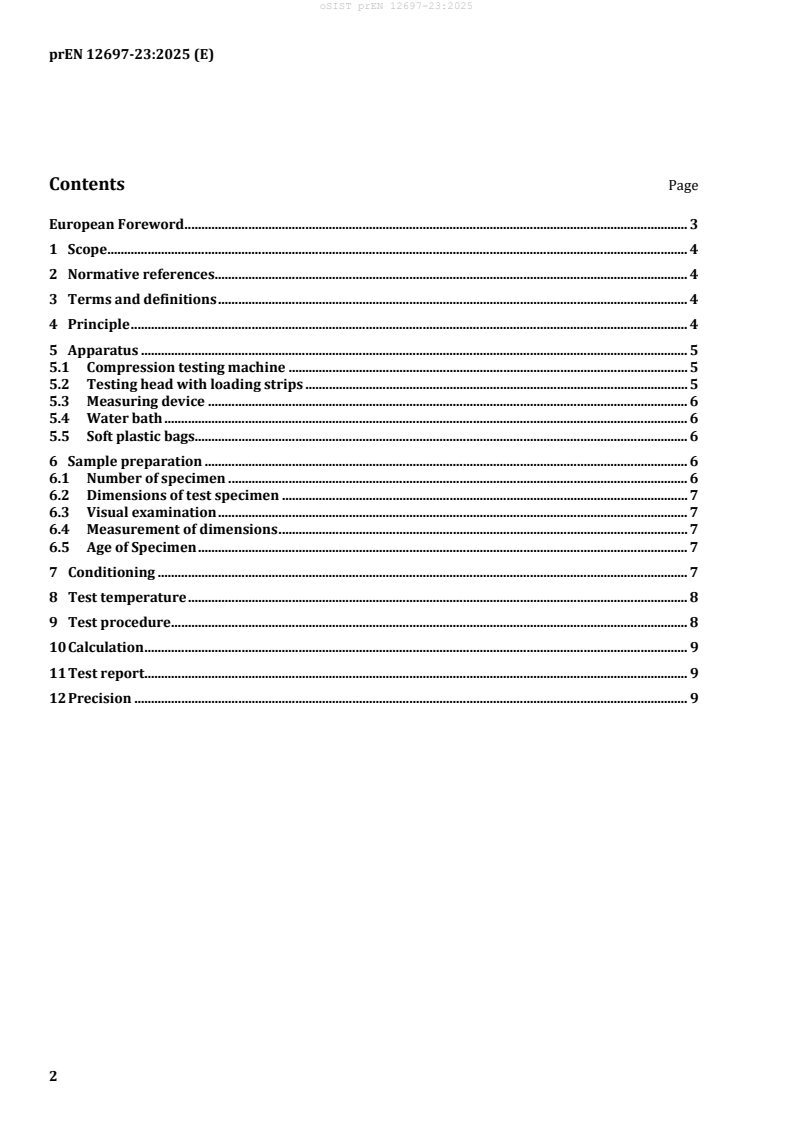
Contents
- 1 Scope
- 2 Normative references
- 3 Terms and definitions
- 3.1 indirect tensile strength
- 3.2 cylindrical specimen
- 4 Principle
- 5 Apparatus
- 5.1 Compression testing machine
- 5.2 Testing head with loading strips
- 5.3 Measuring device
- 5.4 Water bath
- 5.5 Soft plastic bags
- 6 Sample preparation
- 6.1 Number of specimen
- 6.2 Dimensions of test specimen
- 6.3 Visual examination
- 6.4 Measurement of dimensions
- 6.5 Age of Specimen
- 7 Conditioning
- 8 Test temperature
- 9 Test procedure
- 10 Calculation
- 11 Test report
- 12 Precision
1 Scope
This document specifies a test method for determining the (splitting) indirect tensile strength of cylindrical specimens of bituminous mixtures.
2 Normative references
The following documents are referred to in the text in such a way that some or all of their content constitutes requirements of this document. For dated references, only the edition cited applies. For undated references, the latest edition of the referenced document (including any amendments) applies. EN 12697-27, Bituminous mixtures - Test methods - Part 27: Sampling EN 12697-29, Bituminous mixtures - Test methods - Part 29: Determination of the dimensions of a bituminous specimen EN 12697-30, Bituminous mixtures - Test methods - Part 30: Specimen preparation by impact compactor EN 12697-31, Bituminous mixtures - Test methods - Part 31: Specimen preparation by gyratory compactor EN 12697-32, Bituminous mixtures - Test methods - Part 32: Specimen preparation by vibratory compactor EN 12697-33, Bituminous mixtures — Test methods — Part 33: Specimen prepared by roller compactor EN 12697-34, Bituminous mixtures - Test methods - Part 34: Marshall test
3 Terms and definitions
For the purposes of this document, the following terms and definitions apply. ISO and IEC maintain terminology databases for use in standardization at the following addresses:
- ISO Online browsing platform: available at https://www.iso.org/obp
- IEC Electropedia: available at https://www.electropedia.org/
3.1 indirect tensile strength
ITS maximum tensile stress calculated from the peak load applied to a cylindrical specimen loaded diametrically until break at specified test conditions
3.2 cylindrical specimen
laboratory-made (e.g. gyratory or impact-compacted) cylindrical moulded specimen or core taken from a bituminous layer or slab
4 Principle
The cylindrical specimen to be tested is brought to the specified test temperature, placed in the compression testing machine between the loading strips, and loaded diametrically along the direction of the cylinder axis with a constant speed of displacement until it breaks. The indirect tensile strength is the maximum tensile stress calculated from the peak load applied at break and the dimensions of the specimen.
oSIST prEN 12697-23:2025 pEN 12697-23:2025 (E)
5 Apparatus
5.1 Compression testing machine
Compression testing machine, Marshall-type conforming to EN 12697-34, or similar apparatus, having a recommended minimum capacity of 28 kN and capable of applying loads to test specimens at a constant rate of deformation of (50 ± 2) mm/min after a transitory period less than 20 % of the loading time. The rate of deformation shall be maintained.
When the test is conducted at low temperatures, on stiff asphalt samples as/or on specimens with diameter of 150 mm or 160 mm, the loading capacity of 28 kN may not be sufficient in order to reach the indirect tensile strength. In these cases, test devices of higher load capacity can be used.
5.2 Testing head with loading strips
Testing head for indirect tensile strength test equipped with loading strips of hardened steel having a concave surface with a radius of curvature corresponding to the nominal radius of the specimen (see Figure 1).
Loading strips for testing of cylindrical specimens shall have a radius of curvature fitting the specimen under test and a width as shown in Table 1.
Table 1 — Requirements for loading strips Dimensions
...