

oSIST prEN 13037:2025
(Main)Soil improvers and growing media - Determination of pH
- Abstract
This document specifies an instrumental method for the routine determination of pH in a suspension of soil improvers or growing media with water.
NOTE This method has been validated in an interlaboratory study with specific products that were present on the market during the study (as included in Annex A, being bark (Pinus pinaster, 20 mm to 40 mm fraction), coir pith (0 mm to 12 mm, washed and buffered), biowaste compost (Rottegrad 3), green compost (Rottegrad 5, 0 mm to 15 mm), liquid digestate, expanded clay (whole granules, 8 mm to 16 mm), growing media blend 1 (white peat, green compost, wood fibre, lime, inorganic fertilizer (NPK + micro elements)), growing media blend 2 (white peat, black peat, expanded perlite, lime, organic fertilizer) and growing media blend 3 (white peat, black peat, clay, inorganic fertilizer (NPK + micro elements))).
- Status
- Not Published
- Public Enquiry End Date
- 01-Dec-2025
- Technical Committee
- KAT - Soil quality
- Current Stage
- 4020 - Public enquire (PE) (Adopted Project)
- Start Date
- 08-Oct-2025
- Due Date
- 25-Feb-2026
- Completion Date
- 15-Dec-2025
- Mandate
- M/XXX - M/XXX

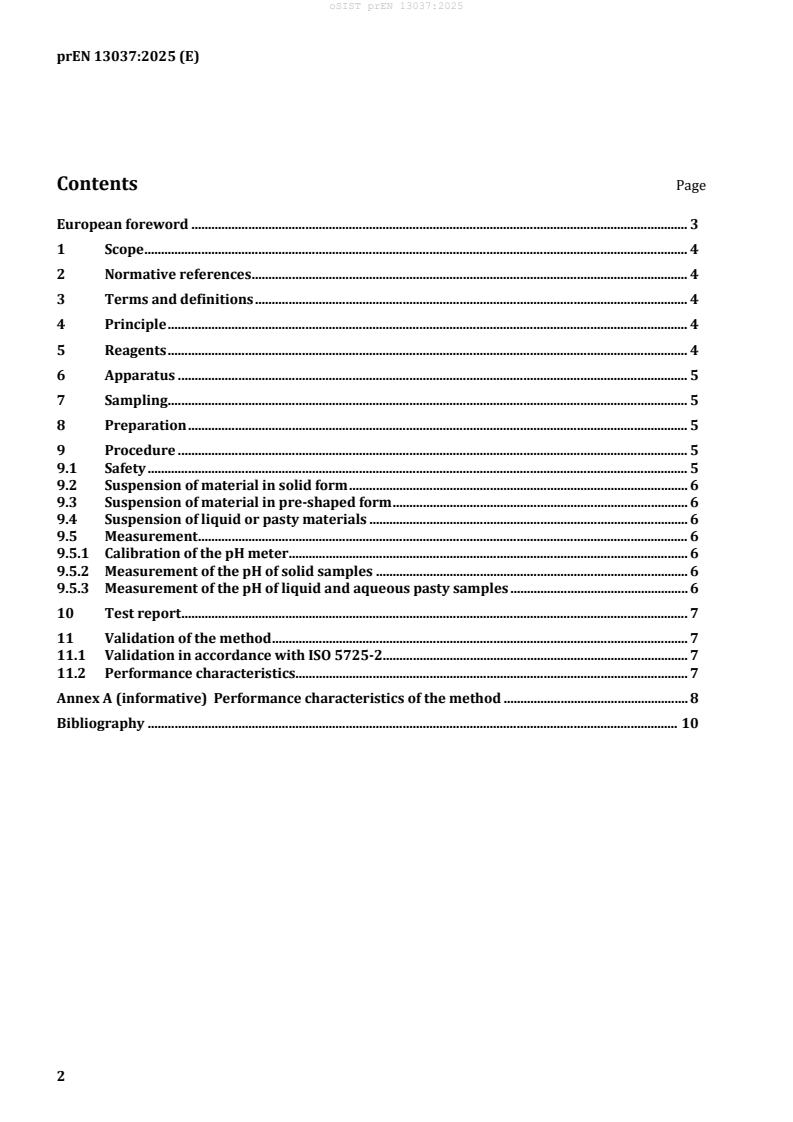
oSIST prEN 13037:2025 is the Slovenian adoption of the CEN draft European Standard prEN 13037:2025. It specifies an instrumental method for the routine determination of pH in a suspension of soil improvers or growing media with water, for laboratories and other users that need a repeatable way to check these materials.
What does oSIST prEN 13037:2025 specify?
oSIST prEN 13037:2025 specifies how to prepare a suspension, calibrate a pH meter, and measure pH for soil improvers and growing media. The standard is organized into scope, normative references, terms and definitions, principle, reagents, apparatus, sampling, preparation, procedure, test report, validation, and one informative annex.
| Annex | What it covers |
|---|---|
| Annex A | Performance characteristics of the method from an interlaboratory study |
The scope is limited to an instrumental routine method. Sampling is handled by EN 12579:2024, and sample preparation is handled by prEN 13040-1:2025, so the document focuses on the laboratory measurement step rather than field sampling.
What are the key requirements of oSIST prEN 13037:2025?
oSIST prEN 13037:2025 requires a defined extraction and measurement procedure so that results are comparable between laboratories. In practice, the method fixes the sample-to-water ratio, the temperature window, the calibration approach, and the way results are reported.
Sample handling and preparation
- Use representative samples and follow EN 12579:2024 for sampling. This matters because a biased sample can give a misleading pH result even if the measurement is correct.
- Prepare the sample according to prEN 13040-1:2025 and determine laboratory bulk density. This information is part of the result record and helps relate the test portion to the product as received.
- Handle samples safely, especially where sharps may be present.
Suspension and extraction
- For solid materials, make a suspension with water at 22 °C ± 3 °C using the specified extraction ratio of 1 part sample to 5 parts water.
- The procedure gives separate handling for material passing through a 20 mm sieve, material passing through a 40 mm sieve, and material larger than 40 mm.
- Pre-shaped materials are shaken with water, then squeezed before measurement. Liquid materials may be measured directly, while pasty materials are first mixed with water and shaken.
Reagents and equipment
- Use water of low conductivity and buffer solutions suitable for calibration at about pH 4.00, 7.00, and 9 to 9.5.
- Use a pH meter with slope adjustment and temperature control, together with a suitable glass or combined electrode.
- For extreme pH values above 10, use an electrode designed for that range. This matters because ordinary electrodes may not be reliable in strongly alkaline samples.
Measurement and reporting
- Calibrate the pH meter with at least two appropriate buffer solutions before measuring samples.
- Measure the pH in the settling suspension after thorough mixing, and read the result once the display is stable within 0.1 pH unit over 15 s.
- Report results to the nearest 0.1 pH unit and include the sample identification, any non-standard or optional operations, and the laboratory bulk density.
Method validation
- The method was validated in accordance with ISO 5725-2 and its repeatability and reproducibility are summarized in Annex A. That gives users a technical basis for judging whether the method fits routine quality control.
What terms does oSIST prEN 13037:2025 define?
oSIST prEN 13037:2025 uses the terminology of CEN/TS 17732:2022 for terms and definitions. Key terms and abbreviations used in the document include:
- pH - the measured value used here to express the acidity or alkalinity of the suspension.
- pH meter - the instrument used to measure the pH of the prepared suspension or liquid sample.
- Soil improvers - materials covered by this standard and named in the scope as test items.
- Growing media - materials covered by this standard and named in the scope as test items.
- Laboratory bulk density - a sample property recorded during preparation and included in the test report.
- Repeatability - the closeness of results under the same method and laboratory conditions, as used in the validation work.
- Reproducibility - the closeness of results between laboratories, as used in the validation work.
Who uses oSIST prEN 13037:2025?
oSIST prEN 13037:2025 is used by testing laboratories, technical staff, quality managers, and manufacturers working with soil improvers and growing media. It is also relevant for conformity assessment and product quality control, where pH is a routine property that needs a standard laboratory method. The standard’s link to the EU Fertilising Product Regulation makes it relevant to users working with regulated fertilising products and related market surveillance.
What changed in oSIST prEN 13037:2025 from the previous edition?
oSIST prEN 13037:2025 will supersede EN 13037:2011. The foreword states one significant technical change: the scope and applicability were adapted with respect to the EU - Fertilizer Product Regulation.
Which standards are used with oSIST prEN 13037:2025?
oSIST prEN 13037:2025 refers to these standards and documents:
- CEN/TS 17732:2022 - provides the terminology used for soil improvers and growing media.
- EN 12579:2024 - gives the sampling method to obtain a representative laboratory sample.
- prEN 13040-1:2025 - gives sample preparation for chemical and physical tests and the determination of laboratory bulk density.
- ISO 5725-2 - provides the statistical basis used for validation, repeatability, and reproducibility.
What does the oSIST prEN 13037:2025 document contain?
oSIST prEN 13037:2025 contains a practical laboratory method built around water extraction, pH meter calibration, and pH measurement for different sample forms. Clauses 5 and 6 list the required reagents and apparatus, while Clause 9 separates the procedure for solid, pre-shaped, liquid, and pasty materials. Clause 10 states what must appear in the test report, and Clause 11 explains the validation basis.
Annex A gives the performance characteristics from an interlaboratory study and identifies the tested materials, including bark, coir pith, composts, liquid digestate, expanded clay, and three growing media blends. This annex is useful for judging method precision in real products and for comparing laboratory results.
Relations
- Effective Date
- 01-Nov-2025
Get Certified
Connect with accredited certification bodies for this standard

Control Union Certifications
Global certification for agriculture and sustainability.

ECOCERT
Organic and sustainability certification.

FSC International
Forest Stewardship Council certification.
Sponsored listings
Frequently Asked Questions
oSIST prEN 13037:2025 is a draft published by the Slovenian Institute for Standardization (SIST). Its full title is "Soil improvers and growing media - Determination of pH". This standard covers: This document specifies an instrumental method for the routine determination of pH in a suspension of soil improvers or growing media with water. NOTE This method has been validated in an interlaboratory study with specific products that were present on the market during the study (as included in Annex A, being bark (Pinus pinaster, 20 mm to 40 mm fraction), coir pith (0 mm to 12 mm, washed and buffered), biowaste compost (Rottegrad 3), green compost (Rottegrad 5, 0 mm to 15 mm), liquid digestate, expanded clay (whole granules, 8 mm to 16 mm), growing media blend 1 (white peat, green compost, wood fibre, lime, inorganic fertilizer (NPK + micro elements)), growing media blend 2 (white peat, black peat, expanded perlite, lime, organic fertilizer) and growing media blend 3 (white peat, black peat, clay, inorganic fertilizer (NPK + micro elements))).
This document specifies an instrumental method for the routine determination of pH in a suspension of soil improvers or growing media with water. NOTE This method has been validated in an interlaboratory study with specific products that were present on the market during the study (as included in Annex A, being bark (Pinus pinaster, 20 mm to 40 mm fraction), coir pith (0 mm to 12 mm, washed and buffered), biowaste compost (Rottegrad 3), green compost (Rottegrad 5, 0 mm to 15 mm), liquid digestate, expanded clay (whole granules, 8 mm to 16 mm), growing media blend 1 (white peat, green compost, wood fibre, lime, inorganic fertilizer (NPK + micro elements)), growing media blend 2 (white peat, black peat, expanded perlite, lime, organic fertilizer) and growing media blend 3 (white peat, black peat, clay, inorganic fertilizer (NPK + micro elements))).
oSIST prEN 13037:2025 is classified under the following ICS (International Classification for Standards) categories: 65.080 - Fertilizers. The ICS classification helps identify the subject area and facilitates finding related standards.
oSIST prEN 13037:2025 has the following relationships with other standards: It is inter standard links to SIST EN 13037:2012. Understanding these relationships helps ensure you are using the most current and applicable version of the standard.
oSIST prEN 13037:2025 is associated with the following European legislation: EU Directives/Regulations: 2019/1009; Standardization Mandates: M/564, M/564 AMD 1, M/564 AMD 2, M/XXX. When a standard is cited in the Official Journal of the European Union, products manufactured in conformity with it benefit from a presumption of conformity with the essential requirements of the corresponding EU directive or regulation.
oSIST prEN 13037:2025 is available in PDF format for immediate download after purchase. The document can be added to your cart and obtained through the secure checkout process. Digital delivery ensures instant access to the complete standard document.
Standards Content (Sample)
SLOVENSKI STANDARD
01-november-2025
Izboljševalci tal in rastni substrati - Določanje pH
Soil improvers and growing media - Determination of pH
Bodenverbesserungsmittel und Kultursubstrate - Bestimmung des pH-Wertes
Amendements du sol et supports de culture - Détermination du pH
Ta slovenski standard je istoveten z: prEN 13037
ICS:
65.080 Gnojila Fertilizers
2003-01.Slovenski inštitut za standardizacijo. Razmnoževanje celote ali delov tega standarda ni dovoljeno.
DRAFT
EUROPEAN STANDARD
prEN 13037
NORME EUROPÉENNE
EUROPÄISCHE NORM
October 2025
ICS 65.080 Will supersede EN 13037:2011
English Version
Soil improvers and growing media - Determination of pH
Amendements du sol et supports de culture - Bodenverbesserungsmittel und Kultursubstrate -
Détermination du pH Bestimmung des pH-Wertes
This draft European Standard is submitted to CEN members for enquiry. It has been drawn up by the Technical Committee
CEN/TC 223.
If this draft becomes a European Standard, CEN members are bound to comply with the CEN/CENELEC Internal Regulations
which stipulate the conditions for giving this European Standard the status of a national standard without any alteration.
This draft European Standard was established by CEN in three official versions (English, French, German). A version in any other
language made by translation under the responsibility of a CEN member into its own language and notified to the CEN-CENELEC
Management Centre has the same status as the official versions.
CEN members are the national standards bodies of Austria, Belgium, Bulgaria, Croatia, Cyprus, Czech Republic, Denmark, Estonia,
Finland, France, Germany, Greece, Hungary, Iceland, Ireland, Italy, Latvia, Lithuania, Luxembourg, Malta, Netherlands, Norway,
Poland, Portugal, Republic of North Macedonia, Romania, Serbia, Slovakia, Slovenia, Spain, Sweden, Switzerland, Türkiye and
United Kingdom.
Recipients of this draft are invited to submit, with their comments, notification of any relevant patent rights of which they are
aware and to provide supporting documentation.
Warning : This document is not a European Standard. It is distributed for review and comments. It is subject to change without
notice and shall not be referred to as a European Standard.
EUROPEAN COMMITTEE FOR STANDARDIZATION
COMITÉ EUROPÉEN DE NORMALISATION
EUROPÄISCHES KOMITEE FÜR NORMUNG
CEN-CENELEC Management Centre: Rue de la Science 23, B-1040 Brussels
© 2025 CEN All rights of exploitation in any form and by any means reserved Ref. No. prEN 13037:2025 E
worldwide for CEN national Members.
prEN 13037:2025 (E)
Contents Page
European foreword . 3
1 Scope . 4
2 Normative references . 4
3 Terms and definitions . 4
4 Principle . 4
5 Reagents . 4
6 Apparatus . 5
7 Sampling . 5
8 Preparation . 5
9 Procedure . 5
9.1 Safety . 5
9.2 Suspension of material in solid form . 6
9.3 Suspension of material in pre-shaped form . 6
9.4 Suspension of liquid or pasty materials . 6
9.5 Measurement . 6
9.5.1 Calibration of the pH meter . 6
9.5.2 Measurement of the pH of solid samples . 6
9.5.3 Measurement of the pH of liquid and aqueous pasty samples . 6
10 Test report . 7
11 Validation of the method . 7
11.1 Validation in accordance with ISO 5725-2. 7
11.2 Performance characteristics. 7
Annex A (informative) Performance characteristics of the method . 8
Bibliography . 10
prEN 13037:2025 (E)
European foreword
This document (prEN 13037:2025) has been prepared by Technical Committee CEN/TC 223 “Soil
improvers and growing media”, the secretariat of which is held by NEN.
This document is currently submitted to the CEN Enquiry.
This document will supersede EN 13037:2011.
prEN 13037:2025 includes the following significant technical changes with respect to EN 13037:2011:
— adaptation of scope and applicability with respect to the EU – Fertilizer Product Regulation [2].
This document has been prepared under a standardization request addressed to CEN by the European
Commission. The Standing Committee of the EFTA States subsequently approves these requests for its
Member States.
prEN 13037:2025 (E)
1 Scope
This document specifies an instrumental method for the routine determination of pH in a suspension of
soil improvers or growing media.
2 Normative references
The following documents are referred to in the text in such a way that some or all of their content
constitutes requirements of this document. For dated references, only the edition cited applies. For
undated references, the latest edition of the referenced document (including any amendments) applies.
CEN/TS 17732:2022, Soil improvers and growing media – Terminology
EN 12579:2024, Soil improvers and growing media - Sampling
prEN 13040-1:2025, Soil improvers and growing media — Sample preparation — Part 1: Sample
preparation for chemical and physical tests, determination of dry matter content, moisture content and
laboratory bulk density
3 Terms and definitions
For the purposes of this document, the terms and definitions given in CEN/TS 17732:2022 apply.
ISO and IEC maintain terminology databases for use in standardization at the following addresses:
— ISO Online browsing platform: available at https://www.iso.org/obp/
— IEC Electropedia: available at https://www.electropedia.org/
4 Principle
A sample is extracted with water at 22 °C ± 3,0 °C in an extraction ratio of 1 to 5 (1 V sample + 5 V water).
The pH of the suspension is measured using a pH meter.
5 Reagents
Use only reagents of recognized analytical grade.
5.1 Water with a specific conductivity not higher than 0,2 mS/m at 25 °C.
5.2 Buffer solution, pH = 4,00 at 20 °C.
Dissolve 10,21 g of potassium hydrogen phthalate (C H KO ) in water (5.1) and dilute to 1 000 ml in a
8 5 4
volumetric flask.
Commercially available buffers (e.g. in the form of tablets) covering the required pH may also be used.
5.3 Buffer solution, pH = 7,00 at 20 °C.
Dissolve 3,800 g of potassium dihydrogen phosphate (KH PO ) and 3,415 g disodium hydrogen
2 4
phosphate (Na HPO ) in water (see 5.1) and dilute to 1 000 ml in a volumetric flask.
2 4
The potassium dihydrogen phosphate shall be dried before use for 2 h at 115 °C ± 5 °C.
Commercially available buffers (e.g. in the form of tablets) covering the required pH may also be used.
5.4 Buffer solu
...