


oSIST prEN 149:2026
(Main)Respiratory protective devices - Filtering half masks to protect against particles - Requirements, testing and marking
Respiratory protective devices - Filtering half masks to protect against particles - Requirements, testing and marking
This document specifies minimum requirements for particle filtering half masks as respiratory protective devices intended to protect the wearer in occupational settings, where there is a health risk(s) from inhaling any type of particles during working activities except for escape purposes.
Laboratory and practical performance tests or references to test method standards are included for the assessment of compliance with the requirements.
Atemschutzgeräte - Filtrierende Halbmasken zum Schutz gegen Partikeln - Anforderungen, Prüfung, Kennzeichnung
Dieses Dokument legt Mindestanforderungen an partikelfiltrierende Halbmasken fest, die als Atemschutzgeräte zum Schutz der gerättragenden Person in Arbeitsumgebungen vorgesehen sind, in denen ein oder mehrere Gesundheitsrisiken durch das Einatmen von Partikeln unterschiedlichster Art im Rahmen von Arbeitstätigkeiten bestehen, ausgenommen Fluchtzwecke.
Laborprüfungen und praktische Leistungsprüfungen bzw. Verweisungen auf Normen zu Prüfverfahren sind enthalten, um die Erfüllung der Anforderungen zu bewerten.
Appareils de protection respiratoire - Demi-masques filtrants contre les particules - Exigences, essais, marquage
Le présent document spécifie les exigences minimales applicables aux demi-masques filtrants contre les particules utilisés comme appareils de protection respiratoire destinés à protéger le porteur dans les environnements professionnels où il existe un ou plusieurs risques pour la santé liés à l’inhalation de tout type de particules pendant les activités professionnelles, à l’exception des situations d’évacuation.
Il contient des essais de laboratoire et des essais pratiques de performance ou des références à des normes de méthodes d’essai pour assurer la conformité aux exigences.
Oprema za varovanje dihal - Polobrazne maske za zaščito pred delci - Zahteve, preskušanje in označevanje
Ta dokument določa minimalne zahteve za polmaske za filtriranje delcev kot dihalne zaščitne naprave, namenjene zaščiti uporabnika v delovnih okoljih, kjer obstaja zdravstveno tveganje zaradi vdihavanja kakršnih koli delcev med delovnimi aktivnostmi, razen za namene pobega.
Vključeni so laboratorijski in praktični preizkusi zmogljivosti ali sklicevanja na standarde preskusnih metod za oceno skladnosti z zahtevami.
General Information
- Status
- Not Published
- Public Enquiry End Date
- 30-May-2026
- Technical Committee
- OVP - Personal protecting equipment
- Current Stage
- 4020 - Public enquire (PE) (Adopted Project)
- Start Date
- 06-Mar-2026
- Due Date
- 24-Jul-2026
Relations
- Effective Date
- 31-Jul-2024

Get Certified
Connect with accredited certification bodies for this standard

NSF International
Global independent organization facilitating standards development and certification.

CIS Institut d.o.o.
Personal Protective Equipment (PPE) certification body. Notified Body NB-2890 for EU Regulation 2016/425 PPE.

Kiwa BDA Testing
Building and construction product certification.
Sponsored listings
Frequently Asked Questions
oSIST prEN 149:2026 is a draft published by the Slovenian Institute for Standardization (SIST). Its full title is "Respiratory protective devices - Filtering half masks to protect against particles - Requirements, testing and marking". This standard covers: This document specifies minimum requirements for particle filtering half masks as respiratory protective devices intended to protect the wearer in occupational settings, where there is a health risk(s) from inhaling any type of particles during working activities except for escape purposes. Laboratory and practical performance tests or references to test method standards are included for the assessment of compliance with the requirements.
This document specifies minimum requirements for particle filtering half masks as respiratory protective devices intended to protect the wearer in occupational settings, where there is a health risk(s) from inhaling any type of particles during working activities except for escape purposes. Laboratory and practical performance tests or references to test method standards are included for the assessment of compliance with the requirements.
oSIST prEN 149:2026 is classified under the following ICS (International Classification for Standards) categories: 13.040.30 - Workplace atmospheres; 13.340.30 - Respiratory protective devices. The ICS classification helps identify the subject area and facilitates finding related standards.
oSIST prEN 149:2026 has the following relationships with other standards: It is inter standard links to SIST EN 149:2001+A1:2009. Understanding these relationships helps ensure you are using the most current and applicable version of the standard.
oSIST prEN 149:2026 is associated with the following European legislation: EU Directives/Regulations: 2016/425; Standardization Mandates: M/571, M/571 AMD 1. When a standard is cited in the Official Journal of the European Union, products manufactured in conformity with it benefit from a presumption of conformity with the essential requirements of the corresponding EU directive or regulation.
oSIST prEN 149:2026 is available in PDF format for immediate download after purchase. The document can be added to your cart and obtained through the secure checkout process. Digital delivery ensures instant access to the complete standard document.
Standards Content (Sample)
SLOVENSKI STANDARD
01-maj-2026
Oprema za varovanje dihal - Polobrazne maske za zaščito pred delci - Zahteve,
preskušanje in označevanje
Respiratory protective devices - Filtering half masks to protect against particles -
Requirements, testing and marking
Atemschutzgeräte - Filtrierende Halbmasken zum Schutz gegen Partikeln -
Anforderungen, Prüfung, Kennzeichnung
Appareils de protection respiratoire - Demi-masques filtrants contre les particules -
Exigences, essais, marquage
Ta slovenski standard je istoveten z: prEN 149
ICS:
13.340.30 Varovalne dihalne naprave Respiratory protective
devices
2003-01.Slovenski inštitut za standardizacijo. Razmnoževanje celote ali delov tega standarda ni dovoljeno.
DRAFT
EUROPEAN STANDARD
NORME EUROPÉENNE
EUROPÄISCHE NORM
March 2026
ICS 13.040.30 Will supersede EN 149:2001+A1:2009
English Version
Respiratory protective devices - Filtering half masks to
protect against particles - Requirements, testing and
marking
Appareils de protection respiratoire - Demi-masques Atemschutzgeräte - Filtrierende Halbmasken zum
filtrants contre les particules - Exigences, essais et Schutz gegen Partikeln - Anforderungen, Prüfung,
marquage Kennzeichnung
This draft European Standard is submitted to CEN members for enquiry. It has been drawn up by the Technical Committee
CEN/TC 79.
If this draft becomes a European Standard, CEN members are bound to comply with the CEN/CENELEC Internal Regulations
which stipulate the conditions for giving this European Standard the status of a national standard without any alteration.
This draft European Standard was established by CEN in three official versions (English, French, German). A version in any other
language made by translation under the responsibility of a CEN member into its own language and notified to the CEN-CENELEC
Management Centre has the same status as the official versions.
CEN members are the national standards bodies of Austria, Belgium, Bulgaria, Croatia, Cyprus, Czech Republic, Denmark, Estonia,
Finland, France, Germany, Greece, Hungary, Iceland, Ireland, Italy, Latvia, Lithuania, Luxembourg, Malta, Netherlands, Norway,
Poland, Portugal, Republic of North Macedonia, Romania, Serbia, Slovakia, Slovenia, Spain, Sweden, Switzerland, Türkiye and
United Kingdom.
Recipients of this draft are invited to submit, with their comments, notification of any relevant patent rights of which they are
aware and to provide supporting documentation.
Warning : This document is not a European Standard. It is distributed for review and comments. It is subject to change without
notice and shall not be referred to as a European Standard.
EUROPEAN COMMITTEE FOR STANDARDIZATION
COMITÉ EUROPÉEN DE NORMALISATION
EUROPÄISCHES KOMITEE FÜR NORMUNG
CEN-CENELEC Management Centre: Rue de la Science 23, B-1040 Brussels
© 2026 CEN All rights of exploitation in any form and by any means reserved Ref. No. prEN 149:2026 E
worldwide for CEN national Members.
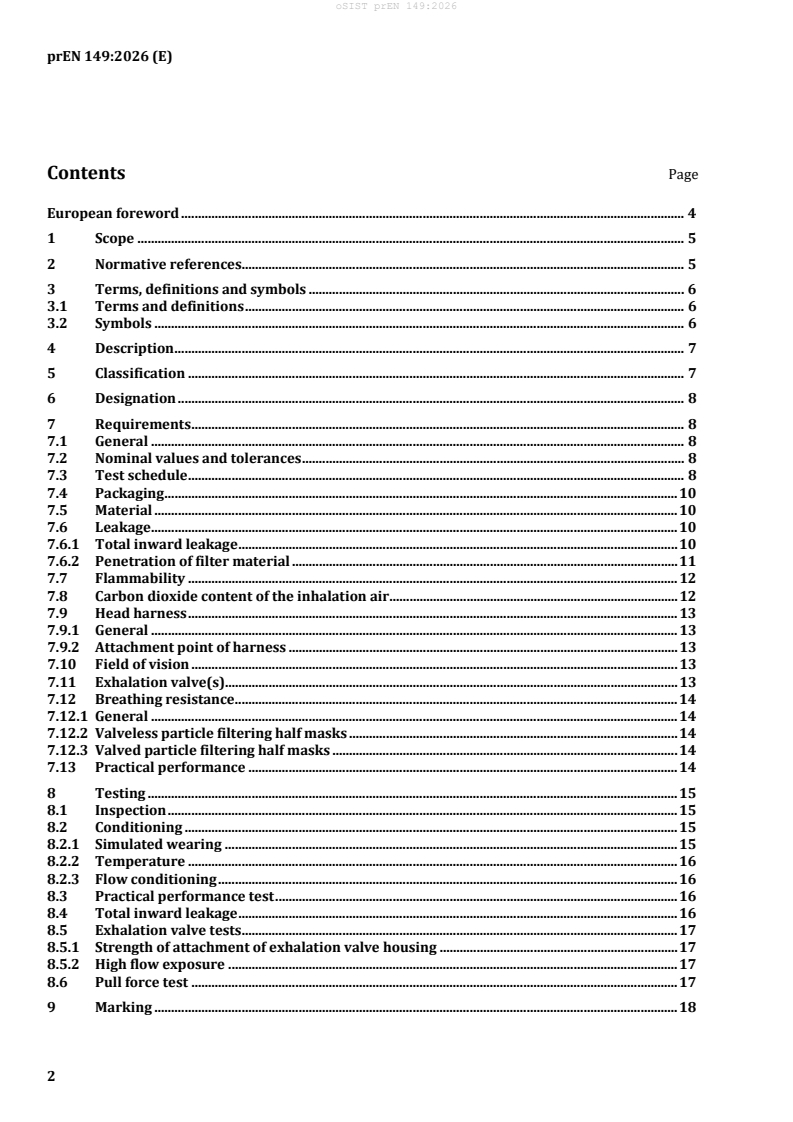
Contents Page
European foreword . 4
1 Scope . 5
2 Normative references. 5
3 Terms, definitions and symbols . 6
3.1 Terms and definitions . 6
3.2 Symbols . 6
4 Description . 7
5 Classification . 7
6 Designation . 8
7 Requirements . 8
7.1 General . 8
7.2 Nominal values and tolerances . 8
7.3 Test schedule . 8
7.4 Packaging . 10
7.5 Material . 10
7.6 Leakage . 10
7.6.1 Total inward leakage . 10
7.6.2 Penetration of filter material . 11
7.7 Flammability . 12
7.8 Carbon dioxide content of the inhalation air . 12
7.9 Head harness . 13
7.9.1 General . 13
7.9.2 Attachment point of harness . 13
7.10 Field of vision . 13
7.11 Exhalation valve(s). 13
7.12 Breathing resistance . 14
7.12.1 General . 14
7.12.2 Valveless particle filtering half masks . 14
7.12.3 Valved particle filtering half masks . 14
7.13 Practical performance . 14
8 Testing . 15
8.1 Inspection . 15
8.2 Conditioning . 15
8.2.1 Simulated wearing . 15
8.2.2 Temperature . 16
8.2.3 Flow conditioning . 16
8.3 Practical performance test . 16
8.4 Total inward leakage . 16
8.5 Exhalation valve tests . 17
8.5.1 Strength of attachment of exhalation valve housing . 17
8.5.2 High flow exposure . 17
8.6 Pull force test . 17
9 Marking . 18
9.1 Packaging . 18
9.1.1 Required markings . 18
9.1.2 Optional markings . 18
9.2 Particle filtering half mask . 19
9.2.1 Required markings . 19
9.2.2 Optional markings . 19
10 Information supplied by the manufacturer . 19
Annex A (informative) Selection of mask size . 21
Annex ZA (informative) Relationship between this European Standard and the essential health
and safety requirements of Regulation 2016/425/EU [2016 OJ L81] aimed to be
covered . 24
Bibliography . 28
European foreword
This document (prEN 149:2026) has been prepared by Technical Committee CEN/TC 79 “Respiratory
protective devices”, the secretariat of which is held by DIN.
This document is currently submitted to the CEN Enquiry.
This document will supersede EN 149:2001+A1:2009.
EN 149:2001+A1:2009:
a) terms and definitions modified;
b) classification extended by optional comfort marking ‘C’;
c) designation modified, R, NR and NR D deleted;
d) values and tolerances modified;
e) test schedule table added;
f) material general requirements modified;
g) cleaning and disinfection as clause deleted;
h) total inward leakage (TIL) test specified in more detail, ISO RPD test heads adopted to be used;
i) test reference for flammability updated;
j) carbon dioxide test modified using ISO RPD test heads;
k) stress tests for head harnesses and attachment points adopted;
l) ISO test for field of vision added;
m) high flow exposure modified;
n) tests for valved masks clearly specified;
o) clogging test deleted;
p) conditioning and simulated wearing treatment modified;
q) marking of packaging updated by size designation;
r) information supplied by the manufacturer updated.
This document has been prepared under a standardization request addressed to CEN by the European
Commission. The Standing Committee of the EFTA States subsequently approves these requests for its
Member States.
For the relationship with EU Legislation, see informative Annex ZA, which is an integral part of this
document.
1 Scope
This document specifies minimum requirements for particle filtering half masks as respiratory protective
devices intended to protect the wearer in occupational settings, where there is a health risk(s) from
inhaling any type of particles during working activities except for escape purposes.
Laboratory and practical performance tests or references to test method standards are included for the
assessment of compliance with the requirements.
2 Normative references
The following documents are referred to in the text in such a way that some or all of their content
constitutes requirements of this document. For dated references, only the edition cited applies. For
undated references, the latest edition of the referenced document (including any amendments) applies.
EN 13274-2:2019, Respiratory protective devices — Methods of test — Part 2: Practical performance tests
EN ISO 16972:2020, Respiratory protective devices — Vocabulary and graphical symbols (ISO 16972:2020)
ISO 16900-1:2019, Respiratory protective devices — Methods of test and test equipment — Part 1:
Determination of inward leakage
ISO 16900-2:2017, Respiratory protective devices — Methods of test and test equipment — Part 2:
Determination of breathing resistance
ISO 16900-3:2012, Respiratory protective devices — Methods of test and test equipment — Part 3:
Determination of particle filter penetration
ISO 16900-5:2016, Respiratory protective devices — Methods of test and test equipment — Part 5:
Breathing machine, metabolic simulator, RPD head forms and torso, tools and verification tools —
Amendment 1: RPD head forms front and side view
ISO 16900-9:2015, Respiratory protective devices — Methods of test and test equipment — Part 9:
Determination of carbon dioxide content of the inhaled gas
ISO 16900-10:2015, Respiratory protective devices — Methods of test and test equipment — Part 10:
Resistance to ignition, flame, radiant heat and heat
ISO 16900-11:2025, Respiratory protective devices — Methods of test and test equipment — Part 11:
Determination of field of vision
ISO 16976-2:2022, Respiratory protective devices — Human factors — Part 2: Anthropometrics
As impacted by ISO 16900-5:2016/Amd1:2018.
3 Terms, definitions and symbols
3.1 Terms and definitions
For the purposes of this document, the terms and definitions given in EN ISO 16972:2020 and the
following apply.
ISO and IEC maintain terminology databases for use in standardization at the following addresses:
— ISO Online browsing platform: available at https://www.iso.org/obp/
— IEC Electropedia: available at https://www.electropedia.org/
3.1.1
working activities
activities that are necessary for the exercise of profession or practice
Note 1 to entry: For example, laboratory work, road work, mining, manual activities such as milling, grinding, drilling
as well as all activities in the non-professional area where harmful conditions may occur, (e.g. gardening)
3.1.2
tightly sealed manner
prevention of any leakages between head form and the half masks sealing line when the particle filtering
half mask is placed on the test head
Note 1 to entry: This can be achieved by taping or other means, taking care not to reduce the filtering area.
3.2 Symbols
For the purposes of this document, the following symbols apply.
3.2.1 SOURCE: ISO 7000, 1641
see information supplied by the manufacturer
3.2.2 SOURCE:ISO 7000, 2607 (in ISO
7000 the explanation is "Use by
date")
Hour glass “end of shelf life”
YYYY-MM
Key
YYYY = year, MM = month
3.2.2 SOURCE: ISO 7000, 0632
temperature range of storage conditions
Key
-xx °C to +yy °C
3.2.4 SOURCE: ISO 7000, 0626
maximum humidity of storage conditions
Key
SOURCE: 17420-2:2021, 3.3.6
3.2.5
RPD head form number allocation for size designation
Note 1 to entry: The RPD head form number allocation does
not correlate with fit of particle filtering half masks to the
actual wearer.
Note 2 to entry: The symbol is taken from ISO 17420-2:2021.
4 Description
A particle filtering half mask covers all the nose and mouth and some or all of the chin. The particle
filtering half mask consists entirely or substantially of filter material or comprises a facepiece in which
the main filter(s) form an inseparable part of the device.
It is intended to provide adequate sealing on the face of the wearer against the ambient atmosphere when
the skin is dry or moist and when the head is moved.
Air enters the particle filtering half mask and passes directly to the nose and mouth area of the facepiece
or, via an inhalation valve(s), if fitted. The exhaled air flows through the filter material and/or an
exhalation valve, if fitted, directly to the ambient atmosphere.
Particle filtering half masks are designed to protect against both solid and liquid aerosols.
5 Classification
Particle filtering half masks are classified according to their filtering efficiency and their maximum total
inward leakage. There are 3 classes of particle filtering half masks:
FFP1, FFP2 and FFP3.
The protection provided by an FFP2 - or FFP3 - particle filtering half mask includes that provided by a
lower class or classes.
If the breathing resistance does not exceed 50 % of the limits specified in 7.12.1 within its class, it may be
marked as breathing comfortable devices with an additional ‘C’.
FFP1 C
6 Designation
Particle filtering half masks meeting the requirements of this document shall be designated in the
following manner:
Particle filtering half mask, standard, year of publication, classification.
EXAMPLE Particle filtering half mask EN 149:20XX FFP1.
7 Requirements
7.1 General
All test samples specified in the related test clauses shall meet the relevant requirements.
Marking and instructions for use in Clauses 9 and 10 shall be followed and inspected in accordance with
8.1.
7.2 Nominal values and tolerances
Values which are not stated as maxima or minima shall be subject to a tolerance of ± 5 %. Any temperature
limits specified shall be subject to an accuracy of ± 1 °C.
Unless otherwise stated, all results of measured air flow rates are deemed to be volumetric flow rates and
shall be corrected to 20 °C, 1 013 hPa according to Formula (1).
P
m
Q Qk⋅⋅ (1)
cor m
T
m
where
Q is the corrected air flow;
cor
Q is the measured air flow;
m
k is a constant 0,289 [K/hPa], i.e. 293 K divided by 1 013 hPa (20 °C);
P is the pressure during measurement in hPa;
m
T is the temperature of the supplied air flow in K.
m
7.3 Test schedule
Before performing tests involving human subjects, account should be taken of any national regulations
concerning the medical history, examination, or supervision of the test subjects.
If no special measuring devices and methods are specified, commonly used devices and methods shall be
used.
The test schedule is given in Table 1.
=
Table 1 — Test schedule
Number of
Requirement Title Conditioning Test clause
a
samples
5 unvalved or 5
As received
valved
7.6.1 Total inward leakage 5 unvalved or 3 8.4
8.2.2
valved
2 valved 8.2.3
3 as per 8.2.2 ISO 16900-3:2012, 8.2
Penetration of filter 6 (for each
7.6.2
material aerosol)
3 as per 8.2.1 ISO 16900-3:2012, 8.3.1
2 as received
ISO 16900-10:2015,
7.7 Flammability 4
6.2.4
2 as per 8.2.2
1 as received
Carbon dioxide content
7.8 3 per size ISO 16900-9:2015
of the inhalation air
2 as per 8.2.2
2 as received
7.9.1 Head harness — General 4 8.3
2 as per 8.2.2
Head harness —
2 as received
7.9.2 Attachment points of 4 8.6
2 as per 8.2.2
harness
1 as received for
7.10 Field of vision 1 per size each head form ISO 16900-11:2025
used
7.11 Exhalation valve
8.2.2 followed by
7.11.1 5 8.4
8.5.2
7.11.2 All As received 8.1
1 as received
7.11.3 2 8.5.1
1 as per 8.2.2
7.12 Breathing resistance
3 as received
Breathing resistance
ISO 16900-2:2017, 6.3.2,
7.12.2 (Valveless particle 9 3 as per 8.2.1
Method 1
filtering half masks)
3 as per 8.2.2
3 as received
Breathing resistance
3 as per 8.2.1
ISO 16900-2:2017, 6.3.2,
7.12.3 (Valved particle filtering 12
Method 1
3 as per 8.2.2
half masks)
3 as per 8.2.3
7.13 Practical performance 1 as received
2 8.3
1 as per 8.2.2
a
Most samples can be used for more than one test.
7.4 Packaging
Particle filtering half masks shall be offered for sale packaged in such a way that they are protected against
mechanical damage and contamination before use.
Check in accordance with 8.1.
7.5 Material
Materials used shall be suitable to withstand handling and wear over the period for which the particle
filtering half mask is designed to be used.
Any material released by the air flow through the particle filtering half mask shall not be known to be
likely to cause a hazard or nuisance for the wearer.
Evidence shall be given by:
a) a declaration supplied by the manufacturer confirming that the PPE does not contain any substances
at levels that are known or suspected to adversely affect user hygiene or health;
b) materials specifications.
The surface of any part of the filter likely to come into contact with the wearer shall be free from sharp
edges and burrs.
Check in accordance with 8.1 and 8.3.
The manufacturer shall supply a declaration that this was addressed by a risk assessment, e.g. a Failure
Mode and Effects Analysis (FMEA).
NOTE Further information is given in EN 60812:2016 [1].
Check in accordance with 8.1.
After undergoing the conditioning specified in 8.2.1, none of the components of the particle filtering half
masks shall have suffered mechanical failure.
When conditioned in accordance with 8.2.1 and 8.2.2, the particle filtering half mask shall withstand
handling and wear over the period of conditioning.
Materials that may come into physical contact with the wearer’s skin shall not be known to be likely to
cause irritation or any other adverse effect to health.
The manufacturer shall supply a declaration that this was addressed by a risk assessment, e.g. a FMEA.
Check in accordance with 8.1 and test in accordance with 8.3 and 8.4.
7.6 Leakage
7.6.1 Total inward leakage
Prior to TIL testing, half mask shall be selected for the test subject in accordance with the information
supplied by the manufacturer.
Samples shall be conditioned 5/5 as received, 5/3 if unvalved after 8.2.2 and 0/2 if valved after 8.2.3.
RPD shall be tested for TIL in accordance with ISO 16900-1:2019 using the sodium chloride test method.
Subjects' facial dimensions, face width and face length (i.e. menton-sellion length) shall be measured and
recorded.
Testing shall be performed with ten subjects distributed across the cells of the bivariate panel
(ISO 16976-2:2022, 8.2) applicable to the size of the particle filtering half mask stated by the
manufacturer.
A maximum number of 15 test subjects shall be assessed in order to select the test panel. If among 15
subjects, a test panel of 10 cannot be identified, the particulate filtering half mask shall not be tested for
TIL and this fact shall be reported as a failure in the test report.
Each size shall be tested at least once and pass the TIL test.
In each exercise of each test subject, the result shall not be greater than:
22 % for FFP1
8 % for FFP2
2 % for FFP3
Test in accordance with the exercise regime given in ISO 16900-1:2019, Table B.1, after an acclimatization
according to number 1 in the following sequence:
6 Walk
7 Walk, head rotation
8 Walk, speaking
5 Hand and knees, head rotation
2 Standing still
7.6.2 Penetration of filter material
The maximum penetration of the filter of the particle filtering half mask shall meet the requirements of
Table 2.
Table 2 — Maximum penetration of filter material
Maximum penetration of test aerosol
(%)
Sodium chloride test Paraffin oil test
Classification at an airflow of 95 l/min with a tolerance of ± 5 %
FFP1 20 20
FFP2 6 6
FFP3 1 1
Six samples of particle filtering half masks shall be tested for each aerosol.
Testing shall be performed on
— three samples in as received state in accordance with ISO 16900-3:2012, 8.2;
— three samples in accord
...
Questions, Comments and Discussion
Ask us and Technical Secretary will try to provide an answer. You can facilitate discussion about the standard in here.
Loading comments...