

SIST EN 12209:2025
(Main)Building hardware - Mechanically operated locks and locking plates - Characteristics and test methods
General Information
- Abstract
This document specifies product characteristics and test methods of mechanically operated locks and their locking plates.
This document covers mechanically operated locks and their locking plates which are either manufactured and placed on the market in their entirety by one producer or assembled from sub-assemblies produced by more than one producer and designed to be used in combination.
This document does not cover assessment of the contribution of the product to the fire resistance of specific fire resistance and/or smoke control door set assemblies.
This document is not applicable to mechanically/electromechanically cylinders, handles, locks for windows, padlocks, locks for safes, furniture locks or prison locks.
This document does not specify mechanically operated multipoint locks and their locking plates which are specified by EN 15685.
- Status
- Published
- Public Enquiry End Date
- 09-Nov-2019
- Publication Date
- 29-Dec-2024
- Technical Committee
- ISTP - Doors and windows
- Current Stage
- 6060 - National Implementation/Publication (Adopted Project)
- Start Date
- 19-Dec-2024
- Due Date
- 23-Feb-2025
- Completion Date
- 30-Dec-2024

Overview
EN 12209:2024 - published by CEN - defines the characteristics and test methods for mechanically operated locks and their locking plates used in building hardware. The standard applies to complete locks manufactured by a single producer or assembled from sub‑assemblies by multiple producers and intended to be used in combination. EN 12209:2024 supersedes the 2016 edition and provides harmonized requirements for performance classification, testing procedures and essential product characteristics across Europe.
Key exclusions:
- Not applicable to mechanically/electromechanically cylinders, handles, padlocks, safes, furniture or prison locks.
- Does not cover mechanically operated multipoint locks (see EN 15685).
- Does not assess the contribution of locks to the fire resistance of specific fire/smoke door assemblies.
Key Topics and Requirements
EN 12209:2024 covers technical areas grouped into product characteristics and associated test methods (see clauses 4 and 5):
- Terms, definitions and symbols - standardized vocabulary for consistent assessment.
- Essential characteristics - material safety (dangerous substances), latch return force, bolt action strength, follower restoring torque.
- Category of use - resistance to side force on latch, operational torque, follower stop strength, deadbolt torque resistance.
- Durability - endurance of latch action, deadbolt mechanism and locking snib under repeated use.
- Door parameters - suitability relative to door mass and door closing force.
- Suitability for fire/smoke door sets - graded designations (Grade 0, A, B, N) for specific use-cases (without assessing set fire resistance).
- Safety, corrosion resistance and temperature performance - test methods for environmental exposure and extreme temperatures.
- Security features - locking and deadlocking performance, torque resistance, resistance to side force, pulling, lifting, anti‑separation and anti‑lifting measures, strong key attack prevention and locking plate resistance.
- Test apparatus and procedures - standardized test doors, drilling procedures, test fixtures and sampling methods for reproducible assessment.
Applications and Who Uses It
EN 12209:2024 is essential for:
- Lock and hardware manufacturers - to design and validate products to European performance classes.
- Test and certification bodies - to perform reproducible conformity and type testing.
- Specifiers, architects and door manufacturers - to select locks suitable for required durability, security and environmental conditions.
- Procurement officers and installers - to ensure compliance with purchaser requirements and building regulations.
- Maintenance and facility managers - to understand expected service life and performance under use.
Using EN 12209 helps ensure consistent performance, supports compliance claims, and guides product specification for security, durability and environmental resistance.
Related Standards
- EN 15685 - mechanically operated multipoint locks (excluded from EN 12209)
- Referenced normative documents and national adoptions via CEN member bodies for harmonized implementation.
Relations
- Effective Date
- 20-May-2026
- Effective Date
- 28-Jan-2026
- Effective Date
- 28-Jan-2026
- Effective Date
- 28-Jan-2026
- Effective Date
- 28-Jan-2026
- Effective Date
- 28-Jan-2026
- Effective Date
- 28-Jan-2026
- Effective Date
- 28-Jan-2026
- Effective Date
- 28-Jan-2026
- Effective Date
- 28-Jan-2026
- Effective Date
- 28-Jan-2026
- Effective Date
- 28-Jan-2026
- Effective Date
- 28-Jan-2026
- Effective Date
- 28-Jan-2026
- Effective Date
- 28-Jan-2026
Get Certified
Connect with accredited certification bodies for this standard

DIBt (Deutsches Institut für Bautechnik)
German Institute for Building Technology.
DIN CERTCO
DIN Group product certification.

Aboma Certification B.V.
Specialized in construction, metal, and transport sectors.
Sponsored listings
Frequently Asked Questions
SIST EN 12209:2025 is a standard published by the Slovenian Institute for Standardization (SIST). Its full title is "Building hardware - Mechanically operated locks and locking plates - Characteristics and test methods". This standard covers: This document specifies product characteristics and test methods of mechanically operated locks and their locking plates. This document covers mechanically operated locks and their locking plates which are either manufactured and placed on the market in their entirety by one producer or assembled from sub-assemblies produced by more than one producer and designed to be used in combination. This document does not cover assessment of the contribution of the product to the fire resistance of specific fire resistance and/or smoke control door set assemblies. This document is not applicable to mechanically/electromechanically cylinders, handles, locks for windows, padlocks, locks for safes, furniture locks or prison locks. This document does not specify mechanically operated multipoint locks and their locking plates which are specified by EN 15685.
This document specifies product characteristics and test methods of mechanically operated locks and their locking plates. This document covers mechanically operated locks and their locking plates which are either manufactured and placed on the market in their entirety by one producer or assembled from sub-assemblies produced by more than one producer and designed to be used in combination. This document does not cover assessment of the contribution of the product to the fire resistance of specific fire resistance and/or smoke control door set assemblies. This document is not applicable to mechanically/electromechanically cylinders, handles, locks for windows, padlocks, locks for safes, furniture locks or prison locks. This document does not specify mechanically operated multipoint locks and their locking plates which are specified by EN 15685.
SIST EN 12209:2025 is classified under the following ICS (International Classification for Standards) categories: 91.190 - Building accessories. The ICS classification helps identify the subject area and facilitates finding related standards.
SIST EN 12209:2025 has the following relationships with other standards: It is inter standard links to SIST EN 1303:2026, SIST EN ISO 12217-2:2002, SIST EN 1303:2015, SIST EN 16035:2024, SIST EN 1634-3:2005, SIST EN 1670:2007, SIST EN 1634-1:2014+A1:2018, SIST EN 1906:2012, SIST EN 17020-4:2021, SIST EN 14600:2006, SIST EN 17020-1:2023, SIST EN 17020-5:2023, SIST EN 1634-2:2009, SIST EN 17020-3:2023, SIST EN 17610:2022. Understanding these relationships helps ensure you are using the most current and applicable version of the standard.
SIST EN 12209:2025 is associated with the following European legislation: EU Directives/Regulations: 305/2011; Standardization Mandates: M/101. When a standard is cited in the Official Journal of the European Union, products manufactured in conformity with it benefit from a presumption of conformity with the essential requirements of the corresponding EU directive or regulation.
SIST EN 12209:2025 is available in PDF format for immediate download after purchase. The document can be added to your cart and obtained through the secure checkout process. Digital delivery ensures instant access to the complete standard document.
Standards Content (Sample)
SLOVENSKI STANDARD
01-februar-2025
Stavbno okovje - Mehanske ključavnice in prijemniki - Značilnosti in preskusne
metode
Building hardware - Mechanically operated locks and locking plates - Characteristics and
test methods
Schlösser und Baubeschläge - Mechanisch betätigte Schlösser und Schließbleche -
Anforderungen und Prüfverfahren
Quincaillerie pour le bâtiment - Serrures mécaniques et gâches - Exigences et méthodes
d'essai
Ta slovenski standard je istoveten z: EN 12209:2024
ICS:
91.190 Stavbna oprema Building accessories
2003-01.Slovenski inštitut za standardizacijo. Razmnoževanje celote ali delov tega standarda ni dovoljeno.
EN 12209
EUROPEAN STANDARD
NORME EUROPÉENNE
December 2024
EUROPÄISCHE NORM
ICS 91.190 Supersedes EN 12209:2016
English Version
Building hardware - Mechanically operated locks and
locking plates - Characteristics and test methods
Quincaillerie pour le bâtiment - Serrures mécaniques Schlösser und Baubeschläge - Mechanisch betätigte
et gâches - Exigences et méthodes d'essai Schlösser und Schließbleche - Anforderungen und
Prüfverfahren
This European Standard was approved by CEN on 27 February 2024.
CEN members are bound to comply with the CEN/CENELEC Internal Regulations which stipulate the conditions for giving this
European Standard the status of a national standard without any alteration. Up-to-date lists and bibliographical references
concerning such national standards may be obtained on application to the CEN-CENELEC Management Centre or to any CEN
member.
This European Standard exists in three official versions (English, French, German). A version in any other language made by
translation under the responsibility of a CEN member into its own language and notified to the CEN-CENELEC Management
Centre has the same status as the official versions.
CEN members are the national standards bodies of Austria, Belgium, Bulgaria, Croatia, Cyprus, Czech Republic, Denmark, Estonia,
Finland, France, Germany, Greece, Hungary, Iceland, Ireland, Italy, Latvia, Lithuania, Luxembourg, Malta, Netherlands, Norway,
Poland, Portugal, Republic of North Macedonia, Romania, Serbia, Slovakia, Slovenia, Spain, Sweden, Switzerland, Türkiye and
United Kingdom.
EUROPEAN COMMITTEE FOR STANDARDIZATION
COMITÉ EUROPÉEN DE NORMALISATION
EUROPÄISCHES KOMITEE FÜR NORMUNG
CEN-CENELEC Management Centre: Rue de la Science 23, B-1040 Brussels
© 2024 CEN All rights of exploitation in any form and by any means reserved Ref. No. EN 12209:2024 E
worldwide for CEN national Members.
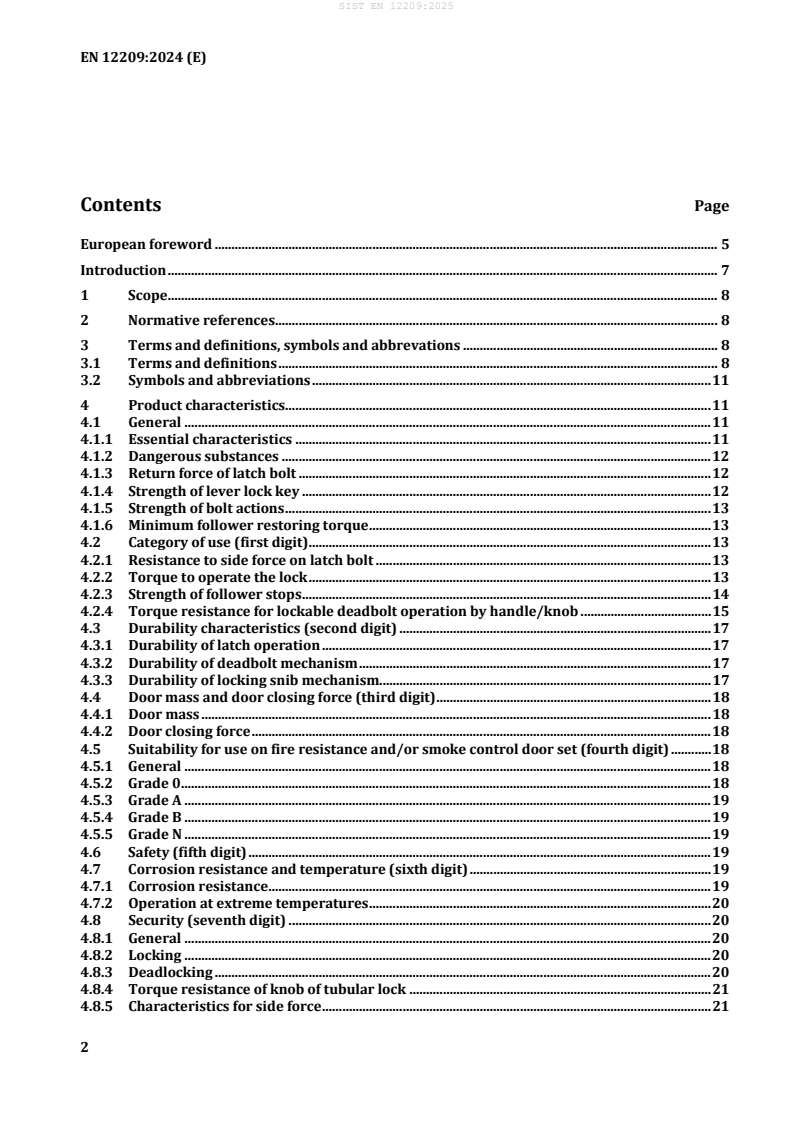
Contents Page
European foreword . 5
Introduction . 7
1 Scope . 8
2 Normative references . 8
3 Terms and definitions, symbols and abbrevations . 8
3.1 Terms and definitions . 8
3.2 Symbols and abbreviations . 11
4 Product characteristics . 11
4.1 General . 11
4.1.1 Essential characteristics . 11
4.1.2 Dangerous substances . 12
4.1.3 Return force of latch bolt . 12
4.1.4 Strength of lever lock key . 12
4.1.5 Strength of bolt actions . 13
4.1.6 Minimum follower restoring torque . 13
4.2 Category of use (first digit) . 13
4.2.1 Resistance to side force on latch bolt . 13
4.2.2 Torque to operate the lock . 13
4.2.3 Strength of follower stops . 14
4.2.4 Torque resistance for lockable deadbolt operation by handle/knob . 15
4.3 Durability characteristics (second digit) . 17
4.3.1 Durability of latch operation . 17
4.3.2 Durability of deadbolt mechanism . 17
4.3.3 Durability of locking snib mechanism. 17
4.4 Door mass and door closing force (third digit) . 18
4.4.1 Door mass . 18
4.4.2 Door closing force . 18
4.5 Suitability for use on fire resistance and/or smoke control door set (fourth digit) . 18
4.5.1 General . 18
4.5.2 Grade 0 . 18
4.5.3 Grade A . 19
4.5.4 Grade B . 19
4.5.5 Grade N . 19
4.6 Safety (fifth digit) . 19
4.7 Corrosion resistance and temperature (sixth digit) . 19
4.7.1 Corrosion resistance . 19
4.7.2 Operation at extreme temperatures . 20
4.8 Security (seventh digit) . 20
4.8.1 General . 20
4.8.2 Locking . 20
4.8.3 Deadlocking . 20
4.8.4 Torque resistance of knob of tubular lock . 21
4.8.5 Characteristics for side force . 21
4.8.6 Locking point projection . 22
4.8.7 Resistance to force in the unlocking direction (disengaging force) . 23
4.8.8 Characteristics for pulling of anti-separation bolt . 24
4.8.9 Characteristics for anti-lifting devices in sliding door locks . 25
4.8.10 Requirement for torque resistance of lockable followers . 26
4.8.11 Strong key attack on lever locks . 27
4.8.12 Resistance to force on box protected locking plates . 27
4.8.13 Resistance to side force on locking plates . 28
4.8.14 Resistance to pulling on locking plates . 28
4.8.15 Resistance to lifting force on locking plates . 28
4.8.16 Protection against removal from door . 28
4.9 Key identification characteristics of lever locks (eight digit) . 34
4.9.1 Minimum number of detaining elements. 34
4.9.2 Minimum number of effective differs . 34
4.9.3 Differing steps height on key . 34
4.9.4 Non-interpassing of keys with just one interval differ . 34
4.9.5 Coding protection . 34
5 Test, assessment and sampling methods . 35
5.1 General . 35
5.2 Test apparatus . 37
5.2.1 Test door . 37
5.2.2 Drill machine . 37
5.2.3 Test fixtures . 37
5.3 Test procedure - Drilling procedure . 37
5.4 Test methods - general . 38
5.4.1 Dangerous substances verification . 38
5.4.2 Return force of latch bolt . 38
5.4.3 Strength of lever lock key . 38
5.4.4 Strength of bolt actions . 38
5.4.5 Minimum follower restoring torque . 39
5.4.6 Protection against removal from door . 39
5.5 Test methods - Category of use . 39
5.5.1 Resistance to side force on latch bolt . 39
5.5.2 Torque to operate the lock . 41
5.5.3 Strength of follower stops . 42
5.5.4 Torque resistance for lockable deadbolt operation by handle/knob . 42
5.6 Test methods - durability . 42
5.6.1 Durability of latch action without force applied . 42
5.6.2 Durability of latch action with force applied . 44
5.6.3 Durability of deadbolt mechanism . 45
5.6.4 Durability of locking snib mechanism. 47
5.7 Door mass and closing force . 47
5.7.1 Door mass verification . 47
5.7.2 Door closing force . 47
5.8 Suitability for use on fire resistance and/or smoke control door set. 48
5.8.1 Grade A . 48
5.8.2 Grade B . 48
5.8.3 Grade N . 48
5.9 Safety . 49
5.10 Corrosion resistance and temperature . 49
5.10.1 Corrosion resistance . 49
5.10.2 Operation at extreme temperatures . 49
5.11 Security . 49
5.11.1 Locking . 49
5.11.2 Torque resistance of knob of tubular lock . 50
5.11.3 Resistance to side force . 51
5.11.4 Deadbolt projection . 54
5.11.5 Resistance to forcing in the unlocking direction (disengaging force) . 55
5.11.6 Resistance to pulling of anti-separation bolt . 58
5.11.7 Resistance to forcing of anti-lifting device in sliding door locks . 59
5.11.8 Torque resistance of lockable followers . 60
5.11.9 Strong key attack on lever locks . 60
5.11.10 Resistance to force on box protected locking plate . 60
5.11.11 Resistance to side force on locking plate . 63
5.11.12 Resistance to pulling on locking plate . 64
5.11.13 Resistance to lifting force on locking plate . 65
5.12 Key related security for lever locks . 65
5.12.1 Detaining elements verification . 65
5.12.2 Effective differs verification . 65
5.12.3 Differing step heights on key . 65
5.12.4 Non-interpassing of keys with just one interval differ . 66
5.12.5 Coding protection . 66
6 Classification . 66
6.1 Coding system . 66
6.2 Classification for mechanically operated locks and locking plates . 67
6.2.1 Category of use (first digit) . 67
6.2.2 Durability (second digit) . 67
6.2.3 Door mass and closing force (third digit) . 67
6.2.4 Suitability for use on fire resisting and/or smoke control door set (fourth digit) . 68
6.2.5 Safety (fifth digit) . 68
6.2.6 Corrosion resistance and temperature (sixth digit) . 68
6.2.7 Security and drill resistance (seventh digit). 69
6.2.8 Key identification of lever locks (eight digit) . 69
6.3 Example for classification of locks, latches and locking plates . 70
7 Marking, labelling and packaging . 70
7.1 On the product . 70
7.2 On the packaging and literature . 70
Annex A (normative) Test sampling and sequencing for locks and latches . 71
Annex B (informative) Product information . 76
Bibliography . 78
European foreword
This document (EN 12209:2024) has been prepared by Technical Committee CEN/TC 33 “Doors, windows,
shutters, building hardware and curtain walling”, the secretariat of which is held by AFNOR.
This European Standard shall be given the status of a national standard, either by publication of an identical
text or by endorsement, at the latest by June 2025, and conflicting national standards shall be withdrawn at
the latest by September 2026.
Attention is drawn to the possibility that some of the elements of this document may be the subject of patent
rights. CEN shall not be held responsible for identifying any or all such patent rights.
This document supersedes EN 12209:2016.
— Introduction deleted;
— Clause 4 changed from requirements to characteristics;
— figures clarified;
— durability grades changed from threshold value to range;
— environmental class B added;
— Annex A moved to subclauses 4.5, 5.8 and 6.2.4;
— the previous Annex B is now modified in the new Annex A;
— the previous Annex C is now modified in the new Annex B;
— Annex ZA and Clause 6 deleted;
— Clause 7 renumbered to Clause 6;
— Clause 8 renumbered to Clause 7;
— changes from version 2004 to version 2016 related to essential characteristics:
— the following clauses were re-numbered without any change of performance:
— self closing ability changed to Self closing – ability to close and keep the door in closed position;
— return force of latch bolt, from 5.1.2 to 4.1.3;
— Closing force, from 5.4.2 to 4.4.2 Door closing force;
— Durability of self closing action changed to Durability of self closing against aging and degradation;
— Durability of latch action, from 5.3.1 to 4.3.1;
— Ability to maintain door in closed position and not contribute the spread of fire changed to
Sustainability for use on fire resistance and/or smoke control door set;
— Suitability for use on fire/smoke doors, from 5.5 to 4.5 Sustainability for use on fire resistance
and/or smoke control door set;
— Control of dangerous substances changed to Dangerous substances;
— Dangerous substances, from 5.1.1 to 4.1.2.
Any feedback and questions on this document should be directed to the users’ national standards body. A
complete listing of these bodies can be found on the CEN website.
According to the CEN-CENELEC Internal Regulations, the national standards organisations of the following
countries are bound to implement this European Standard: Austria, Belgium, Bulgaria, Croatia, Cyprus, Czech
Republic, Denmark, Estonia, Finland, France, Germany, Greece, Hungary, Iceland, Ireland, Italy, Latvia,
Lithuania, Luxembourg, Malta, Netherlands, Norway, Poland, Portugal, Republic of North Macedonia,
Romania, Serbia, Slovakia, Slovenia, Spain, Sweden, Switzerland, Türkiye and the United Kingdom.
Introduction
The intended use for products according to this document is:
a) for use in doors in buildings;
b) for use on fire and smoke compartmentation doors fitted with door closing devices, to enable such doors
to close reliably and thus achieve self-closing in the event of fire;
c) for use on closed fire doors to maintain the fire integrity of the door assembly.
This document is one of a series of European standards dedicated to building hardware products.
European standards for mechanically operated multi-point locks (EN 15685) and for electromechanically
operated locks and locking plates (EN 14846) are also available.
The performance tests incorporated in this standard are considered to be reproducible and as such will
provide a consistent and objective assessment of the performance of these products throughout CEN
Members.
1 Scope
This document specifies product characteristics and test methods of mechanically operated locks and their
locking plates.
This document covers mechanically operated locks and their locking plates which are either manufactured
and placed on the market in their entirety by one producer or assembled from sub-assemblies produced by
more than one producer and designed to be used in combination.
This document does not cover assessment of the contribution of the product to the fire resistance of specific
fire resistance and/or smoke control door set assemblies.
This document is not applicable to mechanically/electromechanically cylinders, handles, locks for windows,
padlocks, locks for safes, furniture locks or prison locks.
This document does not specify mechanically operated multipoint locks and their locking plates which are
specified by EN 15685.
2 Normative references
The following documents are referred to in the text in such a way that some or all of their content constitutes
requirements of this document. For dated references, only the edition cited applies. For undated references,
the latest edition of the referenced document (including any amendments) applies.
EN 1303, Building hardware — Cylinders for locks — Requirements and test methods
EN 1634-1, Fire resistance and smoke control tests for door and shutter assemblies, openable windows and
elements of building hardware — Part 1: Fire resistance test for door and shutter assemblies and openable
windows
EN 1634-2, Fire resistance and smoke control tests for door, shutter and openable window assemblies and
elements of building hardware — Part 2: Fire resistance characterisation test for elements of building hardware
EN 1634-3, Fire resistance and smoke control tests for door and shutter assemblies, openable windows and
elements of building hardware — Part 3: Smoke control test for door and shutter assemblies
EN 1670:2007, Building hardware — Corrosion resistance — Requirements and test methods
EN 16035, Hardware performance sheet (HPS) — Identification and summary of test evidence to facilitate the
inter-changeability of building hardware for application to fire resisting and/or smoke control doorsets and/or
openable windows
ISO 10899, High-speed steel two-flute twist drills — Technical specifications
3 Terms and definitions, symbols and abbrevations
3.1 Terms and definitions
For the purposes of this document, the following terms and definitions apply.
ISO and IEC maintain terminology databases for use in standardization at the following addresses:
— ISO Online browsing platform: available at https://www.iso.org/obp/
— IEC Electropedia: available at https://www.electropedia.org/
3.1.1
automatic deadlocking
deadlocking where deadbolt or deadlocked latch movement is self-propelled, and is triggered when the closed
position of the door leaf has been reached
3.1.2
bored latch set
fastener that comprises an integral assembly of door furniture with a tubular latch
3.1.3
bored lock set
fastener that comprises an integral assembly of door furniture with a tubular lock
3.1.4
cylinder
device, usually separate from, but engaging with, its associated lock or latch, that contains the parts operated
by the key
3.1.5
cylinder lock
lock in which the lock mechanism is operated by one or more cylinders
3.1.6
deadbolt
movable part of a lock that usually engages a locking plate and withdraws into a lock case that is operated at
least in one direction by a key, handle or thumb turn
3.1.7
deadlocking
action of moving a bolt to a thrown position where pushing back of the bolt is positively prevented
3.1.8
detaining element
component which is moved by a key into a pre-determined position to allow the bolt to be operated
3.1.9
differ
variation between lock mechanisms of similar design, achieved by the detaining elements, which enables each
lock to be operated only by its own key
3.1.10
effective differ
difference between lock or key recognition systems of similar design achieved only by the detaining elements
which allows each lock or key recognition system to be operated only by its own key
Note 1 to entry: The number of effective differs is equal to the number of theoretical differs after deduction of the differs
suppressed by the manufacturer due to technical constraints.
3.1.11
follower
part of a lock that operates latch bolt and/or deadbolt(s) when turned by a spindle
3.1.12
forend
part of a case through which the lock is fixed to the door leaf and through which the latch bolt and/or deadbolt
pass
3.1.13
key
device that is removable and portable and is used to operate the lock
3.1.14
latch
self-engaging fastener which keeps the door leaf in a closed position and which can be released
3.1.15
latch action
arrangement and performance of the constituent parts that operate a latch bolt
3.1.16
latch bolt
spring-loaded movable part of a lock that usually engages a component fixed to a frame, and withdraws into
a lockcase that automatically engages a locking plate to keep the door leaf in its closed position
3.1.17
Lever lock
lock with integral differs operated by a key
3.1.18
lock
fastener which secures a door leaf in its closed position, and which is operated by a key or other device
3.1.19
lockable follower
mechanism operated by a key to block the rotation of the follower inside a lock case or the rotation of a
handle/knob when it is a part of the lock
3.1.20
locking plate
component, fixed to a frame to engage a bolt, or bolts
3.1.21
locking snib
manual device, usually in the form of a small lever or knob, operable after installation and which can be
operated to prevent the deadbolt or latch bolt from being thrown or withdrawn, or to change the function of
a lock
3.1.22
lock mechanism
constituent parts of a lock that operate the deadbolt and/or latch bolt, where required, provide the differs
3.1.23
manual deadlocking
dead locking where movement of the deadbolt is by key or handle/thumb turn
3.1.24
multi-point lock
lock comprising at least two points of interaction (security, anti-separation or clenching) interlinked and
centrally controlled, where at least two points are more than 200 mm apart in locked or thrown position
3.1.25
shared latch action
latch action in which withdrawal of the latch bolt is by means of a handle or key
3.2 Symbols and abbreviations
For the purposes of this document, the following symbols and abbreviations apply.
Test parameter Definition Unit
F1 Return force on latch bolt N
F2 Side force on latch bolt kN
F3 Side force on latch bolt and locking plate (durability test) N
F4 Side force on deadbolt and locking plate kN
End load on deadbolt and locking plate / Disengaging force on
F5 kN
hook/claw bolt
F6 Pull force on hook/claw bolt or locking plate kN
F7 Force on locating device or lifting force on locking plate kN
F8 Pull force on knobs kN
F9 Door closing force (Classification) N
F10 Door closing force (Durability test) N
H1 Minimum projection mm
L1 Deadbolt projection mm
L2 Resulting projection mm
M1 Torque to operate the latch bolt and/or deadbolt with key Nm
Torque to operate the latch and/or deadbolt bolt with handle, spring
M2 Nm
handle or knob
M3 Torque on follower stop Nm
M4 Torque on lockable follower (relevant for category of use) Nm
M5 Torque on lockable follower (relevant for security) Nm
M6 Strong key torque on lever locks Nm
M7 Torque resistance on knob or lever handle Nm
Test parameters also illustrated in the figures.
4 Product characteristics
4.1 General
4.1.1 Essential characteristics
a) Self-closing ability
1) ability to close and keep the door in a closed position:
i) 4.1.3, return force of latch bolt;
ii) 4.4.2, door closing force;
2) suitability for use on fire resistance and/or smoke control door set:
i) 4.5, suitability for use on fire resistance and/or smoke control door set;
b) self-closing ability – durability of self-closing against aging and degradation:
1) 4.3.1, durability of latch action.
All locks regardless of classification shall conform to 4.1.2, 4.1.4, 4.1.6 and where applicable 4.1.3 and 4.1.5.
4.1.2 Dangerous substances
National regulations on dangerous substances can require verification and declaration on release and
sometimes content when construction products covered by this standard are placed on those markets. In the
absence of European harmonized test methods, verification and declaration on release/content should be
done taking into account national provisions in the place of use.
Check in accordance with 5.4.1.
NOTE An informative database of European and national provisions on dangerous substances is available at the
Construction website on EUROPA accessed through: https://ec.europa.eu/growth/tools-databases/cp-ds_en.
4.1.3 Return force of latch bolt
The return force F1 (see Figure 1) on each latch bolt of the mechanically operated lock shall be ≥ 2,5 N.
The test result of a lock without latch bolt shall be expressed as “NPD”.
The return force shall be tested in accordance with 5.4.2.
Figure 1 — Return force of latch bolt
4.1.4 Strength of lever lock key
The key for lever lock shall have the strength so it can resist a torque of 2,5 Nm and still be able to operate its
lock with the torque M1 appropriate with its grade in 4.2.2.2.
This requirement is not applicable to cylinder keys which shall conform to EN 1303.
The key strength shall be tested in accordance with 5.4.3.
4.1.5 Strength of bolt actions
The dead bolt components shall resist a torque of 30 Nm and the latch bolt components shall resist a torque
of 20 Nm operated through the follower, if applicable, and after both tests the lock shall still be able to operate
with the torque M1 and M2 appropriate with its grade in 4.2.2.
The strength of bolt actions shall be tested in accordance with 5.4.4.
4.1.6 Minimum follower restoring torque
The lock shall have a minimum restoring torque on the follower of 0,8 Nm, unless the manufacturer has
declared on the Product Information Sheet (Annex B) that the product is intended for use with spring
supported furniture.
The restoring torque shall be tested in accordance with 5.4.5.
4.2 Category of use (first digit)
4.2.1 Resistance to side force on latch bolt
The latch bolt shall resist a side force F2 (see Figure 2) as specified in Table 1 after which operating torque
shall not exceed as specified in 4.2.2, return force on latch shall still not be less than 2,5 N, and closing force
shall not exceed that specified in 4.4.2.
The resistance to side force shall be tested in accordance with 5.5.1.
Figure 2 — Resistance to side force on latch bolt
4.2.2 Torque to operate the lock
4.2.2.1 The lock shall conform to torque on key 4.2.2.2 and torque on follower 4.2.2.3.
4.2.2.2 The torque on the key to operate the lock without side force shall not exceed M1 in accordance
with Table 1 (see Figure 3).
The torque on the key shall be tested in accordance with 5.5.2.
Figure 3 — Torque to operate deadbolt or latch bolt with key
4.2.2.3 The torque on the follower to operate the lock without side force shall not exceed M2 in
accordance with Table 1 (see Figure 4).
The torque on the follower shall be tested in accordance with 5.5.2.
Figure 4 — Torque to operate deadbolt or latch bolt via the follower
4.2.3 Strength of follower stops
The latch components and travel limit stops shall resist a torque M3 (see Figure 5) as specified in Table 1, and
the lock shall still be able to operate with the torque appropriate with its grade in 4.2.2.
The strength of follower stops shall be tested in accordance with 5.5.3.
Figure 5 — Strength of follower stops
4.2.4 Torque resistance for lockable deadbolt operation by handle/knob
4.2.4.1 Torque resistance of lockable followers
A lock with a lockable follower shall resist a torque of M4 (see Figure 6 a and Figure 6 b)) as specified in
Table 1, and the lock and its lockable follower shall still be able to operate with the torque M1 and M2
appropriate with its grade in 4.2.2.
The resistance of lockable followers shall be tested in accordance with 5.5.4.
4.2.4.2 Torque resistance of rim lock with integral lockable handle/knob
A rim lock with an integral lockable handle or knob shall resist a torque of M4 (see Figure 6 c)), where M4
(Nm) = 400 (N) × maximum radius in m of the handle/knob after which the lock and its lockable handle/knob
shall still be able to operate with the torque appropriate with its grade in 4.2.2.
The torque resistance shall be tested in accordance with 5.5.4.
a) b)
c)
Figure 6 — Torque resistance of lockable followers
Table 1 — Category of use
Test Test
Clause Requirement Grade 1 Grade 2 Grade 3 Unit
method para-
meter
4.2.1 Resistance to side force on latch 5.5.1 F 2 2 3 3 kN
Maximum torque to operate the
4.2.2.2 5.5.2 M 1 1,2 1,0 0,8 Nm
lock without side force by key
Maximum torque to operate the
lock, without side force through
4.2.2.3 5.5.2 M 2 10 7 5 Nm
follower
4.2.3 Strength of follower stops 5.5.3 M 3 20 40 60 Nm
Torque resistance of lockable
4.2.4.1 5.5.4 M 4 30 50 70 Nm
follower
400 400 400
Torque resistance of rim lock
(N) × maxi (N) × maxi (N) × maxi
4.2.4.2 with integral lockable handle / 5.5.4 M 4 Nm
mum mum mum
knob
radius (m) radius (m) radius (m)
4.3 Durability characteristics (second digit)
4.3.1 Durability of latch operation
The latch action, the shared latch action (where applicable) or automatic deadbolt shall complete a number
of latch test cycles at the appropriate force in accordance with the grade selected in 6.2.2.
After the test, the operation of the latch action with key or follower shall not exceed the torque M1 and M2 for
the selected grade in 6.2.1.
The door closing force F9 as graded in 4.4.2 shall remain after the selected number of test cycles.
The test method for durability of latch operation is described in 5.6.1 or 5.6.2.
4.3.2 Durability of deadbolt mechanism
The deadbolt mechanism shall complete a number of deadbolt test cycles in accordance with the grade
selected from Table 2.
After the test, the operation of the deadbolt mechanism with key or follower shall not exceed the torque M1
and M2 for the selected grade in 6.2.1.
The test method for durability of deadbolt mechanism is described in 5.6.3.
When the deadbolt is automatically operated it shall be tested in accordance with 5.6.1.
4.3.3 Durability of locking snib mechanism
The locking snib mechanism shall complete the minimum number of cycles specified in Table 2 without
affecting the change of the different functions influenced by the snib position.
The test method for durability of locking snib mechanism is described in 5.6.4.
Table 2 — Durability characteristics
Grade Number of cycles
Latch action Shared latch action Deadbolt Deadbolt Snib
manually Automatically mechanism
Key Handle
locking locking
0 1 to 49 999
A 50 000 to
99 999
25 % of 75 % of 25 % of latch 100 % of latch 25 % of latch
latch action latch action action action action
B, L, R, W 100 000 to
199 999
C, M, S, X ≥ 200 000
4.4 Door mass and door closing force (third digit)
4.4.1 Door mass
The dimensions and mass of the test door are specified in 5.2.1 and 6.2.3.
NOTE The door mass is the mass of the door leaf.
4.4.2 Door closing force
The door closing force F 9, on the test door in accordance with the grade 6.2.3 shall be sufficient to enable the
latch bolt to correctly engage the locking plate every time.
This requirement also applies to locks with automatic engaging point(s).
The door closing force shall be tested in accordance with 5.7.2.
The test result of a lock without latch bolt shall be expressed as “NPD”.
4.5 Suitability for use on fire resistance and/or smoke control door set (fourth digit)
4.5.1 General
The evidence and test application/method shall be shown in the product information.
NOTE 1 The use of a deadbolt can prevent self-closing of the smoke controlled door. It is the responsibility of the
national regulation body to decide which type of dead bolt operation is acceptable.
NOTE 2 It is the responsibility of the specifiers to ensure that the fire resisting evidence for any lock grade B or grade
N cov
...