

SIST EN 13126-11:2026
(Main)Building hardware - Hardware for windows and door-height windows - Requirements and test methods - Part 11: Top hung projecting reversible hardware
General Information
- Abstract
This document specifies requirements and test methods for durability, strength, security and function for top hung projecting hardware for windows and door height windows.
This document is applicable to top hung projecting reversible hardware whether fitted with integral restrictors or not. Where any restrictor is used it is intended to be tested in accordance with EN 13126-5.
- Status
- Published
- Public Enquiry End Date
- 29-Nov-2024
- Publication Date
- 11-Jan-2026
- Technical Committee
- ISTP - Doors and windows
- Current Stage
- 6060 - National Implementation/Publication (Adopted Project)
- Start Date
- 05-Jan-2026
- Due Date
- 12-Mar-2026
- Completion Date
- 12-Jan-2026
Overview
SIST EN 13126-11:2026 is a European standard specifying the requirements and test methods for top hung projecting reversible hardware used in windows and door-height windows. Developed by SIST and aligned with the EN 13126 series, this standard covers critical aspects such as durability, strength, security, and function for building hardware specifically designed for top hung projecting window applications. It applies to hardware with or without integral restrictors. For products incorporating restrictors, additional testing in accordance with EN 13126-5 is referenced.
This standard is essential for manufacturers, specifiers, and installers aiming to ensure that building hardware for windows meets consistent European benchmarks for long-term performance and safety.
Key Topics
Durability Requirements
- Newly defined grades: H1 (5,000 cycles), H2 (10,000 cycles), H3 (20,000 cycles)
- Hardware must maintain normal function after durability testing
Strength and Security
- Static load testing ensures mechanical integrity and functional operation after load is applied
- No increase in clearance gaps by more than 3 mm is permitted post-test
Corrosion Resistance
- Hardware is tested to at least Grade 2 per EN 1670, focused on visible surfaces
- Certain non-visible or process-related areas are exempt
Functionality
- Tests the ease of sash movement to verify usability for the intended window application
- Operating and sustaining movement forces must not exceed 100 N
Classification System
- Four-box system identifies:
- Durability grade
- Maximum tested sash mass (starting at 30 kg, 10 kg increments)
- Corrosion resistance grade
- Relevant tested sizes (sash rebate width × height)
- Four-box system identifies:
Marking and Documentation
- Hardware and documents must visibly show the manufacturer, standard reference, classification, and production details
Applications
SIST EN 13126-11:2026 is widely used in the specification, design, and quality control of building hardware for both residential and commercial properties, focusing on:
- New Builds and Renovations
- Ensures compliant hardware is selected for windows and door-height windows, supporting performance and longevity
- Product Testing and Certification
- Serves as the basis for third-party testing, CE marking, and technical documentation required in European markets
- Manufacturing
- Guides product development to meet or exceed minimum durability and performance levels for top hung projecting reversible window hardware
- Procurement and Specification
- Provides clear performance criteria for architects, builders, and facility managers to select appropriate hardware
By referencing this standard, professionals can meet regulatory requirements, enhance building security, and ensure a consistent user experience for top hung windows.
Related Standards
The EN 13126 series is a comprehensive set of standards for window and door hardware. Parts closely related to Part 11 include:
- EN 13126-1: Requirements common to all types of hardware
- EN 13126-5: Devices that restrict the opening of windows and door-height windows (applicable for restrictor testing)
- EN 13126-12: Side hung projecting reversible hardware
- EN 1670: Building hardware - Corrosion resistance - Requirements and test methods
Other parts of EN 13126 address various hardware components such as window fasteners, handles, sash balances, and sliding mechanisms, enabling holistic window and door hardware specification.
Keywords: SIST EN 13126-11, top hung projecting reversible hardware, window hardware standard, building accessories, durability test, static load test, corrosion resistance, European window hardware requirements, EN 1670, EN 13126 series, building hardware for windows.
Relations
- Effective Date
- 28-Jan-2026
- Effective Date
- 28-Jan-2026
- Effective Date
- 28-Jan-2026
- Effective Date
- 28-Jan-2026
- Effective Date
- 18-Oct-2023
Get Certified
Connect with accredited certification bodies for this standard

DIBt (Deutsches Institut für Bautechnik)
German Institute for Building Technology.
DIN CERTCO
DIN Group product certification.

Aboma Certification B.V.
Specialized in construction, metal, and transport sectors.
Sponsored listings
Frequently Asked Questions
SIST EN 13126-11:2026 is a standard published by the Slovenian Institute for Standardization (SIST). Its full title is "Building hardware - Hardware for windows and door-height windows - Requirements and test methods - Part 11: Top hung projecting reversible hardware". This standard covers: This document specifies requirements and test methods for durability, strength, security and function for top hung projecting hardware for windows and door height windows. This document is applicable to top hung projecting reversible hardware whether fitted with integral restrictors or not. Where any restrictor is used it is intended to be tested in accordance with EN 13126-5.
This document specifies requirements and test methods for durability, strength, security and function for top hung projecting hardware for windows and door height windows. This document is applicable to top hung projecting reversible hardware whether fitted with integral restrictors or not. Where any restrictor is used it is intended to be tested in accordance with EN 13126-5.
SIST EN 13126-11:2026 is classified under the following ICS (International Classification for Standards) categories: 91.190 - Building accessories. The ICS classification helps identify the subject area and facilitates finding related standards.
SIST EN 13126-11:2026 has the following relationships with other standards: It is inter standard links to SIST EN 13126-5:2012+A1:2015, SIST EN 1670:2007, SIST EN 17610:2022, SIST EN 13126-1:2012, SIST EN 13126-11:2009. Understanding these relationships helps ensure you are using the most current and applicable version of the standard.
SIST EN 13126-11:2026 is available in PDF format for immediate download after purchase. The document can be added to your cart and obtained through the secure checkout process. Digital delivery ensures instant access to the complete standard document.
Standards Content (Sample)
SLOVENSKI STANDARD
01-februar-2026
Stavbno okovje - Okovje za okna in zastekljena vrata - Zahteve in preskusne
metode - 11. del: Obrnjeno okovje za izbočena okna s sklopnimi krili
Building hardware - Hardware for windows and door-height windows - Requirements and
test methods - Part 11: Top hung projecting reversible hardware
Baubeschläge - Beschläge für Fenster und Fenstertüren - Anforderungen und
Prüfverfahren - Teil 11: Umkehrbeschläge für auskragende Schwing-Klappflügelfenster
Quincaillerie pour le bâtiment - Exigences et méthodes d'essai des ferrures de fenêtres
et portes-fenêtres - Partie 11: Ferrures pour ouvrants à l'italienne réversibles à axe
horizontal supérieur
Ta slovenski standard je istoveten z: EN 13126-11:2025
ICS:
91.190 Stavbna oprema Building accessories
2003-01.Slovenski inštitut za standardizacijo. Razmnoževanje celote ali delov tega standarda ni dovoljeno.
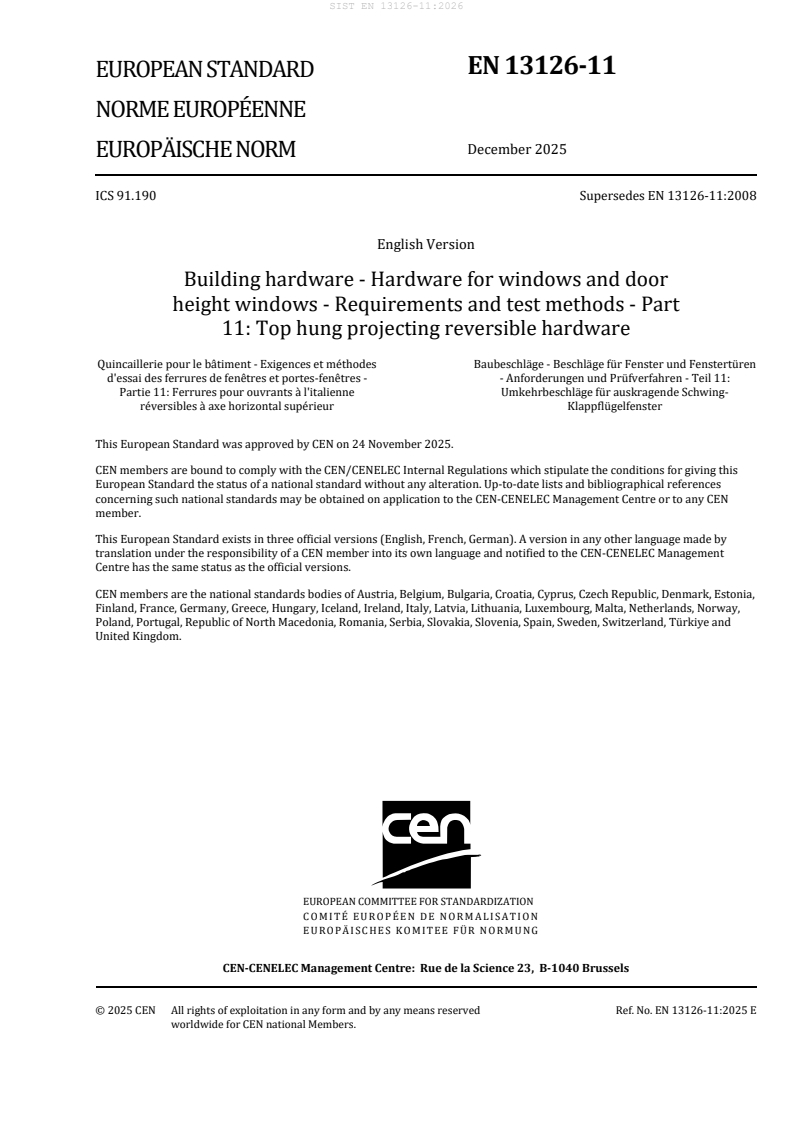
EN 13126-11
EUROPEAN STANDARD
NORME EUROPÉENNE
December 2025
EUROPÄISCHE NORM
ICS 91.190 Supersedes EN 13126-11:2008
English Version
Building hardware - Hardware for windows and door
height windows - Requirements and test methods - Part
11: Top hung projecting reversible hardware
Quincaillerie pour le bâtiment - Exigences et méthodes Baubeschläge - Beschläge für Fenster und Fenstertüren
d'essai des ferrures de fenêtres et portes-fenêtres - - Anforderungen und Prüfverfahren - Teil 11:
Partie 11: Ferrures pour ouvrants à l'italienne Umkehrbeschläge für auskragende Schwing-
réversibles à axe horizontal supérieur Klappflügelfenster
This European Standard was approved by CEN on 24 November 2025.
CEN members are bound to comply with the CEN/CENELEC Internal Regulations which stipulate the conditions for giving this
European Standard the status of a national standard without any alteration. Up-to-date lists and bibliographical references
concerning such national standards may be obtained on application to the CEN-CENELEC Management Centre or to any CEN
member.
This European Standard exists in three official versions (English, French, German). A version in any other language made by
translation under the responsibility of a CEN member into its own language and notified to the CEN-CENELEC Management
Centre has the same status as the official versions.
CEN members are the national standards bodies of Austria, Belgium, Bulgaria, Croatia, Cyprus, Czech Republic, Denmark, Estonia,
Finland, France, Germany, Greece, Hungary, Iceland, Ireland, Italy, Latvia, Lithuania, Luxembourg, Malta, Netherlands, Norway,
Poland, Portugal, Republic of North Macedonia, Romania, Serbia, Slovakia, Slovenia, Spain, Sweden, Switzerland, Türkiye and
United Kingdom.
EUROPEAN COMMITTEE FOR STANDARDIZATION
COMITÉ EUROPÉEN DE NORMALISATION
EUROPÄISCHES KOMITEE FÜR NORMUNG
CEN-CENELEC Management Centre: Rue de la Science 23, B-1040 Brussels
© 2025 CEN All rights of exploitation in any form and by any means reserved Ref. No. EN 13126-11:2025 E
worldwide for CEN national Members.
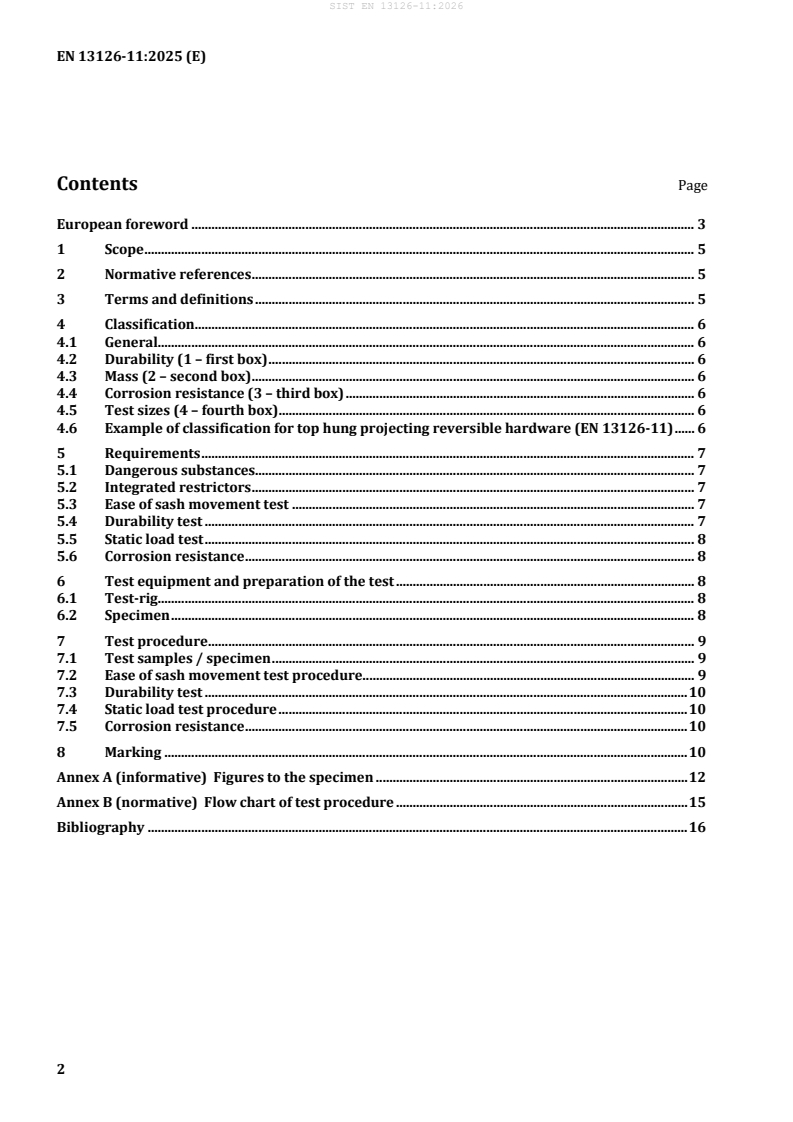
Contents Page
European foreword . 3
1 Scope . 5
2 Normative references . 5
3 Terms and definitions . 5
4 Classification. 6
4.1 General. 6
4.2 Durability (1 – first box) . 6
4.3 Mass (2 – second box) . 6
4.4 Corrosion resistance (3 – third box) . 6
4.5 Test sizes (4 – fourth box) . 6
4.6 Example of classification for top hung projecting reversible hardware (EN 13126-11) . 6
5 Requirements . 7
5.1 Dangerous substances. 7
5.2 Integrated restrictors . 7
5.3 Ease of sash movement test . 7
5.4 Durability test . 7
5.5 Static load test . 8
5.6 Corrosion resistance . 8
6 Test equipment and preparation of the test . 8
6.1 Test-rig. 8
6.2 Specimen . 8
7 Test procedure . 9
7.1 Test samples / specimen . 9
7.2 Ease of sash movement test procedure. 9
7.3 Durability test . 10
7.4 Static load test procedure . 10
7.5 Corrosion resistance . 10
8 Marking . 10
Annex A (informative) Figures to the specimen . 12
Annex B (normative) Flow chart of test procedure . 15
Bibliography . 16
European foreword
This document (EN 13126-11:2025) has been prepared by Technical Committee CEN/TC 33 “Doors,
windows, shutters, building hardware and curtain walling”, the secretariat of which is held by AFNOR.
This European Standard shall be given the status of a national standard, either by publication of an
identical text or by endorsement, at the latest by June 2026, and conflicting national standards shall be
withdrawn at the latest by June 2026.
Attention is drawn to the possibility that some of the elements of this document may be the subject of
patent rights. CEN shall not be held responsible for identifying any or all such patent rights.
This document supersedes EN 13126-11:2008.
11:2008:
— EN 13126-11 now is independent from EN 13126-1; all necessary information is included without
the need of any further information from EN 13126-1;
— several editorial changes in the wording for a better understanding;
— terms under 3.5 'specimen’, 3.6 'sample', 3.7 'test-rig', 3.8 ‘test equipment and 3.9 'supporting
subframe' added;
— under 4.1 classification system changed completely; former digits 1 (Category of use), 4 (Fire
resistance), 5 (Safety in use) and 8 (Application) deleted; former digit 2 changed into box 1
(Durability), former digit 3 changed into box 2 (Mass), former digit 6 changed into box 3 (Corrosion
resistance), former Digit 7 has been deleted in addition to former digits 1, 4, 5 and 8, former digit 9
changed into box 4 (Test sizes);
— under 4.2 new grades for the number of cycles defined; H1 (5 000), H2 (10 000) and H3 (20 000);
see also 5.4;
— under 4.6 new example added for the new classification;
— under 5.4 new grades for the number of cycles defined; H1 (5 000), H2 (10 000) and H3 (20 000) in
accordance with 4.2 established;
— under 5.6. ‘Corrosion resistance’ new text added;
— under Clause 6 subclauses 6.1 ‘Test-rig’ and 6.2 ‘Specimen’ added or text amended;
— under 7.5 ‘Corrosion resistance’ text modified;
— new Clause 8 ‘Marking’ added;
The EN 13126 series, under the general title Building hardware — Hardware for windows and door height
windows — Requirements and test methods, consists of the following parts:
— Part 1: Requirements common to all types of hardware;
— Part 2: Window fastener handles;
— Part 3: Handles, primarily for Tilt and Turn, Tilt-First and Turn-Only hardware;
— Part 4: Espagnolettes;
— Part 5: Devices that restrict the opening of windows and door height windows;
— Part 6: Variable geometry stay hinges (with or without a friction stay);
— Part 7: Finger catches;
— Part 8: Requirements and test methods for tilt and turn, Tilt-First and Turn-Only hardware;
— Part 9: Hardware for horizontal and vertical pivot windows;
— Part 10: Arm-balancing systems;
— Part 11: Top hung projecting reversible hardware;
— Part 12: Side hung projecting reversible hardware;
— Part 13: Sash balances;
— Part 14: Sash fasteners;
— Part 15: Rollers for horizontal sliding and hardware for sliding folding windows;
— Part 16: Hardware for Lift and Slide windows;
— Part 17: Hardware for Tilt and Slide windows;
— Part 19: Sliding Closing Devices.
Any feedback and questions on this document should be directed to the users’ national standards body.
A complete listing of these bodies can be found on the CEN website.
According to the CEN-CENELEC Internal Regulations, the national standards organisations of the
following countries are bound to implement this European Standard: Austria, Belgium, Bulgaria, Croatia,
Cyprus, Czech Republic, Denmark, Estonia, Finland, France, Germany, Greece, Hungary, Iceland, Ireland,
Italy, Latvia, Lithuania, Luxembourg, Malta, Netherlands, Norway, Poland, Portugal, Republic of North
Macedonia, Romania, Serbia, Slovakia, Slovenia, Spain, Sweden, Switzerland, Türkiye and the United
Kingdom.
1 Scope
This document specifies requirements and test methods for durability, strength, security and function for
top hung projecting hardware for windows and door height windows.
This document is applicable to top hung projecting reversible hardware whether fitted with integral
restrictors or not. Where any restrictor is used it is intended to be tested in accordance with EN 13126-
5.
2 Normative references
The following documents are referred to in the text in such a way that some or all of their content
constitutes requirements of this document. For dated references, only the edition cited applies. For
undated references, the latest edition of the referenced document (including any amendments) applies.
EN 1670, Building hardware — Corrosion resistance — Requirements and test methods
EN 13126-5, Building hardware — Hardware for windows and door height windows — Requirements and
test methods — Part 5: Devices that restrict the opening of windows and door height windows
3 Terms and definitions
For the purposes of this document, the following terms and definitions apply.
ISO and IEC maintain terminology d
...