

SIST EN 15632-4:2022
(Main)District heating pipes - Factory made flexible pipe systems - Part 4: Bonded system with metal service pipes; requirements and test methods
General Information
- Abstract
This document specifies requirements and test methods for flexible, factory made, buried district heating pipe systems with metallic service pipes and bonding between the layers of the pipe assemblies and thermal insulation materials of polyurethane or polyisocyanurate foam, the casing being made of polyethylene.
It is only applicable in conjunction with part 1.
This document is applicable to pipes, fittings, their joints and to joints with components made of non-plastics materials intended to be used for district heating installations.
This document is applicable to a continuous operating temperature up to 120 °C and a maximum operating temperature of 140 °C for maximum 300 h/a, and a design pressure up to 2,5 MPa for a design service life of at least 30 years.
This document does not apply to cover surveillance systems.
NOTE For higher temperatures or for the transport of other fluids, for example potable water, additional requirements and testing is needed. Such requirements are not specified in this document.
- Status
- Published
- Public Enquiry End Date
- 31-Jan-2021
- Publication Date
- 12-May-2022
- Technical Committee
- I13 - Imaginarni 13
- Current Stage
- 6060 - National Implementation/Publication (Adopted Project)
- Start Date
- 11-May-2022
- Due Date
- 16-Jul-2022
- Completion Date
- 13-May-2022


Overview
EN 15632-4:2022 is a CEN standard for district heating pipes - specifically factory-made, flexible, buried bonded pipe systems with metal service pipes. It sets requirements and test methods for pre-insulated pipe assemblies that use metallic service pipes (copper, steel or corrugated stainless steel), polyurethane (PUR) or polyisocyanurate (PIR) thermal insulation, and a polyethylene (PE) outer casing. This part is only applicable in conjunction with EN 15632‑1 (general requirements and test methods).
Key operational limits defined:
- Continuous operating temperature: up to 120 °C
- Maximum temperature:140 °C for up to 300 h/year
- Design pressure: up to 2.5 MPa
- Design service life: at least 30 years
Note: The standard does not cover cover surveillance systems and additional testing is required for higher temperatures or other fluids (e.g., potable water).
Key Topics and Requirements
- Materials and dimensions: Specifies acceptable service pipe materials and minimum diameters/wall thicknesses (copper per EN 12449, seamless/welded steel per EN 10305/EN 10216/EN 10217, corrugated stainless steel per EN 10088-2).
- Bonding: Applies to bonded systems where layers (service pipe, insulation, casing) are bonded to prevent internal movement.
- Axial shear strength: Minimum axial shear between service pipe and insulation:
- ≥ 0.12 MPa at ambient temperature
- ≥ 0.08 MPa at continuous operating temperature
(Requirement applies to steel and copper service pipes; not relevant for corrugated stainless steel.)
- Linear water tightness: Leakage limit of ≤ 100 g per pipe end after 168 hours when tested per Clause 6.4.
- Fittings and joints: Fittings, joints and assemblies must meet specified test cycles and show no leakage during cycle testing.
- Testing protocols: Includes axial shear tests, cycle tests and long-duration tightness tests; samples tested from coiled pipes, typically ≥72 hours after production.
Applications
EN 15632-4:2022 is intended for:
- Design and specification of buried district heating networks using metal service pipes
- Manufacturers of pre-insulated flexible pipe systems to certify product compliance
- Testing laboratories performing type and routine tests (axial shear, tightness, cycle tests)
- Engineers, project specifiers and utility operators requiring durable, bonded pipe systems for high-temperature district heating distribution
Keywords: district heating pipes, bonded system, metal service pipes, pre-insulated flexible pipe systems, EN 15632-4:2022, axial shear strength, linear water tightness, polyethylene casing.
Related Standards
- EN 15632-1 - Classification, general requirements and test methods (mandatory companion)
- EN 14419 - Surveillance systems (requirements if measuring systems are installed)
- EN 17248 - Terms and definitions for district heating/cooling pipe systems
- Material standards referenced (examples): EN 12449 (copper), EN 10305 / EN 10216 / EN 10217 (steel), EN 10088-2 (stainless steel)
Relations
- Effective Date
- 11-May-2022
- Effective Date
- 28-Jan-2026
- Effective Date
- 28-Jan-2026
- Effective Date
- 28-Jan-2026
- Effective Date
- 28-Jan-2026
- Effective Date
- 28-Jan-2026
- Refers
SIST EN 17248:2020 - District heating and district cooling pipe systems - Terms and definitions - Effective Date
- 28-Jan-2026
- Effective Date
- 28-Jan-2026
- Effective Date
- 28-Jan-2026
- Effective Date
- 28-Jan-2026
- Effective Date
- 28-Jan-2026
- Effective Date
- 28-Jan-2026
- Effective Date
- 28-Jan-2026
- Effective Date
- 28-Jan-2026
- Effective Date
- 28-Jan-2026
Get Certified
Connect with accredited certification bodies for this standard

DIBt (Deutsches Institut für Bautechnik)
German Institute for Building Technology.
DIN CERTCO
DIN Group product certification.

Aboma Certification B.V.
Specialized in construction, metal, and transport sectors.
Sponsored listings
Frequently Asked Questions
SIST EN 15632-4:2022 is a standard published by the Slovenian Institute for Standardization (SIST). Its full title is "District heating pipes - Factory made flexible pipe systems - Part 4: Bonded system with metal service pipes; requirements and test methods". This standard covers: This document specifies requirements and test methods for flexible, factory made, buried district heating pipe systems with metallic service pipes and bonding between the layers of the pipe assemblies and thermal insulation materials of polyurethane or polyisocyanurate foam, the casing being made of polyethylene. It is only applicable in conjunction with part 1. This document is applicable to pipes, fittings, their joints and to joints with components made of non-plastics materials intended to be used for district heating installations. This document is applicable to a continuous operating temperature up to 120 °C and a maximum operating temperature of 140 °C for maximum 300 h/a, and a design pressure up to 2,5 MPa for a design service life of at least 30 years. This document does not apply to cover surveillance systems. NOTE For higher temperatures or for the transport of other fluids, for example potable water, additional requirements and testing is needed. Such requirements are not specified in this document.
This document specifies requirements and test methods for flexible, factory made, buried district heating pipe systems with metallic service pipes and bonding between the layers of the pipe assemblies and thermal insulation materials of polyurethane or polyisocyanurate foam, the casing being made of polyethylene. It is only applicable in conjunction with part 1. This document is applicable to pipes, fittings, their joints and to joints with components made of non-plastics materials intended to be used for district heating installations. This document is applicable to a continuous operating temperature up to 120 °C and a maximum operating temperature of 140 °C for maximum 300 h/a, and a design pressure up to 2,5 MPa for a design service life of at least 30 years. This document does not apply to cover surveillance systems. NOTE For higher temperatures or for the transport of other fluids, for example potable water, additional requirements and testing is needed. Such requirements are not specified in this document.
SIST EN 15632-4:2022 is classified under the following ICS (International Classification for Standards) categories: 23.040.01 - Pipeline components and pipelines in general; 23.040.07 - Pipeline and its parts for district heat; 91.140.10 - Central heating systems. The ICS classification helps identify the subject area and facilitates finding related standards.
SIST EN 15632-4:2022 has the following relationships with other standards: It is inter standard links to SIST EN 15632-4:2009, SIST EN 12449:2023, SIST EN ISO 3834-2:2021, SIST EN 10305-3:2024, SIST EN 10305-1:2016, SIST EN 15632-1:2022, SIST EN 17248:2020, SIST EN 10305-2:2016, SIST EN 14419:2020, SIST EN ISO 15607:2020, SIST EN 10216-2:2025, SIST EN 10217-2:2019, SIST EN 10204:2004, SIST EN 1057:2006+A1:2010, SIST EN 10088-2:2024. Understanding these relationships helps ensure you are using the most current and applicable version of the standard.
SIST EN 15632-4:2022 is available in PDF format for immediate download after purchase. The document can be added to your cart and obtained through the secure checkout process. Digital delivery ensures instant access to the complete standard document.
Standards Content (Sample)
SLOVENSKI STANDARD
01-julij-2022
Nadomešča:
SIST EN 15632-4:2009
Cevi za daljinsko ogrevanje - Tovarniško izdelani gibki cevni sistemi - 4. del:
Vezane kovinske cevi - Zahteve in preskusne metode
District heating pipes - Factory made flexible pipe systems - Part 4: Bonded system with
metal service pipes; requirements and test methods
Fernwärmerohre - Werkmäßig gedämmte flexible Rohrsysteme - Teil 4:
Verbundmediumrohre aus Metall; Anforderungen und Prüfungen
Tuyaux de chauffage urbain - Systèmes de tuyaux flexibles manufacturés - Partie 4 :
Système bloqué avec tubes de service en métal ; exigences et méthodes d'essai
Ta slovenski standard je istoveten z: EN 15632-4:2022
ICS:
23.040.07 Cevovodi za daljinsko Pipeline and its parts for
ogrevanje in njihovi deli district heat
91.140.10 Sistemi centralnega Central heating systems
ogrevanja
2003-01.Slovenski inštitut za standardizacijo. Razmnoževanje celote ali delov tega standarda ni dovoljeno.
EN 15632-4
EUROPEAN STANDARD
NORME EUROPÉENNE
May 2022
EUROPÄISCHE NORM
ICS 23.040.07 Supersedes EN 15632-4:2009
English Version
District heating pipes - Factory made flexible pipe systems
- Part 4: Bonded system with metal service pipes;
requirements and test methods
Tuyaux de chauffage urbain - Systèmes de tuyaux Fernwärmerohre - Werkmäßig gedämmte flexible
flexibles manufacturés - Partie 4 : Système bloqué avec Rohrsysteme - Teil 4: Verbundmediumrohre aus
tubes de service en métal ; exigences et méthodes Metall; Anforderungen und Prüfungen
d'essai
This European Standard was approved by CEN on 27 March 2022.
CEN members are bound to comply with the CEN/CENELEC Internal Regulations which stipulate the conditions for giving this
European Standard the status of a national standard without any alteration. Up-to-date lists and bibliographical references
concerning such national standards may be obtained on application to the CEN-CENELEC Management Centre or to any CEN
member.
This European Standard exists in three official versions (English, French, German). A version in any other language made by
translation under the responsibility of a CEN member into its own language and notified to the CEN-CENELEC Management
Centre has the same status as the official versions.
CEN members are the national standards bodies of Austria, Belgium, Bulgaria, Croatia, Cyprus, Czech Republic, Denmark, Estonia,
Finland, France, Germany, Greece, Hungary, Iceland, Ireland, Italy, Latvia, Lithuania, Luxembourg, Malta, Netherlands, Norway,
Poland, Portugal, Republic of North Macedonia, Romania, Serbia, Slovakia, Slovenia, Spain, Sweden, Switzerland, Turkey and
United Kingdom.
EUROPEAN COMMITTEE FOR STANDARDIZATION
COMITÉ EUROPÉEN DE NORMALISATION
EUROPÄISCHES KOMITEE FÜR NORMUNG
CEN-CENELEC Management Centre: Rue de la Science 23, B-1040 Brussels
© 2022 CEN All rights of exploitation in any form and by any means reserved Ref. No. EN 15632-4:2022 E
worldwide for CEN national Members.
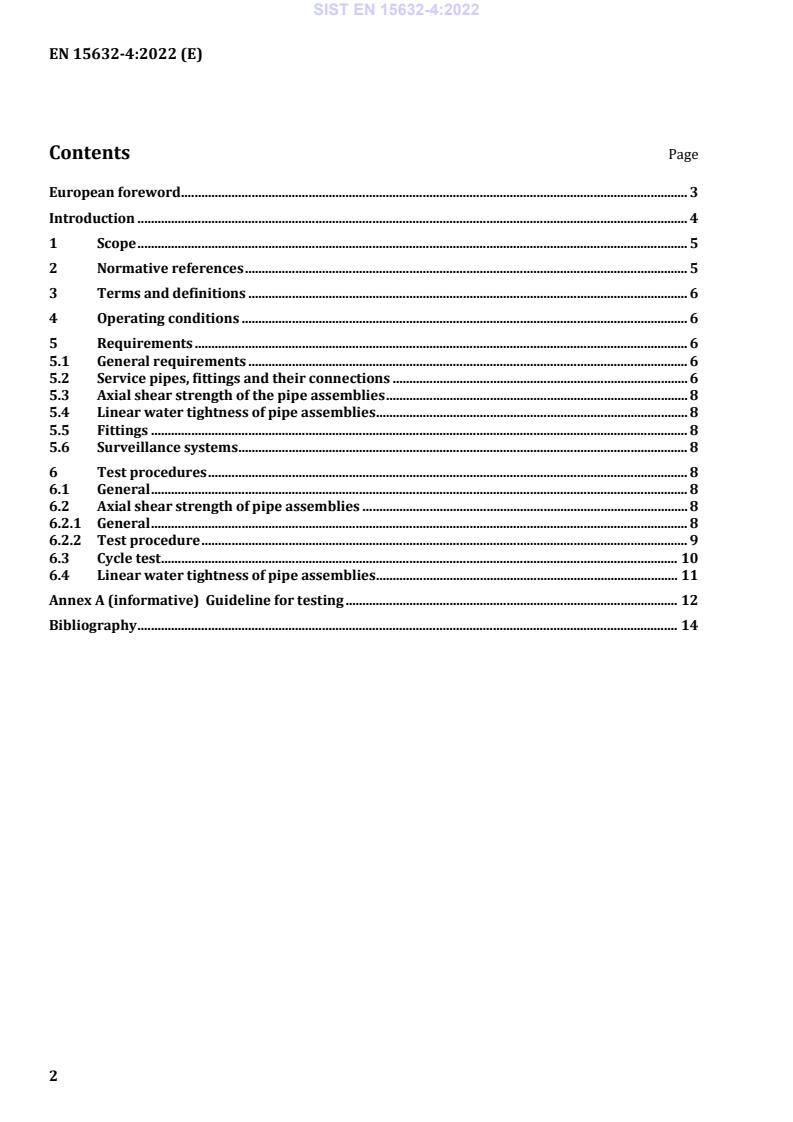
Contents Page
European foreword . 3
Introduction . 4
1 Scope . 5
2 Normative references . 5
3 Terms and definitions . 6
4 Operating conditions . 6
5 Requirements . 6
5.1 General requirements . 6
5.2 Service pipes, fittings and their connections . 6
5.3 Axial shear strength of the pipe assemblies . 8
5.4 Linear water tightness of pipe assemblies . 8
5.5 Fittings . 8
5.6 Surveillance systems . 8
6 Test procedures . 8
6.1 General . 8
6.2 Axial shear strength of pipe assemblies . 8
6.2.1 General . 8
6.2.2 Test procedure . 9
6.3 Cycle test . 10
6.4 Linear water tightness of pipe assemblies . 11
Annex A (informative) Guideline for testing . 12
Bibliography . 14
European foreword
This document (EN 15632-4:2022) has been prepared by Technical Committee CEN/TC 107
“Prefabricated district heating and district cooling pipe systems”, the secretariat of which is held by DS.
This European Standard shall be given the status of a national standard, either by publication of an
identical text or by endorsement, at the latest by November 2022, and conflicting national standards shall
be withdrawn at the latest by November 2022.
Attention is drawn to the possibility that some of the elements of this document may be the subject of
patent rights. CEN shall not be held responsible for identifying any or all such patent rights.
This document supersedes EN 15632-4:2009.
This document is one of a series of standards which form several parts of EN 15632, District heating
pipes — Factory made flexible pipe systems:
— Part 1: Classification, general requirements and test methods;
— Part 2: Bonded system with plastic service pipes; requirements and test methods;
— Part 3: Non bonded system with plastic service pipes; requirements and test methods;
— Part 4: Bonded system with metal service pipes; requirements and test methods.
In comparison with EN 15632-4:2009, the following changes have been made:
a) change in the temperature in the scope;
b) changes in the steel qualities, including the referenced standards;
c) completely revised “guideline for testing” in the informative Annex A.
Any feedback and questions on this document should be directed to the users’ national standards body.
A complete listing of these bodies can be found on the CEN website.
According to the CEN-CENELEC Internal Regulations, the national standards organisations of the
following countries are bound to implement this European Standard: Austria, Belgium, Bulgaria, Croatia,
Cyprus, Czech Republic, Denmark, Estonia, Finland, France, Germany, Greece, Hungary, Iceland, Ireland,
Italy, Latvia, Lithuania, Luxembourg, Malta, Netherlands, Norway, Poland, Portugal, Republic of North
Macedonia, Romania, Serbia, Slovakia, Slovenia, Spain, Sweden, Switzerland, Turkey and the United
Kingdom.
Introduction
District heating technology has developed rapidly since its origin and especially in recent times. Today,
there are different generations of district heating networks. The technologies of these generations are
driven by the different heat sources and operating temperatures used.
CEN/TC 107 provides a set of European standard series for rigid and flexible piping systems in district
heating to suit all generations and requirements of district heating networks in the market.
The standard documents ensure quality for pre-fabricated piping systems in district heating.
This standard series covers flexible, pre-fabricated piping systems for operation conditions as described
in the scope of part 1.
1 Scope
This document specifies requirements and test methods for flexible, factory made, buried district heating
pipe systems with metallic service pipes and bonding between the layers of the pipe assemblies and
thermal insulation materials of polyurethane or polyisocyanurate foam, the casing being made of
polyethylene.
It is only applicable in conjunction with part 1.
This document is applicable to pipes, fittings, their joints and to joints with components made of non-
plastics materials intended to be used for district heating installations.
This document is applicable to a continuous operating temperature up to 120 °C and a maximum
operating temperature of 140 °C for maximum 300 h/a, and a design pressure up to 2,5 MPa for a design
service life of at least 30 years.
This document does not apply to cover surveillance systems.
NOTE For higher temperatures or for the transport of other fluids, for example potable water, additional
requirements and testing is needed. Such requirements are not specified in this document.
2 Normative references
The following documents are referred to in the text in such a way that some or all of their content
constitutes requirements of this document. For dated references, only the edition cited applies. For
undated references, the latest edition of the referenced document (including any amendments) applies.
EN 1057, Copper and copper alloys - Seamless, round copper tubes for water and gas in sanitary and heating
applications
EN 10088-2, Stainless steels - Part 2: Technical delivery conditions for sheet/plate and strip of corrosion
resisting steels for general purposes
EN 10204, Metallic products - Types of inspection documents
EN 10216-2, Seamless steel tubes for pressure purposes - Technical delivery conditions - Part 2: Non-alloy
and alloy steel tubes with specified elevated temperature properties
EN 10217-2, Welded steel tubes for pressure purposes - Technical delivery conditions - Part 2: Electric
welded non-alloy and alloy steel tubes with specified elevated temperature properties
EN 10305-1, Steel tubes for precision applications - Technical delivery conditions - Part 1: Seamless cold
drawn tubes
EN 10305-2, Steel tubes for precision applications - Technical delivery conditions - Part 2: Welded cold
drawn tubes
EN 10305-3, Steel tubes for precision applications - Technical delivery conditions - Part 3: Welded cold sized
tubes
EN 12449, Copper and copper alloys - Seamless, round tubes for general purposes
EN 14419, District heating pipes - Bonded single and twin pipe systems for buried hot water netwo
...