

SIST-TP CEN/TR 1459-6:2015
(Main)Rough-terrain trucks - Safety requirements and verification - Part 6: Application of EN ISO 13849-1 to slewing and non-slewing variable-reach rough-terrain truck
General Information
- Abstract
This Technical Report describes the risk assessment methodology followed to determine the Performance Level required (PLr), as defined in EN ISO 13849-1:2008, for specific safety related parts of control system (SRP/CS) of rough-terrain variable-reach trucks covered by prEN 1459-1, EN 1459-2 and EN 1459-3.
This Technical Report does not apply to SRP/CS that includes no electrical/electronic components.
NOTE It is the intention of CEN TC150 WG2 to use the same methodology to develop future standards (e.g. further parts of EN 1459).
- Status
- Published
- Public Enquiry End Date
- 07-Jun-2015
- Publication Date
- 05-Oct-2015
- Technical Committee
- DTN - Lift and transport appliances
- Current Stage
- 6060 - National Implementation/Publication (Adopted Project)
- Start Date
- 17-Sep-2015
- Due Date
- 22-Nov-2015
- Completion Date
- 06-Oct-2015



Overview
SIST-TP CEN/TR 1459-6:2015 is a Technical Report that explains how to apply EN ISO 13849-1:2008 to slewing and non-slewing variable-reach rough-terrain trucks. Its primary aim is to document the risk assessment methodology used to determine the Performance Level required (PLr) for safety-related parts of control systems (SRP/CS) referenced in prEN 1459‑1, EN 1459‑2 and EN 1459‑3. The report clarifies rationale and procedures for establishing minimum PLs for electrical/electronic SRP/CS (it does not apply where SRP/CS contain no electrical/electronic components).
Key topics and technical requirements
- Risk assessment methodology: Step‑by‑step approach for identifying hazards, estimating and evaluating risk, and deriving required PLr for SRP/CS.
- Risk assessment process elements:
- Determination of machine limits and operating conditions
- Hazard identification (aligned with EN ISO 12100 principles)
- Risk estimation and evaluation for different persons (operator, co‑worker, bystander)
- Performance Level determination: Use of EN ISO 13849‑1 criteria to translate risk priority into required PL for control functions.
- Risk Priority Number (RPN) approach: Numerical weighting and mapping of RPNs to Performance Levels (informative annexes provide the weighting and conversion guidance).
- Extensive annex material: Informative annexes include hazard lists, RPN numerical tables, PL correlation tables and comprehensive risk estimation examples covering many operating scenarios.
Practical applications
- Design and validation of SRP/CS: OEMs and system integrators can use the methodology to justify the required safety architecture and diagnostic measures for electrical/electronic control components.
- Type‑C standard implementation: Enables consistent application of EN ISO 13849‑1 within the EN 1459 series for variable‑reach rough‑terrain trucks.
- Conformity and verification: Useful for safety engineers, notified bodies and test laboratories performing verification, certification or conformity assessments against EN 1459 parts.
- Standards development: The methodology is intended as a template for future EN 1459 parts and can be reused by other technical committees developing machine‑specific standards.
Who should use this standard
- Manufacturers of rough‑terrain trucks and attachments
- Functional safety engineers and control system designers
- Certification bodies, test labs and safety assessors
- Standards committees drafting machine‑specific PL requirements
Related standards
- EN ISO 13849‑1:2008 (Safety of machinery - Safety‑related parts of control systems - Performance levels)
- EN ISO 12100 (general principles for hazard identification and risk assessment)
- prEN 1459‑1, EN 1459‑2, EN 1459‑3 (parts of the EN 1459 series on variable‑reach rough‑terrain trucks)
Keywords: rough‑terrain trucks, variable‑reach, slewing, EN ISO 13849‑1, Performance Level, SRP/CS, risk assessment, EN 1459.
Relations
- Effective Date
- 28-Jan-2026
- Effective Date
- 28-Jan-2026
- Effective Date
- 28-Jan-2026
- Effective Date
- 28-Jan-2026
- Effective Date
- 28-Jan-2026
Frequently Asked Questions
SIST-TP CEN/TR 1459-6:2015 is a technical report published by the Slovenian Institute for Standardization (SIST). Its full title is "Rough-terrain trucks - Safety requirements and verification - Part 6: Application of EN ISO 13849-1 to slewing and non-slewing variable-reach rough-terrain truck". This standard covers: This Technical Report describes the risk assessment methodology followed to determine the Performance Level required (PLr), as defined in EN ISO 13849-1:2008, for specific safety related parts of control system (SRP/CS) of rough-terrain variable-reach trucks covered by prEN 1459-1, EN 1459-2 and EN 1459-3. This Technical Report does not apply to SRP/CS that includes no electrical/electronic components. NOTE It is the intention of CEN TC150 WG2 to use the same methodology to develop future standards (e.g. further parts of EN 1459).
This Technical Report describes the risk assessment methodology followed to determine the Performance Level required (PLr), as defined in EN ISO 13849-1:2008, for specific safety related parts of control system (SRP/CS) of rough-terrain variable-reach trucks covered by prEN 1459-1, EN 1459-2 and EN 1459-3. This Technical Report does not apply to SRP/CS that includes no electrical/electronic components. NOTE It is the intention of CEN TC150 WG2 to use the same methodology to develop future standards (e.g. further parts of EN 1459).
SIST-TP CEN/TR 1459-6:2015 is classified under the following ICS (International Classification for Standards) categories: 53.060 - Industrial trucks. The ICS classification helps identify the subject area and facilitates finding related standards.
SIST-TP CEN/TR 1459-6:2015 has the following relationships with other standards: It is inter standard links to SIST EN 1459-3:2015, SIST EN 1459-2:2015, SIST EN 1459-1:2018, SIST EN ISO 12100:2011, SIST EN ISO 13849-1:2008. Understanding these relationships helps ensure you are using the most current and applicable version of the standard.
SIST-TP CEN/TR 1459-6:2015 is available in PDF format for immediate download after purchase. The document can be added to your cart and obtained through the secure checkout process. Digital delivery ensures instant access to the complete standard document.
Standards Content (Sample)
SLOVENSKI STANDARD
01-november-2015
Vozila za talni transport - Terenska vozila - Varnostne zahteve in preverjanje - 6.
del: Uporaba EN ISO 13849-1 za terenska vozila z vrtljivim in nevrtljivim
mehanizmom za dviganje s spremenljivim dosegom
Rough-terrain trucks - Safety requirements and verification - Part 6: Application of EN
ISO 13849-1 to slewing and non-slewing variable-reach rough-terrain truck
Ta slovenski standard je istoveten z: CEN/TR 1459-6:2015
ICS:
53.060 Industrijski tovornjaki Industrial trucks
2003-01.Slovenski inštitut za standardizacijo. Razmnoževanje celote ali delov tega standarda ni dovoljeno.
TECHNICAL REPORT
CEN/TR 1459-6
RAPPORT TECHNIQUE
TECHNISCHER BERICHT
August 2015
ICS 53.060
English Version
Rough-terrain trucks - Safety requirements and verification –
Part 6: Application of EN ISO 13849-1 to slewing and non-
slewing variable-reach rough-terrain truck
This Technical Report was approved by CEN on 6 July 2015. It has been drawn up by the Technical Committee CEN/TC 150.
CEN members are the national standards bodies of Austria, Belgium, Bulgaria, Croatia, Cyprus, Czech Republic, Denmark, Estonia,
Finland, Former Yugoslav Republic of Macedonia, France, Germany, Greece, Hungary, Iceland, Ireland, Italy, Latvia, Lithuania,
Luxembourg, Malta, Netherlands, Norway, Poland, Portugal, Romania, Slovakia, Slovenia, Spain, Sweden, Switzerland, Turkey and United
Kingdom.
EUROPEAN COMMITTEE FOR STANDARDIZATION
COMITÉ EUROPÉEN DE NORMALISATIO N
EUROPÄISCHES KOMITEE FÜR NORMUNG
CEN-CENELEC Management Centre: Avenue Marnix 17, B-1000 Brussels
© 2015 CEN All rights of exploitation in any form and by any means reserved Ref. No. CEN/TR 1459-6:2015 E
worldwide for CEN national Members.
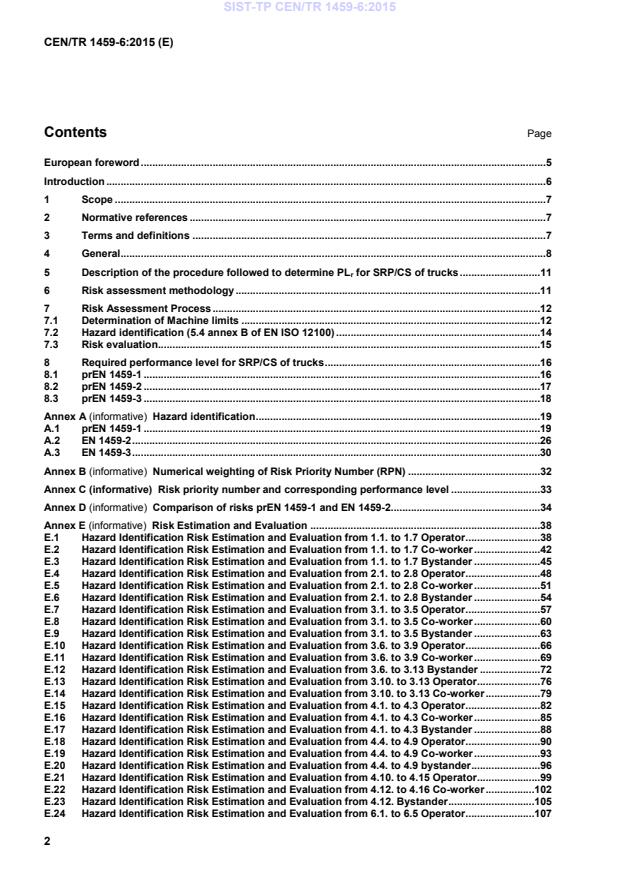
Contents Page
European foreword . 5
Introduction . 6
1 Scope . 7
2 Normative references . 7
3 Terms and definitions . 7
4 General . 8
5 Description of the procedure followed to determine PL for SRP/CS of trucks .11
r
6 Risk assessment methodology .11
7 Risk Assessment Process .12
7.1 Determination of Machine limits .12
7.2 Hazard identification (5.4 annex B of EN ISO 12100) .14
7.3 Risk evaluation.15
8 Required performance level for SRP/CS of trucks .16
8.1 prEN 1459-1 .16
8.2 prEN 1459-2 .17
8.3 prEN 1459-3 .18
Annex A (informative) Hazard identification .19
A.1 prEN 1459-1 .19
A.2 EN 1459-2 .26
A.3 EN 1459-3 .30
Annex B (informative) Numerical weighting of Risk Priority Number (RPN) .32
Annex C (informative) Risk priority number and corresponding performance level .33
Annex D (informative) Comparison of risks prEN 1459-1 and EN 1459-2.34
Annex E (informative) Risk Estimation and Evaluation .38
E.1 Hazard Identification Risk Estimation and Evaluation from 1.1. to 1.7 Operator .38
E.2 Hazard Identification Risk Estimation and Evaluation from 1.1. to 1.7 Co-worker .42
E.3 Hazard Identification Risk Estimation and Evaluation from 1.1. to 1.7 Bystander .45
E.4 Hazard Identification Risk Estimation and Evaluation from 2.1. to 2.8 Operator .48
E.5 Hazard Identification Risk Estimation and Evaluation from 2.1. to 2.8 Co-worker .51
E.6 Hazard Identification Risk Estimation and Evaluation from 2.1. to 2.8 Bystander .54
E.7 Hazard Identification Risk Estimation and Evaluation from 3.1. to 3.5 Operator .57
E.8 Hazard Identification Risk Estimation and Evaluation from 3.1. to 3.5 Co-worker .60
E.9 Hazard Identification Risk Estimation and Evaluation from 3.1. to 3.5 Bystander .63
E.10 Hazard Identification Risk Estimation and Evaluation from 3.6. to 3.9 Operator .66
E.11 Hazard Identification Risk Estimation and Evaluation from 3.6. to 3.9 Co-worker .69
E.12 Hazard Identification Risk Estimation and Evaluation from 3.6. to 3.13 Bystander .72
E.13 Hazard Identification Risk Estimation and Evaluation from 3.10. to 3.13 Operator .76
E.14 Hazard Identification Risk Estimation and Evaluation from 3.10. to 3.13 Co-worker .79
E.15 Hazard Identification Risk Estimation and Evaluation from 4.1. to 4.3 Operator .82
E.16 Hazard Identification Risk Estimation and Evaluation from 4.1. to 4.3 Co-worker .85
E.17 Hazard Identification Risk Estimation and Evaluation from 4.1. to 4.3 Bystander .88
E.18 Hazard Identification Risk Estimation and Evaluation from 4.4. to 4.9 Operator .90
E.19 Hazard Identification Risk Estimation and Evaluation from 4.4. to 4.9 Co-worker .93
E.20 Hazard Identification Risk Estimation and Evaluation from 4.4. to 4.9 bystander .96
E.21 Hazard Identification Risk Estimation and Evaluation from 4.10. to 4.15 Operator .99
E.22 Hazard Identification Risk Estimation and Evaluation from 4.12. to 4.16 Co-worker .102
E.23 Hazard Identification Risk Estimation and Evaluation from 4.12. Bystander .105
E.24 Hazard Identification Risk Estimation and Evaluation from 6.1. to 6.5 Operator .107
E.25 Hazard Identification Risk Estimation and Evaluation from 6.1. to 6.5 Co-worker . 110
E.26 Hazard Identification Risk Estimation and Evaluation from 6.4. to 6.9 Bystander . 113
E.27 Hazard Identification Risk Estimation and Evaluation from 6.6. to 6.10 Operator . 116
E.28 Hazard Identification Risk Estimation and Evaluation from 6.6. to 6.10 Co-worker . 119
E.29 Hazard Identification Risk Estimation and Evaluation from 6.10. to 6.15 Bystander . 122
E.30 Hazard Identification Risk Estimation and Evaluation from 6.11. to 6.14 Operator . 125
E.31 Hazard Identification Risk Estimation and Evaluation from 6.11. to 6.14 Co-worker . 128
E.32 Hazard Identification Risk Estimation and Evaluation from 6.15. to 6.18 Operator . 131
E.33 Hazard Identification Risk Estimation and Evaluation from 6.15. to 6.18 Co-worker . 134
E.34 Hazard Identification Risk Estimation and Evaluation from 7.1. to 7.10 Operator . 137
E.35 Hazard Identification Risk Estimation and Evaluation from 7.1. to 7.5 Co-worker . 140
E.36 Hazard Identification Risk Estimation and Evaluation from 7.1. to 7.8 Bystander . 143
E.37 Hazard Identification Risk Estimation and Evaluation from 7.6. to 7.10 Co-worker . 146
E.38 Hazard Identification Risk Estimation and Evaluation from 8.1. to 8.7 Operator . 149
E.39 Hazard Identification Risk Estimation and Evaluation from 8.1. to 8.4 Co-worker . 152
E.40 Hazard Identification Risk Estimation and Evaluation from 8.2. to 8.5 Bystander . 155
E.41 Hazard Identification Risk Estimation and Evaluation from 8.8 to 8.12 Operator . 158
E.42 Hazard Identification Risk Estimation and Evaluation from 8.5. to 8.8 Co-worker . 161
E.43 Hazard Identification Risk Estimation and Evaluation from 8.9. to 8.12 Co-worker . 164
E.44 Hazard Identification Risk Estimation and Evaluation from 9.1. to 9.6 Co-worker . 167
E.45 Hazard Identification Risk Estimation and Evaluation from 9.1. to 9.4 Bystander . 170
E.46 Hazard Identification Risk Estimation and Evaluation 10.2 Operator . 173
E.47 Hazard Identification Risk Estimation and Evaluation from 10.1 to 10.2 Co-worker . 174
E.48 Hazard Identification Risk Estimation and Evaluation 10.2 Bystander . 177
E.49 Hazard Identification Risk Estimation and Evaluation from 18.1 to 18.4 Operator . 180
E.50 Hazard Identification Risk Estimation and Evaluation from 18.13 to 18.17 Co-worker . 183
E.51 Hazard Identification Risk Estimation and Evaluation from 18.13 to 18.21 Bystander . 186
E.52 Hazard Identification Risk Estimation and Evaluation from 18.4 to 18.8 Operator . 189
E.53 Hazard Identification Risk Estimation and Evaluation from 18.18 to 18.22 Co-worker . 192
E.54 Hazard Identification Risk Estimation and Evaluation from 18.9 to 18.12 Operator . 195
E.55 Hazard Identification Risk Estimation and Evaluation from 18.13 to 18.16 Operator . 198
E.56 Hazard Identification Risk Estimation and Evaluation from 19.1 to 19.4 Operator . 201
E.57 Hazard Identification Risk Estimation and Evaluation from 19.9 to 19.13 Co-worker . 204
E.58 Hazard Identification Risk Estimation and Evaluation from 19.10 to 19.13 Bystander . 207
E.59 Hazard Identification Risk Estimation and Evaluation from 19.5 to 19.16 Operator . 210
E.60 Hazard Identification Risk Estimation and Evaluation from 19.17 to 19.20 Operator . 213
E.61 Hazard Identification Risk Estimation and Evaluation from 20.1 to 20.5 Operator . 216
E.62 Hazard Identification Risk Estimation and Evaluation from 20.1 to 20.5 Co-worker . 219
E.63 Hazard Identification Risk Estimation and Evaluation from 20.1 to 20.5 Bystander . 222
E.64 Hazard Identification Risk Estimation and Evaluation from 20.6 to 20.10 Operator . 225
E.65 Hazard Identification Risk Estimation and Evaluation from 20.6 to 20.10 Co-worker . 228
E.66 Hazard Identification Risk Estimation and Evaluation from 20.6 to 20.10 Bystander . 231
E.67 Hazard Identification Risk Estimation and Evaluation from 20.11 to 20.15 Operator . 234
E.68 Hazard Identification Risk Estimation and Evaluation from 20.11 to 20.15 Co-worker . 237
E.69 Hazard Identification Risk Estimation and Evaluation from 20.11 to 20.15 Bystander . 240
E.70 Hazard Identification Risk Estimation and Evaluation from 21.1 to 21.5 Operator . 243
E.71 Hazard Identification Risk Estimation and Evaluation from 21.1 to 21.4 Co-worker . 246
E.72 Hazard Identification Risk Estimation and Evaluation from 21.1 to 21.3 Bystander . 249
E.73 Hazard Identification Risk Estimation and Evaluation from 21.6 to 21.9 Operator . 252
E.74 Hazard Identification Risk Estimation and Evaluation from 21.5 to 21.9 Co-worker . 255
E.75 Hazard Identification Risk Estimation and Evaluation from 21.4 to 21.6 Bystander . 258
E.76 Hazard Identification Risk Estimation and Evaluation from 22a.1 to 22a.5 Operator . 261
E.77 Hazard Identification Risk Estimation and Evaluation from 22a.1 to 22a.5 Co-worker . 264
E.78 Hazard Identification Risk Estimation and Evaluation from 22a.1 to 22a.4 Bystander . 267
E.79 Hazard Identification Risk Estimation and Evaluation from 22a.6 to 22a.10 Operator . 270
E.80 Hazard Identification Risk Estimation and Evaluation from 22a.6 to 22a.10 Co-worker . 273
E.81 Hazard Identification Risk Estimation and Evaluation from 22a.7 to 22a.10 Bystander . 276
E.82 Hazard Identification Risk Estimation and Evaluation from 22b.1 to 22b.4 Operator . 279
E.83 Hazard Identification Risk Estimation and Evaluation from 22b.1 to 22b.4 Co-worker . 282
E.84 Hazard Identification Risk Estimation and Evaluation from 22b.7 to 22b.9 Bystander . 285
E.85 Hazard Identification Risk Estimation and Evaluation from 22b.5 to 22b.8 Operator . 288
E.86 Hazard Identification Risk Estimation and Evaluation from 22b.5 to 22b.8 Co-worker.291
E.87 Hazard Identification Risk Estimation and Evaluation from 22b.10 to 22b.12 Bystander .294
E.88 Hazard Identification Risk Estimation and Evaluation from 22b.9 to 22b.12 Operator .297
E.89 Hazard Identification Risk Estimation and Evaluation from 22b.9 to 22b.13 Co-worker.300
E.90 Hazard Identification Risk Estimation and Evaluation from 22b.13 to 22b.15 Operator .303
E.91 Hazard Identification Risk Estimation and Evaluation from 22b.14 to 22b.18 Co-worker .306
E.92 Hazard Identification Risk Estimation and Evaluation from 22b.16 to 22b.18 Operator .309
E.93 Hazard Identification Risk Estimation and Evaluation from 22c.1 to 22c.3 Operator.312
E.94 Hazard Identification Risk Estimation and Evaluation from 22c.1 to 22c.3 Co-worker .315
E.95 Hazard Identification Risk Estimation and Evaluation from 22c.3 to 22c.4 Bystander .318
E.96 Hazard Identification Risk Estimation and Evaluation from 22c.4 to 22c.6 Operator.321
E.97 Hazard Identification Risk Estimation and Evaluation from 22c.4 to 22c.6 Co-worker .324
E.98 Hazard Identification Risk Estimation and Evaluation from 22d.1 to 22d.6 Operator .327
E.99 Hazard Identification Risk Estimation and Evaluation from 22d.1 to 22d.6 Co-worker.330
E.100 Hazard Identification Risk Estimation and Evaluation from 22d.3 to 22d.4 Bystander .333
Bibliography .342
European foreword
This document (CEN/TR 1459-6:2015) has been prepared by Technical Committee CEN/TC 150 “Industrial
Trucks - Safety”, the secretariat of which is held by BSI.
Attention is drawn to the possibility that some of the elements of this document may be the subject of patent
rights. CEN [and/or CENELEC] shall not be held responsible for identifying any or all such patent rights.
EN 1459 consists of the following parts, under the general title Rough-terrain trucks — Safety requirements
and verification:
— Part 1: Variable-reach trucks
— Part 2: Slewing variable-reach trucks
— Part 3: Interface between the variable-reach truck and the work platform
— Part 4: Additional requirements for variable reach trucks handling freely suspended loads
— Part 5: Additional requirements for attachments and attachment interface
— Part 6: Application of EN ISO 13849-1 to slewing and non-slewing variable-reach rough-terrain trucks
Introduction
This Technical Report has been prepared to explain the rationale used to determine the minimum required
Performance Levels for rough terrain variable reach trucks as listed in EN 1459 series.
It is intended to provide solid basis to the Performance Level Required (PL ) required for the Safety Related
r
Part of Control System (SRP/CS) referred to in prEN 1459-1, EN 1459-2 and EN 1459-3. The PL have been
r
defined by using approaches from appropriate standards for safety of machinery and proven general
principles for design.
The methodology described in this Technical Report may be used by other Technical Committees to assess
the risk and determine PL for machines covered by other type C-standards.
r
1 Scope
This Technical Report describes the risk assessment methodology followed to determine the
Performance Level required (PL), as defined in EN ISO 13849-1:2008, for specific safety related
r
parts of control system (SRP/CS) of rough-terrain variable-reach trucks covered by prEN 1459-1,
EN 1459-2 and EN 1459-3.
This Technical Report does not apply to SRP/CS that includes no electrical/electronic components.
NOTE It is the intention of CEN TC150 WG2 to use the same methodology to develop future standards (e.g.
further parts of EN 1459).
2 Normative references
The following documents, in whole or in part, are normatively referenced in this document and are
indispensable for its application. For dated references, only the edition cited applies. For undated
references, the latest edition of the referenced document (including any amendments) applies.
prEN 1459-1:2015, Rough-terrain trucks — Safety requirements and verification — Part 1: Variable-
reach trucks
EN 1459-2:2015 Rough-terrain trucks — Safety requirements and verification — Part 2: Slewing
variable-reach trucks
EN 1459-3:2015 Rough-terrain trucks — Safety requirements and verification — Part 3: Interface
between the variable-reach truck and the work platform
EN ISO 12100:2010 Safety of machinery — General principles for design — Risk assessment and
risk reduction (ISO 12100:2010)
EN ISO 13849-1:2008 Safety of machinery — Safety-related parts of control systems — Part 1:
General principles for design (ISO 13849-1:2006)
ISO/TR 14121-2:2012 Safety of machinery — Risk assessment — Part 2: Practical guidance and
examples of methods
3 Terms and definitions
For the purposes of this document, the terms and definitions given in EN ISO 12100, prEN 1459-
1:2015, EN 1459-2:2015 and EN 1459-3:2015 and the following apply.
3.1
operator
competent person who controls the operation of the truck
3.2
co-worker
trained person who is working in the vicinity of the truck but not in control of the truck
3.3
by-stander
untrained person who is in the vicinity of the truck and not involved in the job site activity
4 General
It is intended that this document be read in conjunction with the corresponding Parts -1, -2 and -3 of
this standard (EN 1459).
EN ISO 13849-1 applies to the safety related parts of control system including the design of software,
regardless of the type of technology and energy used (electrical, electronic, hydraulic, pneumatic,
mechanical, etc.), for all kinds of machinery.
For safety functions that comprise mechanical parts only, no specific performance level is necessary.
There are many control systems fitted to trucks but not all will be subject to the requirements of EN
ISO 13849-1.
EN ISO 13849-1 is relevant for cases where a risk assessment according to EN ISO 12100 has
initiated a risk reduction measure that relies on a safety-related control system. In those cases the
safety-related control system has to perform a safety function. The application of EN ISO 13849-1 is
restricted to those cases only (see figures 1 and 2).
Systems may be subject to specific requirements in other standards e.g ISO 6292 - Powered
industrial trucks and tractors — Brake performance and component strength.
Interrelation with ISO 13849-1 in case risk
reduction/protective measures are
connected with the control system
a
The first time the question is asked, it is answered by the result of the initial risk assessment.
Figure 1 — Process flow chart
Safety control system
Risk assessment in accordance
performance level selection
Determination of need to
with EN ISO 12100 (including
determined by risk assessment
meet EN ISO 13849
the elements below)
– Refer to Annex E
END
RISK
SEVE
is a
PROBABILITY OF
RITY
Funct
OCCORRUNCE of
related
OF
ion
that harm
NO
to the HARM
of
Exposure of
consid
person(s) to the
ered
that
Risk reduction
hazard
hazard
can
a
process for the
result
hazard:
The occurrence of
from
Does the
a hazardous event 1 by intrinsic
the
b
protective
design
YES
consid
measure
2 by safeguards
ered
selected
3 by information
The possibility of avoiding c
hazar
depend on a
for use (see ISO
or limiting the harm
d
control
12100-1:2003,
d
Figure 4)
e
Figure 2 — Abbreviated EN ISO 12100/EN ISO 13849-1 process drawing distinction between risk assessment and control system performance
selection
and
5 Description of the procedure followed to determine PL for SRP/CS of
r
trucks
The first stage of meeting EN ISO 13849-1 is to take the risk assessment/risk reduction output from
following EN ISO 12100 and to check whether the protective measure selected depends on the
control system.
In order to perform the EN ISO 12100 assessment correctly for trucks with respect to EN ISO 13849-1
compliance, any existing control system which has been added / modified for achieving safety should
be disregarded at a first stage so that the risk they are addressing can be understood. This is
important to get the correct inputs if the system is later determined as SRP/CS and requires a PL to
r
be determined.
The following key stages were applied to determine PL for SRP/CS:
r
a) Identify which functions of the truck involve SRP/CS and identify the relevant clauses in the
standard. Determine control systems (mechanical, hydraulic, pneumatic, electrical/electronic,
electro-mechanical, electro-hydraulic…) that are necessary for the truck to carry out its intended
function 8.2 and Annex A)
b) Determine the intended truck limits as per EN ISO 12100:2010 clause 5.3 (see 8.1)
c) Perform risk assessment in accordance with EN ISO 12100:2010 clauses 5.5 and 5.6 (see Annex
E)
d) Take into account any risk reduction measures (intrinsic design and safeguards) and re-assess
the system to determine if the intended risk reduction has been achieved at this point any existing
control systems that are known to be used/added/modified for achieving safety should be
considered as a risk reduction measure. (see 8.3, Annex E and EN ISO 12100:2010 clause 5.6)
e) Determine if the protective measure selected is dependent upon a control system (and is
therefore SRP/CS). If it is not the process ends here.
f) If the protective measure is dependent upon a control system, use the information from the EN
ISO 12100 Risk Assessment to determine the EN ISO 13849-1 performance level that applies to
that system (this should consider that other non-control system risk reduction measures intended
to be fitted are in-place) (see Annex E)
NOTE The integrity of control systems which are not subject to EN ISO 13849-1 are to be ensured by
following sound engineering practice and by following relevant technical requirements and standards as
applicable. EN ISO 13849-1 imposes an extra burden to SRP/CS due to the nature and importance of these in
providing safety to exposed persons.
6 Risk assessment methodology
EN ISO 12100 does not define a risk assessment method but does define the elements to be
considered. Users of the above standard are free to choose a risk assessment method and ISO/TR
14121-2 provides practical guidance and examples. It should be noted that the informative “Risk
Graph” as presented in EN ISO 13849-1 is not a risk assessment tool that fulfils the needs of EN ISO
12100 as it does not include the important component of “probability of occurrence”. It also offers
limited selection of exposure, possibility of avoidance or limiting harm and severity as compared to
other documented risk graphs (see for example ISO/TR 14121-2, A.4).
The risk graph in EN ISO 13849-1 is a tool to determine a PL but is not a risk assessment method,
r
this tool was used to determine risks associated with a press and therefore its value is limited in
relation to mobile machinery. See 8.3 for risk evaluation of trucks.
Document ISO/DTR 18670 Safety of machinery — How EN ISO 12100 relates to EN ISO 13849-1
gives more explanation on this point, for instance in clause 4.1 it’s written that:
“For the correct application of EN ISO 13849-1 basic input information resulting from the application of
the overall risk assessment and risk reduction process for the particular machine design is necessary.
Based on this input information the safety-related parts of the control system can be appropriately
designed according to EN ISO 13849-1. Information resulting from a detailed design of safety-related
parts of the control system relevant for its integration into the machine design has then to be
considered in the overall risk assessment and risk reduction process according to EN ISO 12100.”
“…Consequently all necessary input information for the selection of the PL (elements of risk values
r
for the considered hazardous situation) are available from the overall risk assessment and risk
reduction process according to EN ISO 12100.
Therefore a separate risk assessment for the application of EN ISO 13849-1 is not necessary. The
graph given in EN ISO 13849-1:2006, Figure A.1 is used only to select the PL for safety functions
r
and is not intended to be used as a risk estimation method for the overall machine according to EN
ISO 12100.”
1)
.
The risk evaluation used for trucks is based on the Kinney method machinery safety
7 Risk Assessment Process
7.1 Determination of Machine limits
The following limits of use for the trucks is determined first in accordance with ISO 14121 to assist
with the risk assessment.
a) Intended use:
Starting
Driving
Load handling
User stabilizers
Operation (right side window breakage)
Maintenance
Lifting of persons (only EN 1459-3)
b) Foreseeable misuse:
Overriding of LLMC-LLMI and other safety devices (not emergency situation)
Use of stabilizers to displace the machine
Improper use of forks and other attachments
1) Fine, W.T. 1971. Mathematical Evaluation for controlling Hazards, Journal of Safety Research.
Kinney, G & Wiruth A. 1976, Practical Risk Analysis for Safety management
Overload of the platform (only EN 1459-3)
Overriding of controls in normal operation condition (only EN 1459-3)
Use not integrated platform (only EN 1459-3)
c) Limit to the use of the machine by persons:
95% men
Mostly between 18-60 years, occasionally between 14-18 years and more than 60
Right hand operator (dominant hand usage)
Visual limits for placing loads (17-18 m), more for driving (visibility measured at 12 m
considered as the reaction time as per EN 15830)
Hearing limits (regularly checked and medically approved to operate the machine)
Physical size: 5-95 percentile of human size distribution
Strength: level for steering and braking in case of failure
level of training and experience of the operator: newcomers (not trained) and experienced
(rely too much on the experience, less prepared to adapt to new machine and devices).
Increased legal obligation for a training for the operator
experience or ability of the users
operators (refer to above)
maintenance persons
trainees
general public (they should not be entitled to operate machines if they are not
properly trained)
exposure of other persons
other operators
co-workers in the vicinity
non-employees and visitors in the vicinity including children (work site
supervisor’s responsibility)
d) Space limits
Range of movements (travelling, boom movement, stabilizers movement, cab and guards
movement)
Range of movements (boom movement, platform movement) (only EN 1459-3)
Space required to interact with the machine
For the operator
For maintenance people
Operator-machine interface
Machine power supply interface
e) Time limits
Life time of machine and/or components
Recommended service intervals
Stress due to job schedule (quickest way to carry out a task)
f) Other limits:
Exposure to animals and human reaction
Environmental
Minimum and maximum temperature
Indoor and outdoor usage
Weather (dry/wet/rain/snow/fog/direct sunlight/dust)
Ground conditions
Level of cleanness required of the machine and cleaning process
Characteristic of the material to be handled (not applicable to EN 1459-3)
human error/behaviour
human behaviour when faced with a failure or incident with the machine
7.2 Hazard identification (5.4 annex B of EN ISO 12100)
Annex A includes tables which were created to identify the clauses which include SRP/CS within
prEN 1459-1, EN 1459-2 and EN 1459-3 and therefore a PL
r
The hazard identification numbering corresponds to the references within the risk assessment spread
sheet.
Where information is strikethrough an explanation is given rather than deleting the information to
demonstrate the thought processes.
In Annex E, each line of the risk assessment is a breakdown of the task and hazardous events that
may occur.
NOTE 1 Indicators are not part of control system (SRP/CS) so are not addressed in this analysis.
NOTE 2 Tasks including setting, corrective maintenance (being realized at the factory or at the dealership
generally) are considered not applicable to the by-standers assessment because these are carried out by trained
personnel.
7.3 Risk evaluation
The complete risk evaluation and calculation is in Annex E.
The risk evaluation is based on the statistical / numerical method of calculating machinery safety first
developed by Kinney, G and Wiruth A. 1976, Practical Risk Analysis for Safety management.
The risk is calculated separately for the three pre-determined groups operator, co-worker and
bystander
The risk evaluation is made in two steps:
a) the first step (columns J-O initial assessment) assumes the truck has no safety device fitted or a
solution in place for risk reduction on the machine.
The risk priority number (RPN) is calculated using the following formula and the values in Annex B.
P x E x S x N = RPN
where:
P is the possibility/probability of avoiding the hazard or limiting the harm
E is the exposure (time and frequency) to the hazard
S is the severity of injury
N is the number of persons involved
To determine a performance level the highest RPN is used calculated from the three groups.
The values in Annex C determine the risk rating and where the risk assessment deems this is a safety
related part of the control system a corresponding performance level is given.
a) the second step considers the countermeasures within prEN 1459-1, EN 1459-2 or EN 1459-3
have been implemented fully and are working correctly (columns Q-V).
NOTE For the purpose of the residual risk assessment we have to consider the SRP/CS fitted as a
countermeasure is working and P=0.033 is considered the most appropriate value to enable closure of the risk
assessment.
8 Required performance level for SRP/CS of trucks
Tables 1, 2 and 3 identify performance levels required for the SRP/CS referenced to in prEN 1459-1,
EN 1459-2 and EN 1459-3. These PL are based upon generic risk assessment for the collective
r
trucks types with certain control system architecture and being used in the specified application. As
such the identified PL are presented for guidance and manufacturers shall verify that the respective
r
PL are in accordance with their own EN ISO 12100 risk assessments.
r
For electrical, electronic and software based circuits, corresponding Safety Integrity Levels (SILs)
according to EN 62061 may be used in accordance with Table 1 of PD ISO/TR 23849:2010 which is
replicated below.
ISO/TR 23849:2010 – Table 1:
Average Probability of a
Performance Level Dangerous Failure per Hour Safety integrity level (SIL)
(1/h)
-5 -4
a ≥ 10 to < 10 No special safety requirements
-6 -5
b ≥ 3 x 10 to < 10 1
-6 -6
c ≥ 10 to < 3 x 10 1
-7 -6
d ≥ 10 to < 10 2
-8 -7
e ≥ 10 to < 10 3
Where SILs and PLs are used in the same safety function, combination shall be in accordance with
7.1 and 7.3 of PD ISO/TR 23849: 2010.
8.1 prEN 1459-1
Table 1 — PL for variable-reach trucks
r
Ref
SRP/CS (clause of prEN 1459-1:2015) Performance level
No.
1 4.2.2 unintended movement PLb
2 4.2.3 uncontrolled motion PLb
3a 4.2.4.a) powered travel movement PLc
3b 4.2.4.b) powered travel movement PLb
3c 4.2.4.c) powered travel movement PLc
4a 4.2.5 non activation of the parking brake PLb
4b 4.5.5 Multi-function controls – 2nd para PLb
4c 4.7 stabilizing devices 2nd indent PLb
4d 4.7 stabilizing devices 4th paragraph PLb
6 4.5.1.1 multiple operating positions PLc
7 4.5.1.3 inadvertent activation PLb
8 4.5.4.2.1 control with detents PLb
9 4.5.4.2.2 boom float control PLc
10 4.7 stabilizing devices 1st indent PLb
NOTE This reference number in the first column of the table refers to Table A1.
8.2 prEN 1459-2
The comparison of clauses and risks against PL’s already determined for prEN 1459-1 is in Annex D
Table 2 — PL for slewing variable-reach trucks
r
Ref
SRP/CS (clause of EN 1459-2:2015) Performance level
No.
1 4.2.2 unintended movement PLb
2 4.2.3 uncontrolled motion PLb
3a 4.2.4.a) powered travel movement PLc
3b 4.2.4.b) powered travel movement PLb
3c 4.2.4.c) powered travel movement PLc
4a 4.2.5 non activation of the parking brake PLb
6 4.5.1.1 multiple operating positions PLc
7 4.5.1.3 inadvertent activation PLb
8 4.5.4.2.1 control with detents PLb
9 4.5.4.2.2 boom float control PLc
10 4.7 stabilizing devices 1st indent PLb
11 4.7 stabilizing devices 3rd indent PLc
20 4.5.1 f) means shall be provided to
prevent any possibility of powered
PLc
movements actuated by controls if the
operator is not at one operator’s position.
21 4.5.8. Axle oscillation locking PLb
22a 4.10.7.1.1 LLD General PLc
22b 4.10.7.1.1 LLD General (5th paragraph) PLc
PLc
22c 4.10.7.1.1 LLD General (6th paragraph)
PLc
22d
4.10.7.1.1 LLD General (7th paragraph)
NOTE This reference number in the first column of the table refers to Table A2.
8.3 prEN 1459-3
Table 3 — PL for trucks fitted with integrated personnel work platform
r
Ref
SRP/CS (clause of EN 1459-3:2015) Performance level
No.
18 4.2.2 Engagement of platform PLc
19 4.2.3 Disengagement of platform PLc
NOTE this reference number in the first column of the table refers to Table A3.
Annex A
(informative)
Hazard identification
A.1 prEN 1459-1
Areas of the Tasks
No. Paragraph of standard Hazardous event machinery
concerned
1 5.2.1 unauthorized The machine starts Mechanism and Start up
starting inadvertently function
setting
Note: 4.2.1 is covered by
Restart after unscheduled stop
4.2.2 and this is the
Fault finding/troubleshooting
reason why it isn’t
Corrective maintenance
addressed here
1 4.2.2 unintended The machine moves Mechanism and Start up
movement inadvertently after starting function/parts
setting
Environment
Restart after unscheduled stop
Fault finding/troubleshooting
Corrective maintenance
Recovery of operation from jam
Areas of the Tasks
No. Paragraph of standard Hazardous event machinery
concerned
2 4.2.3 uncontrolled motion The machine moves Mechanism and Start up
inadvertently from rest function
Note: the analysis is the setting
same of 4.2.2 Environment
Restart after unscheduled stop
Parts
all modes of operation (boom movement + rpm increase)
Fault finding/troubleshooting
Corrective maintenance
Recovery of operation from jam
3a 4.2.4 a) powered travel The machine moves when the Mechanism and Start up Note: the machine has already started up, not
movement operator is not at the primary function applicable.
operating position
Environment Setting
Parts Testing
Recovery of operation from jam Note: we considered not
applicable
Fault finding/troubleshooting Note: we considered not
applicable
all modes of operation (attachment functions and locking,
trailers connection, PTO operations)
preventive maintenance Note: we considered not applicable
Corrective maintenance
Stopping of the machine Note: we considered not applicable
Stopping the machine in case of emergency Note: we
considered not applicable
Areas of the Tasks
No. Paragraph of standard Hazardous event machinery
concerned
3b 4.2.4 b) powered travel Powered travel shall not occur Mechanism and Start up Note: the machine has already started up, covered
movement automatically when the function by 5.2.2 unintended movement.
operator returns to the normal
Environment Setting
operator’s position without an
Parts Testing
additional operation, e.g., by
Restart after unscheduled stop Note: the machine has
requiring resetting the direction
already started up, covered by 5.2.2 unintended movement
control.
all modes of operation (forward travelling, reverse travelling)
Corrective maintenance
3c 4.2.4 c) powered travel Application of the parking brake Mechanism and Start up
movement shall apply neutral travel function
Setting
control, except on trucks with
Environment
Testing
hydro-static transmission
Parts
Stopping of the machine
Stopping the machine in case of emergency Note: we
considered this already covered by “stopping of the
machine”
4a 4.2.5 non activation of Operator is not warned that the Mechanism and Setting
the parking brake parking brake is engaged. function
Testing (applicable to operator and co-worker only)
Parts
Stopping of the machine
4b 4.5.5 Multi-function Operator is not warned about Mechanism and Setting
nd
controls – 2 para mode of operation (dangerous function
Testing (applicable to operator and co-worker only)
movements)
Parts
Fault finding/troubleshooting (applicable to operator and co-
worker only)
All modes of operation
4c 4.7 stabilizing devices Bystanders hit by stabilizers Mechanism and Setting
nd
2 indent during travel mode function
Testing (applicable to operator and co-worker only)
Parts
All modes of operation
Areas of the Tasks
No. Paragraph of standard Hazardous event machinery
concerned
th
4d 4.7 stabilizing devices 4 Loss of stability Mechanism and Setting
paragraph function
Testing (applicable to operator and co-worker only)
Parts
All modes of operation
5.10.7.1 and 5.10.7.2 LLMI is not considered here
control panels and because it is covered by EN
control displays 15000.
Note: 5.10.7.1 and 5.10.7.2 are
too broad to be covered by the
analysis and these clauses
already give prescriptions
because they have got
standards references.
5 5.3.1 – 5.3.2 Brakes Note: Will be taken into Mechanism and Setting
account electrohydraulic function
Testing
brakes, if added to prEN 1459-
Environment
Stopping of the machine
Parts
Stopping the machine in case of emergency
Restart after unscheduled stop
recovery of operation from jam or blockage (towing)
preventive maintenance
Corrective maintenance
Areas of the Tasks
No. Paragraph of standard Hazardous event machinery
concerned
6a 4.5.1.1 multiple operating Uncontrolled load movement Mechanism and Setting
positions (the use of the function
Uncontrolled movement of Testing (daily checks)
controls at one
stabilizers, levelling, etc. Parts
all modes of operation (boom lifting, lowering, extending,
operator’s position shall
Note: application of man Environment retracting, fork tilting, attachment locking, attachment
preclude the use of the
platform is not considered here functions, stabilizers, leveling, steering, forward and reverse
controls at other
but in EN 1459-3 and in travelling)
operator’s positions)
EN 280.
start-up;
Stopping of the machine
Stopping the machine in case of emergency
Restart after unscheduled stop
Fault-finding/trouble-shooting (only operator and coworker)
Adverse weather conditions (e.g. lightning, wind, etc.) Note:
this is something that is not possible to control and we
cannot define a performance level for this.
7 4.5.1.3 inadvertent Uncontrolled load movement Mechanism and Testing (included in “all modes of operation” because it’s
activation (on
...