

kSIST FprEN 17753:2026
(Main)Inorganic fertilizers - Determination of specific contaminants
- Abstract
This document specifies references to methods for the determination of the following contaminants: mercury, cadmium, nickel, copper, zinc, arsenic, lead, chromium(VI), biuret, perchlorate, total chromium and phosphonates content in inorganic fertilizers.
For the mercury, cadmium, nickel, copper, zinc, arsenic, lead, perchlorate and total chromium content: This document is applicable to the fertilizing products blends where a blend is a mix of at least two of the following components: fertilizers, liming materials, soil improvers, growing media, inhibitors, plant biostimulants, and where the following category: inorganic fertilizers is the highest % in the blend by mass or volume, or in the case of liquid form by dry mass. If inorganic fertilizer is not the highest % in the blend, the European Standard for the highest % of the blend applies. In case a fertilizing product blend is composed of components in equal quantity, the user decides which standard to apply.
For the chromium(VI) and biuret content: This document is applicable to the fertilizing products blends where a blend is a mix of at least two of the following components: fertilizers, liming materials, soil improvers, growing media, inhibitors, plant biostimulants, and where organic matter is present in at least one of the products in the blend. In case a fertilizing product blend is composed only of inorganic products, the European Standard for inorganic fertilizers applies. Variations in analytical methods for fertilizing product blends can lead to differing results as some components or matrix interactions can affect the outcome. Validation procedures have shown that developed standard methods are robust and reliable across diverse product compositions, but possible interferences and unexpected results when analysing fertilizing product blends are possible.
An overview of the references to methods for the determination of the specific contaminants is given in Table 1.
NOTE 1 The determination of copper and zinc in inorganic fertilizers as micronutrients is covered by prEN 17754.
NOTE 2 The determination of copper in ammonium nitrate fertilizers of high nitrogen content is covered by CEN/TS 17751.
- Status
- Not Published
- Public Enquiry End Date
- 01-May-2026
- Technical Committee
- KAT - Soil quality
- Current Stage
- 5020 - Formal vote (FV) (Adopted Project)
- Start Date
- 17-Nov-2026
- Due Date
- 05-Jan-2027

kSIST FprEN 17753:2026 is the Slovenian adoption of the draft European Standard prEN 17753 for inorganic fertilizers. It specifies which reference methods are used to determine mercury, cadmium, nickel, copper, zinc, arsenic, lead, chromium(VI), biuret, perchlorate, total chromium and phosphonates in inorganic fertilizers and in certain fertilizing product blends. It is intended for laboratories, manufacturers, quality managers and conformity-assessment users who need a clear method reference for checking compliance with fertilizer requirements.
What does kSIST FprEN 17753:2026 specify?
kSIST FprEN 17753:2026 specifies references to analytical methods for specific contaminants in inorganic fertilizers. It also sets the conditions under which those references apply to fertilizing product blends, and it links the document to EU fertilizer legislation through Annex ZA.
The document is organized into the following main parts:
- Clause 1 - Scope
- Clause 2 - Normative references
- Clause 3 - Terms and definitions
- Clause 4 - Sampling and sample preparation
- Clause 5 - Determination of specific contaminants
- Annex ZA - Relationship with Regulation (EU) 2019/1009
- Bibliography
In practice, the scope matters because the correct method depends on the product type and, for some blends, on which component class is dominant or whether organic matter is present.
What are the key requirements of kSIST FprEN 17753:2026?
The document’s core requirement is to use the named reference method for each contaminant and product situation. Clause 5 and Table 1 act as a method map, so a laboratory can choose the correct standard without building its own procedure from scratch.
Sampling and sample preparation
Clause 4 states that sampling is not part of this document. It points users to EN 1482-1 and EN 1482-3 for sampling and requires sample preparation to follow EN 1482-2:2024. This matters because a non-representative sample can invalidate the analytical result even when the test method itself is correct.
Mercury, cadmium, nickel, arsenic and lead
For mercury, Clause 5.1 uses EN 16320 after aqua regia extraction and vapour generation. For cadmium, nickel and lead, Clause 5.2 uses prEN 16319 after aqua regia dissolution, while arsenic uses EN 16317. In practice, these clauses tell the lab which element set belongs to which method family and which dissolution step to perform first.
Copper and zinc
Clause 5.3 distinguishes between extraction and measurement for copper and zinc. EN 16964 is used for total copper and zinc extraction, EN 16962 for the water-soluble fraction, and either EN 16963 or EN 16965 for the final determination. This matters because users must decide whether they need total or water-soluble content and then choose between ICP-AES and FAAS.
Chromium(VI)
Clause 5.4 uses EN 16318 and selects the method according to the Cr(VI) level. Method A applies above 1 mg/kg, and Method B applies above 0.1 mg/kg. For users, the practical point is that the reported mass fraction determines which analytical path is valid.
Biuret, perchlorate, total chromium and phosphonates
Clause 5.5 uses ISO 18643 for biuret in liquid and solid urea-based fertilizers, with EN 15479:2009 also allowed for urea. Clause 5.6 uses EN 17246 for perchlorate, Clause 5.7 uses prEN 16319 for total chromium, and Clause 5.8 uses prEN 18319 for phosphonates. The document also notes that biuret results from ISO 18643 need unit conversion to match Regulation (EU) 2019/1009 reporting expectations.
Applicability to blends
The Scope defines two blend cases. For mercury, cadmium, nickel, copper, zinc, arsenic, lead, perchlorate and total chromium, the document applies when inorganic fertilizers are the highest share in the blend. For chromium(VI) and biuret, it applies when organic matter is present in at least one component. This helps users choose the right standard when a product combines several fertilizing materials.
What terms does kSIST FprEN 17753:2026 define?
- PFC 1(C) - the product function category for inorganic fertilizers under Regulation (EU) 2019/1009.
- ICP-AES - inductively coupled plasma-atomic emission spectrometry, used to determine several metals after aqua regia dissolution.
- FAAS - flame atomic absorption spectrometry, an alternative measurement technique for copper and zinc.
- IC-CD - ion chromatography with conductivity detection, used for perchlorate and phosphonates.
- VG - vapour generation, the mercury detection approach used after aqua regia extraction.
- HPLC - high performance liquid chromatography, the method used for biuret in urea-based fertilizers.
- Cr(VI) - hexavalent chromium, the chromium form covered by the document’s dedicated methods.
Who uses kSIST FprEN 17753:2026?
kSIST FprEN 17753:2026 is used by fertilizer producers, contract laboratories, regulatory laboratories and conformity-assessment bodies. Quality managers use it to select the correct test standard for product release or verification. Buyers and technical specifiers use it to agree on which contaminant method applies to a product or blend. It is also relevant to organisations working with EU fertilising products under Regulation (EU) 2019/1009.
What changed in kSIST FprEN 17753:2026 from the previous edition?
kSIST FprEN 17753:2026 supersedes CEN/TS 17753:2022. The stated technical changes are:
- adoption from a CEN Technical Specification to a European Standard, including Annex ZA
- updated Introduction
- updated Scope
- updated normative references
- updated Bibliography
- addition of the phosphonates determination in 5.8
Which standards are used with kSIST FprEN 17753:2026?
| Standard | What it contributes |
|---|---|
| EN 1482-2:2024 | Sample preparation |
| EN 1482-1 | Recommended sampling provisions |
| EN 1482-3 | Sampling of static heaps |
| prEN 12944-1:2026 | General vocabulary |
| prEN 12944-2:2026 | Fertilizer vocabulary |
| EN 16317:2013+A1:2017 | Arsenic determination |
| EN 16318:2013+A1:2016 | Chromium(VI) determination |
| prEN 16319:2025 | Cadmium, chromium, copper, lead, nickel and zinc determination; also total chromium in Clause 5.7 |
| EN 16320:2013+A1:2017 | Mercury determination |
| EN 16962:2018 | Water-soluble micronutrient extraction |
| EN 16963:2018 | Copper and zinc determination by ICP-AES |
| EN 16964:2018 | Total micronutrient extraction |
| EN 16965:2018 | Copper and zinc determination by FAAS |
| EN 17246:2019 | Perchlorate determination |
| ISO 18643:2016 | Biuret determination in urea-based fertilizers |
| EN 15479:2009 | Alternative biuret determination for urea |
| prEN 18319:2026 | Phosphonates determination |
| prEN 17754 | Related method for copper and zinc as micronutrients |
| CEN/TS 17751 | Related method for copper in high-nitrogen ammonium nitrate fertilizers |
What does the kSIST FprEN 17753:2026 document contain?
The document contains a method-reference table that links each contaminant to the standard used to determine it. It also contains the sampling and sample-preparation clause, the detailed contaminant clauses in Clause 5, and Annex ZA showing how the document relates to Regulation (EU) 2019/1009. For chromium(VI), it gives threshold-based method selection, and for biuret it identifies the applicable methods for different fertilizer forms.
Relations
- Effective Date
- 01-Apr-2026
Get Certified
Connect with accredited certification bodies for this standard

Control Union Certifications
Global certification for agriculture and sustainability.

ECOCERT
Organic and sustainability certification.

FSC International
Forest Stewardship Council certification.
Sponsored listings
Frequently Asked Questions
kSIST FprEN 17753:2026 is a draft published by the Slovenian Institute for Standardization (SIST). Its full title is "Inorganic fertilizers - Determination of specific contaminants". This standard covers: This document specifies references to methods for the determination of the following contaminants: mercury, cadmium, nickel, copper, zinc, arsenic, lead, chromium(VI), biuret, perchlorate, total chromium and phosphonates content in inorganic fertilizers. For the mercury, cadmium, nickel, copper, zinc, arsenic, lead, perchlorate and total chromium content: This document is applicable to the fertilizing products blends where a blend is a mix of at least two of the following components: fertilizers, liming materials, soil improvers, growing media, inhibitors, plant biostimulants, and where the following category: inorganic fertilizers is the highest % in the blend by mass or volume, or in the case of liquid form by dry mass. If inorganic fertilizer is not the highest % in the blend, the European Standard for the highest % of the blend applies. In case a fertilizing product blend is composed of components in equal quantity, the user decides which standard to apply. For the chromium(VI) and biuret content: This document is applicable to the fertilizing products blends where a blend is a mix of at least two of the following components: fertilizers, liming materials, soil improvers, growing media, inhibitors, plant biostimulants, and where organic matter is present in at least one of the products in the blend. In case a fertilizing product blend is composed only of inorganic products, the European Standard for inorganic fertilizers applies. Variations in analytical methods for fertilizing product blends can lead to differing results as some components or matrix interactions can affect the outcome. Validation procedures have shown that developed standard methods are robust and reliable across diverse product compositions, but possible interferences and unexpected results when analysing fertilizing product blends are possible. An overview of the references to methods for the determination of the specific contaminants is given in Table 1. NOTE 1 The determination of copper and zinc in inorganic fertilizers as micronutrients is covered by prEN 17754. NOTE 2 The determination of copper in ammonium nitrate fertilizers of high nitrogen content is covered by CEN/TS 17751.
This document specifies references to methods for the determination of the following contaminants: mercury, cadmium, nickel, copper, zinc, arsenic, lead, chromium(VI), biuret, perchlorate, total chromium and phosphonates content in inorganic fertilizers. For the mercury, cadmium, nickel, copper, zinc, arsenic, lead, perchlorate and total chromium content: This document is applicable to the fertilizing products blends where a blend is a mix of at least two of the following components: fertilizers, liming materials, soil improvers, growing media, inhibitors, plant biostimulants, and where the following category: inorganic fertilizers is the highest % in the blend by mass or volume, or in the case of liquid form by dry mass. If inorganic fertilizer is not the highest % in the blend, the European Standard for the highest % of the blend applies. In case a fertilizing product blend is composed of components in equal quantity, the user decides which standard to apply. For the chromium(VI) and biuret content: This document is applicable to the fertilizing products blends where a blend is a mix of at least two of the following components: fertilizers, liming materials, soil improvers, growing media, inhibitors, plant biostimulants, and where organic matter is present in at least one of the products in the blend. In case a fertilizing product blend is composed only of inorganic products, the European Standard for inorganic fertilizers applies. Variations in analytical methods for fertilizing product blends can lead to differing results as some components or matrix interactions can affect the outcome. Validation procedures have shown that developed standard methods are robust and reliable across diverse product compositions, but possible interferences and unexpected results when analysing fertilizing product blends are possible. An overview of the references to methods for the determination of the specific contaminants is given in Table 1. NOTE 1 The determination of copper and zinc in inorganic fertilizers as micronutrients is covered by prEN 17754. NOTE 2 The determination of copper in ammonium nitrate fertilizers of high nitrogen content is covered by CEN/TS 17751.
kSIST FprEN 17753:2026 is classified under the following ICS (International Classification for Standards) categories: 65.080 - Fertilizers. The ICS classification helps identify the subject area and facilitates finding related standards.
kSIST FprEN 17753:2026 has the following relationships with other standards: It is inter standard links to SIST-TS CEN/TS 17753:2023. Understanding these relationships helps ensure you are using the most current and applicable version of the standard.
kSIST FprEN 17753:2026 is associated with the following European legislation: EU Directives/Regulations: 2019/1009; Standardization Mandates: M/564. When a standard is cited in the Official Journal of the European Union, products manufactured in conformity with it benefit from a presumption of conformity with the essential requirements of the corresponding EU directive or regulation.
kSIST FprEN 17753:2026 is available in PDF format for immediate download after purchase. The document can be added to your cart and obtained through the secure checkout process. Digital delivery ensures instant access to the complete standard document.
Standards Content (Sample)
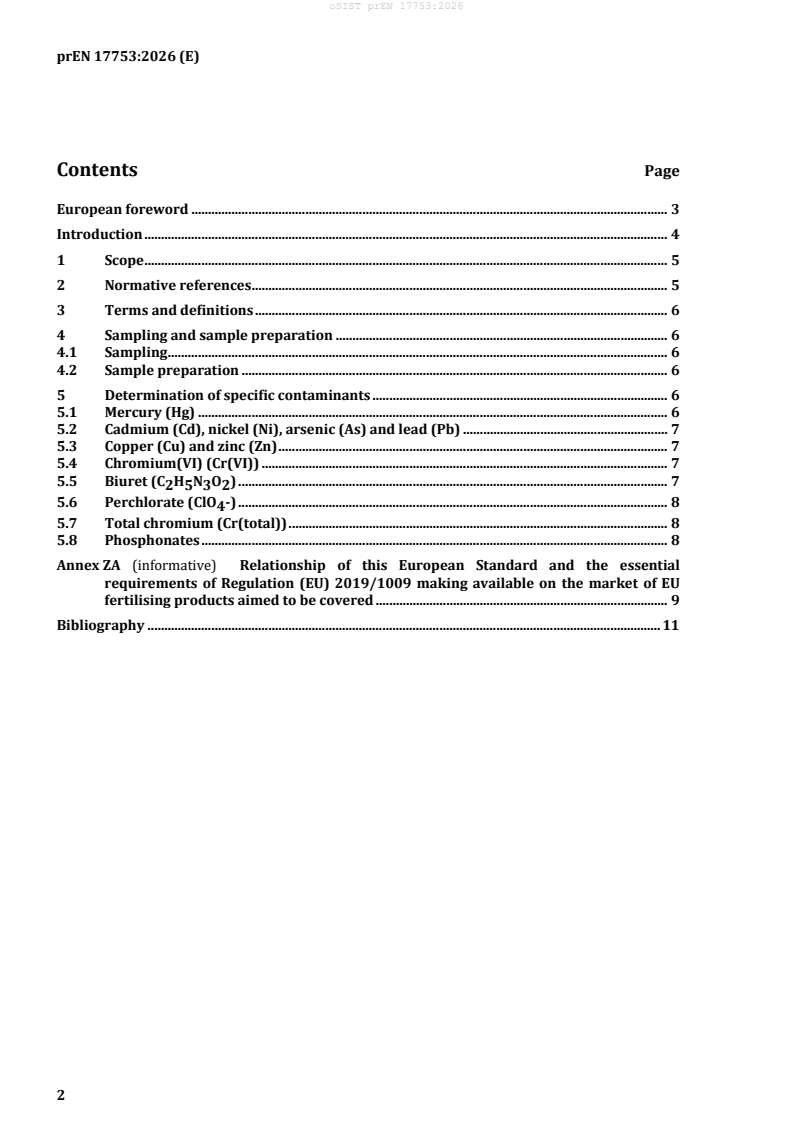
Contents
- Introduction
- 1 Scope
- 2 Normative references
- 3 Terms and definitions
- 4 Sampling and sample preparation
- 4.1 Sampling
- 4.2 Sample preparation
- 5 Determination of specific contaminants
- 5.1 Mercury (Hg)
- 5.2 Cadmium (Cd), nickel (Ni), arsenic (As) and lead (Pb)
- 5.3 Copper (Cu) and zinc (Zn)
- 5.4 Chromium(VI) (Cr(VI))
- 5.5 Biuret (C H N O )
- 5.6 Perchlorate (ClO -)
- 5.7 Total chromium (Cr(total))
- 5.8 Phosphonates
- Annex ZA
- Bibliography
Introduction
Regulation (EU) 2019/1009 [3] lays down the rules on the making available on the market of EU fertilizing products and the specific safety and quality requirements for the defined product function categories (PFCs). Inorganic fertilizers have been classified into PFC 1(C). The specific safety and quality requirements in relation to specific contaminants (i.e. the mercury, cadmium, nickel, copper, zinc, arsenic, lead, chromium VI, biuret, perchlorate and total chromium content) are defined in this document as well as normative references of the test methods to be used in order to measure the compliance with the related requirement in the Regulation (EU) 2019/1009 [3]. The definition of phosphonates is not clearly stated in Regulation (EU) 2019/1009 [3] and to avoid any misunderstanding, the results are expressed as a content of phosphorus (P) bound in the form of free water-soluble phosphonates (P-PO ).
oSIST prEN 17753:2026 prEN 17753:2026 (E)
1 Scope
This document specifies references to methods for the determination of the following contaminants:
mercury, cadmium, nickel, copper, zinc, arsenic, lead, chromium(VI), biuret, perchlorate, total chromium and phosphonates content in inorganic fertilizers.
For the mercury, cadmium, nickel, copper, zinc, arsenic, lead, perchlorate and total chromium content:
This document is applicable to the fertilizing products blends where a blend is a mix of at least two of the following components: fertilizers, liming materials, soil improvers, growing media, inhibitors, plant biostimulants, and where the following category: inorganic fertilizers is the highest % in the blend by mass or volume, or in the case of liquid form by dry mass. If inorganic fertilizer is not the highest % in the blend, the European Standard for the highest % of the blend applies. In case a fertilizing product blend is composed of components in equal quantity, the user decides which standard to apply. For the chromium(VI) and biuret content: This document is applicable to the fertilizing products blends where a blend is a mix of at least two of the following components: fertilizers, liming materials, soil improvers, growing media, inhibitors, plant biostimulants, and where organic matter is present in at least one of the products in the blend. In case a fertilizing product blend is composed only of inorganic products, the European Standard for inorganic fertilizers applies. Variations in analytical methods for fertilizing product blends can lead to differing results as some components or matrix interactions can affect the outcome. Validation procedures have shown that developed standard methods are robust and reliable across diverse product compositions, but possible interferences and unexpected results when analysing fertilizing product blends are possible.
An overview of the references to methods for the determination of the specific contaminants is given in Table 1.
NOTE 1 The determination of copper and zinc in inorganic fertilizers as micronutrients is covered by prEN 17754.
NOTE 2 The determination of copper in ammonium nitrate fertilizers of high nitrogen content is covered by CEN/TS 17751.
2 Normative references
The following documents are referred to in the text in such a way that some or all of their content constitutes requirements of this document. For dated references, only the edition cited applies. For undated references, the latest edition of the referenced document (including any amendments) applies. EN 1482-2:2024, Fertilizers, liming materials and inhibitors — Sampling and sample preparation — Part 2: General sample preparation provisions prEN 12944-1:2026, Fertilizers, liming materials and inhibitors — Vocabulary — Part 1: General terms prEN 12944-2:2026, Fertilizers, liming materials and inhibitors — Vocabulary — Part 2: Terms relating to fertilizers EN 16317:2013+A1:2017, Fertilizers and liming materials — Determination of arsenic by inductively coupled plasma-atomic emission spectrometry (ICP-AES) after aqua regia dissolution EN 16318:2013+A1:2016, Fertilizers and liming materials — Determination of chromium(VI) by photometry (method A) and by ion chromatography with spectrophotometric detection (method B) prEN 16319:2025, Inorganic fertilizers and liming materials — Determination of specific elements — Determination of cadmium, chromium, copper, lead, nickel and zinc by inductively coupled plasma-atomic emission spectrometry (ICP-AES) after aqua regia dissolution
...