

SIST EN 13060:2025
(Main)Sterilizers for medical purposes - Small steam sterilizers - Requirements and testing
General Information
- Abstract
This document specifies the performance requirements and test methods for small steam sterilizers and sterilization cycles which are used for medical purposes or for materials that are likely to come into contact with blood or body fluids.
This document applies to automatically controlled small steam sterilizers that generate steam using electrical heaters or use steam that is generated by a system external to the sterilizer.
This document applies to small steam sterilizers used primarily for the sterilization of medical devices with a chamber volume of less than 60 l and unable to accommodate a sterilization module (300 mm × 300 mm × 600 mm).
The requirements concerning the quality management and risk management are addressed by other standards (e.g. EN ISO 13485, EN ISO 14971).
This document does not apply to small steam sterilizers that are used to sterilize liquids or pharmaceutical products.
This document does not specify safety requirements related to risks associated with the zone in which the sterilizer is used (e.g. flammable gases).
This document does not specify requirements for the validation and routine control of sterilization by moist heat.
NOTE Requirements for the validation and routine control of sterilization by moist heat are given in EN ISO 17665.
This document does not specify requirements for other sterilization processes that also employ moist heat as part of the process (i.e. formaldehyde, ethylene oxide).
- Status
- Published
- Public Enquiry End Date
- 18-Jul-2023
- Publication Date
- 07-Sep-2025
- Technical Committee
- VAZ - Healthcare
- Current Stage
- 6060 - National Implementation/Publication (Adopted Project)
- Start Date
- 04-Sep-2025
- Due Date
- 09-Nov-2025
- Completion Date
- 08-Sep-2025
2017/745 - Regulation (EU) 2017/745 of the European Parliament and of the Council of 5 April 2017 on medical devices, amending Directive 2001/83/EC, Regulation (EC) No 178/2002 and Regulation (EC) No 1223/2009 and repealing Council Directives 90/385/EEC and 93/42/EECOJ Ref: L, 7.4.2026 OJ Date: 07-Apr-2026

Overview
SIST EN 13060:2025 (identical to EN 13060:2025) sets the requirements and test methods for small steam sterilizers used for medical purposes or for materials likely to contact blood or body fluids. It applies to automatically controlled small steam sterilizers that either generate steam with internal electrical heaters or use an external steam supply. The standard covers sterilizers with a chamber volume of less than 60 L and that cannot accommodate a sterilization module of 300 × 300 × 600 mm. It supersedes earlier editions and was approved by CEN on 23 June 2025.
Key technical topics and requirements
SIST EN 13060:2025 addresses design, performance and testing aspects essential for safe and effective sterilization. Major topics include:
- Product definition and equipment development - scope of device categories and design lifecycle considerations.
- Equipment design and construction - chamber design, doors, pressure vessels, materials, interlocks and transport.
- Control, monitoring and recording - automatic control systems, software considerations, instrumentation, indicating devices and digital/analogue recorders.
- Performance and assessment - chamber integrity, air leakage, attainment of sterilization conditions, drying and microbiological performance.
- Test programmes and test instrumentation - type tests, works tests, installation tests and required sensors/recorders.
- Services and local environment - requirements for steam, water, vacuum, electrical supply and ventilation.
- Information and labelling - manufacturer’s instructions for use, marking, technical descriptions and pre-purchase information.
Note: Validation and routine control of moist heat sterilization are outside this document and are covered by EN ISO 17665. Quality management and risk management are handled by standards such as EN ISO 13485 and EN ISO 14971.
Practical applications and users
This standard is intended for stakeholders involved in the design, manufacture, testing, procurement and use of small steam sterilizers:
- Manufacturers - to design and verify compliance of small medical steam sterilizers.
- Test laboratories and notified bodies - to perform type and performance testing, including air-leak and microbiological assessments.
- Biomedical engineers and sterile services departments - to assess suitability for clinical use, installation requirements and maintenance.
- Procurement teams in clinics and dental practices - to compare products against standardized requirements.
SIST EN 13060:2025 is specifically useful where small-capacity, automatically controlled steam sterilizers are deployed for medical instruments and devices.
Related standards (selected)
- EN ISO 17665 - validation and routine control of moist heat sterilization
- EN ISO 13485 - medical device quality management systems
- EN ISO 14971 - medical device risk management
Keywords: SIST EN 13060:2025, EN 13060:2025, small steam sterilizers, medical sterilizers, sterilization requirements and testing, steam sterilizers, sterilization cycles.
Relations
- Effective Date
- 01-Oct-2025
- Effective Date
- 09-Feb-2026
- Effective Date
- 09-Feb-2026
- Effective Date
- 09-Feb-2026
- Effective Date
- 09-Feb-2026
- Effective Date
- 09-Feb-2026
- Effective Date
- 09-Feb-2026
- Effective Date
- 09-Feb-2026
- Effective Date
- 09-Feb-2026
- Effective Date
- 09-Feb-2026
- Effective Date
- 09-Feb-2026
- Effective Date
- 28-Jan-2026
- Effective Date
- 28-Jan-2026
- Effective Date
- 28-Jan-2026
- Effective Date
- 28-Jan-2026
Get Certified
Connect with accredited certification bodies for this standard

BSI Group
BSI (British Standards Institution) is the business standards company that helps organizations make excellence a habit.

TÜV Rheinland
TÜV Rheinland is a leading international provider of technical services.

TÜV SÜD
TÜV SÜD is a trusted partner of choice for safety, security and sustainability solutions.
Sponsored listings
Frequently Asked Questions
SIST EN 13060:2025 is a standard published by the Slovenian Institute for Standardization (SIST). Its full title is "Sterilizers for medical purposes - Small steam sterilizers - Requirements and testing". This standard covers: This document specifies the performance requirements and test methods for small steam sterilizers and sterilization cycles which are used for medical purposes or for materials that are likely to come into contact with blood or body fluids. This document applies to automatically controlled small steam sterilizers that generate steam using electrical heaters or use steam that is generated by a system external to the sterilizer. This document applies to small steam sterilizers used primarily for the sterilization of medical devices with a chamber volume of less than 60 l and unable to accommodate a sterilization module (300 mm × 300 mm × 600 mm). The requirements concerning the quality management and risk management are addressed by other standards (e.g. EN ISO 13485, EN ISO 14971). This document does not apply to small steam sterilizers that are used to sterilize liquids or pharmaceutical products. This document does not specify safety requirements related to risks associated with the zone in which the sterilizer is used (e.g. flammable gases). This document does not specify requirements for the validation and routine control of sterilization by moist heat. NOTE Requirements for the validation and routine control of sterilization by moist heat are given in EN ISO 17665. This document does not specify requirements for other sterilization processes that also employ moist heat as part of the process (i.e. formaldehyde, ethylene oxide).
This document specifies the performance requirements and test methods for small steam sterilizers and sterilization cycles which are used for medical purposes or for materials that are likely to come into contact with blood or body fluids. This document applies to automatically controlled small steam sterilizers that generate steam using electrical heaters or use steam that is generated by a system external to the sterilizer. This document applies to small steam sterilizers used primarily for the sterilization of medical devices with a chamber volume of less than 60 l and unable to accommodate a sterilization module (300 mm × 300 mm × 600 mm). The requirements concerning the quality management and risk management are addressed by other standards (e.g. EN ISO 13485, EN ISO 14971). This document does not apply to small steam sterilizers that are used to sterilize liquids or pharmaceutical products. This document does not specify safety requirements related to risks associated with the zone in which the sterilizer is used (e.g. flammable gases). This document does not specify requirements for the validation and routine control of sterilization by moist heat. NOTE Requirements for the validation and routine control of sterilization by moist heat are given in EN ISO 17665. This document does not specify requirements for other sterilization processes that also employ moist heat as part of the process (i.e. formaldehyde, ethylene oxide).
SIST EN 13060:2025 is classified under the following ICS (International Classification for Standards) categories: 11.080.10 - Sterilizing equipment. The ICS classification helps identify the subject area and facilitates finding related standards.
SIST EN 13060:2025 has the following relationships with other standards: It is inter standard links to SIST EN 13060:2015+A1:2019, SIST EN 61010-1:2010, SIST EN 60529:1997/A2:2014, SIST EN 62366-1:2015, SIST EN 62366-1:2015/A1:2020, SIST EN IEC 61010-2-040:2022, SIST EN 61010-1:2010/A1:2019, SIST EN 60529:1997/A1:2000, SIST EN 60529:1997, SIST EN IEC 61326-1:2021, SIST EN IEC 60751:2022, SIST EN ISO 4126-1:2013/A1:2016, SIST EN 285:2016+A1:2021, SIST EN 13445-3:2021, SIST EN ISO 17665:2024. Understanding these relationships helps ensure you are using the most current and applicable version of the standard.
SIST EN 13060:2025 is associated with the following European legislation: EU Directives/Regulations: 2006/42/EC, 2017/745; Standardization Mandates: M/575, M/575 Amd 2. When a standard is cited in the Official Journal of the European Union, products manufactured in conformity with it benefit from a presumption of conformity with the essential requirements of the corresponding EU directive or regulation.
SIST EN 13060:2025 is available in PDF format for immediate download after purchase. The document can be added to your cart and obtained through the secure checkout process. Digital delivery ensures instant access to the complete standard document.
Standards Content (Sample)
SLOVENSKI STANDARD
01-oktober-2025
Nadomešča:
SIST EN 13060:2015+A1:2019
Sterilizatorji za uporabo v medicini - Mali parni sterilizatorji - Zahteve in
preskušanje
Sterilizers for medical purposes - Small steam sterilizers - Requirements and testing
Sterilisatoren für medizinische Zwecke - Dampf-Klein-Sterilisatoren - Anforderungen und
Prüfung
Stérilisateurs à usage médical - Petits stérilisateurs à la vapeur d'eau - Exigences et
essais
Ta slovenski standard je istoveten z: EN 13060:2025
ICS:
11.080.10 Sterilizacijska oprema Sterilizing equipment
2003-01.Slovenski inštitut za standardizacijo. Razmnoževanje celote ali delov tega standarda ni dovoljeno.
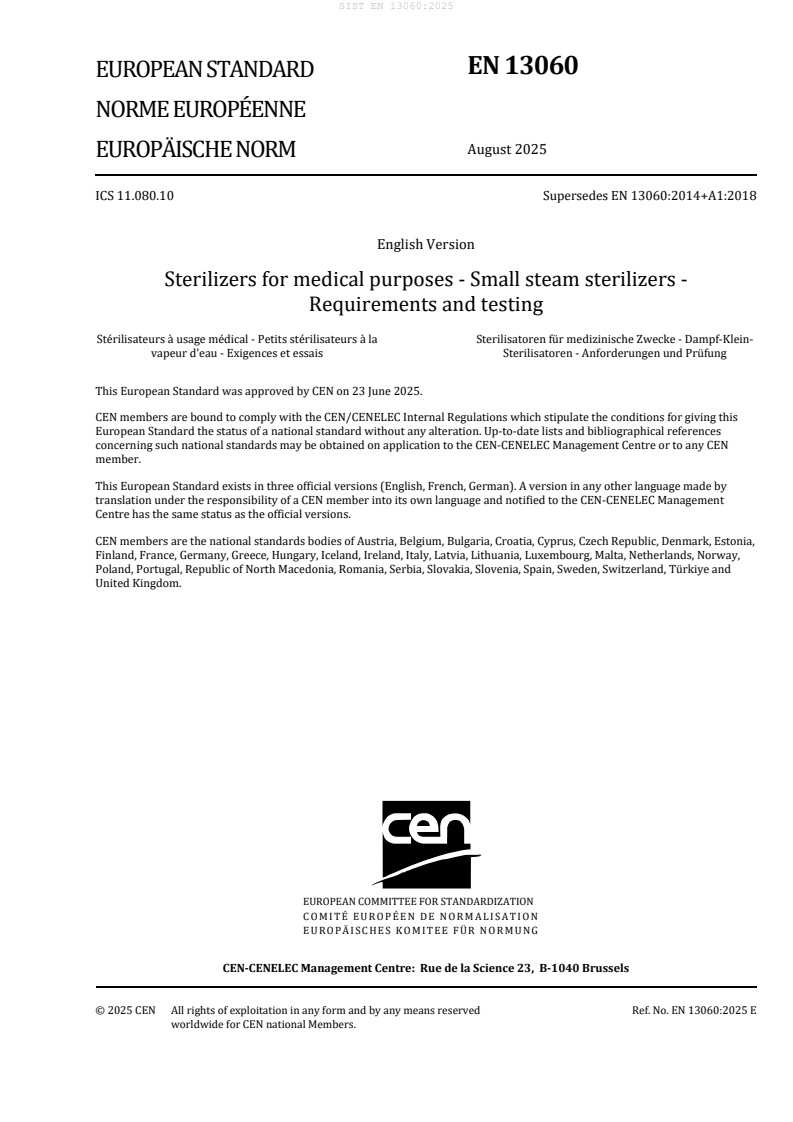
EN 13060
EUROPEAN STANDARD
NORME EUROPÉENNE
August 2025
EUROPÄISCHE NORM
ICS 11.080.10 Supersedes EN 13060:2014+A1:2018
English Version
Sterilizers for medical purposes - Small steam sterilizers -
Requirements and testing
Stérilisateurs à usage médical - Petits stérilisateurs à la Sterilisatoren für medizinische Zwecke - Dampf-Klein-
vapeur d'eau - Exigences et essais Sterilisatoren - Anforderungen und Prüfung
This European Standard was approved by CEN on 23 June 2025.
CEN members are bound to comply with the CEN/CENELEC Internal Regulations which stipulate the conditions for giving this
European Standard the status of a national standard without any alteration. Up-to-date lists and bibliographical references
concerning such national standards may be obtained on application to the CEN-CENELEC Management Centre or to any CEN
member.
This European Standard exists in three official versions (English, French, German). A version in any other language made by
translation under the responsibility of a CEN member into its own language and notified to the CEN-CENELEC Management
Centre has the same status as the official versions.
CEN members are the national standards bodies of Austria, Belgium, Bulgaria, Croatia, Cyprus, Czech Republic, Denmark, Estonia,
Finland, France, Germany, Greece, Hungary, Iceland, Ireland, Italy, Latvia, Lithuania, Luxembourg, Malta, Netherlands, Norway,
Poland, Portugal, Republic of North Macedonia, Romania, Serbia, Slovakia, Slovenia, Spain, Sweden, Switzerland, Türkiye and
United Kingdom.
EUROPEAN COMMITTEE FOR STANDARDIZATION
COMITÉ EUROPÉEN DE NORMALISATION
EUROPÄISCHES KOMITEE FÜR NORMUNG
CEN-CENELEC Management Centre: Rue de la Science 23, B-1040 Brussels
© 2025 CEN All rights of exploitation in any form and by any means reserved Ref. No. EN 13060:2025 E
worldwide for CEN national Members.
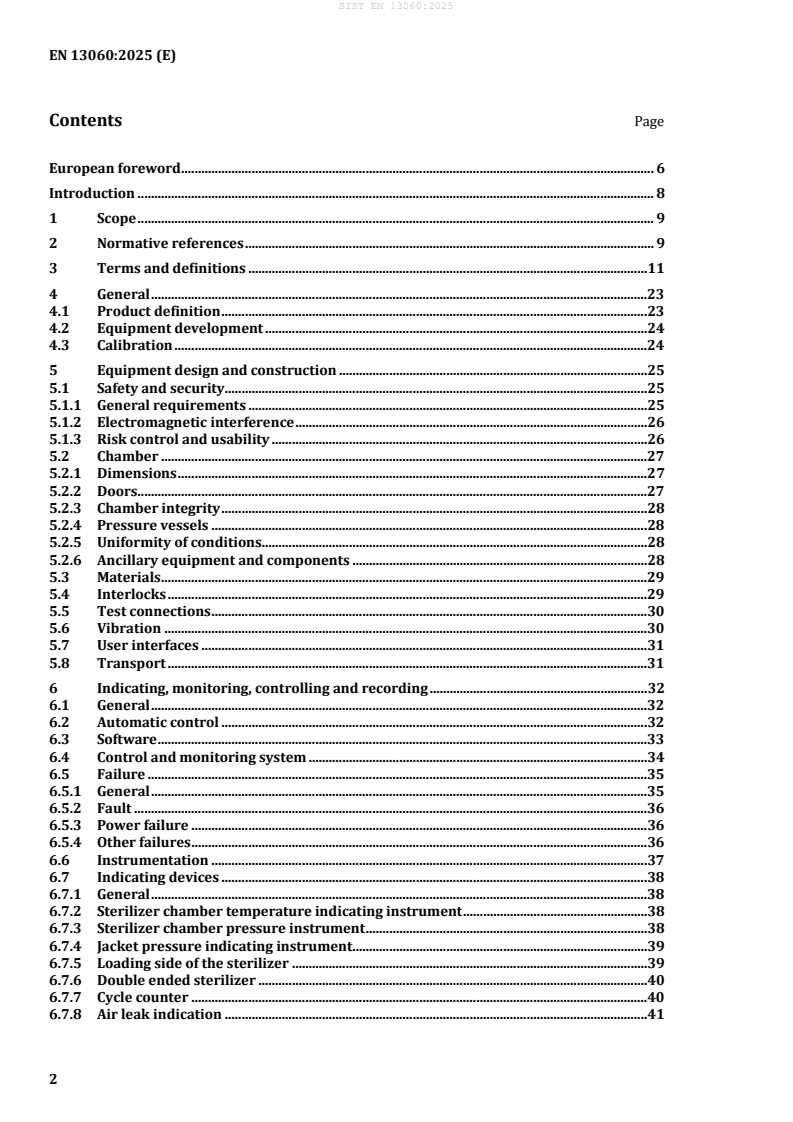
Contents Page
European foreword . 6
Introduction . 8
1 Scope . 9
2 Normative references . 9
3 Terms and definitions .11
4 General .23
4.1 Product definition .23
4.2 Equipment development .24
4.3 Calibration .24
5 Equipment design and construction .25
5.1 Safety and security .25
5.1.1 General requirements .25
5.1.2 Electromagnetic interference .26
5.1.3 Risk control and usability .26
5.2 Chamber .27
5.2.1 Dimensions .27
5.2.2 Doors .27
5.2.3 Chamber integrity .28
5.2.4 Pressure vessels .28
5.2.5 Uniformity of conditions.28
5.2.6 Ancillary equipment and components .28
5.3 Materials .29
5.4 Interlocks .29
5.5 Test connections .30
5.6 Vibration .30
5.7 User interfaces .31
5.8 Transport .31
6 Indicating, monitoring, controlling and recording .32
6.1 General .32
6.2 Automatic control .32
6.3 Software .33
6.4 Control and monitoring system .34
6.5 Failure .35
6.5.1 General .35
6.5.2 Fault .36
6.5.3 Power failure .36
6.5.4 Other failures .36
6.6 Instrumentation .37
6.7 Indicating devices .38
6.7.1 General .38
6.7.2 Sterilizer chamber temperature indicating instrument .38
6.7.3 Sterilizer chamber pressure instrument .38
6.7.4 Jacket pressure indicating instrument .39
6.7.5 Loading side of the sterilizer .39
6.7.6 Double ended sterilizer .40
6.7.7 Cycle counter .40
6.7.8 Air leak indication .41
6.8 Recorders . 41
6.8.1 General . 41
6.8.2 Recorders producing analogue records . 42
6.8.3 Recorders producing digital records . 43
6.9 Process. 46
6.9.1 General . 46
6.9.2 Sterilization temperature, sterilization temperature band, holding time . 46
6.9.3 Time-temperature relationships . 46
6.9.4 Equilibration time . 46
7 Services and local environment . 47
7.1 General . 47
7.2 Sterilizing agent and sterilant . 47
7.3 Electrical supply . 47
7.4 Water . 47
7.4.1 General . 47
7.4.2 Water supply for steam generation in the sterilizer . 47
7.4.3 Water used other than for steam generation . 48
7.5 Steam . 48
7.5.1 External steam supply . 48
7.6 Vacuum . 48
7.7 Drains . 48
7.8 Lighting . 49
7.9 Compressed air . 49
7.10 Air and inert gases. 49
7.11 Ventilation . 49
8 Emissions . 49
8.1 Electromagnetic emissions . 49
8.2 Noise . 49
8.3 Heat emission . 50
9 Test instrumentation . 50
10 Performance and assessment . 51
10.1 General . 51
10.2 Chamber integrity . 52
10.2.1 General . 52
10.2.2 Air leakage rate . 52
10.3 Attainment of conditions . 52
10.4 Performance verification . 53
10.5 Drying . 53
10.6 Microbiological performance . 53
10.7 Pressure change . 53
10.7.1 General . 53
10.7.2 Dynamic sterilizer chamber pressure test . 54
11 Information supplied by the manufacturer . 54
11.1 General . 54
11.2 Information to be made available prior to purchase . 54
11.3 Marking . 59
11.3.1 Marking of the pressure vessel . 59
11.3.2 Marking of the sterilizer and the packaging . 59
11.4 Label . 60
11.5 Instructions for use . 60
11.6 Technical description . 61
Annex A (normative) Test programme .62
A.1 Categories of tests .62
A.2 Type tests .62
A.3 Works test .63
A.4 Installation tests .63
A.5 Test programme .63
A.6 Rationale for the tests (informative) .65
Annex B (normative) Test equipment .68
B.1 Test equipment .68
B.2 Temperature sensors .68
B.3 Thermometric recording instrument .68
B.4 Pressure measurement and recording instrument .69
B.5 Test equipment for the performance of the air leakage test .70
B.6 Process challenge device (PCD) and chemical indicator for narrow lumen .71
B.7 Process challenge device and chemical indicator for simple hollow item .71
B.8 Balance for load dryness test .72
Annex C (normative) Test loads .73
C.1 Test loads .73
C.2 Porous load .73
C.3 Solid load, unwrapped .75
C.4 Solid load, single wrapped .75
C.5 Solid load, double wrapped .75
Annex D (normative) Test procedures .76
D.1 Test procedures .76
D.2 Air leakage test .77
D.3 Dynamic sterilizer chamber pressure test.78
D.4 Empty chamber test .79
D.5 Solid load test .79
D.6 Narrow lumen test .79
D.7 Simple hollow item test.80
D.8 Small porous load test .81
D.9 Full porous load test (single and double wrapped) .82
D.10 Small porous items test (single and double wrapped) .83
D.11 Solid load dryness test.84
D.12 Porous load dryness test (small and full, single and double wrapped) .84
D.13 Small porous items dryness test (single and double wrapped) .85
D.14 Microbiological test for solid loads . 85
D.15 Microbiological test for narrow lumens . 86
D.16 Microbiological test for simple hollow item . 86
D.17 Microbiological test for small porous loads . 86
D.18 Microbiological test for full porous loads . 87
D.19 Microbiological test for small porous items . 87
Annex E (informative) Monitoring system . 88
E.1 General . 88
E.2 Principle . 88
E.3 Equipment . 89
Annex F (informative) Suggested maximum limits of contaminants in and specifications for
water for steam sterilization . 92
F.1 Suggested maximum limits of contaminants in and specifications for water for steam
sterilization . 92
Annex G (informative) Load support systems . 93
Annex H (informative) Illustrations of the interrelationship between control and recording
................................................................................................................................................................... 94
H.1 Overview . 94
H.2 Illustration 1 . 94
H.3 Illustration 2 . 96
H.4 Illustration 3 . 97
Annex I (informative) Environmental aspects . 100
I.1 Environmental impact . 100
I.2 Steam . 100
I.3 Product life cycle . 101
Annex ZA (informative) Relationship between this European Standard and the General
Safety and Performance Requirements of Regulation (EU) 2017/745 aimed to be
covered . 102
Bibliography . 120
European foreword
This document (EN 13060:2025) has been prepared by Technical Committee CEN/TC 102 “Sterilizers
and associated equipment for processing of medical devices”, the secretariat of which is held by DIN.
This European Standard shall be given the status of a national standard, either by publication of an
identical text or by endorsement, at the latest by February 2026, and conflicting national standards shall
be withdrawn at the latest by February 2026.
Attention is drawn to the possibility that some of the elements of this document may be the subject of
patent rights. CEN shall not be held responsible for identifying any or all such patent rights.
This document supersedes EN 13060:2014+A1:2018.
In comparison with the previous edition, the following technical modifications have been made:
— the structure of the main text has been widely adopted to the structure of ISO/TS 22421:2021;
— update of normative references;
— update of terms and definitions to align with EN ISO 11139:2018 and EN ISO 11139:2018/A1:2024;
— for requirement on non-condensable gases test, reference is made to EN 285:2015+A1:2021;
— considerations of aspect of standardization in moist heat sterilization to align with
EN ISO 17665:2024.
This document has been prepared under a standardization request addressed to CEN by the European
Commission. The Standing Committee of the EFTA States subsequently approves these requests for its
Member States.
For the relationship with EU Legislation, see informative Annex ZA, which is an integral part of this
document.
In this document, the following verbal forms are used:
— “shall” indicates a requirement;
— “should” indicates a recommendation;
— “may” indicates a permission;
— “can” indicates a possibility or capability; and
— “must” is used to express an external constraint.
In this document notes are used for giving additional information intended to assist the understanding
or use of the text of document. The document shall be usable without the notes.
Any feedback and questions on this document should be directed to the users’ national standards body.
A complete listing of these bodies can be found on the CEN website.
According to the CEN-CENELEC Internal Regulations, the national standards organisations of the
following countries are bound to implement this European Standard: Austria, Belgium, Bulgaria, Croatia,
Cyprus, Czech Republic, Denmark, Estonia, Finland, France, Germany, Greece, Hungary, Iceland, Ireland,
Italy, Latvia, Lithuania, Luxembourg, Malta, Netherlands, Norway, Poland, Portugal, Republic of North
Macedonia, Romania, Serbia, Slovakia, Slovenia, Spain, Sweden, Switzerland, Türkiye and the United
Kingdom.
Introduction
Small steam sterilizers are widely used for medical purposes, e.g. in general medical practice, dentistry,
podiatry, facilities for personal hygiene and beauty care and also veterinary practice. They are also used
for materials and equipment which are likely to come into contact with blood or bodily fluids, e.g.
implements used by beauty therapists, tattooists, body piercers and hairdressers. The specific nature of
such loads used within these fields of application call for different performance requirements for the
sterilization cycles and hence different corresponding test methods.
This document provides minimum requirements for small steam sterilizers and associated test methods.
Performance is defined by reference to standard test loads. These are used to define a basic minimum
performance and are not necessarily related to specific medical devices. It is the responsibility of the user
and the manufacturer of the device to be sterilized to determine that any particular cycle is suitable for
sterilizing a particular device. The performance tests specified in this document can also be used by the
manufacturer of the device to be sterilized to specify the appropriate performance for decontamination
processes according to the requirements for information to be given by medical device manufacturers
according to EN ISO 17664-1. This will enable users to identify the specific sterilizer performance
required to safely process their devices.
The performance requirements specified in this document are not intended for the process to be effective
in inactivating the causative agents of spongiform encephalopathies such as scrapie, bovine spongiform
encephalopathy and Creutzfeldt-Jakob disease. However, some national regulations require the use of
modified steam processes as part of a general prion decontamination programme.
It is essential that the sterilizer and ancillary equipment is used only for the sterilization of the type of
products for which it is designed. The choice of sterilizer, sterilization cycle or quality of services
provided can be inappropriate for a particular product. Therefore, the suitability of a sterilization
procedure for a particular product is verified by validation, see EN ISO 17665. Conformance with these
requirements for development, validation and routine control of sterilization process ensures that the
sterilization process is both reliable and reproducible so that predictions can be made, with reasonable
confidence, that there is low probability of there being a viable microorganism present on a health care
product after sterilization.
1 Scope
This document specifies the performance requirements and test methods for small steam sterilizers and
sterilization cycles which are used for medical purposes or for materials that are likely to come into
contact with blood or body fluids.
This document applies to automatically controlled small steam sterilizers that generate steam using
electrical heaters or use steam that is generated by a system external to the sterilizer.
This document applies to small steam sterilizers used primarily for the sterilization of medical devices
with a chamber volume of less than 60 l and unable to accommodate a sterilization module
(300 mm × 300 mm × 600 mm).
The requirements concerning the quality management and risk management are addressed by other
standards (e.g. EN ISO 13485, EN ISO 14971).
This document does not apply to small steam sterilizers that are used to sterilize liquids or
pharmaceutical products.
This document does not specify safety requirements related to risks associated with the zone in which
the sterilizer is used (e.g. flammable gases).
This document does not specify requirements for the validation and routine control of sterilization by
moist heat.
NOTE Requirements for the validation and routine control of sterilization by moist heat are given in
EN ISO 17665.
This document does not specify requirements for other sterilization processes that also employ moist
heat as part of the process (i.e. formaldehyde, ethylene oxide).
2 Normative references
The following documents are referred to in the text in such a way that some or all of their content
constitutes requirements of this document. For dated references, only the edition cited applies. For
undated references, the latest edition of the referenced document (including any amendments) applies.
EN 285:2015+A1:2021, Sterilization — Steam sterilizers — Large sterilizers
EN 556-1:2024, Sterilization of medical devices — Requirements for medical devices to be designated
“STERILE” — Part 1: Requirements for terminally sterilized medical devices
EN 764-7:2002, Pressure equipment — Part 7: Safety systems for unfired pressure equipment
EN 868-2:2025, Packaging for terminally sterilized medical devices — Part 2: Sterilization wrap —
Requirements and test methods
EN 868-4:2025, Packaging for terminally sterilized medical devices — Part 4: Paper bags — Requirements
and test methods
EN 868-5:2018, Packaging for terminally sterilized medical devices — Part 5: Sealable pouches and reels of
porous materials and plastic film construction — Requirements and test methods
EN 10088-1:2023, Stainless steels — Part 1: List of stainless steels
This document is impacted by corrigendum EN 764-7:2002/AC:2006.
EN 13445-1:2021, Unfired pressure vessels — Part 1: General
EN 13445-2:2021+A1:2023, Unfired pressure vessels — Part 2: Materials
EN 13445-3:2021, Unfired pressure vessels — Part 3: Design
EN 13445-4:2021+A1:2023, Unfired pressure vessels — Part 4: Fabrication
EN 13445-5:2021+A1:2024, Unfired pressure vessels — Part 5: Inspection and testing
EN 13445-8:2021, Unfired pressure vessels — Part 8: Additional requirements for pressure vessels of
aluminium and aluminium alloys
EN 60529:1991, Degrees of protection provided by enclosures (IP Code)
EN 61010-1:2010, Safety requirements for electrical equipment for measurement, control, and laboratory
use — Part 1: General requirements (IEC 61010-1:2010)
EN 62366-1:2015, Medical devices — Part 1: Application of usability engineering to medical devices
EN IEC 60751:2022, Industrial platinum resistance thermometers and platinum temperature sensors
(IEC 60751:2022)
EN IEC 61010-2-040:2021, Safety requirements for electrical equipment for measurement, control, and
laboratory use — Part 2-040: Particular requirements for sterilizers and washer-disinfectors used to treat
medical materials (IEC 61010-2-040:2020)
EN IEC 61326-1:2021, Electrical equipment for measurement, control and laboratory use — EMC
requirements — Part 1: General requirements (IEC 61326-1:2020)
EN ISO 228-1:2003, Pipe threads where pressure-tight joints are not made on the threads — Part 1:
Dimensions, tolerances and designation (ISO 228-1:2000)
EN ISO 4017:2022, Fasteners — Hexagon head screws — Product grades A and B (ISO 4017:2022)
EN ISO 4126-1:2013, Safety devices for protection against excessive pressure — Part 1: Safety valves
(ISO 4126-1:2013)
EN ISO 11138-3:2017, Sterilization of health care products — Biological indicators — Part 3: Biological
indicators for moist heat sterilization processes (ISO 11138-3:2017)
EN ISO 11140-1:2014, Sterilization of health care products — Chemical indicators — Part 1: General
requirements (ISO 11140-1:2014)
This document is impacted by amendment EN 60529:1991/A1:2000 and EN 60529:1991/A2:2013, with
corrigendum EN 60529:1991/A2:2013/AC:2019-02, and corrigendum EN 60529:1991/AC:2016-12.
This document is impacted by amendment EN 61010-1:2010:2010/A1:2019 and corrigendum EN 61010-
1:2010/A1:2019/AC:2019.
This document is impacted by corrigenda EN 62366-1:2015/AC:2015 and EN 62366-1:2015/AC:2016-09 and
amendment EN 62366-1:2015/A1:2020.
This document is impacted by amendments EN ISO 4126-1:2013/A1:2016 and EN ISO 4126-1:2013/A2:2019.
EN ISO 11140-6:2022, Sterilization of health care products — Chemical indicators — Part 6: Type 2
indicators and process challenge devices for use in performance testing of small steam sterilizers
(ISO 11140-6:2022)
EN ISO 14971:2019, Medical devices — Application of risk management to medical devices
(ISO 14971:2019)
EN ISO 17665:2024, Sterilization of health care products — Moist heat — Requirements for the
development, validation and routine control of a sterilization process for medical devices (ISO 17665:2024)
EN ISO 20417:2021, Medical devices — Information to be supplied by the manufacturer (ISO 20417:2021,
Corrected version 2021-12)
3 Terms and definitions
For the purposes of this document, the following terms and definitions apply.
ISO and IEC maintain terminology databases for use in standardization at the following addresses:
— ISO Online browsing platform: available at https://www.iso.org/obp
— IEC Electropedia: available at https://www.electropedia.org/
3.1
access device
means by which entry to restricted parts of equipment is achieved
Note 1 to entry: This can be by dedicated key, code, or tool.
[SOURCE: EN ISO 11139:2018, 3.4]
3.2
active drain
drain through which fluids present in the chamber are discharged during the process
3.3
automatic controller
device that directs the equipment sequentially through required stages of the cycle in response to
programmed cycle parameters
[SOURCE: EN ISO 11139:2018, 3.18]
3.4
biological indicator
test system containing viable microorganisms providing a specified resistance to a specified sterilization
process
[SOURCE: EN ISO 11139:2018, 3.29]
This document is impacted by amendment EN ISO 14971:2019/A11:2021.
3.5
calibration
operation that, under specified conditions, in a first step, establishes a relation between the quantity
values with measurement uncertainties provided by measurement standards and corresponding
indications with associated measurement uncertainties and, in a second step, uses this information to
establish a relation for obtaining a measurement result from an indication
[SOURCE: EN ISO 11139:2018, 3.31]
3.6
chamber
part of equipment in which a load is processed
[SOURCE: EN ISO 11139:2018, 3.36]
3.7
chemical indicator
test system that reveals change in one or more pre-specified process variables based on a chemical or
physical change resulting from exposure to a process
Note 1 to entry: An indicator intended to be used only in combination with a specific test load is also termed an
indicator (both together becoming an indicator system).
[SOURCE: EN ISO 11139:2018, 3.43, modified – Note 1 to entry has been added]
3.8
control
regulation of variables within specified limits
[SOURCE: EN ISO 11139:2018, 3.63]
3.9
cycle complete
message from the automatic controller that the operating cycle has ended successfully
[SOURCE: EN ISO 11139:2018, 3.71]
3.10
cycle parameter
value of a cycle variable including its tolerance used for control, monitoring, indication, and recording of
an operating cycle
[SOURCE: EN ISO 11139:2018, 3.72]
3.11
cycle variable
property used to control, monitor, indicate, or record an operating cycle
[SOURCE: EN ISO 11139:2018, 3.74]
3.12
double-ended
having separate doors for loading and unloading in separate areas
[SOURCE: EN ISO 11139:2018, 3.92]
3.13
equilibration time
period between the attainment of defined sterilization process parameters at
the reference measurement point and the attainment of the specified sterilization process parameters at
all points within the load
Note 1 to entry: For the purpose of this document, the process parameter to which this definition refers is
temperature.
Note 2 to entry: Independent of the specific load, for the purpose of this document, the allocation of all points is
inside the usable chamber space.
[SOURCE: EN ISO 11139:2018, 3.105, modified – Note 1 and 2 to entry have been added]
3.14
equipment maintenance
combination of all technical and associated administrative actions intended to keep equipment at a state
in which it can perform its required function, or restore it to such a state
[SOURCE: EN ISO 11139:2018, 3.106]
3.15
exposure phase
cycle stage between the introduction of the sterilizing agent or disinfecting agent into the chamber and
when the agent is removed
Note 1 to entry: Disinfecting agent does not concern steam sterilization. For the purpose of this document the
sterilizing agent is moist heat and the exposure phase corresponds to the plateau period which is used in EN 13060.
[SOURCE: EN ISO 11139:2018, 3.111, modified – Note 1 to entry has been added]
3.16
fault
situation in which one or more of the process or cycle parameters is/are outside its/their specified
tolerance(s)
[SOURCE: EN ISO 11139:2018, 3.116]
3.17
hazard
potential source of harm
[SOURCE: EN ISO 11139:2018, 3.130]
3.18
hazardous situation
circumstance in which people, property, or the environment is/are exposed to one or more hazards
[SOURCE: EN ISO 11139:2018, 3.131]
3.19
holding time
period for which the temperatures at the reference measurement point, and at
all points within the load, are continuously within the sterilization temperature band
Note 1 to entry: The holding time follows immediately after the equilibration time. The extent of the holding time
is related to the sterilization temperature.
Note 2 to entry: Independent of the specific loads, for the purpose of this document, the allocation of all points is
inside the usable chamber space.
[SOURCE: EN ISO 11139:2018/A1:2024, 3.133.1, modified – Note 1 and 2 to entry have been added]
3.20
installation test
series of checks and tests performed during installation of the sterilizer in the place of use
3.21
load
product, equipment, or materials to be processed together within an operating cycle
[S
...