

kSIST FprEN 17816:2026
(Main)Liming materials - Determination of physical and chemical properties and specific contaminants
- Abstract
This document is applicable to liming materials, which contain oxides, hydroxides, carbonates or silicates of the nutrients calcium (Ca) or magnesium (Mg) and the function of which is to correct soil acidity.
This document is applicable to the fertilizing products blends where a blend is a mix of at least two of the following components fertilizers, liming materials, soil improvers, growing media, inhibitors, plant biostimulants and where the following category liming materials is the highest % in the blend by mass or volume, or in the case of liquid form by dry mass. If liming materials is not the highest % in the blend, the European Standard for the highest % of the blend applies. In case a fertilizing product blend is composed of components in equal quantity, the user decides which standard to apply. Variations in analytical methods for fertilizing product blends can lead to differing results as some components or matrix interactions can affect the outcome. Validation procedures have shown that developed standard methods are robust and reliable across diverse product compositions, but possible interferences and unexpected results when analysing fertilizing product blends are possible.
In case of chromium VI determination, in a fertilizing product blend containing organic matter, the European Standard for liming materials and inorganic fertilizers is not applicable.
This document specifies references to the methods for the determination of the following physical and chemical properties and specific contaminants in liming materials:
— determination of the cadmium content;
— determination of the chromium VI content;
— determination of the mercury content;
— determination of the nickel content;
— determination of the lead content;
— determination of the arsenic content;
— determination of the total chromium content;
— determination of neutralizing value;
— determination of the reactivity;
— determination of the grain size/granulometry;
— determination of the total CaO content;
— determination of the total MgO content;
— determination of the dry matter content;
— determination of the copper and zinc content;
— determination of the phosphonates content.
— determination of the chloride content;
— determination of quantity (indicated by mass or volume).
- Status
- Not Published
- Public Enquiry End Date
- 01-May-2026
- Technical Committee
- KAT - Soil quality
- Current Stage
- 5020 - Formal vote (FV) (Adopted Project)
- Start Date
- 17-Nov-2026
- Due Date
- 05-Jan-2027

kSIST FprEN 17816:2026 is the Slovenian draft adoption of a CEN European Standard on liming materials. It specifies which referenced test methods are used to determine physical and chemical properties and specific contaminants in liming materials, and it links those measurements to EU fertilizing product requirements. It is written for laboratories, producers, and compliance teams working with liming materials and certain fertilizing product blends.
What does kSIST FprEN 17816:2026 specify?
kSIST FprEN 17816:2026 applies to liming materials made from oxides, hydroxides, carbonates or silicates of calcium or magnesium that are used to correct soil acidity. It also applies to fertilizing product blends when liming materials are the highest proportion in the blend by mass, by volume, or in liquid form by dry mass.
The document is organized into scope, normative references, terms and definitions, sampling and sample preparation, requirements, and an informative Annex ZA. Annex ZA connects the standard to the essential requirements of Regulation (EU) 2019/1009.
What are the key requirements of kSIST FprEN 17816:2026?
kSIST FprEN 17816:2026 is mainly a method-reference standard. Clause 5 says the listed properties and contaminants shall be determined using the referenced standards, so the practical task for a user is to choose the correct method, prepare a representative sample, and document results against the right parameter.
Sampling and sample preparation
Sampling is not part of the method in this document. Clause 4 points users to EN 1482-1 and EN 1482-3 for sampling, and it requires sample preparation to follow EN 1482-2:2024. In practice, this matters because a poor sample can give misleading results even if the laboratory method is correct.
Physical and chemical properties
Clause 5 covers neutralizing value, reactivity, grain size/granulometry, total CaO content, total MgO content, dry matter content, and quantity. Each parameter is tied to one or more named standards, for example EN 12945 for neutralizing value and EN 12948 for grain size/granulometry. For users, this means the document tells them exactly which recognized method to use for each compliance check.
Specific contaminants
Clause 5 also covers cadmium, hexavalent chromium, mercury, nickel, lead, arsenic, total chromium, phosphonates, copper and zinc, and chloride. Several of these are assigned to companion standards such as prEN 16319:2025, EN 16318:2013+A1:2016, EN 16320:2013+A1:2017, prEN 18319:2026, and prEN 17758:2026. In practice, this supports contaminant control for safety, market access, and product specification checks.
Moisture and dry matter
Dry matter content is defined through moisture content, with EN 12048:1996 used for non-calcined liming materials and EN 12049:1996 for calcined liming materials. This matters because dry matter is calculated from the water content, so the correct moisture method affects the final reported value.
Blends and method selection
The scope gives rules for fertilizing product blends: if liming materials are not the highest proportion, the standard for the highest proportion applies; if components are equal, the user decides which standard to use. For chromium VI in a blend containing organic matter, this standard is not applicable. This helps users avoid applying the wrong analytical route to mixed products.
What terms does kSIST FprEN 17816:2026 define?
- Liming materials - Materials containing calcium or magnesium compounds used to correct soil acidity.
- Fertilizing product blend - A mix of at least two listed component types, including fertilizers, liming materials, soil improvers, growing media, inhibitors, and plant biostimulants.
- Neutralizing value - The measure of a liming material’s acid-neutralizing capacity.
- Reactivity - The measure of how the liming material reacts in soil or in the specified test method.
- Granulometry - The grain-size distribution of the material.
- Dry matter content - The mass remaining after moisture is subtracted from total mass.
- PFC 2 - Product function category 2 under Regulation (EU) 2019/1009, covering liming materials.
Who uses kSIST FprEN 17816:2026?
This standard is used by testing laboratories that measure compliance parameters for liming materials. Manufacturers and formulators use it to verify product quality before placing products on the market.
It is also used by quality managers, regulatory teams, and conformity assessment bodies working with EU fertilizing products. Buyers and specification writers use it when they need a common testing language for liming materials and liming-containing blends.
What changed in kSIST FprEN 17816:2026 from the previous edition?
This draft will supersede EN 17816:2023. The European foreword lists these changes:
- Scope updated.
- Normative references updated.
- Sampling and sample preparation updated.
- Added to Clause 5: quantity, copper and zinc content, phosphonates content, dry matter content, and chloride content.
- Annex ZA updated.
Which standards are used with kSIST FprEN 17816:2026?
| Standard | What it contributes |
|---|---|
| EN 1482-2:2024 | General sample preparation provisions |
| EN 12048:1996 | Moisture content by drying at 105 +/- 2 °C for non-calcined materials |
| EN 12049:1996 | Moisture content by drying under reduced pressure for calcined materials |
| prEN 12944-1:2026 | General terminology |
| EN 12944-3:2025 | Liming materials terminology |
| EN 12945:2014+A1:2016 | Neutralizing value |
| EN 12946:2023 | Calcium and magnesium content by complexometric method |
| EN 12947:2000 | Magnesium content by atomic absorption spectrometry |
| EN 12948:2010 | Size distribution by dry and wet sieving |
| EN 13475:2001 | Calcium content by oxalate method |
| EN 13971:2020 | Reactivity by potentiometric titration with hydrochloric acid |
| EN 14984:2016 | Product effect on soil pH by soil incubation |
| EN 16317:2013+A1:2017 | Arsenic by ICP-AES after aqua regia dissolution |
| EN 16318:2013+A1:2016 | Chromium(VI) by photometry or ion chromatography |
| prEN 16319:2025 | Cadmium, chromium, copper, lead, nickel and zinc by ICP-AES after aqua regia dissolution |
| EN 16320:2013+A1:2017 | Mercury by vapour generation after aqua regia dissolution |
| EN 16357:2013 | Reactivity by automatic titration with citric acid |
| prEN 17758:2026 | Chloride content by potentiometric titration |
| EN 17817:2023 | Quantity by mass or volume |
| prEN 18319:2026 | Phosphonates content by ion chromatography and conductivity detection |
What does the kSIST FprEN 17816:2026 document contain?
kSIST FprEN 17816:2026 contains clause headings for scope, normative references, terms and definitions, sampling and sample preparation, and requirements. Clause 5 is split into physical and chemical properties and specific contaminants, which makes it easy to map each property to its test method.
The document also contains informative Annex ZA with a correspondence table linking clause 4 and Clause 5 items to the essential requirements of Regulation (EU) 2019/1009. The bibliography lists related sampling, vocabulary, labelling, and EU legislation references that support laboratory use and conformity assessment.
Relations
- Effective Date
- 01-Apr-2026
Get Certified
Connect with accredited certification bodies for this standard

Control Union Certifications
Global certification for agriculture and sustainability.

ECOCERT
Organic and sustainability certification.

FSC International
Forest Stewardship Council certification.
Sponsored listings
Frequently Asked Questions
kSIST FprEN 17816:2026 is a draft published by the Slovenian Institute for Standardization (SIST). Its full title is "Liming materials - Determination of physical and chemical properties and specific contaminants". This standard covers: This document is applicable to liming materials, which contain oxides, hydroxides, carbonates or silicates of the nutrients calcium (Ca) or magnesium (Mg) and the function of which is to correct soil acidity. This document is applicable to the fertilizing products blends where a blend is a mix of at least two of the following components fertilizers, liming materials, soil improvers, growing media, inhibitors, plant biostimulants and where the following category liming materials is the highest % in the blend by mass or volume, or in the case of liquid form by dry mass. If liming materials is not the highest % in the blend, the European Standard for the highest % of the blend applies. In case a fertilizing product blend is composed of components in equal quantity, the user decides which standard to apply. Variations in analytical methods for fertilizing product blends can lead to differing results as some components or matrix interactions can affect the outcome. Validation procedures have shown that developed standard methods are robust and reliable across diverse product compositions, but possible interferences and unexpected results when analysing fertilizing product blends are possible. In case of chromium VI determination, in a fertilizing product blend containing organic matter, the European Standard for liming materials and inorganic fertilizers is not applicable. This document specifies references to the methods for the determination of the following physical and chemical properties and specific contaminants in liming materials: — determination of the cadmium content; — determination of the chromium VI content; — determination of the mercury content; — determination of the nickel content; — determination of the lead content; — determination of the arsenic content; — determination of the total chromium content; — determination of neutralizing value; — determination of the reactivity; — determination of the grain size/granulometry; — determination of the total CaO content; — determination of the total MgO content; — determination of the dry matter content; — determination of the copper and zinc content; — determination of the phosphonates content. — determination of the chloride content; — determination of quantity (indicated by mass or volume).
This document is applicable to liming materials, which contain oxides, hydroxides, carbonates or silicates of the nutrients calcium (Ca) or magnesium (Mg) and the function of which is to correct soil acidity. This document is applicable to the fertilizing products blends where a blend is a mix of at least two of the following components fertilizers, liming materials, soil improvers, growing media, inhibitors, plant biostimulants and where the following category liming materials is the highest % in the blend by mass or volume, or in the case of liquid form by dry mass. If liming materials is not the highest % in the blend, the European Standard for the highest % of the blend applies. In case a fertilizing product blend is composed of components in equal quantity, the user decides which standard to apply. Variations in analytical methods for fertilizing product blends can lead to differing results as some components or matrix interactions can affect the outcome. Validation procedures have shown that developed standard methods are robust and reliable across diverse product compositions, but possible interferences and unexpected results when analysing fertilizing product blends are possible. In case of chromium VI determination, in a fertilizing product blend containing organic matter, the European Standard for liming materials and inorganic fertilizers is not applicable. This document specifies references to the methods for the determination of the following physical and chemical properties and specific contaminants in liming materials: — determination of the cadmium content; — determination of the chromium VI content; — determination of the mercury content; — determination of the nickel content; — determination of the lead content; — determination of the arsenic content; — determination of the total chromium content; — determination of neutralizing value; — determination of the reactivity; — determination of the grain size/granulometry; — determination of the total CaO content; — determination of the total MgO content; — determination of the dry matter content; — determination of the copper and zinc content; — determination of the phosphonates content. — determination of the chloride content; — determination of quantity (indicated by mass or volume).
kSIST FprEN 17816:2026 is classified under the following ICS (International Classification for Standards) categories: 65.080 - Fertilizers. The ICS classification helps identify the subject area and facilitates finding related standards.
kSIST FprEN 17816:2026 has the following relationships with other standards: It is inter standard links to SIST EN 17816:2024. Understanding these relationships helps ensure you are using the most current and applicable version of the standard.
kSIST FprEN 17816:2026 is associated with the following European legislation: EU Directives/Regulations: 2019/1009; Standardization Mandates: M/564. When a standard is cited in the Official Journal of the European Union, products manufactured in conformity with it benefit from a presumption of conformity with the essential requirements of the corresponding EU directive or regulation.
kSIST FprEN 17816:2026 is available in PDF format for immediate download after purchase. The document can be added to your cart and obtained through the secure checkout process. Digital delivery ensures instant access to the complete standard document.
Standards Content (Sample)
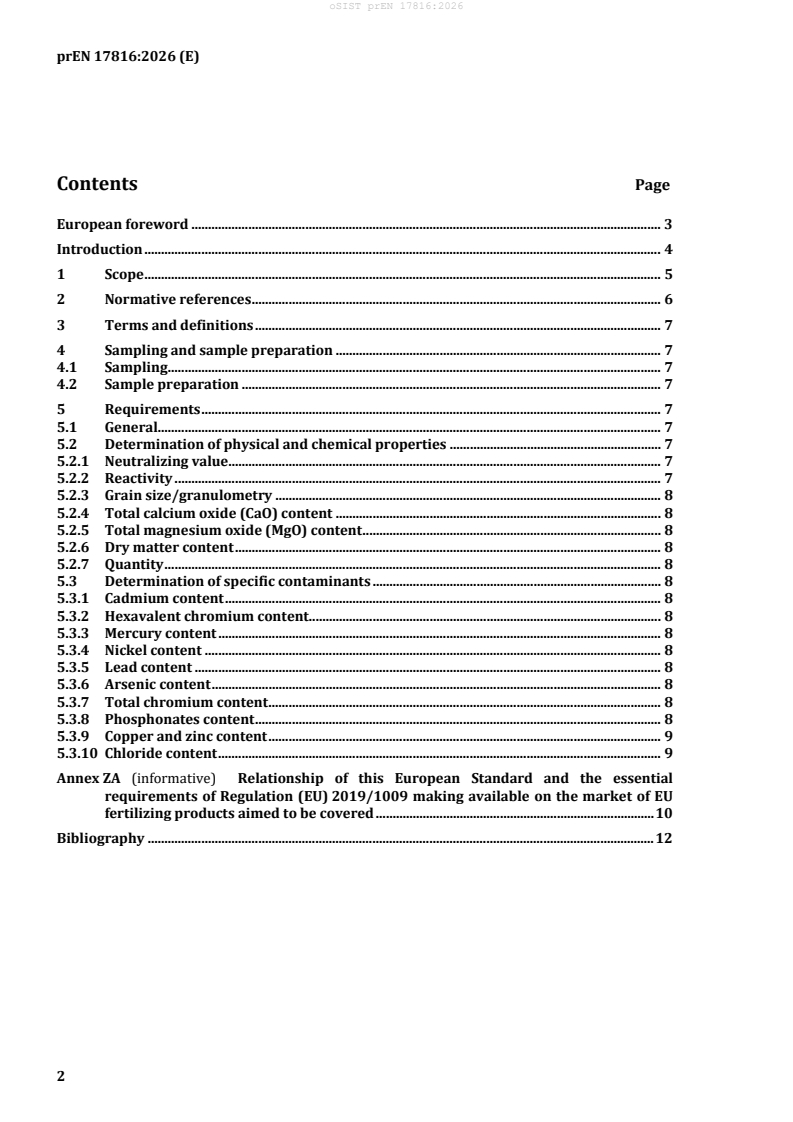
Contents
- Introduction
- 1 Scope
- 2 Normative references
- 3 Terms and definitions
- 4 Sampling and sample preparation
- 4.1 Sampling
- 4.2 Sample preparation
- 5 Requirements
- 5.1 General
- 5.2 Determination of physical and chemical properties
- 5.3 Determination of specific contaminants
- Annex ZA
- Bibliography
Introduction
Regulation (EU) 2019/1009 [6] lays down the rules on the making available on the market of EU fertilizing products and the specific safety, quality and labelling requirements for the defined product function categories (PFCs). Liming materials have been classified as PFC 2. In this document the normative references of the test methods to be used for liming materials (PFC 2) are defined in order to measure the compliance with the related requirement in Regulation (EU) 2019/1009 [6].
Supplementary denominations and specifications widely used in Europe are given in EN 14069 [5].
oSIST prEN 17816:2026 prEN 17816:2026 (E)
1 Scope
This document is applicable to liming materials, which contain oxides, hydroxides, carbonates or silicates of the nutrients calcium (Ca) or magnesium (Mg) and the function of which is to correct soil acidity. This document is applicable to the fertilizing products blends where a blend is a mix of at least two of the following components fertilizers, liming materials, soil improvers, growing media, inhibitors, plant biostimulants and where the following category liming materials is the highest % in the blend by mass or volume, or in the case of liquid form by dry mass. If liming materials is not the highest % in the blend, the European Standard for the highest % of the blend applies. In case a fertilizing product blend is composed of components in equal quantity, the user decides which standard to apply. Variations in analytical methods for fertilizing product blends can lead to differing results as some components or matrix interactions can affect the outcome. Validation procedures have shown that developed standard methods are robust and reliable across diverse product compositions, but possible interferences and unexpected results when analysing fertilizing product blends are possible. In case of chromium VI determination, in a fertilizing product blend containing organic matter, the European Standard for liming materials and inorganic fertilizers is not applicable. This document specifies references to the methods for the determination of the following physical and chemical properties and specific contaminants in liming materials:
- determination of the cadmium content;
- determination of the chromium VI content;
- determination of the mercury content;
- determination of the nickel content;
- determination of the lead content;
- determination of the arsenic content;
- determination of the total chromium content;
- determination of neutralizing value;
- determination of the reactivity;
- determination of the grain size/granulometry;
- determination of the total CaO content;
- determination of the total MgO content;
- determination of the dry matter content;
- determination of the copper and zinc content;
- determination of the phosphonates content.
- determination of the chloride content;
- determination of quantity (indicated by mass or volume).
oSIST prEN 17816:2026 prEN 17816:2026 (E)
2 Normative references
The following documents are referred to in the text in such a way that some or all of their content constitutes requirements of this document. For dated references, only the edition cited applies. For undated references, the latest edition of the referenced document (including any amendments) applies. EN 1482-2:2024, Fertilizers, liming materials and inhibitors — Sampling and sample preparation — Part 2:
...