

oSIST prEN 15634-9:2026
(Main)Foodstuffs - Detection of food allergens by molecular biological methods - Part 9: Fish - Qualitative detection of a specific DNA sequence in food by real-time PCR
General Information
- Abstract
This document specifies a method for the qualitative detection of fish DNA in food, of both animal and plant origin, using real-time PCR based on the Hoxc13 gene, in the context of allergen analyses.
This document does not apply to representatives of the genus of cartilaginous fish (Chondrichthyes), such as sharks or rays. It is also not applicable for differentiating between fish species.
The method was previously validated in an interlaboratory study (ring trial). The limit of detection of the fish real-time PCR has been determined experimentally to be at least 50 mg fish fresh weight/kg.
- Status
- Not Published
- Public Enquiry End Date
- 30-Mar-2026
- Technical Committee
- KŽP - Agricultural food products
- Current Stage
- 4020 - Public enquire (PE) (Adopted Project)
- Start Date
- 29-Jan-2026
- Due Date
- 18-Jun-2026
- Completion Date
- 07-Apr-2026

Overview
oSIST prEN 15634-9:2026: Foodstuffs - Detection of Food Allergens by Molecular Biological Methods - Part 9: Fish defines a standardized procedure for the qualitative detection of fish DNA in foods using real-time PCR. Published by CEN, this draft European Standard focuses on detecting fish-based allergens in foods of both animal and plant origin by targeting a specific DNA sequence (Hoxc13 gene). This approach is essential for compliance, food safety, and accurate allergen labeling.
Importantly, this standard is not applicable to cartilaginous fish (Chondrichthyes, such as sharks or rays) and is not designed for the differentiation between individual fish species. Its primary focus is supporting food allergen analysis, thereby protecting consumers with fish allergies.
Key Topics
Scope and Purpose
- Specifies a real-time PCR protocol for detecting fish DNA as part of food allergen analysis.
- Addresses food matrices of animal and plant origin.
- Not suitable for detecting cartilaginous fish DNA or distinguishing between fish species.
Analytical Approach
- DNA extraction method based on the CTAB technique.
- Real-time PCR targets the Hoxc13 gene sequence unique to bony fish.
- Fluorescent hydrolysis probes are used for qualitative detection.
Performance and Validation
- Experimentally determined limit of detection: at least 50 mg fish fresh weight per kg of food.
- Interlaboratory (ring trial) validation confirms method robustness and repeatability.
Quality Control
- Includes positive and negative controls, reagent controls, and extraction blanks to ensure validity.
- Results are interpreted as positive (fish DNA detected) or negative (not detected), with expected performance levels based on the ring trial.
Applications
oSIST prEN 15634-9:2026 is relevant for laboratories, regulators, and food manufacturers aiming to comply with allergen labeling regulations and ensure food safety:
Food Laboratories
- Supports traceability and identification of fish content in processed foods.
- Can be used to verify the presence or absence of fish allergens in both raw and processed products.
Food Industry and Manufacturers
- Aids in allergen risk assessment and labeling, particularly for production lines processing fish or fish-derived ingredients.
- Ensures compliance with European food allergen regulations, safeguarding allergic consumers.
Regulators and Inspectors
- Provides a harmonized, validated method for official control of foodstuffs.
- Facilitates enforcement of allergen labeling laws and consumer protection regulations.
Allergen Management
- Useful for verifying cleaning efficiency and cross-contamination controls in facilities handling fish.
- Applicable for quality assurance in product development and supply chain verification.
Related Standards
Organizations and laboratories utilizing oSIST prEN 15634-9:2026 might also reference the following related European and international standards:
- EN 15634-1: Foodstuffs - Detection of food allergens by molecular biological methods - Part 1: General considerations
- EN 15842: Foodstuffs - Detection of food allergens - General considerations and validation of methods
- EN ISO 21571: Foodstuffs - Methods for detection of genetically modified organisms and derived products - Nucleic acid extraction
These standards provide broader context for molecular allergen detection, validation procedures, and general requirements for food allergen analysis.
Adopting oSIST prEN 15634-9:2026 enables laboratories and food businesses to consistently apply a robust, harmonized method for detecting fish allergens, supporting consumer safety and regulatory compliance throughout the food chain. Use of this standard contributes to accurate allergen labeling, reduces allergen-related risk, and enhances trust in food products containing or processed with fish.
Get Certified
Connect with accredited certification bodies for this standard

BSI Group
BSI (British Standards Institution) is the business standards company that helps organizations make excellence a habit.

Bureau Veritas
Bureau Veritas is a world leader in laboratory testing, inspection and certification services.

DNV
DNV is an independent assurance and risk management provider.
Sponsored listings
Frequently Asked Questions
oSIST prEN 15634-9:2026 is a draft published by the Slovenian Institute for Standardization (SIST). Its full title is "Foodstuffs - Detection of food allergens by molecular biological methods - Part 9: Fish - Qualitative detection of a specific DNA sequence in food by real-time PCR". This standard covers: This document specifies a method for the qualitative detection of fish DNA in food, of both animal and plant origin, using real-time PCR based on the Hoxc13 gene, in the context of allergen analyses. This document does not apply to representatives of the genus of cartilaginous fish (Chondrichthyes), such as sharks or rays. It is also not applicable for differentiating between fish species. The method was previously validated in an interlaboratory study (ring trial). The limit of detection of the fish real-time PCR has been determined experimentally to be at least 50 mg fish fresh weight/kg.
This document specifies a method for the qualitative detection of fish DNA in food, of both animal and plant origin, using real-time PCR based on the Hoxc13 gene, in the context of allergen analyses. This document does not apply to representatives of the genus of cartilaginous fish (Chondrichthyes), such as sharks or rays. It is also not applicable for differentiating between fish species. The method was previously validated in an interlaboratory study (ring trial). The limit of detection of the fish real-time PCR has been determined experimentally to be at least 50 mg fish fresh weight/kg.
oSIST prEN 15634-9:2026 is classified under the following ICS (International Classification for Standards) categories: 07.100.30 - Food microbiology; 67.120.30 - Fish and fishery products. The ICS classification helps identify the subject area and facilitates finding related standards.
oSIST prEN 15634-9:2026 is available in PDF format for immediate download after purchase. The document can be added to your cart and obtained through the secure checkout process. Digital delivery ensures instant access to the complete standard document.
Standards Content (Sample)
SLOVENSKI STANDARD
01-marec-2026
Živila - Določevanje alergenov v živilih z molekularno biološkimi metodami - 9. del:
Ribe - Kvalitativno določanje specifičnega zaporedja DNK v živilih s PCR v
realnem času
Foodstuffs - Detection of food allergens by molecular biological methods - Part 9: Fish -
Qualitative detection of a specific DNA sequence in food by real-time PCR
Lebensmittel - Nachweis von Lebensmittelallergenen mit molekularbiologischen
Verfahren - Teil 9: Fisch - Qualitativer Nachweis einer spezifischen DNA-Sequenz in
Lebensmitteln mittels Real-time PCR
Produits alimentaires - Détection des allergènes alimentaires par des méthodes
d’analyse de biologie moléculaire - Partie 9 : Poisson - Détection qualitative d’une
séquence d’ADN spécifique dans des produits alimentaires, par PCR en temps réel
Ta slovenski standard je istoveten z: prEN 15634-9
ICS:
07.100.30 Mikrobiologija živil Food microbiology
67.120.30 Ribe in ribji proizvodi Fish and fishery products
2003-01.Slovenski inštitut za standardizacijo. Razmnoževanje celote ali delov tega standarda ni dovoljeno.
DRAFT
EUROPEAN STANDARD
NORME EUROPÉENNE
EUROPÄISCHE NORM
January 2026
ICS 07.100.30; 67.120.30
English Version
Foodstuffs - Detection of food allergens by molecular
biological methods - Part 9: Fish - Qualitative detection of a
specific DNA sequence in food by real-time PCR
Produits alimentaires - Détection des allergènes Lebensmittel - Nachweis von Lebensmittelallergenen
alimentaires par des méthodes d'analyse de biologie mit molekularbiologischen Verfahren - Teil 9: Fisch -
moléculaire - Partie 9 : Poisson - Détection qualitative Qualitativer Nachweis einer spezifischen DNA-Sequenz
d'une séquence d'ADN spécifique dans des produits in Lebensmitteln mittels Real-time PCR
alimentaires, par PCR en temps réel
This draft European Standard is submitted to CEN members for enquiry. It has been drawn up by the Technical Committee
CEN/TC 275.
If this draft becomes a European Standard, CEN members are bound to comply with the CEN/CENELEC Internal Regulations
which stipulate the conditions for giving this European Standard the status of a national standard without any alteration.
This draft European Standard was established by CEN in three official versions (English, French, German). A version in any other
language made by translation under the responsibility of a CEN member into its own language and notified to the CEN-CENELEC
Management Centre has the same status as the official versions.
CEN members are the national standards bodies of Austria, Belgium, Bulgaria, Croatia, Cyprus, Czech Republic, Denmark, Estonia,
Finland, France, Germany, Greece, Hungary, Iceland, Ireland, Italy, Latvia, Lithuania, Luxembourg, Malta, Netherlands, Norway,
Poland, Portugal, Republic of North Macedonia, Romania, Serbia, Slovakia, Slovenia, Spain, Sweden, Switzerland, Türkiye and
United Kingdom.
Recipients of this draft are invited to submit, with their comments, notification of any relevant patent rights of which they are
aware and to provide supporting documentation.
Warning : This document is not a European Standard. It is distributed for review and comments. It is subject to change without
notice and shall not be referred to as a European Standard.
EUROPEAN COMMITTEE FOR STANDARDIZATION
COMITÉ EUROPÉEN DE NORMALISATION
EUROPÄISCHES KOMITEE FÜR NORMUNG
CEN-CENELEC Management Centre: Rue de la Science 23, B-1040 Brussels
© 2026 CEN All rights of exploitation in any form and by any means reserved Ref. No. prEN 15634-9:2026 E
worldwide for CEN national Members.
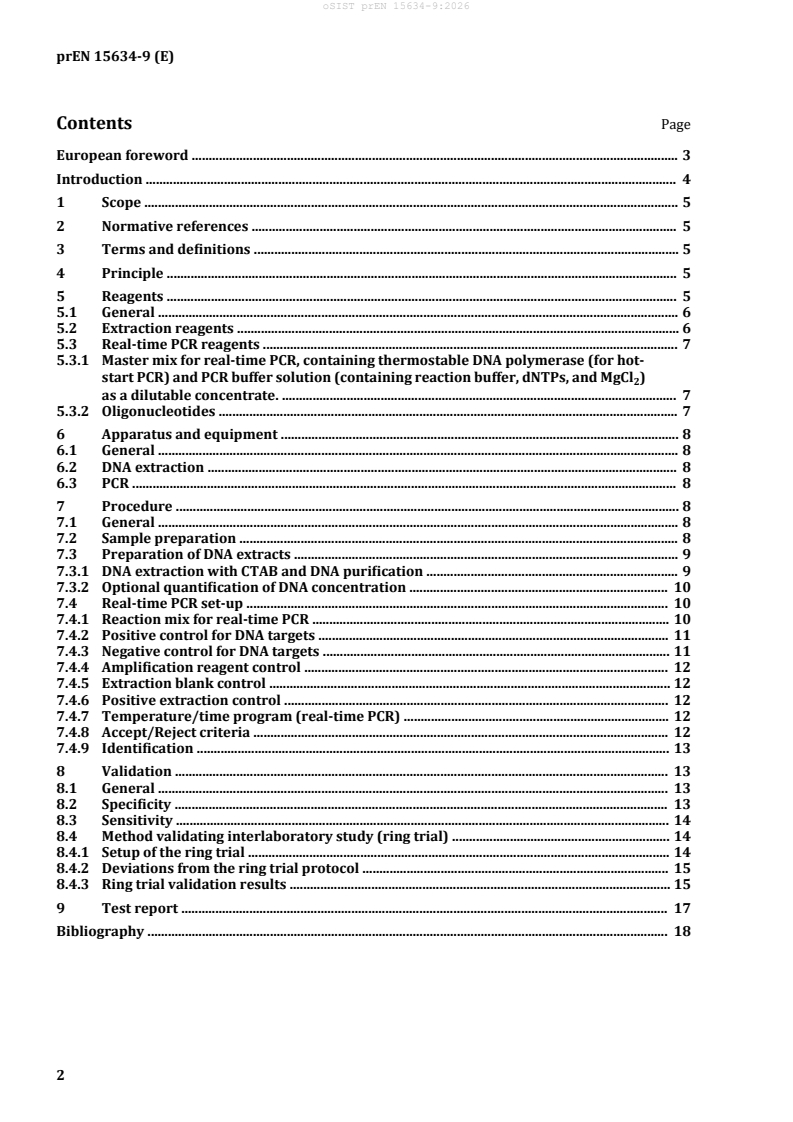
Contents Page
European foreword . 3
Introduction . 4
1 Scope . 5
2 Normative references . 5
3 Terms and definitions . 5
4 Principle . 5
5 Reagents . 5
5.1 General . 6
5.2 Extraction reagents . 6
5.3 Real-time PCR reagents . 7
5.3.1 Master mix for real-time PCR, containing thermostable DNA polymerase (for hot-
start PCR) and PCR buffer solution (containing reaction buffer, dNTPs, and MgCl )
as a dilutable concentrate. . 7
5.3.2 Oligonucleotides . 7
6 Apparatus and equipment . 8
6.1 General . 8
6.2 DNA extraction . 8
6.3 PCR . 8
7 Procedure . 8
7.1 General . 8
7.2 Sample preparation . 8
7.3 Preparation of DNA extracts . 9
7.3.1 DNA extraction with CTAB and DNA purification . 9
7.3.2 Optional quantification of DNA concentration . 10
7.4 Real-time PCR set-up . 10
7.4.1 Reaction mix for real-time PCR . 10
7.4.2 Positive control for DNA targets . 11
7.4.3 Negative control for DNA targets . 11
7.4.4 Amplification reagent control . 12
7.4.5 Extraction blank control . 12
7.4.6 Positive extraction control . 12
7.4.7 Temperature/time program (real-time PCR) . 12
7.4.8 Accept/Reject criteria . 12
7.4.9 Identification . 13
8 Validation . 13
8.1 General . 13
8.2 Specificity . 13
8.3 Sensitivity . 14
8.4 Method validating interlaboratory study (ring trial) . 14
8.4.1 Setup of the ring trial . 14
8.4.2 Deviations from the ring trial protocol . 15
8.4.3 Ring trial validation results . 15
9 Test report . 17
Bibliography . 18
European foreword
This document (prEN 15634-9:2026) has been prepared by Technical Committee CEN/TC "", the
secretariat of which is held by .
This document is currently submitted to the CEN Enquiry.
Introduction
For the use of this document the term:
— ‘shall’ indicates a requirement;
— ‘should’ indicates a recommendation;
— ‘may’ indicates a permission; and
— ‘can’ indicates a possibility and/or a capability.
1 Scope
This document specifies a method for the qualitative detection of fish DNA in food, of both animal and
plant origin, using real-time PCR based on the Hoxc13 gene, in the context of allergen analyses.
This document does not apply to representatives of the genus of cartilaginous fish (Chondrichthyes),
such as sharks or rays. It is also not applicable for differentiating between fish species.
The method was previously validated in an interlaboratory study (ring trial). The limit of detection of
the fish real-time PCR has been determined experimentally to be at least 50 mg fish fresh weight/kg.
2 Normative references
The following documents are referred to in the text in such a way that some or all of their content
constitutes requirements of this document. For dated references, only the edition cited applies. For
undated references, the latest edition of the referenced document (including any amendments) applies.
EN 15634-1, Foodstuffs - Detection of food allergens by molecular biological methods - Part 1: General
considerations
EN 15842, Foodstuffs - Detection of food allergens - General considerations and validation of methods
3 Terms and definitions
For the purposes of this document, the terms and definitions given in EN 15634-1andEN 15842 the
following apply.
ISO and IEC maintain terminology databases for use in standardization at the following addresses:
— ISO Online browsing platform: available at http://www.iso.org/obp
— IEC Electropedia: available at http://www.electropedia.org/
4 Principle
Total DNA is extracted from the sample using a cetyltrimethylammonium bromide (CTAB) method EN
ISO 21571 [1]. In general, CTAB functions as a cationic surfactant, leading to the formation of complexes
with DNA which are precipitated in the presence of low salt concentration leaving other impurities in
solution.
In short, potential PCR inhibitors are removed from the DNA extract through chloroform extraction and
subsequent CTAB precipitation, followed by an alcoholic precipitation of the DNA. The DNA precipitate
is washed, dissolved in buffer solution and the DNA content can be measured. From the extracted sample
DNA, a fish-specific DNA sequence from the Hoxc 13 gene (genomic DNA) is amplified using real-time
PCR. The amplicons have lengths of 112 base pairs (bp) for guppy “Poecilia reticulata” (GenBank :
XM_008413716) to 119 bp for northern pike “Esox lucius” (XM_010875284). The real-time PCR method
involves fluorescence detection with a sequence-specific hydrolysis probe [2].
5 Reagents
NCBI-GenBank® is an example of a suitable search tool for free use. This information is given for the
convenience of users of this document and does not constitute an endorsement by CEN.
5.1 General
The following general conditions for analysis should be followed, unless specified otherwise. Use only
analytical-grade reagents suitable for molecular biology. All water shall be free from DNA and nucleases,
e.g. double distilled or equivalent (molecular grade). Solutions shall be prepared by dissolving the
relevant reagents in water and autoclaving, unless otherwise specified.
5.2 Extraction reagents
5.2.1 Chloroform.
5.2.2 Ethanol, volume fraction φ = 70 %.
5.2.3 Ethylenediaminetetraacetic acid disodium salt (Na EDTA).
5.2.4 Cetyltrimethylammonium bromide (CTAB).
5.2.5 Hydrochloric acid, mass fraction w = 37 %.
5.2.6 Isopropyl alcohol.
5.2.7 Proteinase K.
5.2.8 RNase A.
5.2.9 α-Amylase (>1 500 U/mg protein).
5.2.10 Sodium chloride.
5.2.11 Sodium hydroxide solution.
5.2.12 Tris(hydroxymethyl)aminomethane (TRIS).
5.2.13 Tris(hydroxymethyl)-aminomethane hydrochloride (Tris-HCl).
5.2.14 CTAB extraction buffer solution, containing:
— CTAB (5.2.4), mass concentration ρ = 20 g/l;
— sodium chloride (5.2.10), molar concentration c = 1,4 mol/l;
— TRIS (5.2.12), c = 0,1 mol/l;
— Na EDTA (5.2.3), c = 0,02 mol/l.
The pH is adjusted to 8,0 by adding hydrochloric acid (5.2.5).
5.2.15 Proteinase K solution, ρ = 20 mg/ml.
The freshly produced Proteinase K solution should be stored in the form of aliquots at −20 °C.
5.2.16 Amylase solution, ρ = 10 mg/ml.
Weigh 100 mg of α-amylase (5.2.9) into a sterile glass container and add 10 ml of double distilled, sterile
water.
The solution should be kept refrigerated after preparation until analysis. Frozen storage is possible,
whereby repeated freezing and thawing should be avoided.
Any sediment in the solution has no negative influence on the test.
5.2.17 Solution buffer for RNase A, containing:
— Tris-HCl (5.2.13) (c = 0,01 mol/l),
— sodium chloride (5.2.10) (c = 0,015 mol/l)
The pH is adjusted to 7,5 with hydrochloric acid (5.2.5) or sodium hydroxide solution (5.2.11).
5.2.18 RNase A solution, ρ = 10 mg/ml.
Weigh 100 mg RNase A (5.2.8) into a sterile glass jar and add 10 ml RNase A solution buffer (5.2.17).
Heat for 15 min to 100 °C and cool slowly to room temperature.
The aliquoted solution can be stored frozen at -20 °C for at least 12 months.
5.2.19 CTAB precipitation buffer solution, containing:
— CTAB (5.2.4) (ρ = 5 g/l);
— sodium chloride (5.2.10) (c = 0,04 mol/l).
5.2.20 Sodium chloride solution, c = 1,2 mol/l.
5.2.21 0,2 × TE buffer solution, containing:
— TRIS (5.2.12), c = 0,002 mol/l;
— Na EDTA (5.2.3), c = 0,000 2 mol/l.
The pH is adjusted to 8,0 by adding hydrochloric acid (5.2.5) or sodium hydroxide solution (5.2.11).
NOTE For all solutions commercially available alternatives can be used.
5.3 Real-time PCR reagents
5.3.1 Master mix for real-time PCR, containing thermostable DNA polymerase (for hot-start
PCR) and PCR buffer solution (containing reaction buffer, dNTPs, and MgCl ) as a dilutable
concentrate.
Ready to use reagents or single components may be used as a master mix.
5.3.2 Oligonucleotides
The oligonucleotides are shown in Table 1.
Table 1 — Primers and probes for the real-time PCR
Name DNA sequence of the oligonucleotide
CTfish fwd1 5´ – TTC gCT ggT TCT gCA TCC A – 3´
CTfish fwd7 5´ – TTC gCT ggT CCT gCA TCC A – 3´
CTfish rev4 5´ – CAg ggC AAT TCC CgC TCA AT – 3´
CTfish rev6 5´ – ATT ACC gCT CAg TCC CTC CAT – 3´
CTfish rev7 5´ – ATT CCC gCT TAg TCC CTC CAT – 3´
5´ – FAM – ACA CCT TgA TgT ACg TTT ATg AAA AAA gCC
CTfish1 TMP
a
CgA – BHQ1 – 3′
a FAM: 6-carboxyfluorescein; BHQ1: black hole quencher 1
Equivalent reporter dyes and/or quencher dyes may be used.
6 Apparatus and equipment
6.1 General
In addition to the typical laboratory facilities, the following equipment shall be used.
Due to the high sensitivity of PCR analytics and the risk for DNA contaminations, the use of aerosol-
protected filter tips in the DNA extraction procedure is mandatory. Plastic and glass materials shall be
sterilized and free of DNA before use.
Further general requirements are given in EN ISO 21571 [1].
6.2 DNA extraction
6.2.1 Suitable reaction vials, 1,5 ml and 2 ml, DNA-free.
6.2.2 50 ml centrifuge tubes, sterile.
6.2.3 Thermostat or water bath, preferably with shaker function.
6.2.4 Centrifuge, suitable for centrifuging 50 ml centrifuge tubes at 6 000 g
6.2.5 If no centrifuge with a correspondingly high g-force is available, it is also possible to centrifuge
at a speed of about 4 000 g for a correspondingly extended time until a supernatant is obtained.
6.2.6 Centrifuge, suitable for centrifuging 1,5 ml and 2 ml reaction vials at 14 500 g.
6.2.7 Equipment and/or material for grinding the sample, e.g. blender or mill.
6.2.8 Equipment for DNA quantity estimation (optional), e.g. UV-photometer.
6.2.9 Vacuum dryer (optional).
6.2.10 Mechanical quick shaker, e.g. vortex mixer.
6.3 PCR
6.3.1 Suitable PCR tubes.
6.3.2 Microcentrifuge for PCR tubes.
6.3.3 Real-time PCR equipment, suitable for excitation and for emission measurement of
fluorescence-labeled oligonucleotides.
7 Procedure
7.1 General
General aspects are described in EN 15634-1 [3] and EN ISO 21571 [1].
7.2 Sample preparation
It should be ensured that the test sample taken after milling or homogenizing is representative of the
laboratory sample.
2 –2
g = 9,81 m⋅s
7.3 Preparation of DNA extracts
7.3.1 DNA extraction with CTAB and DNA purification
The sample DNA analysed in the ring trial were obtained using the DNA extraction method described
below.
The use of a commercially available kit is acceptable in place of the DNA extraction procedure described
below, provided it yields comparable or better results.
In parallel to the test samples, the controls listed in 7.4.5 and 7.4.6 should be performed adequately.
— Weigh 2 g of the homogenized sample into a 50 ml centrifuge tube (tube A).
— Add 10 ml of CTAB extraction buffer solution (5.2.14) and 20 μl of amylase solution (5.2.16).
Suspend well by rotating the centrifuge tube around the longitudinal axis. Incubate for 30 min at
65 °C while stirring or gently shaking; alternatively, use a hybridization oven.
— Add 20 µl of Proteinase K solution (5.2.15) and mix.
— Incubate and shake for 90 min at 65 °C.
— Centrifuge for 10 min at 6 000 g at room temperature.
— Place 900 µl of chloroform (5.2.1) in a 2 ml reaction vial (tube B).
— Add 900 µl of supernatant from tube A to tube B and mix thoroughly for 30 s.
— Centrifuge for 10 min at about 14 500 g at room temperature, to separate phases.
— The interphase should be as small as possible, if necessary, mix briefly again and centrifuge for
another 20 min.
— Add 600-650 µl of supernatant from tube B to a new 2 ml reaction vial (tube C).
— Add 2 parts by volume of CTAB precipitation buffer solution (5.2.19) and mix.
— Incubate for 60 min at room temperature.
— Centrifuge for 10 min at about 14 500 g at room temperature.
— Carefully remove and discard the supernatant.
— Incubate the precipitate in 900 μl sodium chloride solution (5.2.20) for at least 30 min at 37 °C
while gently shaking to dissolve the pellet.
— Add 10 μl RNase A solution (5.2.18) and incubate for 10 min at 37 °C.
— Add 900 μl chloroform and mix for 30 s (vortex mixer).
— Centrifuge for 10 min at 14 500 g at room temperature.
— Add the supernatant (the upper, aqueous phase, approx. 800 µl) from tube C to a new 1,5 ml reaction
vial (tube D).
— Add 0,6 parts by volume (approx. 480 μl) of isopropyl alcohol (5.2.6) and mix carefully by turning
upside down several times.
— Incubate at room temperature for at least 20 min (if necessary, overnight).
— Centrifuge for 10 min at 14 500 g at room temperature.
— Carefully remove and discard the supernatant.
— Wash pellet with 500 μl ethanol (70 %) (5.2.2).
— Centrifuge for 10 min at 14 500 g at room temperature.
— Carefully pour off the supernatant completely and discard it.
— Dry extracted DNA at room temperature or u
...