

SIST EN 4056-004:2015
(Main)Aerospace series - Cable ties for harnesses - Part 004: Plastic cable ties - For operating temperatures - 55 °C to 105 °C and - 55 °C to 150 °C - Product standard
General Information
- Abstract
This European Standard defines the characteristics of cable ties with either internal or external serrations manufactured entirely from plastics material, for installation under controlled tension on aircraft cable harnesses. It shall be used together with EN 4056-001.
- Status
- Published
- Publication Date
- 02-Feb-2015
- Technical Committee
- I13 - Imaginarni 13
- Current Stage
- 6060 - National Implementation/Publication (Adopted Project)
- Start Date
- 12-Jan-2015
- Due Date
- 19-Mar-2015
- Completion Date
- 03-Feb-2015

Overview
SIST EN 4056-004:2015 is a European standard published by CEN that specifies the product requirements for plastic cable ties used in aerospace harnesses. These cable ties are designed for controlled tension installation on aircraft cable bundles and operate reliably within temperature ranges from -55 °C up to 105 °C or 150 °C. EN 4056-004 is part of the Aerospace series standards for cable ties and complements EN 4056-001, which covers technical specifications. This standard ensures uniformity, safety, and performance of cable ties critical in aerospace electrical systems and wiring harnesses.
Key Topics
Scope & Application
Defines cable ties manufactured entirely from plastic materials featuring either internal or external serrations. Intended for use in aircraft cable harnesses under controlled tension to secure wiring bundles efficiently.Temperature Ratings & Material Properties
Cable ties covered under this standard operate within these temperature classes:- Code E: -55 °C to 105 °C (Non-UV resistant)
- Code F: -55 °C to 105 °C (UV resistant)
- Code G: -55 °C to 150 °C (Non-UV resistant)
Dimensions and Mechanical Strength
Detailed dimensions and loop tensile strength requirements are specified for various size codes (P to W). Mechanical properties ensure ties hold securely under expected operating stresses.Flammability and Safety
Cable ties conform to strict flammability classes (Class 1 and Class 2). The materials must meet burning behavior tests (EN 2825 and EN 2826), ensuring limited smoke density and low toxic gas emissions during combustion, critical for aerospace safety.Testing and Quality Assurance
Includes visual inspections, tensile strength tests, heat aging, UV resistance, fluid resistance, low-temperature installation, and vibration endurance. Quality control aligns with EN 4056-001 to guarantee product reliability for aerospace use.Variant Codes
Two variants based on serration type:- A: External serrations
- B: Internal serrations (with reinforced strap edges)
Application Tools
Installation requires specialized tensioning tools complying with MS 90387 and EN 4057-407 to ensure correct tension application without exceeding force limits.
Applications
Aerospace Electrical Harnesses
Essential for bundling and securing electrical cables in aircraft, ensuring organized routing and mechanical protection.High-Temperature Environments
Suitable for use in cabin, engine compartments, and avionics bays exposed to temperature extremes.UV and Chemical Exposure Conditions
UV resistant variants optimize tie durability for exposed areas, while fluid resistance supports application near hydraulic and fuel lines.Safety-Critical Installations
Flammability and toxicity requirements minimize risks in fire scenarios, making these cable ties compliant with stringent aerospace safety standards.
Related Standards
EN 4056-001
Technical specifications for aerospace cable ties, meant to be used alongside EN 4056-004.EN 4056-002
Product index providing color codes and material codes for cable ties.EN 4057 (Test Methods Series)
Comprehensive testing methods for cable ties, including tensile strength, UV resistance, and application tool verification.EN 2825 & EN 2826
Standards governing burning behavior and smoke toxicity assessment of non-metallic materials used in aerospace, relevant for fire safety compliance.MS 90387
Military specification for hand tools used to apply plastic and metal tie-down straps.
Summary
SIST EN 4056-004:2015 provides a detailed framework for plastic cable ties used in aerospace harnessing applications, emphasizing mechanical strength, thermal endurance, and fire safety properties. The standard enables manufacturers and aerospace engineers to select and use cable ties that ensure secure electrical bundle management while meeting rigorous performance and safety criteria critical to aircraft reliability. Compliance with this European Standard supports harmonized practices across the aerospace industry and enhances the safety and durability of electrical installations in aircraft environments.
Relations
- Effective Date
- 28-Jan-2026
- Effective Date
- 28-Jan-2026
- Effective Date
- 28-Jan-2026
- Effective Date
- 28-Jan-2026
- Effective Date
- 28-Jan-2026
- Effective Date
- 28-Jan-2026
- Effective Date
- 28-Jan-2026
- Effective Date
- 28-Jan-2026
- Effective Date
- 28-Jan-2026
- Effective Date
- 28-Jan-2026
- Effective Date
- 28-Jan-2026
- Effective Date
- 28-Jan-2026
- Effective Date
- 28-Jan-2026
- Effective Date
- 28-Jan-2026
- Effective Date
- 28-Jan-2026
Get Certified
Connect with accredited certification bodies for this standard

BUREAU VERITAS Certification Germany
Bureau Veritas certification in Germany.

Element Materials Technology
Materials testing and product certification.

AQMS Ltd.
AQMS provides ISO certification to SMEs across the UK.
Sponsored listings
Frequently Asked Questions
SIST EN 4056-004:2015 is a standard published by the Slovenian Institute for Standardization (SIST). Its full title is "Aerospace series - Cable ties for harnesses - Part 004: Plastic cable ties - For operating temperatures - 55 °C to 105 °C and - 55 °C to 150 °C - Product standard". This standard covers: This European Standard defines the characteristics of cable ties with either internal or external serrations manufactured entirely from plastics material, for installation under controlled tension on aircraft cable harnesses. It shall be used together with EN 4056-001.
This European Standard defines the characteristics of cable ties with either internal or external serrations manufactured entirely from plastics material, for installation under controlled tension on aircraft cable harnesses. It shall be used together with EN 4056-001.
SIST EN 4056-004:2015 is classified under the following ICS (International Classification for Standards) categories: 49.060 - Aerospace electric equipment and systems. The ICS classification helps identify the subject area and facilitates finding related standards.
SIST EN 4056-004:2015 has the following relationships with other standards: It is inter standard links to SIST EN 4057-202:2006, SIST EN 4057-304:2009, SIST EN 4057-305:2006, SIST EN 2826:2011, SIST EN 4057-303:2006, SIST EN 4056-001:2015, SIST EN 4057-407:2006, SIST EN 4057-201:2006, SIST EN 4057-402:2014, SIST EN 4057-401:2009, SIST EN 4057-406:2009, SIST EN 2825:2011, SIST EN 4057-301:2006, SIST EN 4056-002:2014, SIST EN 4057-100:2009. Understanding these relationships helps ensure you are using the most current and applicable version of the standard.
SIST EN 4056-004:2015 is available in PDF format for immediate download after purchase. The document can be added to your cart and obtained through the secure checkout process. Digital delivery ensures instant access to the complete standard document.
Standards Content (Sample)
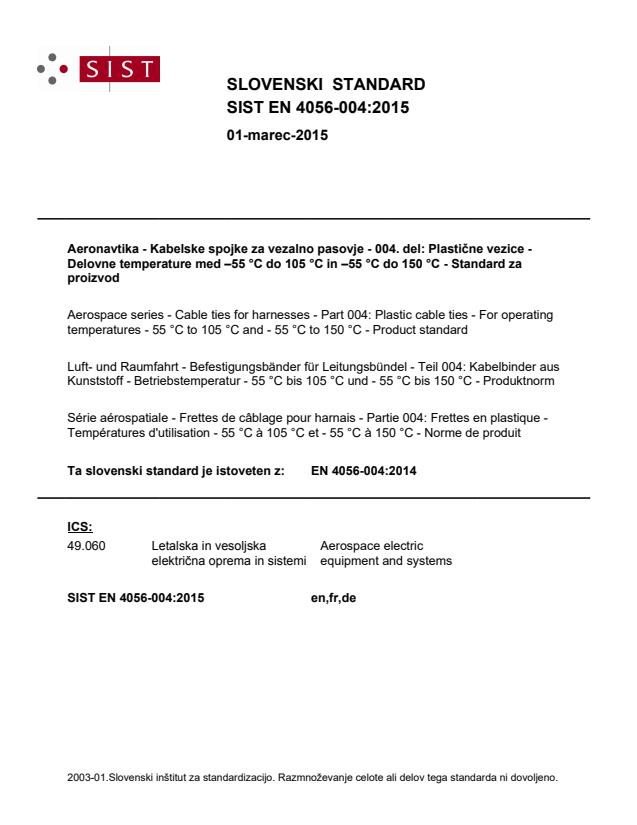
2003-01.Slovenski inštitut za standardizacijo. Razmnoževanje celote ali delov tega standarda ni dovoljeno.SURL]YRGLuft- und Raumfahrt - Befestigungsbänder für Leitungsbündel - Teil 004: Kabelbinder aus Kunststoff - Betriebstemperatur - 55 °C bis 105 °C und - 55 °C bis 150 °C - ProduktnormSérie aérospatiale - Frettes de câblage pour harnais - Partie 004: Frettes en plastique - Températures d'utilisation - 55 °C à 105 °C et - 55 °C à 150 °C - Norme de produitAerospace series - Cable ties for harnesses - Part 004: Plastic cable ties - For operating temperatures - 55 °C to 105 °C and - 55 °C to 150 °C - Product standard49.060Aerospace electric equipment and systemsICS:Ta slovenski standard je istoveten z:EN 4056-004:2014SIST EN 4056-004:2015en,fr,de01-marec-2015SIST EN 4056-004:2015SLOVENSKI
STANDARD
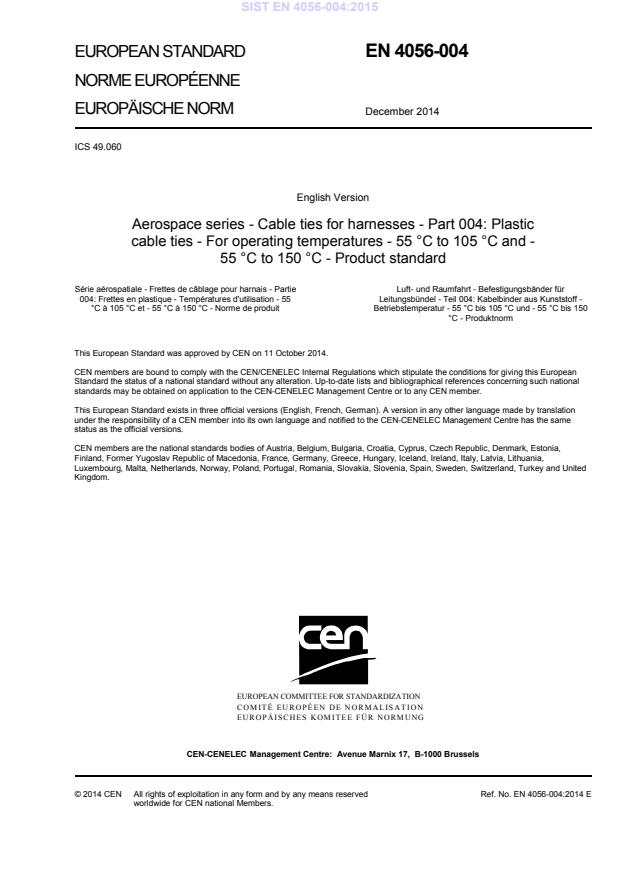
EUROPEAN STANDARD NORME EUROPÉENNE EUROPÄISCHE NORM
EN 4056-004
December 2014 ICS 49.060 English Version
Aerospace series - Cable ties for harnesses - Part 004: Plastic cable ties - For operating temperatures - 55 °C to 105 °C and - 55 °C to 150 °C - Product standard
Série aérospatiale - Frettes de câblage pour harnais - Partie 004: Frettes en plastique - Températures d'utilisation - 55 °C à 105 °C et - 55 °C à 150 °C - Norme de produit
Luft- und Raumfahrt - Befestigungsbänder für Leitungsbündel - Teil 004: Kabelbinder aus Kunststoff - Betriebstemperatur - 55 °C bis 105 °C und - 55 °C bis 150 °C - Produktnorm This European Standard was approved by CEN on 11 October 2014.
CEN members are bound to comply with the CEN/CENELEC Internal Regulations which stipulate the conditions for giving this European Standard the status of a national standard without any alteration. Up-to-date lists and bibliographical references concerning such national standards may be obtained on application to the CEN-CENELEC Management Centre or to any CEN member.
This European Standard exists in three official versions (English, French, German). A version in any other language made by translation under the responsibility of a CEN member into its own language and notified to the CEN-CENELEC Management Centre has the same status as the official versions.
CEN members are the national standards bodies of Austria, Belgium, Bulgaria, Croatia, Cyprus, Czech Republic, Denmark, Estonia, Finland, Former Yugoslav Republic of Macedonia, France, Germany, Greece, Hungary, Iceland, Ireland, Italy, Latvia, Lithuania, Luxembourg, Malta, Netherlands, Norway, Poland, Portugal, Romania, Slovakia, Slovenia, Spain, Sweden, Switzerland, Turkey and United Kingdom.
EUROPEAN COMMITTEE FOR STANDARDIZATION
COMITÉ EUROPÉEN DE NORMALISATION EUROPÄISCHES KOMITEE FÜR NORMUNG
CEN-CENELEC Management Centre:
Avenue Marnix 17,
B-1000 Brussels © 2014 CEN All rights of exploitation in any form and by any means reserved worldwide for CEN national Members. Ref. No. EN 4056-004:2014 ESIST EN 4056-004:2015
...