

SIST EN 17131-2:2025
(Main)Textiles and textile products - Determination of certain residual solvents - Part 2: Determination of benzene, method using headspace gas chromatography
General Information
- Abstract
This document specifies a method using headspace gas chromatography and mass selective spectroscopy (HS-GC-MS) for detection and quantification of benzene in components of textile products.
- Status
- Published
- Public Enquiry End Date
- 31-Jan-2024
- Publication Date
- 08-Apr-2025
- Technical Committee
- ITEK - Textile and textile products
- Current Stage
- 6060 - National Implementation/Publication (Adopted Project)
- Start Date
- 08-Apr-2025
- Due Date
- 13-Jun-2025
- Completion Date
- 09-Apr-2025

Overview
SIST EN 17131-2:2025 is a European Standard developed by CEN that specifies a laboratory method for the detection and quantification of benzene in textile materials and textile products. Utilizing headspace gas chromatography coupled with mass selective spectroscopy (HS-GC-MS), this standard enables precise measurement of residual benzene, a regulated volatile organic compound, in textile components. This standard plays a crucial role in ensuring compliance with European chemical safety regulations, including the REACH Regulation, especially for items that may come into direct contact with human skin.
Key Topics
- Benzene Quantification: The standard details processes for quantifying benzene residues in textiles, which are restricted under REACH due to benzene’s toxic and carcinogenic properties.
- HS-GC-MS Methodology: SIST EN 17131-2:2025 uses headspace gas chromatography-mass spectrometry, a sensitive and selective analytical technique for volatile organic compound detection.
- Preparation and Calibration: Guidance is provided on sample collection, preparation, and the use of calibration and internal standard solutions to ensure reliable and reproducible results.
- Test Reporting: Requirements for documenting the procedure, results, and any deviations or special observations are specified to support traceability and regulatory compliance.
- Limit of Quantification: The standard’s method achieves limits of quantification (LOQ) of 1 mg/kg or lower, allowing for detection at levels relevant to regulatory thresholds.
Applications
SIST EN 17131-2:2025 is applicable to a wide range of textiles and textile products for which the determination of residual benzene is essential for:
- Manufacturers of clothing, home textiles, and footwear who must comply with European safety thresholds (e.g., no more than 5 mg/kg benzene for products in direct skin contact as per REACH).
- Testing laboratories conducting safety and quality assurance, ensuring imported or manufactured textile products meet EU chemical safety requirements.
- Regulatory bodies and market surveillance authorities tasked with enforcement of chemical restrictions in consumer products.
- Stakeholders throughout the textile supply chain that require standardized, reproducible testing methods for internal audits or certification.
- Consumers and retailers seeking confidence that products are safe and compliant with international standards.
This standard is invaluable for mitigating risks associated with residual solvents in textiles, supporting both product safety and regulatory compliance.
Related Standards
Organizations involved with compliance or product testing in relation to SIST EN 17131-2:2025 may also need to reference or align with:
- EN 17131-1: Textiles and textile products – Determination of certain residual solvents – Part 1: Determination of aprotic solvents, method using gas chromatography.
- EN ISO 4787: Laboratory glass and plastic ware – Volumetric instruments – Methods for testing of capacity and for use.
- REACH Regulation (EC No 1907/2006): European Union regulation on Registration, Evaluation, Authorisation and Restriction of Chemicals, specifically addressing restrictions on benzene residues in consumer products.
- Regulation (EU) 2016/425 (PPE) and 2017/745 (Medical Devices): Exclusions and further definitions for regulated textile applications.
SIST EN 17131-2:2025 is an essential resource for laboratories, manufacturers, and regulatory professionals ensuring the safety of textiles and textile products in the European market. By implementing this standard, organizations demonstrate their commitment to high safety standards and regulatory compliance regarding residual benzene in textiles.
Relations
- Effective Date
- 28-Jan-2026
- Effective Date
- 15-Feb-2023
Get Certified
Connect with accredited certification bodies for this standard

Control Union Certifications
Global certification for agriculture and sustainability.

ECOCERT
Organic and sustainability certification.

Hohenstein Institut
Textile testing and certification.
Sponsored listings
Frequently Asked Questions
SIST EN 17131-2:2025 is a standard published by the Slovenian Institute for Standardization (SIST). Its full title is "Textiles and textile products - Determination of certain residual solvents - Part 2: Determination of benzene, method using headspace gas chromatography". This standard covers: This document specifies a method using headspace gas chromatography and mass selective spectroscopy (HS-GC-MS) for detection and quantification of benzene in components of textile products.
This document specifies a method using headspace gas chromatography and mass selective spectroscopy (HS-GC-MS) for detection and quantification of benzene in components of textile products.
SIST EN 17131-2:2025 is classified under the following ICS (International Classification for Standards) categories: 59.080.01 - Textiles in general; 71.040.50 - Physicochemical methods of analysis. The ICS classification helps identify the subject area and facilitates finding related standards.
SIST EN 17131-2:2025 has the following relationships with other standards: It is inter standard links to SIST EN ISO 4787:2022, SIST EN 17131:2019. Understanding these relationships helps ensure you are using the most current and applicable version of the standard.
SIST EN 17131-2:2025 is associated with the following European legislation: EU Directives/Regulations: 1907/2006. When a standard is cited in the Official Journal of the European Union, products manufactured in conformity with it benefit from a presumption of conformity with the essential requirements of the corresponding EU directive or regulation.
SIST EN 17131-2:2025 is available in PDF format for immediate download after purchase. The document can be added to your cart and obtained through the secure checkout process. Digital delivery ensures instant access to the complete standard document.
Standards Content (Sample)
SLOVENSKI STANDARD
01-junij-2025
Tekstilije in tekstilni izdelki - Določevanje nekaterih preostalih topil - 2. del:
Določevanje benzena, metoda z uporabo "headspace" plinske kromatografije
Textiles and textile products - Determination of certain residual solvents - Part 2:
Determination of benzene, method using headspace gas chromatography
Textilien und textile Erzeugnisse - Bestimmung von bestimmten Lösemittelrückständen -
Teil 2: Bestimmung von Benzol, Verfahren mittels Headspace-Gaschromatographie
Textiles et produits textiles - Détermination de certains solvants résiduels - Partie 2 :
Détermination du benzène, méthode par chromatographie en phase gazeuse à espace
de tête
Ta slovenski standard je istoveten z: EN 17131-2:2025
ICS:
59.080.01 Tekstilije na splošno Textiles in general
71.040.50 Fizikalnokemijske analitske Physicochemical methods of
metode analysis
2003-01.Slovenski inštitut za standardizacijo. Razmnoževanje celote ali delov tega standarda ni dovoljeno.
EN 17131-2
EUROPEAN STANDARD
NORME EUROPÉENNE
April 2025
EUROPÄISCHE NORM
ICS 59.080.01 Supersedes EN 17131:2019
English Version
Textiles and textile products - Determination of certain
residual solvents - Part 2: Determination of benzene,
method using headspace gas chromatography
Textiles et produits textiles - Détermination de certains Textilien und textile Erzeugnisse - Bestimmung
solvants résiduels - Partie 2 : Détermination du bestimmter Lösemittelrückstände - Teil 2: Bestimmung
benzène, méthode par chromatographie en phase von Benzol, Verfahren mittels Headspace-
gazeuse à espace de tête Gaschromatographie
This European Standard was approved by CEN on 13 January 2025.
CEN members are bound to comply with the CEN/CENELEC Internal Regulations which stipulate the conditions for giving this
European Standard the status of a national standard without any alteration. Up-to-date lists and bibliographical references
concerning such national standards may be obtained on application to the CEN-CENELEC Management Centre or to any CEN
member.
This European Standard exists in three official versions (English, French, German). A version in any other language made by
translation under the responsibility of a CEN member into its own language and notified to the CEN-CENELEC Management
Centre has the same status as the official versions.
CEN members are the national standards bodies of Austria, Belgium, Bulgaria, Croatia, Cyprus, Czech Republic, Denmark, Estonia,
Finland, France, Germany, Greece, Hungary, Iceland, Ireland, Italy, Latvia, Lithuania, Luxembourg, Malta, Netherlands, Norway,
Poland, Portugal, Republic of North Macedonia, Romania, Serbia, Slovakia, Slovenia, Spain, Sweden, Switzerland, Türkiye and
United Kingdom.
EUROPEAN COMMITTEE FOR STANDARDIZATION
COMITÉ EUROPÉEN DE NORMALISATION
EUROPÄISCHES KOMITEE FÜR NORMUNG
CEN-CENELEC Management Centre: Rue de la Science 23, B-1040 Brussels
© 2025 CEN All rights of exploitation in any form and by any means reserved Ref. No. EN 17131-2:2025 E
worldwide for CEN national Members.
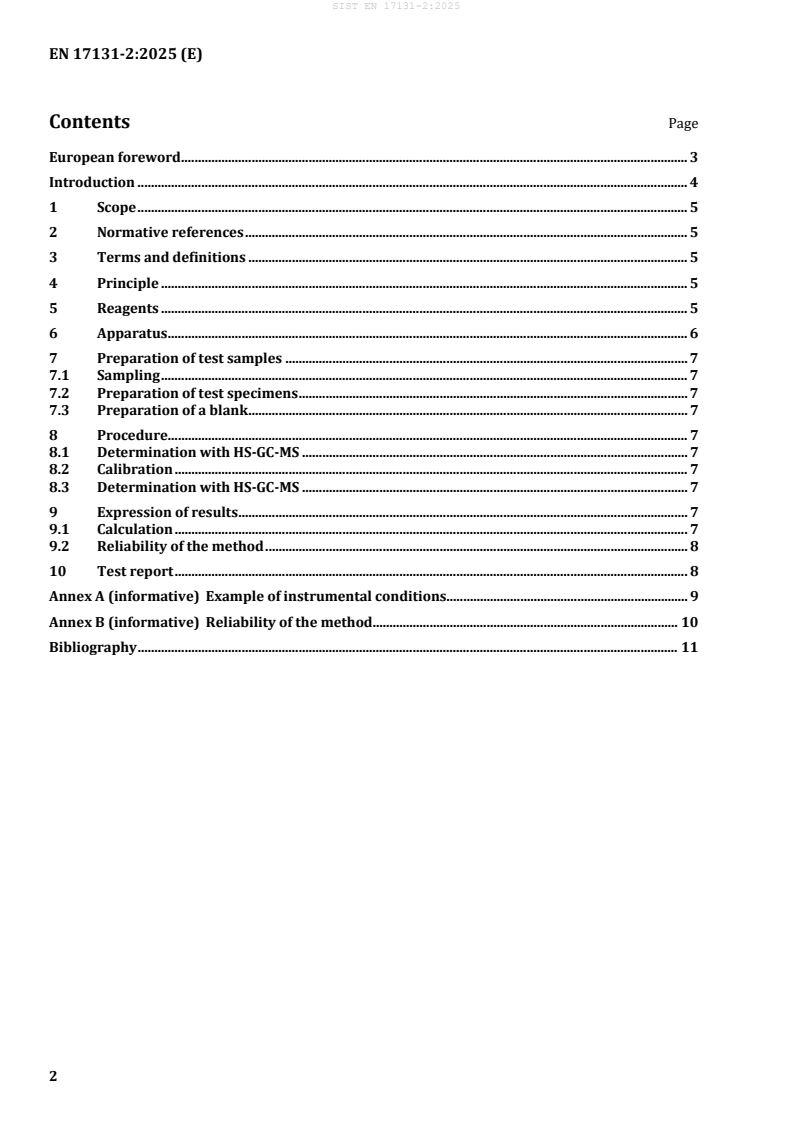
Contents Page
European foreword . 3
Introduction . 4
1 Scope . 5
2 Normative references . 5
3 Terms and definitions . 5
4 Principle . 5
5 Reagents . 5
6 Apparatus . 6
7 Preparation of test samples . 7
7.1 Sampling . 7
7.2 Preparation of test specimens . 7
7.3 Preparation of a blank . 7
8 Procedure. 7
8.1 Determination with HS-GC-MS . 7
8.2 Calibration . 7
8.3 Determination with HS-GC-MS . 7
9 Expression of results . 7
9.1 Calculation . 7
9.2 Reliability of the method . 8
10 Test report . 8
Annex A (informative) Example of instrumental conditions. 9
Annex B (informative) Reliability of the method. 10
Bibliography . 11
European foreword
This document (EN 17131-2:2025) has been prepared by Technical Committee CEN/TC 248 “Textiles
and textile products”, the secretariat of which is held by BSI.
This European Standard shall be given the status of a national standard, either by publication of an
identical text or by endorsement, at the latest by October 2025, and conflicting national standards shall
be withdrawn at the latest by October 2025.
Attention is drawn to the possibility that some of the elements of this document may be the subject of
patent rights. CEN shall not be held responsible for identifying any or all such patent rights.
This document supersedes EN 17131-2:2019.
This document is Part 2 of the EN 17131 series of standards under the title Textiles and textile products
— Determination of certain residual solvents:
— Part 1: Determination of aprotic solvents, method using gas chromatography;
— Part 2: Determination of benzene, method using headspace gas chromatography (this document).
Any feedback and questions on this document should be directed to the users’ national standards body.
A complete listing of these bodies can be found on the CEN website.
According to the CEN-CENELEC Internal Regulations, the national standards organisations of the
following countries are bound to implement this European Standard: Austria, Belgium, Bulgaria, Croatia,
Cyprus, Czech Republic, Denmark, Estonia, Finland, France, Germany, Greece, Hungary, Iceland, Ireland,
Italy, Latvia, Lithuania, Luxembourg, Malta, Netherlands, Norway, Poland, Portugal, Republic of North
Macedonia, Romania, Serbia, Slovakia, Slovenia, Spain, Sweden, Switzerland, Türkiye and the United
Kingdom.
Introduction
In Europe, according to Regulation (EU) 2018/1513 amending Annex XVII to Regulation (EC) No
1907/2006 (REACH) by Entry 72 [1], (a) clothing or related accessories; (b) textiles other than clothing
which, under normal or reasonably foreseeable conditions of use, come into contact with human skin to
an extent similar to clothing; (c) footwear, are not to be placed on the market after 1 November 2020, if
they contain more than 5 mg/kg of benzene.
This restriction does not apply to: (a) clothing, related accessories or footwear, or parts of clothing,
related accessories or footwear, made exclusively of natural leather, fur or hide; (b) non-textile fasteners
and non-textile decorative attachments; (c) second-hand clothing, related accessories, textiles other than
clothing or footwear; (d) wall-to-wall carpets and textile floor coverings for indoor use, rugs and runners.
It also does not apply to clothing, related accessories, textiles other than clothing, or footwear within the
scope of Regulation (EU) 2016/425 on personal protective equipment or Regulation (EU) 2017/745 on
medical devices. The restriction on textiles other than clothing does not apply to disposable textiles.
“Disposable textiles” means textiles that are designed to be used only once or for a limited time and are
not intended for subsequent use for the same or a similar purpose.
Although the Regulation [1] excludes non-textile fastenings and decorative items, this method is also
suitable for such components.
WARNING — The use of this document involves hazardous materials. It does not purport to
address all of the safety or environmental problems associated with its use. It is the responsibility
of users of this document to take appropriate measures to ensure the safety and health of
personnel and the environment prior to application of the document and fulfil statutory and
regulatory requirements for this purpose.
1 Scope
This document specifies a method using headspace gas chromatography and mass selective spectroscopy
(HS-GC-MS) for detection and quantification of benzene in components of textile products.
2 Normative references
The following documents are referred to in the text in such a way that some or all of their content
...