

SIST EN 17681-1:2025
(Main)Textiles and textile products - Per- and polyfluoroalkyl substances (PFAS) - Part 1: Analysis of an alkaline extract using liquid chromatography and tandem mass spectrometry
General Information
- Abstract
This document specifies a test method, including the degradation of certain side-chain fluorinated polymers during the extraction with simultaneous alkaline hydrolysis, and using liquid chromatography (LC) and tandem mass spectrometry (MS/MS) for identification and quantification of certain per- and polyfluoroalkyl substances (PFAS). The document is applicable to all materials of textile products.
Table 2 indicates a list of target PFAS which can be analysed with this document. PFAS of Table 2 marked with the footnote e) and footnote f) undergo alkaline hydrolysis and only their per- or polyfluorinated degradation products such as PFOA or n:2 fluorotelomer alcohols (n:2 FTOHs, n = 4, 6, 8, 10) can be determined.
Through the methods outlined in the informative Annex E and Annex F, free n:2 FTOHs, PFOA and non-polymeric PFAS of Table 2 marked with the footnote e) and footnote f), that are not stable to alkaline hydrolysis, can be identified and quantified.
Certain side-chain fluorinated polymers release n:2 FTOHs (n = 4, 6, 8, 10) under the described extraction conditions. Since these side-chain fluorinated polymers can be PFOA or C9-C14 PFCA-related substances restricted by the EU-POPs [1] or EU-REACH [2] regulations, the amounts of released n:2 FTOHs can be used to indirectly assess whether the concentration of the aforementioned side-chain fluorinated polymers exceed limits for PFOA or C9-C14 PFCA-related substances.
This document is also applicable to the determination of further PFAS, provided that the method is validated with the additional substances and that these PFAS are stable to alkaline hydrolysis and dehydrofluorination.
- Status
- Published
- Public Enquiry End Date
- 31-Jan-2024
- Publication Date
- 14-May-2025
- Technical Committee
- ITEK - Textile and textile products
- Current Stage
- 6060 - National Implementation/Publication (Adopted Project)
- Start Date
- 08-May-2025
- Due Date
- 13-Jul-2025
- Completion Date
- 15-May-2025

Overview
EN 17681-1:2025 (CEN) specifies a laboratory test method for detecting and quantifying per- and polyfluoroalkyl substances (PFAS) in textiles and textile products. The method uses an alkaline extraction (simultaneous extraction with alkaline hydrolysis) followed by liquid chromatography coupled with tandem mass spectrometry (LC‑MS/MS) for identification and quantification. It is applicable to all textile materials and is designed to detect a target list of PFAS (see Table 2 of the standard), including those regulated under EU‑POPs and EU‑REACH.
Key topics and technical requirements
- Extraction with alkaline hydrolysis: The standard prescribes an extraction solvent (methanol + aqueous NaOH) that both extracts residual PFAS and degrades certain side‑chain fluorinated polymers by alkaline hydrolysis.
- Target analytes and degradation behavior: Some PFAS listed in Table 2 are not stable to alkaline hydrolysis (footnotes e/f). These substances are analysed indirectly by measuring their per‑ or polyfluorinated degradation products, e.g., PFOA or n:2 fluorotelomer alcohols (n:2 FTOHs, n = 4, 6, 8, 10).
- Analytical technique: Primary identification and quantification are performed using LC‑MS/MS. Informative annexes describe alternative workflows:
- Annex E: Methanol extraction (informative)
- Annex F: Gas chromatography – mass selective detector (GC‑MSD) analysis for certain PFAS
- Validation requirement: The method can be extended to additional PFAS provided those compounds are stable to alkaline hydrolysis and the laboratory validates the method for the added substances.
- Reporting and reliability: Clauses cover calibration, calculation of individual and summed PFAS results, limits of quantitation and method reliability (see Annex D for statistical reliability data).
Applications and who should use it
- Textile manufacturers and finish suppliers assessing residual PFAS in raw materials and finished products.
- Analytical testing laboratories performing compliance testing for PFAS in textiles.
- Product safety, regulatory compliance and environmental teams ensuring conformity with EU‑POPs and REACH restrictions (e.g., PFOA, PFHxA, C9–C14 PFCAs and related substances).
- Regulators and certification bodies that require a standardized LC‑MS/MS method for PFAS monitoring in textiles.
- Useful for screening side‑chain fluorinated polymers by quantifying released n:2 FTOHs as an indirect indicator of polymer‑derived PFAS that may fall under regulatory limits.
Related standards
- EN 17681-1:2025 updates/supersedes EN 17681-1:2022 and aligns substance naming with related analytical guidance (see referenced EN 17892:2024). Annex F references GC‑MSD approaches from previous EN documents for complementary analysis.
Keywords: EN 17681-1:2025, PFAS in textiles, LC‑MS/MS, alkaline hydrolysis, PFOA, fluorotelomer alcohols, side‑chain fluorinated polymers, CEN standard, REACH, POPs.
Relations
- Effective Date
- 28-Jan-2026
- Effective Date
- 28-Jan-2026
- Effective Date
- 28-Jan-2026
- Effective Date
- 08-Feb-2023
Get Certified
Connect with accredited certification bodies for this standard

Control Union Certifications
Global certification for agriculture and sustainability.

ECOCERT
Organic and sustainability certification.

Hohenstein Institut
Textile testing and certification.
Sponsored listings
Frequently Asked Questions
SIST EN 17681-1:2025 is a standard published by the Slovenian Institute for Standardization (SIST). Its full title is "Textiles and textile products - Per- and polyfluoroalkyl substances (PFAS) - Part 1: Analysis of an alkaline extract using liquid chromatography and tandem mass spectrometry". This standard covers: This document specifies a test method, including the degradation of certain side-chain fluorinated polymers during the extraction with simultaneous alkaline hydrolysis, and using liquid chromatography (LC) and tandem mass spectrometry (MS/MS) for identification and quantification of certain per- and polyfluoroalkyl substances (PFAS). The document is applicable to all materials of textile products. Table 2 indicates a list of target PFAS which can be analysed with this document. PFAS of Table 2 marked with the footnote e) and footnote f) undergo alkaline hydrolysis and only their per- or polyfluorinated degradation products such as PFOA or n:2 fluorotelomer alcohols (n:2 FTOHs, n = 4, 6, 8, 10) can be determined. Through the methods outlined in the informative Annex E and Annex F, free n:2 FTOHs, PFOA and non-polymeric PFAS of Table 2 marked with the footnote e) and footnote f), that are not stable to alkaline hydrolysis, can be identified and quantified. Certain side-chain fluorinated polymers release n:2 FTOHs (n = 4, 6, 8, 10) under the described extraction conditions. Since these side-chain fluorinated polymers can be PFOA or C9-C14 PFCA-related substances restricted by the EU-POPs [1] or EU-REACH [2] regulations, the amounts of released n:2 FTOHs can be used to indirectly assess whether the concentration of the aforementioned side-chain fluorinated polymers exceed limits for PFOA or C9-C14 PFCA-related substances. This document is also applicable to the determination of further PFAS, provided that the method is validated with the additional substances and that these PFAS are stable to alkaline hydrolysis and dehydrofluorination.
This document specifies a test method, including the degradation of certain side-chain fluorinated polymers during the extraction with simultaneous alkaline hydrolysis, and using liquid chromatography (LC) and tandem mass spectrometry (MS/MS) for identification and quantification of certain per- and polyfluoroalkyl substances (PFAS). The document is applicable to all materials of textile products. Table 2 indicates a list of target PFAS which can be analysed with this document. PFAS of Table 2 marked with the footnote e) and footnote f) undergo alkaline hydrolysis and only their per- or polyfluorinated degradation products such as PFOA or n:2 fluorotelomer alcohols (n:2 FTOHs, n = 4, 6, 8, 10) can be determined. Through the methods outlined in the informative Annex E and Annex F, free n:2 FTOHs, PFOA and non-polymeric PFAS of Table 2 marked with the footnote e) and footnote f), that are not stable to alkaline hydrolysis, can be identified and quantified. Certain side-chain fluorinated polymers release n:2 FTOHs (n = 4, 6, 8, 10) under the described extraction conditions. Since these side-chain fluorinated polymers can be PFOA or C9-C14 PFCA-related substances restricted by the EU-POPs [1] or EU-REACH [2] regulations, the amounts of released n:2 FTOHs can be used to indirectly assess whether the concentration of the aforementioned side-chain fluorinated polymers exceed limits for PFOA or C9-C14 PFCA-related substances. This document is also applicable to the determination of further PFAS, provided that the method is validated with the additional substances and that these PFAS are stable to alkaline hydrolysis and dehydrofluorination.
SIST EN 17681-1:2025 is classified under the following ICS (International Classification for Standards) categories: 59.080.01 - Textiles in general; 71.040.50 - Physicochemical methods of analysis. The ICS classification helps identify the subject area and facilitates finding related standards.
SIST EN 17681-1:2025 has the following relationships with other standards: It is inter standard links to SIST EN ISO 4787:2022, SIST EN ISO 3696:1998, SIST EN 17681-2:2022, SIST EN 17681-1:2022. Understanding these relationships helps ensure you are using the most current and applicable version of the standard.
SIST EN 17681-1:2025 is associated with the following European legislation: EU Directives/Regulations: 1907/2006. When a standard is cited in the Official Journal of the European Union, products manufactured in conformity with it benefit from a presumption of conformity with the essential requirements of the corresponding EU directive or regulation.
SIST EN 17681-1:2025 is available in PDF format for immediate download after purchase. The document can be added to your cart and obtained through the secure checkout process. Digital delivery ensures instant access to the complete standard document.
Standards Content (Sample)
SLOVENSKI STANDARD
01-julij-2025
Tekstilije in tekstilni izdelki - Per- in polifluoroalkilne snovi (PFAS) - 1. del: Analiza
alkalnega ekstrakta s tekočinsko kromatografijo in tandemsko masno
spektrometrijo
Textiles and textile products - Per- and polyfluoroalkyl substances (PFAS) - Part 1:
Analysis of an alkaline extract using liquid chromatography and tandem mass
spectrometry
Textilien und textile Erzeugnisse - Per- und polyfluorierte Alkylverbindungen (PFAS) -
Teil 1: Untersuchung eines alkalischen Extraktes mittels Flüssigkeitschromatographie
und Tandem-Massenspektrometrie
Textiles et produits textiles - Substances perfluoroalkylées et polyfluoroalkylées (PFAS) -
Partie 1 : Analyse d’un extrait alcalin par chromatographie en phase liquide et
spectrométrie de masse en tandem
Ta slovenski standard je istoveten z: EN 17681-1:2025
ICS:
59.080.01 Tekstilije na splošno Textiles in general
71.040.50 Fizikalnokemijske analitske Physicochemical methods of
metode analysis
2003-01.Slovenski inštitut za standardizacijo. Razmnoževanje celote ali delov tega standarda ni dovoljeno.
EN 17681-1
EUROPEAN STANDARD
NORME EUROPÉENNE
April 2025
EUROPÄISCHE NORM
ICS 59.080.01 Supersedes EN 17681-1:2022
English Version
Textiles and textile products - Per- and polyfluoroalkyl
substances (PFAS) - Part 1: Analysis of an alkaline extract
using liquid chromatography and tandem mass
spectrometry
Textiles et produits textiles - Substances Textilien und textile Erzeugnisse - Per- und
perfluoroalkylées et polyfluoroalkylées (PFAS) - Partie polyfluorierte Alkylverbindungen (PFAS) - Teil 1:
1 : Analyse d'un extrait alcalin par chromatographie en Untersuchung eines alkalischen Extraktes mittels
phase liquide et spectrométrie de masse en tandem Flüssigkeitschromatographie und Tandem-
Massenspektrometrie
This European Standard was approved by CEN on 14 March 2025.
CEN members are bound to comply with the CEN/CENELEC Internal Regulations which stipulate the conditions for giving this
European Standard the status of a national standard without any alteration. Up-to-date lists and bibliographical references
concerning such national standards may be obtained on application to the CEN-CENELEC Management Centre or to any CEN
member.
This European Standard exists in three official versions (English, French, German). A version in any other language made by
translation under the responsibility of a CEN member into its own language and notified to the CEN-CENELEC Management
Centre has the same status as the official versions.
CEN members are the national standards bodies of Austria, Belgium, Bulgaria, Croatia, Cyprus, Czech Republic, Denmark, Estonia,
Finland, France, Germany, Greece, Hungary, Iceland, Ireland, Italy, Latvia, Lithuania, Luxembourg, Malta, Netherlands, Norway,
Poland, Portugal, Republic of North Macedonia, Romania, Serbia, Slovakia, Slovenia, Spain, Sweden, Switzerland, Türkiye and
United Kingdom.
EUROPEAN COMMITTEE FOR STANDARDIZATION
COMITÉ EUROPÉEN DE NORMALISATION
EUROPÄISCHES KOMITEE FÜR NORMUNG
CEN-CENELEC Management Centre: Rue de la Science 23, B-1040 Brussels
© 2025 CEN All rights of exploitation in any form and by any means reserved Ref. No. EN 17681-1:2025 E
worldwide for CEN national Members.
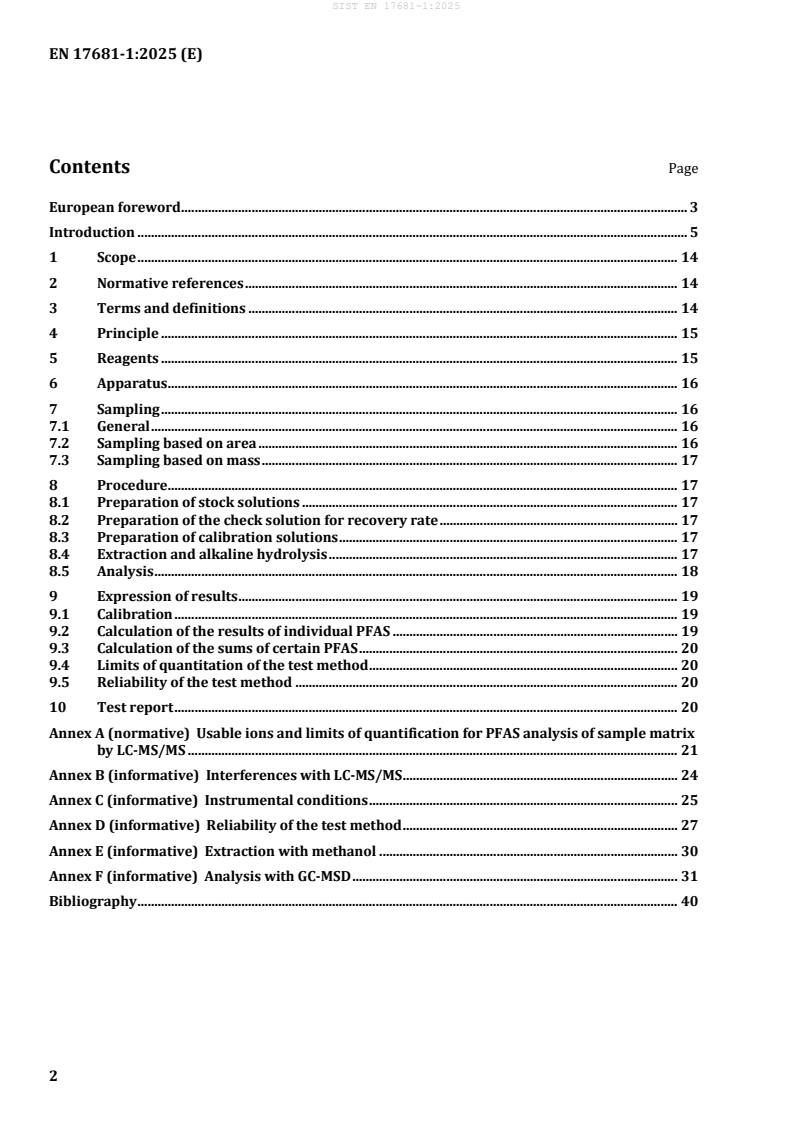
Contents Page
European foreword . 3
Introduction . 5
1 Scope . 14
2 Normative references . 14
3 Terms and definitions . 14
4 Principle . 15
5 Reagents . 15
6 Apparatus . 16
7 Sampling . 16
7.1 General . 16
7.2 Sampling based on area . 16
7.3 Sampling based on mass . 17
8 Procedure. 17
8.1 Preparation of stock solutions . 17
8.2 Preparation of the check solution for recovery rate . 17
8.3 Preparation of calibration solutions . 17
8.4 Extraction and alkaline hydrolysis . 17
8.5 Analysis . 18
9 Expression of results . 19
9.1 Calibration . 19
9.2 Calculation of the results of individual PFAS . 19
9.3 Calculation of the sums of certain PFAS . 20
9.4 Limits of quantitation of the test method . 20
9.5 Reliability of the test method . 20
10 Test report . 20
Annex A (normative) Usable ions and limits of quantification for PFAS analysis of sample matrix
by LC-MS/MS . 21
Annex B (informative) Interferences with LC-MS/MS . 24
Annex C (informative) Instrumental conditions . 25
Annex D (informative) Reliability of the test method . 27
Annex E (informative) Extraction with methanol . 30
Annex F (informative) Analysis with GC-MSD . 31
Bibliography . 40
European foreword
This document (EN 17681-1:2025) has been prepared by Technical Committee CEN/TC 248 “Textiles
and textile products”, the secretariat of which is held by BSI.
This European Standard shall be given the status of a national standard, either by publication of an
identical text or by endorsement, at the latest by October 2025, and conflicting national standards shall
be withdrawn at the latest by October 2025.
Attention is drawn to the possibility that some of the elements of this document may be the subject of
patent rights. CEN shall not be held responsible for identifying any or all such patent rights.
This document supersedes EN 17681-1:2022.
This document includes the following significant technical changes with respect to EN 17681-1:2022:
— the title has been changed;
— the introduction has been amended;
— Table 1 has been revised;
— Table 2 has been reordered and updated with regard to new EU regulations; the majority of the
substance names has been aligned with EN 17892:2024 [8]; 10:2 fluorotelomer methacrylate has
been added;
— Clause 1: the scope has been changed considering extraction with simultaneous alkaline hydrolysis;
— Clause 2: EN 17681-2 has been deleted;
— 3.1, 3.2 and 3.3 have been added;
— Clause 4 has been changed, describing the extraction with simultaneous alkaline hydrolysis;
— Clause 5 and Clause 6 have been amended and reorganised;
— 7.1: the note has been deleted;
— 8.4 has been technically revised, describing the extraction with simultaneous hydrolysis;
— 9.3 and 9.4 have been rephrased and amended;
— 9.5 has been deleted, statistical data on the reliability are shown in Annex D;
— Clause 10 has been rephrased;
— Table A.1: the majority of the substance names has been aligned with EN 17892:2024 [8];
— Table C.1 has been integrated into Table 2 and former Annex C has been deleted;
— former Annex D has become Annex C;
— Annex D on the reliability of the test method has been added;
— Annex E describing the methanol extraction has been added;
— Annex F describing the analysis of certain PFAS with gas chromatography with mass selective
detector (GC-MSD) based on EN 17681-2:2022 [9] has been added;
— Bibliography: further references have been added.
Any feedback and questions on this document should be directed to the users’ national standards body.
A complete listing of these bodies can be found on the CEN website.
According to the CEN-CENELEC Internal Regulations, the national standards organisations of the
following countries are bound to implement this European Standard: Austria, Belgium, Bulgaria, Croatia,
Cyprus, Czech Republic, Denmark, Estonia, Finland, France, Germany, Greece, Hungary, Iceland, Ireland,
Italy, Latvia, Lithuania, Luxembourg, Malta, Netherlands, Norway, Poland, Portugal, Republic of North
Macedonia, Romania, Serbia, Slovakia, Slovenia, Spain, Sweden, Switzerland, Türkiye and the United
Kingdom.
Introduction
In the European Union, several groups of per- and polyfluoroalkyl substances (PFAS) are restricted
whether on their own, in mixtures or in articles.
Regulation (EU) 2019/1021 on persistent organic pollutants (POPs) [1] restricts:
— perfluorooctane sulfonic acid and its derivatives (PFOS);
— perfluorooctanoic acid (PFOA), its salts and PFOA-related compounds;
— perfluorohexane sulfonic acid (PFHxS), its salts and PFHxS-related compounds (status September
2024).
Regulation (EC) No 1907/2006 (REACH), Annex XVII, Entry 68 [2] restricts:
— perfluorocarboxylic acids containing 9 to 14 carbon atoms in the chain (C9-C14 PFCAs), their salts
and C9-C14 PFCA-related substances;
— perfluorohexanoic acid (PFHxA), its salts and PFHxA-related substances, in textiles in clothing and
related accessories for the general public from 10 October 2026, in textiles other than in clothing and
related accessories for the general public from 10 October 2027 [3] (status September 2024).
Restrictions of other groups of PFAS are subject to the REACH restriction process [4].
Additionally, several per- and poly-fluorinated alkyl substances (PFAS), which are not restricted under
the EU-POPs or EU-REACH regulations have been added as substances of very high concern (SVHC) to the
candidate list according to Regulation (EC) No 1907/2006 (REACH), Article 59 [2].
Some of the aforementioned restrictions can also concern side-chain fluorinated polymers if they are
PFOA or C9-C14 PFCA-related substances. By using methanol as extraction solvent as described in
EN 17681-1:2022 and EN 17681-2:2022, the presence of side-chain fluorinated polymers cannot be
determined.
This document describes a method that will result in alkaline hydrolysis of certain side-chain fluorinated
polymers during the extraction process by using a mixture of methanol and aqueous sodium hydroxide
solution as extraction solvent. This extraction solvent cannot only extract residual PFAS from the sample,
but also cleaves the polymers that are esters of polymerized hydrocarbon acids, such as acrylic acid, and
n:2 fluorotelomer alcohols (n:2 FTOHs) to release n:2 FTOHs as a consequence. By quantifying the
amount of n:2 FTOHs, one can indirectly assess whether the amount of side-chain fluorinated polymers
consisting of polymerised hydrocarbon acids and n:2 FTOHs exceeds the limits for polymers that are
related substances to perfluorocarboxylic acids, which are restricted under the relevant EU-POPs or EU-
REACH regulations.
Since the group of PFAS consist of several thousand substances it is not possible to test for all of them in
targeted testing, e.g. for many PFAS reference standards are not available. Therefore,
CEN/TC 248/WG 26 “Textiles — Test methods for analysis of EC restricted substances”,
CEN/TC 289/WG 1 “Chemical test methods”, CEN/TC 309/WG 2 “Footwear and environmental aspects“
and ISO/TC 216/WG 2 “Chemical Test methods for footwear and footwear components” formed a joint
working group which discussed which PFAS are likely to be found in textiles, textile products, leather and
footwear materials. Based on test results and experiences provided by experts of the joined working
group, the group agreed on the PFAS listed in Table 2 as lead substances which are recommended to be
tested in order to significantly minimize the risk of PFAS contaminations in textiles, textile products,
leather and footwear materials. Furthermore, it was considered to only include PFAS for which analytical
reference standards were available. In addition, Table 1 was added to provide background information
which categories of PFAS exist and for which purpose particular groups of PFAS are or were used.
WARNING — The use of this document involves hazardous materials. It does not purport to
address all of the safety or environmental problems associated with its use. It is the responsibility
of users of this document to take appropriate measures to ensure the safety and health of
personnel and the environment prior to application of the document and fulfil statutory and
regulatory requirements for this purpose.
Table 1 — Examples of subgroups of PFAS and their applications
Applications
Subgroups of PFAS
a
Use Sources of contamination
Surfactant in fire-fighting foam, emulsifier in floor polish, mist
Surfactant for alkaline
+ +
K , Li , diethanolamine (DEA) salt suppressant for metal plating baths, surfactant for etching acids for
cleaners
circuit boards, pesticide active ingredient for ant bait traps
Amines — Mist suppressant for metal plating baths
Ammonium salts — Emulsifier for fluoropolymer production
Water/solvent
Amphoterics repellence for —
leather/paper
Carboxylates — Antistatic agent in photographic paper
Amides — Pesticide active ingredient
Oxazolidinones — Waterproofing casts (electronics)
Alcohols, silanes, alkoxylates, fatty acid esters,
Soil and water
adipates, urethanes, polyurethanes polyesters, —
repellence
acrylates, polyacrylates
Soil, oil and water repellence for plates, food containers, bags, wraps,
Copolymers, phosphate esters Water repellence
folding cartons, containers, carbonless forms, masking papers
a
These substances are not relevant in the manufacturing process of textiles, but it is possible to find them as contaminants.
Table 2 — PFAS regulated in the EU and considered for regulation
Applicable chromatographic system
CAS Registry
No. Substance Number®
EU regulation
Gas chromatography see
a
Liquid chromatography
(CAS RN®)
informative Annex F
C4-C5 Perfluoro carboxylic acids
Included in a proposal to
1 PFBA Perfluoro-n-butanoic acid 375–22–4 X — amend REACH
Annex XVII
Included in a proposal to
2 PFPeA Perfluoro-n-pentanoic acid 2706–90–3 X — amend REACH
Annex XVII
C4-C5 Perfluoro carboxylic acids related substances
Included in a proposal to
3 4:2 FTOH 4:2 Fluorotelomer alcohol 2043–47–2 X — amend REACH
Annex XVII
b
Perfluoro hexanoic acid and salts
j
4 PFHxA Perfluoro-n-hexanoic acid 307–24–4 X — REACH Annex XVII
Perfluoro-n-hexanoic acid salts
b j
4.1 APFHx REACH Annex XVII
‒ Ammonium perfluoro-n-
21615–47–4 X —
hexanoate
c
Perfluoro hexanoic acid related substances
j
5 6:2 FTOH 6:2 Fluorotelomer alcohol 647–42–7 X — REACH Annex XVII
f j
6 6:2 FTA 6:2 Fluorotelomer acrylate 17527–29–6 — X REACH Annex XVII
f j
7 6:2 FTMA 6:2 Fluorotelomer methacrylate 2144–53–8 — X REACH Annex XVII
j
8 6:2 FTS 6:2 Fluorotelomer sulfonic acid 27619–97–2 X — REACH Annex XVII
Table 2 lists certain PFAS that are restricted or proposed for restriction according to the technical view of CEN/TC 248 of September 2024. The list is not
exhaustive. Users of this document should pay attention for updated information. The assignment of the PFAS listed to specific regulations in the column “EU
regulation” express the technical view of CEN/TC 248 and does not constitute legal advice. Users of this document remain responsible for their own compliance
with the restrictions.
Applicable chromatographic system
CAS Registry
No. Substance Number®
EU regulation
Gas chromatography see
a
Liquid chromatography
(CAS RN®)
informative Annex F
Perfluoro heptanoic acids
9 PFHpA Perfluoro-n-heptanoic acid 375–85–9 X — REACH (SVHC)
Included in a proposal to
10 7HPFHpA 7H-Perfluoroheptanoic acid 1546–95–8 X — amend REACH
Annex XVII
b
Perfluoro octanoic acid and salts
11 PFOA Perfluoro-n-octanoic acid 335–67–1 X — POPs and REACH (SVHC)
Perfluoro-n-octanoic acid salts
‒ Ammonium perfluoro-n-
APFO 3825–26–1
octanoate
b
11.1 X — POPs
Na-PFO ‒ Sodium perfluoro-n-octanoate 335–95–5
K-PFO ‒ Potassium perfluoro-n-octanoate 2395–00–8
Ag-PFO ‒ Silver perfluoro-n-octanoate 335–93–3
c
Perfluoro octanoic acid related substances
e
12 F-PFO Perfluoro-n-octanoyl fluoride 335–66–0 X — POPs
e
13 Me-PFOA Methyl perfluoro-n-octanoate 376–27–2 — X POPs
e
14 Et-PFOA Ethyl perfluoro-n-octanoate 3108–24–5 — X POPs
POPs and REACH
g
15 8:2 FTOH 8:2 Fluorotelomer alcohol 678–39–7 X —
Annex XVII
f
16 8:2 FTA 8:2 Fluorotelomer acrylate 27905–45–9 — X POPs
f
17 8:2 FTMA 8:2 Fluorotelomer methacrylate 1996–88–9 — X POPs
18 8:2 FTS 8:2 Fluorotelomer sulfonic acid 39108–34–4 X — POPs
Applicable chromatographic system
CAS Registry
No. Substance Number®
EU regulation
Gas chromatography see
a
Liquid chromatography
(CAS RN®)
informative Annex F
c
C9-C14 Perfluoro carboxylic acids and salts
REACH Annex XVII and
19 PFNA Perfluoro-n-nonanoic acid 375–95–1 X —
SVHC
Perfluoro-n-nonanoic acid salts
REACH Annex XVII and
b
19.1
SVHC
Na-PFN ‒ Sodium perfluoro-n-nonanoate 21049–39–8 X —
REACH Annex XVII and
20 PFDA Perfluoro-n-decanoic acid 335–76–2 X —
SVHC
Perfluoro-n-decanoic acid salts
‒ Ammonium perfluoro-n- REACH Annex XVII and
b
20.1 NH4-PFD 3108–42–7
decanoate SVHC
X —
Na-PFD ‒ Sodium perfluoro-n-decanoate 3830–45–3
REACH Annex XVII and
21 PFUnA Perfluoro-n-undecanoic acid 2058–94–8 X —
SVHC
REACH Annex XVII and
22 PFDoA Perfluoro-n-dodecanoic acid 307–55–1 X —
SVHC
REACH Annex XVII and
23 PFTrDA Perfluoro-n-tridecanoic acid 72629–94–8 X —
SVHC
REACH Annex XVII and
24 PFTeDA Perfluoro-n-tetradecanoic acid 376–06–7 X —
SVHC
Perfluoro(3,7-dimethyloctanoic
25 PF-3,7-DMOA 172155–07–6 X — REACH Annex XVII
acid)
Applicable chromatographic system
CAS Registry
No. Substance Number®
EU regulation
Gas chromatography see
a
Liquid chromatography
(CAS RN®)
informative Annex F
c
C9-C14 Perfluoro carboxylic acids related substances
2H,2H,3H,3H-Perfluoro-n-
26 4HPFUnA 34598–33–9 X — REACH Annex XVII
undecanoic acid
POPs and REACH
g
15 8:2 FTOH 8:2 Fluorotelomer alcohol 678–39–7 X —
Annex XVII
27 10:2 FTOH 10:2 Fluorotelomer alcohol 865–86–1 X — REACH Annex XVII
f
28 10:2 FTA 10:2 Fluorotelomer acrylate 17741–60–5 — X REACH Annex XVII
f
29 10:2 FTMA 10:2 Fluorotelomer methacrylate 2144–54–9 — X REACH Annex XVII
30 10:2 FTS 10:2 Fluorotelomer sulfonic acid 120226–60–0 X — REACH Annex XVII
d
Perfluoro octane sulfonic acid and its salts
31 PFOS Perfluoro-n-octane sulfonic acid 1763–23–1 X — POPs
Perfluoro-n-octane sulfonic acid
salts C8F17SO2X
‒ Potassium perfluoro-n-octane
2795–39–3
sulfonate
‒ Lithium perfluoro-n-octane
29457–72–5
sulfonate
‒ Ammonium perfluoro-n-octane
b
31.1 PFOS-X 29081–56–9 X — POPs
sulfonate
‒ Bis(2-hydroxyethyl)ammonium
70225–14–8
perfluoro-n-octane sulfonate
‒ Tetraethyl ammonium perfluoro-
56773–42–3
n-octane sulfonate
‒ Didecyl(dimethyl) azanium
251099–16–8
perfluoro-n-octane sulfonate
Applicable chromatographic system
CAS Registry
No. Substance Number®
EU regulation
Gas chromatography see
a
Liquid chromatography
(CAS RN®)
informative Annex F
d
Perfluoro octane sulfonic acid derivates
32 FOSA Perfluoro-1-octanesulfonamide 754–91–6 X — POPs
N-Methylperfluoro-1-
33 N-MeFOSA 31506–32–8 X — POPs
octanesulfonamide
N-Ethylperfluoro-1-
34 N-EtFOSA 4151–50–2 X — POPs
octanesulfonamide
2-(N-Methylperfluoro-1-
35 N-MeFOSE 24448–09–7 X — POPs
octanesulfonamido)-ethanol
2-(N-Ethylperfluoro-1-
36 N-EtFOSE 1691–99–2 X — POPs
octanesulfonamido)-ethanol
h
37 PFOSF Perfluoro-1-octanesulfonyl fluoride 307–35–7 X — POPs
b
Perfluoro sulfonic acids and its salts
38 PFBS Perfluorobutanesulfonic acid 375–73–5 X — REACH (SVHC)
39 PFHxS Perfluoro-n-hexanesulfonic acid 355–46–4 X — POPs
Included in a proposal to
40 PFHpS Perfluoro-n-heptanesulfonic acid 375–92–8 X — amend REACH
Annex XVII
Included in a proposal to
41 PFDS Perfluoro-n-decanesulfonic acid 335–77–3 X — amend REACH
Annex XVII
Included in a proposal to
42 4:2 FTS 4:2 Fluorotelomer sulfonic acid 757124–72–4 X — amend REACH
Annex XVII
Applicable chromatographic system
CAS Registry
No. Substance Number®
EU regulation
Gas chromatography see
a
Liquid chromatography
(CAS RN®)
informative Annex F
b
Perfluoro-2-propoxypropanoic acid its salts and derivatives
43 HFPO-DA Perfluoro-2-propoxypropanoic acid 13252–13–6 X — REACH (SVHC)
Perfluoro-2-propoxypropanoic acid
salts and acyl halides
i
X = F 2062–98–8 X —
43.1 HFPO-DA-X REACH (SVHC)
b
X = NH 62037–80–3 X —
b
X = K 67118–55–2 X —
a
CAS Registry Number® (CAS RN®) is a trademark of the American Chemical Society (ACS). This information is given for the convenience of users of this document and does not constitute
an endorsement by CEN of the product named. Equivalent products may be used if they can be shown to lead to the same results.
b
Salts cannot be identified by the method described in this document and only be quantified as the corresponding acid.
c
If required legally or as agreed with the customer the results of related substances shall be summed up (9.3).
d
If required legally or as agreed with the customer the results of PFOS and its derivates shall be summed up and calculated as PFOS (9.3).
e
Substance is hydrolysed and releases PFOA when treated with methanol/sodium hydroxide solution (8.4). It contributes to the amount of PFOA if present in the sample.
f
Substance is hydrolysed and releases related fluorotelomer alcohols (n:2 FTOH) when treated with methanol/sodium hydroxide solution (8.4). It contributes to the amount of the related
n:2 FTOH if present in the sample.
g
8:2 FTOH can degrade to PFOA and is thus a PFOA-related substance [7]. It contains a C8F17C-moiety which is also characterized as a C9-C14 PFCA-related substance [5].
h
Substance will convert to PFOS.
i
Substance is hydrolysed and can only be quantified as HFPO-DA.
j
Coming into force for textiles in clothing and related accessories for the general public from 10 October 2026, for textiles other than in clothing and related accessories for the general
public from 10 October 2027 [3].
1 Scope
This document specifies a test method, including the degradation of certain side-chain fluorinated
polymers during the extraction with simultaneous alkaline hydrolysis, and using liquid chromatography
(LC) and tandem mass spectrometry (MS/MS) for identification and quantification of certain per- and
polyfluoroalkyl substances (PFAS). The document is applicable to all materials of textile products.
Table 2 indicates a list of target PFAS which can be analysed with this document. PFAS of Table 2 marked
with the footnote e) and footnote f) undergo alkaline hydrolysis and only their per- or polyfluorinated
degradation products such as PFOA or n:2 fluorotelomer alcohols (n:2 FTOHs, n = 4, 6, 8, 10) can be
determined.
Through the methods outlined in the informative Annex E and Annex F, free n:2 FTOHs, PFOA and non-
polymeric PFAS of Table 2 marked with the footnote e) and footnote f), that are not stable to alkaline
hydrolysis, can be identified and quantified.
Certain side-chain fluorinated polymers release n:2 FTOHs (n = 4, 6, 8, 10) under the described extraction
conditions. Since these side-chain fluorinated polymers can be PFOA or C9-C14 PFCA-related substances
restricted by the EU-POPs [1] or EU-REACH [2] regulations, the amounts of released n:2 FTOHs can be
used to indirectly assess whether the concentration of the aforementioned side-chain fluorinated
polymers exceed limits for PFOA or C9-C14 PFCA-related substances.
This document is also applicable to the determination of further PFAS, provided that the method is
validated with the additional substances and that these PFAS are stable to alkaline hydrolysis and
dehydrofluorination.
2 Normative references
The following documents are referred to in the text in such a way that some or all of their content
constitutes requirements of this document. For dated references, only the edition cited applies. For
undated references, the latest edition of the referenced document (including any amendments) applies.
EN ISO 3696, Water for analytical laboratory use — Specification and test methods (ISO 3696)
EN ISO 4787, Laboratory glass and plastic ware — Volumetric instruments — Methods for testing of
capacity and for use (ISO 4787)
3 Terms and definitions
For the purposes of this document, the following terms and definitions apply.
ISO and IEC maintain terminological databases for use in standardization at the following addresses:
— ISO Online browsing platform: available at https://www.iso.org/obp
— IEC Electropedia: available at https://www.electropedia.org/
3.1
textile product
any raw, semi-worked, worked, semi-manufactured, manufactured, semi-made-up or made-up product
which is exclusively composed of textile fibres or a product containing at least 80 % by mass of textile
fibres
Note 1 to entry: Furniture, umbrella and sunshade coverings containing at least 80 % by mass of textile
components and textile components of the upper layer of multi-layer floor coverings, mattress coverings and
coverings of camping goods, provided such textile components constitute at least 80 % by mass of such upper layers
or coverings, and textiles incorporated in other products and forming an integral part thereof, where their
composition is specified are also considered as textile products.
Note 2 to entry: This definition is based on Regulation (EU) No 1007/2011, Article 2, paragraph 2 and Article 3,
paragraph 1 [11].
3.2
fluoropolymer
polymer with a carbon backbone that contains at least one fully fluorinated methyl (CF -) or methylene
(-CF -) carbon atom
3.3
side-chain fluorinated polymer
polymer with a hydrocarbon backbone and fluorinated side-chains
4 Principle
The sample is cut into small pieces and extracted in an ultrasonic bath with a methanol/sodium hydroxide
solution. Thereby, PFAS stable to alkaline hydrolysis will be extracted and certain side-chain fluorinated
polymers with fluorotelomer side-chains bonded to the polymer backbone via ester groups will be
degraded and release n:2 FTOHs. Certain non-polymeric PFAS that contain functional groups that are not
stable to alkaline hydrolysis, e.g. certain ester groups, will also be degraded and release related per- or
polyfluorinated acids or alcohols, for example n:2 FTOHs. An aliquot of the extract is analysed by a liquid
chromatograph with a tandem mass spectrometric detector (LC-MS/MS) for the substances listed in
Table 2. The results are reported for the single substances and, if required, as the sum of certain single
substances.
NOTE 1 Certain esters of per- and polyfluoroalkyl carboxylic acids are not stable to alkaline hydrolysis, whereas
esters of other per- and polyfluoro acids can be stable, for example, some esters of PFOS.
NOTE 2 Certain PFAS, such as 2H,2H-perfluorodecanoic acid (CAS RN® 27854-31-5), can undergo
dehydrofluorination when treated with strong alkaline solvents and consequently cannot be correctly determined.
5 Reagents
Unless otherwise specified, all reagents shall be of a recognized analytical grade.
5.1 Methanol, LC-MS grade, CAS RN® 67-56-1.
5.2 Sodium hydroxide (NaOH), CAS RN® 1310-73-2.
5.2.1 Sodium hydroxide solution, at 40 % (mass fraction) equal to 10 mol/l, either commercially
available or prepared by dissolution of NaOH (5.2) in water (5.5).
WARNING — Dissolution of NaOH in water is exothermic. Cooling of the solution is required.
5.2.2 Sodium hydroxide solution, 5 mmol/l either commercially available or prepared by stepwise
dilution of 5.2.1 in water (5.5).
5.3 Glacial acetic acid, CAS RN® 64-19-7.
13 13
5.4 Perfluoro-n-[1,2,3,4- C ]-octanoic acid ( C -PFOA), CAS RN® 960315-48-4, substance for
4 4
check solution (8.2).
5.5 Water, grade 1 according to EN ISO 3696 or LC-MS grade.
5.6 Selected PFAS, listed in Table 2 with a tick in column “Liquid chromatography”. Target substances
are available commercially as certified solutions, or a solution of target substances may be prepared.
6 Apparatus
6.1 General
If possible, use equipment free from all types of fluoropolymer plastics, including polytetrafluoroethylene
(PTFE). For example, use equipment made of polypropylene (PP) or polyethylene (PE).
NOTE Further information about interferences can be found in Annex B.
The usual laboratory apparatus and laboratory glassware according to EN ISO 4787 or equivalent
laboratory plasticware shall be used, in addition to the following:
6.2 Analytical balance, with a resolution of at least 0,1 mg.
6.3 Cutting die or template and cutting tool, to measure and cut area materials.
6.4 Extraction vials (glass, polypropylene), for example 40 ml, free from interfering substances.
6.5 LC vials of glass, polypropylene or polyethylene, free from interfering substances.
6.6 Ultrasonic bath, with adjustable temperature suitable for operation at about 60 °C.
6.7 Filter, for example cellulosic filter, 0,45 µm pore size or polypropylene filter, 0,2 µm pore size.
NOTE Filters can be contaminated with PFAS. A check can be made by washing the filter with a solvent
corresponding to the extraction solvent and analysing the washing.
6.8 Liquid chromatograph coupled to a tandem mass spectrometric detector (LC-MS/MS), free
from all types of fluoropolymer plastics, including PTFE.
6.9 Balance, with a resolution of 10 mg or better.
6.10 Centrifuge.
7 Sampling
7.1 General
If possible, the chosen sample shall be representative of the lot it is taken from. When the sampling is
being performed on products that have separate distinct parts, the product shall be dismantled, and each
part shall be treated according to the applicable 7.2 or 7.3. Thereby, a test specimen shall consist of single
components (e.g. fabric or coated fabrics).
7.2 Sampling based on area
If required to report the results of certain PFAS in μg/m legally or as agreed with the customer, take test
specimen of the fabric in order to get at least 1 g of material and an area of at least 100 cm .
Cut out using a cutting die or applicable tool and template (6.3) avoiding distortion of the fabric, to
determine the test specimen area to the nearest 0,1 cm each side. When using the cutting die, use the area
of the die for the calculation. Weigh the test specimen, record the mass to the nearest 10 mg using a
balance (6.9) and transfer the sample into an extraction vial (6.4).
Determination of both area and mass allows expression of the results in both units of µg/kg and µg/m .
If less than 1 g of the sample is available the volumes of extraction solvent and check solution may be
reduced proportionately.
7.3 Sampling based on mass
If required to report the results of certain PFAS masses based, for example in µg/kg, legally or as agreed
with the customer or if the material is not suitable to provide area-based test specimens (fibres, yarns),
take test specimens in order to get at least 1 g of material.
Cut the test specimen into pieces of about 0,3 cm to 0,5 cm edge length, weigh about 1 g of the test
specimen using a balance (6.9) into an extraction vial (6.4) and record the mass to the nearest 10 mg.
8 Procedure
8.1 Preparation of stock solutions
Stock solutions shall only be prepared with PFAS listed in Table 2 and a tick in column “Liquid
chromatography”.
Certified stock solutions with selected PFAS are available commercially.
To prepare stock solutions containing 0,1 µg/ml PFAS (10 µg/ml for n:2 FTOH substances) from
individual components use the analytical balance (6.2) to weigh the appropriate amount of PFAS.
Dissolve them together in methanol (5.1) and add 40 % NaOH solution (5.2.1) to get a stock solution of
1 mol/l NaOH. For example, a 10 ml stock solution shall include 1 ml 40 % NaOH solution (5.2.1).
NOTE The addition of NaOH is required in order to prevent decrease of the PFCA concentrations, for example
due to esterification with the methanol.
8.2 Preparation of the check solution for recovery rate
Prepare at least monthly a fresh check solution containing 0,1 μg/ml C -PFOA (5.4) in methanol (5.1)
containing 0,05 mmol/l NaOH. Prepare the methanol and NaOH solution, for example, mixing 99 ml
methanol (5.1) with 1 ml 5 mmol/l NaOH (5.2.2).
8.3 Preparation of calibration solutions
Prepare calibration solutions for at least 5 calibration points using the stock solutions (8.1), at suitable
concentrations for the analysis, for example in the range of 0,000 1 µg/ml to 0,01 µg/ml (0,001 µg/ml to
1 µg/ml for the n:2 FTOHs). All calibration solutions shall be prepared in methanol (5.1) containing
0,05 mmol/l NaOH. Prepare the methanol and NaOH solution, for example, mixing 99 ml methanol (5.1)
with 1 ml 5 mmol/l NaOH (5.2.2).
8.4 Extraction and alkaline hydrolysis
Add 14 ml methanol (5.1) and 1,4 ml NaOH solution (5.2.1) to the vial with the test specimen (7.2 or 7.3)
and extract the test specimen in an ultrasonic bath starting at a temperature of (60 ± 5) °C for
(60 ± 5) min.
After cooling down, add a sufficient amount (approx. 1,4 ml) of glacial acetic acid (5.3), e.g. in steps of
0,1 ml, to decrease the pH value between 6 and 7, and check the pH value, e.g. by putting a drop of the
extract on a pH paper. After at least 5 min check the pH value again. If it is outside a range of 6 to 7, adjust
it again by adding further glacial acetic acid (5.3) or NaOH solution (5.2.1) and check again after at least
5 min. Repeat these steps if required. Record the volume of the liquids added and add water to get a total
volume of 20 ml, e.g. 14 ml methanol (5.1) + 1,4 ml NaOH (5.2.1) + 1,4 ml glacial acetic
acid (5.3) = 16,8 ml extraction volume, so 3,2 ml water (5.5) have to be added.
If the extract is turbid, centrifuge (6.10) and decant the supernatant or filter it (6.7) to a new extraction
vial (6.4).
NOTE 1 If further precipitation occurs in the subsequent course of the determination, e.g. due to using a cooled
autosampler, it has been found suitable to freeze the extract for at least 30 min at approx. −18 °C, to centrifuge (6.10)
it immediately afterwards and to decant the supernatant or to filter it (6.7) to a new extraction vial (6.4).
Pipette 0,99 ml of the clear extract in a LC vial (6.5), add 0,01 ml of the check solution (8.2).
If the quantification of C4-C7 PFAS is required, a further dilution with a methanol-water mixture with a
volume fraction of 20 % water shall be performed as ion suppression can occur. In this case a, e.g. 1 to 5
dilution (e.g. 200 µl extraction solution is diluted to give a total volume of 1000 µl) shows higher results
than the original extract and should be verified by another dilution if unclear results are yielded.
No concentration step shall be performed due to the high salt content that leads to ion suppression in the
MS/MS-detector and the high volatility of some of the target PFAS, e.g. n:2 FTOHs (n = 4, 6).
NOTE 2 An extraction method without hydrolysis utilizing methanol as extraction solvent is described in
Annex E. This method can be used to explore whether certain PFAS listed in Table 2 and marked with the footnote e)
and footnote f) are sources for PFOA or n:2 FTOHs detected when applying the extraction with methanol and NaOH.
8.5 Analysis
Analyse the extract (8.4) with an LC-MS/MS (6.8). An example of instrumental conditions is given in
Annex C.
NOTE 1 The high salt concentration in the extraction solvent might clog the inlet of certain mass spectrometers.
This can be overcome by adding a switching valve between column outlet and mass spectrometer and switching the
eluent to waste until the void peak is eluted.
The recovery rate of check solutions in the extract shall be ≥ 60 %. If the recovery rate is < 60 % perform
one or more of the following steps to overcome matrix effects and/or ion suppression until the recovery
rate is ≥ 60 %:
— Perform an additional dilution without check solution and analyse again.
— Perform a standard addition (preferred concentration: double of the concentration of the limits of
quantification (LOQ), see Annex A).
— Perform a new extraction with less sample mass but the same extraction solvent volume as described
in 8.4.
NOTE 2 The LOQ can increase as a result of one of the above three steps. Thereby, the resulting LOQ can exceed
legal limits.
NOTE 3 One suitable quality control measure among others is to treat 20 µl of a solution of 1 µg/ml PFOA,
1 µg/ml PFOS, 25 µg/ml 8:2 FTOH and 25 µg/ml 6:2 FTMA in methanol according to 8.4 and to analyse it according
to 8.5. Thereby, a recovery rate of ≥ 75 % for PFOA, PFOS, 8:2 FTOH and 6:2 FTOH has been found suitable.
False-positive results for 4:2 FTOH can occur due to coelution or matrix interference. In this case
chromatographic conditions shall be optimized, e.g. increase the first interval of the gradient from 7 min
(Table C.1) to 20 min.
NOTE 4 Annex F describes a method for detection and quantification of volatile PFAS listed in Table 2 and having
a tick in column “Gas chromatography” using a gas chromatograph with a triple-quadrupole mass spectrometric
detector (GC-MS/MS), with a single-quadrupole mass spectrometer with chemical ionization (GC-CI-MS) or with a
single-quadrupole mass spectrometer with electron impact ionization (GC-EI-MS). This method can be used after
methanol extraction (Annex E) to explore whether volatile PFAS listed in Table 2 are sources for PFOA or n:2 FTOHs
detected when applying the extraction with methanol and NaOH and subsequent LC-MS/MS analysis.
9 Expression of results
9.1 Calibration
The calibration is based on solutions containing the substances of interest (8.3). Ensure there is a linear
dependence between signal and concentration. The calibration curve for a substance is valid only for the
measured concentration range. Additionally, the calibration curve depends on the condition of the
instrument, which shall be checked regularly. For routine analysis, a check (i.e. continuing calibration
check) of the calibration curve, by means of a five-point calibration, is sufficient. From the calibration
curve for each substance i calculate the slope a and intercept b .
i i
9.2 Calculation of the results of individual PFAS
See Annex A for the ions of each substance i to be monitored for the determination. The mass
concentration c of the substance i is calculated in accordance with Formula (1):
i
Ab −
( )
ii
c = (1)
i
a
i
where
c is the mass concentration of substance i in the extract, in µg/ml;
i
A is the measured value of substance i in the extract (area value);
i
a is the slope of the calibration curve of substance i;
i
b is the intercept of the calibration curve of substance i.
i
Starting from c (Formula (1)) the mass fraction w of each substance i in the test specimen is calculated
i
by applying the dilution factor and/or concentration and/or portion factors used for the extraction
process. The simple case is shown in Formula (2).
c
i
w × V× 1000 (2)
i =
m
S
where
w is the mass fraction of substance i in the test specimen, in µg/kg;
i
V is the extraction volume, in ml;
c is the mass concentration of substance i in the extract, in µg/ml;
i
m is the mass of the test specimen, in g.
S
If the result shall be expressed in µg/m (where the sample is a fabric) the mass fraction per area unit w
Ai
of each substance i in the test specimen is calculated using Formula (3):
m
S
w= ××w 10 (3)
Aii
A
where
w is the mass fraction of substance i in the test specimen per unit area, in µg/m ;
Ai
w is the mass fraction of substance i in the test specimen, in µg/kg
...