

SIST EN 13282-1:2013
(Main)Hydraulic road binders - Part 1: Rapid hardening hydraulic road binders - Composition, specifications and conformity criteria
General Information
- Abstract
This European Standard defines and gives the specifications for rapid hardening hydraulic road binders, produced in a factory and supplied ready for treatment of materials for bases, sub-bases and capping layers as well as earthworks, in road, railway, airport and other types of infrastructure.
It includes the mechanical, physical and chemical requirements and the classification of these binders based on their compressive strength at 7 d and 28 d. It also includes the conformity criteria and evaluation procedures to be applied by the manufacturer.
- Status
- Published
- Public Enquiry End Date
- 19-Apr-2010
- Publication Date
- 21-May-2013
- Technical Committee
- CAA - Mineral binders and masonry
- Current Stage
- 6060 - National Implementation/Publication (Adopted Project)
- Start Date
- 10-Apr-2013
- Due Date
- 15-Jun-2013
- Completion Date
- 22-May-2013
- Directive
- 305/2011 - Regulation (eu) No 305/2011 of the European Parliament and of the Council of 9 march 2011 laying down harmonised conditions for the marketing of construction products and repealing council directive 89/106/eecOJ Ref: C 259 OJ Date: 08-Aug-2014
89/106/EEC - Construction productsOJ Ref: C 186 OJ Date: 28-Jun-2013

Overview
EN 13282-1:2013 (CEN) specifies requirements for rapid hardening hydraulic road binders - factory-produced hydraulic binders supplied ready for use in bases, sub‑bases, capping layers and earthworks for roads, railways, airports and other infrastructure. The standard defines composition, mechanical/physical/chemical properties, classification by compressive strength at 7 d and 28 d, and the manufacturer’s conformity criteria and evaluation procedures.
Key topics
- Scope & purpose: Applies to rapid hardening hydraulic road binders used for treatment and stabilization of road construction materials and earthworks; excludes site-mixed binders, cements (EN 197-1) and building limes (EN 459-1).
- Classification: Strength classes designated E2, E3, E4 and E4‑RS, based on compressive strength at 7 and 28 days (tested per EN 196-1).
- Constituents:
- Main constituents (>10%): e.g., Portland cement clinker, granulated blast furnace slag, pozzolans, fly ash, burnt shale, limestone, hydrated or natural hydraulic lime conforming to EN 459-1.
- Minor constituents (≤10%): inorganic mineral materials to improve workability or physical properties.
- Calcium sulfate (gypsum/anhydrite) and additives (typically ≤1% unless declared).
- Properties & tests:
- Mechanical: compressive strength at 7 d and 28 d (EN 196-1).
- Physical: fineness (EN 196-6), initial setting time and soundness (EN 196-3).
- Chemical: sulfate content and other chemical limits (EN 196-2 referenced).
- Durability and restrictions on dangerous substances are also addressed.
- Conformity & factory control:
- Autocontrol (continuous manufacturer testing), control periods, characteristic values and sampling/evaluation procedures are defined to demonstrate compliance.
Applications
- Specification and selection of binders for pavement base/sub-base, capping layers and soil stabilization in road, rail and airport projects.
- Used by materials manufacturers to formulate compliant products, by testing laboratories to verify performance, and by engineers and specifiers to write procurement and construction specifications.
- Supports quality assurance and regulatory compliance for infrastructure contractors and public authorities.
Related standards
- EN 13282-2: Normal hardening hydraulic road binders (companion part)
- EN 13282-3: Conformity evaluation
- EN 196 series: Methods of testing cement (strength, chemical analysis, setting time, fineness)
- EN 197-1 and EN 459-1: Cements and building limes (for constituent references)
EN 13282-1:2013 is essential for anyone involved in specifying, producing or testing rapid hardening hydraulic road binders for modern infrastructure projects.
Relations
- Replaces
SIST ENV 13282:2001 - Hydraulic road binders - Composition, specifications and conformity criteria - Effective Date
- 01-Jun-2013
- Effective Date
- 09-Feb-2026
- Effective Date
- 28-Jan-2026
- Effective Date
- 28-Jan-2026
- Effective Date
- 28-Jan-2026
- Effective Date
- 28-Jan-2026
- Effective Date
- 28-Jan-2026
- Refers
SIST EN 459-1:2015 - Building lime - Part 1: Definitions, specifications and conformity criteria - Effective Date
- 28-Jan-2026
- Effective Date
- 28-Jan-2026
- Effective Date
- 28-Jan-2026
- Effective Date
- 28-Jan-2026
- Effective Date
- 28-Jan-2026
- Effective Date
- 28-Jan-2026
- Effective Date
- 28-Jan-2026
- Effective Date
- 28-Jan-2026
Get Certified
Connect with accredited certification bodies for this standard

Zavod za gradbeništvo Slovenije (ZAG) - Inšpekcija
ZAG inspection body for construction products, structures, and materials.
Sponsored listings
Frequently Asked Questions
SIST EN 13282-1:2013 is a standard published by the Slovenian Institute for Standardization (SIST). Its full title is "Hydraulic road binders - Part 1: Rapid hardening hydraulic road binders - Composition, specifications and conformity criteria". This standard covers: This European Standard defines and gives the specifications for rapid hardening hydraulic road binders, produced in a factory and supplied ready for treatment of materials for bases, sub-bases and capping layers as well as earthworks, in road, railway, airport and other types of infrastructure. It includes the mechanical, physical and chemical requirements and the classification of these binders based on their compressive strength at 7 d and 28 d. It also includes the conformity criteria and evaluation procedures to be applied by the manufacturer.
This European Standard defines and gives the specifications for rapid hardening hydraulic road binders, produced in a factory and supplied ready for treatment of materials for bases, sub-bases and capping layers as well as earthworks, in road, railway, airport and other types of infrastructure. It includes the mechanical, physical and chemical requirements and the classification of these binders based on their compressive strength at 7 d and 28 d. It also includes the conformity criteria and evaluation procedures to be applied by the manufacturer.
SIST EN 13282-1:2013 is classified under the following ICS (International Classification for Standards) categories: 93.080.20 - Road construction materials. The ICS classification helps identify the subject area and facilitates finding related standards.
SIST EN 13282-1:2013 has the following relationships with other standards: It is inter standard links to SIST ENV 13282:2001, SIST ISO 10694:1996, SIST EN 459-2:2021, SIST EN 196-7:2008, SIST EN 197-1:2011, SIST EN 196-6:2019, SIST EN 196-3:2017, SIST EN 459-1:2015, SIST EN 196-1:2016, SIST EN 196-2:2026, SIST EN 14227-15:2016, SIST EN 14227-13:2006, SIST EN 13282-3:2015, SIST EN 14227-5:2013, SIST EN 14227-1:2005. Understanding these relationships helps ensure you are using the most current and applicable version of the standard.
SIST EN 13282-1:2013 is associated with the following European legislation: EU Directives/Regulations: 305/2011, 89/106/EEC; Standardization Mandates: M/114. When a standard is cited in the Official Journal of the European Union, products manufactured in conformity with it benefit from a presumption of conformity with the essential requirements of the corresponding EU directive or regulation.
SIST EN 13282-1:2013 is available in PDF format for immediate download after purchase. The document can be added to your cart and obtained through the secure checkout process. Digital delivery ensures instant access to the complete standard document.
Standards Content (Sample)
2003-01.Slovenski inštitut za standardizacijo. Razmnoževanje celote ali delov tega standarda ni dovoljeno.Hydraulische Tragschichtbinder - Teil 1: Schnell erhärtende hydraulische Tragschichtbinder - Zusammensetzung, Anforderungen und KonformitätskriterienLiants hydrauliques routiers - Partie 1: Liants hydrauliques routiers à durcissement rapide - Composition, spécifications et critères de conformitéHydraulic road binders - Part 1: Rapid hardening hydraulic road binders - Composition, specifications and conformity criteria93.080.20Materiali za gradnjo cestRoad construction materialsICS:Ta slovenski standard je istoveten z:EN 13282-1:2013SIST EN 13282-1:2013en,fr,de01-junij-2013SIST EN 13282-1:2013SLOVENSKI
STANDARDSIST ENV 13282:20011DGRPHãþD
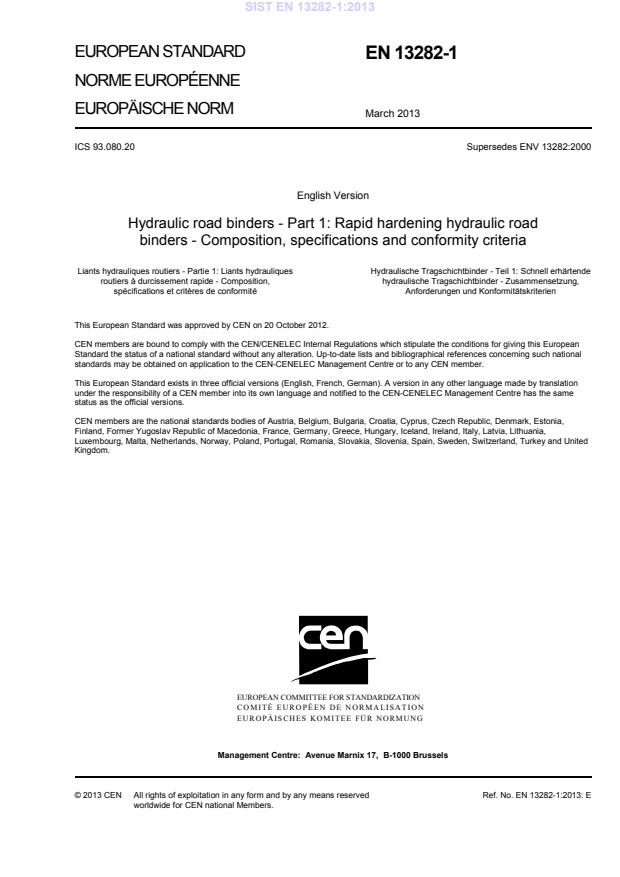
EUROPEAN STANDARD NORME EUROPÉENNE EUROPÄISCHE NORM
EN 13282-1
March 2013 ICS 93.080.20 Supersedes ENV 13282:2000English Version
Hydraulic road binders - Part 1: Rapid hardening hydraulic road binders - Composition, specifications and conformity criteria
Liants hydrauliques routiers - Partie 1: Liants hydrauliques routiers à durcissement rapide - Composition, spécifications et critères de conformité
Hydraulische Tragschichtbinder - Teil 1: Schnell erhärtende hydraulische Tragschichtbinder - Zusammensetzung, Anforderungen und Konformitätskriterien This European Standard was approved by CEN on 20 October 2012.
CEN members are bound to comply with the CEN/CENELEC Internal Regulations which stipulate the conditions for giving this European Standard the status of a national standard without any alteration. Up-to-date lists and bibliographical references concerning such national standards may be obtained on application to the CEN-CENELEC Management Centre or to any CEN member.
This European Standard exists in three official versions (English, French, German). A version in any other language made by translation under the responsibility of a CEN member into its own language and notified to the CEN-CENELEC Management Centre has the same status as the official versions.
CEN members are the national standards bodies of Austria, Belgium, Bulgaria, Croatia, Cyprus, Czech Republic, Denmark, Estonia, Finland, Former Yugoslav Republic of Macedonia, France, Germany, Greece, Hungary, Iceland, Ireland, Italy, Latvia, Lithuania, Luxembourg, Malta, Netherlands, Norway, Poland, Portugal, Romania, Slovakia, Slovenia, Spain, Sweden, Switzerland, Turkey and United Kingdom.
EUROPEAN COMMITTEE FOR STANDARDIZATION
COMITÉ EUROPÉEN DE NORMALISATION EUROPÄISCHES KOMITEE FÜR NORMUNG
Management Centre:
Avenue Marnix 17,
B-1000 Brussels © 2013 CEN All rights of exploitation in any form and by any means reserved worldwide for CEN national Members. Ref. No. EN 13282-1:2013: ESIST EN 13282-1:2013
(informative)
Clauses of this European Standard addressing the provisions of the EU Construction Products Directive . 17 Bibliography. 21
1) To be published. SIST EN 13282-1:2013
Hydraulic road binders are finished products, produced in a factory and supplied ready for use. They are differentiated according to their strength development in rapid hardening hydraulic road binders, specified in this part of this European Standard and normal hardening hydraulic road binders, specified in prEN 13282-2. Part 3 of EN 13282 defines the conformity evaluation procedure for hydraulic road binders according to this standard. Binders obtained through mixing of their constituents on site are not covered by this European Standard. Cements, masonry cements and building limes are also outside the scope of this European Standard, as they are defined in specific European Standards.
Terms and definitions For the purposes of this document, the following terms and definitions apply. 3.1 autocontrol testing continual testing by the manufacturer of rapid hardening hydraulic road binder spot samples taken at the point(s) of release from the factory/depot 3.2 control period period of production and dispatch identified for the evaluation of the autocontrol test results 3.3 characteristic value value of a required mechanical, physical or chemical property outside of which lies a specified percentage, the percentile Pk, of all the values of the population SIST EN 13282-1:2013
for a given sampling plan, the allowed probability of acceptance of a rapid hardening hydraulic road binder with a characteristic value outside the specified characteristic value 4 Hydraulic road binder 4.1 General A hydraulic binder, when mixed with water, hardens both in the air and under water and remains solid, even under water. A hydraulic road binder is a factory produced hydraulic binder, supplied ready for use, having properties specifically suitable for treatment of materials for bases, sub-bases and capping layers as well as earthworks, in road, railway, airport and other types of infrastructures. NOTE 1 Hydraulic road binders are not only used for road construction but this general designation will be used for a better understanding in this document. A hydraulic road binder consists of a powder made from a blend of different constituents and statistically homogeneous in composition. A high degree of uniformity in all properties shall be obtained through continuous mass production processes.
NOTE 2 Continuous production refers to the process, the definition of the product, its composition and properties but does not imply a 24 h production. 4.2 Rapid hardening hydraulic road binder A rapid hardening hydraulic road binder is a hydraulic road binder which conforms to the requirements for strength at 7 days and 28 days, fineness, initial setting time, soundness, sulfate content and composition, as given in Clause 7. 5 Constituents 5.1 Main constituents The main constituents of a rapid hardening hydraulic road binder are those in a proportion exceeding 10 % by mass. They shall be selected from the following list: a) constituents defined as main constituents in EN 197-1: 1) Portland cement clinker (K); 2) granulated blastfurnace slag (S); 3) pozzolanic materials: natural pozzolana (P) and natural calcined pozzolana (Q); 4) fly ash: siliceous fly ash (V) and calcareous fly ash (W); SIST EN 13282-1:2013
Minor additional constituents are specially selected, inorganic natural mineral materials, inorganic mineral materials derived from the clinker or calcium lime production process, or constituents as specified in 5.1 unless they are included as main constituents which, after appropriate preparation and on account of their particle size distribution, improve the physical properties of the binder (such as workability or water retention). They can be inert or have slightly hydraulic, latent hydraulic or pozzolanic properties. However, no requirements are set for them in this respect. Minor additional constituents shall be correctly prepared, i.e. selected, homogenised, dried and comminuted depending on their state of production or delivery. Minor additional constituents shall not impair the properties of the binder. 5.3 Calcium sulfate (Cs) Calcium sulfate, gypsum, hemihydrate or anhydrite (natural or artificial) or any mixture of them may be added to the other constituents of the rapid hardening hydraulic road binder during its manufacture. 5.4 Additives Additives, for the purpose of this European Standard, are constituents not covered in 5.1 to 5.3 which are added to improve the manufacture or the properties of the rapid hardening hydraulic road binder.
The total quantity of additives on dry basis should not exceed 1 % by mass of the binder. A total content of additives greater than 1 % by mass is permitted provided that quantity and function of each of them are stated on the packaging and/or on the delivery note. Additives shall not impair the properties of the rapid hardening hydraulic road binder. 6 Classification Rapid hardening hydraulic road binders are designated by the letter E followed by a number, representing the strength class. The strength class of a rapid hardening hydraulic road binder shall be determined by the compressive strength at 7 days and 28 days tested in accordance with EN 196-1. Three strength classes are defined in Table 1: E 2, E 3 and E 4 (see 7.1). For class E 4, a sub-class indicated as E 4-RS and representing rapid setting rapid hardening hydraulic road binders is defined. NOTE 1 An E 1 class is not included in this European Standard in order to be consistent with the strength classes defined in prEN 13282-2. NOTE 2 Strength classes are incorporated for the purpose of classifying product performance and carrying out attestation of conformity and are not related to the mechanical performance of soils or other materials treated with rapid hardening hydraulic road binders. SIST EN 13282-1:2013
7.2 Physical requirements 7.2.1 Fineness The fineness of a rapid hardening hydraulic road binder shall be determined by sieving. Sieving shall be carried out in accordance with EN 196-6. The sieve residue shall conform to the requirement given in Table 2. 7.2.2 Initial setting time Initial setting time, determined in accordance with EN 196-3, shall conform to the requirement given in Table 2. 7.2.3 Soundness Expansion, determined in accordance with EN 196-3, shall conform to the requirement given in Table 2. Rapid hardening hydraulic road binders containing more than 4,0 % by mass of SO3 shall, in addition, withstand the cold water test described in EN 459-2. They shall be regarded as unsound if, following storage in water, the two specimens have warping or gaping edge cracks either on their own or in conjunction with crazing. SIST EN 13282-1:2013
≤ 15
≥ 90
≤ 10 E 4-RS ≤ 15 ≤ 90 ≤ 10
7.3
Chemical requirement - Sulfate content The sulfate content, expressed as the percentage of SO3 by mass, and determined in accordance with EN 196-2, shall not exceed 4,0 %. A sulfate content of up to 7,0 % by mass (classes E 4 and E 4-RS) and 9,0 % by mass (classes E 2 and E 3), respectively, is permitted for the following rapid hardening road binders, provided that they meet the requirements in 7.2.3: rapid hardening hydraulic road binders containing burnt shale (T) or calcareous fly ash (W), only when most of the sulfate comes from the main constituents; rapid hardening hydraulic road binders containing more than 65 %, by mass, of granulated blastfurnace slag (S). A sulfate content of up to 9,0 % by mass (classes E 4 and E 4-RS) and 11,5 % (classes E 2 and E 3), respectively, is permitted for binders containing burnt shale or calcareous fly ash, only when the greater part of the sulfate content comes from the burnt shale or from the calcareous fly ash.
7.4
Composition 7.4.1 Declaration of composition The constituents of a rapid hardening hydraulic road binder, and their average proportion in the finished product, shall be recorded. When requested, the main constituents (5.1) shall be declared by the manufacturer (see Clause 8), as well as the presence of calcium sulfate (5.3) if the sulfate (SO3) content of the rapid hardening hydraulic road binder exceeds 4,0 %. 7.4.2 Requirements on composition The content of Portland cement clinker of rapid hardening hydraulic road binders shall be not less than 20 %. The composition of a rapid hardening hydraulic road binder shall meet, for all main constituents taken individually, the values documented by the manufacturer and declared if requested (see 7.4.1 and Clause 8) within absolute tolerances given in Table 3. When SO3 content exceeds 4,0 %, the notation Cs shall be added in the declaration (see 7.4.1). SIST EN 13282-1:2013
...