


oSIST FprEN 61643-11:2009
(Main)Low-voltage surge protective devices -- Part 11: Surge protective devices connected to low-voltage power distribution systems - Performance requirements and testing methods
Low-voltage surge protective devices -- Part 11: Surge protective devices connected to low-voltage power distribution systems - Performance requirements and testing methods
IEC 61643-11:2011 is applicable to devices for surge protection against indirect and direct effects of lightning or other transient overvoltages. These devices are packaged to be connected to 50/60 Hz a.c. power circuits, and equipment rated up to 1 000 V r.m.s. Performance characteristics, standard methods for testing and ratings are established. These devices contain at least one nonlinear component and are intended to limit surge voltages and divert surge currents. This first edition of IEC 61643-11 cancels and replaces the second edition of IEC 61643-1 published in 2005. The main changes with respect of the second edition of IEC 61643-1 are the complete restructuring and improvement of the test procedures and test sequences. NOTE: The attention of National Committees is drawn to the fact that equipment manufacturers and testing organizations may need a transitional period following publication of a new, amended or revised IEC publication in which to make products in accordance with the new requirements and to equip themselves for conducting new or revised tests. It is the recommendation of the committee that the content of this publication be adopted for national implementation not earlier than 12 months from the date of publication. In the meantime, the previous edition can still be ordered by contacting your local IEC member National Committee or the IEC Central Office.
Parafoudres basse-tension -- Partie 11: Parafoudres connectés aux réseaux de distribution basse tension - Exigences de fonctionnement et méthodes d'essais
La CEI 61643-11:2011 est applicable aux dispositifs de protection contre les effets indirects et directs de la foudre ou contre les surtensions transitoires. Ces dispositifs sont conçus pour être connectés à des circuits sous tension alternative 50/60 Hz et à des équipements de tension assignée efficace allant jusqu'à 1 000 V efficace. Sont définies les caractéristiques de fonctionnement, les méthodes normalisées d'essai ainsi que les valeurs assignées applicables. Ces dispositifs comportent au moins un composant non linéaire et sont utilisés pour limiter les surtensions et écouler les courants de foudre. Cette première édition de la CEI 61643-11 annule et remplace la deuxième édition de la CEI 61643-1 parue en 2005. Les modifications principales par rapport à la deuxième édition de la CEI 61643-1 sont une restructuration complète et l'adaptation des procédures et séquences d'essai. NOTE: L'attention des Comités Nationaux est attirée sur le fait que les fabricants d'appareils et les organismes d'essai peuvent avoir besoin d'une période transitoire après la publication d'une nouvelle publication CEI, ou d'une publication amendée ou révisée, pour fabriquer des produits conformes aux nouvelles exigences et pour adapter leurs équipements aux nouveaux essais ou aux essais révisés. Le comité recommande que le contenu de cette publication soit entériné au niveau national au plus tôt 12 mois après la date de publication. Dans l'intervalle, l'édition précédente peut encore être commandée en communiquant avec le membre de votre local CEI Comité National ou le Bureau Central de la CEI.
Nizkonapetostne naprave za zaščito pred prenapetostnimi udari - 11. del: Naprave za zaščito pred prenapetostnimi udari za nizkonapetostne sisteme - Zahtevane lastnosti in preskusne metode
General Information
- Status
- Not Published
- Public Enquiry End Date
- 30-Dec-2009
- Technical Committee
- POD - Surge aresters
- Current Stage
- 98 - Abandoned project (Adopted Project)
- Start Date
- 16-Nov-2022
- Due Date
- 21-Nov-2022
- Completion Date
- 16-Nov-2022

Relations
- Effective Date
- 03-Feb-2026
- Effective Date
- 03-Feb-2026
- Effective Date
- 03-Feb-2026
- Effective Date
- 03-Feb-2026
- Effective Date
- 03-Feb-2026
- Effective Date
- 03-Feb-2026
- Effective Date
- 03-Feb-2026
- Effective Date
- 28-Jan-2023
- Effective Date
- 28-Jan-2023
- Effective Date
- 07-Jun-2022
- Effective Date
- 07-Jun-2022
Overview
oSIST FprEN 61643-11:2009 specifies the performance requirements and testing methods for low-voltage surge protective devices (SPDs) connected to low-voltage power distribution systems. Developed under the framework of IEC 61643-11:2011 and adopted by SIST, this standard is central to ensuring safety and functionality for devices designed to protect electrical installations from the effects of lightning and transient overvoltages. The standard applies to SPDs rated up to 1,000 V AC, intended for operation on 50/60 Hz power systems. It defines SPDs that contain at least one nonlinear component, specifying how these devices limit surge voltages and divert surge currents to safeguard connected equipment.
Key Topics
- Scope and Purpose: Applicable to SPDs designed to protect against direct and indirect lightning and other transient overvoltages in low-voltage power systems.
- Performance Requirements: Defines essential performance characteristics, electrical and mechanical properties, and environmental tolerances for SPDs.
- Testing Methods: Outlines standardized test sequences for classifying SPDs (Classes I, II, III) and describes type, routine, and acceptance tests that help verify conformity to performance benchmarks.
- SPD Classes and Applications:
- Class I: Simulates partial lightning current impulses; suitable for entry points with high exposure.
- Class II/III: Tested with impulses of shorter duration for broader system protection.
- Designs and Configurations: Covers one-port and two-port SPDs, voltage switching and voltage limiting types, and combination SPDs.
- Electrical and Mechanical Parameters: Includes maximum continuous operating voltage (UC), nominal discharge current (In), voltage protection level (Up), and more.
- Environmental Conditions: Specifies temperature, humidity, air pressure, and enclosure protection levels (IP Code) for SPD operation and testing.
Applications
Low-voltage surge protective devices standardized in oSIST FprEN 61643-11:2009 are vital in numerous settings:
- Power Distribution Systems: Enhance the resilience of main low-voltage power distribution networks by protecting transformers, switchgear, and downstream equipment from surges.
- Commercial and Industrial Buildings: Deployed at building entry points and distribution panels, SPDs secure critical systems and sensitive electronics against transient overvoltages.
- Data Centers and Communication Facilities: Ensure the uninterrupted operation of IT infrastructure by mitigating threats from lightning and switching surges.
- Residential Installations: Used in circuit breaker panels to protect household appliances and electrical systems from voltage spikes.
- Renewable Energy and Utility Applications: Integral to the safe operation of photovoltaic, wind turbines, and energy storage systems subject to atmospheric and grid-related disturbances.
By providing clear performance and testing benchmarks, the standard helps manufacturers, electrical engineers, and installers select and implement SPDs that guarantee protection, compliance, and operational continuity.
Related Standards
For comprehensive overvoltage protection and electrical safety, reference is made to these closely associated standards:
- IEC 61643-12: Surge protective devices connected to low-voltage power distribution systems - Selection and application principles.
- IEC 60364-4-44: Electrical installations of buildings – Protection against voltage disturbances and electromagnetic disturbances.
- IEC 60529: Degrees of protection provided by enclosures (IP Code).
- IEC 60068-2-14: Environmental testing - Change of temperature.
- IEC 60947-1: Low voltage switchgear and controlgear - General rules.
Practical Value
Implementing IEC 61643-11 through oSIST FprEN 61643-11:2009 is essential for compliance, reliability, and safety in modern electrical installations. The standard addresses evolving challenges in surge protection, laying out robust methods for product development, testing, and certification. National adoption ensures that products and practices meet stringent European and international expectations, contributing to a safer and more efficient electrical environment. By following this standard, stakeholders can confidently specify, install, and maintain SPDs, reducing the risks of damage, downtime, and costly repairs due to transient overvoltages.
Get Certified
Connect with accredited certification bodies for this standard

IMQ S.p.A. (Certification)
Italian electrical product certification.

SLG Prüf- und Zertifizierungs GmbH
German testing and certification body.

UL Solutions
Global safety science company with testing, inspection and certification.
Sponsored listings
Frequently Asked Questions
oSIST FprEN 61643-11:2009 is a draft published by the Slovenian Institute for Standardization (SIST). Its full title is "Low-voltage surge protective devices -- Part 11: Surge protective devices connected to low-voltage power distribution systems - Performance requirements and testing methods". This standard covers: IEC 61643-11:2011 is applicable to devices for surge protection against indirect and direct effects of lightning or other transient overvoltages. These devices are packaged to be connected to 50/60 Hz a.c. power circuits, and equipment rated up to 1 000 V r.m.s. Performance characteristics, standard methods for testing and ratings are established. These devices contain at least one nonlinear component and are intended to limit surge voltages and divert surge currents. This first edition of IEC 61643-11 cancels and replaces the second edition of IEC 61643-1 published in 2005. The main changes with respect of the second edition of IEC 61643-1 are the complete restructuring and improvement of the test procedures and test sequences. NOTE: The attention of National Committees is drawn to the fact that equipment manufacturers and testing organizations may need a transitional period following publication of a new, amended or revised IEC publication in which to make products in accordance with the new requirements and to equip themselves for conducting new or revised tests. It is the recommendation of the committee that the content of this publication be adopted for national implementation not earlier than 12 months from the date of publication. In the meantime, the previous edition can still be ordered by contacting your local IEC member National Committee or the IEC Central Office.
IEC 61643-11:2011 is applicable to devices for surge protection against indirect and direct effects of lightning or other transient overvoltages. These devices are packaged to be connected to 50/60 Hz a.c. power circuits, and equipment rated up to 1 000 V r.m.s. Performance characteristics, standard methods for testing and ratings are established. These devices contain at least one nonlinear component and are intended to limit surge voltages and divert surge currents. This first edition of IEC 61643-11 cancels and replaces the second edition of IEC 61643-1 published in 2005. The main changes with respect of the second edition of IEC 61643-1 are the complete restructuring and improvement of the test procedures and test sequences. NOTE: The attention of National Committees is drawn to the fact that equipment manufacturers and testing organizations may need a transitional period following publication of a new, amended or revised IEC publication in which to make products in accordance with the new requirements and to equip themselves for conducting new or revised tests. It is the recommendation of the committee that the content of this publication be adopted for national implementation not earlier than 12 months from the date of publication. In the meantime, the previous edition can still be ordered by contacting your local IEC member National Committee or the IEC Central Office.
oSIST FprEN 61643-11:2009 is classified under the following ICS (International Classification for Standards) categories: 29.130.20 - Low voltage switchgear and controlgear. The ICS classification helps identify the subject area and facilitates finding related standards.
oSIST FprEN 61643-11:2009 has the following relationships with other standards: It is inter standard links to SIST EN 60112:2004, SIST EN 60664-1:2007, SIST EN 61180-1:1998, SIST HD 588.1 S1:1998, SIST EN 61000-4-21:2011, SIST EN 60529:1997, SIST EN 60695-2-11:2002, SIST EN 61643-11:2002/A11:2008, SIST EN 61643-11:2002, SIST EN 61643-11:2002/A11:2008, SIST EN 61643-11:2002. Understanding these relationships helps ensure you are using the most current and applicable version of the standard.
oSIST FprEN 61643-11:2009 is associated with the following European legislation: EU Directives/Regulations: 2006/95/EC. When a standard is cited in the Official Journal of the European Union, products manufactured in conformity with it benefit from a presumption of conformity with the essential requirements of the corresponding EU directive or regulation.
oSIST FprEN 61643-11:2009 is available in PDF format for immediate download after purchase. The document can be added to your cart and obtained through the secure checkout process. Digital delivery ensures instant access to the complete standard document.
Standards Content (Sample)
2003-01.Slovenski inštitut za standardizacijo. Razmnoževanje celote ali delov tega standarda ni dovoljeno.Parafoudres basse-tension -- Partie 11: Parafoudres connectés aux réseaux de distribution basse tension - Exigences de fonctionnement et méthodes d'essaisLow-voltage surge protective devices -- Part 11: Surge protective devices connected to low-voltage power distribution systems - Performance requirements and testing methods29.130.20Nizkonapetostne stikalne in krmilne napraveLow voltage switchgear and controlgearICS:Ta slovenski standard je istoveten z:FprEN 61643-11oSIST FprEN 61643-11:2009en,fr,de01-december-2009oSIST FprEN 61643-11:2009SLOVENSKI
STANDARD
FORM CDV (IEC)
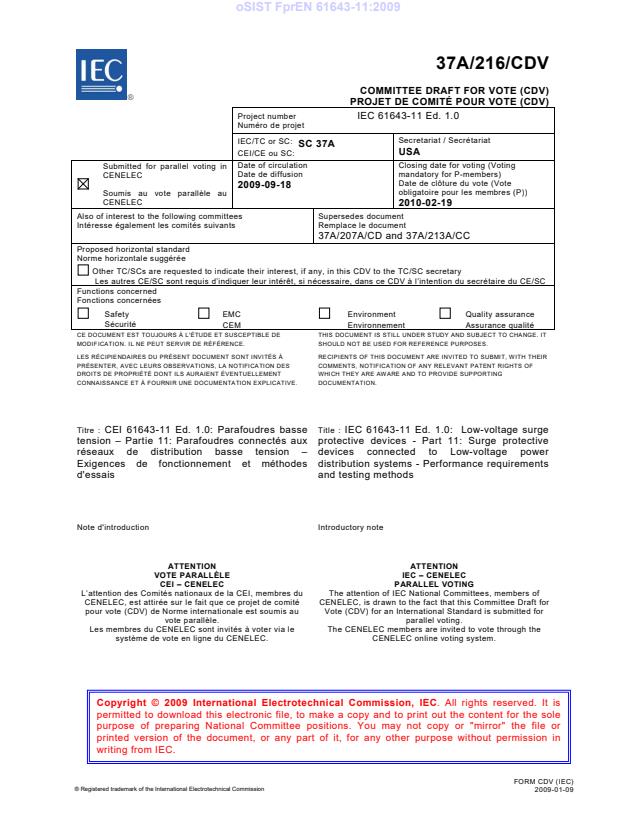
2009-01-09 ® Registered trademark of the International Electrotechnical Commission37A/216/CDVCOMMITTEE DRAFT FOR VOTE (CDV)PROJET DE COMITÉ POUR VOTE (CDV)Project number IEC 61643-11 Ed. 1.0 Numéro de projet
IEC/TC or SC:
SC 37A CEI/CE ou SC:
Secretariat / Secrétariat USA
Submitted for parallel voting in CENELEC
Soumis au vote parallèle au CENELEC Date of circulation Date de diffusion 2009-09-18 Closing date for voting (Voting mandatory for P-members) Date de clôture du vote (Vote obligatoire pour les membres (P)) 2010-02-19 Also of interest to the following committees Intéresse également les comités suivants
Supersedes document Remplace le document 37A/207A/CD and 37A/213A/CC Proposed horizontal standard Norme horizontale suggérée
Other TC/SCs are requested to indicate their interest, if any, in this CDV to the TC/SC secretary
Les autres CE/SC sont requis d’indiquer leur intérêt, si nécessaire, dans ce CDV à l’intention du secrétaire du CE/SC Functions concerned Fonctions concernées
Safety
Sécurité
EMC
CEM
Environment
Environnement
Quality assurance
Assurance qualité CE DOCUMENT EST TOUJOURS À L'ÉTUDE ET SUSCEPTIBLE DE MODIFICATION. IL NE PEUT SERVIR DE RÉFÉRENCE. LES RÉCIPIENDAIRES DU PRÉSENT DOCUMENT SONT INVITÉS À PRÉSENTER, AVEC LEURS OBSERVATIONS, LA NOTIFICATION DES DROITS DE PROPRIÉTÉ DONT ILS AURAIENT ÉVENTUELLEMENT CONNAISSANCE ET À FOURNIR UNE DOCUMENTATION EXPLICATIVE. THIS DOCUMENT IS STILL UNDER STUDY AND SUBJECT TO CHANGE. IT SHOULD NOT BE USED FOR REFERENCE PURPOSES. RECIPIENTS OF THIS DOCUMENT ARE INVITED TO SUBMIT, WITH THEIR COMMENTS, NOTIFICATION OF ANY RELEVANT PATENT RIGHTS OF WHICH THEY ARE AWARE AND TO PROVIDE SUPPORTING DOCUMENTATION.
Titre : CEI 61643-11 Ed. 1.0: Parafoudres basse tension – Partie 11: Parafoudres connectés aux réseaux de distribution basse tension – Exigences de fonctionnement et méthodes d'essais
Title : IEC 61643-11 Ed. 1.0:
Low-voltage surge protective devices - Part 11: Surge protective devices connected to Low-voltage power distribution systems - Performance requirements and testing methods
Note d'introduction
Introductory note
ATTENTION VOTE PARALLÈLE CEI – CENELEC L’attention des Comités nationaux de la CEI, membres du CENELEC, est attirée sur le fait que ce projet de comité pour vote (CDV) de Norme internationale est soumis au vote parallèle.
Les membres du CENELEC sont invités à voter via le système de vote en ligne du CENELEC. ATTENTION IEC – CENELEC PARALLEL VOTING The attention of IEC National Committees, members of CENELEC, is drawn to the fact that this Committee Draft for Vote (CDV) for an International Standard is submitted for parallel voting. The CENELEC members are invited to vote through the CENELEC online voting system.
61643-11 Ed. 1/CDV © IEC
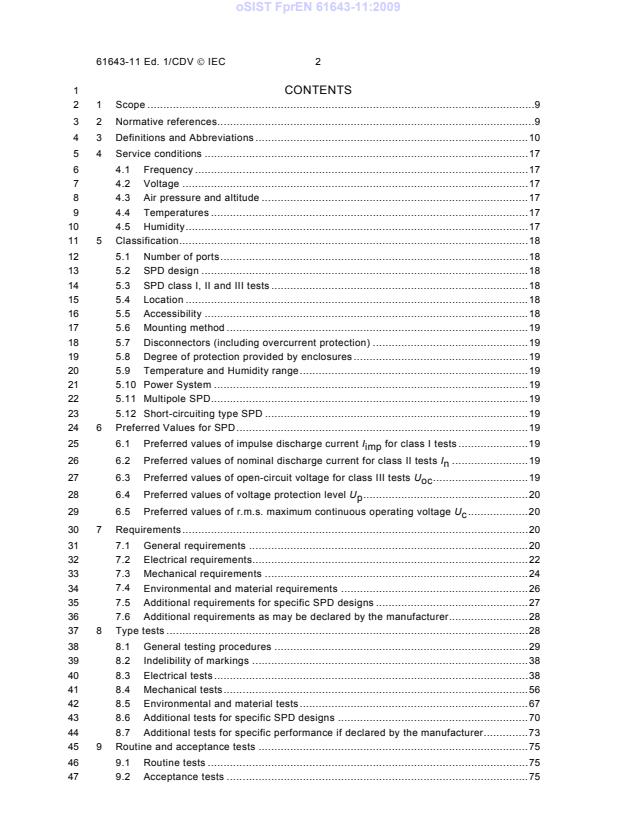
2CONTENTS 1 1 Scope.9 2 2 Normative references.9 3 3 Definitions and Abbreviations.10 4 4 Service conditions.17 5 4.1 Frequency.17 6 4.2 Voltage.17 7 4.3 Air pressure and altitude.17 8 4.4 Temperatures.17 9 4.5 Humidity.17 10 5 Classification.18 11 5.1 Number of ports.18 12 5.2 SPD design.18 13 5.3 SPD class I, II and III tests.18 14 5.4 Location.18 15 5.5 Accessibility.18 16 5.6 Mounting method.19 17 5.7 Disconnectors (including overcurrent protection).19 18 5.8 Degree of protection provided by enclosures.19 19 5.9 Temperature and Humidity range.19 20 5.10 Power System.19 21 5.11 Multipole SPD.19 22 5.12 Short-circuiting type SPD.19 23 6 Preferred Values for SPD.19 24 6.1 Preferred values of impulse discharge current Iimp for class I tests.19 25 6.2 Preferred values of nominal discharge current for class II tests In.19 26 6.3 Preferred values of open-circuit voltage for class III tests Uoc.19 27 6.4 Preferred values of voltage protection level Up.20 28 6.5 Preferred values of r.m.s. maximum continuous operating voltage Uc.20 29 7 Requirements.20 30 7.1 General requirements.20 31 7.2 Electrical requirements.22 32 7.3 Mechanical requirements.24 33 7.4 Environmental and material requirements.26 34 7.5 Additional requirements for specific SPD designs.27 35 7.6 Additional requirements as may be declared by the manufacturer.28 36 8 Type tests.28 37 8.1 General testing procedures.29 38 8.2 Indelibility of markings.38 39 8.3 Electrical tests.38 40 8.4 Mechanical tests.56 41 8.5 Environmental and material tests.67 42 8.6 Additional tests for specific SPD designs.70 43 8.7 Additional tests for specific performance if declared by the manufacturer.73 44 9 Routine and acceptance tests.75 45 9.1 Routine tests.75 46 9.2 Acceptance tests.75 47 oSIST FprEN 61643-11:2009
61643-11 Ed. 1/CDV © IEC
3Annex A Reference test voltages for SPDs UREF (normative).76 48 Annex B TOV Ratings
(normative).80 49 B.1 Special distribution system requirements.80 50 Annex C Tests to determine the presence of a switching component and the magnitude 51 of the follow current
(normative).83 52 C.1 Test to determine the presence of a switching (crowbar) component.83 53 C.2 Test to determine the magnitude of the follow current.83 54 Annex D Reduced Test Procedures (normative).84 55 Annex E Alternative circuits for testing SPDs under TOVs caused by faults in the high 56 (medium) voltage system (informative).86 57 Annex F Environmental tests for Outdoor SPDs (informative).87 58 F.1 Accelerated aging test with UV radiation.87 59 F.2 Water immersion test.87 60 F.3 Dielectric test.87 61 F.4 Temperature cycle test.88 62 F.5 Verification of resistance to corrosion.88 63 Annex G Temperature rise limits
(normative).89 64 Annex H Bibliography (informative).90 65 oSIST FprEN 61643-11:2009
61643-11 Ed. 1/CDV © IEC
4FIGURES 66
67 Figure 1 Metallic screen test set-up.30 68 Figure 2 Example of a decoupling network for single-phase power.37 69 Figure 3 Example of a decoupling network for three-phase power.37 70 Figure 4 Alternate test for the measured limiting voltage.37 71 Figure 5 Flow chart of testing to check the voltage protection level Up.40 72 Figure 6
Flow chart of the operating duty test.43 73 Figure 7 Circuit diagram for test set-up during operating duty test.44 74 Figure 8 Operating duty test timing diagram for test classes I and II.45 75 Figure 9 Additional duty test timing diagram for test class I.46 76 Figure 10 Operating duty test timing diagram for test class III.46 77 Figure 11 Test circuit for SPDs with Ifi lower than the declared short-circuit 78 rating .50 79 Figure 12 Example of a test circuit to perform the test under TOVs caused by 80 faults in the low voltage system.53 81 Figure 13 Timing diagram for the test under TOVs caused by faults in the low 82 voltage system .54 83 Figure 14 Example of circuit for use in testing SPDs under TOVs caused by 84 faults in high (medium) voltage system according Fehler! Verweisquelle konnte nicht 85 gefunden werden. in d).55 86 Figure 15 Timing diagram for use in testing SPDs under TOVs caused by faults 87 in the high (medium) voltage system using circuit of Figure 14.56 88 Figure 16 Test apparatus for impact test.65 89 Figure 17 Striking element of the pendulum hammer.65 90 Figure 18 Ball thrust tester.68 91 Figure 19 Loading rod for ball thrust tester.68 92 Figure 20 Examples for appropriate test circuits for the
load side short-circuit 93 test(s) .72 94
95 TABLES 96
97 Table 1: List of Abbreviations.16 98 Table 2: Class I, II and III tests.18 99 Table 3: Type test requirements for SPDs.31 100 Table 4: Common pass criteria for type tests.33 101 Table 5: Preferred parameters for class I test.34 102 Table 6: Tests to be performed to determine the measured limiting voltage.41 103 Table 7: Prospective short-circuit current and power factor.48 104 Table 8: Dielectric withstand.52 105 Table 9: Screw thread diameters and applied torques.57 106 Table 10: Cross-sections of copper conductors for screw-type or screwless terminals.58 107 Table 11: Pulling forces (screw terminals).59 108 Table 12: Conductor dimensions.59 109 Table 13: Conductor dimensions.60 110 Table 14: Air clearances for SPDs.62 111 Table 15: Creepage distances for SPDs.63 112 oSIST FprEN 61643-11:2009
61643-11 Ed. 1/CDV © IEC
5Table 16: Relationship between material groups and classifications.64 113 Table 17: Relationship between material groups and classifications.66 114 Table 18: test conductors for rated load current test.70 115 Table 19: Current factor k for overload behaviour.71 116 Table 20: Tolerances for proportional surge currents.74 117
118 Table A1: Reference test voltage values.77 119
120 Table B1: TOV test values for Systems complying with IEC 60364 series.80 121 Table B2: TOV test parameters for North American Systems.81 122 Table B3: TOV test parameters for Japanese systems.82 123 oSIST FprEN 61643-11:2009
61643-11 Ed. 1/CDV © IEC
6INTERNATIONAL ELECTROTECHNICAL COMMISSION 124 ____________ 125 LOW-VOLTAGE SURGE PROTECTIVE DEVICES 126
127 Part 11: Surge protective devices connected to low-voltage 128 power distribution systems – Performance requirements and testing 129 methods 130
131 FOREWORD 132 1) The International Electrotechnical Commission (IEC) is a worldwide organization for standardization comprising 133 all national electrotechnical committees (IEC National Committees). The object of IEC is to promote 134 international co-operation on all questions concerning standardization in the electrical and electronic fields. To 135 this end and in addition to other activities, IEC publishes International Standards, Technical Specifications, 136 Technical Reports, Publicly Available Specifications (PAS) and Guides (hereafter referred to as “IEC 137 Publication(s)”). Their preparation is entrusted to technical committees; any IEC National Committee interested 138 in the subject dealt with may participate in this preparatory work. International, governmental and non-139 governmental organizations liaising with the IEC also participate in this preparation. IEC collaborates closely 140 with the International Organization for Standardization (ISO) in accordance with conditions determined by 141 agreement between the two organizations. 142 2) The formal decisions or agreements of IEC on technical matters express, as nearly as possible, an international 143 consensus of opinion on the relevant subjects since each technical committee has representation from all 144 interested IEC National Committees.
145 3) IEC Publications have the form of recommendations for international use and are accepted by IEC National 146 Committees in that sense. While all reasonable efforts are made to ensure that the technical content of IEC 147 Publications is accurate, IEC cannot be held responsible for the way in which they are used or for any 148 misinterpretation by any end user. 149 4) In order to promote international uniformity, IEC National Committees undertake to apply IEC Publications 150 transparently to the maximum extent possible in their national and regional publications. Any divergence 151 between any IEC Publication and the corresponding national or regional publication shall be clearly indicated in 152 the latter. 153 5) IEC provides no marking procedure to indicate its approval and cannot be rendered responsible for any 154 equipment declared to be in conformity with an IEC Publication. 155 6) All users should ensure that they have the latest edition of this publication. 156 7) No liability shall attach to IEC or its directors, employees, servants or agents including individual experts and 157 members of its technical committees and IEC National Committees for any personal injury, property damage or 158 other damage of any nature whatsoever, whether direct or indirect, or for costs (including legal fees) and 159 expenses arising out of the publication, use of, or reliance upon, this IEC Publication or any other IEC 160 Publications.
161 8) Attention is drawn to the Normative references cited in this publication. Use of the referenced publications is 162 indispensable for the correct application of this publication. 163 9) Attention is drawn to the possibility that some of the elements of this IEC Publication may be the subject of 164 patent rights. IEC shall not be held responsible for identifying any or all such patent rights. 165 International Standard IEC 61643-11 has been prepared by subcommittee 37A: Low-voltage 166 surge protective devices, of IEC technical committee 37: Surge arresters. 167 This project is based on the complete restructuring of the former IEC 61643-1 and 168 simplification of the test procedures and test sequences. 169 This draft includes the comments that WG5 agreed to in Vienna and Athens. 170 The text of this standard is based on the following documents: 171
172 FDIS Report on voting
173 Full information on the voting for the approval of this standard can be found in the report on 174 voting indicated in the above table. 175 oSIST FprEN 61643-11:2009
61643-11 Ed. 1/CDV © IEC
7Annexes A, B, C and F are normative and Annexes D, E, G and H are informative only. 176 IEC 61643 consists of the following parts, under the general title: Surge protective devices 177 connected to low-voltage power distribution systems: 178 – Part 11: Performance requirements and testing methods. 179 – Part 12: Selection and application principles 180 oSIST FprEN 61643-11:2009
61643-11 Ed. 1/CDV © IEC
8INTRODUCTION 181 The present standard addresses safety and performance tests for surge protective devices 182 (SPDs). 183 There are three classes of tests: 184 The Class I test is intended to simulate partial conducted lightning current impulses. SPDs 185 subjected to Class I test methods are generally recommended for locations at points of high 186 exposure, e.g., line entrances to buildings protected by lightning protection systems. 187 SPDs tested to Class II or III test methods are subjected to impulses of shorter duration.
188 All SPDs are tested on a “black box” basis as far as possible. 189 Part 12 addresses the selection and application principles of SPDs in practical situations. 190
191 This International Standard IEC 61643-11 has been prepared by subcommittee 37A: Low-voltage surge protective 192 devices, of IEC technical committee 37: Surge arresters. 193 The text of this document is based on the following documents: 194
195 FDIS Report on voting
196 Full information on the voting for the approval of this amendment can be found in the report on voting indicated in 197 the above table. 198 The committee has decided that the contents of the base publication and its amendments will remain unchanged 199 until xxxx. At this date1, the publication will be
200 • reconfirmed; 201 • withdrawn; 202 • replaced by a revised edition, or 203 • amended 204
205 IEC 61643-11: Low-voltage surge protective devices – Part 11: Surge protective devices connected to low-voltage 206 power distribution systems – Performance requirements and testing methods 207 ————————— 1 The National Committees are requested to note that for this publication the maintenance result date is 2013.
61643-11 Ed. 1/CDV © IEC
9LOW-VOLTAGE SURGE PROTECTIVE DEVICES 208
209 Part 11: Surge protective devices connected to low-voltage 210 power distribution systems – Performance requirements and testing 211 methods 212
213 1 Scope 214 This part of IEC 61643 is applicable to devices for surge protection against indirect and direct 215 effects of lightning or other transient overvoltages. These devices are packaged to be 216 connected to 50/60 Hz a.c. power circuits, and equipment rated up to 1,000 V r.m.s. 217 Performance characteristics, standard methods for testing and ratings are established. These 218 devices contain at least one nonlinear component and are intended to limit surge voltages 219 and divert surge currents.
220 2 Normative references 221 The following normative documents contain provisions, which, through reference in this text, 222 constitute provisions of this part of IEC 61643. At the time of publication, the editions 223 indicated were valid. All normative documents are subject to revision, and parties to 224 agreements based on this part of IEC 61643 are encouraged to investigate the possibility of 225 applying the most recent editions of the normative documents indicated below. Members of 226 IEC and ISO maintain registers of currently valid International Standards. 227 IEC 60060-1, High-voltage test techniques – Part 1: General definitions and test requirements 228 IEC 60068-2-14:1986, Tests. Test N: Change of temperature 229 IEC 60099-4:2004, Surge arresters – Part 4: Metal oxide surge arresters without gaps for a.c. 230 systems 231 IEC 60112, Method for the determination of the proof and the comparative tracking indices of 232 solid insulating materials 233 IEC 60320 (all parts), Appliance couplers for household and similar general purposes 234 IEC 60529 Degrees of protection provided by enclosures (IP Code) 235 IEC 60664-1:2002, Insulation coordination for equipment within low-voltage systems - Part 1: 236 Principles, requirements and tests 237 IEC 60695-2-11:xxx, Fire hazard testing – Part 2-11: Test method - Glow wire end-product 238 test and guidance 239 IEC 60884-1:1994, Plugs and socket outlets for household and similar purposes – Part 1: 240 General requirements; Amendment 1 (1994); Amendment 2 (1995) 241 IEC 60947-1:1996, Low voltage switchgear and control gear – Part 1: General rules 242 IEC 61643-12: Surge protective devices connected to low-voltage power distribution systems 243 - Part 12: Selection and application principles 244 IEC 61180-1, High-voltage test techniques for low voltage equipment – Part 1: Definitions, test 245 and procedure requirements 246 oSIST FprEN 61643-11:2009
61643-11 Ed. 1/CDV © IEC
10IEC 60364-4-44:2007, Electrical installations of buildings – Part 4-44: Protection for safety – 247 Protection against voltage disturbances and electromagnetic disturbances
248 IEC 60364-5-51: Electrical installations of buildings –Part 5-51: Selection and erection of 249 electrical equipment – Common rules 250 IEC 60364-5-53 Electrical Installations of buildings selection and erection of electrical 251 equipment, isolation, switching and, control.
252 3 Definitions and Abbreviations 253 For the purpose of this part of IEC 61643, the following definitions apply. 254 3.1
255 surge protective device 256 SPD 257 device that contains at least one nonlinear component that is intended to limit surge voltages 258 and divert surge currents 259 NOTE: An SPD is a complete assembly, having appropriate connecting means.
260 3.2
261 one-port SPD 262 SPD having no intended series impedance 263 NOTE: A one port SPD may have separate input and output connections. 264 3.3
265 two-port SPD 266 SPD having a specific series impedance connected between separate input and output 267 connections 268 3.4
269 voltage switching type SPD 270 SPD that has a high impedance when no surge is present, but can have a sudden change in 271 impedance to a low value in response to a voltage surge 272 NOTE Common examples of components used in voltage switching type SPDs are spark gaps, gas tubes and 273 thyristors. These are sometimes called "crowbar type" components 274 3.5
275 voltage limiting type SPD 276 SPD that has a high impedance when no surge is present, but will reduce it continuously with 277 increased surge current and voltage 278 NOTE Common examples of components used in voltage limiting type SPDs are varistors and avalanche 279 breakdown diodes. These are sometimes called "clamping type" components. 280 3.6
281 combination type SPD 282 SPD that incorporates both, voltage switching components and voltage limiting components. 283 The SPD may exhibit voltage switching, limiting or both 284 3.7
285 short-circuiting type SPD 286 SPD tested according to Class II tests which changes its characteristic to an intentional 287 internal short-circuit due to a surge current exceeding its nominal discharge current In 288 oSIST FprEN 61643-11:2009
61643-11 Ed. 1/CDV © IEC
113.8
289 mode of protection of a SPD 290 an intended current path, between terminals that contains protective components, e.g. line-to-291 line, line-to-earth, line-to-neutral, neutral-to-earth. 292 3.9
293 nominal discharge current
294 In 295 crest value of the current through the SPD having a current waveshape of 8/20 296 NOTE: In is used for the determination of the residual voltage and for the operating duty test for test class II 297 3.10
298 impulse discharge current for class I test 299 Iimp 300 crest value of a discharge current through the SPD with specified charge transfer Q and 301 specified energy W/R in the specified time 302 3.11
303 maximum continuous operating voltage 304 UC 305 maximum r.m.s. voltage, which may be continuously applied to the SPD´s mode of protection 306 NOTE: The UC value covered by this document may exceed 1000 V. 307 3.12
308 follow current 309 If 310 peak current supplied by the electrical power system and flowing through the SPD after a 311 discharge current impulse 312 3.13
313 rated load current 314 IL 315 maximum continuous rated r.m.s. current that can be supplied to a resistive load connected to 316 the protected output of an SPD 317 3.14
318 voltage protection level 319 Up 320 maximum voltage to be expected at the SPD terminals due to an impulse stress with defined 321 voltage steepness and an impulse stress with a discharge current with given amplitude and 322 waveshape. 323 NOTE: The voltage protection level is given by the manufacturer and may not be exceeded by: 324 - the measured limiting voltage, determined for front-of-wave sparkover (if applicable) and the measured 325 limiting voltage, determined from the residual voltage measurements at amplitudes corresponding to In 326 and/or Iimp for test classes I and II 327 - the measured limiting voltage at UOC, determined for the combination wave for test class III 328 3.15
329 measured limiting voltage 330 highest value of voltage that is measured across the terminals of the SPD during the 331 application of impulses of specified waveshape and amplitude 332 oSIST FprEN 61643-11:2009
61643-11 Ed. 1/CDV © IEC
123.16
333 residual voltage 334 Ures 335 crest value of voltage that appears between the terminals of an SPD due to the passage of 336 discharge current 337 3.17
338 temporary overvoltage test value 339 UT 340 test voltage applied to the SPD for a specific duration tT, to simulate the stress under TOV 341 conditions
342 3.18
343 load-side surge withstand capability for a two-port SPD 344 ability of a two-port SPD to withstand surges on the output terminals originating in circuitry 345 downstream of the SPD 346 3.19
347 voltage rate-of-rise of a two-port SPD 348 rate of change of voltage with time measured at the output terminals of a two port SPD under 349 specified test conditions 350 3.20
351 1,2/50 voltage impulse 352 voltage impulse with a nominal virtual front time of 1,2 µs and a nominal time to half-value of 353 50 µs
354 NOTE. IEC 60060-1 (1989) Section 6 defines the voltage impulse definitions of front time, time to half-value and 355 waveshape tolerance. 356 3.21
357 8/20 current impulse 358 current impulse with a nominal virtual front time of 8 µs and a nominal time to half-value of 359 20 µs 360 NOTE: IEC 60060-1 (1989) Section 8 defines the current impulse definitions of front time, time to half-value and 361 waveshape tolerance. 362 3.22
363 combination wave 364 a wave characterized by defined amplitude (UOC)and waveshape under open-circuit conditions 365 and a defined amplitude (ICW) and waveshape under short-circuit conditions 366 NOTE The voltage amplitude, current amplitude and waveform that is delivered to the SPD are determined by the 367 combination wave generator (CWG) impedance and the impedance of the DUT.
368 3.23
369 Open circuit voltage
370 UOC 371 Open circuit impulse voltage of the combination wave generator at the point of connection of 372 the device under test.
373 3.24
374 Combination Wave Generator short-circuit current
375 ICW 376 Prospective Impulse Short-circuit current of the combination wave generator, at the point of 377 connection of the device under test 378 NOTE: When the SPD is connected to the Combination Wave Generator, the current that flows through the device 379 is generally lesser than Icw 380 oSIST FprEN 61643-11:2009
61643-11 Ed. 1/CDV © IEC
133.25
381 thermal runaway 382 operational condition when the sustained power dissipation of an SPD exceeds the thermal 383 dissipation capability of the SPD component, housing and connection, leading to a cumulative 384 increase in the temperature of the internal elements and resulting
in failure 385 3.26
386 thermal stability 387 SPD is thermally stable if, after heating up during the operating duty test, its temperature 388 decreases with time while energized at specified maximum continuous operating voltage and 389 at specified ambient temperature conditions 390 3.27
391 degradation (of performance) 392 undesired permanent departure in the operational performance of equipment or a system from 393 its intended performance 394 3.28
395 short-circuit current rating 396 ISCCR 397 maximum prospective short-circuit current from the power system for which the SPD, in 398 conjunction with the disconnectors specified, is rated 399 3.29
400 SPD disconnector 401 device for disconnecting an SPD, or part of an SPD, from the power system 402 NOTE: This disconnecting device is not required to have isolating capability for safety purposes. It is to prevent a 403 persistent fault on the system and is used to give an indication of an SPD’s failure. Disconnectors can be internal 404 (built in) or external (required by the manufacturer). There may be more than one disconnector function, for 405 example an over-current protection function and a thermal protection function. These functions may be in separate 406 units. 407 3.30
408 degree of protection of enclosure
409 IP 410 numerical classification preceded by the symbol IP indicating the extent of protection provided 411 by an enclosure against access to hazardous parts, against ingress of solid foreign objects 412 and possibly harmful ingress of water 413 3.31
414 type test 415 conformity test made on one or more items representative of the production. 416 (IEV 151-16-16) 417 3.32
418 routine tests 419 tests made on each SPD or on parts and materials as required to ensure that the product 420 meets the design specifications 421 (IEV 151-16-17) 422 3.33
423 acceptance tests 424 contractual test to prove to the customer that the item meets certain conditions of its 425 specification 426 (IEV 151-16-23) 427 oSIST FprEN 61643-11:2009
61643-11 Ed. 1/CDV © IEC
143.34
428 decoupling network 429 an electrical circuit intended to prevent surge energy from being propagated to the power 430 network during energized testing of SPDs 431 NOTE: This electrical circuit is sometimes called a "back filter" 432 3.35
433 Impulse test classification 434 3.33.1 435 class I tests 436 tests carried out with the impulse
discharge current Iimp, with an 8/20 current impulse with a 437 value equal to the crest value of Iimp, and with a 1,2/50 voltage impulse 438 3.33.2 439 class II tests 440 tests carried out with the nominal discharge current In, and
the 1,2/50 voltage impulse 441 3.33.3 442 class III tests 443 tests carried out with the 1,2/50 voltage - 8/20 current combination wave generator 444 3.36
445 residual current device 446 RCD 447 Switching device or associated devices intended to cause the opening of the power circuit 448 when the residual or unbalance current attains a given value under specified conditions 449 3.37
450 sparkover voltage or trigger voltage of a voltage switching SPD 451 maximum voltage value at which the sudden change from high to low impedance starts for a 452 voltage switching SPD 453 3.38
454 specific energy for class I test 455 W/R 456 energy dissipated by a unit resistance of 1 ÷ with the impulse discharge current Iimp 457 NOTE This is equal to the time integral of the square of the current (W/R = ∫ i2dt). 458 3.39
459 prospective short-circuit current of a power supply 460 IP 461 current which would flow at a given location in a circuit if it were short-circuited at that 462 location by a link of negligible impedance 463 NOTE: This prospective symmetrical current is expressed by its rms value. 464 3.40
465 follow current interrupt rating 466 Ifi 467 prospective short-circuit current that an SPD is able to interrupt without operation of a 468 disconnector 469 3.41
470 residual current 471 IPE 472 current flowing through the PE terminal of the SPD while energized at the reference test 473 voltage (UREF) when connected according to the manufacturer’s instructions 474 oSIST FprEN 61643-11:2009
61643-11 Ed. 1/CDV © IEC
153.42
475 status indicator 476 device that indicates the operational status of an SPD, or a part of an SPD. 477 NOTE: Such indicators may be local with visual and/or audible alarms and/or may have remote signalling and/or 478 output contact capability. 479 3.43
480 output contact 481 contact included in a circuit separate from the main circuit of an SPD, and linked to a 482 disconnector or status indicator. 483 3.44
484 multipole SPD 485 type of SPD with more than one mode of protection, or a combination of electrically 486 interconnected SPDs offered as a unit. 487 3.45
488 total discharge current 489 ITotal 490 current which flows through the PE or PEN conductor of a multipole SPD during the total 491 discharge current test 492 NOTE1 This test is used to check for the cumulative effects that occur when multiple modes of protection of a 493 multipole SPD conduct at the same time. 494 NOTE2 ITotal is particularly relevant for SPDs tested according to test class I, and is used for the purpose of 495 lightning protection equipotential bonding according to IEC 62305 series. 496 3.46
497 Reference test voltage 498 UREF 499 r.m.s. value of voltage used for testing, which depends on the mode of protection of the SPD 500 and on the nominal system voltage, the system configuration and the voltage regulation within 501 the system. 502 NOTE: This reference test voltage is selected from Annex A based on the information given by the manufacturer 503 according 7.1.1 b8). 504 3.47
505 transition surge current rating for short-circuiting type SPD 506 Itrans 507 8/20 impulse current value exceeding the nominal discharge current In, that will cause a short-508 circuiting type SPD to short-circuit
509 3.48
510 nominal ac voltage of the system 511 UO 512 line to neutral voltage of the low voltage system 513 3.49
514 maximum discharge current 515 Imax 516 crest value of a current through the SPD having an 8/20 waveshape and magnitude according 517 to the manufacturers specification. Imax is equal to or greater than In. 518 oSIST FprEN 61643-11:2009
61643-11 Ed. 1/CDV © IEC
16Table 1: List of Abbreviations 519 Abbreviation Description Definition/clauseGeneral abbreviations CWG combination wave generator 3.22 RCD residual current device 3.36 DUT device under test General IP degree of protection of enclosure 3.30 TOV temporary overvoltage General SPD surge protective device 3.1 k trip current factor for overload behaviour Table 19 Zf fictive Impedance (of combination wave generator) 3.22 W/R specific energy for class I test 3.38 T1, T2, and/or
T3 product marking for test classes I, II and/or III
7.1.1 tT TOV application time for testing 3.17 Abbreviations related to Voltage UC maximum continuous operating voltage 3.11 UREF Reference test voltage 3.46 Uo nominal a.c. voltage of the system 3.48 UOC open circuit voltage of the combination wave generator 3.22, 3.23 Up voltage protection level 3.14 Ures residual voltage 3.16 Umax Highest measured voltage during surge current applications according 8.3.3 for clearance determination 8.3.3 UT temporary overvoltage test value 3.17 oSIST FprEN 61643-11:2009
61643-11 Ed. 1/CDV © IEC
17 520 4 Service conditions 521 4.1 Frequency 522 Frequency range is from 47 Hz to 63 Hz a.c. 523 4.2 Voltage 524 The voltage applied continuously between the terminals of the Surge Protective Device (SPD) 525 must not exceed its maximum continuous operating voltage UC. 526 4.3 Air pressure and altitude 527 Air pressure is 80 kPa to 106 kPa. These values represent an altitude of +2,000 m to -500 m 528 respectively. 529 4.4 Temperatures 530 • normal range: –5 °C to +40 °C 531 NOTE: This range addresses SPDs for indoor use in weather protected locations having neither temperature nor 532 humidity control and corresponds to the characteristics of external influences code AB4 in IEC 60364-5-51. 533 • extended range: –40 °C to +70 °C 534 NOTE: This range addresses SPDs for outdoor use in non weather protected locations. 535 4.5 Humidity 536 • normal range: 5 % to 95 % 537 NOTE: This range addresses SPDs for indoor use in weather protected locations having neither temperature nor 538 humidity control and corresponds to the characteristics of external influences code AB4 in IEC 60364-5-51. 539 • extended range: 5 % to 100 % 540 NOTE: This range addresses SPDs for outdoor use in non weather protected locations. 541 Abbreviations related to Current Iimp impulse discharge current for class I test 3.10 Imax maximum discharge current 3.49 In nominal discharge current for class II test 3.9 If follow current 3.12 Ifi follow current interrupt rating
3.40 IL rated load current 3.13 ICW short-circuit current of the combination wave generator 3.24 ISCCR short-circuit current rating 3.28 IP prospective short-circuit current of the power supply 3.39 IPE residual current at UREF 3.41 ITotal total discharge current for multipole SPD 3.45 Itrans transition surge current rating for short-circuiting type SPD 3.47 oSIST FprEN 61643-11:2009
61643-11 Ed. 1/CDV © IEC
185 Classification
542 The manufacture shall classify the SPDs in accordance with the following parameters. 543 5.1 Number of ports 544 5.1.1 One 545 5.1.2 Two 546 5.2 SPD design 547 5.2.1 Voltage switching
548 5.2.2 Voltage limiting
549 5.2.3 Combination
550 5.3 SPD class I, II and III tests 551 Information required for class I, class II and class III tests is given in Table 2. 552 Table 2: Class I, II and III tests 553 Tests Required information Test procedures (see subclauses) Class I Iimp 8.1.1; 8.1.2; 8.1.3 Class II In 8.1.2; 8.1.3 Class III Uoc 8.1.4; 8.1.4.1 5.4 Location 554 5.4.1 Indoor 555 SPDs intended for use in enclosures and/or inside buildings or shelters. 556 SPDs installed in outdoor enclosures or shelters are considered for indoor use. 557 5.4.2 Outdoor 558 SPDs intended for use without enclosures and outside of buildings or shelters (e.g. on low 559 voltage overhead lines). 560 5.5 Accessibility 561 5.5.1 Accessible 562 An SPD which can be fully or partly touched by an unskilled person, without the use of a tool 563 to open any covers or enclosures, once installed.
564 5.5.2 Inaccessible 565 An SPD which cannot be touched by an unskilled person either due to being mounted out of 566 reach (e.g. mounted on overhead lines) or due to being located within enclosures which can 567 only be opened by using a tool, once installed. 568 oSIST FprEN 61643-11:2009
61643-11 Ed. 1/CDV © IEC
195.6 Mounting method 569 5.6.1 Fixed 570 5.6.2 Portable 571 5.7 Disconnectors (including overcurrent protection) 572 5.7.1 Location
573 5.7.1.1 Internal 574 5.7.1.2 External 575 5.7.1.3 Both (one part internal and one part external) 576 5.7.2 Protection functions 577 5.7.2.1 Thermal
578 5.7.2.2 Leakage current
579 5.7.2.3 Overcurrent 580 5.8 Degree of protection provided by enclosures 581
According to IP codes of IEC 60529 582 5.9 Temperature and Humidity range 583 5.9.1 Normal 584 5.9.2 Extended 585 5.10 Power System 586 5.10.1 a.c. between 47 and 63 Hz (if not otherwise specified) 587 5.11 Multipole SPD 588 5.12 Short-circuiting type SPD 589 6 Preferred Values for SPD 590 NOTE: Preferred values means values which are often used in practice. Depending on real conditions lower and in 591 some cases higher values may be needed. 592 6.1 Preferred values of impulse discharge current Iimp for class I tests 593 Iimp
1; 2; 5; 10; 12,5;
and 25 kA
594 Q 0,5; 1; 2,5; 5; 6,25; 10
and 12,5 As 595 W/R 0,25; 1,0; 6,25; 25; 39; 100
and 156 kJ/Ω 596 6.2 Preferred values of nominal discharge current for class II tests In 597 0,05 0,1; 0,25; 0,5; 1,0; 1,5; 2,0; 2,5; 3,0; 5,0; 10;
15 and 20 kA 598 6.3 Preferred values of open-circuit voltage for class III tests Uoc 599 0,1 0
...