

oSIST prEN 868-5:2026
(Main)Packaging for terminally sterilized medical devices - Part 5: Sealable pouches and reels constructed of porous materials and plastic film - Requirements and test methods
General Information
- Abstract
This document specifies test methods and values for single-use sealable pouches and reels constructed of a porous material as specified in EN 868 part 2, 3, 6, 7, 9 or 10 and a plastic film. These sealable pouches and reels are intended to be used as sterile barrier systems and/or packaging systems for terminally sterilized medical devices. Other than the general requirements as specified in EN ISO 11607-1 and EN ISO 11607-2, this part of EN 868 series specifies materials, test methods and values that are specific to the products covered by this document.
- Status
- Not Published
- Public Enquiry End Date
- 30-Mar-2026
- Technical Committee
- VAZ - Healthcare
- Current Stage
- 4020 - Public enquire (PE) (Adopted Project)
- Start Date
- 23-Jan-2026
- Due Date
- 12-Jun-2026
- Completion Date
- 07-Apr-2026

Overview
oSIST prEN 868-5:2026 is a draft European standard developed by CEN (European Committee for Standardization) that specifies requirements and test methods for single-use sealable pouches and reels made of porous materials and plastic film. These pouches and reels serve as sterile barrier systems or packaging systems for terminally sterilized medical devices, supporting the sterilization and safe storage of devices in healthcare environments. Part of the broader EN 868 series, this standard aligns with the requirements of EN ISO 11607 for medical device packaging, focusing on specific materials, design, and performance relevant to pouches and reels.
Standardized packaging ensures the sterility and safety of medical devices until the point of use, and oSIST prEN 868-5:2026 provides a harmonized approach for manufacturers and healthcare providers to assess the suitability and compliance of these packaging materials.
Key Topics
Material Requirements
- Specifies acceptable porous materials (as detailed in EN 868 Parts 2, 3, 6, 7, 9, or 10) and mandates that plastic films be free from defects such as pinholes.
- Includes criteria for visual clarity, resistance to sterilization processes, and ability to be effectively sealed and opened.
Construction and Design
- Defines the structure of pouches and reels, including minimum seal widths, peel features, and thumb notches for ease of use.
- Outlines marking and labeling requirements, such as lot numbers, manufacturer information, and process indicators per EN ISO 11140-1.
Performance Testing
- Includes comprehensive test methods to validate seal strength (before and after sterilization), absence of pinholes, resistance to sterilization processes, clean peel characteristics, and clarity of materials.
- References test standards like ASTM D882 for plastics and ASTM F88/F88M for seal strength.
Sterilization Compatibility
- Requires evaluation of material compatibility with intended sterilization methods, considering changes in physical properties after sterilization.
Environmental and Labelling Aspects
- Encourages consideration of environmental impact, with guidance on reducing sampling waste and disposal procedures.
- Covers environmental labeling and declarations (EN ISO 14021, EN ISO 14025) and encourages the provision of end-of-life recyclability and disposal information.
Applications
oSIST prEN 868-5:2026 plays a critical role in:
Healthcare Facilities
- Ensuring that medical device packaging used in hospitals, clinics, dental offices, and other healthcare settings maintains sterility during handling, storage, and transport.
- Supporting compliance with regulatory and safety requirements for infection prevention.
Medical Device Manufacturing
- Providing manufacturers with clear guidelines for developing and validating packaging systems intended for terminal sterilization.
- Assisting in risk management and process validation in accordance with EN ISO 11607-1 and EN ISO 11607-2.
Testing and Quality Assurance
- Offering standardized test methods for laboratories and quality assurance professionals to verify the performance and conformity of packaging products.
Procurement and Supply Chain
- Establishing a benchmark for purchasing decisions and supplier qualifications within the healthcare industry.
Related Standards
oSIST prEN 868-5:2026 works in close conjunction with several other key standards, including:
EN 868 Series:
- EN 868-2: Sterilization wrap
- EN 868-3: Paper for paper bags, and pouches/reels
- EN 868-6/7/9/10: Various materials for sterilization packaging
EN ISO 11607-1 & EN ISO 11607-2:
- General requirements for packaging materials, design, forming, and validation.
EN ISO 11140-1:
- Chemical indicators for sterilization.
Environmental Standards:
- EN ISO 14021 & EN ISO 14025 for environmental labeling and declarations.
Test Standards:
- ASTM D882 (tensile properties of plastics), ASTM F88/F88M (seal strength).
Adherence to oSIST prEN 868-5:2026 is vital for manufacturers and healthcare providers seeking to ensure safe, reliable, and compliant packaging solutions for terminally sterilized medical devices.
Relations
- Effective Date
- 28-Jan-2026
- Referred By
SIST EN 1366-3:2022 - Fire resistance tests for service installations - Part 3: Penetration seals - Effective Date
- 28-Jan-2026
- Effective Date
- 13-Nov-2024
Get Certified
Connect with accredited certification bodies for this standard

BSI Group
BSI (British Standards Institution) is the business standards company that helps organizations make excellence a habit.

TÜV Rheinland
TÜV Rheinland is a leading international provider of technical services.

TÜV SÜD
TÜV SÜD is a trusted partner of choice for safety, security and sustainability solutions.
Sponsored listings
Frequently Asked Questions
oSIST prEN 868-5:2026 is a draft published by the Slovenian Institute for Standardization (SIST). Its full title is "Packaging for terminally sterilized medical devices - Part 5: Sealable pouches and reels constructed of porous materials and plastic film - Requirements and test methods". This standard covers: This document specifies test methods and values for single-use sealable pouches and reels constructed of a porous material as specified in EN 868 part 2, 3, 6, 7, 9 or 10 and a plastic film. These sealable pouches and reels are intended to be used as sterile barrier systems and/or packaging systems for terminally sterilized medical devices. Other than the general requirements as specified in EN ISO 11607-1 and EN ISO 11607-2, this part of EN 868 series specifies materials, test methods and values that are specific to the products covered by this document.
This document specifies test methods and values for single-use sealable pouches and reels constructed of a porous material as specified in EN 868 part 2, 3, 6, 7, 9 or 10 and a plastic film. These sealable pouches and reels are intended to be used as sterile barrier systems and/or packaging systems for terminally sterilized medical devices. Other than the general requirements as specified in EN ISO 11607-1 and EN ISO 11607-2, this part of EN 868 series specifies materials, test methods and values that are specific to the products covered by this document.
oSIST prEN 868-5:2026 is classified under the following ICS (International Classification for Standards) categories: 11.080.30 - Sterilized packaging. The ICS classification helps identify the subject area and facilitates finding related standards.
oSIST prEN 868-5:2026 has the following relationships with other standards: It is inter standard links to SIST EN 1366-3:2022+A1:2025, SIST EN 1366-3:2022, SIST EN 868-5:2019. Understanding these relationships helps ensure you are using the most current and applicable version of the standard.
oSIST prEN 868-5:2026 is available in PDF format for immediate download after purchase. The document can be added to your cart and obtained through the secure checkout process. Digital delivery ensures instant access to the complete standard document.
Standards Content (Sample)
SLOVENSKI STANDARD
01-marec-2026
Embalaža za končno sterilizirane medicinske pripomočke - 5. del: Vrečke in zvitki
papirja z možnostjo tesnjenja (samolepilni) iz poroznega materiala in s plastičnimi
folijami - Zahteve in preskusne metode
Packaging for terminally sterilized medical devices - Part 5: Sealable pouches and reels
constructed of porous materials and plastic film - Requirements and test methods
Verpackungen für in der Endverpackung zu sterilisierende Medizinprodukte - Teil 5:
Siegelfähige Klarsichtbeutel und -schläuche aus porösem Material und Kunststofffolie -
Anforderungen und Prüfverfahren
Emballages des dispositifs médicaux stérilisés au stade terminal - Partie 5 : Sachets et
gaines scellables constitués de matériaux poreux et de film plastique - Exigences et
méthodes d’essai
Ta slovenski standard je istoveten z: prEN 868-5
ICS:
11.080.30 Sterilizirana embalaža Sterilized packaging
2003-01.Slovenski inštitut za standardizacijo. Razmnoževanje celote ali delov tega standarda ni dovoljeno.
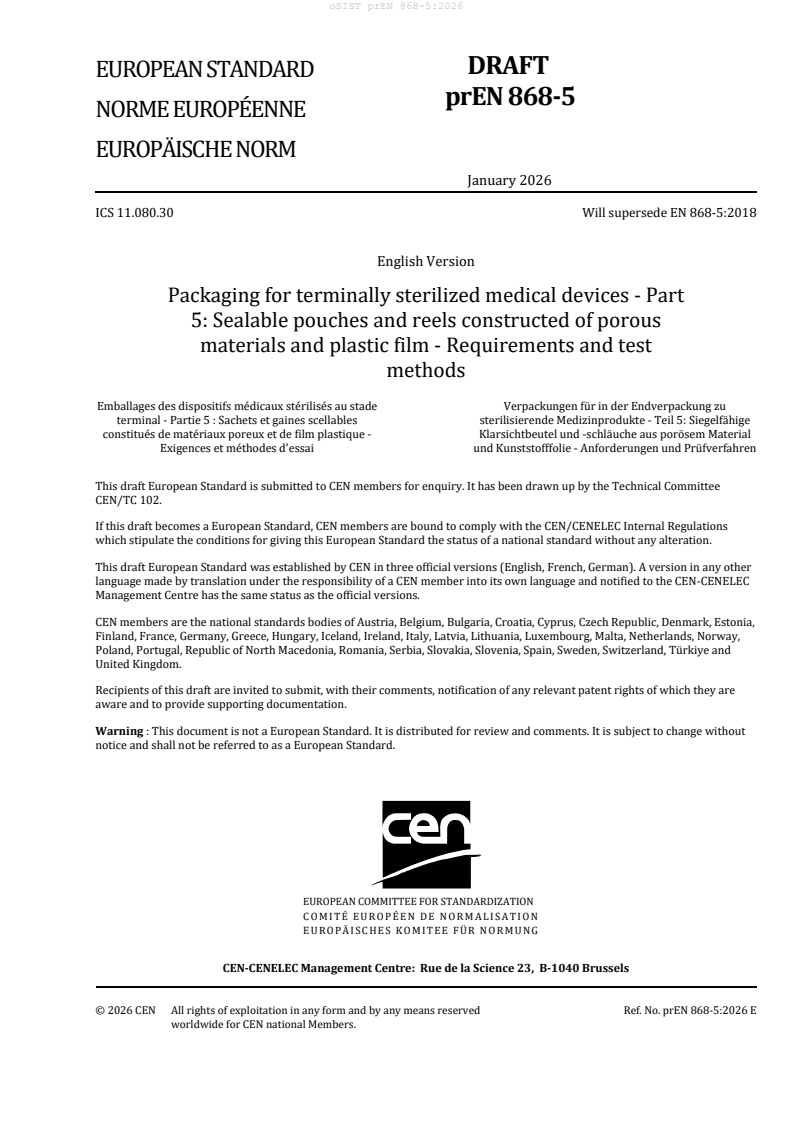
DRAFT
EUROPEAN STANDARD
prEN 868-5
NORME EUROPÉENNE
EUROPÄISCHE NORM
January 2026
ICS 11.080.30 Will supersede EN 868-5:2018
English Version
Packaging for terminally sterilized medical devices - Part
5: Sealable pouches and reels constructed of porous
materials and plastic film - Requirements and test
methods
Emballages des dispositifs médicaux stérilisés au stade Verpackungen für in der Endverpackung zu
terminal - Partie 5 : Sachets et gaines scellables sterilisierende Medizinprodukte - Teil 5: Siegelfähige
constitués de matériaux poreux et de film plastique - Klarsichtbeutel und -schläuche aus porösem Material
Exigences et méthodes d'essai und Kunststofffolie - Anforderungen und Prüfverfahren
This draft European Standard is submitted to CEN members for enquiry. It has been drawn up by the Technical Committee
CEN/TC 102.
If this draft becomes a European Standard, CEN members are bound to comply with the CEN/CENELEC Internal Regulations
which stipulate the conditions for giving this European Standard the status of a national standard without any alteration.
This draft European Standard was established by CEN in three official versions (English, French, German). A version in any other
language made by translation under the responsibility of a CEN member into its own language and notified to the CEN-CENELEC
Management Centre has the same status as the official versions.
CEN members are the national standards bodies of Austria, Belgium, Bulgaria, Croatia, Cyprus, Czech Republic, Denmark, Estonia,
Finland, France, Germany, Greece, Hungary, Iceland, Ireland, Italy, Latvia, Lithuania, Luxembourg, Malta, Netherlands, Norway,
Poland, Portugal, Republic of North Macedonia, Romania, Serbia, Slovakia, Slovenia, Spain, Sweden, Switzerland, Türkiye and
United Kingdom.
Recipients of this draft are invited to submit, with their comments, notification of any relevant patent rights of which they are
aware and to provide supporting documentation.
Warning : This document is not a European Standard. It is distributed for review and comments. It is subject to change without
notice and shall not be referred to as a European Standard.
EUROPEAN COMMITTEE FOR STANDARDIZATION
COMITÉ EUROPÉEN DE NORMALISATION
EUROPÄISCHES KOMITEE FÜR NORMUNG
CEN-CENELEC Management Centre: Rue de la Science 23, B-1040 Brussels
© 2026 CEN All rights of exploitation in any form and by any means reserved Ref. No. prEN 868-5:2026 E
worldwide for CEN national Members.
prEN 868-5:2025 (E)
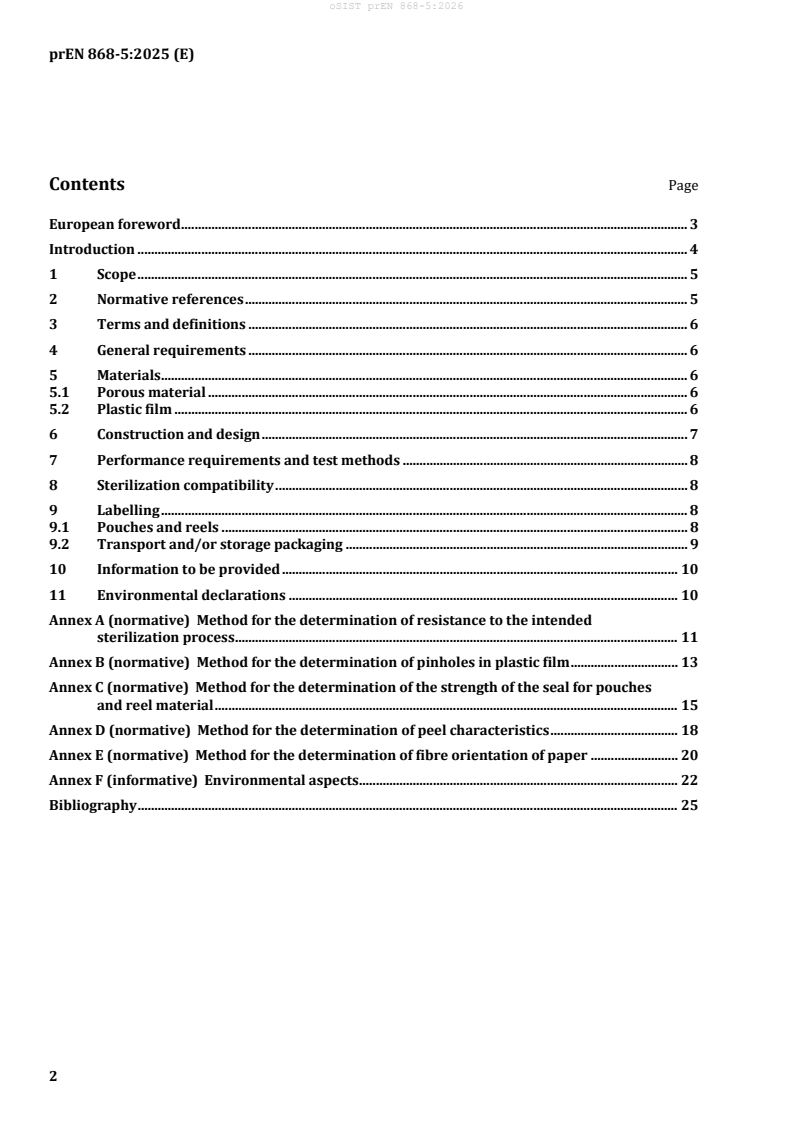
Contents Page
European foreword . 3
Introduction . 4
1 Scope . 5
2 Normative references . 5
3 Terms and definitions . 6
4 General requirements . 6
5 Materials . 6
5.1 Porous material . 6
5.2 Plastic film . 6
6 Construction and design . 7
7 Performance requirements and test methods . 8
8 Sterilization compatibility . 8
9 Labelling . 8
9.1 Pouches and reels . 8
9.2 Transport and/or storage packaging . 9
10 Information to be provided . 10
11 Environmental declarations . 10
Annex A (normative) Method for the determination of resistance to the intended
sterilization process . 11
Annex B (normative) Method for the determination of pinholes in plastic film . 13
Annex C (normative) Method for the determination of the strength of the seal for pouches
and reel material . 15
Annex D (normative) Method for the determination of peel characteristics . 18
Annex E (normative) Method for the determination of fibre orientation of paper . 20
Annex F (informative) Environmental aspects . 22
Bibliography . 25
prEN 868-5:2025 (E)
European foreword
This document (prEN 868-5:2025) has been prepared by Technical Committee CEN/TC 102 “Sterilizers
and associated equipment for processing of medical devices”, the secretariat of which is held by DIN.
This document is currently submitted to the CEN Enquiry.
This document will supersede EN 868-5:2018.
prEN 868-5:2025 includes the following significant technical changes with respect to EN 868-5:2018:
a) Clause 4 “General requirements” was slightly revised for clarity and aligned with the other parts of
the EN 868 series, and a statement was added clarifying when acceptance criteria apply.
b) Clause 8 “Environmental declarations” was added and aligned with the other parts of EN 868 series.
c) The list of major changes was moved to the foreword, thus the Annex with “Details of significant
technical changes between this European Standard and the previous edition” (former Annex A) was
deleted.
d) New Clause “Environmental aspects for testing” was added to each test method in Annexes A to E.
e) New Annex F regarding environmental aspects was added.
EN 868 series consists of the following parts, under the general title Packaging for terminally sterilized
medical devices:
— Part 2: Sterilization wrap — Requirements and test methods;
— Part 3: Paper for use in the manufacture of paper bags (specified in EN 868-4) and in the manufacture
of pouches and reels (specified in EN 868-5) — Requirements and test methods;
— Part 4: Paper bags — Requirements and test methods;
— Part 5: Sealable pouches and reels constructed of porous materials and plastic film— Requirements and
test methods;
— Part 6: Paper for low temperature sterilization processes — Requirements and test methods;
— Part 7: Adhesive coated paper for low temperature sterilization processes — Requirements and test
methods;
— Part 8: Re-usable sterilization containers for large steam sterilizers — Requirements and test methods;
— Part 9: Uncoated nonwoven materials of polyolefins — Requirements and test methods;
— Part 10: Adhesive coated nonwoven materials of polyolefins — Requirements and test methods.
prEN 868-5:2025 (E)
Introduction
The EN ISO 11607 series of standards consists of two parts under the general title “Packaging for
terminally sterilized medical devices”. EN ISO 11607-1 specifies general requirements and test methods
for materials, preformed sterile barrier systems, sterile barrier systems and packaging systems that are
intended to maintain sterility of terminally sterilized medical devices to the point of use. EN ISO 11607-2
[6] specifies validation requirements for forming, sealing and assembly processes.
General requirements for all types of sterile barrier systems are provided by EN ISO 11607-1 and
EN ISO 11607-2.
The EN 868 series of standards have been developed mainly for materials and sterile barrier systems
used in health care facilities. This part of EN 868 series has been developed for pouches and reels used in
typical sterilization processes for reprocessing of reusable medical devices for healthcare facilities. The
EN 868 series of standards can be used to demonstrate compliance with one or more of the requirements
specified in EN ISO 11607-1.
Considering CEN guide 4 [9] and the CEN environmental checklists, this revision has been complemented
with a new annex with guidance to encourage users to also include environmental aspects when applying
the EN 868 series of standards with the objective to minimize the environmental impact. Environmental
aspects have also been included into the description of test methods with the same objective.
prEN 868-5:2025 (E)
1 Scope
This document specifies test methods and values for single-use sealable pouches and reels constructed
of a porous material as specified in EN 868 part 2, 3, 6, 7, 9 or 10 and a plastic film. These sealable pouches
and reels are intended to be used as sterile barrier systems and/or packaging systems for terminally
sterilized medical devices. Other than the general requirements as specified in EN ISO 11607-1 and
EN ISO 11607-2, this part of EN 868 series specifies materials, test methods and values that are specific
to the products covered by this document.
2 Normative references
The following documents are referred to in the text in such a way that some or all of their content
constitutes requirements of this document. For dated references, only the edition cited applies. For
undated references, the latest edition of the referenced document (including any amendments) applies.
EN 868-2:2025, Packaging for terminally sterilized medical devices - Part 2: Sterilization wrap -
Requirements and test methods
EN 868-3:2025, Packaging for terminally sterilized medical devices - Part 3: Paper for use in the
manufacture of paper bags (specified in EN 868-4) and in the manufacture of pouches and reels (specified
in EN 868-5) - Requirements and test methods
EN 868-6:2025, Packaging for terminally sterilized medical devices - Part 6: Paper for low temperature
sterilization processes - Requirements and test methods
EN 868-7:2025, Packaging for terminally sterilized medical devices - Part 7: Adhesive coated paper for low
temperature sterilization processes - Requirements and test methods
EN 868-9:—, Packaging for terminally sterilized medical devices — Part 9: Uncoated nonwoven materials
of polyolefines — Requirements and test methods
EN 868-10:—, Packaging for terminally sterilized medical devices — Part 10: Adhesive coated nonwoven
materials of polyolefines — Requirements and test methods
EN ISO 11140-1, Sterilization of health care products - Chemical indicators - Part 1: General requirements
(ISO 11140-1)
EN ISO 11607-1, Packaging for terminally sterilized medical devices - Part 1: Requirements for materials,
sterile barrier systems and packaging systems (ISO 11607-1)
EN ISO 14021, Environmental labels and declarations - Self-declared environmental claims (Type II
environmental labelling) (ISO 14021)
EN ISO 14025, Environmental labels and declarations - Type III environmental declarations - Principles and
procedures (ISO 14025)
ISO 8601-1, Date and time — Representations for information interchange — Part 1: Basic rules
Under preparation. Stage at the time of publication: prEN 868-9:2025.
Under preparation. Stage at the time of publication: prEN 868-10:2025.
prEN 868-5:2025 (E)
ASTM D882:2018, Test Methods for Tensile Properties of the Thin Plastic Sheeting
ASTM F88/F88M:2023, Standard Test Method for Seal Strength of Flexible Barrier Materials
3 Terms and definitions
For the purposes of this document, the terms and definitions given in EN ISO 11607-1 apply.
ISO and IEC maintain terminology databases for use in standardization at the following addresses:
— ISO Online browsing platform: available at https://www.iso.org/obp/
— IEC Electropedia: available at https://www.electropedia.org/
4 General requirements
4.1 For any material, preformed sterile barrier system or sterile barrier system, the requirements of
EN ISO 11607-1 shall apply.
NOTE When additional materials are used inside the sterile barrier system in order to ease the organization,
drying or aseptic presentation (e.g. inner wrap, indicators, packing lists, mats, instrument organizer sets, tray liners
or an additional envelope around the medical device) then other requirements, including the determination of the
acceptability of these materials during validation activities, can apply.
4.2 This part of EN 868 series only introduces performance requirements and test methods that are
specific to the products covered by this part of EN 868 series but does not add or modify the general
requirements specified in EN ISO 11607-1.
NOTE This document introduces test methods in Annex A, Annex B, Annex C, Annex D and Annex E.
4.3 As such, the requirements in Clause 5 can be used to demonstrate compliance with one or more but
not all of the requirements of EN ISO 11607-1.
NOTE Conformity with this document does not automatically mean conformity with EN ISO 11607-1.
4.4 All acceptance criteria in Clause 4 and Clause 5 shall be applied for testing materials before
sterilization unless it is specified otherwise.
4.5 A confirmation of compliance to this document shall contain a statement of whether
EN ISO 11607-1 is covered.
5 Materials
5.1 Porous material
The porous material shall comply with the requirements of Clause 4 of either EN 868-2:2025, EN 868-
3:2025, EN 868-6:2025, EN 868-7:2025, EN 868-9: — or EN 868-10: —.
5.2 Plastic film
5.2.1 The plastic film shall be manufactured using technology that ensures it is free from pinholes.
Absence of pinholes shall be tested in accordance with Annex B.
NOTE Such technology can include, but is not limited to, lamination, co-extrusion or any technology that
ensures a pinhole-free product.
prEN 868-5:2025 (E)
5.2.2 When tested after the intended sterilization process in accordance with Annex A the internal
structure of the plastic film shall not separate nor become cloudy.
5.2.3 When examined by unaided normal or corrected vision in transmitted light (daylight or good
artificial light with a minimum of 540 lm/m of white light on the specimens) the plastic film shall be free
from foreign matter and/or other imperfections that would adversely affect compliance with the
requirements of 7.
NOTE Slight continuous surface irregularities arising from the extrusion of the plastic film is not regarded as a
defect.
5.2.4 The plastic film shall be sealable to the porous material under the conditions specified.
5.2.5 The breaking factor of the plastics film, machine direction and cross direction, shall be not less
than 20 N per 15 mm width when tested in accordance with ASTM D882:2018 (Method A).
6 Construction and design
6.1 Reel material shall be constructed from one web of porous material and one web of plastic film,
sealed together along parallel sides.
6.2 Pouches shall be constructed from one web of porous material and one web of plastic film by
sealing three sides and may include an area to effect closure of the pouch.
6.3 The overall width of the seal(s) shall be not less than 6 mm. For ribbed seals, the sum of the widths
of the ribs shall be not less than 6 mm.
NOTE Requirements for seal width set forth in this document are valid for pouches and reels delivered as
preformed sterile barrier systems to healthcare facilities and for healthcare facilities to create a sterile barrier
system. For applications in industry, different values can be established based on the specific applications and on
the validation requirements of EN ISO 11607–1.
6.4 The distance between the end of a pouch and the nearest edge of the width wise seal shall be
sufficient to enable the two webs to be separated and peeled apart.
NOTE The side seals can extend beyond the width wise seal to the end of the pouch provided that this does not
impair peelability.
6.5 One of the materials of a pouch shall be:
a) provided with a thumb notch not more than 12 mm deep at either the top or bottom of the pouch or
at both ends; the bottom of the notch shall be at least 1 mm from the seal; or
b) lipped such that the length of one web is greater than the length of the other web by not less than
1,0 mm.
NOTE The requirements of 4.3.4 do not apply to a reel that is sealed at the third side.
6.6 The pouch and/or reel shall be closed according to the manufacturer's instructions.
NOTE 1 For validation requirements for forming, sealing and assembly processes, see EN ISO 11607-2.
NOTE 2 The closure and or sealing system can give the possibility to indicate whether or not the seal has been
opened.
prEN 868-5:2025 (E)
6.7 Process indicator:
If one or more Type I indicator(s) [process indicator(s)] are printed on the pouches and reels, the
indicator’s performance shall comply with the requirements of EN ISO 11140-1. Each individual indicator
shall be not less than 100 mm in area. Indicators shall not be affected by the sealing procedure.
7 Performance requirements and test methods
7.1 When tested in accordance with the method described in Annex C, the strength of the seal shall be
not less than required for the intended purpose, both before and after being subjected to the sterilization
process.
NOTE The specification for seal strength before and after exposure to sterilization processes can differ.
7.2 For use for sterilization in healthcare facilities, the minimum value for seal strength shall be 1,5 N
per 15 mm for steam sterilization and 1,2 N per 15 mm for other sterilization processes.
NOTE 1 Requirements for seal strength set forth in this document are valid for pouches and reels delivered as
preformed sterile barrier systems to healthcare facilities and for healthcare facilities to create a sterile barrier
system. For applications in industry, different values can be established based on the specific applications and on
the validation requirements of EN ISO 11607–1.
NOTE 2 Healthcare facilities are locations where patients are medically treated and/or medical devices are
terminally sterilized (e.g. hospital, dentist office, practitioner).
7.3 The seal shall be continuous and cover the specified width. There shall be no disruption of the
surface of the porous material adjacent to the seal area upon opening. Compliance shall be tested in
accordance with Annex D.
7.4 If applicable, for porous materials, the direction of the peel marked on the product shall correspond
to that direction which ensures least fibre disturbance. Compliance shall be tested in accordance with
Annex E.
8 Sterilization compatibility
8.1 The sterilization processes applicable to the products under the scope of this document shall be
defined.
8.2 The sterilization compatibility of the products shall be evaluated following the requirements of
EN ISO 11607-1. The effects shall be evaluated considering the intended sterilization process(es).
NOTE Sterilization processes generally have an effect on material properties, therefore evaluation of
sterilization compatibility involves a risk-based assessment considering the characteristics of the material and its
application to define the properties to be evaluated, which typically include material strength properties relevant
for maintenance of sterility after sterilization.
9 Labelling
9.1 Pouches and reels
9.1.1 Pouches and reel material shall be clearly marked with information required by EN ISO 11607-1.
Additionally, the following information shall be provided unless agreed otherwise between the supplier
and the customer:
prEN 868-5:2025 (E)
a) the words “Do not use if the sterile barrier system is damaged”, or symbol (see EN ISO 15223-1:2021,
Table 1, symbol 5.2.8 [8]);
b) lot number ;
c) the manufacturers name or trade name;
d) process indicator(s), if applicable;
e) the direction of peel which will ensure the least fibre tear for reels;
f) nominal dimensions and/or identification code.
9.1.2 The product shall not be printed on any surface which is designed to come into direct contact with
the items to be packaged.
9.1.3 For lot number, process indicator, peel direction, and nominal dimensions or identification code
[see 4.6.1.1 b), d), e) and f)], the print repeat interval on reel material shall be not greater than 155 mm.
For other information mentioned in 4.6.1.1 a) and c), the print repeat interval shall be not greater than
310 mm.
9.1.4 Preformed sterile barrier systems placed on the market for delivery to healthcare facilities shall
not be supplied individually labelled with a CE logo and/or with the symbol “sterile”.
NOTE 1 This is to avoid confusion in terms of legal responsibility with the CE mark for the final product.
NOTE 2 For CE marking of transport and/or storage packaging, see 4.6.2 h).
9.2 Transport and/or storage packaging
9.2.1 Each unit of the transport and/or storage packaging shall be legibly and durably labelled.
9.2.2 For industrial applications, the customer and the supplier should agree on the required label
information.
9.2.3 For deliveries to health care facilities, the label shall include at least following information:
a) description of contents including the size, or/and an identification code, for the pouch or reel and
reference to this document;
b) quantity;
c) the manufacturer's or supplier's or authorized representative's name or trade name, and address;
d) date of manufacture in accordance with ISO 8601-1;
e) lot number;
f) any specific storage conditions, if applicable;
A reference number in order to trace the manufacturing history of the product.
prEN 868-5:2025 (E)
g) compatible sterilization process(es);
h) CE mark.
10 Information to be provided
The instructions for sealing, including recommended process parameters shall be provided.
NOTE 1 For heat seals, the indicative range of temperature, pressure and time/speed is typically provided. The
final validated parameters can vary depending on the design of the heat sealing equipment used.
NOTE 2 For validation of sealing processes, see EN ISO 11607-2.
NOTE 3 For general information supplied by the manufacturer, see EN ISO 20417 [2]. For requirements on
information to be provided by the manufacturer, national or regional legislation can apply, see in particular
Regulation 2017/745 [11].
11 Environmental declarations
11.1 Environmental labels and declarations, as applicable, shall be made in accordance with
EN ISO 14021 or EN ISO 14025.
NOTE Guidance on environmental aspects is provided in Annex F.
11.2 End-of-life treatment recommendations should be provided.
11.3 If an assessment of recyclability is performed, the following information shall be provided:
— information about the assessment methodology
— product reference under assessment
— standards and regulations used
— overall results and any additional information to be provided as required by the assessment
methodology.
prEN 868-5:2025 (E)
Annex A
(normative)
Method for the determination of resistance
to the intended sterilization process
A.1 Preparation of test specimens
Take 10 of the items under test (pouches or lengths of reel material) and half fill with absorbent cotton
gauze (see EN 14079 [12]) without compression.
A.2 Environmental aspects of testing
A.2.1 Product samples
Number of samples and dimensions of the samples necessary should be carefully defined to avoid over
sampling and unnecessary waste. The number of samples should be based on a risk level with realistic
confidence and reliability levels.
NOTE Carefully defined sample dimensions reduce waste when preparing (cutting) of samples.
Unnecessary samples should be disposed of per manufacturers’ instructions (waste or recycled as
applicable).
A.2.2 Testing agents and materials
A.2.2.1 To avoid unnecessary waste, the shelf life and the amount of testing planned to define the
necessary amount of testing agent should be considered.
A.2.2.2 Only necessary amount should be used when applying testing agents/material item under
test.
A.2.2.3 Testing agents should be disposed of per manufacturers’ instructions.
NOT
...