

SIST EN 302-3:2023
(Main)Adhesives for load-bearing timber structures - Test methods - Part 3: Determination of the effect of acid damage to wood fibres by temperature and humidity cycling on the transverse tensile strength
General Information
- Abstract
This document specifies a method for determining the effect on bond strength of damage to wood fibres caused by the action of acids from the adhesive or primer used in the gluing process during climatic cycling.
It is applicable to the following applications:
a) for assessing the compliance of adhesives with EN 301, EN 15425 and EN 16254;
b) for assessing the suitability and quality of adhesives for load-bearing timber structures;
c) for determining if the adhesive after bonding has a damaging influence on the strength of the wood due to chemical action.
This test is intended primarily to obtain performance data for the classification of adhesives for load-bearing timber structures according to their suitability for use in defined climatic environments. This test is carried out on Norway spruce (Picea abies L.) or Beech (Fagus sylvatica L.).
This method is not intended to provide data for structural design and does not necessarily represent the performance of the bonded member in service.
- Status
- Published
- Public Enquiry End Date
- 15-Mar-2022
- Publication Date
- 28-Feb-2023
- Technical Committee
- IPMA - Polimer materials and products
- Current Stage
- 6060 - National Implementation/Publication (Adopted Project)
- Start Date
- 23-Feb-2023
- Due Date
- 30-Apr-2023
- Completion Date
- 01-Mar-2023



Overview
SIST EN 302-3:2023 is a European standard developed by CEN that specifies a test method to determine the effect of acid damage on wood fibers caused by adhesives or primers used in load-bearing timber structures. This damage results from chemical action during temperature and humidity cycling, which can influence the transverse tensile strength of the wood-adhesive bond. The standard focuses on assessing how acid release from adhesives impacts the bond integrity, particularly for timber species like Norway spruce (Picea abies L.) and Beech (Fagus sylvatica L.).
This testing method supports the classification and performance evaluation of adhesives used in structural timber applications under varying climatic conditions. Although primarily intended to provide performance data for adhesive classification, SIST EN 302-3:2023 is not designed for direct structural design calculations nor does it predict the long-term in-service performance of bonded timber members.
Key Topics
Purpose and Scope
Specifies a method to evaluate bond strength degradation due to acid-induced damage under climatic cycling involving temperature and humidity variations.Applicable Timber and Adhesives
Testing uses Norway spruce or Beech wood samples. It is applicable for adhesives complying with EN 301, EN 15425, and EN 16254 standards, representing phenolic, aminoplastic, and polyurethane adhesives respectively.Test Procedure
- Preparation of wood samples with precise dimensions and moisture content (12% ± 1%)
- Bonded assemblies using specified glue line thicknesses and spacers (ranging from 0.1 mm to 2.0 mm)
- Climatic cycling in controlled conditions simulating relevant industrial environments:
- 10 ± 2 °C at 87.5% RH
- 50 ± 2 °C at 87.5% RH
- 50 ± 2 °C with RH below 20%
- Measurement of transverse tensile strength after cycling using constant rate loading machines
Performance Data for Classification
The test results assist in determining the chemical impact from adhesives on wood fibers, contributing to adhesive suitability classification for load-bearing timber structures in defined climates.Standards Referenced
Key normative references include EN 301, EN 15425, EN 16254 for adhesives classification, EN 923 for adhesive terminology, EN 384 for timber properties, and ISO 5893 for test equipment specifications.
Applications
Adhesive Quality Assurance
SIST EN 302-3:2023 is essential for manufacturers and quality controllers to verify adhesive performance, ensuring no harmful acid damage occurs during service life.Structural Timber Engineering
Engineers and designers use the adhesive classification supported by this test to select adhesives compatible with climatic demands typical in different regions, thus improving safety and durability of timber structures.Product Development
Adhesive developers can use this standard to benchmark new formulations against acid damage criteria, facilitating innovation and compliance with Eurocode 5 related standards.Regulatory Compliance
The standard aids compliance with European requirements, enabling harmonized assessment of adhesive products across CEN member countries.
Related Standards
- EN 301 – Phenolic and aminoplastic adhesives classification and performance for load-bearing timber
- EN 15425 – One component polyurethane adhesives classification and performance
- EN 16254 – Emulsion polymer isocyanate adhesives classification and performance
- EN 17334 – Testing and classification of glued-in rods in glued structural timber products
- EN 17418 – Two-component epoxy and polyurethane adhesives for on-site repair of cracked timber
- EN 302 series – Comprehensive test methods for adhesives, including longitudinal tensile shear strength (Part 1), resistance to delamination (Part 2), and other bond performance aspects
Summary
SIST EN 302-3:2023 delivers a reliable and standardized method to evaluate how adhesive-induced acid damage under cyclic climatic conditions affects the transverse tensile strength of timber bonds. It is a critical reference for professionals engaged in the manufacturing, testing, and application of adhesives in structural timber construction, facilitating enhanced durability and safety in load-bearing wood structures. The standard aligns with key adhesives classification norms and complements the Eurocode 5 framework for timber design, underpinning sustainable and high-performance timber construction practices in Europe and beyond.
Keywords: SIST EN 302-3:2023, adhesives, load-bearing timber structures, acid damage, wood fibers, transverse tensile strength, temperature cycling, humidity cycling, timber adhesives testing, Norway spruce, Beech wood, adhesive classification, EN 301, EN 15425, EN 16254, structural timber, climatic conditions, Eurocode 5.
Relations
- Effective Date
- 18-Mar-2026
- Effective Date
- 18-Mar-2026
- Effective Date
- 28-Jan-2026
- Effective Date
- 28-Jan-2026
- Effective Date
- 28-Jan-2026
- Effective Date
- 28-Jan-2026
- Effective Date
- 28-Jan-2026
- Effective Date
- 28-Jan-2026
- Effective Date
- 28-Jan-2026
- Effective Date
- 28-Jan-2026
- Effective Date
- 28-Jan-2026
- Effective Date
- 28-Jan-2026
- Effective Date
- 28-Jan-2026
- Effective Date
- 28-Jan-2026
- Effective Date
- 28-Jan-2026
Get Certified
Connect with accredited certification bodies for this standard

DIN CERTCO
DIN Group product certification.
DIBt (Deutsches Institut für Bautechnik)
German Institute for Building Technology.

Aboma Certification B.V.
Specialized in construction, metal, and transport sectors.
Sponsored listings
Frequently Asked Questions
SIST EN 302-3:2023 is a standard published by the Slovenian Institute for Standardization (SIST). Its full title is "Adhesives for load-bearing timber structures - Test methods - Part 3: Determination of the effect of acid damage to wood fibres by temperature and humidity cycling on the transverse tensile strength". This standard covers: This document specifies a method for determining the effect on bond strength of damage to wood fibres caused by the action of acids from the adhesive or primer used in the gluing process during climatic cycling. It is applicable to the following applications: a) for assessing the compliance of adhesives with EN 301, EN 15425 and EN 16254; b) for assessing the suitability and quality of adhesives for load-bearing timber structures; c) for determining if the adhesive after bonding has a damaging influence on the strength of the wood due to chemical action. This test is intended primarily to obtain performance data for the classification of adhesives for load-bearing timber structures according to their suitability for use in defined climatic environments. This test is carried out on Norway spruce (Picea abies L.) or Beech (Fagus sylvatica L.). This method is not intended to provide data for structural design and does not necessarily represent the performance of the bonded member in service.
This document specifies a method for determining the effect on bond strength of damage to wood fibres caused by the action of acids from the adhesive or primer used in the gluing process during climatic cycling. It is applicable to the following applications: a) for assessing the compliance of adhesives with EN 301, EN 15425 and EN 16254; b) for assessing the suitability and quality of adhesives for load-bearing timber structures; c) for determining if the adhesive after bonding has a damaging influence on the strength of the wood due to chemical action. This test is intended primarily to obtain performance data for the classification of adhesives for load-bearing timber structures according to their suitability for use in defined climatic environments. This test is carried out on Norway spruce (Picea abies L.) or Beech (Fagus sylvatica L.). This method is not intended to provide data for structural design and does not necessarily represent the performance of the bonded member in service.
SIST EN 302-3:2023 is classified under the following ICS (International Classification for Standards) categories: 83.180 - Adhesives; 91.080.20 - Timber structures. The ICS classification helps identify the subject area and facilitates finding related standards.
SIST EN 302-3:2023 has the following relationships with other standards: It is inter standard links to SIST EN 301:2023+A1:2026, SIST EN 15425:2023+A1:2026, kSIST-TS FprCEN ISO/TS 20443:2026, SIST EN 923:2016, SIST EN 1245:2011, SIST EN 384:2016+A2:2022, SIST EN 16254:2023, SIST EN 15425:2023, SIST EN 301:2023, SIST EN 14080:2005, SIST EN 15416-1:2025, SIST EN 16254:2014+A1:2016, SIST EN 16254:2014, SIST EN 301:2006, SIST EN 301:2018. Understanding these relationships helps ensure you are using the most current and applicable version of the standard.
SIST EN 302-3:2023 is available in PDF format for immediate download after purchase. The document can be added to your cart and obtained through the secure checkout process. Digital delivery ensures instant access to the complete standard document.
Standards Content (Sample)
SLOVENSKI STANDARD
01-april-2023
Lepila za nosilne lesene konstrukcije - Preskusne metode - 3. del: Ugotavljanje
vpliva kislinskih poškodb lesnih vlaken, nastalih zaradi cikličnih obremenitev s
temperaturo in vlago, na prečno natezno trdnost
Adhesives for load-bearing timber structures - Test methods - Part 3: Determination of
the effect of acid damage to wood fibres by temperature and humidity cycling on the
transverse tensile strength
Klebstoffe für tragende Holzbauteile - Prüfverfahren - Teil 3: Bestimmung des Einflusses
von Säureschädigung der Holzfasern durch Temperatur- und Feuchtezyklen auf die
Querzugfestigkeit
Adhésifs pour structures portantes en bois - Méthodes d’essai - Partie 3 : Détermination
de l’influence de l’attaque d’acide des fibres de bois, résultant de traitements cycliques
en température et humidité sur la résistance à la traction transversale
Ta slovenski standard je istoveten z: EN 302-3:2023
ICS:
83.180 Lepila Adhesives
91.080.20 Lesene konstrukcije Timber structures
2003-01.Slovenski inštitut za standardizacijo. Razmnoževanje celote ali delov tega standarda ni dovoljeno.
EN 302-3
EUROPEAN STANDARD
NORME EUROPÉENNE
February 2023
EUROPÄISCHE NORM
ICS 83.180 Supersedes EN 302-3:2017
English Version
Adhesives for load-bearing timber structures - Test
methods - Part 3: Determination of the effect of acid
damage to wood fibres by temperature and humidity
cycling on the transverse tensile strength
Adhésifs pour structures portantes en bois - Méthodes Klebstoffe für tragende Holzbauteile - Prüfverfahren -
d'essai - Partie 3 : Détermination de l'influence de Teil 3: Bestimmung des Einflusses von
l'attaque d'acide des fibres de bois, résultant de Säureschädigung der Holzfasern durch Temperatur-
traitements cycliques en température et humidité sur und Feuchtezyklen auf die Querzugfestigkeit
la résistance à la traction transversale
This European Standard was approved by CEN on 18 December 2022.
CEN members are bound to comply with the CEN/CENELEC Internal Regulations which stipulate the conditions for giving this
European Standard the status of a national standard without any alteration. Up-to-date lists and bibliographical references
concerning such national standards may be obtained on application to the CEN-CENELEC Management Centre or to any CEN
member.
This European Standard exists in three official versions (English, French, German). A version in any other language made by
translation under the responsibility of a CEN member into its own language and notified to the CEN-CENELEC Management
Centre has the same status as the official versions.
CEN members are the national standards bodies of Austria, Belgium, Bulgaria, Croatia, Cyprus, Czech Republic, Denmark, Estonia,
Finland, France, Germany, Greece, Hungary, Iceland, Ireland, Italy, Latvia, Lithuania, Luxembourg, Malta, Netherlands, Norway,
Poland, Portugal, Republic of North Macedonia, Romania, Serbia, Slovakia, Slovenia, Spain, Sweden, Switzerland, Türkiye and
United Kingdom.
EUROPEAN COMMITTEE FOR STANDARDIZATION
COMITÉ EUROPÉEN DE NORMALISATION
EUROPÄISCHES KOMITEE FÜR NORMUNG
CEN-CENELEC Management Centre: Rue de la Science 23, B-1040 Brussels
© 2023 CEN All rights of exploitation in any form and by any means reserved Ref. No. EN 302-3:2023 E
worldwide for CEN national Members.
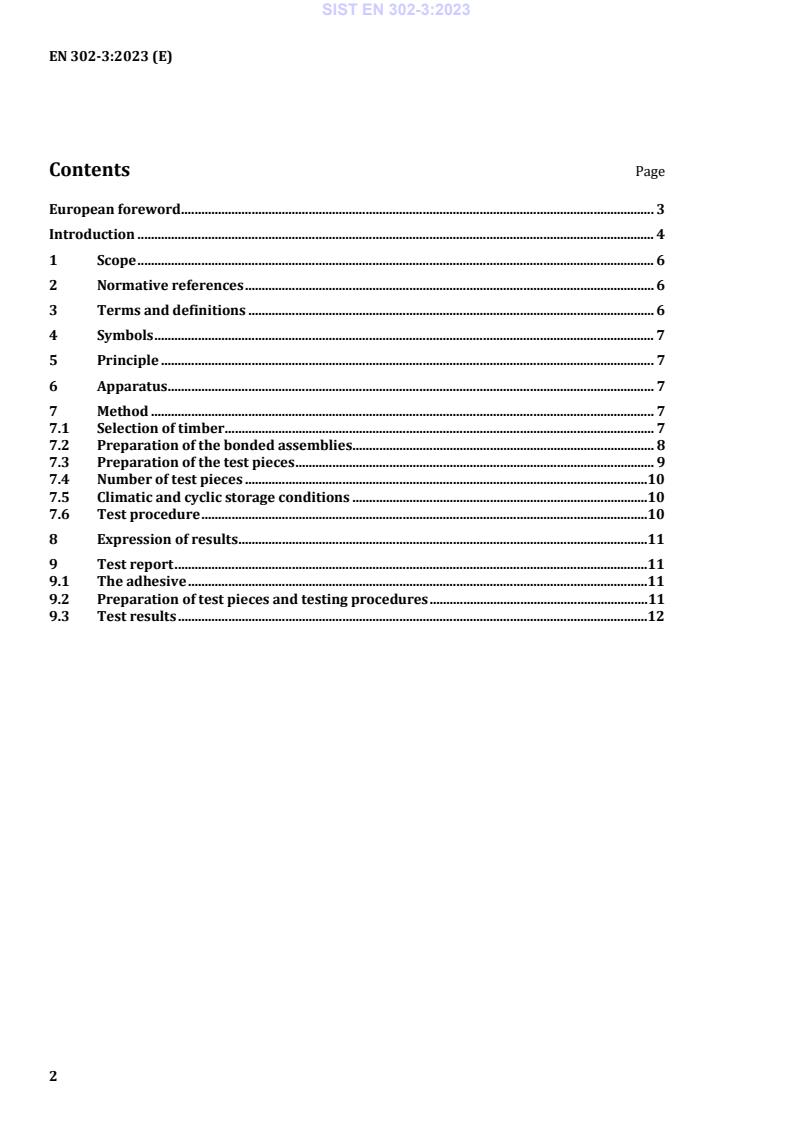
Contents Page
European foreword . 3
Introduction . 4
1 Scope . 6
2 Normative references . 6
3 Terms and definitions . 6
4 Symbols . 7
5 Principle . 7
6 Apparatus . 7
7 Method . 7
7.1 Selection of timber . 7
7.2 Preparation of the bonded assemblies . 8
7.3 Preparation of the test pieces . 9
7.4 Number of test pieces .10
7.5 Climatic and cyclic storage conditions .10
7.6 Test procedure .10
8 Expression of results .11
9 Test report .11
9.1 The adhesive .11
9.2 Preparation of test pieces and testing procedures .11
9.3 Test results .12
European foreword
This document (EN 302-3:2023) has been prepared by Technical Committee CEN/TC 193 “Adhesives”,
the secretariat of which is held by UNE.
This European Standard shall be given the status of a national standard, either by publication of an
identical text or by endorsement, at the latest by August 2023, and conflicting national standards shall be
withdrawn at the latest by August 2023.
Attention is drawn to the possibility that some of the elements of this document may be the subject of
patent rights. CEN shall not be held responsible for identifying any or all such patent rights.
This document supersedes EN 302-3:2017.
The main changes compared to the previous edition are listed below:
a) two new standards, EN 17334 and EN 17418, have been included in the list of standards in the
Introduction;
b) two new Clauses (Terms and definitions and Symbols) have been introduced.
Any feedback and questions on this document should be directed to the users’ national standards body.
A complete listing of these bodies can be found on the CEN website.
According to the CEN-CENELEC Internal Regulations, the national standards organisations of the
following countries are bound to implement this European Standard: Austria, Belgium, Bulgaria, Croatia,
Cyprus, Czech Republic, Denmark, Estonia, Finland, France, Germany, Greece, Hungary, Iceland, Ireland,
Italy, Latvia, Lithuania, Luxembourg, Malta, Netherlands, Norway, Poland, Portugal, Republic of North
Macedonia, Romania, Serbia, Slovakia, Slovenia, Spain, Sweden, Switzerland, Türkiye and the United
Kingdom.
Introduction
This document is one of a series dealing with adhesives for use with timber structures, and is published
in support of the EN 1995 series, Eurocode 5: Design of timber structures. The series consists of five
classification and performance requirements for adhesives for load-bearing timber structures, phenolic
and aminoplastic adhesives (EN 301), one component polyurethane adhesives (EN 15425), emulsion
polymer isocyanate adhesives (EN 16254), two component epoxy and polyurethane adhesives for glued
in rods (EN 17334) and for on-site repair of cracked timber structures (EN 17418), and all together
twelve test methods (EN 302-1, EN 302-2, EN 302-3, EN 302-4, EN 302-5, EN 302-6, EN 302-7, EN 302-8,
EN 15416-1, EN 15416-3, EN 15416-4 and EN 15416-5).
These European standards have the following titles.
EN 301, Adhesives, phenolic and aminoplastic, for load-bearing timber structures — Classification and
performance requirements
EN 302, Adhesives for load-bearing timber structures — Test methods:
— Part 1: Determination of longitudinal tensile shear strength
— Part 2: Determination of resistance to delamination
— Part 3: Determination of the effect of acid damage to wood fibres by temperature and humidity cycling
on the transverse tensile strength
— Part 4: Determination of the effects of wood shrinkage on the shear strength
— Part 5: Determination of maximum assembly time under referenced conditions
— Part 6: Determination of the minimum pressing time under referenced conditions
— Part 7: Determination of the working life under referenced conditions
— Part 8: Static load test of multiple bond line specimens in compression shear
EN 15416, Adhesives for load bearing timber structures other than phenolic and aminoplastic — Test
methods:
— Part 1: Long-term tension load test perpendicular to the bond line at varying climate conditions with
specimens perpendicular to the glue line (Glass house test)
— Part 3: Creep deformation test at cyclic climate conditions with specimens loaded in bending shear
— Part 4: Determination of open assembly time under referenced conditions
— Part 5: Determination of minimum pressing time under referenced conditions
EN 15425, Adhesives — One component polyurethane (PUR) for load-bearing timber structures —
Classification and performance requirements
EN 16254, Adhesives — Emulsion polymer isocyanate (EPI) for load-bearing timber structures —
Classification and performance requirements
EN 17334, Glued-in rods in glued structural timber products — Testing, requirements and bond shear
strength classification
EN 17418, Two-component epoxy and polyurethane adhesives for on-site repair of cracked timber
structures — Testing, requirements and repair strength verification
Safety statement
Persons using this document should be familiar with the normal laboratory practice, if applicable. This
document cannot address all of the safety problems, if any, associated with its use. It is the responsibility
of the user to establish appropriate safety and health practices and to ensure compliance with any
regulatory conditions.
Environmental statement
It is understood that some of the material permitted in this standard can have a negative environmental
impact. As technological advantages lead to better alternatives for these materials, they will be eliminated
from this document to the greatest extent possible.
At the end of the test, it is recommended that the users of the standard take care to carry out an
appropriate disposal of the wastes, according to local regulations.
1 Scope
This document specifies a method for determining the effect on bond strength of damage to wood fibres
caused by the action of acids from the adhesive or primer used in the gluing process during climatic
cycling.
It is applicable to the following applications:
a) for assessing the compliance of adhesives with EN 301, EN 15425 and EN 16254;
b) for assessing the suitability and quality of adhesives for load-bearing timber structures;
c) for determining if the adhesive after bonding has a damaging influence on the strength of the wood
due to chemical action.
This test is intended primarily to obtain performance data for the classification of adhesives for load-
bearing timber structures according to their suitability for use in defined climatic environments. This test
is carried out on Norway spruce (Picea abies L.) or Beech (Fagus sylvatica L.).
This method is not intended to provide data for structural design and does not necessarily represent the
performance of the bonded member in service.
2 Normative references
The following documents are referred to in the text in such a way that some or all of their content
constitutes require
...