

oSIST prEN 16810:2024
(Main)Resilient, textile, laminate and modular mechanical locked floor coverings, underlays - Environmental product declarations - Product category rules
General Information
- Abstract
This document provides product category rules (PCR) for Type III environmental product declarations (EPD) for resilient, textile, laminate and modular mechanical locked floor coverings, as well for underlays specific to these floor coverings.
This document applies to the following products:
- resilient floor coverings manufactured from plastics, linoleum, cork or rubber, including loose-laid mats;
- textile floor coverings, including loose-laid mats, rugs and runners;
- laminate floor coverings;
- modular mechanical locked floor coverings;
- underlays.
An EPD can be developed for single or individual products, product groups and average products.
- Status
- Not Published
- Public Enquiry End Date
- 04-Dec-2024
- Technical Committee
- ITEK - Textile and textile products
- Current Stage
- 4020 - Public enquire (PE) (Adopted Project)
- Start Date
- 25-Sep-2024
- Due Date
- 12-Feb-2025
- Completion Date
- 06-Dec-2024

Overview
oSIST prEN 16810:2024 is a European draft standard developed by SIST and established by CEN/TC 134. The document provides comprehensive Product Category Rules (PCR) for drafting Type III Environmental Product Declarations (EPD) specifically for resilient, textile, laminate, and modular mechanical locked floor coverings, as well as underlays. It ensures EPDs are prepared, verified, and presented in a consistent, transparent, and scientifically sound format.
The standard covers a broad range of floor coverings, including:
- Resilient floor coverings (plastics, linoleum, cork, rubber, including loose-laid mats)
- Textile floor coverings (mats, rugs, runners)
- Laminate floor coverings
- Modular mechanical locked floor coverings
- Underlays specific to these floor coverings
By following this standard, manufacturers, suppliers, and stakeholders can deliver accurate, reliable, and comparable environmental information about their flooring products, facilitating informed decision-making and supporting sustainability objectives in the construction sector.
Key Topics
- Product Category Rules (PCR): Provides detailed PCR for developing EPDs in accordance with EN 15804 and EN ISO 14025 tailored to the specific needs of flooring products.
- Life Cycle Assessment (LCA): Outlines requirements for conducting LCA, including the modeling of life cycle stages from raw material extraction to end-of-life and beyond.
- EPD Structure & Content: Specifies what environmental indicators, scenarios, and technical information must appear in Type III EPDs.
- Comparability: Sets guidelines for comparing environmental performance among flooring products, emphasizing consistency in the use context and life cycle assumptions.
- Additional Environmental Information: Addresses the declaration of further impact indicators, technical performance, and any emissions to indoor air, soil, or water during use.
Applications
- Manufacturers and Industry Associations: Use the PCR to produce standardized and third-party verifiable EPDs for flooring products, enhancing brand credibility and compliance with green procurement policies.
- Architects, Designers, and Specifiers: Access harmonized EPDs to select floor coverings with lower environmental impacts, supporting eco-design and sustainable building certifications.
- Construction Project Owners and Green Building Assessors: Integrate consistent environmental data into building-level assessments, benchmarking and reporting according to leading sustainability schemes.
- Regulators and Policy Makers: Reference a common methodology for the ecological evaluation of floor coverings, supporting transparent ecolabelling and sustainable construction mandates.
- EPD Programme Operators: Adopt and recognize uniform product category rules for the registration and publication of EPDs in line with European and international frameworks.
Related Standards
The standard references several key documents to ensure alignment with international and European sustainability requirements:
- EN 15804:2012+A2:2019: Core rules for the product category of construction products' EPDs.
- EN ISO 14025:2010: Specifies principles and procedures for Type III environmental declarations.
- EN ISO 10874: Classification of resilient, textile, and laminate floor coverings.
- EN 15942: Communication format for B2B EPDs.
- ISO 21930: Sustainability in buildings - Core rules for environmental product declarations.
- ISO 22095: General terminology for chain of custody.
These related standards ensure that EPDs for floor coverings are compatible with broader sustainability assessment practices and contribute to overall environmental transparency in the construction sector.
Keywords: Environmental Product Declaration (EPD), Product Category Rules (PCR), resilient floor coverings, textile floor coverings, laminate floor covering, modular mechanical locked floor coverings, underlays, life cycle assessment, EN 15804, EN ISO 14025, sustainability, construction products, ecolabelling, building environmental performance.
Relations
- Effective Date
- 24-May-2023
Get Certified
Connect with accredited certification bodies for this standard

BSI Group
BSI (British Standards Institution) is the business standards company that helps organizations make excellence a habit.

Bureau Veritas
Bureau Veritas is a world leader in laboratory testing, inspection and certification services.

DNV
DNV is an independent assurance and risk management provider.
Sponsored listings
Frequently Asked Questions
oSIST prEN 16810:2024 is a draft published by the Slovenian Institute for Standardization (SIST). Its full title is "Resilient, textile, laminate and modular mechanical locked floor coverings, underlays - Environmental product declarations - Product category rules". This standard covers: This document provides product category rules (PCR) for Type III environmental product declarations (EPD) for resilient, textile, laminate and modular mechanical locked floor coverings, as well for underlays specific to these floor coverings. This document applies to the following products: - resilient floor coverings manufactured from plastics, linoleum, cork or rubber, including loose-laid mats; - textile floor coverings, including loose-laid mats, rugs and runners; - laminate floor coverings; - modular mechanical locked floor coverings; - underlays. An EPD can be developed for single or individual products, product groups and average products.
This document provides product category rules (PCR) for Type III environmental product declarations (EPD) for resilient, textile, laminate and modular mechanical locked floor coverings, as well for underlays specific to these floor coverings. This document applies to the following products: - resilient floor coverings manufactured from plastics, linoleum, cork or rubber, including loose-laid mats; - textile floor coverings, including loose-laid mats, rugs and runners; - laminate floor coverings; - modular mechanical locked floor coverings; - underlays. An EPD can be developed for single or individual products, product groups and average products.
oSIST prEN 16810:2024 is classified under the following ICS (International Classification for Standards) categories: 13.020.50 - Ecolabelling; 97.150 - Floor coverings. The ICS classification helps identify the subject area and facilitates finding related standards.
oSIST prEN 16810:2024 has the following relationships with other standards: It is inter standard links to SIST EN 16810:2017. Understanding these relationships helps ensure you are using the most current and applicable version of the standard.
oSIST prEN 16810:2024 is available in PDF format for immediate download after purchase. The document can be added to your cart and obtained through the secure checkout process. Digital delivery ensures instant access to the complete standard document.
Standards Content (Sample)
SLOVENSKI STANDARD
01-december-2024
Netekstilne, tekstilne, laminirane in modularne mehansko zaklenjene talne obloge,
podlage - Okoljske deklaracije za proizvode - Pravila za opredelitev vrste izdelka
Resilient, textile, laminate and modular mechanical locked floor coverings, underlays -
Environmental product declarations - Product category rules
Elastische, textile, Laminat- und modulare mechanisch verriegelnde Bodenbeläge,
Verlegeunterlagen - Umwelt-Produktdeklarationen - Produktkategorieregeln
Revêtements de sol résilients, textiles, stratifiés et modulaires à clipsage mécanique,
sous-couches - Déclarations environnementales des produits - Règles régissant les
catégories de produits
Ta slovenski standard je istoveten z: prEN 16810
ICS:
13.020.50 Označevanje z ekološko Ecolabelling
nalepko
97.150 Talne obloge Floor coverings
2003-01.Slovenski inštitut za standardizacijo. Razmnoževanje celote ali delov tega standarda ni dovoljeno.
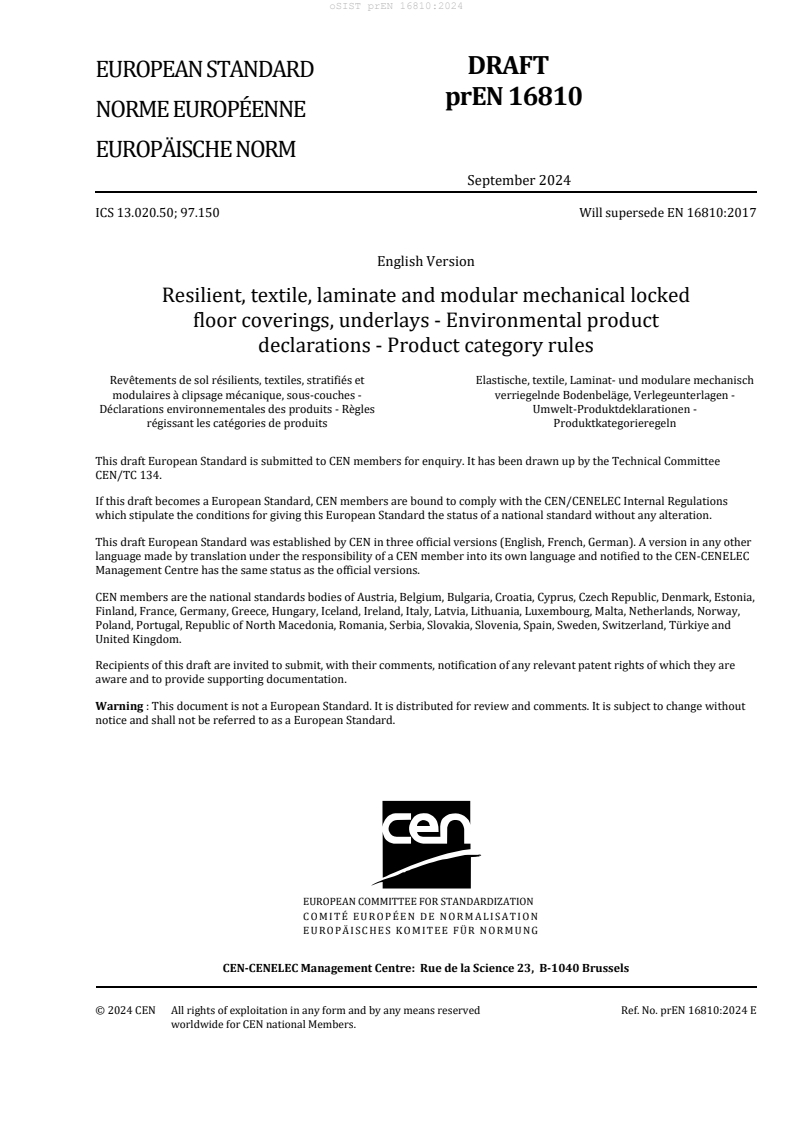
DRAFT
EUROPEAN STANDARD
NORME EUROPÉENNE
EUROPÄISCHE NORM
September 2024
ICS 13.020.50; 97.150 Will supersede EN 16810:2017
English Version
Resilient, textile, laminate and modular mechanical locked
floor coverings, underlays - Environmental product
declarations - Product category rules
Revêtements de sol résilients, textiles, stratifiés et Elastische, textile, Laminat- und modulare mechanisch
modulaires à clipsage mécanique, sous-couches - verriegelnde Bodenbeläge, Verlegeunterlagen -
Déclarations environnementales des produits - Règles Umwelt-Produktdeklarationen -
régissant les catégories de produits Produktkategorieregeln
This draft European Standard is submitted to CEN members for enquiry. It has been drawn up by the Technical Committee
CEN/TC 134.
If this draft becomes a European Standard, CEN members are bound to comply with the CEN/CENELEC Internal Regulations
which stipulate the conditions for giving this European Standard the status of a national standard without any alteration.
This draft European Standard was established by CEN in three official versions (English, French, German). A version in any other
language made by translation under the responsibility of a CEN member into its own language and notified to the CEN-CENELEC
Management Centre has the same status as the official versions.
CEN members are the national standards bodies of Austria, Belgium, Bulgaria, Croatia, Cyprus, Czech Republic, Denmark, Estonia,
Finland, France, Germany, Greece, Hungary, Iceland, Ireland, Italy, Latvia, Lithuania, Luxembourg, Malta, Netherlands, Norway,
Poland, Portugal, Republic of North Macedonia, Romania, Serbia, Slovakia, Slovenia, Spain, Sweden, Switzerland, Türkiye and
United Kingdom.
Recipients of this draft are invited to submit, with their comments, notification of any relevant patent rights of which they are
aware and to provide supporting documentation.
Warning : This document is not a European Standard. It is distributed for review and comments. It is subject to change without
notice and shall not be referred to as a European Standard.
EUROPEAN COMMITTEE FOR STANDARDIZATION
COMITÉ EUROPÉEN DE NORMALISATION
EUROPÄISCHES KOMITEE FÜR NORMUNG
CEN-CENELEC Management Centre: Rue de la Science 23, B-1040 Brussels
© 2024 CEN All rights of exploitation in any form and by any means reserved Ref. No. prEN 16810:2024 E
worldwide for CEN national Members.
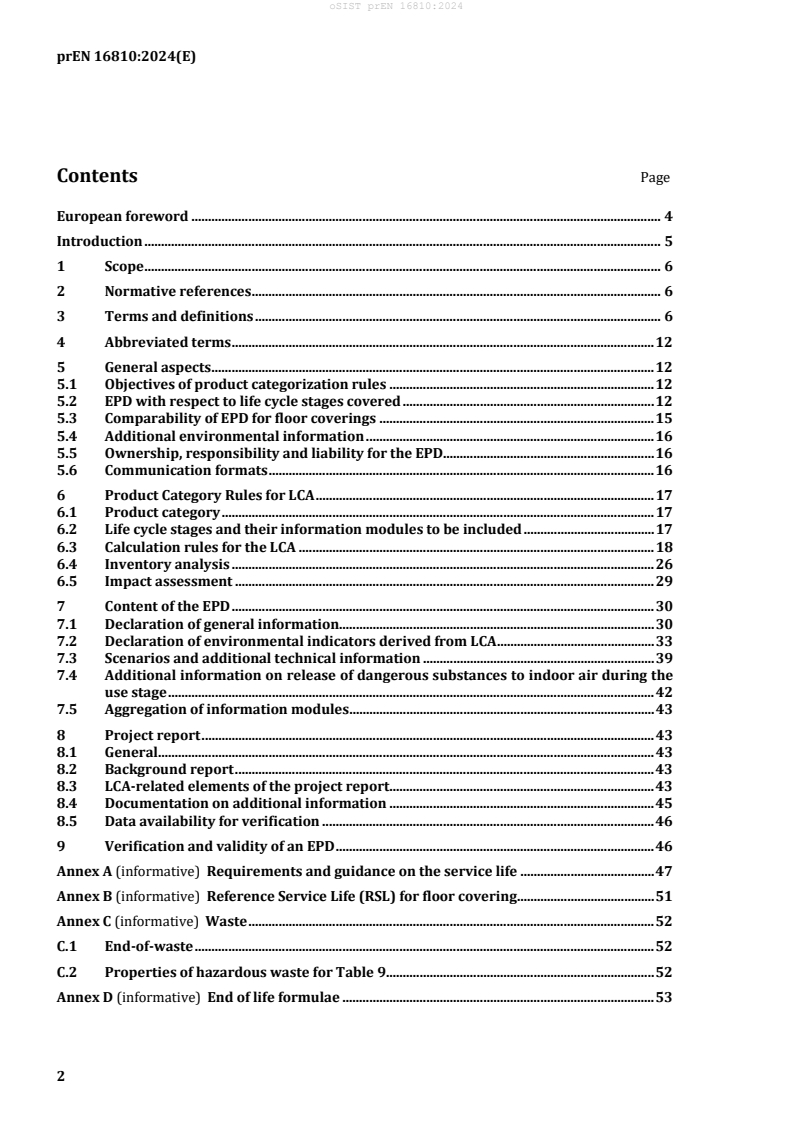
Contents Page
European foreword . 4
Introduction . 5
1 Scope . 6
2 Normative references . 6
3 Terms and definitions . 6
4 Abbreviated terms . 12
5 General aspects . 12
5.1 Objectives of product categorization rules . 12
5.2 EPD with respect to life cycle stages covered . 12
5.3 Comparability of EPD for floor coverings . 15
5.4 Additional environmental information . 16
5.5 Ownership, responsibility and liability for the EPD. 16
5.6 Communication formats . 16
6 Product Category Rules for LCA . 17
6.1 Product category . 17
6.2 Life cycle stages and their information modules to be included . 17
6.3 Calculation rules for the LCA . 18
6.4 Inventory analysis . 26
6.5 Impact assessment . 29
7 Content of the EPD . 30
7.1 Declaration of general information. 30
7.2 Declaration of environmental indicators derived from LCA . 33
7.3 Scenarios and additional technical information . 39
7.4 Additional information on release of dangerous substances to indoor air during the
use stage . 42
7.5 Aggregation of information modules . 43
8 Project report . 43
8.1 General. 43
8.2 Background report . 43
8.3 LCA-related elements of the project report. 43
8.4 Documentation on additional information . 45
8.5 Data availability for verification . 46
9 Verification and validity of an EPD . 46
Annex A (informative) Requirements and guidance on the service life . 47
Annex B (informative) Reference Service Life (RSL) for floor covering . 51
Annex C (informative) Waste . 52
C.1 End-of-waste . 52
C.2 Properties of hazardous waste for Table 9. 52
Annex D (informative) End of life formulae . 53
D.1 Introduction . 53
D.2 Terms and definitions . 53
D.3 Formulae . 56
Annex E (normative) Impact Categories and related indicators, methodologies and
characterization factors (CF) . 58
E.1 Core environmental impact categories and indicators . 58
E.2 Calculation rules for the climate change impact category . 59
E.3 Additional impact categories and indicators . 61
E.4 Characterization factors . 61
Bibliography . 62
European foreword
This document (prEN 16810:2024) has been prepared by Technical Committee CEN/TC 134 “Resilient,
textile, laminate and modular mechanical locked floor coverings”, the secretariat of which is held by NBN.
This document is currently submitted to the CEN Enquiry.
This document will supersede EN 16810:2017.
— underlays added to the scope;
— alignment of the standard with the latest updated version of EN 15804 i.e. EN 15804:2012+A2:2019;
— module A1, A2, A3 declared separately;
— module B3 as optional and to be adapted to the SL considered;
— integration of application rules for mass balance model.
Introduction
This document provides core product category rules for resilient, textile, laminate and modular
mechanical locked floor coverings. It is based on the principles laid down in EN 15804 and in
EN ISO 14025 and modified to suit the specific needs of the product families addressed in the scope of
this document.
It provides a structure to ensure that all Environmental Product Declarations (EPD) for resilient, textile
and laminate floor coverings processes are derived, verified and presented in a harmonized way.
An EPD communicates verifiable, accurate, non-misleading environmental information for products and
their applications, thereby supporting scientifically based, fair choices and stimulating the potential for
market driven continuous environmental improvement.
EPD information is expressed in information modules, which allow easy organization and expression of
data packages throughout the life cycle of the product. The approach requires that the underlying data
should be consistent, reproducible and comparable.
The EPD is expressed in a form that allows aggregation (addition) to provide complete information for
buildings. This document does not deal with aggregation at the building level nor does this document
describe the rules for applying EPD in a building assessment.
The document deals with a limited number of quantifiable predetermined parameters. Future revisions
may incorporate additional parameters.
This document provides the means for developing a Type III environmental declaration of resilient,
textile and laminate floor coverings.
1 Scope
This document provides product category rules (PCR) for Type III environmental product declarations
(EPD) for resilient, textile, laminate and modular mechanical locked floor coverings, as well for underlays
specific to these floor coverings.
This document applies to the following products:
— resilient floor coverings manufactured from plastics, linoleum, cork or rubber, including loose-laid
mats;
— textile floor coverings, including loose-laid mats, rugs and runners;
— laminate floor coverings;
— modular mechanical locked floor coverings;
— underlays.
An EPD can be developed for single or individual products, product groups and average products.
2 Normative references
The following documents are referred to in the text in such a way that some or all of their content
constitutes requirements of this document. For dated references, only the edition cited applies. For
undated references, the latest edition of the referenced document (including any amendments) applies.
EN 15398, Resilient, textile, laminate and modular mechanical locked floor coverings (MMF) — Floor
covering standard symbols — Complementary element
EN 15804:2012+A2:2019 , Sustainability of construction works — Environmental product declarations —
Core rules for the product category of construction products
EN 15942, Sustainability of construction works — Environmental product declarations — Communication
format business-to-business
EN ISO 10874, Resilient, textile and laminate floor coverings — Classification (ISO 10874)
EN ISO 14025:2010, Environmental labels and declarations — Type III environmental declarations —
Principles and procedures (ISO 14025:2006)
EN ISO 14044:2006, Environmental management — Life cycle assessment — Requirements and guidelines
(ISO 14044:2006)
ISO 21930, Sustainability in buildings and civil engineering works — Core rules for environmental product
declarations of construction products and services
ISO 22095, Chain of custody — General terminology and models
3 Terms and definitions
For the purposes of this document, the following terms and definitions apply.
As impacted by EN 15804:2012+A2:2019/AC:2021.
ISO and IEC maintain terminology databases for use in standardization at the following addresses:
— ISO Online browsing platform: available at https://www.iso.org/obp/
— IEC Electropedia: available at https://www.electropedia.org/
3.1
ancillary material
input material or product that is used by the unit process producing the product, but which does not
constitute part of the product
[SOURCE: EN ISO 14040:2006]
3.2
average data
data representative of a product, product group or construction service, provided by one or more than
one supplier
Note 1 to entry: The product group or construction service can contain similar products or construction services.
3.3
comparative assertion
environmental claim regarding the superiority or equivalence of one product versus a competing product
that performs the same function
[SOURCE: EN ISO 14044:2006]
3.4
co-product
secondary product, resulting from a production process, which can be re-used for production (either
within or outside the flooring industry) without prior re-processing
Note 1 to entry: Bearing in mind that any substance or object can be either waste or non-waste, by-products are
regarded by definition as non-waste. This means that by-products can be subject, where applicable, to legislation
which excludes waste from its scope, such as REACH.
Note 2 to entry: Directive 2008/98/EC (Waste framework), Article 5(1) sets out the following four conditions that
a production residue is obligated to meet in order to be considered a by-product:
— further use of the substance or object is certain;
— the substance or object can be used directly without any further processing other than normal industrial
practice;
— the substance or object is produced as an integral part of a production process;
— further use is lawful, i.e. the substance or object fulfils all relevant product, environmental and health-
protection requirements for the specific use and will not lead to overall adverse environmental or human
health impacts.
Note 3 to entry :Co-product, by-product and product have the same status and are used for identification of several
distinguished flows of products from the same unit process. From co-product, by-product and product, waste is the
only output to be distinguished as a non-product.
[SOURCES: Directive 2008/98/EC Article 5(1) of the European Parliament and of the Council of 19
November 2008 on wasteCOM (2007) 59 final COMMUNICATION FROM THE COMMISSION TO THE
COUNCIL AND THE EUROPEAN PARLIAMENT on the Interpretative Communication on waste and by-
products]
3.5
declared unit
quantity of a floor covering for use as a reference unit in an EPD for an environmental declaration based
on one or more information modules
Note 1 to entry: For floor coverings the declared unit is 1 m of installed floor covering.
3.6
environmental performance
performance related to environmental impacts and environmental aspects
[SOURCE: ISO 15392:2008 and ISO 21931-1:2010]
3.7
functional unit
quantified performance of a product system for use as a reference unit
[SOURCE: EN ISO 14040: 2006]
3.8
information module
compilation of data to be used as a basis for a Type III environmental declaration covering a unit process
or a combination of unit processes that are part of the life cycle of a product
[SOURCE: EN ISO 14025:2010]
3.9
life cycle assessment
LCA
compilation and evaluation of the inputs, outputs and the potential environmental impacts of a product
system throughout its life cycle
[SOURCE: EN ISO 14044: 2006]
3.10
life cycle inventory analysis
LCI
phase of life cycle assessment involving the compilation and quantification of inputs and outputs for a
product throughout its life cycle
[SOURCE: EN ISO 14040: 2006]
3.11
manufacturer's declaration
environmental product declaration (EPD) by a manufacturer
— for a specific product from one plant or as an average from several plants; or
— for an average product from one plant or as an average from several plants
Note 1 to entry: A reference product, which describes a specific (usually typical) product, can also be declared.
3.12
manufacturer's group declaration
EPD for a specific or average product as an average from several manufacturers’ plants
3.13
mass balance model
chain of custody model in which materials or products with a set of specified characteristics are mixed
according to defined criteria with materials or products without that set of characteristics
Note 1 to entry: The proportion of the input with specified characteristics might only match the initial proportions
on average and will typically vary across different outputs.
[SOURCE: ISO 22095]
3.14
non-renewable energy
energy from sources which are not defined as renewable energy sources
3.15
non-renewable resource
resource that exists in a finite amount that cannot be replenished on a human time scale
3.16
performance
magnitude of a particular aspect of the object of consideration relative to specified requirements,
objectives or targets
[SOURCE: ISO 6707-1:2004, modified according to the draft recommendation of ISO/TC 59
Terminology.]
3.17
product category
group of construction products that can fulfil equivalent functions
[SOURCE: EN ISO 14025:2010]
3.18
product category rules
PCR
set of specific rules, requirements and guidelines for developing Type III environmental declarations for
one or more product categories
[SOURCE: EN ISO 14025:2010]
3.19
product system
collection of unit processes with elementary and product flows, performing one or more defined
functions, and which models the life cycle of a product
[SOURCE: EN ISO 14040: 2006]
3.20
programme operator
body or bodies that conduct a Type III environmental declaration programme
Note 1 to entry: A program operator can be a company or a group of companies, industrial sector or trade
association, public authorities or agencies, or an independent scientific body or other organization.
3.21
recycling
diverting a discarded product or semi-finished product from waste and using it for the manufacture of a
new product
3.22
renewable energy
energy from renewable non-fossil sources
EXAMPLES Wind, solar, aerothermal, geothermal, hydrothermal and ocean energy, hydropower, biomass,
landfill gas, sewage treatment plant gas and biogases.
[SOURCE: Directive 2009/28/EC]
3.23
renewable resource
resource that is grown, naturally replenished or naturally cleansed, on a human time scale
Note 1 to entry: A renewable resource is capable of being exhausted, but can last indefinitely with proper
stewardship. Examples include: trees in forests, grasses in grassland, fertile soil
Note 2 to entry: Activities that occur in the technosphere such as recycling are not considered natural
replenishment or natural cleansing.
Note 3 to entry: In this context, human time refers to the typical lifetime of a human rather than the time humans
have been in existence
[SOURCE: ISO 21930: 2017]
3.24
RSL
reference service life
service life of a construction product which is known to be expected under a particular set of reference
in-use conditions which can form the basis for estimating the service life under other in-use conditions
Note 1 to entry: the RSL is described as part of the functional unit and considered in the calculation of replacements
at both the construction product level and construction works level (B4) and refurbishment (B5).
Note 2 to entry: the shorter acronym, RSL, is used as the preferred term in this document.
[SOURCE: ISO 21930:2017]
3.25
scenario
collection of assumptions and information concerning an expected sequence of possible future events
3.26
secondary fuel
fuel recovered from previous use or from waste which substitutes primary fuels
Note 1 to entry: Processes providing a secondary fuel are considered from the point where the secondary fuel
enters the system from the previous system.
Note 2 to entry: Any combustible material recovered from previous use or from waste from the previous product
system and used as a fuel in a following system is a secondary fuel.
Note 3 to entry: Examples for primary fuels are: coal, natural gas, biomass, etc.
Note 4 to entry: Examples for secondary fuels recovered from previous use or as waste are: solvents, wood, tyres,
oil, animal fats.
3.27
specific data
data representative of a product, product group or construction service, provided by one supplier
3.28
third party
person or body that is recognized as being independent of the parties involved, as concerns the issues in
question
Note 1 to entry: “Parties involved” are usually supplier (“first party”) and purchaser (“second party”) interests.
[SOURCE: EN ISO 14050:2020]
3.29
type III environmental declaration
environmental declaration providing quantified environmental data using predetermined parameters
and, where relevant, additional environmental information
Note 1 to entry: The calculation of predetermined parameters is based on the ISO 14040 series, which is made up
of ISO 14040.
[SOURCE: EN ISO 14025:2010, modified.]
3.30
upstream, downstream process
process that either precedes (upstream) or follows (downstream) a given life cycle stage
3.31
waste
substance or object which the generator or holder discards or intends to discard or is required to discard
[SOURCE: Waste Framework Directive 2008/98/EC Article 3(1)]
3.32
unit process
smallest element considered in the life cycle inventory analysis for which input and output data are
quantified
[SOURCE: EN ISO 14040]
3.33
biogenic
produced in natural processes by living organisms but not fossilized or derived from fossil resources
3.34
biogenic carbon
carbon derived from biomass
4 Abbreviated terms
For the purposes of this document, the following abbreviated terms apply.
EPD Environmental product declaration
FCSS Floor covering standard symbol
LCA Life cycle assessment
LCI Life cycle inventory analysis
LCIA Life cycle impact assessment
PCR Product category rules
RSL Reference service life
5 General aspects
5.1 Objectives of product categorization rules
An EPD according to this document provides quantified environmental information on a harmonized and
scientific basis. The purpose of an EPD for floor coverings in the construction sector is to provide the
basis for assessing buildings and other construction works, and identifying those, which cause less stress
to the environment.
Thus the objectives of a PCR for floor coverings are to ensure:
— the provision of verifiable and consistent data for an EPD, based on LCA;
— the provision of verifiable and consistent product related technical data and/or scenarios for the
assessment of the environmental performance of buildings;
— the provision of verifiable and consistent product related technical data and/or scenarios potentially
related to the health of users for the assessment of the performance of buildings;
— that comparisons between floor coverings are carried out in the context of their application in the
building;
— the communication of the environmental information of floor coverings from business to consumer.
Declarations based on this document are not comparative assertions.
NOTE See EN 15804:2012+A2:2019, 3.4 and ISO 14044:2006, 5.1 for more information concerning LCA used
for comparative assertion.
5.2 EPD with respect to life cycle stages covered
The life cycle stages and their information modules to be included are described in full in EN 15804.
The LCA based information in a business to consumer EPD shall cover the life cycle of a product according
to the system boundary (see 6.3.5).
For the products in this document the EPD covers the product stage, installation into the building, the use
stage (cleaning and maintenance) and the end-of-life and is said to be 'cradle to grave' and becomes an
EPD of construction products based on a LCA, i.e. covering all information modules A1 to A5, B2, C1 to C4
and D. (see Table 1, the grey shaded stages don't apply for floor coverings).
Floor covering, during its lifetime in the use stage, has no environmental aspects and impacts during its
normal (i.e. anticipated) use and is neither replaced nor refurbished (other than at the end of life). As a
result, floor coverings are not contributing to modules B1 and B4 to B7 which are set to be zero “0”.
Module B2 includes provisions for cleaning agent(s), energy and water consumption for the cleaning of
the floor covering, incl. wastewater treatment.
Module B3 is optional.
The service lifetime of a floor covering for a certain application on a floor is too widespread to give one
common number. For this EPD model the reference service lifetime (RSL) is set to one year (see Annex B).
This means that all impacts for the use phase are based on the cleaning and maintenance model for one
year (see Table 1). Depending on the area of use, based on EN ISO 10874, the technical lifetime advised
by the manufacturer and the estimated time on the floor by the customer, the service lifetime could be
determined. The use phase impacts should be calculated with the foreseen service life to arrive at the
total environmental impact.
Table 1 — Types of EPD with respect to life cycle stages covered and life cycle stages and modules for the building assessment
BUILDING ASSESSMENT INFORMATION
CONSTRUCTION WORKS LIFE CYCLE INFORMATION SUPPLEMENTARY
INFORMATION
BEYOND THE
CONSTRUCTION
WORKS LIFE CYCLE
A 1–3 A 4–5 B 1–7 C 1–4 D
PRODUCT STAGE CONSTRUCTION USE STAGE END OF LIFE STAGE Benefits and loads
PROCESS STAGE beyond the system
boundary
A1 A2 A3 A4 A5 B1 B2 B3 B4 B5 C1 C2 C3 C4
(1yr)
Reuse, recovery,
recycling potential
scenario scenario scenario
B6 Operational energy use
scenario
B7 Operational water use
scenario
Cradle to M RSL (2) M
grave
(functional
unit)
M = mandatory; 1) inclusion for a declared scenario; 2) if all scenarios are given
0 = optional
Raw material
supply
Transport
Manufacturing
M 1) 2) Transport
M 1) 2) Construction
or installation
process
Use
M 1) 2) Maintenance
O Repair
Replacement
Refurbishment
M 1) 2) De-
construction
M 1) 2) Transport
Waste
M 1) 2)
processing
M 1) 2) Disposal
5.3 Comparability of EPD for floor coverings
In principle the comparison of products on the basis of their EPD is defined by the contribution they make
to the environmental performance of the building. Consequently, comparison of the environmental
performance of construction products using the EPD information shall be based on the product’s use in
and its impacts on the building and shall consider the complete life cycle (all information modules).
Comparisons of different floor coverings are only allowed, where EN 15804 consistent and/or pre-
verified background data and EN 15804 consistent calculation methods and database versions are used
and when the building context is taken into account, i.e. on the basis of the same use-classification
(EN ISO 10874), same service life and comparable assumptions for the end of life.
In order to ensure an equal basis for comparison the assessment of the product of the comparison
preferably should be carried out by the same assessor. This contributes to the selection of identical data
sets, decisions and choices, etc. in the calculation process.
The estimated service life of a floor covering depends e.g. on the kind of floor covering and the area of
application, the user himself and the maintenance of the product. Comparisons of different floor
coverings are only allowed if these parameters are considered in a consistent way. For this purpose, the
EN ISO 10874 and ISO 15686-1 give guidance.
The difference between two products may be insignificant in the building context.
NOTE 1 EPD that are not in a building context are not tools to compare construction products and construction
services.
For the sustainability assessment of buildings comparisons of the environmental aspects and impacts
need to be undertaken in conjunction with the social and economic aspects and impacts related to the
building.
NOTE 2 For the interpretation of a comparison, benchmarks or reference values are needed. This document does
not set benchmarks or reference values.
NOTE 3 the product is integrated in the building and can impact the technical performance and functional use of
the building. E.g. safety aspects (slippery floors), contribution to the acoustical comfort, demand for cleaning
(maintenance).
Comparisons are possible at the sub-building level, e.g. for assembled systems, components, products for
one or more life cycle stages. In such cases the principle that the basis for comparison of the assessment
is the entire building, shall be maintained by ensuring that:
— the same functional requirements as defined in the client’s brief are met;
NOTE Attention is drawn to legislation that can apply.
and;
— the environmental performance and technical performance of any assembled systems, components,
or products excluded are the same; and;
— the amounts of any material excluded are the same; and;
— excluded processes or life cycle stages are the same; and;
— the influence of the product systems on the operational aspects and impacts of the building are taken
into account.
The information provided for such comparison shall be transparent to allow the purchaser or user to
understand the limitations of comparability. A justification shall be given for any excluded aspects.
5.4 Additional environmental information
5.4.1 General
Any additional environmental information provided shall meet the requirements in EN ISO 14025:2010,
7.2.4.
In this core PCR, the following categories of additional information are addressed.
5.4.2 Additional impact indicators
This core PCR includes additional environmental impact indicators. The defined set of these LCA-based
additional environmental impact indicators (see 7.2.3.2) shall be calculated and included in the project
report. They may be declared in the EPD and if declared they shall be declared as additional
environmental impact indicators including the appropriate disclaimers from Table 4 (see 7.2.3.3).
5.4.3 Additional information on carbon offset, carbon storage and delayed emissions
Carbon offset processes are not part of the product system under study. Carbon offset shall not be
included in the calculation of the GWP.
NOTE A carbon offset is a reduction in emissions of carbon dioxide or other greenhouse gases made in order
to compensate for an emission elsewhere.
The effect of temporary carbon storage and delayed emissions, i.e. the discounting of emissions and
removals, shall not be included in the calculation of the GWP. The effect of permanent biogenic carbon
storage shall also not be included in the calculation of the GWP.
5.4.4 Additional Information not derived from LCA
The following two categories of information not derived from LCA shall be addressed:
— Additional technical information, describing technical conditions underlying scenarios and
characterizing the product’s technical and functional performance during the life cycle stages other
than the product stage (A4–C4) and for the information provided under module D for any scenario-
based calculation of the LCA based indicators (see 6.3.6.4 and 7.3).
— Additional information on emissions to indoor air, soil and water during the use stage, describing
release of dangerous substances into indoor air, soil and water which are not covered by LCA. This
additional information is required (see 7.4).
NOTE Information concerning health related emissions to indoor air, soil and water supports the social
performance of buildings which is addressed in EN 16309 Sustainability of construction works — Assessment of
social performance of buildings — Calculation methodology.
5.5 Ownership, responsibility and liability for the EPD
A manufacturer or a group of manufacturers are the sole owners and have liability and responsibility for
an EPD.
5.6 Communication formats
The communication format of the EPD shall be in accordance with EN 15942.
The format of the EPD shall address the complete content of the EPD specified in Clause 7. It can be
communicated via hard copy or via electronic media.
6 Product Category Rules for LCA
6.1 Product category
The product category referred to in this document includes resilient, textile, laminate and modular
mechanical locked floor coverings and underlays for floor coverings.
6.2 Life cycle stages and their information modules to be included
6.2.1 General
The environmental information of an EPD for floor coverings (“cradle to grave”) shall be subdivided into
the modules A1, A2, A3, A4-A5, B2, B3, C1-C4 and module D (see Table 1).
B3 is an optional module and shall be adapted to the SL considered.
Information modules include impacts and aspects related to losses in the module in which the losses
occur (i.e. production, transport, and waste processing and disposal of the lost waste products and
materials).
6.2.2 A1-A3, Product stage, information modules
The product stage includes:
— A1, raw material extraction and processing, processing of secondary material input (e.g. recycling
processes);
— A2, transport to the manufacturer;
— A3, manufacturing.
This includes provision of all materials, products and energy, as well as waste processing up to the end-
of waste state (6.3.3.5 and Annex C) or disposal of final residues during the product stage.
Module A1, A2 and A3 shall be declared separately.
6.2.3 A4-A5, Construction process stage, information modules
The construction process stage includes:
— A4, transport to the building site;
— A5, installation into the building.
This includes provision of all materials, products and energy, as well as waste processing up to the end-
of-waste state or disposal of final residues during the construction process stage. These information
modules also include all impacts and aspects related to any losses during this construction process stage
(i.e. production, transport, and waste processing and disposal of the lost products and materials).
6.2.4 B1-B5, Use stage, information modules related to the building fabric
The use stage, related to the building fabric includes:
— B1, use or application of the installed product;
— B2, cleaning and maintenance;
— B3, repair;
— B4, replacement;
— B5, refurbishment.
Module B2, cleaning and maintenance, applies to floor coverings. B3 is an optional module and shall be
adapted to the service lifetime considered. B1, B4 and B5 are set to zero (see 5.2).
This includes provision and transport of all materials, products and related energy and water use, as well
as waste processing up to the end-of-waste state or disposal of final residues during this part of the use
stage. These information modules also include all impacts and aspects related to the losses during this
part of the use stage (i.e. production, transport, and waste processing and disposal of the lost products
and materials).
6.2.5 B6-B7, use stage, information modules related to the operation of the building
The modules B6 (operational energy use) and B7 (operational water use) are set to zero (see 5.2).
6.2.6 C1-C4 End-of-life stage, information modules
The end-of-life stage includes:
— C1, de-construction, demolition:
— C2, transport to waste processing;
— C3, waste processing for reuse, recovery and/or recycling;
— C4, disposal.
This includes provision of all transport, all materials, products and related energy and water use.
6.2.7 D, Benefits and loads beyond the system boundary, information module
Module D includes reuse, recovery and/or recycling potentials, expressed as net impacts and benefits.
6.3 Calculation rules for the LCA
6.3.1 Functional unit
The functional unit is 1m of installed floor covering for specified applications and use areas according to
EN ISO 10874.
6.3.2 Reference service life (RSL)
The service lifetime of a floor covering for a certain application on a floor is too widespread to give one
common number. For this EPD model the reference service lifetime (RSL) is set to one year; see Annex B.
This means that all impacts for the use phase are based on the cleaning and maintenance model for one
year. Depending on the area of use based on EN ISO 10874, the technical lifetime advised by the
manufacturer and the estimated time on the floor by the customer, the service lifetime can be determined.
The use phase impacts should be calculated with the foreseen service life to arrive at the total
environmental impact.
6.3.3 System boundaries
6.3.3.1 General
The modular set up of the LCA underlying an EPD (see Table 1) allows easy organization and expression
of data packages throughout the life cycle of the product. This approach requires that the system
boundaries for the life cycle stages, and the information modules included are transparent, well defined
and applicable to any floor covering.
The setting of the system boundaries follows two principles:
— The “modularity principle”: Where processes influence the product’s environmental performance
during its life cycle, they shall be assigned to the information module of the life cycle where they
occur; all environmental aspects and impacts are declared in the information module where they
appear;
— the “polluter pays principle”: Processes of waste processing shall be assigned to the product system
that generates the waste until the end-of-waste state is reached.
These principles are used in the following clauses and are reflected in the formulae in Annex D. These
formulae may be used as support while making calculations. No other formulae shall be used for the
implementation of the principles in this clause.
6.3.3.2 Product stage
The product stage is an information module required to be included in the EPD. As illustrated in Table 1
it includes the information modules A1 to A3. The system boundary with nature is set to include those
processes that provide the material and energy inputs into the system and the following manufacturing,
and transport processes up to the factory gate as well as the processing of any waste arising from those
processes.
In the case of input of secondary (recycled or reused) materials or energy recovered from secondary
fuels, the system boundary between the system under study and the previous system (providing the
secondary materials) is set where outputs of the previous system, e.g. materials, products, building
elements or energy, reach the end-of-waste state (see 6.3.3.5 and Annex C).
Flows leaving the system at the end-of-waste boundary of the product stage (A1-A3) shall be allocated as
co-products (see 6.4.3.2). Loads and benefits from allocated co-products shall not be declared in Module
D (see 6.3.3.6). If such a co-product allocation is not possible, other methods may be chosen and shall be
justified. Therefore, as a general rule, potential loads or benefits from A1-A3 do not appear in module D.
Information modules (A1-A3) include:
— A1 extraction and processing of raw materials (e.g. mining processes) and biomass production and
processing (e.g. agricultural or forestry operations);
— A1 reuse of products or materials from a previous product system;
— A1 processing of secondary materials used as input for manufacturing the product, but not including
those processes that are part of the waste processing in the previous product system;
— A1 generation of electricity, steam and heat from primary energy resources, also including their
extraction, refining and transport;
— A1 energy recovery and other recovery processes from secondary fuels, but not including those
processes that are part of waste processing in the previous product system;
— A2 transportation up to the factory gate and internal transport;
— A3 production of ancillary materia
...